Desmond Waverley Operations and Inventory Management Louisville, 40204, United States [email protected] · (502) 555-1176
11 September 2026
Mr. Lucian Petrosyan Inbound Operations Cutbank Distribution Group Louisville, United States
Application for Inbound Operations Supervisor, Cutbank Distribution Group
Dear Mr. Petrosyan,
I am applying for the Inbound Operations Supervisor role at Cutbank Distribution Group. I have spent eleven years in multi-unit food service, the last six running a single site, and I am moving deliberately: I want to spend the next decade on the operations side of a supply chain rather than the customer side of a dining room, and the parts of my current job I am best at are the parts that already look like yours.
For six years I have owned a site with $4.1 million in annual revenue and 62 staff. In practice that means scheduling 62 people across 14 shifts a week against a demand forecast and holding labor cost to its target percentage of sales, which I have done in every period for four years. It means a weekly inventory cycle across roughly 900 stock lines with a documented investigation for any variance over $250, a monthly reconciliation against vendor invoices, and receiving inbound from 14 vendors including the short and damaged goods claims. I also rebuilt onboarding and the schedule together, which took annual staff turnover from 96 percent to 61 percent across three years. The product is different in your building. The counting, the coverage and the claims are not.
Cutbank has been adding evening inbound capacity at the Louisville site this year, which is the shift pattern I have staffed for a decade and the one most candidates avoid. I would want to start on receiving and the variance process, where I can be useful in week one rather than month three.
Two things I will be straightforward about: this is a step down in title from general manager, which I accept, and I have not worked in a distribution center before. I completed forklift operator training in June and started the CPIM program in August. I can start with four weeks of notice. Thank you for your time.
Sincerely, Desmond Waverley
Summary
A career change cover letter is the only document where the reason for the change belongs, and it needs one forward-facing sentence rather than a paragraph. This guide gives you a full adaptable letter, a way to translate the old job for a reader who has never done it, and current Bureau of Labor Statistics figures on what moving usually costs.
Career Change cover letter examples by experience level
A career change cover letter carries the one thing your resume cannot: why you are doing this. The resume states what you did and what you want next. The letter is where a reader holding an unfamiliar work history gets an explanation that is short, forward-facing and not defensive, and is then shown that the old job already contained the new one. Most career change letters fail by spending three paragraphs on the reason and one on the evidence. It should be the other way round.
Guide to a career change cover letter
This guide and the corresponding career change cover letter example will cover:
- How to answer "why are you leaving" in one sentence
- A full letter you can adapt to your own change
- How to translate the old job for a reader who has never done it
- What to say about the rung and the step down
- What the published figures say about pay after a move
How to write a career change cover letter
Four paragraphs, 300 to 400 words. This is one of the few letters worth the upper end of that range, because you are doing translation work a matching-title candidate does not have to do.
| Paragraph | Its job | Length |
|---|---|---|
| Opening | The post, the rung, and one sentence on why you are moving | 3 sentences |
| Evidence | The part of your old job that is already this job, with numbers | 5 to 6 sentences |
| Fit | Something real about them, and what you would take on first | 2 to 3 sentences |
| Close | What you are honest about, availability, thank you | 2 sentences |
The reason goes in the first paragraph and takes one sentence
Career changers bury the reason at the bottom, or spread it across the letter as a mood. Both are worse than saying it once at the top and moving on. One sentence, facing forward: "I want to spend the next decade on the operations side of a supply chain rather than on the customer side of a dining room, and the parts of my current job I am best at are the parts that already look like yours."
What it must not contain: a complaint about your employer, a reference to burnout, an explanation of an industry's problems, or the word passionate. The reader does not need you to be unhappy; they need to know you are running toward something.
A career change cover letter example you can adapt
Dear Mr. Petrosyan,
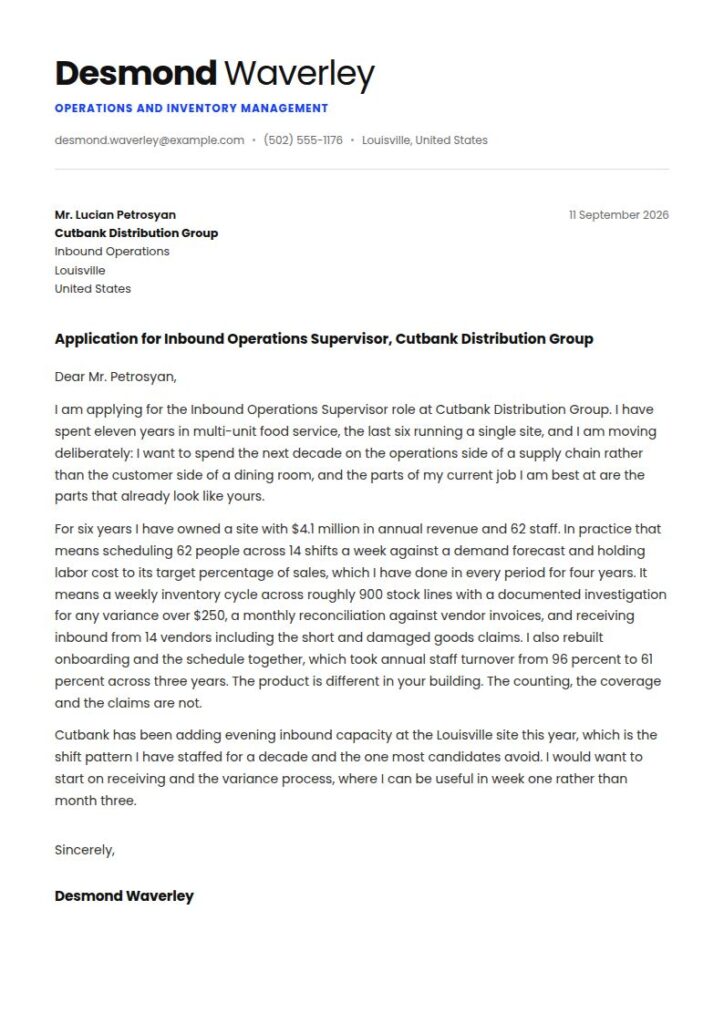
I am applying for the Inbound Operations Supervisor role at Cutbank Distribution Group. I have spent eleven years in multi-unit food service, the last six running a single site, and I am moving deliberately: I want to spend the next decade on the operations side of a supply chain rather than the customer side of a dining room, and the parts of my current job I am best at are the parts that already look like yours.
For six years I have owned a site with $4.1 million in annual revenue and 62 staff. In practice that means scheduling 62 people across 14 shifts a week against a demand forecast and holding labor cost to its target percentage of sales, which I have done in every period for four years. It means a weekly inventory cycle across roughly 900 stock lines with a documented investigation for any variance over $250, a monthly reconciliation against vendor invoices, and receiving inbound from 14 vendors including the short and damaged goods claims. I also rebuilt onboarding and the schedule together, which took annual staff turnover from 96 percent to 61 percent across three years. The product is different in your building. The counting, the coverage and the claims are not.
Cutbank has been adding evening inbound capacity at the Louisville site this year, which is the shift pattern I have staffed for a decade and the one most candidates avoid. I would want to start on receiving and the variance process, where I can be useful in week one rather than month three.
Two things I will be straightforward about: this is a step down in title from general manager, which I accept, and I have not worked in a distribution center before. I completed forklift operator training in June and started the CPIM program in August. I can start with four weeks of notice. Thank you for your time.
Sincerely, Desmond Waverley
Answering "why are you leaving" in one sentence
The reader is checking three risks: that you will leave again, that you are running from something they will inherit, and that you have not understood what the new job is.
| Instead of | Use |
|---|---|
| After many years in hospitality, I am seeking a new challenge | I want to spend the next decade on the operations side of a supply chain rather than the customer side of a dining room |
| The restaurant industry has become unsustainable for me | The parts of my current job I am best at are the parts that already look like yours |
| I am passionate about logistics and have always been fascinated by it | I completed forklift training in June and started the CPIM program in August |
The right column points forward. None of it is a complaint, and none of it asks the reader to feel anything.
Translating the old job for a reader who has never done it
The evidence paragraph is the letter. Write it so a reader with no knowledge of your industry can tell whether the work was hard.
| What you would say to a colleague | What the new reader needs |
|---|---|
| We were doing 400 covers on a Saturday | The site turns $4.1 million a year and I schedule 62 staff across 14 shifts a week against forecast |
| I did the ordering | Weekly cycle counts across roughly 900 stock lines, with a documented investigation over $250 |
Then add the sentence that carries the whole letter, in your own words: the product is different, the counting is not.
Most job changes happen young, which is why yours needs the letter
The claim that people change careers seven times has no federal source, and BLS does not measure career changes at all. What it measures is jobs. People born between 1957 and 1964 held an average of 12.9 jobs from ages 18 to 58, and more than 40 percent of those were held between ages 18 and 24, where a job means an uninterrupted period of work with one employer (US Bureau of Labor Statistics, National Longitudinal Survey of Youth 1979, published 26 August 2025).
The second figure is the point. Movement is concentrated early, so a change made at 35 or 48 is the unusual one, which is why it needs an explanation the reader can accept in one sentence and evidence in the paragraph after it.
Being straight about the rung and the pay
Say the step down out loud if there is one. It removes the reader's main worry: that you will arrive, find the title smaller than your last, and leave within a year.
The honest context: among long-tenured workers displaced between January 2023 and December 2025 and reemployed in full-time wage and salary work, about 49 percent were earning as much or more than at the job they lost, against about 62 percent in the January 2024 survey (US Bureau of Labor Statistics, Worker Displacement, published 27 August 2026). That is an involuntary population, mostly moving within its own field, and roughly half still took a cut; a voluntary move into a new field usually costs more.
None of that belongs in the letter as a statistic. It belongs as a posture: one sentence accepting the rung, and no negotiation before an offer exists.
Give the reason once, in the first paragraph, facing forward. Spend the middle paragraph on numbers a stranger can size. Name the rung you are applying for. Say plainly what you have not done yet, and what you have started. Name one real thing about the employer. Keep it to 400 words and address a named person.
Do not criticize your current employer or industry. Do not mention burnout, stress or being undervalued. Do not call yourself passionate about a field you have not worked in. Do not claim experience you do not have, because the first technical question will find it. Do not apologize for your background; translate it. Do not ask for the same salary in the letter.
Length, format and sending it
Four paragraphs, 300 to 400 words, one page. PDF unless the portal says otherwise, named for yourself and the post.
Address a named person. The letter is asking for a judgment call rather than a match, and judgment calls get made by people with names.
Keep the numbers identical to the ones on your page. Our career change resume example is written with the figures used here.
Key takeaways
- The reason for the change belongs in the letter, not the resume, and it takes one sentence.
- Face forward: what you are moving toward, never what you are escaping.
- Spend the middle paragraph on numbers a reader outside your industry can size.
- Translate the vocabulary; the product is different, the work often is not.
- Name the rung and accept the step down out loud if there is one.
- State what you have not done, and what you have started, with dates.
- Four paragraphs, 400 words, addressed to a named person.
Write your career change cover letter in 10 minutes with our AI cover letter builder.
Career change cover letter questions, answered
How do I explain why I am changing careers?
One sentence, in the first paragraph, pointing forward: what you want to spend the next decade doing and which parts of your current job already look like it. No complaint about your employer, no burnout, no story about the industry. The reader is checking whether you will leave again, and a forward-facing reason answers it faster than a paragraph of context.
Should I admit I have no experience in the new field?
Yes, in one clause, immediately followed by what you have started. "I have not worked in a distribution center before; I completed forklift training in June and started CPIM in August" is credible. Silence is not, because the reader notices anyway and wonders what else is missing.
Do I mention that I am willing to take a pay cut?
Do not put a number in the letter. Name the rung and accept it plainly if it is a step down. Pay is negotiated after an offer, and volunteering a cut prices you before anyone has decided they want you.
How long should a career change cover letter be?
Four paragraphs and 300 to 400 words, longer than most letters should be. The middle paragraph needs the room.
Is it worth writing a letter if the application is a portal form?
Yes, wherever there is a field for it. The form collects titles and dates, and your titles are the part that does not match. The letter is the only place to say why that is not a problem.