Operations and Inventory Management Desmond Waverley
General Manager
[email protected] | (502) 555-1176 | Louisville, United States
Profile
Operations candidate with eleven years in multi-unit food service, the last six running a single site with 62 staff and $4.1 million in annual revenue. Built rotas against forecast demand, held labor cost to a target percentage of sales every period for four years, and ran weekly inventory counts and a shrink investigation process. Moving into distribution operations and applying for a coordinator role; I am comfortable starting a rung below my current title and working nights or weekends.
Work Experience
04/2020 - Present, General Manager, Harbor Lantern Kitchen Group, Louisville, United States
- Schedule 62 staff across 14 shifts a week against a demand forecast, holding labor cost to its target percentage of sales in every period for four years.
- Run a weekly inventory cycle across roughly 900 stock lines, with a documented investigation for any variance over $250.
- Receive inbound deliveries from 14 vendors and handle short and damaged goods claims.
06/2017 - 04/2020, Assistant General Manager, Harbor Lantern Kitchen Group, Louisville, United States
- Opened two new sites, each from empty building to trading in under 90 days, including hiring and training the opening team.
- Held the ordering and receiving function across both openings.
03/2015 - 06/2017, Shift Lead, Harbor Lantern Kitchen Group, Louisville, United States
- Ran shifts of up to 18 staff, including opening and closing counts and the daily stock check.
Education
08/2011 - 05/2013, Associate of Applied Science, Hospitality Management, Falls City Technical College, Louisville, United States
Coursework in cost control, purchasing and supervision.
Skills
Inventory cycle counts and variance investigation, 85
Inbound receiving and vendor claims, 80
Scheduling against demand, 90
Labor cost control to target, 85
Invoice reconciliation, 80
Powered industrial truck operation, 60
Languages
English, native
Spanish, intermediate
Certificates
06/2026, Powered Industrial Truck (Forklift) Operator Training, Cutbank Training Services
Completed June 2026 ahead of applying into distribution operations.
08/2026, Certified in Planning and Inventory Management (CPIM), in progress, Association for Supply Chain Management
Started August 2026, completion expected 2027.
02/2023, ServSafe Food Protection Manager Certification, National Restaurant Association
Current through 2028.
Summary
A career change resume is a reverse chronological document that rewrites your old job in the language of the new one without hiding when any of it happened. This guide gives you three adaptable versions, a three-column sort for what transfers and what does not, and current Bureau of Labor Statistics figures on tenure, job counts and what reemployment usually pays.
Career Change resume examples by experience level
A career change resume is a reverse chronological document whose whole job is to make an unfamiliar work history legible to a reader who has never hired anyone from your field.
Be honest at the start: this is the hardest resume to write well, and the change is harder than the advice industry admits. You are asking someone to take a risk they do not have to take, when there is a queue of applicants whose last job title matches the posting. Most successful career changes involve a step down in title, a period of lower pay, or both, and a page that pretends otherwise reads as naive.
The good news is narrower but real. What decides these applications is not enthusiasm and not a certificate. It is whether the reader can look at your old job and see the new one inside it, and that is a writing problem you can solve.
Resume guide for a career change resume
This guide and the corresponding career change resume example will cover:
- How to write a career change resume that a new-industry reader can use
- A three-column sort for what transfers, what needs translating and what does not
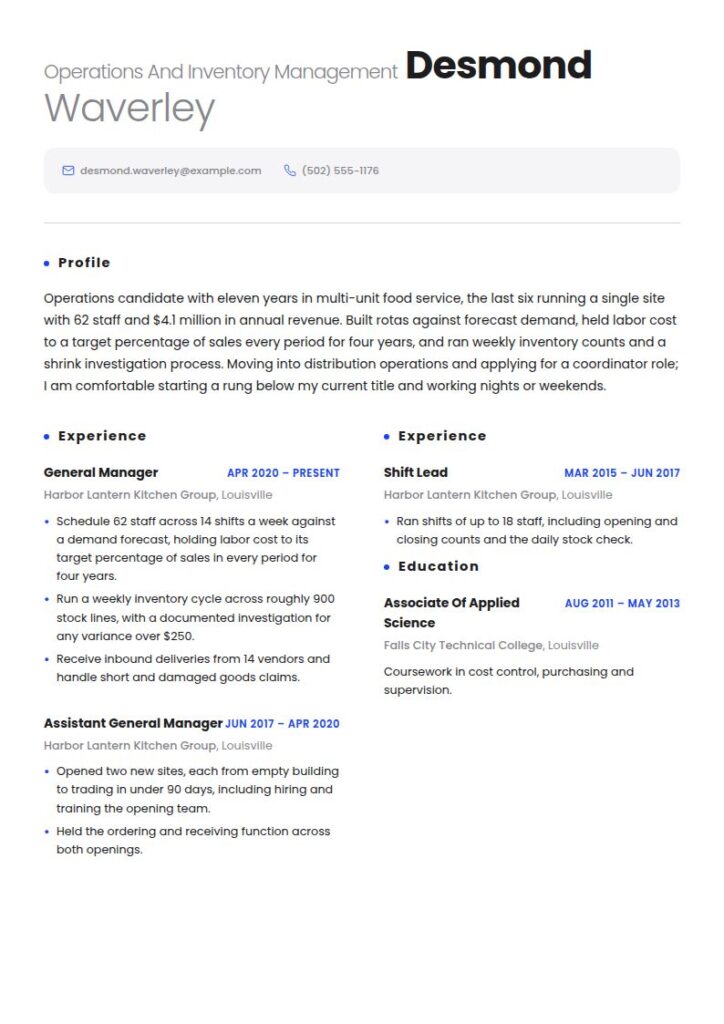
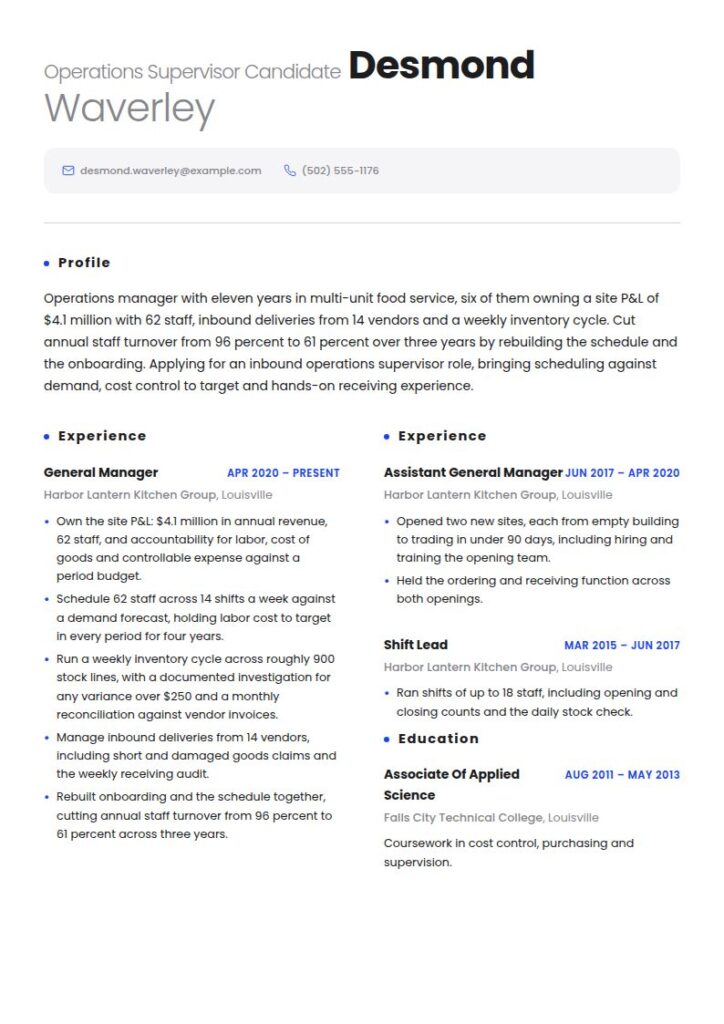
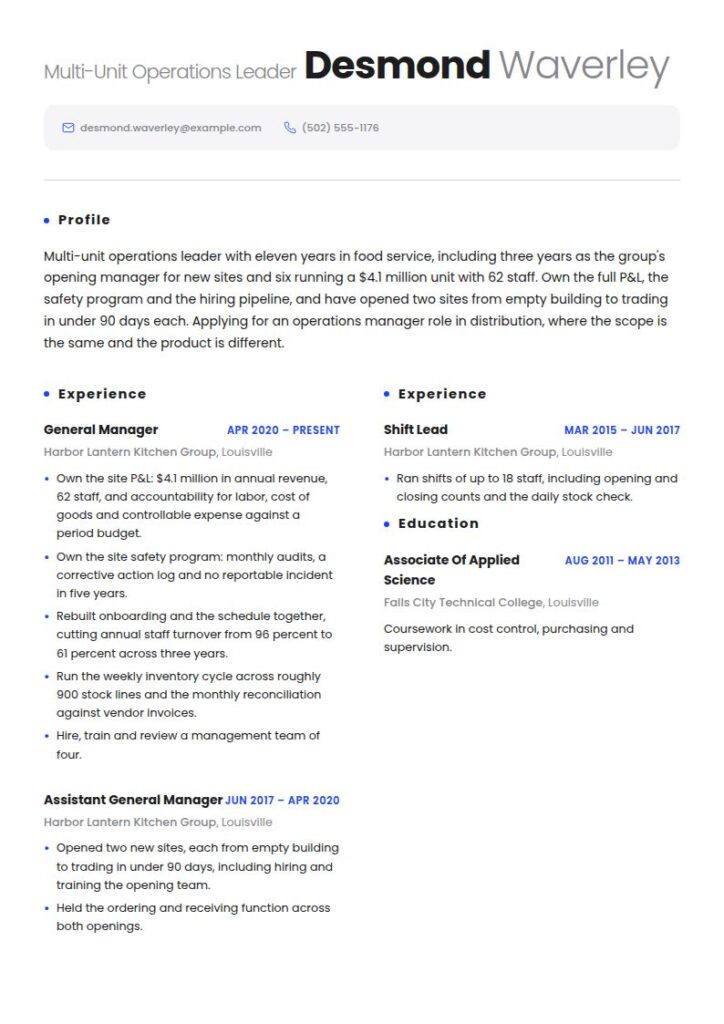
- Three adaptable versions, aimed at an entry rung, a lateral rung and a leadership rung
- Why a purely functional resume usually hurts you
- What the data actually says about tenure, job counts and pay after a move
How to write a career change resume
Six sections: contact header, target-facing summary, skills, experience, education and certifications, and any evidence of the new field. One to two pages, depending on how long the old career ran. The order is the one adjustment worth making: skills move above experience, because the reader needs a frame before reading a history they do not recognize, and experience stays in date order underneath, because the dates are what make the frame believable.
| Section | The question it answers | Where it goes |
|---|---|---|
| Summary | What am I applying for, and what am I bringing to it? | Top, rewritten for every posting |
| Core skills | What can this person already do that I need? | Above experience, six to nine items |
| Experience | When did all this happen, and at what scale? | Reverse chronological, dates visible |
| Evidence of the new field | Have they done anything in my world, at any size? | Its own short block, only if real |
| Education and certifications | Have they started, or just talked about it? | Bottom, with dates including in-progress ones |
Run the finished file through the ATS resume checker before you send it. Career change resumes are the ones most often filtered out on keywords, because your old job titles are not the words the posting uses.
Choosing the best resume format for a career change resume
A combination format: a skills block near the top, then a full reverse chronological history. Not a purely functional resume, and this is the single most common mistake on career change pages.
The functional format groups everything under skill headings and pushes employers and dates to a short list at the bottom, or leaves them out. It is recommended constantly for career changers, and it usually hurts, for three reasons.
First, recruiters read it as concealment: a page with no dates is assumed to be hiding a gap, a short stint or an age, and the assumption costs you whether or not it is right. Second, it is mechanical. Applicant tracking systems parse a resume into structured records of title, employer and date, and a functional page arrives as a name attached to a cloud of adjectives. Third, it throws away your best argument, because eleven years of anything is evidence of reliability and hiding when it happened hides the eleven years too.
Keep the history. Change the language it is written in.
Include your contact information
| ✅ Right | ❌ Wrong |
|---|---|
| Desmond Waverley | Desmond Waverley |
| Operations and Inventory Management | Restaurant General Manager |
| (502) 555-1176, [email protected], Louisville, KY | (502) 555-1176, [email protected] |
| Open to shift patterns including nights and weekends | Seeking a new challenge in a dynamic industry |
The title line under your name is not your current job title. It is the job you are applying for, written plainly. That is a heading, not a claim, and the experience section immediately below states what you actually do now. Use an email address that does not carry your old employer's name in it.
Make use of a summary
Four lines, rewritten for every posting: the scope you have run, what transfers, what you are moving into, and where you are willing to start.
Operations candidate with eleven years in multi-unit food service, the last six running a single site with 62 staff and $4.1 million in annual revenue. Built rotas against forecast demand, held labor cost to a target percentage of sales every period for four years, and ran weekly inventory counts and a shrink investigation process. Moving into distribution operations and applying for a coordinator role; I am comfortable starting a rung below my current title and working nights or weekends.
Operations manager with eleven years in multi-unit food service, six of them owning a site P&L of $4.1 million with 62 staff, inbound deliveries from 14 vendors and a weekly inventory cycle. Cut annual staff turnover from 96 percent to 61 percent over three years by rebuilding the schedule and the onboarding. Applying for an inbound operations supervisor role, bringing scheduling against demand, cost control to target and hands-on receiving experience.
Multi-unit operations leader with eleven years in food service, including three years as the group's opening manager for new sites and six running a $4.1 million unit with 62 staff. Own the full P&L, the safety program and the hiring pipeline, and have opened two sites from empty building to trading in under 90 days each. Applying for an operations manager role in distribution, where the scope is the same and the product is different.
Right vs wrong: the same career change summary, twice
| ✅ Right | ❌ Wrong |
|---|---|
| Eleven years in multi-unit food service, six of them owning a $4.1 million P&L with 62 staff. | Seasoned professional seeking to transition into a new and exciting industry. |
| Built rotas against forecast demand and held labor cost to target every period for four years. | Highly transferable skill set with a proven ability to adapt to any environment. |
| Applying for an inbound operations supervisor role; comfortable starting a rung below my current title. | Looking for an opportunity to grow and take on new challenges. |
The right column gives a reader something to weigh. The left asks them to translate it themselves, and a reader with forty applications will not.
Outline your experience
Same structure as any other resume: title, employer, city, dates, three to five lines. What changes is the vocabulary. Write every line so that someone who has never worked in your industry can price it.
| Instead of | Use |
|---|---|
| Managed front of house operations | Scheduled 62 staff across 14 shifts a week against forecast demand, holding labor cost to target every period for four years |
| Responsible for ordering and stock | Ran weekly counts across 900 stock lines, with a documented investigation for any variance over $250 |
| Handled customer complaints | Owned service recovery: 140 incidents a year logged, resolved and reviewed for cause, with repeat causes fixed in the process |
| Worked with suppliers | Managed inbound deliveries from 14 vendors, including short and damaged goods claims and a weekly reconciliation against invoices |
| Trained new staff | Rebuilt onboarding and cut annual turnover from 96 percent to 61 percent across three years |
Nothing in the right column is inflated. It is the same work, counted, with the industry-specific words taken out. "Covers" became demand; "food cost" became stock variance. That is the whole trick, repeated forty times.
General Manager, Harbor Lantern Kitchen Group, Louisville, KY, April 2020 to Present
Own the site P&L: $4.1 million in annual revenue, 62 staff, and accountability for labor, cost of goods and controllable expense against a period budget.
Schedule 62 staff across 14 shifts a week against a demand forecast, holding labor cost to its target percentage of sales in every period for four years.
Run a weekly inventory cycle across roughly 900 stock lines, with a documented investigation for any variance over $250, and a monthly reconciliation against vendor invoices.
Rebuilt onboarding and the schedule together, which cut annual staff turnover from 96 percent to 61 percent across three years.
Assistant General Manager, Harbor Lantern Kitchen Group, Louisville, KY, June 2017 to April 2020
Opened two new sites, each from empty building to trading in under 90 days, including hiring and training the opening team.
The career change sort: what transfers, what translates and what does not carry
Do this before you write a word. Break your last job into its parts and put every part into one of three columns. Most people put everything in the first column, which is why most career change resumes read as wishful.
| Transfers as it stands | Needs translating | Does not carry |
|---|---|---|
| Owning a P&L and hitting a budget | Covers, seats, table turns: rewrite as throughput and demand | Your job title |
| Scheduling people against demand | Food cost percentage: rewrite as cost of goods variance | Your seniority and your place in a queue |
| Hiring, onboarding and turnover numbers | Comps and voids: rewrite as service recovery and exception handling | Your professional network in the old field |
| Inventory counts, variance and shrink | The point of sale system: name the function, not the brand | Industry-specific software nobody else uses |
| Vendor management and claims | Health inspections: rewrite as audited compliance with a corrective action log | Menu, recipe and product knowledge |
| Safety programs and incident reporting | Shift patterns: rewrite as coverage models | The trust you had built with your old employer |
The middle column is the work. The right column is the honesty, and leaving it out is what makes these pages fail: a reader who spots you claiming something that obviously does not carry stops trusting the rest.
One more thing belongs in the right column and rarely gets said: the assumption that you know the industry. You do not yet, and the page should not imply you do. What you can show is that you have started. A certification in progress with a date, a shift you picked up, a course you finished, is worth more than any claimed passion for the sector.
Write the old job for the new reader, not for your old colleagues
Read every experience line and ask: would someone who has never worked in my industry know whether this was hard?
"Managed a busy site" fails. "62 staff, 14 shifts a week, $4.1 million in annual revenue" passes, because those are numbers any operations reader can size.
The fast way to do it is to take three postings in the field you are moving to, pull the nouns out of them, and check whether those nouns appear on your page. If the postings say throughput, variance, coverage and corrective action and your page says covers, waste, rotas and write-ups, you are describing the same work in a language the reader does not read.
Build a snapshot of your key skills
Six to nine entries, above experience, each one something the posting asked for and you can evidence from the old job.
Operations: Demand forecasting and scheduling, Labor cost control to target, Inventory cycle counts and variance investigation, Inbound receiving and vendor claims
People: Hiring and onboarding at volume, Turnover reduction, Shift supervision across seven days
Systems and compliance: Safety program ownership and corrective action logs, Weekly invoice reconciliation, Warehouse management system training in progress
Do not list a skill the posting did not ask for. This block is not a summary of who you are; it is a short answer to one advertisement, and every line that does not answer it hides the lines that do.
List your education and certifications
Dates on everything, including anything in progress, with an expected completion date. An in-progress certification with a date is credible; "currently studying" with no date reads as an intention.
Certified in Planning and Inventory Management (CPIM), Association for Supply Chain Management. In progress, expected 2027.
Powered industrial truck (forklift) operator training, completed June 2026.
ServSafe Food Protection Manager Certification, National Restaurant Association, current through 2028.
Associate of Applied Science, Hospitality Management, Falls City Technical College, Louisville, KY, 2013.
Keep the old field's credentials on the page. They are dated evidence that you finish things, whether or not they are relevant. They should not take more space than the new field's.
Choose the right layout and design
One column, plain type at 11 or 12 point, clear headings, no photograph, no graphics. Two pages is defensible here and often correct, because a decade compressed onto one page usually loses the numbers and the numbers are the argument. Put the skills block and the most recent role above the fold on page one; nobody reads page two until page one has earned it.
Keep a full reverse chronological history with dates. Put a short skills block above it. Rewrite every line in the target field's vocabulary. Give a number to anything that had one. Name the rung you are applying for and be honest about where you will start. Date anything that is in progress. Put the reason for the change in the cover letter, in one forward-facing sentence.
Do not use a purely functional resume, and do not drop your dates. Do not claim the new field's experience you do not have. Do not put the reason you are leaving on the resume; it has no place there. Do not describe yourself as passionate about the industry. Do not delete the old career to look like a beginner, because eleven years of anything is worth more than a blank page. Do not send the same page to two different rungs.
Career change job market and outlook
There is no BLS occupation called career changer and no employment projection or median wage for one. What is published is how long people stay in jobs, how many they hold, and what happens to pay when they move involuntarily.
| Measure | Value |
|---|---|
| Median tenure with current employer, all workers, January 2024 | 3.9 years |
| Median tenure, workers aged 25 to 34 | 2.7 years |
| Median tenure, workers aged 45 to 54 | 7.0 years |
| Average number of jobs held from ages 18 to 58, people born 1957 to 1964 | 12.9 |
| Long-tenured workers displaced, January 2023 to December 2025 | 3.3 million |
| Share of those reemployed by January 2026 | 66.1% |
Sources: US Bureau of Labor Statistics, Employee Tenure in 2024, published 26 September 2024; Number of Jobs, Labor Market Experience, Marital Status, and Health for Those Born 1957 to 1964, published 26 August 2025; Worker Displacement 2023 to 2025, published 27 August 2026.
The seven careers claim is folklore, and the real number counts something else
You will be told that the average person changes careers seven times. There is no federal source for it. BLS does not publish, and has never published, a count of career changes, because a career is not a unit anyone measures.
What BLS does publish is jobs. People born in the latter years of the baby boom, between 1957 and 1964, held an average of 12.9 jobs from ages 18 to 58, and more than 40 percent of those jobs were held between the ages of 18 and 24 (US Bureau of Labor Statistics, National Longitudinal Survey of Youth 1979, published 26 August 2025). A job there means an uninterrupted period of work with a particular employer, so the number counts employers, not occupations and not careers.
The second half of that sentence is the useful part. Most job changes happen early, when nobody has much to lose. The change you are making at 35 or 48 is the rarer one, and the resume has to do more work because of it.
What salary you can expect after a career change
Expect less, at least at first, and plan for it. The closest published measure is what happens to people who change jobs involuntarily. Of long-tenured workers displaced between January 2023 and December 2025 who were reemployed in full-time wage and salary work, about 49 percent were earning as much or more than at the job they lost, compared with about 62 percent in the January 2024 survey (US Bureau of Labor Statistics, Worker Displacement, published 27 August 2026). That is an involuntary population rather than a career-changing one, and it is the honest bracket: roughly half take a cut even when the move is forced and often within the same field.
A voluntary change usually costs more, for a simple reason. Part of your current wage pays for knowledge specific to your industry, and that part does not move with you. What moves is the general part: managing people, owning a budget, running a process.
Three things soften it, and two of them belong on the resume. Move to an adjacent field rather than a distant one, because restaurant operations to distribution operations is a shorter step than restaurant operations to software and the gap closes faster. Target the rung that matches your transferable scope rather than your title, since a supervisor role you can evidence beats a manager role you cannot. And start the credential before you apply, with a date on it: it does not make you qualified, it makes you a lower risk than the applicant who has done nothing.
The title drop deserves the same plainness. A general manager who becomes a coordinator has not gone backward if the coordinator role is in the field they want, but the page should not pretend the titles are equivalent. Name the rung, say you understand it is a step, and let the experience section show what you were running before.
Key takeaways for a career change resume
- Keep a full reverse chronological history; a purely functional page reads as concealment and parses badly.
- Put a short skills block above experience so the reader has a frame before the history.
- Sort your old job into what transfers, what needs translating, and what does not carry.
- Rewrite every line in the target field's vocabulary, using nouns taken from real postings.
- Show one piece of real evidence from the new field, with a date, however small.
- Be honest about the rung you are targeting and about the step down.
- Put the reason you are changing in the cover letter, in one forward-facing sentence, never on the resume.
Build your career change resume in 15 minutes with our AI resume builder.
Related resume examples
- Entry level resume
- One year experience resume
- General resume
- Self employed resume
- Freelancer resume
- Volunteer resume
- Stay at home mom resume
- Stay at home dad resume
- Work from home resume
- Part time job resume
- Technical writer resume
- Grant writer resume
Pair it with a matching career change cover letter.
Career change resume questions, answered
Should a career change resume be functional or chronological?
Combination: a short skills block near the top, then a full reverse chronological history with dates. A purely functional resume hides the timeline, which recruiters read as concealment, gives applicant tracking systems nothing to parse, and discards your strongest asset, the length of the record itself.
How far back should a career change resume go?
Ten to fifteen years in full, with earlier roles compressed into a line or two if they matter. Do not delete a long career to look like a beginner. The point is not to hide where you came from; it is to make the reader see what came with you.
Do I explain why I am changing careers on the resume?
No. The resume states what you did and what you are applying for. The reason belongs in the cover letter, in one sentence, facing forward: what you are moving toward, not what you are getting away from. Complaints about the old employer, however justified, damage the application every time.
Will I have to take a pay cut to change careers?
Often, yes. Among long-tenured workers displaced from 2023 to 2025 and reemployed full time, about 49 percent were earning as much or more than at the lost job (BLS, Worker Displacement, published 27 August 2026), and that is a population moving mostly within their own field. A voluntary move to a new field usually costs more. Plan for a period of lower pay and target adjacent fields, where the gap closes faster.
Is it true that people change careers seven times?
No, and there is no federal source for it. BLS does not measure career changes at all. It measures jobs: people born from 1957 to 1964 held an average of 12.9 jobs from ages 18 to 58, more than 40 percent of them between 18 and 24, where a job means an uninterrupted period with one employer (BLS, published 26 August 2025). Those are employers, not careers.
What do I put on the resume if I have no experience in the new field yet?
Whatever real evidence exists, with a date: a certification in progress and its expected completion, a course you finished, a shift or volunteer role in the sector, a project you delivered. Keep it short and never pad it. One dated real thing beats five aspirational ones.