Customer Support Specialist, Tampa FL (Eastern, UTC-5) Adaeze Nwosu
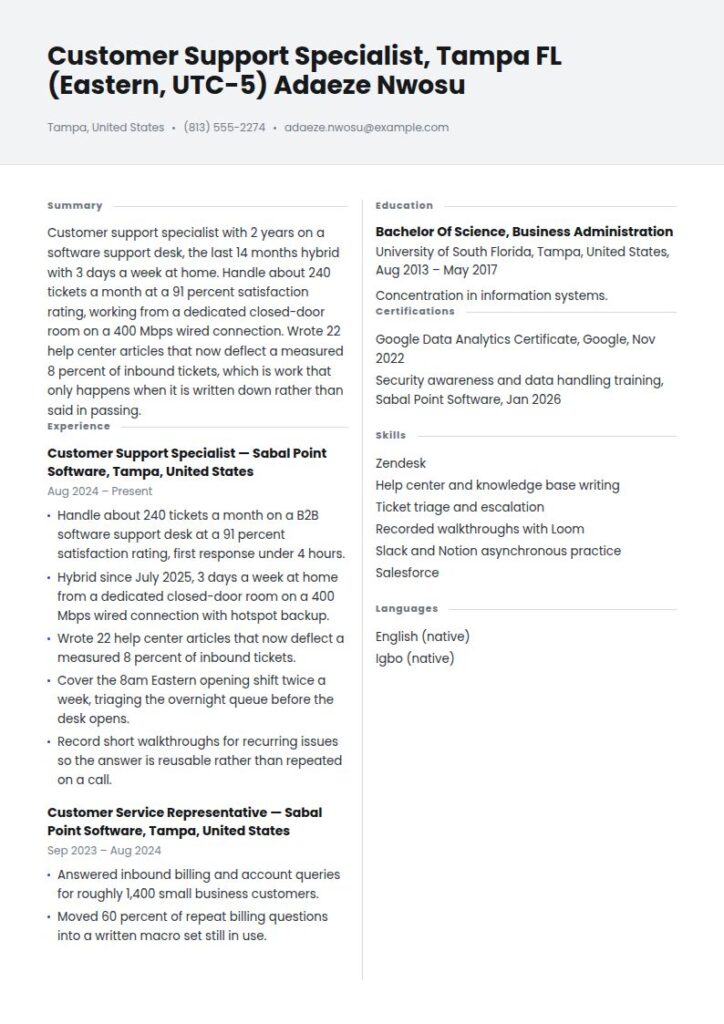
Customer Support Specialist
[email protected] | (813) 555-2274 | Tampa, United States
Profile
Customer support specialist with 2 years on a software support desk, the last 14 months hybrid with 3 days a week at home. Handle about 240 tickets a month at a 91 percent satisfaction rating, working from a dedicated closed-door room on a 400 Mbps wired connection. Wrote 22 help center articles that now deflect a measured 8 percent of inbound tickets, which is work that only happens when it is written down rather than said in passing.
Work Experience
08/2024 - Present, Customer Support Specialist, Sabal Point Software, Tampa, United States
- Handle about 240 tickets a month on a B2B software support desk at a 91 percent satisfaction rating, first response under 4 hours.
- Hybrid since July 2025, 3 days a week at home from a dedicated closed-door room on a 400 Mbps wired connection with hotspot backup.
- Wrote 22 help center articles that now deflect a measured 8 percent of inbound tickets.
- Cover the 8am Eastern opening shift twice a week, triaging the overnight queue before the desk opens.
- Record short walkthroughs for recurring issues so the answer is reusable rather than repeated on a call.
09/2023 - 08/2024, Customer Service Representative, Sabal Point Software, Tampa, United States
- Answered inbound billing and account queries for roughly 1,400 small business customers.
- Moved 60 percent of repeat billing questions into a written macro set still in use.
Education
08/2013 - 05/2017, Bachelor of Science, Business Administration, University of South Florida, Tampa, United States
Concentration in information systems.
Skills
Zendesk, 85
Help center and knowledge base writing, 80
Ticket triage and escalation, 80
Recorded walkthroughs with Loom, 70
Slack and Notion asynchronous practice, 80
Salesforce, 65
Languages
English, native
Igbo, native
Certificates
11/2022, Google Data Analytics Certificate, Google
01/2026, Security awareness and data handling training, Sabal Point Software
Annual renewal.
Summary
A work from home resume is a one to two page document written for a remote or hybrid employee post, and its job is to prove the setup rather than ask for it. This guide gives you three adaptable versions, the home office evidence block that replaces being seen working, and cited Bureau of Labor Statistics data on how much work is actually done at home.
Work-from-Home resume examples by experience level
A work from home resume is a one to two page document applying for a remote or hybrid employee post, written to prove that you already work this way rather than to ask whether you can.
The difference matters more than it sounds. "Seeking remote opportunities" is a request, and it asks the reader to grant something. "Four years remote, 9am to 3pm Eastern overlap, 400 Mbps wired connection, closed-door office" describes an arrangement that already works, and asks them only to continue it.
In short, this page is about being an employee who works from home. If you run your own business or bill clients independently, our separate self employed and freelancer guides cover the questions that apply to that instead.
Resume guide for a work from home resume
To start, this guide and the corresponding work from home resume example will cover:
- First, how to write a work from home resume, section by section
- Then, the home office evidence block that replaces being seen working
- Also, three adaptable summaries: first remote role, established and team lead
- Next, overlap hours, written work and documented output
- Finally, what the published data says about who works at home
How to write a work from home resume
Overall, six sections: contact header with a location and time zone line, summary, remote setup, experience, skills and tooling, and education. In general, one page early on, two once you have led distributed work.
In fact, the setup block is the only structural difference from any other resume, and it is short. Four lines under the summary, answering the doubts a hiring manager holds about a remote hire before they read anything else.
| Section | What it is answering | Where it goes |
|---|---|---|
| Location and time zone | Where are they, and when are they reachable? | Header, next to the city |
| Remote setup | Is there a real workspace, or a laptop on a sofa? | Four lines under the summary |
| Experience | Did the work get done without supervision? | Reverse chronological, output in every bullet |
| Tooling | Can they work in our stack unaided? | Named products, not categories |
| Written evidence | Can they write well enough to work asynchronously? | Shown by the resume itself |
Write the time zone into your header, not into the cover letter
A distributed team is scheduled, not located. The question behind "where are you based" is almost always "which of our meetings can you attend", and a city name answers that only if the reader knows the map.
So write both: "Tampa, FL (Eastern, UTC-5). Core overlap 9am to 3pm ET, flexible to 6pm ET." Eleven words, and it removes a round of email.
Applying across time zones, say what you will hold rather than what you would tolerate. A candidate who commits to four hours of overlap and keeps it beats one who claims full flexibility and then resents the 7am call.
Run the finished file through the ATS resume checker first. Remote postings draw far larger applicant pools than on-site ones, and larger pools mean heavier reliance on the parsed record.
Choosing the best resume format for a work from home resume
As a rule, reverse chronological, and do not mark the remote roles with a separate heading.
Of course, the temptation is a "Remote Experience" section that pulls those jobs out of the timeline. It backfires, because it tells the reader that remote work is a special category of your history rather than how you work. Put the word remote in the location field of each entry instead: "Mangrove Data Group, Remote (Tampa, FL)". That way, the pattern reads at a glance and the timeline stays intact.
In addition, functional formats fail here for an extra reason. After all, a remote hire is a bet on self-direction, and self-direction is evidenced by continuity: the same employer, over years, without an office to hold you there.
Include your contact information
| ✅ Right | ❌ Wrong |
|---|---|
| Adaeze Nwosu | Adaeze Nwosu |
| Customer Success Manager | Remote work enthusiast seeking work from home opportunity |
| Tampa, FL (Eastern, UTC-5) | Tampa, Florida |
| Core overlap 9am to 3pm ET | Available anytime |
| (813) 555-2274, [email protected] | (813) 555-2274, [email protected] |
Keep the city. Applicants drop it on the theory that remote means location does not matter, and it costs them: payroll, tax registration and equipment shipping all depend on which state you are in, and a recruiter who cannot find it will ask before doing anything else. Cut "available anytime" as well. Instead, it reads as having nothing else on, and it promises something you will not keep.
Make use of a summary
For the summary, three or four lines: your job and years, how long you have worked remotely, your overlap hours, and one output number that did not need anyone watching.
Customer support specialist with 2 years on a software support desk, the last 14 months hybrid with 3 days a week at home. Handle about 240 tickets a month at a 91 percent satisfaction rating, working from a dedicated closed-door room on a 400 Mbps wired connection. Wrote 22 help center articles that now deflect a measured 8 percent of inbound tickets, which is work that only happens when it is written down rather than said in passing.
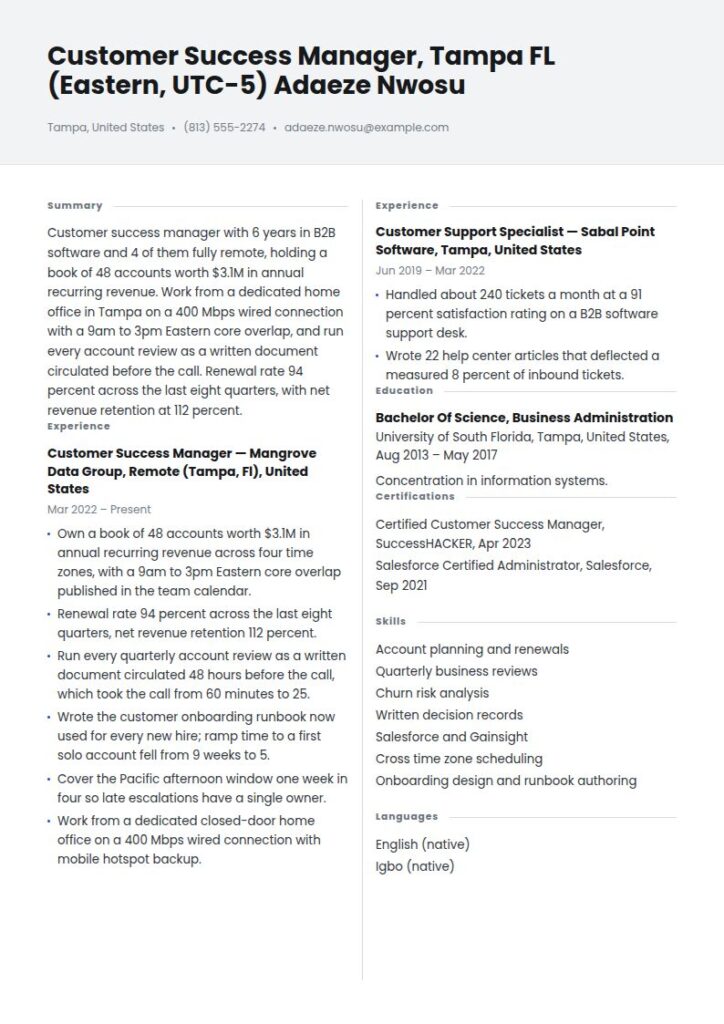
Customer success manager with 6 years in B2B software and 4 of them fully remote, holding a book of 48 accounts worth $3.1M in annual recurring revenue. Work from a dedicated home office in Tampa on a 400 Mbps wired connection with a 9am to 3pm Eastern core overlap, and run every account review as a written document circulated before the call. Renewal rate 94 percent across the last eight quarters, with net revenue retention at 112 percent.
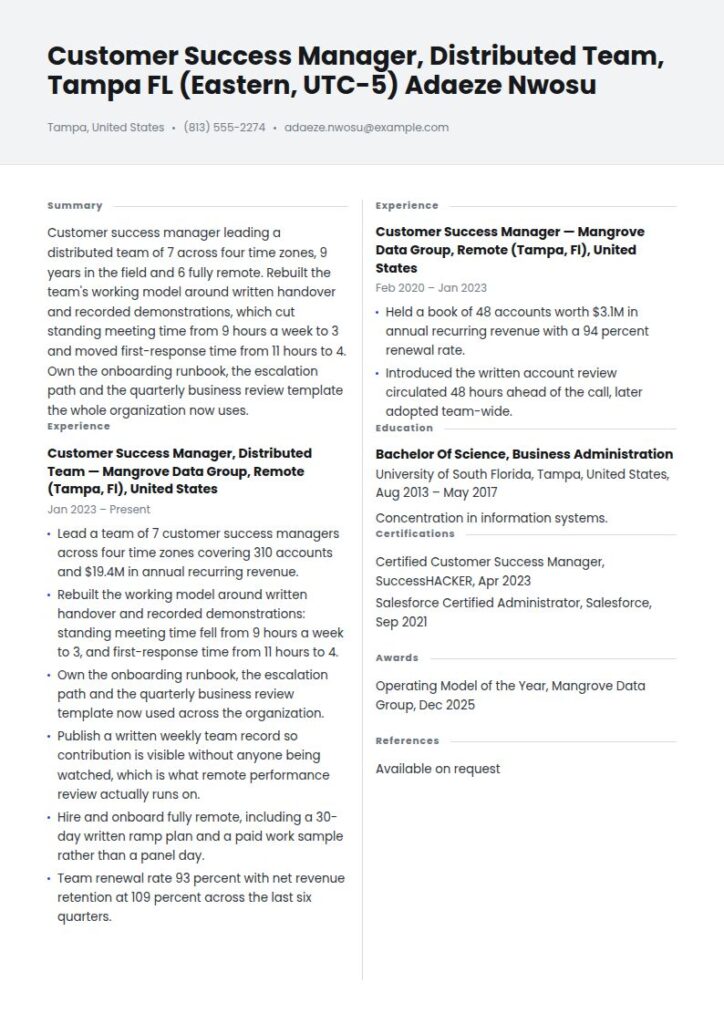
Customer success manager leading a distributed team of 7 across four time zones, 9 years in the field and 6 fully remote. Rebuilt the team's working model around written handover and recorded demonstrations, which cut standing meeting time from 9 hours a week to 3 and moved first-response time from 11 hours to 4. Own the onboarding runbook, the escalation path and the quarterly business review template the whole organization now uses.
Right vs wrong: the same work from home summary, twice
| ✅ Right | ❌ Wrong |
|---|---|
| Customer success manager with 6 years in B2B software and 4 of them fully remote. | Experienced professional seeking a work from home position. |
| Dedicated home office, 400 Mbps wired connection, 9am to 3pm Eastern core overlap. | Comfortable working independently in a remote environment. |
| Book of 48 accounts worth $3.1M in annual recurring revenue, renewal rate 94 percent. | Proven track record of delivering results for customers. |
| Run every account review as a written document circulated before the call. | Excellent written and verbal communication skills. |
The right column is checkable. By contrast, the wrong column is what every applicant for every remote post has already written.
Outline your experience
For each role, give employer, the word Remote with your city in brackets, your title, and dates by month and year. Then four or five bullets, each carrying an output rather than an activity.
That distinction does more work here than anywhere else. For example, in an office, being present is itself a signal. At home nobody sees the effort, so the only thing that travels is what the work produced.
| Instead of | Use |
|---|---|
| Worked remotely with a distributed team | Held a 9am to 3pm Eastern overlap across four time zones, with every decision written up the same day |
| Communicated effectively with colleagues | Ran account reviews as written documents circulated 48 hours ahead, cutting the call from 60 minutes to 25 |
| Managed my own time and priorities | Carried 48 accounts worth $3.1M in annual recurring revenue with a 94 percent renewal rate across eight quarters |
| Responded to customer queries | Handled about 240 tickets a month at a 91 percent satisfaction rating, first response under 4 hours |
| Helped improve team processes | Wrote the onboarding runbook now used for every new hire; ramp time fell from 9 weeks to 5 |
Customer Success Manager, Mangrove Data Group, Remote (Tampa, FL), March 2022 to Present
Own a book of 48 accounts worth $3.1M in annual recurring revenue across four time zones, with a 9am to 3pm Eastern core overlap published in the team calendar.
Renewal rate 94 percent across the last eight quarters, with net revenue retention at 112 percent.
Run every quarterly account review as a written document circulated 48 hours before the call, which took the call from 60 minutes to 25 and left the account a record it can act on.
Wrote the customer onboarding runbook now used for every new hire; ramp time to a first solo account fell from 9 weeks to 5.
Cover the Pacific afternoon window one week in four, so late escalations have a single owner.
Prove the home office, not the preference
In particular, this is the section that separates a work from home resume from an ordinary one, and it is four lines long. Yet every applicant for a remote post says they are self-motivated. Almost none tell the reader what the setup actually is. Therefore, write it as a block under the summary.
Remote setup: dedicated closed-door home office in Tampa, FL. 400 Mbps wired connection with a mobile hotspot as backup. Company-issued laptop, second monitor and wired headset.
Availability: Eastern time, core overlap 9am to 3pm ET, flexible to 6pm ET. Pacific afternoon cover one week in four.
Written practice: every decision recorded in the shared doc the same day; account reviews circulated 48 hours before the call; onboarding runbook and escalation path maintained.
Continuity: 4 years fully remote with the same employer, 6 years remote or hybrid in total.
Four things are doing the work there, and each answers a specific doubt.
The room, not the house. A closed door is the most useful detail, because the doubt is not whether you own a desk. It is whether a customer call is going to have a doorbell in it. Without a separate room, say what you do have: "dedicated desk in a converted alcove, door to the hallway, no shared use during working hours."
The connection, with a number and a backup. "Good internet" is not a claim. "400 Mbps wired, mobile hotspot as backup" is, and the backup is the part that reads as experience.
Overlap hours, written work and output
Overlap hours, stated as a commitment. Name the window and the time zone, then the edge you will flex to. If you cover an unpopular window, say so: someone who takes the Pacific afternoon one week in four is solving a real problem for the reader.
Written asynchronous work, evidenced. This is the one almost nobody writes, and it is the strongest of the four. Remote teams run on documents, not on presence, and the hiring manager is working out whether you can carry a decision in writing. Name the artifacts: the runbook, the review document, the recorded walkthrough, the changelog, the escalation path. Then let the resume itself be the demonstration, because a badly written resume claiming strong written communication makes the opposite case.
And the output, which replaces being seen. In an office, activity is visible and outcomes get inferred. At home nothing is visible and outcomes are all there is. Every experience bullet should survive the question "what changed because of this", and a bullet that cannot is describing attendance.
Work at home is common, but it is concentrated
On days they worked, 35 percent of employed people in the United States did some or all of their work at home in 2025, against 70 percent who did some or all of it at their workplace (Bureau of Labor Statistics, American Time Use Survey 2025 results, released 25 June 2026, USDL-26-1022).
That hides a sharp split by education and by industry. Among workers aged 25 and over, 51 percent of those with a bachelor's degree or higher did some work at home, against 19 percent of those with a high school diploma and no college (same release). By industry, telework rates in June 2026 ran at 52.5 percent in financial activities, 47.2 percent in information and 41.8 percent in professional and business services, against 7.7 percent in leisure and hospitality and 3.9 percent in accommodation and food services (BLS, The Economics Daily, published 29 July 2026).
Your competition is not everyone. It is the people already doing your job at home in your industry, a far smaller and more specific group, and the way to beat them is to be more concrete than they are.
Build a snapshot of your key skills
For skills, list ten to fourteen named entries in three groups. Name the products, not the categories, because a remote hire is expected to be productive in the stack from the first week without someone sitting next to them.
Customer and account: Account planning and renewals, Quarterly business reviews, Escalation management, Churn risk analysis, Onboarding design
Asynchronous practice: Written decision records, Runbook and playbook authoring, Recorded walkthroughs with Loom, Meeting-free handover documents, Cross time zone scheduling
Tools: Salesforce, Gainsight, Zendesk, Slack, Notion, Zoom, Looker, Jira
Setup: Wired 400 Mbps connection with hotspot backup, Dual monitor workstation, Company-managed device with disk encryption and multi-factor authentication
The last group earns its place, especially if you handle customer data. Similarly, a candidate who mentions disk encryption and multi-factor authentication unprompted has worked somewhere that took home working seriously.
List your education and certifications
Two to four lines. Degree, institution, city and state, year. Then certifications with the issuing body and the date, and any remote-specific training that is a credential rather than a webinar.
Bachelor of Science, Business Administration, University of South Florida, Tampa, FL, 2017
Certifications: Certified Customer Success Manager, SuccessHACKER, 2023. Salesforce Certified Administrator, Salesforce, 2021. Google Data Analytics Certificate, Google, 2022.
Security training: annual security awareness and data handling training, completed 2026.
Education matters less than the output record here, but the qualification level does track with who gets to work at home at all. Occupations that typically need a bachelor's degree accounted for 42,870,100 jobs in 2025, 25.2 percent of total employment, projected to reach 45,292,000 by 2035, a rise of 5.6 percent against 3.5 percent across all occupations (BLS Employment Projections, table 5.2, last modified 8 September 2026).
Choose the right layout and design
As for layout, single column, one typeface at 10.5 to 12 point, month and year dates, no photograph. PDF unless the portal says otherwise.
One remote-specific point. Also, your resume is often the first writing sample the reader sees, and for a remote role writing is not a soft skill, it is the medium the job runs in. Read it aloud before sending. As a result, a run-on sentence in the summary quietly answers the question the setup block was trying to answer.
Put your city, state and time zone in the header. Write a four-line setup block naming the room, the connection speed, the backup and the overlap window. Give an output number in every experience bullet. Name the written artifacts you have produced. Mark remote roles in the location field rather than in a separate section. Say how long you have worked remotely, in total and with one employer.
Do not write "seeking remote opportunities" as a headline; it asks rather than states. Do not write "available anytime". Do not drop your city on the grounds that the role is remote, because payroll and tax registration depend on it. Do not create a separate remote experience section. Do not claim full overlap with a time zone you will resent by the second week. Do not describe the arrangement you want in place of the one you have had.
Work from home job market and outlook
There is no Bureau of Labor Statistics employment level, growth rate or median wage for working from home, because it is a way of holding a job rather than an occupation. What BLS does publish is how many people work at home, who they are and in which industries, and that is the context for this page.
| Measure | Value |
|---|---|
| Employed people who did some or all work at home on days worked, 2025 | 35% |
| Employed people who did some or all work at their workplace, 2025 | 70% |
| Women, some work at home, 2025 | 38% |
| Men, some work at home, 2025 | 31% |
| Workers 25+ with a bachelor's degree or higher, some work at home, 2025 | 51% |
| Workers 25+ with a high school diploma and no college, 2025 | 19% |
| Workers who teleworked or worked at home for pay, March 2026 | 22.6% |
Sources: U.S. Bureau of Labor Statistics, American Time Use Survey 2025 results, released 25 June 2026 (USDL-26-1022); BLS, The Economics Daily, telework in March 2026, published 16 April 2026. The two measure different things: the time use survey counts any work done at home on a day worked, while the telework question counts people who teleworked or worked at home for pay in a reference week.
The wider labor market for remote workers
Meanwhile, the labor market those figures sit inside is steady. For instance, the unemployment rate was 4.1 percent in August 2026, nonfarm payroll employment rose by 162,000 on the month, and the labor force participation rate was 61.6 percent (BLS Employment Situation, August 2026, released 4 September 2026).
Two things follow. Working at home is common enough that it needs no argument, so do not spend a paragraph justifying it. And it is concentrated enough by industry and education that the reader almost certainly works at home too, so the claims they will check are the specific ones: the overlap, the connection, the written record.
What salary you can expect working from home
In other words, there is no salary for working from home. Instead, the number comes from your occupation, your seniority and, in many companies, where you live, and the occupation is the thing to look up.
As orientation only, the median annual wage across all occupations was $50,980 in May 2025 (BLS Occupational Outlook Handbook, May 2025 wage data published 27 August 2026). That is a median across the whole workforce at every level of seniority, so it is neither a floor nor a target, and it is not a starting salary for a remote post.
Even so, what moves the number in a remote negotiation is narrower. Location-based pay bands, which many employers still apply, so ask early which band the role sits in and whether it follows the company's location or yours. Equipment and connectivity stipends, often separate from base pay. Time zone premiums, if the role needs a window nobody wants. And the thing your resume can influence directly: a documented output record that makes you the safe hire rather than the cheap one.
Key takeaways for a work from home resume
- State the arrangement you already have; do not ask for one.
- Put city, state and time zone in the header and keep the city.
- Write a four-line setup block: room, connection, backup, overlap.
- Give an output number in every experience bullet.
- Name the written artifacts you produced; remote teams run on documents.
- Mark remote roles in the location field, not in a separate section.
- Read the page aloud; it is your first writing sample.
Build your work from home resume in 15 minutes with our AI resume builder.
Related resume examples
- Self employed resume
- Freelancer resume
- Freelance writer resume
- Technical writer resume
- Copywriter resume
- Translator resume
- Career change resume
- One year experience resume
- Entry level resume
- Part time job resume
- General resume
- Volunteer resume
Pair it with a matching work from home cover letter.
Work from home resume questions, answered
Should I say I want to work from home on my resume?
No, not as a request. Describe the arrangement you already hold: how long you have worked remotely, your time zone and overlap window, and your setup. A statement of fact reads differently from a preference, and only one of them survives a comparison with a candidate already doing it.
Do I need a separate remote experience section?
No. Put the word Remote in the location field of each entry, next to your city. A separate section implies remote work is a category apart from your real history, the opposite of the argument you are making.
What if I have never worked from home before?
Write the evidence you do have: any hybrid or on-call period, anything you owned end to end without supervision, any document, runbook or process you wrote that other people then used. Then write the setup block anyway, because it costs four lines and answers the reader's practical doubts either way.
How specific should I be about my internet connection?
Specific enough to be checkable and no more: the speed, whether it is wired, and the backup. One line. It is not the most important thing on the page, but it is the detail whose absence a remote hiring manager notices, because they have hired someone whose connection failed in the second week.
Is remote work still common enough to build a job search around?
Yes, though it is concentrated rather than universal. In 2025, 35 percent of employed people did some or all of their work at home on days they worked (BLS American Time Use Survey, released 25 June 2026), and telework in June 2026 ran above 40 percent in financial activities, information and professional and business services, against under 8 percent in leisure and hospitality (BLS, The Economics Daily, published 29 July 2026). Search inside those industries rather than across the whole market.