Walking Tour Guide, English and Greek Desmond Petrakis
Seasonal Walking Tour Guide
[email protected] | (912) 555-1207 | Savannah, United States
Profile
Walking tour guide with two seasons in a historic district operation, delivering the 90-minute architecture and the two-hour riverfront tours in English and Greek. Ran 214 departures across two seasons for groups of 12 to 30, with no departure canceled for guide availability and no late coach connections. Trained in group headcount procedure and carry a current American Red Cross adult first aid and CPR certificate.
Work Experience
03/2015 - 11/2016, Seasonal Walking Tour Guide, Moss Lane Walking Tours, Savannah, United States
- Ran 214 departures across two seasons of the 90-minute architecture walk and the two-hour riverfront walk, groups of 12 to 30.
- Delivered in English and Greek, covering the only Greek-language departures on the schedule.
- Ran headcounts at five fixed points per route; no guest separations across both seasons.
- No departure canceled for guide availability, including 11 short-notice covers for colleagues.
09/2013 - 05/2015, Campus Tour Guide, Georgia Southern University, Office of Campus Visits, Savannah, United States
- Led 60-minute campus tours for prospective student groups of 8 to 25, about 4 departures a week in term.
- Trained 6 new student guides on the route, the timing and the question set.
Education
08/2011 - 05/2015, Bachelor of Arts, History, Georgia Southern University, Armstrong Campus, Savannah, United States
Concentration in coastal southern architecture and urban history. Two years as a campus tour guide alongside study.
Skills
Historic district walking tours, 80
Group headcount procedure, 85
Commentary and pacing, 75
Greek-language delivery, 85
Accessibility routing and step-free alternatives, 65
Weather and route contingency, 65
Two-way radio, 70
FareHarbor booking system, 60
Languages
English, native
Greek, fluent
Spanish, beginner
Certificates
03/2016, Adult First Aid, CPR and AED, American Red Cross
Two-year certification, held continuously since 2015.
Summary
A tour guide resume is a one to two page document naming the tours you run, the group sizes you hold, the licenses a city or site requires of you, and the safety routine underneath the performance. This guide gives you three adaptable versions, an honest way to use ratings and gratuities as evidence, and current Bureau of Labor Statistics pay and outlook.
Tour Guide resume examples by experience level
In short, a tour guide resume is a one to two page document that names the tours you run, the group sizes you hold, the languages you deliver in, the license a city or site requires, and the safety routine that sits under all of it.
At first glance, guiding looks like a performance job, and the front of it is. Tour guides take people on sightseeing tours or lead them through places of interest such as art galleries and public buildings, on tours that can run from under an hour to more than 12 hours (U.S. Bureau of Labor Statistics, Occupational Outlook Handbook, last modified 27 August 2026). What an operations manager is hiring for is the part the guest never sees: the headcount, the timing, the weather call, the guest who wandered off, and the coach that has to leave at 4:15 whether the group is back or not.
Resume guide for a tour guide resume
For this reason, this guide and the corresponding tour guide resume example will cover:
- First, how to write a tour guide resume, section by section
- Then, why tour type and group size belong on the page as numbers
- Also, three adaptable summaries: seasonal, experienced and lead guide
- In addition, how to use ratings and gratuities as evidence without overclaiming
- Finally, what the market looks like and what the Bureau of Labor Statistics says it pays
How to write a tour guide resume
Overall, six sections: contact header, summary, tours and group sizes, guiding experience, licensing and safety certifications, and languages with skills. In general, one page for your first five years, two once you train other guides or build itineraries.
After all, the order suits a manager with a season to staff. They read for capability first and personality second, because personality is what the trial tour is for.
| Section | What it is answering | Where it goes |
|---|---|---|
| Tours and group sizes | What can this person be scheduled to run, and for how many? | Its own block, directly under the summary |
| Licensing | Is this person legally allowed to guide here? | With the issuing authority and the expiry |
| Experience | Volume, timing discipline and what went wrong safely | Reverse chronological, with numbers |
| Languages | Which departures can they cover? | Listed by level, with the tours you have actually delivered in each |
| Safety certifications | Who can I put in front of a group without a second staff member? | Named certification with the issuing body and the date |
Write your tours as a schedule, not as a description
An operations manager staffing a season is holding a grid: departures, times, languages and guide names. A resume that reads as prose has to be translated into that grid by the reader, and a resume that is already in that shape does not.
So write the tours as a list with numbers attached. "Historic district walking tour, 90 minutes, 6 departures a week, groups of 12 to 25, delivered in English and Spanish" is one line that fills four columns of the grid.
Then add the ones you have run occasionally or could run with a briefing. A guide who can cover a colleague's evening ghost walk when somebody calls in sick is worth substantially more to a small operator than one who cannot, and that flexibility never appears on a resume unless you put it there.
Run the finished file through the ATS resume checker before you send it. Larger operators and attraction groups hire through applicant systems even for seasonal roles.
Choosing the best resume format for a tour guide resume
As for format, use reverse chronological, with a tours block lifted above experience. In other words, one page under five years, two once you have trained guides, written itineraries or held a site license with a formal examination behind it.
However, seasonal work creates a formatting problem that a functional resume makes worse. For example, guiding careers often look like a list of four-month engagements, and a reader glancing at eight entries in six years reads instability. Even so, the fix is not to hide the dates. Instead, it is to group by operator and label the seasons: "Seasonal Guide, four seasons, April to October 2021 to 2024" is one entry with a visible pattern rather than four entries that look like four short jobs.
Include your contact information
| ✅ Right | ❌ Wrong |
|---|---|
| Desmond Petrakis | Desmond Petrakis |
| Licensed Tour Guide, Historic Walking and Coach Tours | Enthusiastic people person who loves history |
| NYC Sightseeing Guide License #SG-40218, English and Greek | Licensed guide |
| (912) 555-1207, [email protected], Savannah, GA | (912) 555-1207, [email protected] |
The license number matters for the same reason a teaching certificate number does: somebody has to verify it, and the file that lets them do it in ten seconds moves first. The languages belong in the header because they decide which departures you can be put on.
Make use of a summary
For the summary, use four lines: the tours you run, the group sizes, the languages, and one number that shows volume or reliability.
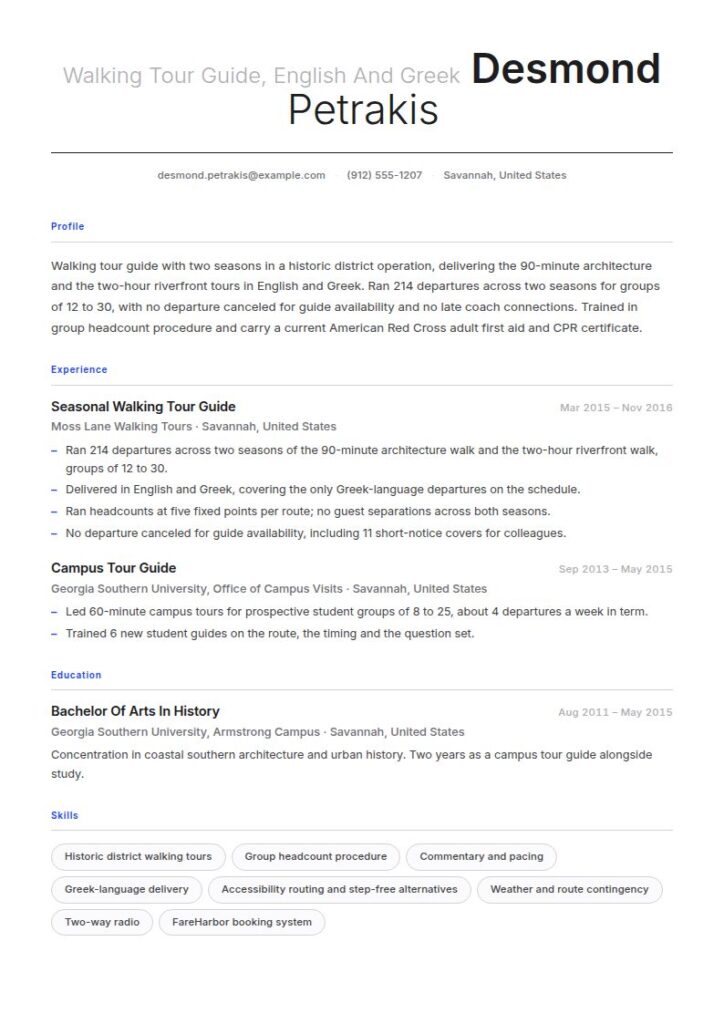
Walking tour guide with two seasons in a historic district operation, delivering the 90-minute architecture and the two-hour riverfront tours in English and Greek. Ran 214 departures across two seasons for groups of 12 to 30, with no departure canceled for guide availability and no late coach connections. Trained in group headcount procedure and carry a current American Red Cross adult first aid and CPR certificate.
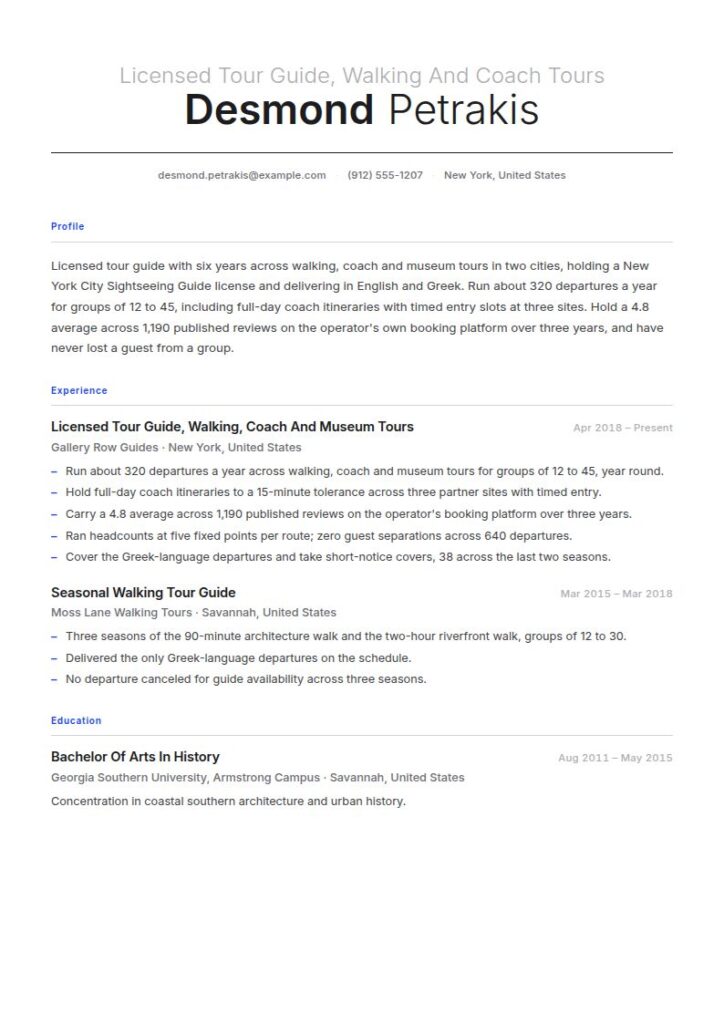
Licensed tour guide with six years across walking, coach and museum tours in two cities, holding a New York City Sightseeing Guide license and delivering in English and Greek. Run about 320 departures a year for groups of 12 to 45, including full-day coach itineraries with timed entry slots at three sites. Hold a 4.8 average across 1,190 published reviews on the operator's own booking platform over three years, and have never lost a guest from a group.
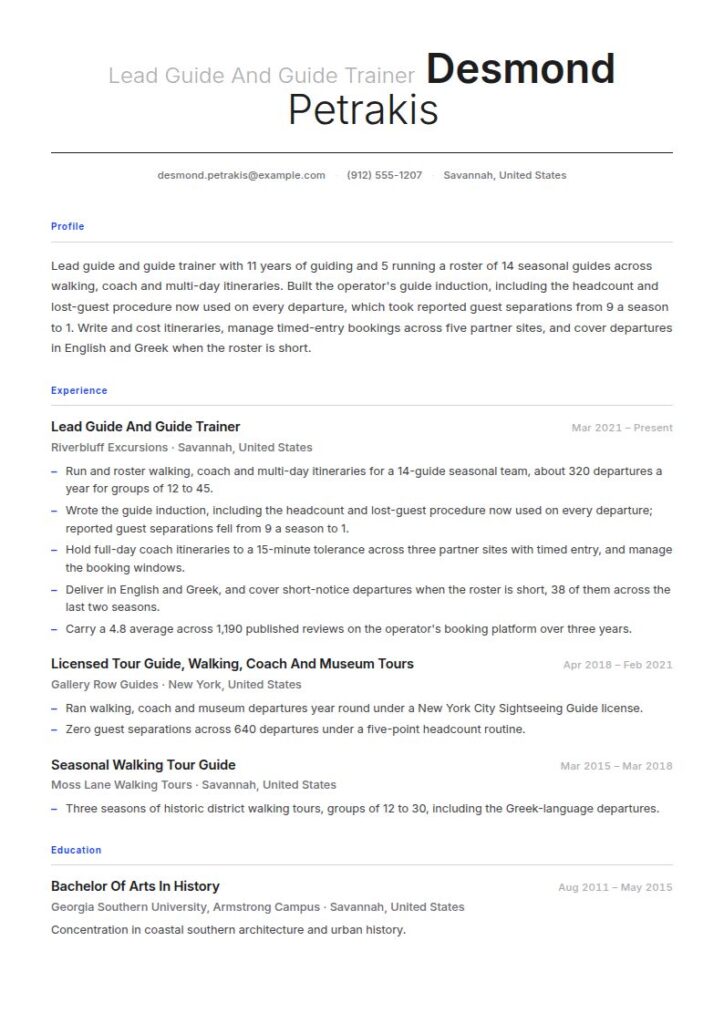
Lead guide and guide trainer with 11 years of guiding and 5 running a roster of 14 seasonal guides across walking, coach and multi-day itineraries. Built the operator's guide induction, including the headcount and lost-guest procedure now used on every departure, which took reported guest separations from 9 a season to 1. Write and cost itineraries, manage timed-entry bookings across five partner sites, and cover departures in English and Greek when the roster is short.
Right vs wrong: the same tour guide summary, twice
| ✅ Right | ❌ Wrong |
|---|---|
| Licensed tour guide with six years across walking, coach and museum tours in two cities. | Passionate about history and sharing my city with visitors from around the world. |
| Run about 320 departures a year for groups of 12 to 45, including full-day coach itineraries. | Experienced leading tours of various sizes and types. |
| Hold a New York City Sightseeing Guide license and deliver in English and Greek. | Licensed guide with excellent communication skills. |
| 4.8 average across 1,190 published reviews over three years, and have never lost a guest. | Consistently receive great feedback from guests. |
In practice, a manager can put the right column on next Tuesday's 10 a.m. departure. By contrast, the left column is a personality description, and every applicant in the folder has written one.
Outline your experience
Operator, city, tour types, dates and season pattern, then three to five bullets. In the experience section, each bullet carries a number: departures, group size, minutes, or an incident count.
| Instead of | Use |
|---|---|
| Led walking tours for tourists | Ran 214 departures of a 90-minute historic district walk, groups of 12 to 30, English and Greek |
| Provided excellent customer service | 4.8 average across 1,190 published reviews on the operator's booking platform over three years |
| Kept groups safe | Ran headcounts at five fixed points per route; zero guest separations across 640 departures |
| Managed tour logistics | Held full-day coach itineraries to a 15-minute tolerance across three timed-entry sites |
| Trained new staff | Wrote the guide induction and trained 14 seasonal guides across two seasons |
| Worked flexible hours | Covered 38 short-notice departures across two seasons, including evening and holiday slots |
Lead Guide and Guide Trainer, Riverbluff Excursions, Savannah, GA, March 2021 to Present, year round
Run and roster walking, coach and multi-day itineraries for a 14-guide seasonal team, about 320 departures a year for groups of 12 to 45.
Wrote the guide induction, including the headcount and lost-guest procedure now used on every departure; reported guest separations fell from 9 a season to 1.
Hold full-day coach itineraries to a 15-minute tolerance across three partner sites with timed entry, and manage the booking windows.
Deliver in English and Greek, and cover short-notice departures when the roster is short, 38 of them across the last two seasons.
Carry a 4.8 average across 1,190 published reviews on the operator's booking platform over three years.
Ratings and gratuities: the public numbers you can cite and the part you do not control
In fact, guiding is one of the few jobs where a stranger can look up your performance record. That is a genuine advantage on a resume and it is also a trap, and the difference is in how you write the number.
Use it, because it is evidence nobody else in the folder has. That is why a review average with a count and a period attached is a real measurement: "4.8 average across 1,190 published reviews on the operator's booking platform, 2023 to 2026" says how many people, over how long, on whose platform. On the other hand, an average with no count behind it says nothing, and a screenshot of five nice comments says less.
Then be honest about what the number contains, because an operations manager already knows.
| What moves a rating | Who controls it |
|---|---|
| Delivery, pacing, knowledge, how a group is handled | The guide |
| Weather, traffic, a closed site, a late coach | Nobody on the tour |
| Booking platform mechanics, when the review prompt fires | The operator |
| Price expectation set before the guest arrived | The sales channel |
| A single group with one difficult guest | Chance |
So write the rating as one line of evidence among several, never as the headline, and pair it with a number you fully control. Similarly, departures run, cancellations for guide availability, on-time coach connections and guest separations are all yours. A resume that leads on a rating and offers nothing else reads as though the rating is all there is.
Tour guide gratuities as performance evidence
Likewise, gratuities are the same problem in a different currency. On a free walking tour or a tip-led model, average gratuity per guest is a real performance signal, and it is also shaped by the currency in guests' pockets, the nationality mix on the day and the weather. If you use it, use it as a comparison inside one operation: "averaged 1.4 times the team mean gratuity per guest across two seasons" is defensible in a way that a raw dollar figure is not, and it does not require you to publish your income.
Give a review average with the count, the platform and the period. Put a number you control next to it: departures run, separations, on-time connections. Write gratuities as a ratio to the team mean rather than as a dollar amount. Say plainly when a rating covers a tour type you no longer run.
Do not quote a rating without the number of reviews behind it. Do not paste review screenshots or guest names into a resume. Do not claim a perfect record across a volume that makes it implausible. Do not use a rating from a platform the operator cannot check. Do not name individual guests, including in an anecdote.
Build a snapshot of your key skills
For skills, list twelve to sixteen entries in four groups: tours and delivery, logistics, safety, and languages and systems.
Tours and delivery: Historic district walking tours, Coach touring with commentary, Museum and gallery guiding, Multi-day itineraries, Evening and themed walks, Group sizes 8 to 48
Logistics: Timed-entry booking management, Coach and driver coordination, Itinerary costing, Weather and route contingency, Accessibility routing and step-free alternatives
Safety: Headcount procedure, Lost-guest protocol, Adult first aid and CPR, Incident reporting, Heat and hydration management on summer routes
Languages and systems: English (native), Greek (fluent), Spanish (conversational), FareHarbor and Rezdy booking systems, Whisper audio guide systems, Two-way radio
List your education and certifications
License first with the issuing authority and expiry, then safety certifications, then any site or subject accreditation, then degrees.
New York City Sightseeing Guide License #SG-40218, Department of Consumer and Worker Protection, current license period to March 2028. The license requires a 150-question examination with a minimum of 97 correct answers.
Adult First Aid, CPR and AED, American Red Cross, renewed March 2026
Site accreditations: Timed-entry guiding accreditation at three partner museums, renewed annually
Bachelor of Arts, History, Armstrong Campus, Georgia Southern University, Savannah, GA, 2015
Licensing is local and it is not universal, so state where yours applies. Guides in some locations, such as New York City and Washington, D.C., may need a locally issued license, and cruise directors need a Transportation Worker Identification Credential (BLS Occupational Outlook Handbook, last modified 27 August 2026). In New York City, the Department of Consumer and Worker Protection requires applicants to be at least 18 and to pass a 150-question examination with at least 97 correct answers, and the license runs in two-year periods expiring on 31 March in even years (NYC Department of Consumer and Worker Protection, nyc.gov, retrieved 17 September 2026).
If you guide in a city with no licensing regime, say that too, in one clause, so the omission does not read as a gap. Most of the occupation needs no license at all: the typical entry-level education is a high school diploma or equivalent, and guides usually receive moderate-term on-the-job training after hiring (BLS Occupational Outlook Handbook, last modified 27 August 2026).
Choose the right layout and design
As for layout, use a single column, plain type at 11 or 12 point, and the tours block visible without scrolling. No photograph, even though this is a public-facing job; operators who want to see you will ask for a trial tour, which tells them more than a headshot.
Name the file for yourself and the work: desmond-petrakis-tour-guide-savannah.pdf. Seasonal hiring happens in batches and the filename is the first sort.
Tour guide job market and outlook
A small occupation growing faster than average, with heavy turnover, and openings far out of proportion to its size.
| Measure | Value |
|---|---|
| Tour and travel guide jobs, 2025 | 62,200 |
| Projected change, 2025 to 2035 | 6 percent, 3,900 jobs |
| Projected annual openings | About 11,900 |
| Typical entry-level education | High school diploma or equivalent |
| On-the-job training | Moderate-term |
| Median annual wage, May 2025 | $38,120, or $18.33 an hour |
Source: U.S. Bureau of Labor Statistics, Occupational Outlook Handbook, May 2025 wage data and 2025 to 2035 projections, last modified 27 August 2026.
Openings are a fifth of the occupation every year
Hold two of those numbers next to each other. The occupation holds 62,200 jobs and is projected to produce about 11,900 openings a year through 2035 (BLS Occupational Outlook Handbook, 2025 to 2035 projections, published 27 August 2026). That is roughly one opening a year for every five jobs that exist.
Growth accounts for only 3,900 jobs across the whole decade, so almost all of that churn is replacement. Part-time work is common, schedules include weekends, evenings and holidays, and the work may be seasonal with guides busier at peak travel times (BLS Occupational Outlook Handbook, last modified 27 August 2026).
For a resume this is good news and a warning at once. Getting hired is not the hard part, so a resume that only proves you can be hired is competing at the bottom. What is scarce is a guide who comes back for a fourth season, covers a sick colleague's departure, and has never lost anybody. Every one of those is a number you can put on the page, and almost nobody does.
Where the work sits:
| Setting | Share of employment | Median annual wage (May 2025) |
|---|---|---|
| Museums, historical sites and similar institutions | 26 percent | $35,250 |
| Amusement, gambling and recreation industries | 18 percent | $42,050 |
| Travel arrangement and reservation services | 11 percent | $45,890 |
| Self-employed workers | 9 percent | Not published |
| Scenic and sightseeing transportation | 6 percent | $42,170 |
Source: U.S. Bureau of Labor Statistics, May 2025.
What salary you can expect as a tour guide
On pay, the median annual wage for tour and travel guides was $38,120, or $18.33 an hour, in May 2025. The lowest 10 percent earned less than $28,520 and the highest 10 percent more than $60,930 (BLS Occupational Outlook Handbook, May 2025). For comparison, the median for all occupations was $50,980, and the median across personal care and service occupations was $36,410 in the same period.
The industry table above is the most useful pay information on this page, because the gap between settings is larger than the gap most guides can negotiate. The largest employer, museums and historical sites, pays the lowest median of the five at $35,250, while travel arrangement and reservation services pays $45,890, about 30 percent more (BLS, May 2025). As a result, a guide whose resume reads only as a museum guide is applying into the lowest-paying quarter of the occupation.
Still, three things on a resume move you between those columns. To begin with, coach and multi-day itinerary experience opens travel arrangement work. Next, a second language opens departures a monolingual guide cannot cover. And roster, training or itinerary-costing responsibility moves you from guiding to running guiding, which is where the top decile of the occupation sits.
Note that gratuities sit on top of that in tip-led operations and are not in the BLS figures, which cover wages. Worth knowing when you compare a salaried museum post against a tip-led walking operation: the published numbers are not measuring the same thing.
Key takeaways for a tour guide resume
- To sum up, write your tours as a schedule: type, duration, departures, group size, language.
- Put the license number, its authority and its expiry where it can be checked.
- Give a number you fully control next to any rating: departures, cancellations, separations.
- Quote a review average only with its count, its platform and its period.
- Group seasonal work by operator and label the seasons so it reads as a pattern.
- Name the safety procedure, because it is what lets you be scheduled alone.
- List languages by level and by the tours you have actually delivered in each.
Build your tour guide resume in 15 minutes with our AI resume builder.
Related resume examples
- Travel agent resume
- Translator resume
- Volunteer resume
- Freelancer resume
- Self-employed resume
- Part-time job resume
- Zookeeper resume
- Dog trainer resume
- Career change resume
- Entry-level resume
- Journalist resume
- General resume
Pair it with a matching tour guide cover letter.
Tour guide resume questions, answered
How long should a tour guide resume be?
One page for your first five years. Two pages once you train guides, write or cost itineraries, or hold a license with a formal examination behind it. A long list of seasonal engagements is the usual reason these run over, and grouping seasons by operator fixes it without deleting anything.
Do I need a license to work as a tour guide?
It depends entirely on where you guide. Most of the United States has no licensing regime, but guides in some locations, such as New York City and Washington, D.C., may need a locally issued license (BLS Occupational Outlook Handbook, last modified 27 August 2026). Individual sites and museums often have their own accreditation on top. Name the license, the authority and the expiry if you hold one, and say which city it covers.
How do I write seasonal tour guide work without it looking unstable?
Group it. One entry per operator, with the season pattern in the date line: "Seasonal Guide, four seasons, April to October 2021 to 2024". Then say what you did between seasons, even briefly. A guide who returns to the same operator for four seasons has been rehired three times, which is a recommendation, and the ungrouped version hides that.
Should I put my tour ratings on my resume?
Yes, with the count, the platform and the period, and never on its own. A rating is shaped by weather, traffic, site closures and the booking channel as much as by the guide, so put a number you fully control beside it: departures run, cancellations for guide availability, or guest separations. Never paste review screenshots or name a guest.
What do I put on a tour guide resume with no experience?
Any work where you held a group to a timetable: teaching, coaching, camp work, retail floor supervision, event stewarding, front of house. Then the things you can bring on day one: languages by level, first aid and CPR certification, availability across weekends, evenings and holidays, and specific local knowledge written as a subject rather than as enthusiasm. Volunteer guiding at a museum or historic site counts fully, and should carry hours and group sizes like any other entry.
How do I show I can handle a group safely?
Name the procedure and give it a number. Headcount points per route, the lost-guest protocol you follow, incidents reported and how they closed, and any separations across a stated number of departures. Then add the certification with its issuing body and date. A guide who can describe what they do when someone is missing at the third stop is describing the skill the operator is actually buying.