Dog Walker, Pet First Aid and CPR Certified Callum Brady
Dog Walker
[email protected] | (503) 555-2272 | Portland, United States
Profile
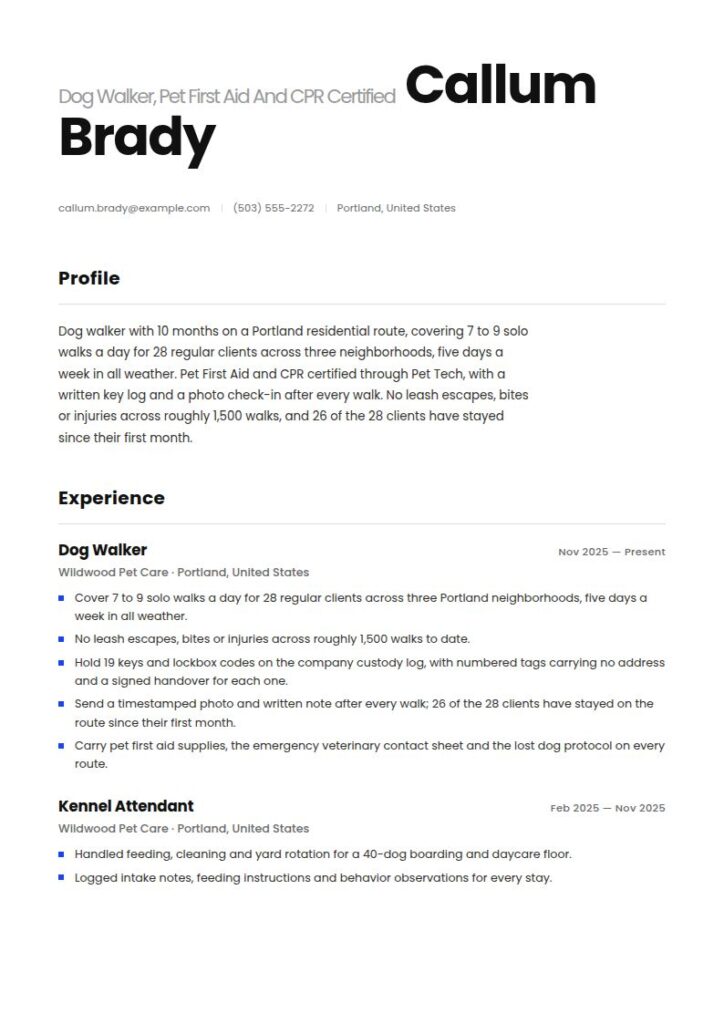
Dog walker with 10 months on a Portland residential route, covering 7 to 9 solo walks a day for 28 regular clients across three neighborhoods, five days a week in all weather. Pet First Aid and CPR certified through Pet Tech, with a written key log and a photo check-in after every walk. No leash escapes, bites or injuries across roughly 1,500 walks, and 26 of the 28 clients have stayed since their first month.
Work Experience
11/2025 - Present, Dog Walker, Wildwood Pet Care, Portland, United States
- Cover 7 to 9 solo walks a day for 28 regular clients across three Portland neighborhoods, five days a week in all weather.
- No leash escapes, bites or injuries across roughly 1,500 walks to date.
- Hold 19 keys and lockbox codes on the company custody log, with numbered tags carrying no address and a signed handover for each one.
- Send a timestamped photo and written note after every walk; 26 of the 28 clients have stayed on the route since their first month.
- Carry pet first aid supplies, the emergency veterinary contact sheet and the lost dog protocol on every route.
02/2025 - 11/2025, Kennel Attendant, Wildwood Pet Care, Portland, United States
- Handled feeding, cleaning and yard rotation for a 40-dog boarding and daycare floor.
- Logged intake notes, feeding instructions and behavior observations for every stay.
Education
09/2007 - 06/2011, High School Diploma, Rosehill High School, Portland, United States
Oregon high school diploma.
Skills
Leash and harness fitting, 75
Pet first aid and CPR, 80
Key custody and lockbox handling, 75
Route planning and time blocking, 65
GPS walk tracking and photo check-in, 80
Written incident reporting, 70
Languages
English, native
Spanish, beginner
Certificates
02/2026, Pet First Aid and CPR, Pet Tech, PT-PS-48210
PetSaver in-person day course. Certification valid two years.
08/2025, Cat and Dog First Aid, American Red Cross
Online course with digital certificate.
Summary
A dog walker resume is a one page document that answers the question behind every hire in this field: can this person be trusted with a house key and an animal, unsupervised, every weekday. This guide gives you three adaptable versions, the coverage and certification block that carries the page, and current Bureau of Labor Statistics pay and outlook for animal caretakers.
Dog Walker resume examples by experience level
In short, a dog walker resume is a one page document that proves you can be handed a house key and an animal, unsupervised, five days a week, and that nothing will go wrong you have not already planned for.
In fact, nobody is evaluating your love of dogs. A client is deciding whether to give a stranger the code to their back door while they are at work, and an agency owner is deciding whether your name on a route will cost them a claim. For this reason, this page is aimed at those two readers.
In federal data, the occupation covering this work is animal caretakers, inside the Bureau of Labor Statistics profile for animal care and service workers. Animal caretakers had a median wage of $35,360 a year in May 2025 and are projected to grow 12 percent between 2025 and 2035, adding 44,100 jobs (BLS Occupational Outlook Handbook, animal care and service workers, last modified 27 August 2026).
Resume guide for a dog walker resume
To start, this guide and the corresponding dog walker resume example will cover:
- First, how to write a dog walker resume, section by section
- Then, the coverage, key handling and incident block that decides the hire
- Also, three adaptable summaries: new walker, route lead and business owner
- Next, pet first aid and professional certification, and what each one proves
- Finally, what animal caretakers earn, and where the spread comes from
How to write a dog walker resume
Overall, six blocks: contact header, summary, coverage and certifications, walking experience with volume, handling and protocol skills, and education. In general, one page for the first several years, two only once you run a team and a client book.
Above all, coverage and certifications go directly under the summary, above experience. In most occupations, by contrast, that block is a formality at the bottom of the page. Here, however, it answers the reader's first question.
| Block | What it is answering | Where it goes |
|---|---|---|
| Coverage | If this person loses a key or a dog, who pays? | Under the summary, with limits |
| Certifications | Has anyone outside their own business assessed them? | Same block, with issuer and date |
| Walk volume | How much work is this, and at what cadence? | First bullet of every entry |
| Key and access protocol | How do they hold, label and return access? | Its own short block |
| Incident record | Have they had one, and what changed after? | One honest line, never omitted |
Write the coverage line with numbers, not the word bonded
"Bonded and insured" appears on almost every dog walking profile in the country, and it is close to meaningless because it names no product and no limit. The two things behind it are different. A commercial general liability policy, in the Insurance Information Institute's definition, "protects your business from financial loss should you be liable for property damage or personal and advertising injury caused by your services, business operations or your employees" (Insurance Information Institute, commercial general liability insurance, accessed 17 September 2026). That answers a broken window, a bitten passerby or a dog injured on your leash. A dishonesty or fidelity bond is a separate instrument covering a client's loss if you or an employee steals from the home.
So write both, with limits: "Commercial general liability, $1,000,000 per occurrence and $2,000,000 aggregate, current through March 2027. Dishonesty bond, $25,000." A client who has ever filed a claim reads that differently from bonded and insured.
Run the finished file through the ATS resume checker first. National pet care chains and larger walking platforms parse applications before a person reads them.
Choosing the best resume format for a dog walker resume
As a rule, reverse chronological, one page, with self-employment written exactly like employment.
For example, a quarter of animal care and service workers are self-employed, and 40 percent of animal caretaker employment sits in other personal services (BLS Occupational Outlook Handbook, May 2025 data published 27 August 2026). If that is you, give the business a name, a city and a start date, and list it in the same run as any employer. "Self-employed dog walker" with no structure under it reads as a gap with a label on it.
Functional formats fail here because the reader wants continuity: how long you have held the same clients, and how long you have held the same keys.
Include your contact information
| ✅ Right | ❌ Wrong |
|---|---|
| Callum Brady | Callum Brady |
| Dog Walker, Pet First Aid and CPR certified | Animal lover and dog enthusiast |
| Commercial general liability $1M / $2M, dishonesty bond $25,000 | Bonded and insured |
| Portland, OR | 2214 NE Holloway Street, Apt 4, Portland, OR 97212 |
| (503) 555-2272, [email protected] | (503) 555-2272, [email protected] |
Put the coverage on the header line or immediately under it, since it costs eleven words. Also leave your street address off, because you are applying to hold other people's addresses and a page publishing your own reads as someone who has not thought about that.
Make use of a summary
For the summary, three or four lines: how long you have walked, your volume, your coverage and first aid status, and one retention or safety number.
Dog walker with 10 months on a Portland residential route, covering 7 to 9 solo walks a day for 28 regular clients across three neighborhoods, five days a week in all weather. Pet First Aid and CPR certified through Pet Tech, with a written key log and a photo check-in after every walk. No leash escapes, bites or injuries across roughly 1,500 walks, and 26 of the 28 clients have stayed since their first month.
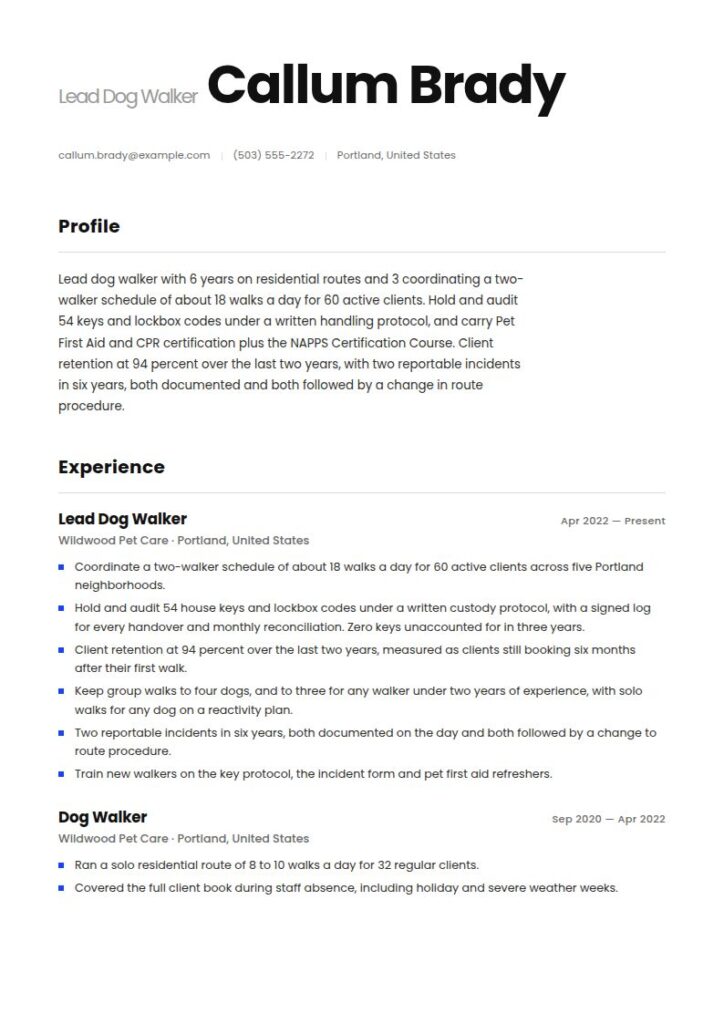
Lead dog walker with 6 years on residential routes and 3 coordinating a two-walker schedule of about 18 walks a day for 60 active clients. Hold and audit 54 keys and lockbox codes under a written handling protocol, and carry Pet First Aid and CPR certification plus the NAPPS Certification Course. Client retention at 94 percent over the last two years, with two reportable incidents in six years, both documented and both followed by a change in route procedure.
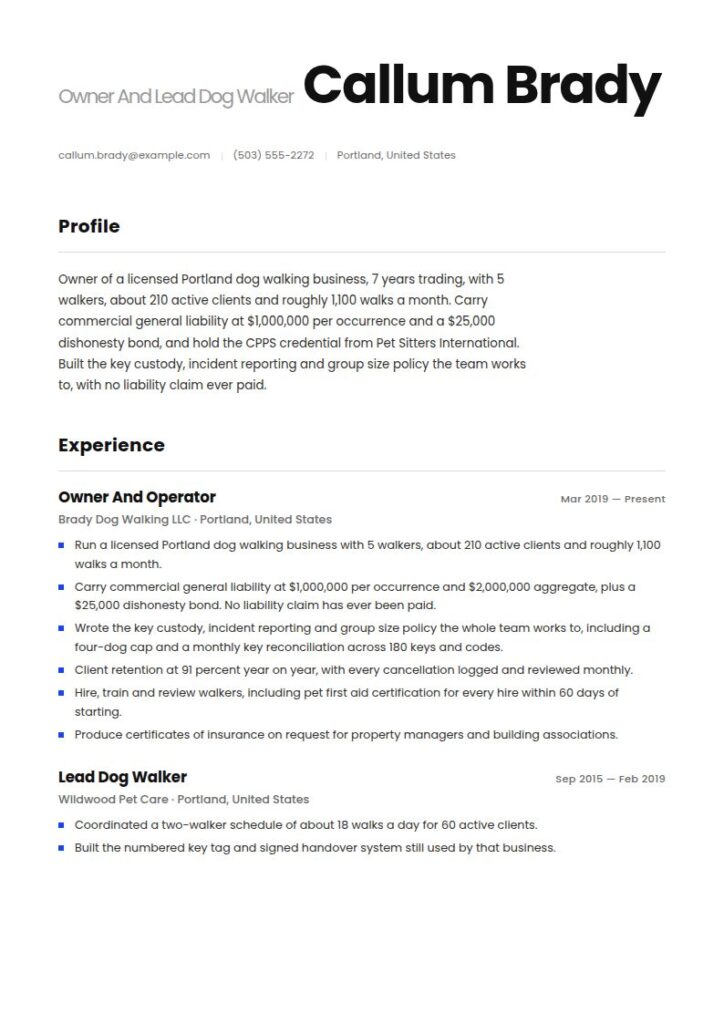
Owner of a licensed Portland dog walking business, 7 years trading, with 5 walkers, about 210 active clients and roughly 1,100 walks a month. Carry commercial general liability at $1,000,000 per occurrence and a $25,000 dishonesty bond, and hold the CPPS credential from Pet Sitters International. Built the key custody, incident reporting and group size policy the team works to, with no liability claim ever paid.
Right vs wrong: the same dog walker summary, twice
| ✅ Right | ❌ Wrong |
|---|---|
| Dog walker with 10 months on a Portland residential route, 7 to 9 solo walks a day for 28 regular clients. | Passionate dog lover with experience caring for animals of all kinds. |
| Pet First Aid and CPR certified through Pet Tech, with a written key log and photo check-in after every walk. | Reliable, trustworthy and great with dogs. |
| No leash escapes, bites or injuries across roughly 1,500 walks, and 26 of the 28 clients have stayed since their first month. | Always puts the safety of the animals first, and builds strong relationships with clients and their pets. |
The right column is checkable. The left column is what every other applicant also wrote.
Outline your experience
For each entry, give business or employer, city and state, your title, and dates by month and year. Then three to five bullets, the first of which is always volume.
| Instead of | Use |
|---|---|
| Walked dogs for clients in the local area | Covered 7 to 9 solo walks a day for 28 regular clients across three neighborhoods, five days a week |
| Responsible for keys and access to client homes | Held 54 keys and lockbox codes under a written custody log, audited monthly, zero keys unaccounted for in three years |
| Ensured the safety of the animals in my care | No leash escapes, bites or injuries across roughly 1,500 walks; two documented incidents in six years |
Lead Dog Walker, Wildwood Pet Care, Portland, OR, April 2022 to Present
Coordinate a two-walker schedule of about 18 walks a day for 60 active clients across five neighborhoods, five days a week in all weather.
Hold and audit 54 house keys and lockbox codes under a written custody protocol, with numbered tags carrying no address and a signed log for every handover. Zero keys unaccounted for in three years.
Client retention at 94 percent over the last two years, measured as clients still booking six months after their first walk.
Keep group walks to four dogs, and to three for any walker under two years of experience, with solo walks for any dog on a reactivity plan.
Two reportable incidents in six years, both documented on the day and both followed by a change to route procedure.
Keys, insurance and the incident record
Indeed, this is the block that separates a dog walker's resume from every other animal job, and almost nobody writes it. The three things in the heading are what a client, an agency owner or a platform checks before they let you work, and each one has a written form.
Coverage, with limits and dates. Give the policy type, the per-occurrence and aggregate limits, the expiry, and the bond separately. If a client asks for a certificate of insurance naming them, say you can produce one, because most applicants cannot. San Francisco is explicit about the level it expects: its commercial dog walker permit requires proof of $1 million general liability insurance (City and County of San Francisco, SF Business Portal, dog walking permit, accessed 17 September 2026).
Key handling, written as a protocol. Three lines is enough, and it is three lines nobody else writes.
Key and access protocol: numbered key tags carrying no address or client name, stored in a locked cabinet away from the vehicle. Signed handover log for every key received and returned. Lockbox and smart lock codes held in an encrypted password manager, never a phone note, and rotated when a walker leaves. Monthly reconciliation against the active client list.
The incident record, stated rather than hidden. Every walker with real volume has had something happen: a slipped collar, a scuffle at a gate, a dog that went lame mid-route. A resume claiming a perfect record over ten thousand walks is either new or not being straight, and experienced readers know it. Write the count, the documentation and the change that followed.
Group walk limits for dog walkers
Group size, and the rule where you work. Group walk limits are the most common regulatory line in this field, and they vary by jurisdiction. San Francisco requires a commercial dog walker permit from Animal Care and Control for any individual walking four or more dogs, caps the total at eight, and charges $285 initially with a $114 annual renewal; applicants qualify through three or more years of documented dog walking experience or through completed training, and must hold a valid city business license (City and County of San Francisco, SF Business Portal, dog walking permit, accessed 17 September 2026). On federal land nearby the limit is tighter: commercial dog walking at Golden Gate National Recreation Area requires a commercial use authorization and allows no more than six dogs at a time (National Park Service, Golden Gate National Recreation Area, commercial dog walking, page last updated 1 August 2025).
Most cities have no such rule. Check the one where you work, and if it licenses this work, put the permit number on the page the way a licensed trade would. If it does not, state your own cap anyway: four, with a reason attached, reads as judgment.
The money in this field is in services, and the services line is growing
Of the $158 billion Americans spent on their pets, $14.3 billion went to the category the American Pet Products Association defines as boarding, grooming, insurance, training, pet sitting, pet walking and all services outside veterinary care, and 95 million United States households own at least one pet (American Pet Products Association, industry trends and statistics, 2024 actual sales, and the APPA announcement of 26 March 2026).
Federal projections point the same way. Animal caretakers are projected to grow 12 percent from 2025 to 2035, adding 44,100 jobs, against 3.5 percent for all occupations, with about 69,400 openings a year across animal care and service workers (BLS Occupational Outlook Handbook, 2025 to 2035 projections published 27 August 2026).
Demand is not your problem in this market. The constraint is trust, and the resume's only job is to shorten the time it takes a stranger to extend it.
Build a snapshot of your key skills
For skills, list eight to twelve named entries in three groups. Name only things you would be comfortable demonstrating on a trial walk, because a trial walk is how this job is interviewed.
Handling: Leash and harness fitting, Front-clip and double-clip protocols, Reactive dog route planning, Multi-dog group management to a stated cap, Securing dogs in a vehicle, Heat and cold weather route adjustment
Safety and response: Pet first aid and CPR, Bite and scuffle de-escalation, Lost dog protocol, Emergency veterinary escalation, Written incident reporting
Operations and client: Key custody and lockbox management, Route planning, Scheduling and booking software, GPS walk tracking and photo check-in, Meet and greet assessments, Holiday and severe weather coverage
List your education and certifications
Education is short here and nobody minds: BLS gives the typical entry-level education for animal care and service workers as a high school diploma or equivalent with on-the-job training (BLS Occupational Outlook Handbook, last modified 27 August 2026). Certifications are where the page gains weight, so give the issuer, the date and the renewal period for each.
Pet First Aid and CPR, Pet Tech, certified February 2026, valid two years
Cat and Dog First Aid, American Red Cross, completed August 2025
Certified Professional Pet Sitter (CPPS), Pet Sitters International, certified 2024, valid three years, 30 continuing education units per cycle
NAPPS Certification Course, National Association of Professional Pet Sitters, completed 2023
Business license, City of Portland, current. Commercial general liability $1,000,000 per occurrence and $2,000,000 aggregate, current through March 2027. Dishonesty bond $25,000.
High School Diploma, Rosehill High School, Portland, OR, 2017
In addition, two certification routes are worth knowing by name. For instance, Pet Sitters International's Certified Professional Pet Sitter credential is a proctored 100-question exam requiring 80 percent or above, costs $275, is valid three years and needs 30 continuing education units per cycle to renew (Pet Sitters International, certification exam FAQs, accessed 17 September 2026). The National Association of Professional Pet Sitters runs a certification course of credit-bearing sections including dog studies, cat studies, business and pet first aid, with a passing score of 75 percent in each and six months from purchase to complete it (National Association of Professional Pet Sitters, certification course, accessed 17 September 2026).
Similarly, for first aid, name the provider and the format. The American Red Cross Cat and Dog First Aid course runs 35 minutes online with a digital certificate on completion (American Red Cross, cat and dog first aid, accessed 17 September 2026), while a Pet Tech PetSaver class is an in-person day course whose certification runs two years (Pet Tech, PetSaver Pet CPR, First Aid and Care, accessed 17 September 2026). Only one puts your hands on a manikin, and a client who asks will therefore hear the difference.
Choose the right layout and design
As for layout, single column, one typeface at 10.5 to 12 point, month and year dates, no photograph of you and none of a dog. One page, sent as a PDF named for yourself and the role, because this file goes to private individuals as often as to businesses.
Put coverage limits and expiry dates on the page rather than the word bonded. Give walk volume in the first bullet of every entry. Write the key custody protocol as a short block. State your incident count and what changed afterward. Name the first aid provider and the expiry. State your group size cap and any permit your city requires.
Do not publish your home address on a document about holding other people's addresses. Do not claim a perfect record across thousands of walks. Do not name a client, a household or a dog in a way that identifies them. Do not claim a permit or an insurance limit you cannot produce on request.
Dog walker job market and outlook
In other words, a growing occupation with high turnover, low formal entry requirements and a hiring decision that turns on trust.
| Measure | Value |
|---|---|
| Animal care and service worker jobs, 2025 | 413,000 |
| Projected change, 2025-35 | 11% (+46,100) |
| Animal caretakers specifically, projected change | 12% (+44,100) |
| Projected annual openings | ~69,400 |
| Typical entry-level education | High school diploma or equivalent |
| Median annual wage, animal caretakers, May 2025 | $35,360 |
Source: U.S. Bureau of Labor Statistics, Occupational Outlook Handbook, animal care and service workers, 2025 to 2035 projections and May 2025 wage data, page last modified 27 August 2026.
Where the work sits:
| Setting | Share of animal caretaker employment |
|---|---|
| Other personal services | 40% |
| Self-employed workers | 25% |
Source: BLS Occupational Outlook Handbook, May 2025.
Two thirds of this occupation works for a small personal services business or for itself, so most hiring is done by an owner who is also on a route, reading applications between walks.
What salary you can expect as a dog walker
On pay, the median annual wage for animal caretakers was $35,360 in May 2025, with the lowest 10 percent under $27,250 and the highest 10 percent above $50,060. Likewise, across animal care and service workers as a whole the median was $35,530 a year, or $17.08 an hour (BLS Occupational Outlook Handbook, May 2025 wage data published 27 August 2026).
Still, the top of that spread is rarely an hourly wage at all. It belongs to people running a book: several walkers, a client list that renews, and pricing set per walk rather than per hour. Meanwhile, animal trainers, the adjacent occupation in the same Handbook profile, had a median of $39,990 with the top 10 percent above $75,490.
Even so, what moves your own figure is narrow. Midday availability, because that is where the demand is and it is the hardest window to staff. Solo walks and reactive dogs, which price above group walks because fewer people take them. Holiday and severe weather coverage. Certifications and coverage, which let a business put you on a route without raising its own risk. And retention, which only shows before you are hired if you put the number on the page.
Key takeaways for a dog walker resume
- Lead with coverage limits, expiry and the bond, not the phrase bonded and insured.
- Put walk volume and client count in the first bullet of every entry.
- Write the key custody protocol as a short block; almost no competing file has one.
- State your incident record honestly, with what changed after each one.
- Give a group size cap and the permit rule where you work, if there is one.
- Name the first aid provider and the expiry date.
- Write your own business as an employer, and keep it to one page.
Build your dog walker resume in 15 minutes with our AI resume builder.
Related resume examples
- Dog trainer resume
- Zoo keeper resume
- Farm worker resume
- Tour guide resume
- Volunteer resume
- Self employed resume
- Freelancer resume
- Part time job resume
- Entry level resume
- General resume
- One year experience resume
- Career change resume
Pair it with a matching dog walker cover letter.
Dog walker resume questions, answered
How long should a dog walker resume be?
One page, for almost everyone. Two only once you employ other walkers and carry a client book worth describing. The reader is usually an owner-operator or a household, and neither has an afternoon for it.
Do I need a certification to be a dog walker?
No. In most of the United States there is no license to walk dogs, and BLS gives the typical entry requirement as a high school diploma with on-the-job training (BLS Occupational Outlook Handbook, last modified 27 August 2026). That is why certification is worth having: when nothing is required, the voluntary credential is the only outside assessment on the page. Pet first aid is the one to get first.
What insurance should a dog walker have, and how do I write it?
Commercial general liability for injury and property damage, and a separate dishonesty or fidelity bond for theft from a client's home. Write both with limits and an expiry rather than the phrase bonded and insured. For scale, San Francisco's commercial dog walker permit requires proof of $1 million general liability insurance (City and County of San Francisco, SF Business Portal, dog walking permit, accessed 17 September 2026).
How do I write a dog walker resume with no experience?
Start with volume you have: a neighbor's dog three times a week for a year is a countable record, and so is shelter volunteering with hours attached. Get pet first aid certified before you apply. Then write the protocol section anyway, because a new walker who has already thought about key custody and group size reads as someone who will be safe on day one.
Should I mention an incident where a dog was hurt or got loose?
Yes, as a count with a documented response, not as a story. Experienced readers do not believe a perfect record across thousands of walks, and the applicants who claim one are the ones who worry them. What you are showing is that you document, escalate and change procedure.