Medical Coder, Revenue Integrity Bronwen Kovalchuk CPC
Coding Associate
[email protected] | (515) 555-2254 | Des Moines, United States
Profile
Certified Professional Coder with six years in orthopedic and multispecialty outpatient coding before a seven-year caregiving break, back in full-time practice since January 2025. Maintained the CPC credential through the break, completing 36 AAPC continuing education units in every two-year cycle, and coded on contract for a three-provider clinic across two of those years. Currently code 90 to 110 outpatient encounters a day at a 14-clinic network with a 97% first-pass acceptance rate.
Work Experience
01/2025 - Present, Coding Associate, Hawkeye Ridge Health Network, Des Moines, United States
- Code 90 to 110 outpatient encounters a day across orthopedics, general surgery and primary care in Epic Resolute Professional Billing.
- Hold a 97% first-pass claim acceptance rate against a department standard of 95%, measured monthly.
- Clear the modifier 25 and modifier 59 edit queue for two clinics, roughly 60 held claims a week.
08/2017 - 12/2024, Full-Time Caregiver, Career break for family caregiving, Des Moines, United States
- Managed a household of five including medical scheduling and insurance appeals for a family member with a chronic condition.
- Contract Coder, three-provider orthopedic clinic, March 2021 to August 2023: roughly 300 encounters a month on a part-time schedule.
- Elected Treasurer, elementary school parent organization, 2019 to 2023: a $41,000 annual budget across 6 events a year, annual report filed on time in all four years.
- Completed 36 AAPC continuing education units in each two-year cycle, including the annual ICD-10-CM and CPT code set updates.
06/2011 - 07/2017, Medical Coder, Two Rivers Orthopedic Group, Des Moines, United States
- Coded surgical and office encounters for 11 orthopedic providers, roughly 70 a day.
- Cut the practice's coding-related denial rate from 8.1% to 3.4% over three years by rebuilding the operative report query template.
Education
08/2009 - 05/2011, Associate of Applied Science, Health Information Technology, Des Moines Area Community College, Des Moines, United States
Conferred May 2011. Coursework in CPT, ICD-10-CM, medical terminology and payer policy.
Skills
CPT and HCPCS Level II coding, 85
ICD-10-CM coding, 85
E/M documentation guidelines, 75
Modifier 25 and 59 application, 80
Epic Resolute Professional Billing, 70
3M CodeFinder, 75
Denial trend analysis, 65
Languages
English, native
Ukrainian, conversational
Certificates
06/2011, Certified Professional Coder (CPC), AAPC, 01654982
Continuously certified since June 2011, current through December 2027. 36 continuing education units completed in each two-year cycle, including the 2017 to 2024 caregiving period.
03/2022, Risk Adjustment Coding, AAPC
Completed online during the caregiving period.
Summary
A stay-at-home mom resume is a reverse chronological document that dates the caregiving years instead of hiding them, then carries evidence that your skills did not expire while you were out. This guide gives you three adaptable versions, a currency test for every line you are thinking of keeping, and current federal figures on mothers in the labor force.
Stay-at-Home Mom resume examples by experience level
A stay-at-home mom resume is a reverse chronological document that gives the caregiving years a start date, an end date and a scope line, and then spends the rest of the page proving that the skills underneath them are still current.
However, those are two separate jobs and most files only attempt the first. A resume that dates the break cleanly but lists a certification with no renewal date still leaves a reader guessing about whether you can do the work today. In short, this page is about closing both gaps.
Resume guide for a stay-at-home mom resume
To start, this guide and the corresponding stay-at-home mom resume example will cover:
- First, how to write a stay-at-home mom resume, section by section
- How to date the caregiving years so they read as a period rather than a hole
- Then, three adaptable summaries: first role back, established again, and leading
- Finally, the four kinds of evidence that show a skill is current, and what makes each one invisible
- What federal data actually says about mothers and work, and what it does not
How to write a stay-at-home mom resume
Six sections: contact header, summary, experience including the caregiving entry, currency evidence, education and certifications, and skills. One page if your pre-break career was under six years, two if longer.
Above all, keep everything in one reverse chronological list. In contrast, building a separate "professional experience" section and a separate "other experience" section tells the reader you have already judged half your history as not counting.
| Section | What it is answering | Where it goes |
|---|---|---|
| Summary | What did she do before, and what can she do now? | Top, three or four lines |
| Experience | What happened in every year on this page? | One reverse chronological list, break included |
| Currency evidence | Is any of this still true in 2026? | Certifications with renewal dates, dated coursework, contract work |
| Education | What was the original training? | Below experience once you have any work history |
| Skills | Which tools would she not need training on? | Grouped and named, no rating bars |
Give the caregiving entry a scope line, not an apology
The entry itself is two lines. A title, a date range, and one sentence of scope.
"Full-Time Caregiver, Des Moines, IA, August 2017 to December 2024. Managed a household of five, including the medical scheduling and insurance appeals for a family member with a chronic condition, alongside contract coding work and an elected school treasurer role."
What makes that work is the nouns. Medical scheduling, insurance appeals, contract work and an elected office are things a reader can picture. "Cared for my children" is true and gives the reader nothing to hold.
Do not use a joke title. "Chief Household Officer" and "Domestic Engineer" read as evasions and cost you the seriousness the rest of the page is building.
Run the finished file through the ATS resume checker first. A file with an unusual entry mid-timeline is exactly the kind that parses badly, and you want to know that before a recruiter does.
Choosing the best resume format
As a rule, reverse chronological, one column, one or two pages. In particular, not functional, and this is the single most consequential format decision on this page.
Of course, the functional resume is marketed to people returning from a break as a way to lead with skills and bury the timeline. Recruiters know what it is for. Yet a file that groups everything under "Core Competencies" with no dates reads as a longer break than the one you took, because the reader assumes the worst case and moves on.
A hybrid is the useful compromise: a short skills block near the top, then the full dated history underneath. That way, you get the skills up front and keep every year visible.
Include your contact information
| ✅ Right | ❌ Wrong |
|---|---|
| Bronwen Kovalchuk, CPC | Bronwen Kovalchuk |
| Medical Coder, Revenue Integrity | Stay-at-Home Mom Returning to the Workforce |
| CPC #01654982, AAPC, current through 2027 | Certified coder |
| (515) 555-2254, [email protected], Des Moines, IA | (515) 555-2254, [email protected] |
Two specifics. Also, your header line is the job you want, not the life stage you are leaving, because "returning to the workforce" is a category and the reader has a stack of files in it. And the credential goes in the header with its expiry, because that line answers the question the rest of the page is otherwise arguing about.
Make use of a summary
Three or four lines: what you did before, how long, what you have kept current, and one number from actual work.
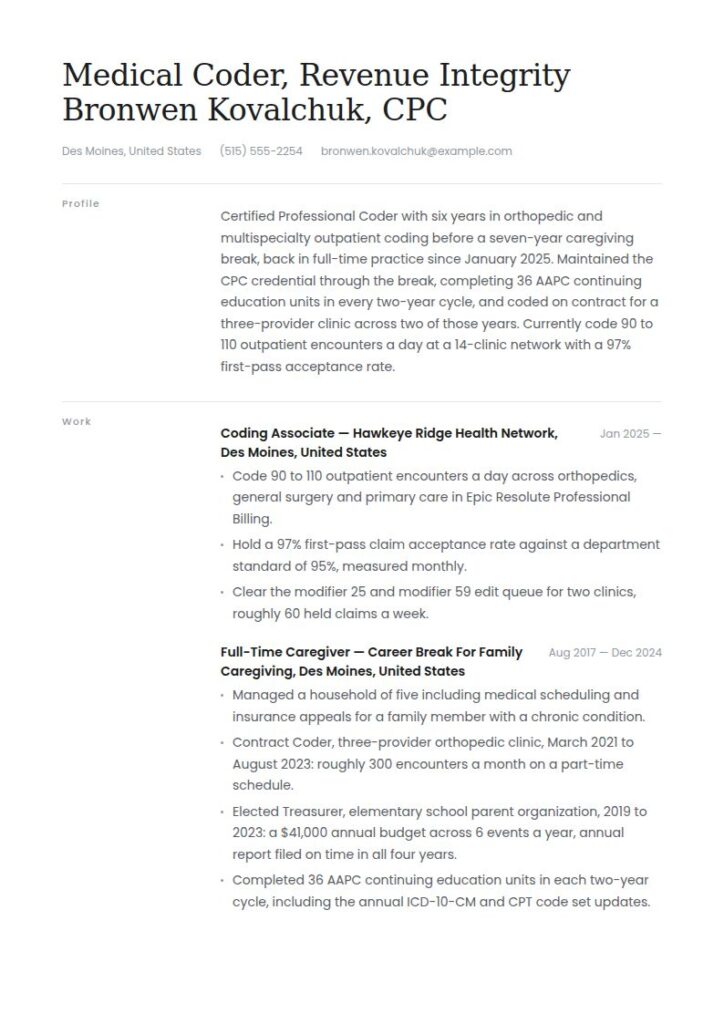
Certified Professional Coder with six years in orthopedic and multispecialty outpatient coding before a seven-year caregiving break, back in full-time practice since January 2025. Maintained the CPC credential through the break, completing 36 AAPC continuing education units in every two-year cycle, and coded on contract for a three-provider clinic across two of those years. Currently code 90 to 110 outpatient encounters a day at a 14-clinic network with a 97% first-pass acceptance rate.
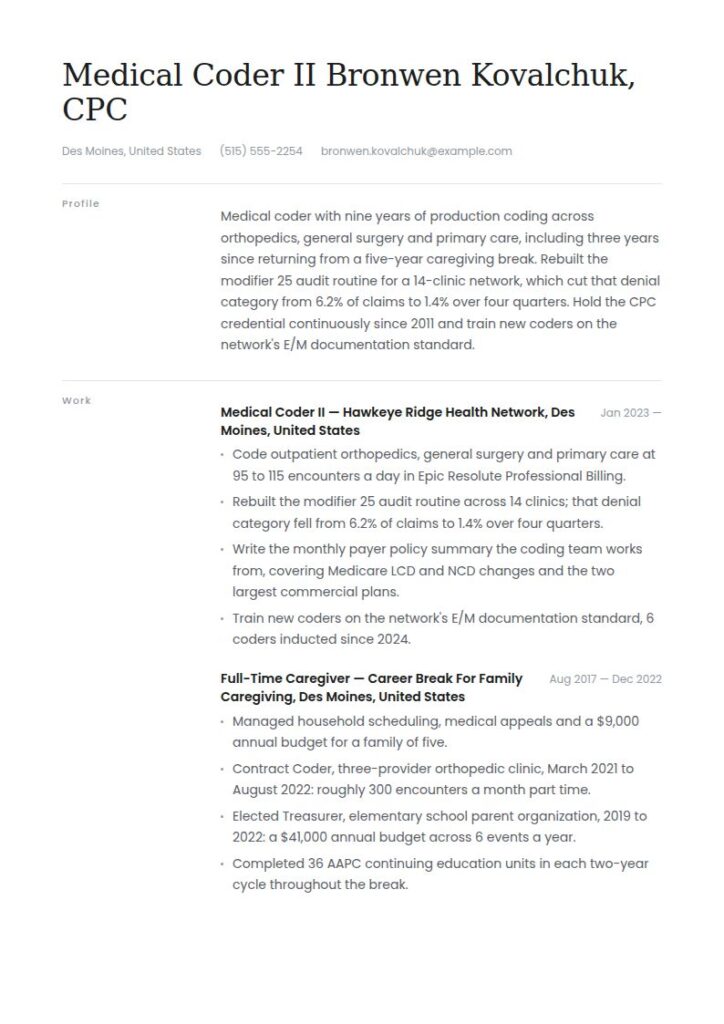
Medical coder with nine years of production coding across orthopedics, general surgery and primary care, including three years since returning from a five-year caregiving break. Rebuilt the modifier 25 audit routine for a 14-clinic network, which cut that denial category from 6.2% of claims to 1.4% over four quarters. Hold the CPC credential continuously since 2011 and train new coders on the network's E/M documentation standard.
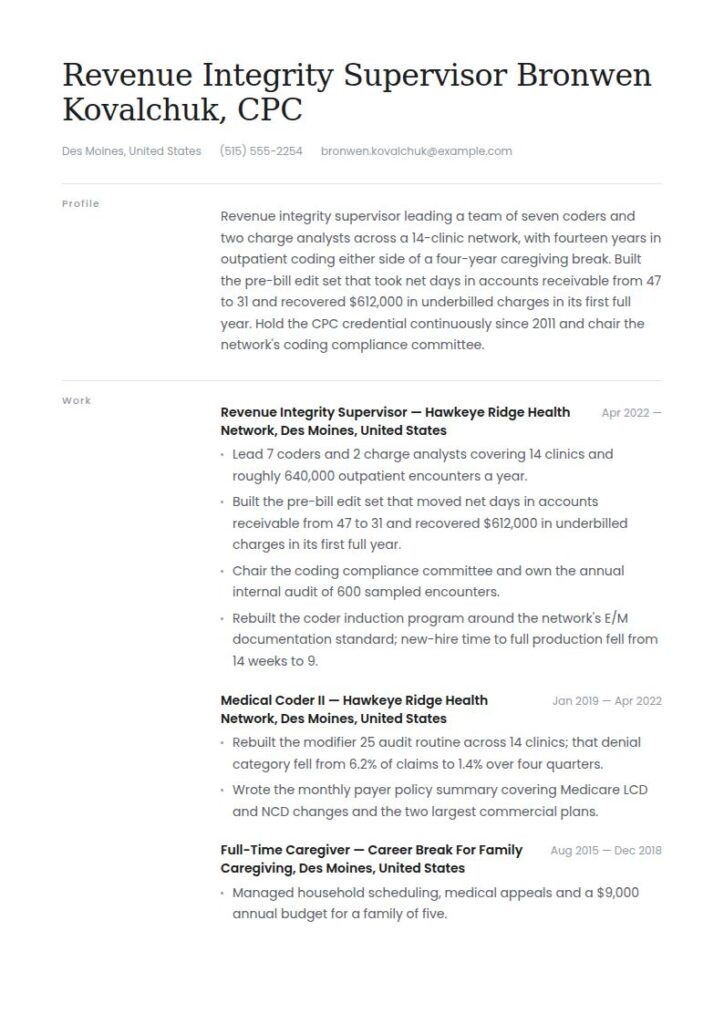
Revenue integrity supervisor leading a team of seven coders and two charge analysts across a 14-clinic network, with fourteen years in outpatient coding either side of a four-year caregiving break. Built the pre-bill edit set that took net days in accounts receivable from 47 to 31 and recovered $612,000 in underbilled charges in its first full year. Hold the CPC credential continuously since 2011 and chair the network's coding compliance committee.
Right vs wrong: the same stay-at-home mom summary, twice
| ✅ Right | ❌ Wrong |
|---|---|
| Certified Professional Coder with six years in orthopedic and multispecialty outpatient coding before a seven-year caregiving break. | Highly motivated professional re-entering the workforce after taking time off to raise a family. |
| Maintained the CPC credential through the break with 36 AAPC continuing education units in every two-year cycle. | Eager to apply my organizational and multitasking skills gained through managing a busy household. |
| Currently code 90 to 110 outpatient encounters a day at a 14-clinic network with a 97% first-pass acceptance rate. | A fast learner who is confident I can quickly get back up to speed. |
For example, the right column is a coder whose history has a gap in it. The left column is an apology, and it leaves a stranger to decide whether the skills survived.
Outline your experience
Employer, title, city, dates, then two to four bullets with a number in each. In addition, the caregiving entry sits in the same list, in its correct chronological position, formatted like the paid roles.
| Instead of | Use |
|---|---|
| Stayed home to raise my children | Full-Time Caregiver, August 2017 to December 2024. Managed household scheduling, medical appeals and a $9,000 annual budget for a family of five |
| Volunteered at my kids' school | Elected Treasurer, elementary school parent organization, 2019 to 2023. Held a $41,000 annual budget across 6 fundraising events and filed the annual report |
| Kept my skills up | Completed 36 AAPC continuing education units in each two-year cycle, 2017 to 2024, including the annual code set updates |
| Helped organize events | Ran a 240-family annual fundraiser; net proceeds rose from $11,400 to $19,800 |
Coding Associate, Hawkeye Ridge Health Network, Des Moines, IA, January 2025 to present
Code 90 to 110 outpatient encounters a day across orthopedics, general surgery and primary care in Epic Resolute Professional Billing.
Hold a 97% first-pass claim acceptance rate against a department standard of 95%, measured monthly.
Full-Time Caregiver, Des Moines, IA, August 2017 to December 2024
Managed a household of five including medical scheduling and insurance appeals for a family member with a chronic condition.
Contract Coder, three-provider orthopedic clinic, March 2021 to August 2023: roughly 300 encounters a month on a part-time schedule.
Elected Treasurer, elementary school parent organization, 2019 to 2023: a $41,000 annual budget across 6 events a year.
Medical Coder, Two Rivers Orthopedic Group, Des Moines, IA, June 2011 to July 2017
Coded surgical and office encounters for 11 orthopedic providers, roughly 70 a day, and cut the practice's coding-related denial rate from 8.1% to 3.4% over three years.
Date the caregiving years and prove your skills are current
Two arguments, and you need both. First, the dated entry answers where the years went. The currency evidence answers whether any of it still holds. A page that wins the first and loses the second still fails.
In practice, the dated entry has three parts, each doing a specific job.
| Part of the entry | What it is for | What it looks like |
|---|---|---|
| A plain title | Stops the reader inventing one | Full-Time Caregiver, or Career Break for Family Caregiving |
| A month-to-month date range | Makes the period finite and measurable | August 2017 to December 2024 |
| One scope sentence with nouns in it | Gives the reader something concrete to hold | Household of five, medical scheduling, insurance appeals, a $9,000 annual budget |
Proof your skills are still current
Then the currency evidence, which almost nobody plans for. Specifically, four kinds count, and each has a visible version and an invisible one.
| Evidence | What makes it count | What makes it invisible |
|---|---|---|
| A certification kept current | The credential, the issuing body, the number, and the date it is valid through | Listing the credential with no date, which reads as expired |
| A volunteer or school role | A budget, a headcount, a term of office, and a result with a number | "Volunteered at my children's school", with no scope attached |
| Contract or part-time work | An employer or client, month-to-month dates, and a volume figure | "Occasional freelance work" with no date range |
| Coursework | The provider, the completion date, and what it qualifies you to do | A course with no completion date, or a course list with no dates at all |
The volunteer row is worth arguing about, because volunteering is common enough that the word alone carries almost no information. In the Current Population Survey Civic Engagement and Volunteering Supplement covering September 2022 to September 2023, 28.3 percent of Americans aged 16 and over formally volunteered through an organization: 75.7 million people, an estimated 4.99 billion hours, about $167.2 billion in value (U.S. Census Bureau and AmeriCorps, published 19 November 2024). More than one in four adults did the thing you are putting on your resume. Instead, what separates your line from theirs is the budget, the headcount and the term.
Put the renewal cycle on the credential, not just the credential
A certification with no date attached is read as lapsed, because a reader who cannot check assumes the answer they can defend.
Write the maintenance requirement and show you met it. AAPC requires 36 continuing education units every two years to keep a single certification such as the CPC, rising to 40 for two certifications and 52 for five or more, with annual membership due regardless of where you are in the reporting cycle (AAPC continuing education policy, retrieved 17 September 2026).
So the line is: "Certified Professional Coder, AAPC, #01654982, continuously certified since 2011, 36 CEUs completed in each two-year cycle including 2017 to 2024." That sentence does more work than the entire skills section underneath it, because it proves the credential never went dormant while you were out.
The same shape works for any renewable credential: name the body, name the cycle, say you met it.
Build a snapshot of your key skills
For skills, list eight to twelve entries in three groups: the systems, the technical work, and the parts of the job that are about judgment. Even so, only list a tool you could be asked about in the interview.
Systems: Epic Resolute Professional Billing, 3M CodeFinder, Availity, Waystar claim edits, Excel including pivot tables and lookups
Coding and compliance: CPT and HCPCS Level II, ICD-10-CM, E/M documentation guidelines, Modifier 25 and 59 application, NCCI edit resolution, Medicare LCD and NCD review
Revenue cycle: Denial trend analysis, Appeal letter drafting, Charge capture audit, Payer policy monitoring, Provider education and query writing
Cut anything you would have to relearn before your first week. A system you last opened in 2017 is something the interview will find, and that is a worse place to find it than the draft.
List your education and certifications
For education, give degree, field, institution, conferral month and year. Then certifications with numbers and valid-through dates, then anything dated you completed during the break.
Certified Professional Coder (CPC), AAPC, #01654982, continuously certified since June 2011, current through December 2027. 36 continuing education units completed in each two-year cycle, including the 2017 to 2024 caregiving period.
Associate of Applied Science, Health Information Technology, Des Moines Area Community College, Des Moines, IA, conferred May 2011.
Completed during the caregiving period: ICD-10-CM annual code set update, AAPC, 2018 through 2024. Risk Adjustment Coding, AAPC online, completed March 2022. Epic Resolute Professional Billing end-user training, completed January 2025.
Give the coursework its completion month. After all, a dated certificate is an entry; an undated one is a claim.
Choose the right layout and design
As for layout, one column, one or two pages, 10 or 11 point, clear headings, wide margins, no photograph and no graphics. PDF unless the posting asks for a Word file.
Write the caregiving period as a dated entry in the main experience list, with a title and a scope sentence. Put the credential and its valid-through date in the header. Give every volunteer role a budget, a headcount or a term of office. Date every course by completion month. Keep one reverse chronological list. Explain the break in one line in the cover letter, not in three on the resume.
Do not use a functional format to hide the timeline; it reads as a longer break than you took. Do not invent a corporate-sounding title for parenting. Do not list a certification without saying whether it is current. Do not write "transferable skills gained through parenting" as a section; write the specific dated things instead. Do not apologize anywhere on the page. Do not leave the years between your last paid role and today unaccounted for.
Stay-at-home mom job market and outlook
Notably, there is no Bureau of Labor Statistics occupational profile for "stay-at-home mom", because it is not an occupation. As a result, BLS publishes no employment level, no projected growth and no median wage for it. Instead, what federal statistics can tell you is how common your situation is and what the population you are rejoining looks like.
| Measure | Value |
|---|---|
| Labor force participation rate, mothers with children under 18, 2025 | 73.9 percent |
| Mothers whose youngest child is under 6 | 68.0 percent |
| Mothers whose youngest child is 6 to 17 | 78.2 percent |
| Employed mothers working full time | 79 percent |
| Employed mothers with a child under 6 working full time | 77 percent |
| Families with children under 18 | 32.9 million |
| Families with children where at least one parent was employed | 91.6 percent |
Source: U.S. Bureau of Labor Statistics, Employment Characteristics of Families, 2025, released 23 April 2026. BLS notes that October 2025 data were unavailable because of the federal government shutdown, which affects the annual estimates.
Roughly a quarter of mothers are out of the labor force in any given year
In 2025 the labor force participation rate for mothers with children under 18 was 73.9 percent, which means about one in four was neither working nor looking in the reference period (BLS, Employment Characteristics of Families, 2025, released 23 April 2026).
The figure moves with the age of the youngest child: 68.0 percent where the youngest is under 6, against 78.2 percent where the youngest is 6 to 17. Participation rises by more than ten percentage points as children reach school age, which is the statistical shape of the transition you are writing a resume for.
The full-time share is what most people get wrong about this population. Of employed mothers, 79 percent worked full time in 2025, and 77 percent of those with a child under 6 did. Returning is not mainly a part-time story, and a resume that quietly asks for part-time work when the posting is full time is answering a question nobody asked.
Two things follow. A recruiter reading your file has almost certainly hired someone in your position before. And because participation rises with the age of the youngest child, your timing is ordinary; a resume written as though it were extraordinary works against its own evidence.
What salary you can expect
In other words, no honest guide can give you a salary for "stay-at-home mom", because pay attaches to the occupation you return to rather than to the fact of having been away. Therefore, what follows is population context, not a starting salary.
For instance, across all occupations, the median annual wage was $50,980 in May 2025 (BLS, Occupational Outlook Handbook, May 2025 wage data published 27 August 2026). Your own floor is the current median for the occupational title you are applying into, looked up directly rather than taken from a crowdsourced site.
Similarly, educational attainment is the other population-level lever, and the one your break does not touch. Among full-time wage and salary workers aged 25 and over in 2025, median usual weekly earnings were $1,578 for bachelor's degree holders, $1,135 for associate degree holders, $1,062 for those with some college and no degree, and $966 for those whose highest attainment was a high school diploma. The matching unemployment rates were 2.8, 3.0, 3.8 and 4.3 percent (BLS Table 5.1, unemployment rates and earnings by educational attainment, 2025 data, table last modified 1 September 2026; the 2025 estimates are 11-month averages excluding October because of a federal government shutdown).
Meanwhile, employers commonly anchor a returning candidate to the salary at the end of the previous role, which is several years of market movement out of date. Your counter, then, is the current published median for the occupation plus the things this page told you to write down: the credential you never let lapse, the contract volume you carried, the system you are already trained in. Those are the parts of your file that cut what the employer pays for before you are productive, and they are the parts that price.
Key takeaways for a stay-at-home mom resume
- Give the caregiving years a title, a month-to-month date range and one scope sentence.
- Keep one reverse chronological list; never split it into relevant and other experience.
- Put the credential and its valid-through date in the header, not buried at the bottom.
- Attach a budget, a headcount or a term of office to every volunteer and school role.
- Date every course and certificate by completion month.
- Use reverse chronological or hybrid; the functional format costs you more than the gap does.
- Make your header line the job you want, not the life stage you are leaving.
Build your stay-at-home mom resume in 15 minutes with our AI resume builder.
Related resume examples
- Career change resume
- Stay-at-home dad resume
- Volunteer resume
- Part time job resume
- Entry level resume
- Work from home resume
- One year experience resume
- General resume
- Self employed resume
- Freelancer resume
- Translator resume
- Grant writer resume
Pair it with a matching stay-at-home mom cover letter.
Stay-at-home mom resume questions, answered
Should I put being a stay-at-home mom on my resume?
Yes, as a dated entry in your main experience list with a plain title and one scope sentence. The alternative is an unexplained multi-year gap, and an unexplained gap is always read less generously than a documented one.
How long should a stay-at-home mom resume be?
One page if your pre-break career was under six years, two if it was longer. The break itself does not earn space; the paid history on either side of it and the dated currency evidence do.
Will a career break stop me getting interviews?
Most hiring managers have handled this before. In 2025 the labor force participation rate for mothers with children under 18 was 73.9 percent, so roughly a quarter were out of the labor force in the reference period (BLS, Employment Characteristics of Families, 2025, released 23 April 2026). What costs interviews is a file that leaves the years silent or lists a credential without saying whether it is current.
What skills from parenting can I put on my resume?
Only the ones attached to something dated and countable. An elected treasurer role with a $41,000 budget belongs on the page. "Multitasking and time management gained through raising three children" does not, because every file in the stack says it and none can be checked. Write the role, the budget, the headcount and the result, and let the reader draw the conclusion.
Do I need to explain the gap in my cover letter too?
One sentence, stated plainly, then move on to the work. "I took seven years out for family caregiving and returned to full-time coding in January 2025" is the whole explanation. After that sentence the letter's job is what you have done since, not why you left.
Should I take a lower title to get back in?
Sometimes, but write it deliberately. Keep the previous title visible in your history and make the current entry carry volume figures showing what you are actually handling. A file with a senior history, a break, and a current role producing at senior volume makes the case for a promotion conversation within the year.