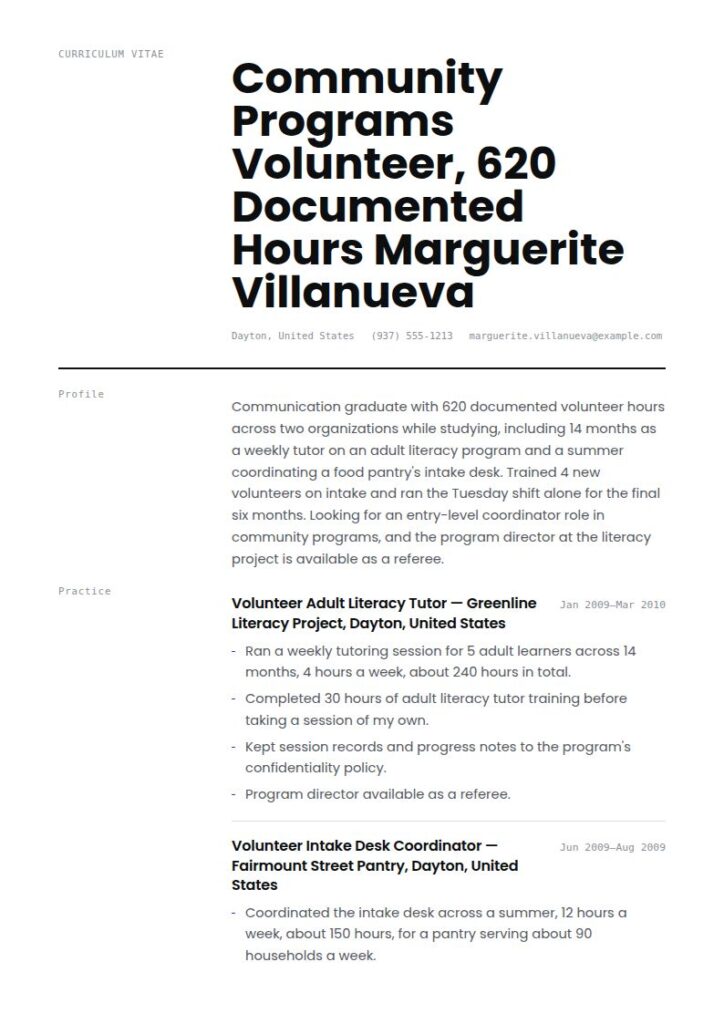
Community Programs Volunteer, 620 Documented Hours Marguerite Villanueva
Volunteer Adult Literacy Tutor
[email protected] | (937) 555-1213 | Dayton, United States
Profile
Communication graduate with 620 documented volunteer hours across two organizations while studying, including 14 months as a weekly tutor on an adult literacy program and a summer coordinating a food pantry's intake desk. Trained 4 new volunteers on intake and ran the Tuesday shift alone for the final six months. Looking for an entry-level coordinator role in community programs, and the program director at the literacy project is available as a referee.
Work Experience
01/2009 - 03/2010, Volunteer Adult Literacy Tutor, Greenline Literacy Project, Dayton, United States
- Ran a weekly tutoring session for 5 adult learners across 14 months, 4 hours a week, about 240 hours in total.
- Completed 30 hours of adult literacy tutor training before taking a session of my own.
- Kept session records and progress notes to the program's confidentiality policy.
- Program director available as a referee.
06/2009 - 08/2009, Volunteer Intake Desk Coordinator, Fairmount Street Pantry, Dayton, United States
- Coordinated the intake desk across a summer, 12 hours a week, about 150 hours, for a pantry serving about 90 households a week.
- Trained 4 new volunteers on the intake process and ran the Tuesday shift alone for the final six weeks.
- Handled household records under the pantry's confidentiality policy.
09/2008 - 05/2010, Campus Bookstore Assistant, Part Time, Wright State University, Dayton, United States
- Worked 12 hours a week in term across the counter and stock room, including the two textbook rush weeks each semester.
Education
08/2006 - 05/2010, Bachelor of Arts, Communication, Wright State University, Dayton, United States
Adult literacy tutor training, 30 hours, completed 2009 alongside study.
Skills
Volunteer induction and training, 60
Intake process and records, 70
Adult literacy tutoring, 70
Shift coverage and reliability, 80
Confidentiality and case notes, 70
Conflict handling at a public-facing desk, 60
Spreadsheet reporting, 60
Languages
English, native
Spanish, intermediate
Certificates
01/2009, Adult Literacy Tutor Training, 30 hours, Greenline Literacy Project
Assessed classroom practicum before taking an independent session.
Summary
A volunteer resume is a one to two page document that carries unpaid work as real evidence: hours, scope, responsibility and a referee who can confirm it. This guide gives you three adaptable versions, an honest account of how readers discount volunteering and how to counter it, and cited national data on what volunteering in the United States actually looks like.
Volunteer resume examples by experience level
In short, a volunteer resume is a one to two page document that carries unpaid work as evidence: what you did, for how many hours, over what period, with what responsibility, and who can confirm it.
However, two things are true at once, and a guide that tells you only the encouraging one is not much use. Volunteering is common and measurable: 75.7 million people, 28.3 percent of the United States population aged 16 and over, formally volunteered through an organization between September 2022 and September 2023, giving 4.99 billion hours (U.S. Census Bureau and AmeriCorps, Current Population Survey Civic Engagement and Volunteering Supplement, released 19 November 2024). And some hiring managers discount it anyway, because much volunteer work genuinely is low-commitment, and a line that says "volunteer" with no hours behind it does not distinguish a Saturday from three years.
This page closes that gap. Volunteering is not a substitute for paid experience, and writing as though it were is the fastest way to lose a reader. Still, written properly, with hours, scope and a referee, it is evidence in its own right.
Resume guide for a volunteer resume
To start, this guide and the corresponding volunteer resume example will cover:
- First, how to write a volunteer resume, section by section
- Then, what makes an unpaid role count, and what makes it read as filler
- Also, three adaptable summaries: first resume, re-entry and program lead
- Where volunteer work belongs on the page, and when it should move
- Finally, what the national data says about volunteering, and what it cannot tell an employer
How to write a volunteer resume
Overall, six sections: contact header, summary, experience, a volunteer section written to the same standard, skills, education, and references. In general, one page for a first resume, two once volunteer work has grown into program responsibility.
The single decision that matters most is placement, and it depends on whether the unpaid work is your strongest relevant evidence or your supporting evidence.
| Your situation | Where volunteer work goes | Section heading |
|---|---|---|
| First resume, little paid work | In the main experience section, in date order with any paid work | Experience |
| Re-entering after a break | In the main experience section, covering the break dates | Experience |
| Changing field, volunteering in the new one | In the main experience section, above older paid work | Relevant Experience |
| Established in your field | A separate block after experience and education | Volunteer Experience |
| One-off days and short events | A single grouped line, or leave it off | Community Involvement |
Hours are the number that changes how a line is read
Almost every weak volunteer entry has the same defect: it says what the organization does rather than what the writer did, and gives no quantity.
"Volunteer, community food pantry" could describe two hours in 2019 or 600 hours across three years, and a reader who cannot tell assumes the smaller one.
So write the quantity: hours a week and the period, or total hours if the organization tracks them, which many do. "Volunteer Shift Lead, 6 hours a week, March 2023 to present, about 480 hours" is a different claim from "Volunteer, food pantry", and it costs eight extra words.
If you do not know your hours, reconstruct them honestly and say how: "roughly 5 hours a week across two years". An estimate you can defend beats a blank, and beats a number you cannot explain when asked.
Run the finished file through the ATS resume checker before you send it. Nonprofit and public sector employers use applicant systems as much as anyone, and a volunteer entry with no job title in it parses badly.
Choosing the best resume format for a volunteer resume
As a rule, reverse chronological, with unpaid roles in the same timeline as paid ones. Again, one page for a first resume, two once you hold program or board responsibility.
Of course, the temptation with a gap or a career change is a functional, skills-first format that hides dates. Resist it. Yet recruiters read a functional resume as one with something to hide, which is the assumption you are trying to defeat. For example, a chronological page showing a five-year break with 1,400 documented volunteer hours inside it beats a skills grid with no dates at all.
Instead, give unpaid roles the same structure as paid ones: title, organization, location, dates, and bullets with numbers. The visual parity does real work; by contrast, a separate italicized paragraph labeled "volunteering" signals that you think it counts for less.
Include your contact information
| ✅ Right | ❌ Wrong |
|---|---|
| Marguerite Villanueva | Marguerite Villanueva |
| Volunteer Program Lead, Adult Literacy and Food Security | Enthusiastic volunteer and community-minded person |
| 1,400 volunteer hours since 2019, referee available | Lots of volunteer experience |
| (937) 555-1213, [email protected], Dayton, OH | (937) 555-1213, [email protected] |
In the right column, the headline names a function and a subject, which is what a title is for. Then the line under it gives a total and offers proof.
Make use of a summary
For the summary, four lines: what you do, the quantity behind it, the responsibility you hold, and what you are looking for now.
Communication graduate with 620 documented volunteer hours across two organizations while studying, including 14 months as a weekly tutor on an adult literacy program and a summer coordinating a food pantry's intake desk. Trained 4 new volunteers on intake and ran the Tuesday shift alone for the final six months. Looking for an entry-level coordinator role in community programs, and the program director at the literacy project is available as a referee.
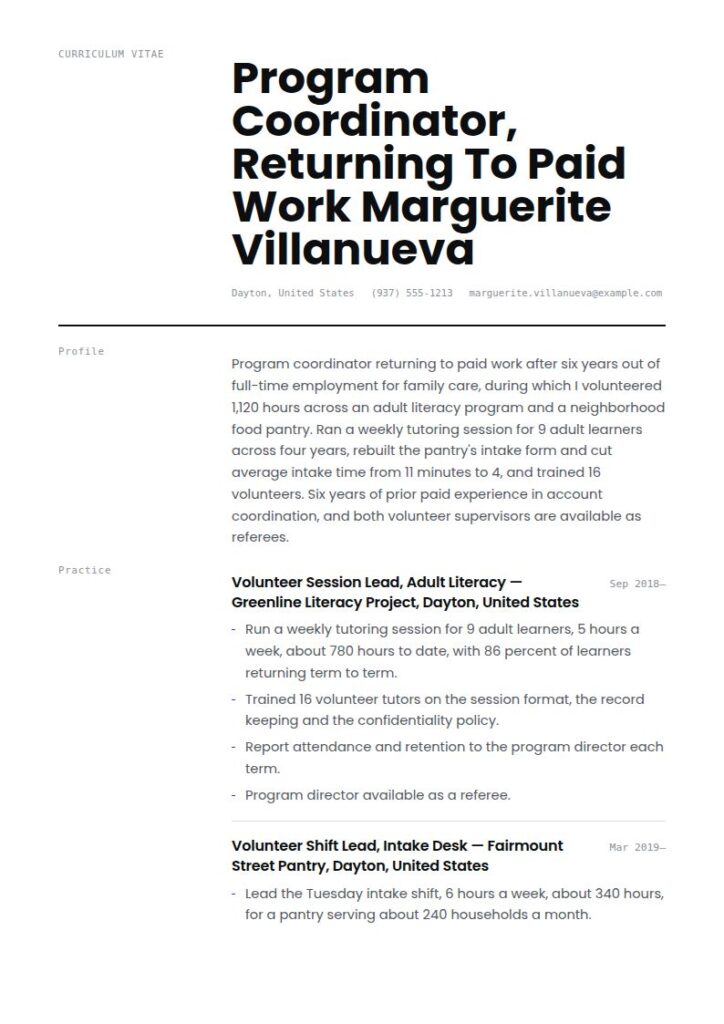
Program coordinator returning to paid work after six years out of full-time employment for family care, during which I volunteered 1,120 hours across an adult literacy program and a neighborhood food pantry. Ran a weekly tutoring session for 9 adult learners across four years, rebuilt the pantry's intake form and cut average intake time from 11 minutes to 4, and trained 16 volunteers. Six years of prior paid experience in account coordination, and both volunteer supervisors are available as referees.
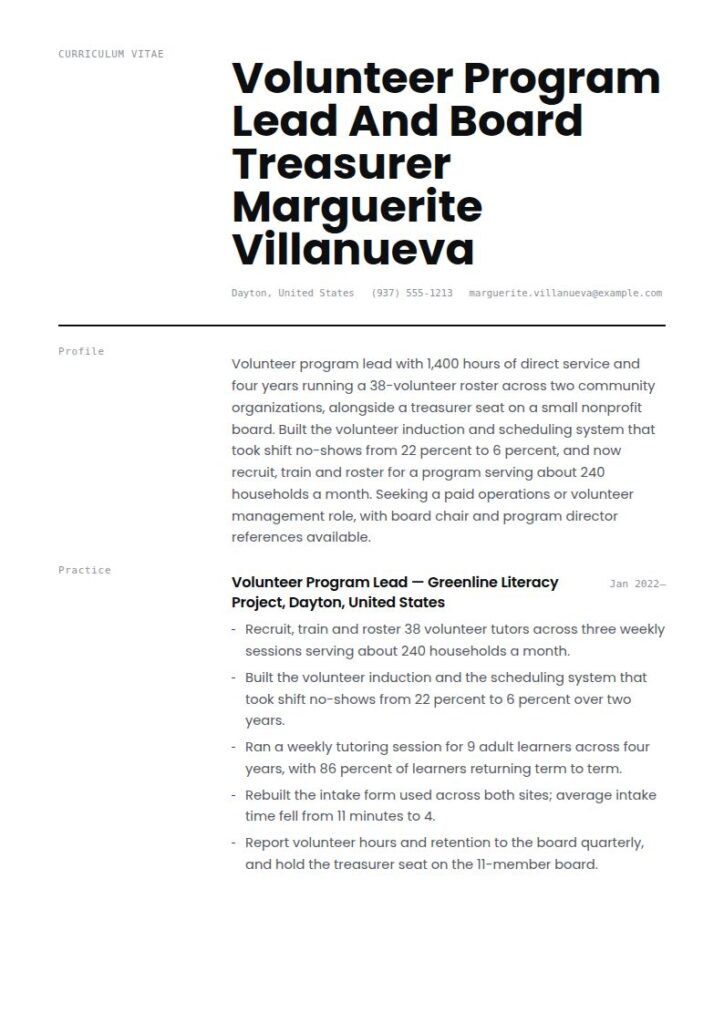
Volunteer program lead with 1,400 hours of direct service and four years running a 38-volunteer roster across two community organizations, alongside a treasurer seat on a small nonprofit board. Built the volunteer induction and scheduling system that took shift no-shows from 22 percent to 6 percent, and now recruit, train and roster for a program serving about 240 households a month. Seeking a paid operations or volunteer management role, with board chair and program director references available.
Right vs wrong: the same volunteer summary, twice
| ✅ Right | ❌ Wrong |
|---|---|
| 1,120 hours across an adult literacy program and a neighborhood food pantry over six years. | Extensive volunteer experience with various community organizations. |
| Ran a weekly tutoring session for 9 adult learners across four years. | Helped people in the community and made a real difference. |
| Rebuilt the intake form and cut average intake time from 11 minutes to 4. | Assisted with administrative tasks and general duties. |
| Both volunteer supervisors are available as referees. | References available upon request. |
The right column is checkable. That is the whole difference, and it is why the same six years reads as work in one column and as a gap in the other.
Outline your experience
Title, organization, city, dates, hours, then three to five bullets. In the experience section, every bullet carries a number or a named responsibility.
| Instead of | Use |
|---|---|
| Volunteered at a local food pantry | Volunteer Shift Lead, 6 hours a week, March 2023 to present, about 480 hours |
| Helped with administrative work | Rebuilt the intake form and cut average intake time from 11 minutes to 4 |
| Worked with a team of volunteers | Trained 16 volunteers on intake and ran the Tuesday shift roster |
| Supported the community | Ran a weekly session for 9 adult learners across four years, 86 percent returning term to term |
| Assisted at fundraising events | Coordinated a 40-volunteer event day, including briefing, rota and close-down |
| Was on a nonprofit board | Treasurer, 11-member board, quarterly reporting on a $310,000 annual budget |
Volunteer Program Lead, Greenline Literacy Project, Dayton, OH, January 2022 to Present, 8 to 10 hours a week
Recruit, train and roster 38 volunteer tutors across three weekly sessions serving about 240 households a month.
Built the volunteer induction and the scheduling system that took shift no-shows from 22 percent to 6 percent over two years.
Ran a weekly tutoring session for 9 adult learners across four years, with 86 percent of learners returning term to term.
Rebuilt the intake form used across both sites; average intake time fell from 11 minutes to 4.
Report volunteer hours and retention to the board quarterly, and hold the treasurer seat on the 11-member board.
As a result, nothing in that entry depends on the reader caring about the cause. Instead, every line is a transferable operations fact: recruitment, training, rostering, process redesign, retention, reporting. That is the translation step most volunteer resumes skip.
Give every unpaid role its hours, its scope and a named referee
In practice, three things turn an unpaid line into evidence, and all three are missing from most volunteer resumes.
Hours, with a period. Quantity separates commitment from attendance. Write hours a week and the date range, or a total if you have one. Formal volunteers gave an estimated 4.99 billion hours in a single year, worth about $167.2 billion (U.S. Census Bureau and AmeriCorps, released 19 November 2024). Volunteer time is measured in the aggregate, and it should be measured on your page too. For a grant application or a board report, Independent Sector and the Do Good Institute at the University of Maryland put the value of a volunteer hour at $36.14 for 2025, based on average hourly earnings for production and nonsupervisory workers on private nonfarm payrolls (Independent Sector, released 21 April 2026). Do not put a dollar figure for your own time on a resume; it reads as though you are pricing yourself. Use hours.
Volunteer scope and a named referee
Scope, written as responsibility rather than participation. There is a difference between helping at a shift, running one, and building the rota. Say which: people trained or supervised, a budget you reported on, a process you owned. A reader discounts volunteering mostly because they assume nobody was accountable for anything, and scope answers that.
A referee who will confirm it. Paid work carries an implicit referee because there is a payroll record behind it. Unpaid work has none, so supply one: the volunteer coordinator, the program director, the board chair. Name the role and the organization, and ask the person first. A volunteer entry with a referee attached is verifiable, and a verifiable claim is not discounted in the same way.
Answering doubts about volunteer experience
Now the honest part. To be fair, some readers weigh volunteer experience below paid experience and a few do not count it at all. That is not always prejudice: unpaid roles vary enormously in commitment, supervision and consequence, and the reader cannot see which kind yours was. You will not talk anyone out of it in a resume, so counter it structurally instead.
| The objection | What answers it |
|---|---|
| Nobody was depending on this | Hours, a fixed schedule, and what happened when you were absent |
| There was no accountability | A supervisor's title, reporting you did, a budget or a roster you owned |
| The work was not comparable to a job | Process redesign, training, retention numbers, anything transferable |
| It might be exaggerated | A named referee and an organization with a checkable address |
| It is a gap with activity in it | Continuity: the same organization for years beats six organizations for weeks |
Finally, there is one more thing candidates forget they can say. About 18 percent of formal volunteers, more than 13.4 million people, served completely or partially online in 2023 (U.S. Census Bureau and AmeriCorps, released 19 November 2024). Remote volunteering, whether bookkeeping, translation, web work or helpline shifts, is work done to a schedule and belongs on the page written the same way.
What the research does and does not say about volunteering and jobs
There is federal research on this question and it is worth knowing precisely, because it is often quoted loosely.
A study of ten two-year cohorts between 2002 and 2012 found that, after controlling for demographic variables, volunteering was associated with 27 percent higher odds of employment among the out-of-work, rising to 51 percent for people without a high school diploma and 55 percent for people in rural areas (Corporation for National and Community Service, Volunteering as a Pathway to Employment, June 2013).
Two cautions. It is an association rather than proof of cause, and people who volunteer may differ from people who do not in ways the controls did not capture. And it is a 2013 study of a period ending in 2012, so it describes that decade's labor market, not this one.
What it supports is the thing this page is built on: the mechanisms the authors point to, which are contacts, references and recent evidence of reliable activity, are all things a resume can make visible.
Build a snapshot of your key skills
Ten to fourteen entries in three groups, written as workplace skills rather than as qualities.
Program and people: Volunteer recruitment and induction, Shift rostering, Training and supervision, Retention tracking, Conflict handling at a public-facing desk
Operations and administration: Intake process design, Case note records and confidentiality, Quarterly board reporting, Budget monitoring, Grant reporting on volunteer hours
Systems: Volunteer scheduling software, Google Workspace, Spreadsheet reporting, Client database entry, Basic bookkeeping
Leave "compassionate" and "hard-working" off. In fact, every volunteer resume uses them and none of them can be checked.
List your education and certifications
Degrees first, then any training the volunteer role gave you, which is often more relevant than it looks.
Bachelor of Arts, Communication, Wright State University, Dayton, OH, 2010
Volunteer training: Adult literacy tutor training, 30 hours, completed 2019 and refreshed 2023. Food safety handling for community kitchens, 2022. Trauma-informed front desk practice, 8 hours, 2024.
Board service: Treasurer, Fairmount Street Pantry, 11-member board, 2023 to present. Quarterly financial reporting on an annual budget of about $310,000.
Adult First Aid and CPR, American Red Cross, renewed 2026
Volunteer training belongs on a resume for the same reason employer training does: somebody assessed you and the hours are documented.
Choose the right layout and design
Single column, plain type at 11 or 12 point, and unpaid roles formatted identically to paid ones. Also, no photograph, no icons, no charity logos.
Do not put volunteer work in a visually lighter block unless it genuinely is supporting evidence. After all, formatting is a signal, and an italic footnote at the bottom of page two tells the reader how much weight you think it deserves.
Give hours and a date range for every unpaid role. Write a title that names a function, not "volunteer". Name what you owned: a roster, a process, a budget line, a training session. Offer a referee by role and organization, after asking them. Keep unpaid roles in the same timeline and the same format as paid ones. Say in one clause what you are looking for now.
Do not imply that volunteering is equivalent to a paid job; state what it was and let the detail carry it. Do not list one-off event days as separate entries. Do not name an individual client, learner, patient or family you worked with. Do not put a dollar value on your own volunteer hours. Do not pad the page with causes you supported but did not work for. Do not hide dates behind a functional format.
Volunteer resume job market and outlook
There is no occupation called volunteer. The Bureau of Labor Statistics publishes no Occupational Outlook Handbook profile, no employment level, no projected growth and no median wage for volunteering, because it is unpaid activity rather than an occupation. Therefore, any page quoting you a volunteer salary is quoting something else. Instead, what is published is the scale of the activity.
| Measure | Value |
|---|---|
| Formal volunteering rate, population aged 16 and over | 28.3 percent |
| People who formally volunteered, September 2022 to September 2023 | 75.7 million |
| Hours given | 4.99 billion |
| Estimated economic value of those hours | $167.2 billion |
| Informal helping rate (helping neighbors directly) | 54.2 percent, 137.5 million people |
| Formal volunteers serving completely or partially online | About 18 percent, more than 13.4 million |
Source: U.S. Census Bureau and AmeriCorps, Current Population Survey Civic Engagement and Volunteering Supplement, released 19 November 2024.
In particular, the informal helping figure is the one most job seekers overlook. More than half the adult population helps neighbors without going through an organization, and that help is nearly impossible to evidence, because there is no record and no referee. If your unpaid work has been of that kind, attach yourself to an organization that tracks hours, even for a few months, so something becomes checkable.
What salary you can expect
Volunteering pays nothing, so the honest version of this section is about the paid role the volunteering is meant to reach.
For this reason, use the published median for the occupation you are targeting, not a general figure. The median annual wage for all occupations was $50,980 in May 2025 (U.S. Bureau of Labor Statistics, Occupational Outlook Handbook, last modified 27 August 2026), but that is a population midpoint, not a salary anyone is offered. Similarly, the occupation you are applying into has its own median, percentiles and entry-level education requirement in the Handbook, and those are the numbers to argue from.
Even so, what volunteer experience does for pay is narrow. It rarely moves a starting offer by itself, because offers are set against the occupation and the market. What it does is qualify you to be considered at all when the alternative is a blank period, and occasionally move you from an entry band into a coordinator band when the hours and responsibility genuinely match the job description.
Key takeaways for a volunteer resume
- Give every unpaid role hours and a date range, because without a quantity a reader assumes the smallest one.
- Write a real title that names a function, not the word volunteer on its own.
- Put unpaid roles in the same timeline and the same format as paid roles.
- Name what you owned: a roster, a process, a budget, a training session.
- Offer a referee by role and organization, and ask that person first.
- Never imply volunteering is the same as paid experience; let the detail carry the weight.
- Translate the work into transferable operations language, not into the cause.
Build your volunteer resume in 15 minutes with our AI resume builder.
Related resume examples
- Career change resume
- Stay-at-home mom resume
- Stay-at-home dad resume
- Entry-level resume
- One year experience resume
- Part-time job resume
- General resume
- Freelancer resume
- Self-employed resume
- Work-from-home resume
- Tour guide resume
- Grant writer resume
Pair it with a matching volunteer cover letter.
Volunteer resume questions, answered
How long should a volunteer resume be?
One page for a first resume or a straightforward re-entry. Two pages once volunteer work has grown into program, roster or board responsibility. Length should come from responsibility, not from the number of organizations you have supported.
Where should volunteer experience go on a resume?
In the main experience section whenever it is your strongest relevant evidence: a first resume, a career change into the field you volunteer in, or a period out of paid work. In a separate block after experience and education when you are established in your field and the volunteering is supporting evidence. The placement is a statement about weight, so make it deliberately.
Will employers take volunteer experience seriously?
Some will and some will not, and the difference is usually in how it is written. A reader discounts volunteering when they cannot tell whether it was two hours or two years, whether anyone was accountable, or whether it happened at all. Hours, a supervisory scope and a named referee remove all three doubts. Federal research has found volunteering associated with 27 percent higher odds of employment among the out-of-work, though it is an association rather than proof of cause (Corporation for National and Community Service, June 2013).
Should I put volunteer hours on my resume?
Yes, as hours a week with a date range, or as a total where the organization tracks one. It is the single most useful number on a volunteer entry, because quantity is exactly what a reader cannot infer and will otherwise assume to be small. If you are estimating, say so and keep the estimate defensible.
Can volunteer work cover an employment gap?
It can cover the dates honestly, which is the useful thing. Write the unpaid role in the timeline with its hours so the period reads as occupied rather than blank, and add one plain clause about why you were out of full-time work. What it cannot do is pretend to be a paid job, and any attempt to blur that is usually caught at reference stage.
What if my volunteering was informal, with no organization behind it?
Then it is hard to evidence, and you should know that going in: more than half the adult population helps neighbors informally, with no record and no referee (U.S. Census Bureau and AmeriCorps, released 19 November 2024). You can still describe the skills it built, but put the weight on something checkable. A few months with an organization that logs hours and can supply a supervisor gives you a line a reader can verify, which the informal help never will.