Marguerite Villanueva Volunteer Program Lead, Returning to Paid Work Dayton, 45409, United States [email protected] · (937) 555-1213
11 September 2026
Mr. Ronan Halloran Programs Westbrook Community Trust Dayton, United States
Application for Program Coordinator, Westbrook Community Trust
Dear Mr. Halloran,
I am applying for the Program Coordinator post at Westbrook Community Trust. For the past four years I have run a weekly adult literacy session and led a food pantry intake shift, about 1,120 documented hours across the two organizations, and for the last two of those years I have also rostered a team of 38 volunteer tutors.
The piece of that work closest to your posting is the intake redesign. The pantry's intake form was taking an average of 11 minutes a household and generating queues on Tuesdays, so I rebuilt it around the questions that actually drove a referral and dropped the rest. Average intake time fell to 4 minutes and it is now the form used at both sites. On the tutoring side, I built the volunteer induction and the scheduling system that took shift no-shows from 22 percent to 6 percent over two years, which mattered more to the program than any single session I taught.
I was out of full-time paid work between 2016 and 2022 to care for a family member, and I volunteered throughout that period rather than after it. Before the break I spent six years as an account coordinator running print and mail projects for 22 recurring accounts, so the scheduling, proofing and client-facing parts of your posting are familiar ground rather than new ones. I am looking for a paid coordinator role now, and I am not looking to keep one foot in unpaid work.
The program director at the literacy project and the board chair at the pantry have both agreed to act as referees and can confirm the hours, the roster responsibility and the dates. I am available to start within four weeks. Thank you for your time.
Sincerely, Marguerite Villanueva
Summary
A volunteer cover letter turns unpaid work into evidence a hiring manager can check: hours, responsibility, a result and a referee, with one plain clause about why you were out of paid work. This guide gives you a full adaptable letter, an honest account of how readers weigh volunteering, and the openings that get a re-entry file read rather than set aside.
Volunteer cover letter examples by experience level
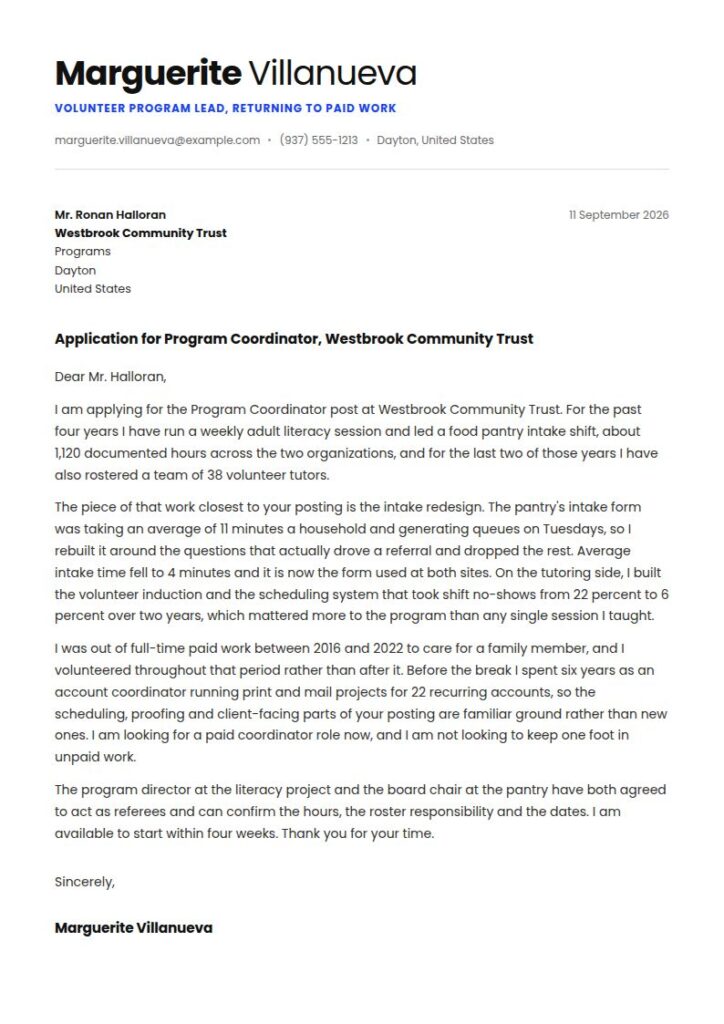
A volunteer cover letter is a one-page letter that turns unpaid work into evidence a hiring manager can actually use: what you ran, for how many hours, with what responsibility, and who will confirm it.
It usually has a second job. Most people writing one are re-entering after a break, changing field, or applying with less paid experience than the posting asks for, and the letter is where that gets addressed in plain words rather than left for the reader to guess at.
Guide to a volunteer cover letter
This guide and the corresponding volunteer cover letter example will cover:
- How to structure the letter, paragraph by paragraph
- Why hours and scope belong in the first two sentences
- How to name a gap or a career change in one clause without apologizing
- What changes between a nonprofit employer and a commercial one
How to write a volunteer cover letter
| Paragraph | Its job | Length |
|---|---|---|
| Opening | The role, what you ran, the hours behind it | 2 to 3 sentences |
| Evidence | One result with a number, and the responsibility you held | 4 to 5 sentences |
| Context | Why you were out of paid work, in one clause, and what you want now | 2 to 3 sentences |
| Close | The referee, availability, thank you | 2 sentences |
Say the hours before anything else
A reader cannot tell two hours of volunteering from two thousand, and without a number they assume the smaller one. That is not cynicism; most volunteering is occasional.
So put the quantity in the opening: "I have run a weekly adult literacy session for four years, about 780 hours." Nine extra words, and the whole letter is now being read as work.
Then say what you were responsible for, not what the organization does. Rostering, training, a process you rebuilt, a budget line you reported on. The reader's real doubt is whether anyone was depending on you, and scope is the only thing that answers it.
A volunteer cover letter example you can adapt
Dear Mr. Halloran,
I am applying for the Program Coordinator post at Westbrook Community Trust. For the past four years I have run a weekly adult literacy session and led a food pantry intake shift, about 1,120 documented hours across the two organizations, and for the last two of those years I have also rostered a team of 38 volunteer tutors.
The piece of that work closest to your posting is the intake redesign. The pantry's intake form was taking an average of 11 minutes a household and generating queues on Tuesdays, so I rebuilt it around the questions that actually drove a referral and dropped the rest. Average intake time fell to 4 minutes and it is now the form used at both sites. On the tutoring side, I built the volunteer induction and the scheduling system that took shift no-shows from 22 percent to 6 percent over two years, which mattered more to the program than any single session I taught.
I was out of full-time paid work between 2016 and 2022 to care for a family member, and I volunteered throughout that period rather than after it. Before the break I spent six years as an account coordinator running print and mail projects for 22 recurring accounts, so the scheduling, proofing and client-facing parts of your posting are familiar ground rather than new ones. I am looking for a paid coordinator role now, and I am not looking to keep one foot in unpaid work.
The program director at the literacy project and the board chair at the pantry have both agreed to act as referees and can confirm the hours, the roster responsibility and the dates. I am available to start within four weeks. Thank you for your time.
Sincerely, Marguerite Villanueva
Openings that work
| Instead of | Use |
|---|---|
| I am passionate about giving back to my community | I have run a weekly adult literacy session for four years, about 780 hours |
| Although I have been out of the workforce, I have kept busy volunteering | I rostered 38 volunteer tutors and took shift no-shows from 22 percent to 6 percent |
| I believe my transferable skills would be an asset | I rebuilt the pantry intake form; average intake time fell from 11 minutes to 4 |
| I hope you will consider my application despite my gap | I was out of full-time paid work from 2016 to 2022 to care for a family member, and volunteered throughout |
Naming the gap or the change in one clause
The instinct is to either hide it or over-explain it, and both cost you the reader. One clause, stated plainly, closes the subject.
| Situation | The clause |
|---|---|
| Caregiving break | I was out of full-time paid work from 2016 to 2022 to care for a family member |
| Redundancy | My role was eliminated in the 2024 restructure, and I volunteered while job searching |
| Health | I took two years out for health reasons and have been back at full capacity since 2025 |
| Career change | I moved into community programs deliberately, which is why the last four years are unpaid |
| First job | I built this experience while studying, which is where the 620 hours come from |
Then move on in the same paragraph to what you want now. A letter that names the break without saying what it is asking for leaves the reader holding the explanation and not the request.
One thing not to do: never write that volunteering is the same as a paid job. It invites an argument you cannot win, and it makes a reader look for what else you are overselling. State what the work was, give the numbers, and let it be weighed.
Nonprofit employers and commercial employers read this differently
Write to a nonprofit about program mechanics: rostering, retention, intake, reporting, grant hours, board relations. Write to a commercial employer in operations language instead: scheduling, process redesign, training, throughput, records. Give a referee by name and role in both cases, after asking. Say what you are looking for now, in one sentence.
Do not apologize for the gap or for the unpaid work. Do not claim volunteering is equivalent to employment. Do not name an individual client, learner or family you worked with. Do not list causes you donated to or supported but did not work for. Do not leave the hours out, which is the single most common defect in these letters.
The scale of it, and what the research actually supports
Volunteering is not a minority activity. Between September 2022 and September 2023, 28.3 percent of the United States population aged 16 and over, about 75.7 million people, formally volunteered through an organization, giving 4.99 billion hours with an estimated economic value of $167.2 billion; 54.2 percent helped neighbors informally, and about 18 percent of formal volunteers served completely or partially online (U.S. Census Bureau and AmeriCorps, Current Population Survey Civic Engagement and Volunteering Supplement, released 19 November 2024).
On employment outcomes, the strongest federal evidence is older and should be quoted carefully. Across ten two-year cohorts between 2002 and 2012, volunteering was associated with 27 percent higher odds of employment among the out-of-work after controlling for demographics, rising to 51 percent for people without a high school diploma and 55 percent for people in rural areas (Corporation for National and Community Service, Volunteering as a Pathway to Employment, June 2013). That is an association, not proof of cause, and it describes a labor market that has since changed.
The practical reading is narrow but real. Volunteering produces contacts, referees and recent evidence of reliable activity, and a letter that makes those three visible is doing the only thing a letter can do here.
Length, format and sending it
One page, four paragraphs, 250 to 400 words. PDF unless the portal says otherwise, named for yourself and the role: marguerite-villanueva-program-coordinator-letter.pdf.
Address a person. Small nonprofits list their team, and a named opening matters more here than in most sectors, because the sector is small.
Ask your referee before you name them, and tell them what the role is. A referee who is expecting the call is worth several paragraphs of self-description.
Keep the numbers identical to your resume. Our volunteer resume example uses the same hours and intake figures.
Key takeaways
- Put the hours in the opening; without a number the reader assumes the smallest version.
- Name what you were responsible for, not what the organization does.
- Give one result with a before, an after and a period.
- State the gap or the change in a single plain clause, then say what you want now.
- Offer a referee by name and role, after asking them.
- Never claim volunteering is equivalent to a paid job; let the detail do the work.
- Translate the work into the employer's language, whether that is program or operations.
Write your volunteer cover letter in 10 minutes with our AI cover letter builder.
Volunteer cover letter questions, answered
How long should a volunteer cover letter be?
One page, four paragraphs, 250 to 400 words. The extra paragraph a re-entry letter needs is the one-clause explanation of the gap, and it should be short enough not to become the subject.
Should I explain an employment gap in the cover letter or the resume?
One clause in the letter, dates in the resume. The resume shows the period was occupied by writing the unpaid role in the timeline with its hours. The letter says why in a sentence and moves on to what you are asking for. Splitting it that way stops the gap occupying either document.
Will a hiring manager take my volunteer experience seriously?
Some will and some will not, and how you write it is most of the difference. The doubts are the same three: how much time, who was accountable, and can it be checked. Hours with a period, a named scope, and a referee who has agreed to take the call answer all three. Federal research found volunteering associated with 27 percent higher odds of employment among the out-of-work, as an association rather than proof of cause (Corporation for National and Community Service, June 2013).
Should I say I am looking for paid work now?
Yes, plainly, in one sentence. A manager who suspects you will treat a salaried post as another volunteer commitment has a doubt that is hard to dislodge later. Saying what you want removes it in nine words.
What if all my volunteering was remote?
Write it the same way. About 18 percent of formal volunteers, more than 13.4 million people, served completely or partially online in 2023 (U.S. Census Bureau and AmeriCorps, released 19 November 2024). Remote bookkeeping, helpline shifts or web work are done to a schedule and carry hours, scope and a referee like anything else.