Bronwen Kovalchuk Medical Coder, CPC Des Moines, 50312, United States [email protected] · (515) 555-2254
17 September 2026
Ms. Ruthanne Mabry Revenue Cycle Prairie Meridian Health Des Moines, United States
Application for Coding Specialist II, Prairie Meridian Health
Dear Ms. Mabry,
I am applying for the Coding Specialist II post at Prairie Meridian Health. I returned to full-time outpatient coding in January 2025 and currently code 90 to 110 encounters a day across orthopedics, general surgery and primary care, holding a 97% first-pass claim acceptance rate against a 95% department standard. My CPC has been continuously current since 2011.
I took seven years out for family caregiving between 2017 and 2024. During that period I kept the credential live, completing 36 AAPC continuing education units in each two-year cycle including the annual code set updates, and coded on contract for a three-provider orthopedic clinic at roughly 300 encounters a month.
The work I would most want to bring to your team is the denial side. At Two Rivers Orthopedic Group I rebuilt the operative report query template we sent back to surgeons, which took the practice's coding-related denial rate from 8.1% to 3.4% over three years. Since coming back I have been clearing the modifier 25 and 59 edit queue for two clinics, roughly 60 held claims a week, and the pattern is usually documentation rather than code selection.
Your posting mentions a move to a single pre-bill edit set across all clinics this year, which is the part of the role I am most interested in. I am available full time and can start on two weeks' notice. Thank you for reading.
Sincerely, Bronwen Kovalchuk, CPC
Summary
A stay-at-home mom cover letter explains a caregiving break in a single sentence and then spends the rest of the page on evidence: the credential you kept current, the dated work you did during the break, and one result with a number. This guide gives you a full adaptable letter, the openings that work, and what to do when the posting asks about the gap directly.
Stay-at-Home Mom cover letter examples by experience level
A stay-at-home mom cover letter is a one-page letter that accounts for a caregiving break in one sentence and then argues, for the rest of the page, that your skills did not expire while you were out.
The ratio matters more than the wording. One sentence on the break, four paragraphs on the work. A reader who spends three paragraphs inside your explanation never reaches your evidence.
Guide to a stay-at-home mom cover letter
This guide and the corresponding stay-at-home mom cover letter example will cover:
- How to structure the letter, paragraph by paragraph
- The one-sentence break explanation, and where it goes
- What counts as currency evidence in a letter rather than a resume
- What changes when the posting asks about employment gaps directly
- The closings that get a returning candidate a call
How to write a stay-at-home mom cover letter
| Paragraph | Its job | Length |
|---|---|---|
| Opening | The role, your credential, and the date you came back | 2 to 3 sentences |
| The break | One sentence, stated plainly, with dates | 1 sentence |
| Evidence | One result with a number, from paid work | 4 to 5 sentences |
| Fit and close | Something specific about them, availability, thank you | 3 to 4 sentences |
Put the return date in the first paragraph, not the break
The first sentence a hiring manager reads should carry a recent date attached to work, because that is the fact they are missing.
"I returned to full-time outpatient coding in January 2025 and currently code 90 to 110 encounters a day" tells them the break is over before they have had time to wonder how long it was. The break sentence can then follow and read as background rather than as the subject.
Written the other way around, the letter opens with an absence and spends three sentences recovering from it.
A stay-at-home mom cover letter example you can adapt
Dear Ms. Mabry,
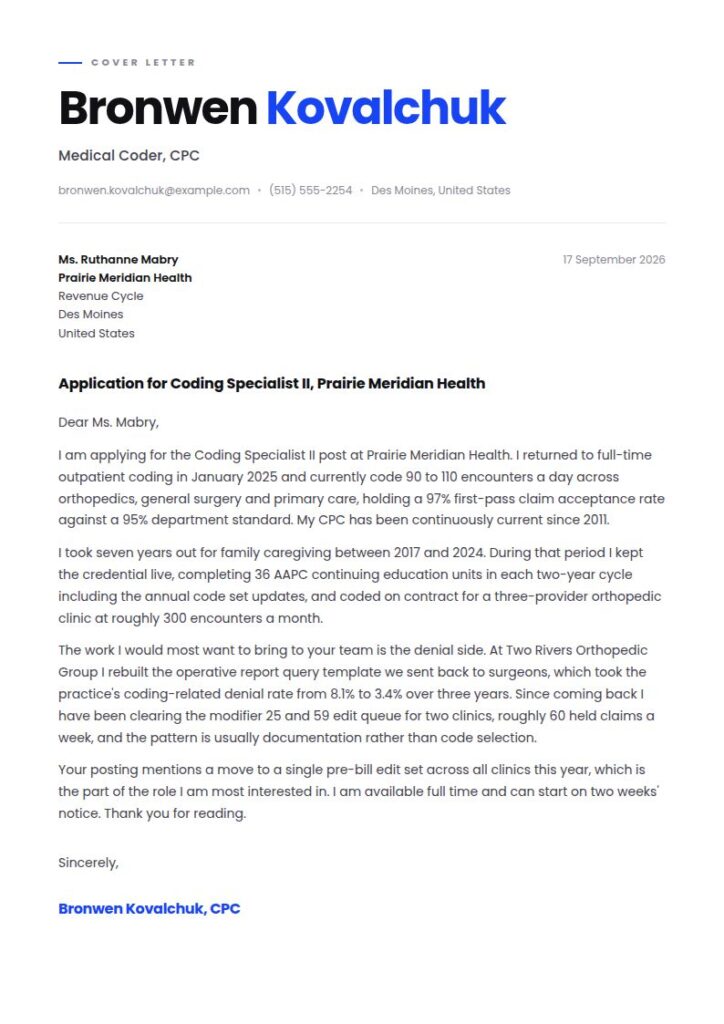
I am applying for the Coding Specialist II post at Prairie Meridian Health. I returned to full-time outpatient coding in January 2025 and currently code 90 to 110 encounters a day across orthopedics, general surgery and primary care, holding a 97% first-pass claim acceptance rate against a 95% department standard. My CPC has been continuously current since 2011.
I took seven years out for family caregiving between 2017 and 2024. During that period I kept the credential live, completing 36 AAPC continuing education units in each two-year cycle including the annual code set updates, and coded on contract for a three-provider orthopedic clinic at roughly 300 encounters a month.
The work I would most want to bring to your team is the denial side. At Two Rivers Orthopedic Group I rebuilt the operative report query template we sent back to surgeons, which took the practice's coding-related denial rate from 8.1% to 3.4% over three years. Since coming back I have been clearing the modifier 25 and 59 edit queue for two clinics, roughly 60 held claims a week, and the pattern is usually documentation rather than code selection.
Your posting mentions a move to a single pre-bill edit set across all clinics this year, which is the part of the role I am most interested in. I am available full time and can start on two weeks' notice. Thank you for reading.
Sincerely, Bronwen Kovalchuk, CPC
Openings that work
| Instead of | Use |
|---|---|
| I am writing to express my interest in returning to the workforce | I returned to full-time outpatient coding in January 2025 and currently code 90 to 110 encounters a day |
| After taking time off to raise my family, I am eager to restart my career | My CPC has been continuously current since 2011, including through a seven-year caregiving break |
| I believe the skills I gained managing a household would transfer well | I coded on contract for a three-provider clinic at roughly 300 encounters a month during the break |
| I am a fast learner and a hard worker | I hold a 97% first-pass claim acceptance rate against a 95% department standard |
Each line on the right contains a date, a number or a credential. That is the whole test. A sentence with none of the three is decoration, and it is taking space from something that would earn the reply.
The one-sentence break explanation
Write it plainly, in the past tense, with dates, and without a justification.
"I took seven years out for family caregiving between 2017 and 2024." That is the whole thing. No apology, no reassurance that it will not happen again, no account of the circumstances. A reader who gets a clean fact moves past it; a reader who gets a defense wonders what is being defended.
Place it in the second paragraph, after the opening has established that you are currently working. Use the rest of that paragraph for the dated things you did during the break.
| What to include in the break paragraph | What to leave out |
|---|---|
| The date range, stated once | The reason, beyond "family caregiving" |
| A credential kept current, with the maintenance requirement met | Any promise about future availability |
| Contract or part-time work with a volume figure | Details about your family's circumstances |
| A volunteer or elected role with a budget or headcount | An apology, or the phrase "I know this may look like a gap" |
About a quarter of mothers are out of the labor force in any given year
In 2025 the labor force participation rate for mothers with children under 18 was 73.9 percent, and it ranged from 68.0 percent for mothers whose youngest child was under 6 to 78.2 percent for those whose youngest was 6 to 17 (U.S. Bureau of Labor Statistics, Employment Characteristics of Families, 2025, released 23 April 2026).
Of employed mothers, 79 percent worked full time in 2025 (77 percent of those with a child under 6). Returning is overwhelmingly a full-time story, so a letter that hedges toward part-time hours when the posting is full time is volunteering an obstacle.
There were 32.9 million families with children under 18 in 2025, and at least one parent was employed in 91.6 percent of them. Write to a reader who already understands the situation rather than to one who needs convincing it is normal.
When the posting asks about gaps directly
Some applications include a field for it. Answer in the register you used in the letter: the date range, the dated work, nothing else.
Give the date range in months and years. Name the credential you kept current and the maintenance you completed. Name any contract, part-time or volunteer work with a volume figure. Keep it to two or three sentences. Use the same dates in the form, the letter and the resume.
Do not describe your family's circumstances; that is not information the employer needs or that you owe. Do not promise your availability will never change. Do not argue that parenting is equivalent to professional experience; the dated work you did during the break makes the point better. Do not leave the field blank when the information is already on your resume.
Length, format and sending it
One page, four paragraphs, 250 to 400 words. PDF unless the portal asks for something else, named for yourself and the role: bronwen-kovalchuk-coding-specialist-cover-letter.pdf.
Address a person. Revenue cycle managers are usually named on a health system's own pages or on the posting, and a named salutation on an otherwise specific letter is worth the five minutes.
Use the same figures as your resume so the two agree. Our stay-at-home mom resume example uses the numbers written here, and the free ATS checker will tell you whether the pair parses cleanly.
Key takeaways
- Open with the date you came back and what you are doing now, not with the break.
- Explain the break in one plain sentence with dates, and never justify it.
- Fill the rest of that paragraph with dated work: credential maintenance, contract hours, an elected role with a budget.
- Give one result with a number and a time frame, taken from paid work.
- Name one real thing from their posting or their own pages.
- State your availability and your notice period explicitly.
- Keep the letter to one page and make every sentence carry a date, a number or a credential.
Write your stay-at-home mom cover letter in 10 minutes with our AI cover letter builder.
Stay-at-home mom cover letter questions, answered
Do I have to mention the career break in my cover letter?
Yes, in one sentence. Your resume shows the dates anyway, and a letter that ignores something visible on the attached document reads as avoidance. One plain sentence closes the question; leaving it open means the reader answers it for you.
How do I explain a ten-year gap rather than a two-year one?
The same way, with more weight on currency. A long break makes the dated evidence more important, not the explanation longer. Lead with the last twenty-four months, name the credential and its maintenance cycle, and let the date range sit in one sentence exactly as a shorter one would.
Should I say I am a stay-at-home mom in the letter?
Use "family caregiving" and a date range. That phrasing covers children, parents and any other dependent, keeps the sentence short, and does not invite the reader into your household.
What if I have no paid work since the break started?
Then the evidence is whatever was dated: a certification renewal, a course with a completion month, an elected or volunteer role with a budget or headcount, a contract of any size. Write those the way you would write a job, and be plain that the most recent paid role predates the break.
Is a cover letter worth it when the application is a portal?
Attach one wherever there is a field. The portal collects the same structured fields from every candidate and none of them explain a date range. The letter is the only place you can put the break in its proper proportion: one sentence out of about three hundred words.