Cassius Verbeek Owner and Lead Trainer, CPDT-KA, CDBC Chattanooga, 37405, United States [email protected] · (423) 555-1291
17 September 2026
Ms. Adaeze Okonkwo Practice Management Fernhill Veterinary Group Chattanooga, United States
Application for Behavior and Training Lead, Fernhill Veterinary Group
Dear Ms. Okonkwo,
I am applying for the Behavior and Training Lead post at Fernhill Veterinary Group. I hold CPDT-KA from the Certification Council for Professional Dog Trainers and the IAABC Certified Dog Behavior Consultant credential, and I have run my own four-trainer practice in Chattanooga for eight years, carrying roughly 120 behavior consultations a year alongside 10 group classes a term.
The work closest to what you are advertising is the shelter behavior program I hold under contract with a 140 kennel humane society. I rebuilt it around written intake, a documented modification plan per dog and a two-week follow-up with adopters, and behavior-related returns moved from 19 percent to 11 percent across two years. The gain came mostly from the follow-up call rather than from anything clever in the training, which is the part I would want to bring into a veterinary setting.
I work reward-based throughout, in line with the AVSAB position statement on humane dog training, and I take aggression, sudden behavior change and suspected pain-related cases only alongside a veterinary referral, with a written summary sent back to the practice afterwards. I have worked that way with three local practices for years and I would expect your clinicians to want the same. I read that you are opening a second site next spring, and a shared intake and referral form between the two would be the first thing I would want to build.
I recertified CPDT-KA by continuing education in 2024, hold 36 IAABC continuing education units in the current cycle, and carry general and professional liability insurance. I could start with six weeks' notice. Thank you for your time.
Sincerely, Cassius Verbeek, CPDT-KA, CDBC
Summary
A dog trainer cover letter has to answer a question most fields never ask: nobody licenses dog trainers in most of the United States, so why should this employer believe you. This guide gives you a full adaptable letter built on certification, case volume, a stated methods position and a written referral boundary, with current BLS figures for animal trainers.
Dog Trainer cover letter examples by experience level
In short, a dog trainer cover letter answers a question most cover letters never face: in a field where nobody holds a license, why should this reader believe you can do the work?
That is not cynicism, it is the hiring reality. In fact, BLS treats certification here as optional, noting only that "Although not required, certifications may help workers establish their credentials", and the one licensing requirement it mentions is a business license for self-employed workers (BLS Occupational Outlook Handbook, last modified 27 August 2026). As a result, a veterinary practice manager or shelter director has no register to check. Your letter is the register.
Guide to a dog trainer cover letter
To help, this guide and the corresponding dog trainer cover letter example will cover:
- First, how to structure the letter, paragraph by paragraph
- Next, why the certification and the case volume belong in the first paragraph
- Then, how to state your methods position without starting an argument
- Finally, the referral boundary, and why it makes a veterinary employer trust you
How to write a dog trainer cover letter
| Paragraph | Its job | Length |
|---|---|---|
| Opening | The post, your certification, your caseload and formats | 2 to 3 sentences |
| Evidence | One program or case type, with a number and a period of time | 4 to 5 sentences |
| Fit | Something real about their practice, plus methods and referral position | 3 to 4 sentences |
| Close | Credentials, insurance, availability, thank you | 2 sentences |
Certification, volume, methods, boundary: in that order
Those four things are what an employer here is testing for, and a letter delivering them in order reads as unusually professional.
Certification, because it is the only external assessment available. Volume, because it separates a practice from a hobby. Methods, because there is a published veterinary position on them. The boundary, because knowing where your scope ends is what a veterinary employer most fears you do not know.
None needs more than a sentence. "CPDT-KA since 2014 and IAABC Certified Dog Behavior Consultant since 2019, carrying about 120 behavior consultations a year, reward-based throughout, with aggression cases taken only alongside a veterinary referral" does all four in one line.
A dog trainer cover letter example you can adapt
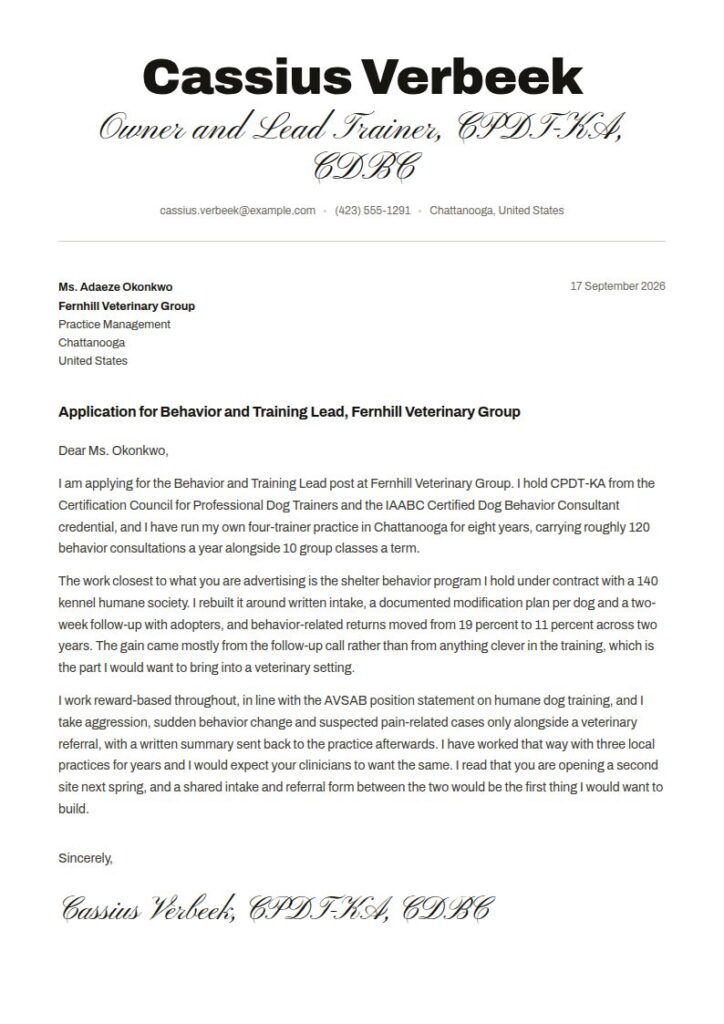
Dear Ms. Okonkwo,
I am applying for the Behavior and Training Lead post at Fernhill Veterinary Group. I hold CPDT-KA from the Certification Council for Professional Dog Trainers and the IAABC Certified Dog Behavior Consultant credential, and I have run my own four-trainer practice in Chattanooga for eight years, carrying roughly 120 behavior consultations a year alongside 10 group classes a term.
The work closest to what you are advertising is the shelter behavior program I hold under contract with a 140 kennel humane society. I rebuilt it around written intake, a documented modification plan per dog and a two-week follow-up with adopters, and behavior-related returns moved from 19 percent to 11 percent across two years. The gain came mostly from the follow-up call rather than from anything clever in the training, which is the part I would want to bring into a veterinary setting.
I work reward-based throughout, in line with the AVSAB position statement on humane dog training, and I take aggression, sudden behavior change and suspected pain-related cases only alongside a veterinary referral, with a written summary sent back to the practice afterwards. I have worked that way with three local practices for years and I would expect your clinicians to want the same. I read that you are opening a second site next spring, and a shared intake and referral form between the two would be the first thing I would want to build.
I recertified CPDT-KA by continuing education in 2024, hold 36 IAABC continuing education units in the current cycle, and carry general and professional liability insurance. I could start with six weeks' notice. Thank you for your time.
Sincerely, Cassius Verbeek, CPDT-KA, CDBC
Openings that work
| Instead of | Use |
|---|---|
| I am a passionate dog lover with years of experience | I hold CPDT-KA and the IAABC Certified Dog Behavior Consultant credential and carry about 120 consultations a year |
| I can rehabilitate any dog, no matter the problem | My case mix is roughly 40 percent manners, 30 percent leash reactivity, 20 percent separation-related |
| I use a balanced approach tailored to each dog | I work reward-based throughout, in line with the AVSAB position statement on humane dog training |
| I would love the opportunity to join your team | I read that you are opening a second site next spring, and a shared referral form would be the first thing I build |
The right column is checkable, and in an unlicensed field that is the whole currency.
What counts as evidence
| Kind of evidence | What it looks like in a sentence |
|---|---|
| Certification | CPDT-KA since 2014, recertified by continuing education in 2024 |
| Case volume | About 120 behavior consultations a year plus 10 group classes a term |
| Case mix | Roughly 40 percent manners, 30 percent leash reactivity, 20 percent separation-related |
| Program result | Behavior-related shelter returns moved from 19 to 11 percent across two years |
| Class metrics | 78 percent six-week completion against a 64 percent site average |
| Referral relationships | Written summaries sent back to three referring veterinary practices |
| Staff | Supervise three trainers through their documented certification hours |
With no paid cases yet, however, the equivalent is hours and teams: classes assisted, teams taught, shelter handling hours, foster history with the behaviors named.
The methods question, and how to handle it in a letter
The employer will ask. Veterinary practices, shelters and many daycare groups ask about methods before anything else, because the question has a published professional answer.
The American Veterinary Society of Animal Behavior's position statement on humane dog training states: "Based on current scientific evidence, AVSAB recommends that only reward-based training methods are used for all dog training, including the treatment of behavior problems", and defines aversive methods as those which "rely on application of force, pain, or emotional or physical discomfort" (AVSAB, 2021).
In practice, say your position in one sentence and move on. After all, if it differs from the employer's, the interview is a better place to find that out than three months in.
Name your certification and its awarding body in the first paragraph. Give a case volume number. State your methods position in one plain sentence. Write the referral boundary explicitly for veterinary or shelter employers. Name one real thing about their practice. Mention insurance and business licensing if self-employed.
Do not promise results or guarantees. Do not use the word behaviorist unless your credential supports it. Do not attack other trainers or methods; it reads badly even when the reader agrees. Do not send a letter with no numbers in it.
Why the numbers matter more here than almost anywhere
Animal trainers, the published line that covers dog trainers, had a median annual wage of $39,990 in May 2025. The lowest 10 percent earned less than $29,600 and the highest 10 percent more than $75,490 (BLS Occupational Outlook Handbook, animal care and service workers, May 2025, published 27 August 2026).
The reason for that $45,890 spread is in the same profile: 39 percent of animal trainers are self-employed, the largest single category, ahead of other personal services at 19 percent. The occupation is projected to grow 4 percent between 2025 and 2035, from 47,800 jobs to 49,700, while the wider animal care and service workers group grows 11 percent with about 69,400 openings a year (BLS, May 2025 and 2025 to 2035 projections).
So the top of this field is a practice rather than a promotion, and practices are described in numbers: cases, classes, retention, referrals, staff.
Length, format and sending it
For length, aim for one page, four paragraphs, 250 to 400 words. PDF unless the employer says otherwise, named for yourself and the post.
Address a person. Practice managers, shelter behavior directors and training school owners are nearly always named on the organization's site. Keep the credential letters in your sign-off. Use the same case numbers as your resume so the two agree; our dog trainer resume example is written with the figures used here.
Key takeaways
- To start, put certification and awarding body in the first paragraph.
- A case volume number, because almost no letter has one.
- Then give your case mix by behavior type, in one line.
- Also, state a methods position plainly and leave it there.
- The referral boundary written out, especially for veterinary and shelter employers.
- One real detail about their practice.
- In short, one page, addressed to a person, credential letters in the sign-off.
Write your dog trainer cover letter in 10 minutes with our AI cover letter builder.
Dog trainer cover letter questions, answered
How long should a dog trainer cover letter be?
One page, four paragraphs, 250 to 400 words. With no licensing register the letter is doing verification work, so it should be dense with checkable facts rather than long.
Should I mention that dog training is unlicensed?
Not as a complaint, but write as though the reader knows it. BLS treats certification as optional and mentions only a business license for self-employed workers (BLS, last modified 27 August 2026), so your reader has no register to check. Answer that quietly by naming your certification, its awarding body and your recertification date.
What if I do not have a certification yet?
Write the hours and the assessment you are working toward. CPDT-KA eligibility requires a minimum of 300 hours of dog training experience within the last 3 years, being at least 18 with a high school diploma or equivalent, and a signed Attestation Statement from a CCPDT certificant, veterinarian or other approved professional (CCPDT, retrieved 17 September 2026). "620 documented hours logged, sitting the CPDT-KA examination in the spring window" is a serious sentence.
How do I write about aggression cases?
Carefully, with the veterinary involvement stated: the proportion of your caseload, the referral arrangement, and what you send back to the referring practice. The published professional position is that a trainer having difficulty modifying a behavior should consult another reward-based trainer or refer to a veterinarian, board-certified veterinary behaviorist or certified applied animal behaviorist (AVSAB, 2021). Board-certified veterinary behaviorists hold Diplomate status with the American College of Veterinary Behaviorists and are licensed to prescribe psychotropic medication when indicated. A letter showing you work inside that structure beats one claiming a success rate.
Do I need a cover letter if I am applying to a daycare or a big box class program?
Yes, and it is worth more there than you might think, because those employers get many applications with no numbers in them. Give the formats you can teach unsupervised, your class metrics, your documented hours and your availability. Retail trade employs 7 percent of animal trainers at a median of $36,240 against $39,990 in other personal services (BLS, May 2025), and is a standard way to accumulate the hours certification needs.