Dog Training Instructor Cassius Verbeek
Group Class Instructor
[email protected] | (423) 555-1291 | Chattanooga, United States
Profile
Dog training instructor with two years teaching group classes at a Chattanooga training school, running 6 classes a week across puppy socialization, basic manners and canine good citizen preparation. Have taught 340 dog and handler teams and hold a 78 percent six-week completion rate against a 64 percent site average. Work exclusively with reward-based methods and log 620 documented training hours toward CPDT-KA eligibility. Assist on private sessions for house training, leash reactivity and separation-related cases under a certified trainer.
Work Experience
07/2024 - Present, Group Class Instructor, Ridgepole Canine Academy, Chattanooga, United States
- Teach 6 classes a week across puppy socialization, basic manners and canine good citizen preparation, 6 to 8 teams per class.
- Have taught 340 dog and handler teams, with a 78 percent six-week completion rate against a 64 percent site average.
- Assist on private sessions for house training, leash reactivity and separation-related cases under a certified trainer.
- Work exclusively with reward-based methods and write session notes and a home plan for every class series.
- Log documented training hours toward CPDT-KA eligibility; 620 hours recorded to date.
09/2022 - 06/2024, Kennel and Enrichment Attendant, Quarry Hill Humane Society, Chattanooga, United States
- Daily handling, enrichment and kennel routine across a 140 kennel shelter.
- Ran the shelter's structured playgroup sessions and recorded behavior observations for the adoption file.
Education
08/2020 - 05/2024, Bachelor of Arts, Psychology, University of Tennessee at Chattanooga, Chattanooga, United States
Coursework in learning and conditioning. Volunteered as a shelter handler through the degree.
Skills
Group class instruction, 80
Reward-based training, 80
Marker and clicker mechanics, 75
Owner coaching and mechanical skills, 70
Puppy socialization class delivery, 80
Session notes and home plans, 75
Shelter handling and enrichment, 85
Languages
English, native
Dutch, intermediate
Certificates
01/2026, Pet First Aid and CPR, American Red Cross
Renewed January 2026.
Summary
A dog trainer resume is a one to two page document that has to solve a problem most fields do not have: almost nowhere in the United States licenses dog trainers, so anyone can print a card. This guide gives you three adaptable versions, the certification bodies that do exist and what each asks for, and current Bureau of Labor Statistics pay for animal trainers.
Dog Trainer resume examples by experience level
In short, a dog trainer resume is a one to two page document naming the certifications you hold, the case volume you carry, the methods you use and the point at which you refer a case on.
However, it has to do something most resumes never do. After all, in almost every part of the United States, nobody licenses dog trainers. In other words, there is no board, no exam you must pass, no title protected in law. Someone can order business cards on a Tuesday and call themselves a trainer on Wednesday, and nothing about that is illegal. That is what this page is about, because it means the resume is carrying the weight a license carries elsewhere.
BLS is direct: certifications are optional. "Although not required, certifications may help workers establish their credentials", and "Professional associations and private vocational and state-approved trade schools offer certification for dog trainers" (BLS Occupational Outlook Handbook, animal care and service workers, last modified 27 August 2026). Indeed, the only licensing the Handbook mentions is commercial: "Many states require self-employed animal care and service workers to have a business license."
Resume guide for a dog trainer resume
To start, this guide and the corresponding dog trainer resume example will cover:
- First, how to write a dog trainer resume, section by section
- Then, how to prove competence in a field with no licensing body
- Also, three adaptable summaries: class instructor, trainer and owner
- Next, case volume, class formats, methods and the referral boundary
- Finally, what animal trainers earn, and where the spread comes from
How to write a dog trainer resume
Overall, six blocks: contact header, summary, certifications, training experience with case volume, skills and formats, and education. In general, one page for the first few years, two once you carry certifications, a caseload and a business.
Certifications go directly under the summary. In a licensed field that block would be a formality; here, by contrast, it is the only third-party evidence on the page.
| Block | What it answers | Where it goes |
|---|---|---|
| Certifications | Has anyone outside this person's own business assessed them? | Directly under the summary |
| Case volume and type | How much work, of what kind, and how recently? | Its own block, with numbers |
| Formats | Group classes, private, shelter, day training? | In skills or experience, named |
| Referral boundary | Do they know where their scope ends? | One line, in experience or the summary |
Run the finished file through the ATS resume checker before you send it. Veterinary groups, national daycare and boarding chains and humane societies all run applications through a system.
Choosing the best resume format for a dog trainer resume
As a rule, reverse chronological, with self-employment written as employment.
A large share of this field works for itself: 39 percent of animal trainers were self-employed in May 2025, the largest single category, ahead of other personal services at 19 percent and support activities for agriculture and forestry at 17 percent (BLS Occupational Outlook Handbook, animal care and service workers, May 2025, published 27 August 2026).
So if you run your own training business, write it as a job: business name, dates, caseload, formats, staff. "Freelance" with no structure under it reads as an absence rather than a business.
Include your contact information
| ✅ Right | ❌ Wrong |
|---|---|
| Cassius Verbeek | Cassius Verbeek |
| Dog Trainer and Behavior Consultant, CPDT-KA, CDBC | Professional dog trainer and canine behaviorist |
| Group classes, private training and shelter behavior programs | All breeds, all problems, all ages |
| (423) 555-1291, [email protected], Chattanooga, TN | (423) 555-1291, [email protected] |
Put the credential letters after your name and spell them out once further down. CPDT-KA and CDBC mean something to a veterinary practice manager or a shelter behavior director and nothing to a general recruiter, so the page needs both.
Avoid the word behaviorist unless your credential supports it. It has a specific meaning in veterinary medicine, and using it loosely is the fastest way to lose a veterinary referral relationship before you have one.
Make use of a summary
For the summary, use four lines: what you do, how much of it, what certifies you, and one result with a number attached.
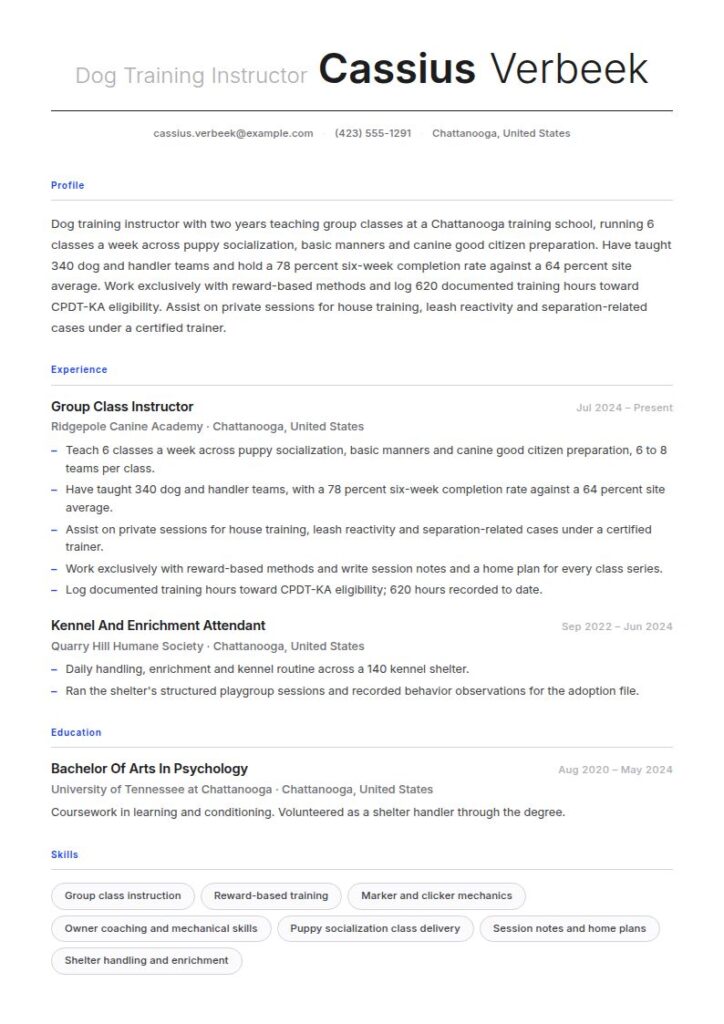
Dog training instructor with two years teaching group classes at a Chattanooga training school, running 6 classes a week across puppy socialization, basic manners and canine good citizen preparation. Have taught 340 dog and handler teams and hold a 78 percent six-week completion rate against a 64 percent site average. Work exclusively with reward-based methods and log 620 documented training hours toward CPDT-KA eligibility. Assist on private sessions for house training, leash reactivity and separation-related cases under a certified trainer.
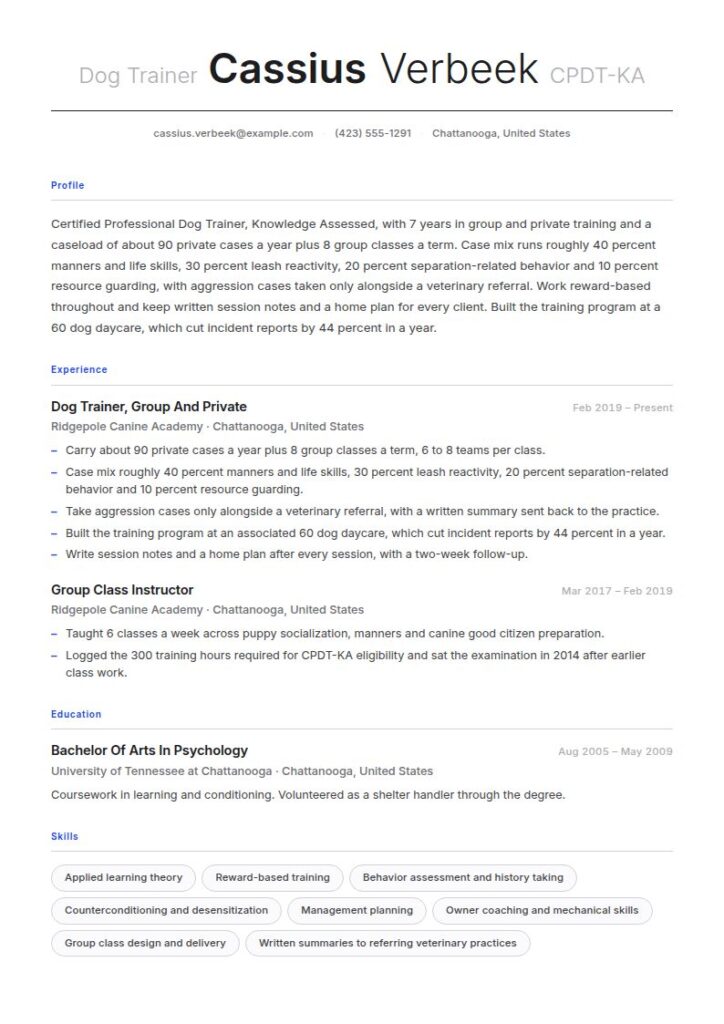
Certified Professional Dog Trainer, Knowledge Assessed, with 7 years in group and private training and a caseload of about 90 private cases a year plus 8 group classes a term. Case mix runs roughly 40 percent manners and life skills, 30 percent leash reactivity, 20 percent separation-related behavior and 10 percent resource guarding, with aggression cases taken only alongside a veterinary referral. Work reward-based throughout and keep written session notes and a home plan for every client. Built the training program at a 60 dog daycare, which cut incident reports by 44 percent in a year.
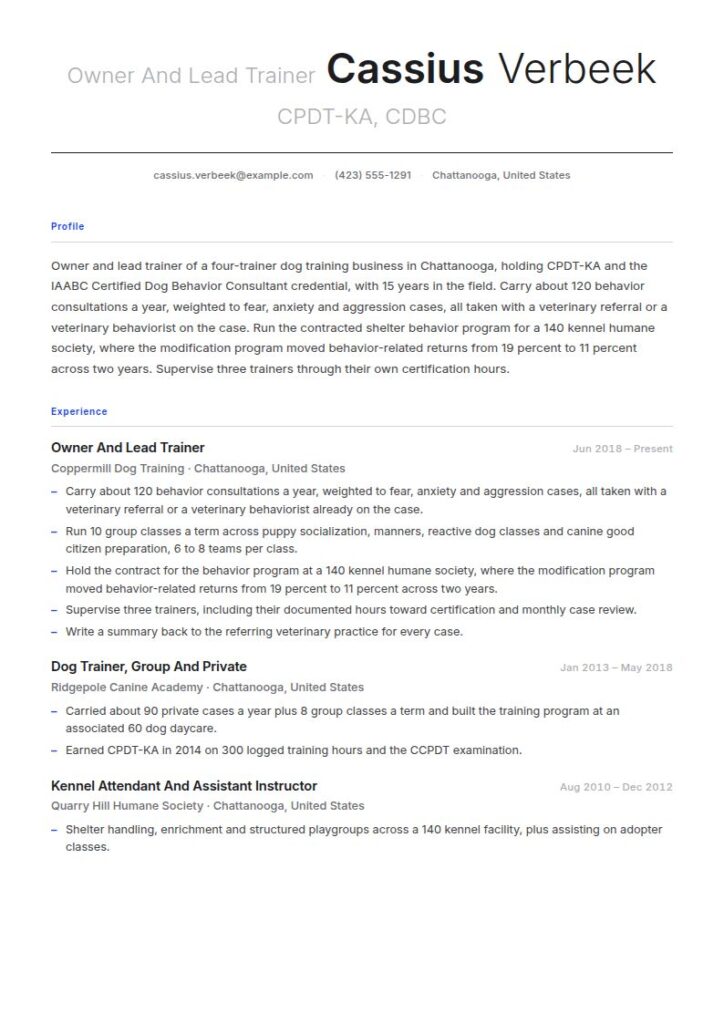
Owner and lead trainer of a four-trainer dog training business in Chattanooga, holding CPDT-KA and the IAABC Certified Dog Behavior Consultant credential, with 15 years in the field. Carry about 120 behavior consultations a year, weighted to fear, anxiety and aggression cases, all taken with a veterinary referral or a veterinary behaviorist on the case. Run the contracted shelter behavior program for a 140 kennel humane society, where the modification program moved behavior-related returns from 19 percent to 11 percent across two years. Supervise three trainers through their own certification hours.
Right vs wrong: the same dog trainer summary, twice
| ✅ Right | ❌ Wrong |
|---|---|
| Certified Professional Dog Trainer, Knowledge Assessed, with 7 years in group and private training. | Experienced professional dog trainer and canine behavior expert. |
| Caseload of about 90 private cases a year plus 8 group classes a term. | Works with a wide variety of dogs and behavior issues. |
| Case mix roughly 40 percent manners, 30 percent leash reactivity, 20 percent separation-related, 10 percent resource guarding. | Specializes in obedience, behavior modification and aggression rehabilitation. |
| Aggression cases taken only alongside a veterinary referral. | Can fix any dog, any problem, guaranteed results. |
For example, the right column is a professional describing a practice. The left, on the other hand, is an advertisement, and a veterinary practice manager reads the difference instantly.
Outline your training experience
Employer or business, dates, formats, then the numbers. This field runs on volume and mix, yet almost nobody writes either down.
| Instead of | Use |
|---|---|
| Trained dogs of all breeds and ages | Carry about 90 private cases a year plus 8 group classes a term, 6 to 8 teams per class |
| Handled behavior issues | Case mix roughly 40 percent manners, 30 percent leash reactivity, 20 percent separation-related, 10 percent resource guarding |
| Taught obedience classes | Teach 6 classes a week across puppy socialization, manners and canine good citizen preparation |
| Got great results with clients | 78 percent six-week class completion against a 64 percent site average |
| Worked with shelter dogs | Run the modification program for a 140 kennel shelter; behavior-related returns fell from 19 to 11 percent over two years |
| Communicated with owners | Written session notes and a home plan after every session, plus a two-week follow-up |
Owner and Lead Trainer, Coppermill Dog Training, Chattanooga, TN, June 2018 to Present. Four trainers, group classes and private behavior work.
Carry about 120 behavior consultations a year, weighted to fear, anxiety and aggression cases, all taken with a veterinary referral or a veterinary behaviorist already on the case.
Run 10 group classes a term across puppy socialization, manners, reactive dog classes and canine good citizen preparation, 6 to 8 teams per class.
Hold the contract for the behavior program at a 140 kennel humane society, where the modification program moved behavior-related returns from 19 percent to 11 percent across two years.
Supervise three trainers, including their documented hours toward certification and monthly case review, and write a summary back to the referring veterinary practice for every case.
How a dog trainer proves competence when no license exists
This is the section that decides the page, because it is the question underneath every dog training interview and every client inquiry.
To repeat, there is no state licensing board for dog trainers in most of the United States, no protected title, no mandatory exam and no register a client can check. BLS says only that certifications are optional and may help workers establish their credentials, and that many states require self-employed animal care and service workers to hold a business license (BLS Occupational Outlook Handbook, last modified 27 August 2026). A business license is a tax and zoning instrument; it says nothing about whether you can read a dog.
So you build the proof yourself, out of four things.
Certifications that prove a dog trainer’s skill
Certification from a body with an assessment behind it. The Certification Council for Professional Dog Trainers awards the CPDT-KA, Certified Professional Dog Trainer, Knowledge Assessed. Candidates log a minimum of 300 hours of dog training experience within the last 3 years, must be at least 18 with a high school diploma, GED or equivalent, provide a signed Attestation Statement from a CCPDT certificant, veterinarian or other approved professional, and confirm compliance with the Standards of Practice and Code of Ethics. The examination is 200 multiple-choice questions, 180 scored and 20 unscored pretest items, in 3 hours, weighted Instructional and Teaching Skills 32 percent, Canine Behavior, Ethology and Well-being 26 percent, Applied Learning Theory 25 percent, and Professional Skills, Ethics, and Laws and Regulations 17 percent. Certificants recertify every 3 years, by continuing education units or by retaking the exam (CCPDT, retrieved 17 September 2026).
The International Association of Animal Behavior Consultants runs a second ladder: the Accredited Dog Trainer credential, for animal trainers with two or more years of training experience who teach manners, life skills, sports, enrichment and the prevention of behavior problems, and the Certified Dog Behavior Consultant credential, for behavior consultants with three or more years of consulting experience working with complex behavior cases. IAABC requires a minimum of 36 continuing education units every three years and serves professionals in more than 70 countries (International Association of Animal Behavior Consultants, retrieved 17 September 2026).
Case volume, methods and the referral boundary
Volume, written down. Cases a year, classes a term, teams per class, and the mix by behavior type. Nobody in this field writes their numbers down, which is why doing so is persuasive.
A stated methods position. Employers and clients ask about methods because the question has a published answer they can check. The American Veterinary Society of Animal Behavior's position statement on humane dog training says: "Based on current scientific evidence, AVSAB recommends that only reward-based training methods are used for all dog training, including the treatment of behavior problems", defining aversive methods as those which "rely on application of force, pain, or emotional or physical discomfort" (AVSAB, 2021). Write your position in one plain sentence rather than in slogans.
A referral boundary. That is the line separating a professional from a card printer.
Write the referral boundary, because it is the strongest line on the page
The most credible sentence a dog trainer can put on a resume is the one describing where their scope ends.
AVSAB's position statement is explicit about the path: "If a trainer is having difficulty modifying a particular behavior, they should consult with another reward-based trainer, or refer to a veterinarian, board-certified veterinary behaviorist, or certified applied animal behaviorist" (AVSAB, 2021).
Those roles are not interchangeable with a trainer. A board-certified veterinary behaviorist is a veterinarian holding Diplomate status with the American College of Veterinary Behaviorists; Diplomates have extensive knowledge of psychotropic medications and are licensed to prescribe them when indicated (American College of Veterinary Behaviorists). A trainer is not, and no certification changes that.
So put the boundary on the page as practice rather than modesty: "Aggression, sudden behavior change and suspected pain-related cases taken only alongside a veterinary referral, with a written summary sent back to the practice." A hiring veterinary group reads that and knows you will not cost them a client.
Build a snapshot of your key skills
For skills, use four groups: training and behavior, formats, client work, and business. Keep the formats block, because it is how employers filter.
Training and behavior: Applied learning theory, Reward-based training, Marker and clicker mechanics, Shaping and desensitization, Counterconditioning, Management planning, Behavior assessment and history taking
Formats: Group classes, Private in-home sessions, Day training, Puppy socialization, Reactive dog classes, Canine good citizen preparation, Shelter behavior programs, Virtual consultations
Client work: Session notes and written home plans, Follow-up scheduling, Owner coaching and mechanical skills, Written summaries to referring veterinary practices, Case intake and triage
Business: Scheduling and client management software, Pricing and package design, Liability insurance and waivers, Instructor supervision, Class capacity planning
Owner coaching deserves its own line. The CPDT-KA exam weights Instructional and Teaching Skills at 32 percent, the largest of its four domains and larger than Applied Learning Theory at 25 percent (CCPDT, retrieved 17 September 2026). The people you teach are human, too, and the certifying body's exam blueprint says so.
List your education and certifications
In practice, certifications come first, with the awarding body, the full credential name, the year and the recertification date. Then formal schooling, then courses.
CPDT-KA, Certified Professional Dog Trainer, Knowledge Assessed, Certification Council for Professional Dog Trainers, certified 2014, current through 2027. Recertified by continuing education units in 2024.
CDBC, Certified Dog Behavior Consultant, International Association of Animal Behavior Consultants, 2019. 36 continuing education units completed in the current three year cycle.
Pet First Aid and CPR, 2026. Bachelor of Arts, Psychology, University of Tennessee at Chattanooga, 2009.
Business license, City of Chattanooga, held since 2018. General liability and professional liability insurance in force.
That last line matters more than it looks. With no occupational license, the business license and the insurance are often the only formal documents in the file, and an employer or facility partner will ask for both.
Put certifications directly under the summary, with the awarding body spelled out. Give case volume and case mix as numbers. Name the formats you teach, since employers filter on them. State your methods position in one plain sentence. Write the referral boundary explicitly. Write self-employment as a business, with dates and caseload.
Do not use the word behaviorist unless your credential supports it. Do not promise results or guarantees anywhere. Do not describe yourself as certified without naming who certified you. Do not claim aggression work without saying how veterinary involvement is handled. Do not list a seminar as though it were a credential.
Choose the right layout and design
As for layout, single column, plain type at 11 or 12 point, no photograph and no photographs of dogs. Two pages once you carry certifications, a caseload and a business.
One point specific to this field: veterinary practices, shelters and daycare groups read resumes the way clinical employers do and want the credential block near the top, while a training school cares more about the class list and completion numbers. Then reorder those two blocks for the audience and leave the rest alone.
Dog trainer job market and outlook
Of course, dog trainer is not a Bureau of Labor Statistics occupation title. The published line covering it is animal trainers, inside the animal care and service workers profile, which also includes horse and marine mammal trainers, so read the figures as a bracket rather than a dog training wage.
| Measure | Animal trainers | Animal care and service workers, all |
|---|---|---|
| Employment, 2025 | 47,800 | 413,000 |
| Projected employment, 2035 | 49,700 | 459,100 |
| Projected change, 2025 to 2035 | 4 percent growth, 2,000 new jobs | 11 percent growth |
| Projected annual openings | Part of the group total | About 69,400 |
| Typical entry-level education | High school diploma or equivalent | High school diploma or equivalent |
| Median annual wage, May 2025 | $39,990 | Animal caretakers $35,360 |
Source: U.S. Bureau of Labor Statistics, Occupational Outlook Handbook, animal care and service workers, May 2025 wage data and 2025 to 2035 projections, last modified 27 August 2026.
Where animal trainers work: 39 percent self-employed, 19 percent other personal services, 17 percent support activities for agriculture and forestry, 7 percent animal production and aquaculture, 7 percent retail trade, with medians of $39,990 in other personal services and $36,240 in retail trade (BLS, May 2025).
The spread is the business, not the job title
Animal trainers had a median annual wage of $39,990 in May 2025. The lowest 10 percent earned less than $29,600 and the highest 10 percent more than $75,490 (BLS Occupational Outlook Handbook, animal care and service workers, May 2025, published 27 August 2026).
That is a wide spread for an occupation with a high school diploma as its typical entry education, and the reason is in the same table: 39 percent of animal trainers are self-employed, the largest category by some distance (BLS, May 2025).
The top of this occupation is not a promotion. It is a practice with a caseload, a price list, repeat clients and referral sources. Case volume, case mix, retention, class fill rates, referral relationships and staff supervised are what describe a practice, and they are what separate the two ends of that $45,890 gap. Certification opens doors; the numbers show the business behind it.
The retail trade line makes the same point in miniature: animal trainers in retail trade had a median of $36,240 against $39,990 in other personal services (BLS, May 2025). Big box class programs are a real entry route and a real way to accumulate documented hours, but they are not where the occupation's money sits.
What salary you can expect as a dog trainer
Instead, the median annual wage for animal trainers was $39,990 in May 2025, with the lowest 10 percent under $29,600 and the highest 10 percent over $75,490 (BLS Occupational Outlook Handbook, May 2025, published 27 August 2026). Horse and marine mammal trainers sit in that line too, so treat it as a bracket.
Employment terms vary more here than in most fields. For instance, group class instruction is often paid per class or per term, private work per session or per package. Meanwhile, daycare, boarding and veterinary employers tend to pay hourly with a salaried track for a head trainer. Similarly, shelter behavior posts are usually salaried and often the most stable work in the field.
What moves pay is the list that makes a good resume: certification, because it is the only external assessment available; volume and retention, because they demonstrate a practice rather than a hobby; veterinary referral relationships, because those cases are steadier; contract work with shelters, daycares or veterinary groups, because that is recurring revenue; and staff, because a business with trainers in it is a different proposition from one person with a van.
Key takeaways for a dog trainer resume
- Certifications go directly under the summary, with the awarding body named.
- Give case volume and case mix as numbers, because nobody else does.
- Name the formats you teach, because employers filter on them.
- State your methods position plainly, in one sentence.
- Write the referral boundary; in fact, it is the most credible line on the page.
- Write self-employment as a business, with dates, caseload and staff.
- Avoid the word behaviorist unless your credential supports it.
Build your dog trainer resume in 15 minutes with our AI resume builder.
Related resume examples in other fields
- Dog walker resume
- Zoo keeper resume
- Self-employed resume
- Freelancer resume
- Career change resume
- Entry-level resume
- One-year experience resume
- Part-time job resume
- Tour guide resume
- Volunteer resume
- Work from home resume
- General resume
Pair it with a matching dog trainer cover letter.
Dog trainer resume questions, answered
Do I need a license to be a dog trainer in the United States?
Not as an occupation, in most of the country. There is no state licensing board for dog trainers in most states, no protected title and no mandatory exam. BLS treats certification as optional, saying it "may help workers establish their credentials", and the only licensing it mentions is commercial: "Many states require self-employed animal care and service workers to have a business license" (BLS Occupational Outlook Handbook, last modified 27 August 2026). Check your own state and city, because business licensing, kennel rules and zoning all vary.
Which dog training certification should I put on a resume?
Whichever one you hold, named in full with its awarding body and year. Two widely recognized independent routes are CCPDT, which awards the CPDT-KA on 300 logged training hours in the last 3 years, an attestation from a certificant, veterinarian or other approved professional, and a 200 question examination with 180 scored items in 3 hours, recertified every 3 years; and IAABC, which accredits dog trainers with two or more years of training experience and certifies dog behavior consultants with three or more years on complex cases, requiring 36 continuing education units every three years (CCPDT and IAABC, both retrieved 17 September 2026). Never write "certified" without saying by whom.
How do I show results without exaggerating?
Use operational numbers instead of outcome claims: class completion rates, class fill rates, cases a year, case mix by behavior type, client retention, repeat and referral share, shelter return rates. Those are measurable and specific, and they avoid the promise-of-results language that makes a professional reader suspicious.
Should the resume say what methods I use?
Yes, in one sentence, because you will be asked. It is a live professional question with a published veterinary position behind it: AVSAB "recommends that only reward-based training methods are used for all dog training, including the treatment of behavior problems", and defines aversive methods as those relying on "application of force, pain, or emotional or physical discomfort" (AVSAB, 2021). Veterinary practices, shelters and many daycare groups ask about methods first, so a plain statement saves everyone time.
What do I put on a dog trainer resume with no paid experience?
Documented hours and documented formats. Shelter volunteer handling hours, assisting on group classes, a foster history with the behaviors you worked on, apprenticeship under a certified trainer, and any academy program with its length and content. Count the hours, because CPDT-KA eligibility is counted in hours and an employer knows it. Then say which formats you can teach unsupervised today and which you are still assisting on.
When should a behavior case go to a veterinarian?
That is a decision for the veterinary profession rather than something a resume guide should rule on. The relevant published position is AVSAB's: a trainer having difficulty modifying a behavior should consult another reward-based trainer, or refer to a veterinarian, board-certified veterinary behaviorist or certified applied animal behaviorist (AVSAB, 2021). Board-certified veterinary behaviorists hold Diplomate status with the American College of Veterinary Behaviorists, have extensive knowledge of psychotropic medications, and are licensed to prescribe them when indicated. For the resume, what matters is that you write the boundary down and describe how referrals and written summaries work in your practice.