Independent Designer and Front-End Developer Oskar Stenhouse
Principal, Independent Design and Front-End Practice
[email protected] | (401) 555-1219 | Providence, United States
Profile
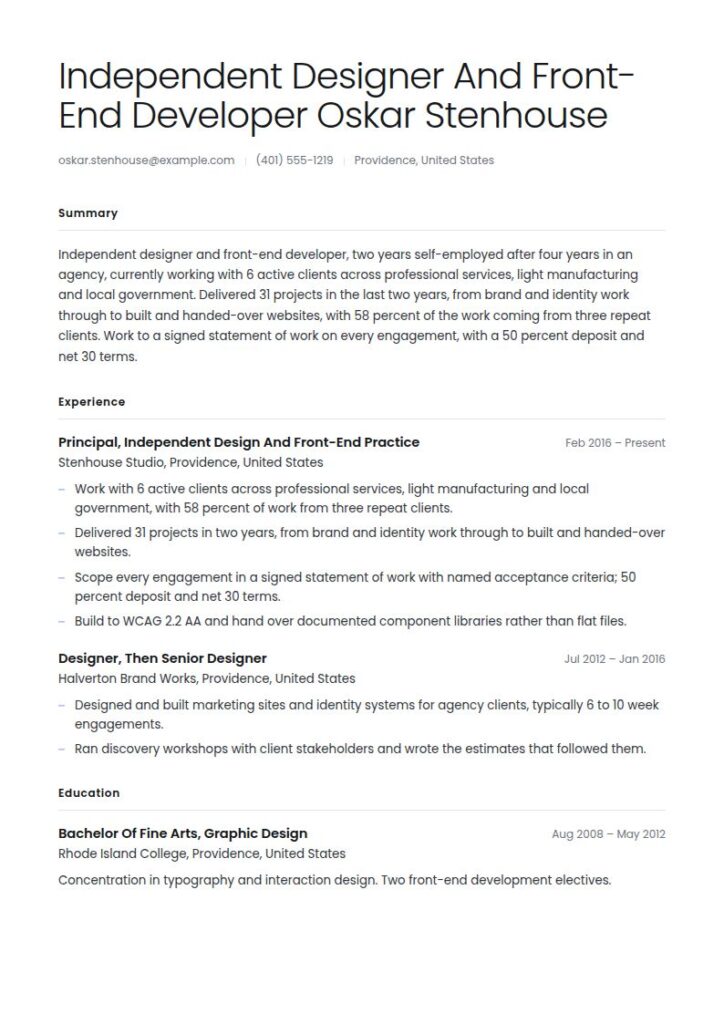
Independent designer and front-end developer, two years self-employed after four years in an agency, currently working with 6 active clients across professional services, light manufacturing and local government. Delivered 31 projects in the last two years, from brand and identity work through to built and handed-over websites, with 58 percent of the work coming from three repeat clients. Work to a signed statement of work on every engagement, with a 50 percent deposit and net 30 terms.
Work Experience
02/2016 - Present, Principal, Independent Design and Front-End Practice, Stenhouse Studio, Providence, United States
- Work with 6 active clients across professional services, light manufacturing and local government, with 58 percent of work from three repeat clients.
- Delivered 31 projects in two years, from brand and identity work through to built and handed-over websites.
- Scope every engagement in a signed statement of work with named acceptance criteria; 50 percent deposit and net 30 terms.
- Build to WCAG 2.2 AA and hand over documented component libraries rather than flat files.
07/2012 - 01/2016, Designer, then Senior Designer, Halverton Brand Works, Providence, United States
- Designed and built marketing sites and identity systems for agency clients, typically 6 to 10 week engagements.
- Ran discovery workshops with client stakeholders and wrote the estimates that followed them.
Education
08/2008 - 05/2012, Bachelor of Fine Arts, Graphic Design, Rhode Island College, Providence, United States
Concentration in typography and interaction design. Two front-end development electives.
Skills
Interface design, 80
Front-end build in HTML, CSS and JavaScript, 75
Accessibility to WCAG 2.2 AA, 70
Discovery and requirements workshops, 70
Estimating and scheduling, 70
Scoping and statements of work, 75
Net 30 invoicing and collections, 70
Figma, 85
Git and GitHub, 70
Languages
English, native
Swedish, intermediate
Certificates
02/2016, Sole Proprietorship Business Registration, State of Rhode Island
Registered practice with a federal Employer Identification Number held for subcontractor payments.
Summary
A freelancer resume is a one to two page document showing how independent work is structured: the client mix behind it, how concentrated the revenue is, and the contract terms that govern scope and payment. This guide gives you three adaptable versions, the four objections a salaried hiring manager holds, and cited Bureau of Labor Statistics data on independent contractors.
Freelancer resume examples by experience level
A freelancer resume is a one to two page document showing how independent work is actually structured: who the clients are as a mix, how concentrated the revenue is, what the contracts say, and what happens when a scope changes.
In practice, this page is written for independent work in any discipline: design, development, consulting, bookkeeping, photography, translation, trades, events, video. If you freelance specifically as a writer, our separate freelance writer resume guide covers the byline, retainer and editorial questions that apply only to that work, and this page covers what applies to everybody.
Independent work is not unusual. In July 2023 there were 11.9 million independent contractors in the United States, 7.4 percent of total employment, and 80.3 percent of them preferred their arrangement to a traditional one, while 8.3 percent would have preferred a traditional job (U.S. Bureau of Labor Statistics, Contingent and Alternative Employment Arrangements, released 8 November 2024). However, the problem a freelancer resume solves is not rarity. Instead, it is that a salaried reader cannot see the structure.
Resume guide for a freelancer resume
To start, this guide and the corresponding freelancer resume example will cover:
- First, how to write a freelancer resume, section by section
- Then, why client mix and concentration belong on the page as numbers
- Also, three adaptable summaries: early independent, established and practice lead
- The four objections a salaried hiring manager is holding while they read
- Finally, what the Bureau of Labor Statistics publishes about independent work, and what it does not
How to write a freelancer resume
In short, six sections: contact header with a portfolio or site link, summary, the practice as one entry, client mix, skills and tooling, and education with credentials. In general, one page under five years independent, two once you subcontract or hold multi-year engagements.
Above all, the structural decision comes first: one entry for the practice, with client work described inside it. Not one entry per client.
| Section | What it is answering | Where it goes |
|---|---|---|
| The practice | Is this one continuous thing, or a run of short jobs? | One entry with a name, a location and dates |
| Client mix | Who buys this, and is it one buyer or twenty? | Sectors and counts, directly under the practice |
| Concentration | What happens to this person if one client leaves? | A percentage, stated plainly |
| Contract terms | Do they scope, invoice and get paid like a professional? | Two lines: scope and payment terms |
| Skills and tooling | Can they work inside our stack? | Named products, not categories |
One entry for the practice, not one entry per client
An applicant tracking system and a human reader make the same mistake with a freelance history: twelve client entries parse as twelve jobs, and twelve jobs in six years reads as a person who does not stay anywhere.
Write the practice as a single continuous role: a name, a city, and dates that run from the first month to the present. Under it, describe the client work in bullets, grouped by sector or by type of engagement rather than by individual client.
This is presentation, not invention. A sole proprietorship operating under your own name is a real business entity, and the practice genuinely is the job. The individual clients are the work, and work belongs in bullets.
Keep a full client list for the portfolio or the interview. On the resume it costs you the only thing the entry was built to say.
Run the finished file through the ATS resume checker before you send it. Freelance resumes fail parsing more often than most, usually because of unusual date ranges and entries with no employer name in them.
Choosing the best resume format for a freelancer resume
As a rule, reverse chronological, with the practice as one entry and any prior salaried roles below it. One page under five years, two once the practice has subcontractors, multi-year engagements or a specialism worth documenting.
Of course, the temptation is a portfolio-style or functional layout that leads on projects. It reads well to a peer and badly to a hiring manager, because it removes the two things being checked: continuity and recency. Instead, keep the timeline and put the projects in the portfolio.
If you have moved between salaried and independent work more than once, do not hide the pattern. Alternating is common and far less alarming than an unexplained sequence. One clause after the practice entry, saying why you went independent and what you want now, does more than any layout choice.
Include your contact information
| ✅ Right | ❌ Wrong |
|---|---|
| Oskar Stenhouse | Oskar Stenhouse |
| Independent Design and Front-End Practice, 2016 to present | Freelancer, available for hire |
| 9 active clients, no client above 24 percent of revenue | Worked with dozens of happy clients |
| (401) 555-1219, [email protected], Providence, RI | (401) 555-1219, [email protected], remote |
For example, the right column answers a structural question in the header. The wrong column, by contrast, answers none, and "remote" in place of a location is a small red flag on a page already asking a reader to trust an unfamiliar shape.
Make use of a summary
For the summary, four lines: what the practice does, the client mix, one structural number, and the terms you work under.
Independent designer and front-end developer, two years self-employed after four years in an agency, currently working with 6 active clients across professional services, light manufacturing and local government. Delivered 31 projects in the last two years, from brand and identity work through to built and handed-over websites, with 58 percent of the work coming from three repeat clients. Work to a signed statement of work on every engagement, with a 50 percent deposit and net 30 terms.
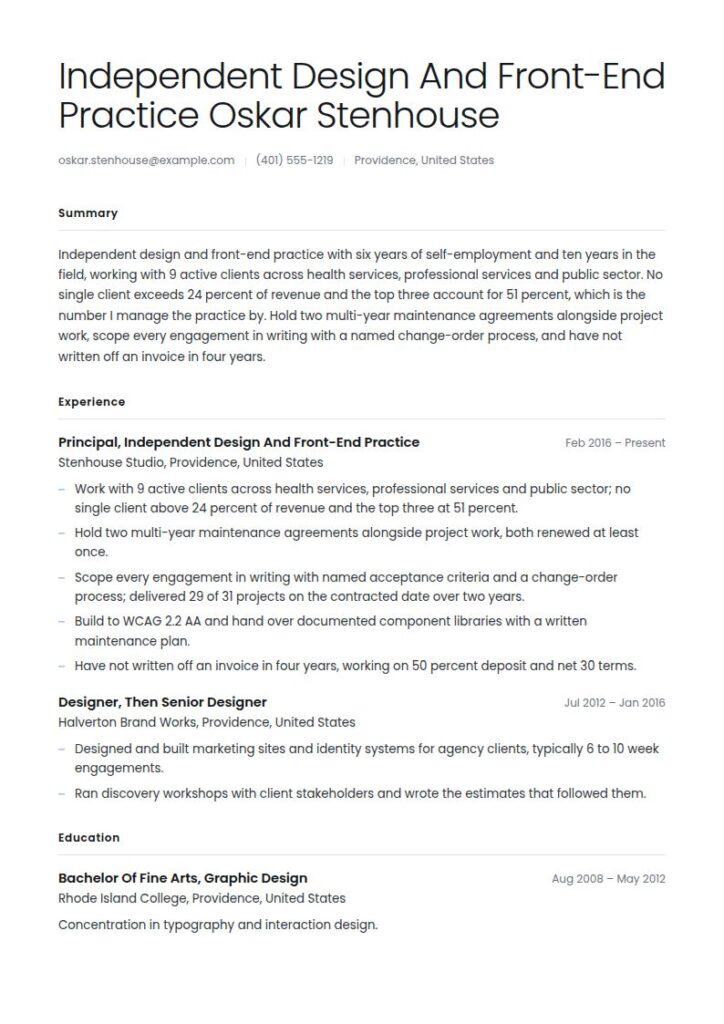
Independent design and front-end practice with six years of self-employment and ten years in the field, working with 9 active clients across health services, professional services and public sector. No single client exceeds 24 percent of revenue and the top three account for 51 percent, which is the number I manage the practice by. Hold two multi-year maintenance agreements alongside project work, scope every engagement in writing with a named change-order process, and have not written off an invoice in four years.
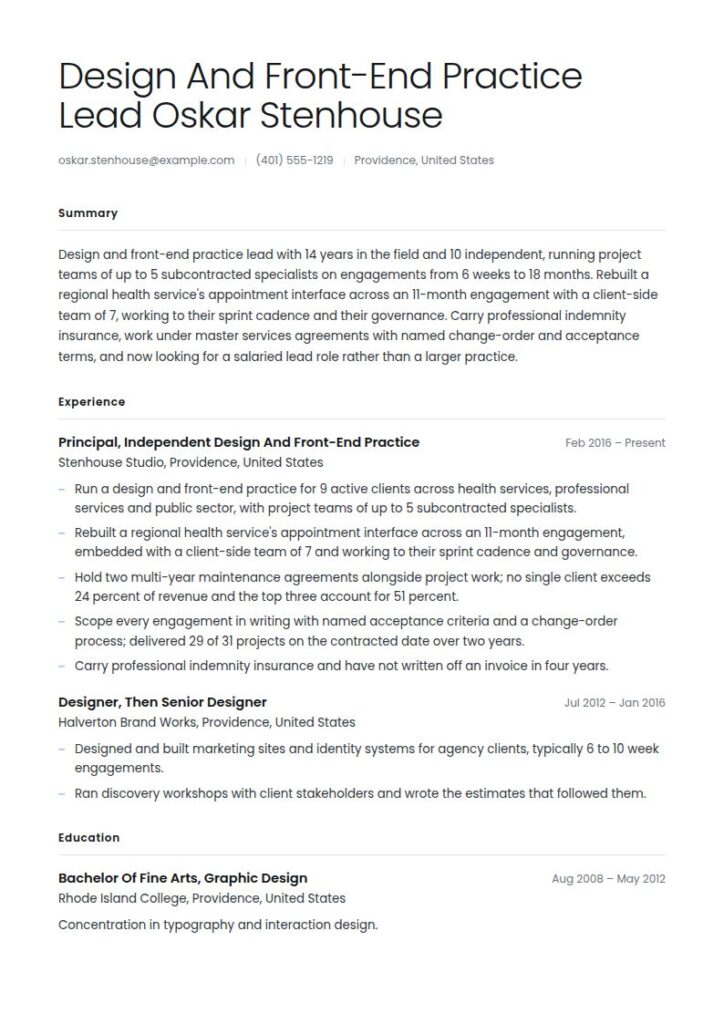
Design and front-end practice lead with 14 years in the field and 10 independent, running project teams of up to 5 subcontracted specialists on engagements from 6 weeks to 18 months. Rebuilt a regional health service's appointment interface across an 11-month engagement with a client-side team of 7, working to their sprint cadence and their governance. Carry professional indemnity insurance, work under master services agreements with named change-order and acceptance terms, and now looking for a salaried lead role rather than a larger practice.
Right vs wrong: the same freelancer summary, twice
| ✅ Right | ❌ Wrong |
|---|---|
| Independent design and front-end practice, six years self-employed, 9 active clients. | Experienced freelancer with a wide range of clients and projects. |
| No single client exceeds 24 percent of revenue; the top three account for 51 percent. | Trusted by businesses of all sizes across many different industries. |
| Scope every engagement in writing with a named change-order process. | Flexible and adaptable, always willing to go the extra mile. |
| Two multi-year maintenance agreements alongside project work. | Available for both short-term and long-term work. |
Again, the right column describes a business with a shape. Meanwhile, the left column describes availability, which is the one thing a hiring manager is not worried about.
Outline your experience
Practice name, city, dates, then bullets grouped by engagement type. In addition, each bullet carries a number: duration, team size, throughput, retention or a measured outcome.
| Instead of | Use |
|---|---|
| Worked with various clients on different projects | 9 active clients across health services, professional services and public sector; 31 projects in two years |
| Managed my own workload and deadlines | Delivered 29 of 31 projects on the contracted date; both slips were scope changes agreed in writing |
| Built strong client relationships | Two multi-year maintenance agreements; 51 percent of revenue from the top three clients |
| Handled all aspects of running a business | Scope, change orders, acceptance criteria and net 30 invoicing on every engagement |
| Worked as part of a team | Ran an 11-month engagement embedded with a client-side team of 7, to their sprint cadence |
| Led other freelancers | Ran project teams of up to 5 subcontracted specialists, including briefing and quality review |
Principal, Stenhouse Studio, Independent Design and Front-End Practice, Providence, RI, February 2016 to Present
Run a design and front-end practice for 9 active clients across health services, professional services and public sector, with project teams of up to 5 subcontracted specialists.
Rebuilt a regional health service's appointment interface across an 11-month engagement, embedded with a client-side team of 7 and working to their sprint cadence and governance.
Hold two multi-year maintenance agreements alongside project work; no single client exceeds 24 percent of revenue and the top three account for 51 percent.
Scope every engagement in writing with named acceptance criteria and a change-order process; delivered 29 of 31 projects on the contracted date over two years.
Carry professional indemnity insurance and have not written off an invoice in four years.
The four objections a salaried hiring manager holds about independent work
In fact, this is the section the rest of the resume is serving, and the four objections are remarkably consistent across industries. None of them is about whether you can do the work.
One: you will not tolerate being managed. The reader's fear is that someone who has chosen their own priorities for six years will resent a sprint board, a review cycle and somebody else's deadline. Answer it with evidence of working inside a client's process rather than around it. Embedded engagements, a client's ceremonies, their tooling, their governance, their acceptance criteria. "Worked to their sprint cadence and their governance" is the sentence, and it is worth more than any statement about being a team player.
Two: you freelanced because you could not get hired. Often untrue and almost always suspected, and silence confirms it. One honest clause is enough: "went independent to specialize in accessibility work", "built the practice after a 2016 redundancy and kept it for ten years", "freelanced while caring for a family member". You do not owe more than a clause, and a clause closes the question. The national data is on your side here too: 80.3 percent of independent contractors preferred their arrangement to a traditional job (BLS, Contingent and Alternative Employment Arrangements, released 8 November 2024).
Freelancer loyalty and a performance record
Three: you will leave the moment a good client appears. This is the objection people most often fail to address, because addressing it feels like negotiating against yourself. Say what you intend, plainly, in the summary or the closing clause: whether you are winding the practice down, keeping a single legacy client with the employer's knowledge, or closing it entirely. Ambiguity here is expensive, because it is the doubt that surfaces at offer stage rather than at screening.
Four: nobody has ever appraised this person. Salaried candidates arrive with a performance record. You arrive with your own account of your own work. So supply things a third party produced: retention and renewal, a client-side manager who will act as a referee, an acceptance sign-off, a multi-year agreement that was renewed, a professional credential with an issuing body, or insurance you had to qualify for. Each of those is somebody other than you attesting to something.
| The objection | What answers it on the page |
|---|---|
| Will not tolerate being managed | Embedded work inside a client's process, tooling and governance |
| Freelanced because they could not get hired | One clause saying why, in plain words |
| Will leave for a client | A stated intention about the practice, in the summary or the close |
| Never been appraised | Renewals, referees, sign-offs, credentials, insurance |
Write the practice as one entry with a name, a location and dates. Give the client mix as sectors and counts. State concentration as a percentage. Name the contract terms you work under: scope, change orders, acceptance, payment. Say in one clause why you went independent and what you want now. Offer a client-side referee.
Do not list one entry per client. Do not name a client who has not agreed to it, or whose work was under a non-disclosure agreement. Do not describe a sole practice in the plural as though it were an agency with staff. Do not leave a multi-year period labeled only "freelance". Do not claim availability as a selling point. Do not hide that you are looking for salaried work.
Build a snapshot of your key skills
For skills, list twelve to sixteen entries in four groups: craft, delivery, commercial, and tooling. In particular, the commercial group is the one freelancers leave out and the one that separates the page.
Craft: Interface design, Design systems and component libraries, Accessibility to WCAG 2.2 AA, Front-end build in HTML, CSS and JavaScript, Prototyping
Delivery: Discovery and requirements workshops, Estimating and scheduling, Working inside client sprint cadences, Subcontractor briefing and quality review, Handover and documentation
Commercial: Scoping and statements of work, Change-order process, Acceptance criteria, Net 30 invoicing and collections, Professional indemnity insurance, Subcontractor agreements
Tooling: Figma, Git and GitHub, Storybook, Jira and Linear, Google Analytics, Notion
List your education and certifications
Degree, then credentials with an issuing body, then insurance and registrations, then continuing education. Anything a third party assessed is worth more here than on a salaried resume, because you have less else that a stranger verified.
Professional indemnity and general liability insurance, held continuously since 2018, certificate available on request
Certified Professional in Accessibility Core Competencies, International Association of Accessibility Professionals, 2021, renewed 2024
Bachelor of Fine Arts, Graphic Design, Rhode Island College, Providence, RI, 2012
Business registration: Sole proprietorship registered in Rhode Island, 2016. Federal Employer Identification Number held for subcontractor payments.
Continuing education: Accessible component patterns (2025). Contract law for independent professionals (2023).
Similarly, registration and insurance belong on a freelancer's resume in a way they never would on a salaried one. They are cheap to state, verifiable, and they answer the quiet question of whether the practice is a business or a habit.
Choose the right layout and design
As for layout, single column, plain type at 11 or 12 point, one link to a portfolio or site, no photograph. Resist the urge to design the resume itself if design is your discipline, because a hiring manager's parser does not reward it and a two-column grid loses the dates.
Name the file for yourself and the role you are applying to, not for your practice: oskar-stenhouse-lead-product-designer.pdf. The practice name belongs inside the document.
Freelancer job market and outlook
There is no occupation called freelancer, and the Bureau of Labor Statistics publishes no Occupational Outlook Handbook profile, no employment projection and no median wage for one, because freelancing is a working arrangement rather than an occupation. Instead, what BLS does publish, and what this section uses, is a direct measurement of independent work across the whole economy.
| Measure, July 2023 | Value |
|---|---|
| Independent contractors | 11.9 million, 7.4 percent of total employment |
| On-call workers | 2.8 million, 1.7 percent |
| Temporary help agency workers | 945,000, 0.6 percent |
| Workers provided by contract firms | 862,000, 0.5 percent |
| Contingent workers (sole or main job) | 6.9 million, 4.3 percent, up from 3.8 percent in May 2017 |
| Independent contractors working full time | 70.7 percent |
Source: U.S. Bureau of Labor Statistics, Contingent and Alternative Employment Arrangements, July 2023 reference period, released 8 November 2024.
Four in five independent contractors chose it
The single most useful statistic for a freelancer's resume is about preference. In July 2023, 80.3 percent of independent contractors preferred their arrangement to a traditional work arrangement, and only 8.3 percent would have preferred a traditional one (U.S. Bureau of Labor Statistics, released 8 November 2024).
That is the evidence against the assumption that independent work is a fallback, and it is worth knowing even though you would never quote a national statistic on your own resume. What you do with it is structural: if four in five chose this, then the interesting question about you is not why you freelanced but what you built, which is exactly where your page should put the emphasis.
Two further figures shape how a reader sees the arrangement. About 36 percent of independent contractors were aged 55 or over, against roughly 22 percent in traditional arrangements. And 74.2 percent had health insurance from any source, which is the practical reason many people move back to salaried work and a reasonable thing to say in an interview.
For the occupation you practice, use the published Handbook profile for that occupation rather than anything about freelancing. For instance, a freelance bookkeeper competes against the bookkeeping market and a freelance photographer against the photography market, and those are the medians a salary conversation is conducted against.
What salary you can expect as a freelancer
There is no median for freelancers, because there is no such occupation. There is a measured comparison, and it is worth reading carefully rather than as a headline.
Among full-time workers in July 2023, independent contractors had median usual weekly earnings of $949 against $1,132 for workers in traditional arrangements (U.S. Bureau of Labor Statistics, released 8 November 2024). The median annual wage across all occupations was $50,980 in May 2025 (BLS Occupational Outlook Handbook, last modified 27 August 2026).
The gap is real but it is not measuring the same thing on both sides. After all, a salaried figure buys paid leave, employer contributions, equipment, software and often insurance. An independent figure covers all of that plus the unbilled hours spent quoting, scoping, invoicing and chasing payment, and it spans a wider range at both ends, which is why a median describes it poorly.
In other words, what a resume moves is which conversation you are having. Concentration, renewals and multi-year agreements show that the practice has a floor under it; as a result, a candidate whose page shows a floor negotiates differently from one showing a list of projects. If you are moving to salaried work, the comparison you want is the published median for the occupation and level you are applying at, not your own last twelve months.
Key takeaways for a freelancer resume
- Therefore, write the practice as one continuous entry, not one entry per client.
- Give the client mix as sectors and counts, and state concentration as a percentage.
- Name the contract terms: scope, change orders, acceptance criteria, payment terms.
- Show work done inside a client's process, because that answers the first objection.
- Say in one clause why you went independent and what you want now.
- Put anything a third party assessed on the page: renewals, referees, credentials, insurance.
- Use the published data for the occupation you practice, not for freelancing.
Build your freelancer resume in 15 minutes with our AI resume builder.
Related resume examples
- Self-employed resume
- Freelance writer resume
- Work-from-home resume
- Career change resume
- Translator resume
- Copywriter resume
- Technical writer resume
- Journalist resume
- Part-time job resume
- Volunteer resume
- Tour guide resume
- General resume
Pair it with a matching freelancer cover letter.
Freelancer resume questions, answered
How long should a freelancer resume be?
One page for your first five years independent. Two once the practice subcontracts, holds multi-year agreements, or carries a specialism worth documenting. Length on a freelance resume almost always comes from client lists, and that is the part to cut.
Should I list every client I have worked with?
No. Group them by sector with counts, name only the ones who have agreed and whose work was not confidential, and keep the full list for the portfolio or the interview. A long client list reads as a long list of short jobs, which is the opposite of what the entry is supposed to establish.
Should I put revenue or client concentration on my resume?
Concentration, yes, as a percentage, because it is the clearest evidence that you manage the practice rather than just work in it. Revenue is a judgment call and it depends on your discipline and level; where you do give it, say it is billed revenue rather than profit and attach a named tax year. Never give either as a range with no period attached.
Is it a problem that I have been self-employed for years?
It is a question rather than a problem, and the data says it is a common one: 11.9 million people, 7.4 percent of total employment, were independent contractors in July 2023 (BLS, released 8 November 2024). What creates the problem is leaving the question unanswered. A clause about why you went independent, evidence of working inside a client's process, and a plain statement of what you want now will settle it.
How do I show I can work in a team after years alone?
With an embedded engagement. Name a client-side team you worked inside, its size, whose cadence and tooling you used, how long it ran, and who signed the work off. That is the only kind of evidence that answers this, and a claim to be collaborative is not a substitute. Subcontractor management counts too: briefing, reviewing and paying other specialists is people work.
What do I do about clients covered by a non-disclosure agreement?
Describe them by sector, size and the nature of the engagement, and give the duration and your role. "An eleven-month engagement with a regional health service, embedded with a client-side team of seven" names nobody and tells a reader everything they need. Never list a confidential client, even in a portfolio, and never assume an expired project ends the obligation.