Oskar Stenhouse Design and Front-End Practice Lead Providence, 02906, United States [email protected] · (401) 555-1219
11 September 2026
Ms. Ingrid Lindgren Product Design Northharbor Systems Boston, United States
Application for Lead Product Designer, Northharbor Systems
Dear Ms. Lindgren,
I am applying for the Lead Product Designer post at Northharbor Systems. I have run an independent design and front-end practice for ten years, currently with nine active clients across health services, professional services and public sector, and no single client above 24 percent of revenue.
The work closest to your posting is an eleven-month engagement rebuilding a regional health service's appointment interface. I was embedded with a client-side team of seven, working to their sprint cadence, their design system and their accessibility governance rather than my own, and their product manager signed off each release. We took the appointment journey to WCAG 2.2 AA and cut abandoned bookings by a third over two quarters. Across the practice I have also run project teams of up to five subcontracted specialists, which is briefing, reviewing and paying other people rather than doing the work myself.
I went independent in 2016 to specialize in accessibility, which was difficult to do inside an agency at the time, and the practice did what I wanted it to do. I am moving to a salaried role now because the problems I want next are longer than an engagement, and I would rather own a product than a pipeline. I am closing the practice apart from one maintenance agreement that runs to March, which I would tell you about in the first week rather than the fourth.
The product manager on the health service engagement has agreed to act as a referee and can speak to how I work inside a team rather than beside one. I am available from the first of next month. Thank you for your time.
Sincerely, Oskar Stenhouse
Summary
A freelancer cover letter answers the four doubts a salaried hiring manager holds about independent work: whether you will accept management, why you freelanced, whether you will leave for a client, and who has ever appraised you. This guide gives you a full adaptable letter, the clauses that close each doubt, and cited data on independent contractors in the United States.
Freelancer cover letter examples by experience level
In short, a freelancer cover letter is a one-page letter written to a reader who has a salaried job to fill and four unspoken doubts about hiring somebody who has been running their own thing.
The doubts are not about competence. They are about fit with a team, a process and a payroll, and the letter is where you close them. On paper, a resume can show the practice had a shape. However, only the letter can say why you went independent and what you want now.
Guide to a freelancer cover letter
To help, this guide and the corresponding freelancer cover letter example will cover:
- First, how to structure the letter, paragraph by paragraph
- Next, the four doubts a salaried hiring manager is holding, and the clause that closes each
- Finally, why embedded client work is the strongest evidence you have
- What changes when you write to an agency, a startup or a large employer
How to write a freelancer cover letter
| Paragraph | Its job | Length |
|---|---|---|
| Opening | The role, the practice in one line, and the client mix behind it | 2 to 3 sentences |
| Evidence | One engagement run inside somebody else's process, with numbers | 4 to 5 sentences |
| Intent | Why you went independent, and what you are doing with the practice now | 3 to 4 sentences |
| Close | A client-side referee, availability, thank you | 2 sentences |
Lead with an engagement you did not run
The instinct is to open with the most impressive thing you have built alone. Resist it. The reader is not uncertain about your work, and an independent showcase feeds the doubt rather than closing it.
Open your evidence paragraph with an engagement where somebody else set the priorities: a client-side team you sat inside, their cadence, their tooling, their governance, their acceptance criteria. Name the team size and the duration.
"Eleven months embedded with a client-side team of seven, working to their sprint cadence" is the single most persuasive sentence an independent candidate can write, and it is usually buried on page two of the resume if it appears at all.
A freelancer cover letter example you can adapt
Dear Ms. Lindgren,
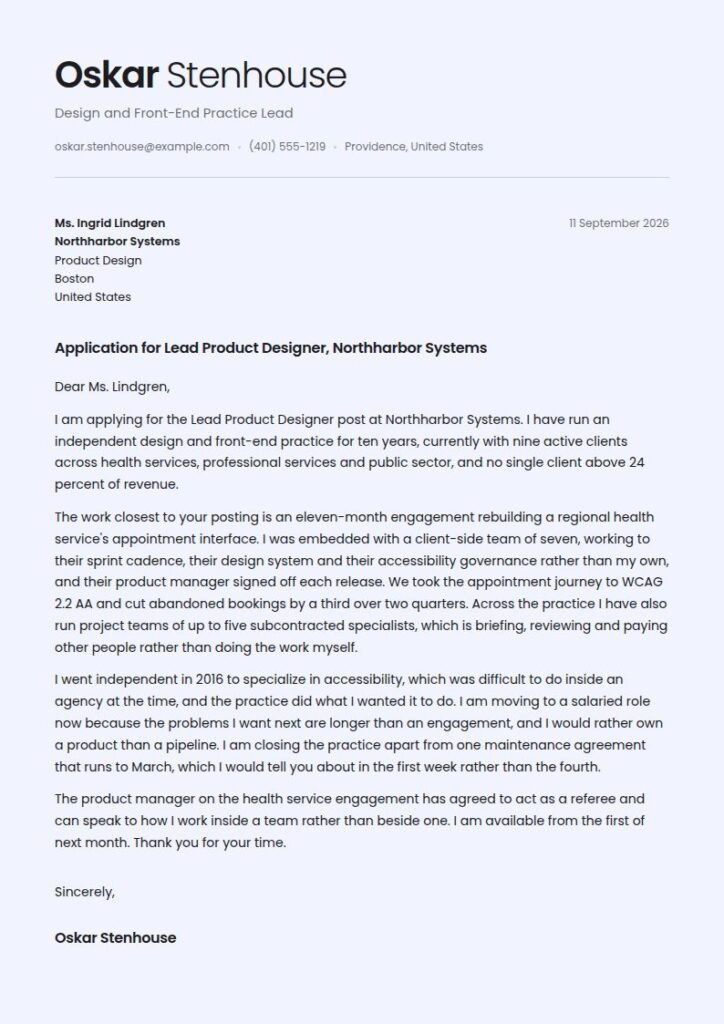
I am applying for the Lead Product Designer post at Northharbor Systems. I have run an independent design and front-end practice for ten years, currently with nine active clients across health services, professional services and public sector, and no single client above 24 percent of revenue.
The work closest to your posting is an eleven-month engagement rebuilding a regional health service's appointment interface. I was embedded with a client-side team of seven, working to their sprint cadence, their design system and their accessibility governance rather than my own, and their product manager signed off each release. We took the appointment journey to WCAG 2.2 AA and cut abandoned bookings by a third over two quarters. Across the practice I have also run project teams of up to five subcontracted specialists, which is briefing, reviewing and paying other people rather than doing the work myself.
I went independent in 2016 to specialize in accessibility, which was difficult to do inside an agency at the time, and the practice did what I wanted it to do. I am moving to a salaried role now because the problems I want next are longer than an engagement, and I would rather own a product than a pipeline. I am closing the practice apart from one maintenance agreement that runs to March, which I would tell you about in the first week rather than the fourth.
The product manager on the health service engagement has agreed to act as a referee and can speak to how I work inside a team rather than beside one. I am available from the first of next month. Thank you for your time.
Sincerely, Oskar Stenhouse
The four doubts, and the clause that closes each
| The doubt | The clause that closes it |
|---|---|
| Will they accept being managed? | Embedded with a client-side team of seven, to their sprint cadence and their governance |
| Did they freelance because nobody would hire them? | I went independent in 2016 to specialize in accessibility |
| Will they leave the moment a client calls? | I am closing the practice apart from one maintenance agreement that runs to March |
| Has anyone ever appraised them? | Their product manager signed off each release and has agreed to act as a referee |
The third row is the one candidates most often skip, because saying it feels like volunteering a problem. It is the opposite. An unresolved question about whether you will keep freelancing on the side is the kind of doubt that surfaces at offer stage, when it is expensive, rather than at screening, when it is a sentence.
Of course, you do not have to close the practice, and plenty of employers accept a legacy client. What they do not accept is finding out later on.
Openings that work
| Instead of | Use |
|---|---|
| As a freelancer, I have worn many hats and thrive on variety | I have run an independent design and front-end practice for ten years, nine active clients, none above 24 percent of revenue |
| I am looking for stability after years of freelancing | I am moving to a salaried role because the problems I want next are longer than an engagement |
| I am a self-starter who needs no supervision | I spent eleven months embedded with a client-side team of seven, to their cadence and governance |
| I have worked with clients across many industries | Health services, professional services and public sector, with two multi-year maintenance agreements |
The second row matters more than it looks. "Looking for stability" invites the reader to hear that you are tired, and tired is not a reason anyone hires. Instead, a sentence about the work you want next is the same fact, told as ambition.
Agencies, startups and large employers want different letters
Write to an agency about utilization, scoping and client handling, because you already speak their language. Write to a startup about breadth and ownership, and about the fact that you have made commercial decisions with consequences. Write to a large employer about process: governance, acceptance, documentation and handover, which is what they are most worried an independent will lack. Offer a client-side referee in all three cases.
Do not open with the range of things you can do; range is what they suspect, not what they doubt. Do not name a client under a non-disclosure agreement. Do not quote your day rate. Do not describe a sole practice as "we". Do not leave your intentions about the practice unstated. Do not apologize for having freelanced.
Most independent contractors chose the arrangement
In July 2023 there were 11.9 million independent contractors in the United States, 7.4 percent of total employment, alongside 2.8 million on-call workers, 945,000 temporary help agency workers and 862,000 workers provided by contract firms (U.S. Bureau of Labor Statistics, Contingent and Alternative Employment Arrangements, released 8 November 2024).
Of those independent contractors, 80.3 percent preferred their arrangement to a traditional work arrangement and 8.3 percent would have preferred a traditional job, and 70.7 percent worked full time (BLS, released 8 November 2024).
You would never quote those numbers in a letter. What they should change is your posture. Independent work is a chosen arrangement for four in five of the people in it, so a letter written apologetically is answering an accusation nobody made. Write the clause about why you went independent as a decision, because for most people it was one.
Length, format and sending it
One page, four paragraphs, 250 to 400 words. PDF unless the portal says otherwise, named for yourself and the role rather than for your practice: oskar-stenhouse-lead-product-designer-letter.pdf.
Address a person. A letter from an independent candidate is already asking for extra trust, and a generic salutation spends some of it before the first sentence.
Keep the numbers identical to your resume. Our freelancer resume example uses the same client mix and engagement figures, so the two read as one account.
If the posting asks for salary expectations, answer against the published median for the occupation and level, not your own last twelve months of billing. Freelance revenue and a salary are not comparable, and anchoring on the wrong one costs you either the offer or the money.
Key takeaways
- To start, open with the practice in one line: years, client mix, concentration.
- Then lead your evidence with an engagement somebody else ran, not one you ran alone.
- Also, name the client-side team size, the cadence and who signed the work off.
- Say why you went independent, as a decision rather than a fallback.
- Say what you are doing with the practice now, before anyone has to ask.
- In addition, offer a client-side referee who can speak to how you work inside a team.
- Above all, do not quote a day rate, and do not compare billings to a salary.
Write your freelancer cover letter in 10 minutes with our AI cover letter builder.
Freelancer cover letter questions, answered
How long should a freelancer cover letter be?
One page, four paragraphs, 250 to 400 words. The extra work this letter has to do is intent, not length: two sentences about why you went independent and what you are doing with the practice will outperform a page of project descriptions.
Should I say I am closing my freelance practice?
Say what is true, in one sentence. Closing it entirely, keeping one legacy client, or winding down over a notice period are all acceptable answers, and all of them beat silence. The doubt about a candidate who might keep freelancing on the side is the one that resurfaces at offer stage, and it is far cheaper to settle in the letter.
How do I prove I can work in a team?
With an embedded engagement, described concretely: the client-side team and its size, whose cadence and tooling you used, how long it ran, and who signed the work off. Managing subcontractors counts as well, because briefing, reviewing and paying other specialists is people work. A claim to be collaborative proves nothing on its own.
Should I mention how much I earned freelancing?
No, and especially not as a comparison to the salary. Billed revenue is not take-home pay, and among full-time workers in July 2023 independent contractors had median usual weekly earnings of $949 against $1,132 for traditional arrangements, which is a comparison that cuts both ways (U.S. Bureau of Labor Statistics, released 8 November 2024). Answer salary questions against the published median for the occupation and level you are applying at.
What if most of my clients are confidential?
Describe them by sector, size and engagement type: "an eleven-month engagement with a regional health service, embedded with a client-side team of seven". That names nobody and carries what a reader needs. Then offer a referee, because a referee is how a confidential engagement becomes checkable without breaching anything.