Keeper Aide, Hoofstock and Small Carnivores Tamar Boghossian
Keeper Aide, African Hoofstock and Small Carnivores
[email protected] | (520) 555-1273 | Tucson, United States
Profile
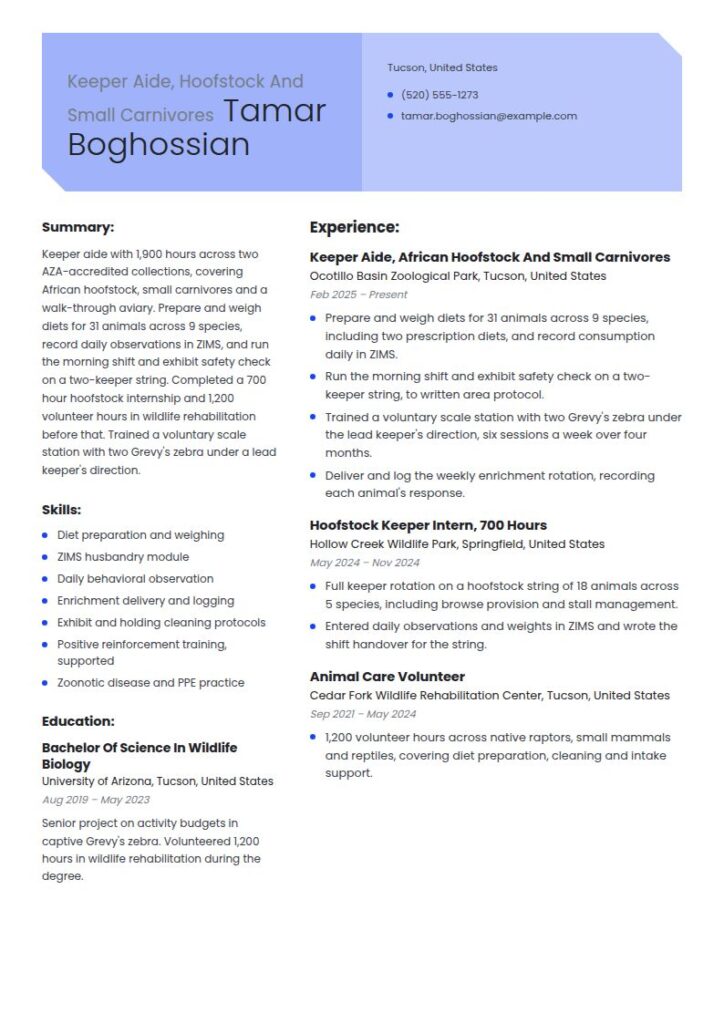
Keeper aide with 1,900 hours across two AZA-accredited collections, covering African hoofstock, small carnivores and a walk-through aviary. Prepare and weigh diets for 31 animals across 9 species, record daily observations in ZIMS, and run the morning shift and exhibit safety check on a two-keeper string. Completed a 700 hour hoofstock internship and 1,200 volunteer hours in wildlife rehabilitation before that. Trained a voluntary scale station with two Grevy's zebra under a lead keeper's direction.
Work Experience
02/2025 - Present, Keeper Aide, African Hoofstock and Small Carnivores, Ocotillo Basin Zoological Park, Tucson, United States
- Prepare and weigh diets for 31 animals across 9 species, including two prescription diets, and record consumption daily in ZIMS.
- Run the morning shift and exhibit safety check on a two-keeper string, to written area protocol.
- Trained a voluntary scale station with two Grevy's zebra under the lead keeper's direction, six sessions a week over four months.
- Deliver and log the weekly enrichment rotation, recording each animal's response.
05/2024 - 11/2024, Hoofstock Keeper Intern, 700 hours, Hollow Creek Wildlife Park, Springfield, United States
- Full keeper rotation on a hoofstock string of 18 animals across 5 species, including browse provision and stall management.
- Entered daily observations and weights in ZIMS and wrote the shift handover for the string.
09/2021 - 05/2024, Animal Care Volunteer, Cedar Fork Wildlife Rehabilitation Center, Tucson, United States
- 1,200 volunteer hours across native raptors, small mammals and reptiles, covering diet preparation, cleaning and intake support.
Education
08/2019 - 05/2023, Bachelor of Science, Wildlife Biology, University of Arizona, Tucson, United States
Senior project on activity budgets in captive Grevy's zebra. Volunteered 1,200 hours in wildlife rehabilitation during the degree.
Skills
Diet preparation and weighing, 80
ZIMS husbandry module, 70
Daily behavioral observation, 75
Enrichment delivery and logging, 75
Exhibit and holding cleaning protocols, 85
Positive reinforcement training, supported, 55
Zoonotic disease and PPE practice, 80
Languages
English, native
Armenian, native
Spanish, intermediate
Certificates
04/2025, CPR and First Aid, American Red Cross
Renewed April 2025.
06/2024, Species360 ZIMS for Husbandry, Species360
Working proficiency in the husbandry module since the 2024 internship.
Summary
A zoo keeper resume is a one to two page document naming the species you have worked, the daily husbandry you are responsible for, the behaviors you have trained and the record systems you keep. This guide gives you three adaptable versions, the trained behavior block that separates keepers from applicants, and an honest read of a competitive entry market.
Zoo Keeper resume examples by experience level
A zoo keeper resume is a one to two page document that names the species you have worked, the daily husbandry you were responsible for, the behaviors you have trained, and the records you kept.
Notice what is not on that list: nothing about loving animals, nothing about a childhood ambition. Every applicant for every keeper post has those, which is why they carry no information. The reader is a curator deciding whether you can be handed a string of animals on Monday, and what they want is evidence of hands.
Resume guide for a zoo keeper resume
This guide and the corresponding zoo keeper resume example will cover:
- How to write a zoo keeper resume, section by section
- The trained behavior block that separates a keeper from an enthusiast
- Three adaptable summaries: keeper aide, keeper and lead keeper
- Record keeping, safety protocol and the AZA context around both
- What the published figures say about pay, and what they do not cover
How to write a zoo keeper resume
Six blocks: contact header, summary, species and collection experience, husbandry and training experience, skills and systems, and education. One page early on, two once you run an area or a training program.
Species go high because they are the first filter. A curator hiring for a carnivore string wants someone who has worked carnivores, and a resume that makes them read to page two to find out is a resume that does not get read.
| Block | What it answers | Where it goes |
|---|---|---|
| Species and collection | What have they actually worked, and at what scale? | Directly under the summary |
| Trained behaviors | Can this animal take part in its own care because of them? | Its own block, not a bullet |
| Daily husbandry | Diets, cleaning, observation, exhibit maintenance: can they do the job? | In experience, with counts |
| Records and systems | Can they keep a defensible record? | With the system named |
Run the finished file through the ATS resume checker before you send it. Zoo and aquarium applications usually go through a portal, and attachments get parsed before a curator opens them.
Choosing the best resume format for a zoo keeper resume
Reverse chronological, with internships and volunteer work written as jobs rather than as an afterthought at the bottom.
That matters here more than in almost any other field, because the entry route runs through unpaid and low-paid work. BLS says so plainly: "Volunteering and internships at zoos and aquariums are excellent ways to gain" animal experience, and most zoos require zookeepers to have a bachelor's degree in biology, animal science or a related field (BLS Occupational Outlook Handbook, animal care and service workers, last modified 27 August 2026).
So a 700 hour internship on a hoofstock string is a job. Give it a title, dates, species, hours and tasks, and put it in experience with everything else. Burying it under "Volunteer Activities" is the most common self-inflicted wound on a keeper resume.
Include your contact information
| ✅ Right | ❌ Wrong |
|---|---|
| Tamar Boghossian | Tamar Boghossian |
| Zoo Keeper, Carnivores and African Hoofstock | Animal lover seeking zoo opportunities |
| 9 years keeper experience, AZA-accredited institutions | Experienced with many kinds of animals |
| (520) 555-1273, [email protected], Tucson, AZ | (520) 555-1273, [email protected] |
The title line tells the reader which string you belong to before they read anything else. If you have worked across areas, name the two you know best rather than claiming all of them.
Make use of a summary
Four lines: species and area, years, the training and record work you own, and one number.
Keeper aide with 1,900 hours across two AZA-accredited collections, covering African hoofstock, small carnivores and a walk-through aviary. Prepare and weigh diets for 31 animals across 9 species, record daily observations in ZIMS, and run the morning shift and exhibit safety check on a two-keeper string. Completed a 700 hour hoofstock internship and 1,200 volunteer hours in wildlife rehabilitation before that. Trained a voluntary scale station with two Grevy's zebra under a lead keeper's direction.
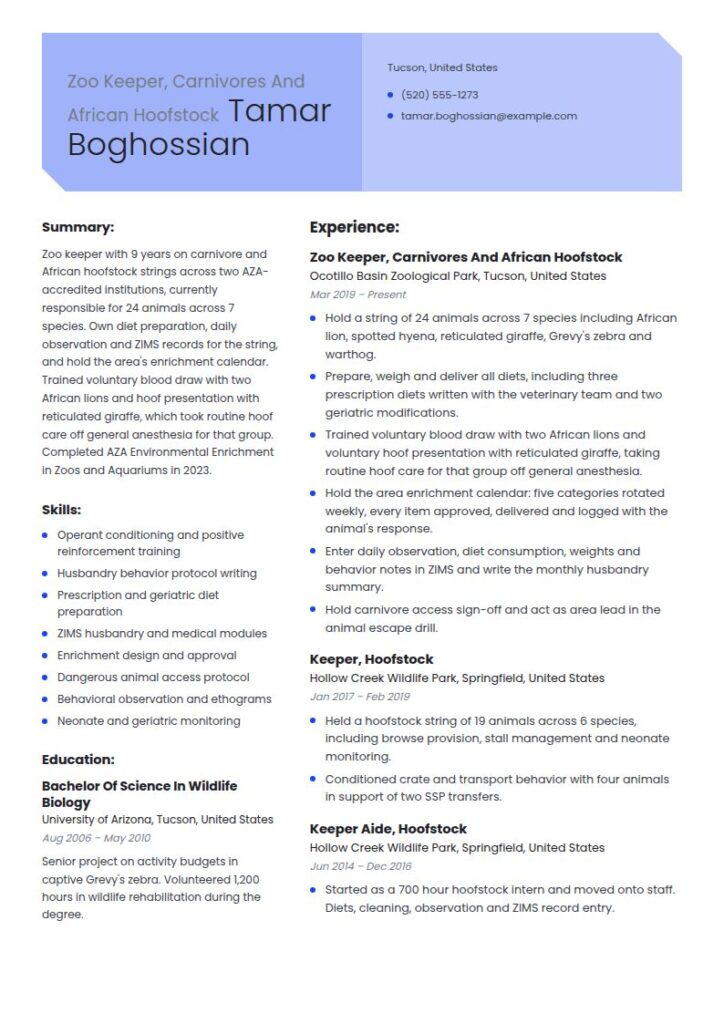
Zoo keeper with 9 years on carnivore and African hoofstock strings across two AZA-accredited institutions, currently responsible for 24 animals across 7 species. Own diet preparation, daily observation and ZIMS records for the string, and hold the area's enrichment calendar. Trained voluntary blood draw with two African lions and hoof presentation with reticulated giraffe, which took routine hoof care off general anesthesia for that group. Completed AZA Environmental Enrichment in Zoos and Aquariums in 2023.
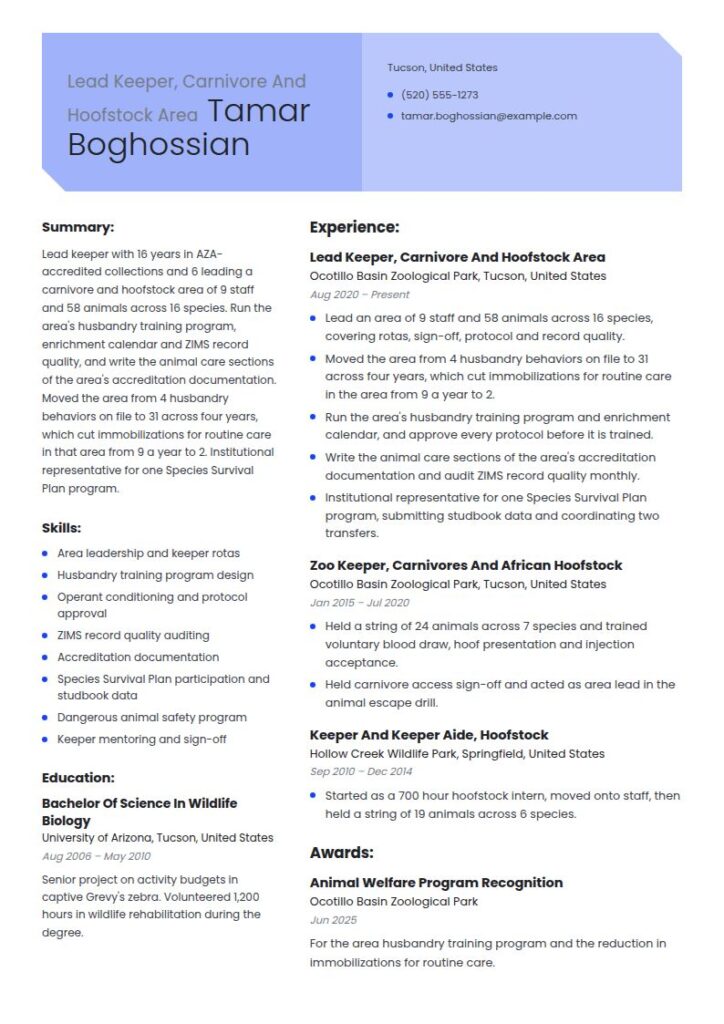
Lead keeper with 16 years in AZA-accredited collections and 6 leading a carnivore and hoofstock area of 9 staff and 58 animals across 16 species. Run the area's husbandry training program, enrichment calendar and ZIMS record quality, and write the animal care sections of the area's accreditation documentation. Moved the area from 4 husbandry behaviors on file to 31 across four years, which cut immobilizations for routine care in that area from 9 a year to 2. Institutional representative for one Species Survival Plan program.
Right vs wrong: the same zoo keeper summary, twice
| ✅ Right | ❌ Wrong |
|---|---|
| Zoo keeper with 9 years on carnivore and African hoofstock strings, currently responsible for 24 animals across 7 species. | Animal care professional with a lifelong love of wildlife and conservation. |
| Own diet preparation, daily observation and ZIMS records for the string. | Responsible for feeding, cleaning and general animal care duties. |
| Trained voluntary blood draw with two African lions and hoof presentation with reticulated giraffe. | Assisted with animal training and enrichment activities. |
| Completed AZA Environmental Enrichment in Zoos and Aquariums in 2023. | Committed to ongoing professional development. |
The right column describes a keeper. The left describes someone who has been near keepers, and a curator reading eighty applications for one post tells them apart in four seconds.
Outline your husbandry experience
Institution, area or string, dates, then the species and the count, then three to five lines each naming a task and a number.
| Instead of | Use |
|---|---|
| Fed and cared for animals | Prepare and weigh diets for 24 animals across 7 species, including three prescription and two geriatric diets |
| Cleaned enclosures | Run daily cleaning and substrate management on four carnivore holdings and two giraffe stalls, to written protocol |
| Provided enrichment | Hold the area enrichment calendar: 5 categories rotated weekly, each item approved and logged with the animal's response |
| Kept records | Enter daily observation, diet consumption, weights and behavior notes in ZIMS for the full string |
| Helped with training | Trained voluntary hoof presentation with two reticulated giraffe using operant conditioning and a target, over 14 weeks |
| Worked with dangerous animals | Hold carnivore access sign-off: two-lock protocol, shift-and-confirm before entry, and the escape drill role |
Zoo Keeper, Carnivores and African Hoofstock, Ocotillo Basin Zoological Park, Tucson, AZ, March 2019 to Present. 24 animals across 7 species, including African lion, spotted hyena, reticulated giraffe, Grevy's zebra and warthog.
Prepare, weigh and deliver diets for the full string, including three prescription diets written with the veterinary team and two geriatric modifications.
Trained voluntary blood draw with two African lions and voluntary hoof presentation with reticulated giraffe, taking routine hoof care for that group off general anesthesia.
Hold the area enrichment calendar: five categories rotated weekly, every item approved, delivered and logged with the animal's response.
Enter daily observation, diet consumption, weights and behavior notes in ZIMS, and write the monthly husbandry summary.
Hold carnivore access sign-off and act as area lead in the animal escape drill.
The husbandry behaviors you have trained, and what each one replaced
This is the block that separates a keeper from an applicant, and it is the one almost nobody writes properly.
Modern zoo training is not a show. It is operant conditioning used so an animal can take part in its own veterinary and husbandry care: stepping onto a scale, presenting a foot, holding still against a mesh for an injection or blood draw, shifting between spaces on cue, entering a crate calmly before a transport. Each behavior has a purpose, and the purpose is almost always that something which used to require immobilization or restraint now does not.
So write the behavior, the species, the method and what it replaced.
Voluntary blood draw, African lion, 2 animals, trained 2022 to 2023, positive reinforcement with mesh presentation and a bridge. Replaced immobilization for routine geriatric bloodwork.
Voluntary hoof presentation, reticulated giraffe, 3 animals, trained 2021, target and shaping. Routine hoof care for the group now done awake.
Voluntary injection and vaccine acceptance, spotted hyena, 2 animals, trained 2023.
Crate and transport conditioning, warthog and Grevy's zebra, 4 animals, 2020 to 2024, supporting two SSP transfers.
Scale station and voluntary weights, all 24 animals on the string, weekly.
Shift and recall on cue, full string, maintained daily as a safety behavior.
Six things are legible there to a reader who does this for a living: species, number of animals, method, timeframe, clinical or operational purpose, and the fact that you are counting. A species list with "enrichment and training" beside it proves none of them.
If you have trained little yet, say what you supported and be exact. "Assisted a lead keeper on a scale station protocol with two Grevy's zebra, six sessions a week for four months" is honest and far better than a claim you cannot describe in an interview.
Say which records system, and say what the records are for
Record keeping is a third of this job and the part applicants skip. Name the system.
The Zoological Information Management System, ZIMS, is maintained by Species360 and used by over 1,400 member organizations in more than 100 countries, with modules for Husbandry, Medical, Studbooks, Aquatics, Education and Animal Welfare (Species360, 2026). Daily husbandry entry is one line. Work in the medical module alongside veterinary staff, or a studbook contribution, are separate lines, because they are different levels of trust.
Records feed real institutional obligations. AZA manages nearly 300 Species Survival Plan Programs, each responsible for a population studbook, with the Population Management Center working with program leaders to develop breeding and transfer plans (Association of Zoos and Aquariums). The weights, diets and observations you enter are the raw material for those plans and for the accreditation file.
Write it as scope, not software: "Daily husbandry records in ZIMS for a 24 animal string, plus weight and body condition data submitted to two SSP studbooks."
Build a snapshot of your key skills
Four groups: husbandry, training and behavior, records and systems, and safety and compliance. Keep them concrete.
Husbandry: Diet preparation and weighing, Prescription and geriatric diets, Substrate and holding management, Exhibit cleaning protocols, Browse and forage provision, Neonate and geriatric monitoring
Training and behavior: Operant conditioning, Positive reinforcement training, Target and bridge work, Shaping and desensitization, Husbandry behavior protocol writing, Enrichment design and approval, Ethograms
Records and systems: ZIMS husbandry module, ZIMS medical module, Studbook data submission, Shift handover writing, Diet and body condition tracking
Safety and compliance: Dangerous animal access protocol, Two-lock and shift-and-confirm procedure, Animal escape drill role, Radio discipline, Zoonotic disease and PPE practice, Quarantine and preshipment procedure
Safety belongs on the page in that form, as named protocol rather than a claim to be careful. It is one of the areas AZA evaluates in accreditation, alongside animal welfare, veterinary care, conservation, education, guest services, physical facilities, staffing, finance and governing body (Association of Zoos and Aquariums). A candidate who writes the protocol correctly is saying they have worked somewhere that had one.
List your education and certifications
Degree first, because most zoos ask for one. Then AZA professional courses, then the practical certifications that let you be scheduled.
Bachelor of Science, Wildlife Biology, University of Arizona, Tucson, AZ, 2010. Senior project on activity budgets in captive Grevy's zebra.
AZA Professional Development Courses: Environmental Enrichment in Zoos and Aquariums (2023), Animal Training Applications in Zoo and Aquarium Settings (2021), Institutional Records Keeping (2019).
Species360 ZIMS for Husbandry, working proficiency since 2016; ZIMS for Medical, data entry access since 2021.
Certifications: American Red Cross CPR and First Aid, renewed 2026. Chemical immobilization safety awareness, institutional, 2022. Commercial driver license, Class B, for animal transport.
Internship: Hoofstock Keeper Intern, 700 hours, Hollow Creek Wildlife Park, 2014.
AZA runs week-long intensive professional development courses including Environmental Enrichment in Zoos and Aquariums, Animal Training Applications in Zoo and Aquarium Settings, Managing Animal Enrichment and Training Programs, Institutional Records Keeping, Animal Welfare: Evidence-Based Management and Principles of Elephant Management I and II (Association of Zoos and Aquariums). They differentiate a resume because they cost time and are usually employer-sponsored, so one says somebody invested in you.
List species with counts and the string they sat in. Write internships and volunteer hours as jobs, with hours and tasks. Give trained behaviors with the species, the method and what the behavior replaced. Name the records system and the modules you have access to. Write safety as named protocol. Say which AZA courses you completed and when.
Do not open with how much you love animals; every file does. Do not write "various species" when the list is the point. Do not claim a behavior you supported rather than trained, because the interview finds it in one question. Do not pad a thin resume with childhood pet care.
Choose the right layout and design
Single column, plain type at 11 or 12 point, no photograph, no animal graphics. Two pages is normal here once you have a species list, a behavior list and a course list, because lists take room.
Keep the species list as a list rather than a paragraph, because a curator scans it for the taxon they are hiring. If you have worked many taxa, group them: carnivores, hoofstock, primates, birds, herptiles, aquatics, with counts under each.
Zoo keeper job market and outlook
Zoo keeper is not a Bureau of Labor Statistics occupation. The Occupational Outlook Handbook covers broad occupations rather than job titles, and there is no Handbook profile for zoo keepers.
What there is: the animal care and service workers profile, which names the job inside it. "Zookeepers care for animals in zoos. They plan diets, feed animals, and monitor the animals' eating patterns", and most zoos require zookeepers to have a bachelor's degree in biology, animal science or a related field (BLS Occupational Outlook Handbook, animal care and service workers, last modified 27 August 2026). Zoo keepers are counted inside the animal caretakers line, which also holds kennel attendants, shelter staff and pet sitters, so no published median is specific to zoo work.
So bracket it, and say which figure is which.
| Bracketing occupation or line | Employment, 2025 | Change, 2025 to 2035 | Annual openings | Median annual wage, May 2025 |
|---|---|---|---|---|
| Animal care and service workers, all | 413,000 | 11 percent growth | About 69,400 | Animal caretakers $35,360; animal trainers $39,990 |
| Animal caretakers (the line zoo keepers sit in) | 365,300 | 12 percent growth, 44,100 new jobs | Part of the 69,400 | $35,360, or $17.08 an hour |
| Zoologists and wildlife biologists (same entry degree) | 19,500 | 4 percent growth | About 1,400 | $76,780 |
Source: U.S. Bureau of Labor Statistics, Occupational Outlook Handbook, animal care and service workers and zoologists and wildlife biologists, May 2025 wage data and 2025 to 2035 projections, both last modified 27 August 2026.
A degree-required job paid on the caretaker line
Two figures from the same Handbook, published on the same day, describe the whole shape of this career.
Animal caretakers had a median annual wage of $35,360, or $17.08 an hour, in May 2025, with the lowest 10 percent under $27,250 and the highest 10 percent over $50,060. Within that line, arts, entertainment and recreation, the industry group zoos and aquariums belong to, paid a median of $37,460 and accounted for 5 percent of animal caretaker employment, the smallest of the four industries listed (BLS Occupational Outlook Handbook, animal care and service workers, May 2025, published 27 August 2026).
Zoologists and wildlife biologists, an occupation with the same typical entry-level education of a bachelor's degree, had a median of $76,780 across 19,500 jobs (BLS Occupational Outlook Handbook, May 2025, published 27 August 2026).
Zoo keeping asks for a four year degree, pays on the caretaker line, and the part of that line where zoos sit is its smallest slice. That is not a reason to avoid the field, but it is why the resume has to work hard. Applicants outnumber posts, entry runs through internships and volunteer hours that are often unpaid, and the file that wins carries species, counts, trained behaviors and record systems rather than enthusiasm.
The accreditation context tells you which employers you are competing for. Roughly 10 percent of the nearly 2,150 animal exhibitors licensed by the United States Department of Agriculture are AZA accredited, and member institutions repeat the entire accreditation process every five years (Association of Zoos and Aquariums). Accredited institutions are a small, visible part of the sector, and experience inside one is read as a quality signal elsewhere, which is part of why entry posts there attract so many applications.
What salary you can expect as a zoo keeper
There is no published zoo keeper median, so use the line you sit in and say what it is. Animal caretakers had a median annual wage of $35,360, or $17.08 an hour, in May 2025, with the lowest 10 percent under $27,250 and the highest 10 percent over $50,060 (BLS Occupational Outlook Handbook, May 2025, published 27 August 2026).
Within that occupation, arts, entertainment and recreation paid $37,460, retail trade $35,290, other personal services $35,190 and professional, scientific and technical services $33,350 (BLS, May 2025). Zoos and aquariums fall in the first, the best paid of the four and also the smallest.
Three things move pay here, and all three are resume material. The ladder from keeper aide to keeper to lead or senior keeper to area supervisor and curator, which is where the real steps are. Specializing, because elephants, great apes, marine mammals, venomous herptiles and aquatics all sit behind additional institutional training. And the work adjacent to keeping, such as records, training program coordination or a registrar role, where responsibilities are documented and bands are usually higher.
Key takeaways for a zoo keeper resume
- Lead with species and counts; they are the first filter a curator applies.
- Write internships and volunteer hours as jobs, with hours, species and tasks.
- Give a trained behavior block: species, method, timeframe and what it replaced.
- Name your records system and the modules you have access to.
- Write safety as named protocol rather than as a claim to be careful.
- List AZA professional courses with the year.
- Keep it factual. The enthusiasm is assumed in every file in the pile.
Build your zoo keeper resume in 15 minutes with our AI resume builder.
Related resume examples in other fields
- Dog trainer resume
- Dog walker resume
- Farm worker resume
- Scientist resume
- Volunteer resume
- Tour guide resume
- Entry-level resume
- One-year experience resume
- Career change resume
- Translator resume
- Part-time job resume
- General resume
Pair it with a matching zoo keeper cover letter.
Zoo keeper resume questions, answered
How long should a zoo keeper resume be?
One page for a keeper aide or first keeper post, two once you carry a species list, a trained behavior list and professional courses. Two pages is normal here, provided the second page is lists rather than padding.
Do I need a degree to be a zoo keeper?
Usually, yes. BLS states that most zoos require zookeepers to have a bachelor's degree in biology, animal science or a related field, while the broader occupation of animal care and service workers typically needs only a high school diploma or equivalent (BLS Occupational Outlook Handbook, last modified 27 August 2026). Degree subject matters less than people fear: biology, zoology, animal science, wildlife and psychology all appear in keeper strings. Hands matter more, which is why the internship section carries so much weight.
How do I get keeper experience if every job asks for experience?
Through the routes BLS names: "Volunteering and internships at zoos and aquariums are excellent ways to gain" animal experience (BLS Occupational Outlook Handbook, last modified 27 August 2026). In practice that means wildlife rehabilitation centers, nature centers, small licensed collections, veterinary clinics, humane societies and seasonal keeper aide posts alongside zoo internships. Count the hours, name the species, and write every one as a job. A candidate with 1,900 documented hours across two collections is a serious applicant without a paid keeper title.
What is the difference between a keeper aide, a keeper and a lead keeper?
Access, autonomy and ownership. A keeper aide works to protocol under supervision, usually with limited or no access to dangerous animal spaces. A keeper holds a string, owns its diets, records and daily decisions, and is signed off for the access that string requires. A lead keeper owns the area's program: training, enrichment calendar, record quality, rotas and part of the accreditation documentation. Titles vary, so describe the responsibility rather than relying on the title.
Should I put trained behaviors on the resume if I have only supported them?
Yes, but write them as support and be exact. "Ran six sessions a week on a scale station protocol under the lead keeper, four months, two Grevy's zebra" is a strong line. Claiming you trained a behavior you assisted with is the fastest way to lose an interview, because the first follow-up question is about the criteria you set and the approximations you used.
Does AZA accreditation matter when I choose where to apply?
It is worth knowing about. About 10 percent of the nearly 2,150 USDA-licensed animal exhibitors are AZA accredited, member institutions repeat the full process every five years, and the evaluation covers animal welfare, veterinary care, conservation, education, guest services, physical facilities, safety, staffing, finance and governing body (Association of Zoos and Aquariums). Experience at an accredited institution reads as a quality signal elsewhere. Good keeper experience exists outside AZA accreditation too, and the way to make it count is to write the husbandry, protocols and records with the same precision.