Marketing Analyst Yuki Nakashima
Marketing Analytics Intern (paid)
[email protected] | (206) 555-2270 | Seattle, United States
Profile
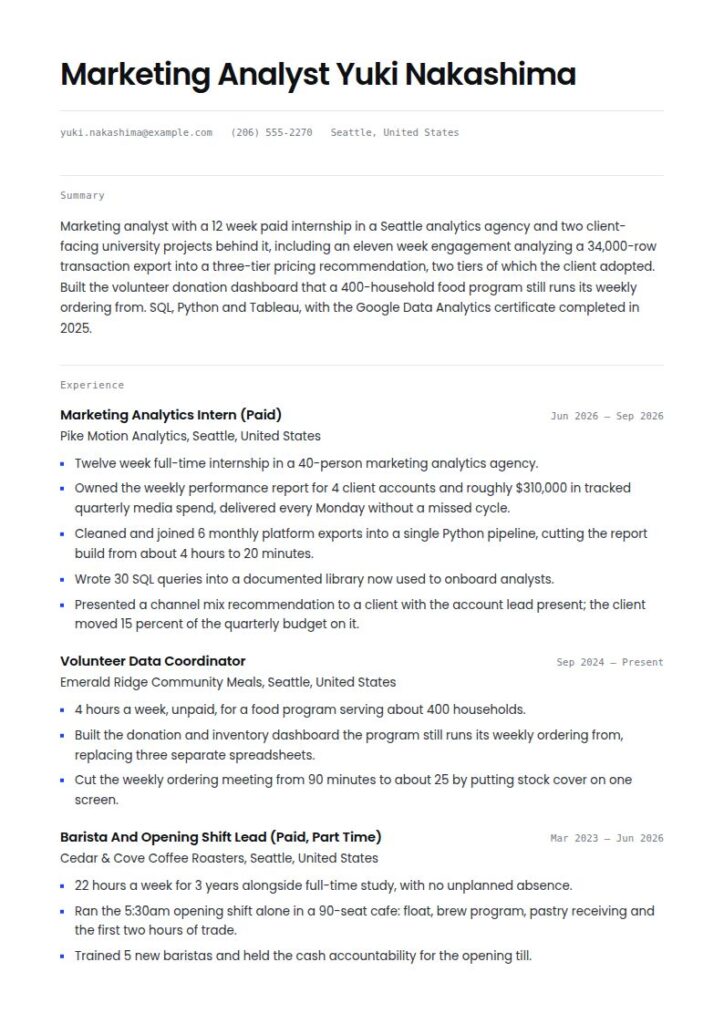
Marketing analyst with a 12 week paid internship in a Seattle analytics agency and two client-facing university projects behind it, including an eleven week engagement analyzing a 34,000-row transaction export into a three-tier pricing recommendation, two tiers of which the client adopted. Built the volunteer donation dashboard that a 400-household food program still runs its weekly ordering from. SQL, Python and Tableau, with the Google Data Analytics certificate completed in 2025.
Work Experience
06/2026 - 09/2026, Marketing Analytics Intern (paid), Pike Motion Analytics, Seattle, United States
- Twelve week full-time internship in a 40-person marketing analytics agency.
- Owned the weekly performance report for 4 client accounts and roughly $310,000 in tracked quarterly media spend, delivered every Monday without a missed cycle.
- Cleaned and joined 6 monthly platform exports into a single Python pipeline, cutting the report build from about 4 hours to 20 minutes.
- Wrote 30 SQL queries into a documented library now used to onboard analysts.
- Presented a channel mix recommendation to a client with the account lead present; the client moved 15 percent of the quarterly budget on it.
09/2024 - Present, Volunteer Data Coordinator, Emerald Ridge Community Meals, Seattle, United States
- 4 hours a week, unpaid, for a food program serving about 400 households.
- Built the donation and inventory dashboard the program still runs its weekly ordering from, replacing three separate spreadsheets.
- Cut the weekly ordering meeting from 90 minutes to about 25 by putting stock cover on one screen.
03/2023 - 06/2026, Barista and Opening Shift Lead (paid, part time), Cedar & Cove Coffee Roasters, Seattle, United States
- 22 hours a week for 3 years alongside full-time study, with no unplanned absence.
- Ran the 5:30am opening shift alone in a 90-seat cafe: float, brew program, pastry receiving and the first two hours of trade.
- Trained 5 new baristas and held the cash accountability for the opening till.
Education
09/2022 - 06/2026, Bachelor of Arts, Business Administration, Information Systems option, University of Washington, Seattle, United States
Conferred June 2026. Relevant coursework: Database Systems, Applied Regression, Marketing Analytics, Data Visualization.
Skills
SQL including joins, window functions and CTEs, 75
Python with pandas, 70
Tableau dashboard design, 75
Data cleaning and validation, 80
Cohort and segmentation analysis, 65
Google Analytics 4, 70
Spreadsheet modeling, 85
Languages
English, native
Japanese, native
Certificates
10/2025, Google Data Analytics Professional Certificate, Google
SQL, R, spreadsheet analysis and data visualization.
02/2026, Tableau Desktop Specialist, Tableau
Dashboard design and calculated fields.
Summary
An entry level resume is a one page document written for someone who has not yet held the job title they are applying for. This guide ranks the evidence that substitutes for paid experience, shows how to write each kind as a job with scope and a number, and gives three adaptable versions plus current Bureau of Labor Statistics and NACE figures on entry level hiring.
Entry Level resume examples by experience level
In short, an entry level resume is a one page document someone writes before holding the job title they want, and its whole task is to show they have already done pieces of the work anyway.
However, almost everyone in this position writes the page the wrong way round. First, they lead with what they lack, hedged into an objective statement, then list unpaid work in a vocabulary that announces it as unpaid: "assisted with", "was involved in", "helped to". As a result, a capstone that ran eleven weeks for a real client, with a real dataset and a delivered recommendation, becomes one line under "Academic Projects" and dies there.
The fix is not confidence. Instead, it is ranking and translation: knowing which of your material counts for most, and writing each piece as a job with a scope and a number in it.
Resume guide for an entry level resume
To start, this guide and the corresponding entry level resume example will cover:
- First, how to write an entry level resume, section by section
- Then, the evidence ladder: what substitutes for a job title, in order
- Also, three adaptable summaries: first application, two years in and team lead
- Next, how to turn unpaid scope into a bullet with a number
- Finally, what the data says about entry level hiring, and what sets your pay
How to write an entry level resume
In short, five sections: contact header, summary, experience, projects, and education with skills and certifications. As a rule, one page, and the words "entry level" appear nowhere on it.
In particular, experience is not a synonym for paid employment on this page. In fact, it is the container for everything with a scope, a duration and an outcome, whatever the payment arrangement was. So give that arrangement its own word inside the entry and stop worrying about it.
| Section | What it is answering | Where it goes |
|---|---|---|
| Header and title line | What job is this person applying for? | Top, in the posting's own words |
| Summary | What have they actually done that resembles the work? | Three lines, under the header |
| Experience | What scope have they held, and with what result? | Reverse chronological, paid and unpaid together |
| Projects | Can they show the work rather than describe it? | Two entries maximum, each with a link or artifact |
| Education, skills, certifications | Do they clear a stated requirement? | Foot of the page, compact |
Write the scope, then write the number, then write the verb last
The reason unpaid work reads as unpaid is the verb. "Assisted with market research for a local business" describes a position in a hierarchy. It says nothing about what was done.
Reverse the order. Start with scope: how many, how long, how much, for whom. "Eleven weeks, a 34,000-row transaction export, one client, one delivered pricing recommendation." Then attach the outcome: "the client adopted two of the three tiers." Only then pick the verb, and pick the plainest one: built, ran, analyzed, delivered, wrote.
What you end up with is "Analyzed a 34,000-row transaction export over an eleven week engagement and delivered a three-tier pricing recommendation, two tiers of which the client adopted." Nothing in it is inflated, and nothing announces that no money changed hands.
Run the finished file through the ATS resume checker before you apply. Entry level postings attract the largest applicant volumes of any level, which is where automated filtering is heaviest.
Choosing the best resume format for an entry level resume
Reverse chronological, one page, single column. This holds even when your most impressive entry is a project and your most recent entry is a job in a different industry.
The temptation is a functional layout, on the theory that it foregrounds what you can do rather than where you have been. It backfires. A reader who cannot see dates assumes the dates are the problem, and at entry level they almost never are: readers expect and forgive an early career, but not a page that looks evasive. If you can show the work, put a portfolio link in the header and let the page index it.
Include your contact information
| ✅ Right | ❌ Wrong |
|---|---|
| Yuki Nakashima | Yuki Nakashima |
| Marketing Analyst | Recent graduate seeking an entry-level position |
| Seattle, WA | 4417 Stonebridge Court, Apt 3B, Seattle, WA 98105 |
| (206) 555-2270, [email protected] | (206) 555-2270, [email protected] |
| Portfolio: three case studies with data and method | Objective: To obtain a position where I can grow |
In the header, put the target job title, taken from the posting. In other words, not "entry level marketing analyst", not "aspiring" anything. If the posting says Marketing Analyst, your header says Marketing Analyst, and the dates underneath supply the context honestly.
Above all, the objective statement is the most damaging line on an entry level resume. After all, it spends your most valuable inches describing what you want from the employer, in a document whose only job is to describe what they get.
Make use of a summary
For the summary, three lines: what you can do and where you did it, one scope figure, and the credential or tool that makes you usable on day one.
Marketing analyst with a 12 week paid internship in a Seattle analytics agency and two client-facing university projects behind it, including an eleven week engagement analyzing a 34,000-row transaction export into a three-tier pricing recommendation, two tiers of which the client adopted. Built the volunteer donation dashboard that a 400-household food program still runs its weekly ordering from. SQL, Python and Tableau, with the Google Data Analytics certificate completed in 2025.
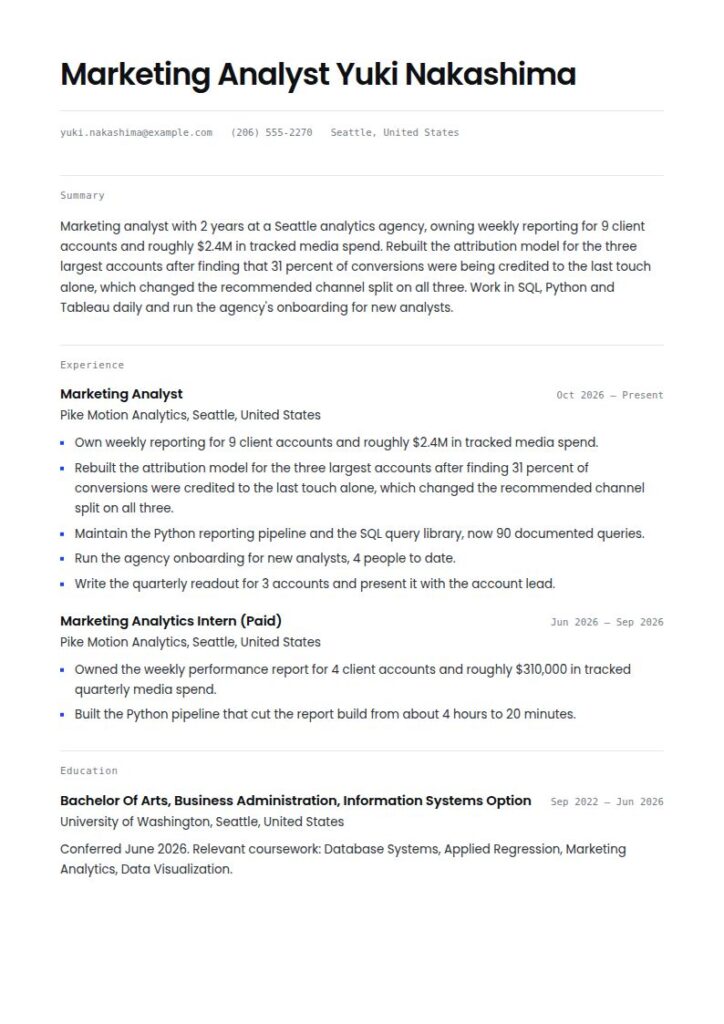
Marketing analyst with 2 years at a Seattle analytics agency, owning weekly reporting for 9 client accounts and roughly $2.4M in tracked media spend. Rebuilt the attribution model for the three largest accounts after finding that 31 percent of conversions were being credited to the last touch alone, which changed the recommended channel split on all three. Work in SQL, Python and Tableau daily and run the agency's onboarding for new analysts.
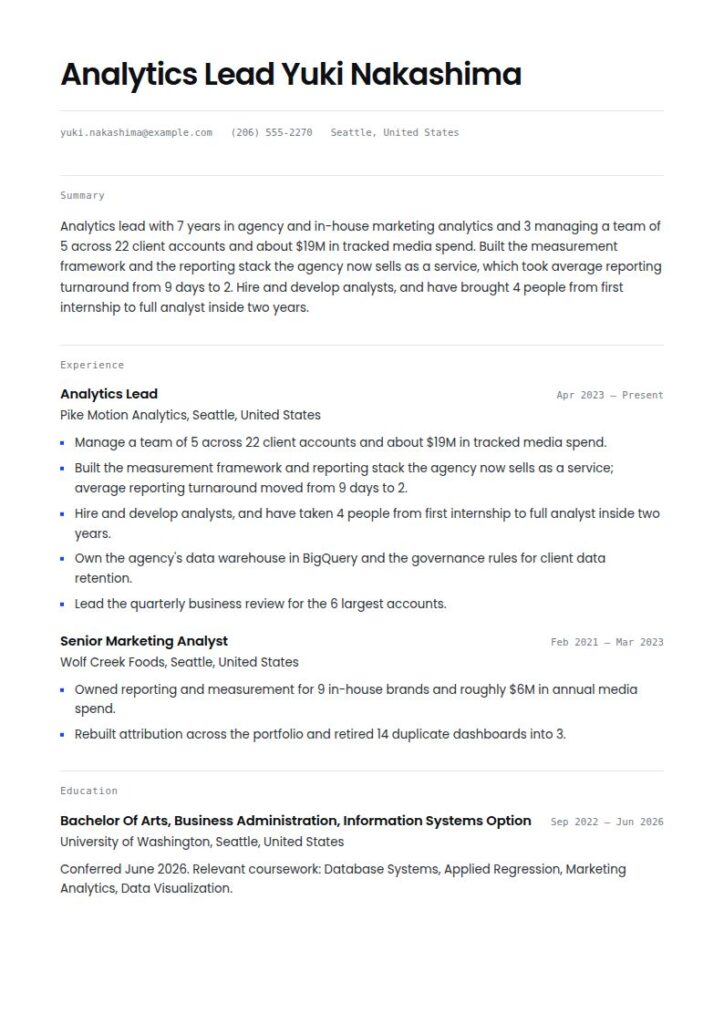
Analytics lead with 7 years in agency and in-house marketing analytics and 3 managing a team of 5 across 22 client accounts and about $19M in tracked media spend. Built the measurement framework and the reporting stack the agency now sells as a service, which took average reporting turnaround from 9 days to 2. Hire and develop analysts, and have brought 4 people from first internship to full analyst inside two years.
Right vs wrong: the same entry level summary, twice
| ✅ Right | ❌ Wrong |
|---|---|
| Marketing analyst with a 12 week paid internship in a Seattle analytics agency. | Recent graduate seeking an entry-level opportunity in marketing. |
| Eleven week client engagement on a 34,000-row transaction export, delivered as a three-tier pricing recommendation. | Completed various academic projects involving data analysis. |
| Built a donation dashboard a 400-household food program still runs its weekly ordering from. | Volunteered with a local nonprofit organization. |
| SQL, Python and Tableau, Google Data Analytics certificate completed 2025. | Familiar with a range of data analysis tools and eager to learn. |
By contrast, every line in the right column is a thing that happened, with a size attached. Meanwhile, the left column strips the sizes from the same four facts, and that is the whole difference between the two resumes.
Outline your experience
For experience, use one section, in date order, holding paid work, internships and any unpaid role with a defined scope. For each entry, give organization, city and state, your title, dates by month and year, and one word for the arrangement: paid, credit-bearing, volunteer, contract.
| Instead of | Use |
|---|---|
| Participated in a capstone project | Analyzed a 34,000-row transaction export over 11 weeks into a three-tier pricing recommendation |
| Worked part time while studying | Ran the morning shift alone at a 90-seat coffee house, 22 hours a week for 3 years, no unplanned absence |
Marketing Analytics Intern (paid), Pike Motion Analytics, Seattle, WA, June 2026 to September 2026
Twelve week full-time internship in a 40-person marketing analytics agency.
Owned the weekly performance report for 4 client accounts and roughly $310,000 in tracked quarterly media spend, delivered every Monday without a missed cycle.
Cleaned and joined 6 monthly platform exports into a single Python pipeline, which cut the build time for that report from about 4 hours to 20 minutes and is still in use.
Wrote 30 SQL queries into a documented library now used to onboard analysts.
Presented a channel mix recommendation to a client directly, with the account lead in the room; the client moved 15 percent of the quarterly budget on the strength of it.
The evidence ladder when you have no job title yet
Of course, not all substitutes for paid experience are worth the same, and the ordering is stable enough to plan around. Here they are, strongest first, with what each rung must contain to count.
| Rung | Why it ranks here | What makes it count |
|---|---|---|
| 1. Internship, paid or credit-bearing | The work itself, supervised, inside a real organization | Duration in weeks, what you owned, one delivered outcome |
| 2. Coursework with a real client or dataset | Real constraints, real stakeholder, real deadline | The client, the size, the deliverable, what was adopted |
| 3. Part-time or unrelated paid work | It proves what employers worry about: attendance, judgment, customers, money | Hours a week, duration, volume, one responsibility held alone |
| 4. Volunteer work with defined scope | The same shape as a job when it has a rota and an owner | Hours, duration, what you owned, who uses it |
| 5. Certification | Verifiable, dated, third-party, and closes a stated requirement | Issuing body, date earned, the tool it maps to |
| 6. Portfolio artifact | Shows the work instead of describing it | A link and one line on the problem it solved |
Writing entry level evidence that counts
Three things follow, and they matter more than the ordering itself.
Rung three is the one people cut, and the one hiring managers read. Three years of part-time work in a coffee house is not filler on a marketing analyst's resume. It is evidence of attendance, cash accountability, working with the public under time pressure, and staying somewhere. Write it as a job with hours and volume, four lines, and do not apologize for it being unrelated. The unrelated part is visible; the reliability is not unless you write it.
Every rung is written in the same grammar. Title, organization, dates, one word for the arrangement, then bullets with numbers. The moment you format volunteer work differently from paid work, the reader sorts it into a different pile.
Unpaid scope translates; unpaid vocabulary does not. A capstone's scope can be genuinely comparable to a junior task: a real dataset, a real client, eleven weeks, a decision at the end. What kills it is the language it arrives in.
| Instead of | Use |
|---|---|
| Group capstone project analyzing customer data for a local retailer | Pricing analysis for a 4-store grocery cooperative, 11 weeks, team of 3, my scope was the transaction data |
| Used various statistical techniques to identify trends | Segmented 34,000 transactions into 5 baskets and tested three price tiers against each |
| Presented findings to the client | Delivered a three-tier recommendation; the client adopted two tiers and reported the outcome back at week 14 |
Pricing Analysis, Sound Harvest Grocery Cooperative, Seattle, WA, January to April 2026 (university capstone, real client)
Team of 3, eleven weeks, with the cooperative's general manager as client.
Cleaned and analyzed a 34,000-row transaction export covering 4 stores and 18 months; my scope was the transaction data and segmentation.
Segmented purchases into 5 basket types and tested three candidate price tiers against each.
Delivered a three-tier pricing recommendation with a written method appendix; the cooperative adopted two tiers and reported results back at week 14.
Two project entries is the maximum. Otherwise, a third reads as a substitute for having applied for anything.
Build a snapshot of your key skills
For skills, list eight to twelve named entries in two or three groups. Name only what an employer could test you on, because at this level a screening exercise is common.
Data: SQL including joins, window functions and CTEs, Python with pandas, spreadsheet modeling to an advanced level, data cleaning and validation
Analysis and reporting: Tableau dashboard design, cohort and segmentation analysis, A/B test readout, attribution and channel mix reporting, written method documentation
Platforms: Google Analytics 4, Google Ads and Meta Ads reporting interfaces, BigQuery, Git for version control
Delete any skill you would not want to demonstrate if someone handed you a laptop. At entry level the interviewer is more likely to test than to take your word.
List your education and certifications
For education, give degree, institution, city and state, and the year of conferral or expected conferral. Include GPA only if it is strong, and only for about two years. Then certifications with the issuing body and the date.
Bachelor of Arts, Business Administration, Information Systems option, University of Washington, Seattle, WA, conferred June 2026
Relevant coursework: Database Systems, Applied Regression, Marketing Analytics, Data Visualization
Certifications: Google Data Analytics Professional Certificate, Google, earned October 2025. Tableau Desktop Specialist, Tableau, earned February 2026.
Portfolio: three case studies with data, method and outcome
Also keep the coursework line to four courses that map to the posting, and delete it once you have a year of paid work in the field. Similarly, a certification with an issuing body and a date does something a coursework list cannot: it is third-party verifiable, which your unpaid entries are not.
Choose the right layout and design
As for layout, single column, 10.5 to 12 point, month and year dates, no photograph, no skill rating bars. One page. If you fall short of it, add detail to the entries you have rather than adding sections.
Put the posting's job title in your header. Write every entry in the same grammar, paid or not. Say the arrangement in one word inside the entry: paid, credit-bearing, volunteer. Give a scope figure in the first bullet of each entry. Keep unrelated part-time work and write its hours and volume. Name certifications with the issuing body and the date. Link a portfolio if the work can be shown.
Do not write "entry level", "aspiring" or "seeking" anywhere on the page. Do not open with an objective statement. Do not separate academic work into a section that reads as a consolation prize. Do not list a tool you could not demonstrate. Do not use a functional format to hide a short history. Do not pad to two pages.
Entry level job market and outlook
Notably, there is no Bureau of Labor Statistics employment level, growth projection or median wage for "entry level", because it describes a career stage rather than an occupation. What BLS does publish is employment by the education an occupation typically needs to enter it, and that is the closest published view of the doors you are knocking on.
| Measure | Value |
|---|---|
| Jobs in occupations typically needing a bachelor's degree, 2025 | 42,870,100 (25.2 percent of total employment) |
| Projected by 2035 | 45,292,000, up 5.6 percent |
| Jobs in occupations typically needing a high school diploma or equivalent, 2025 | 60,319,000 (35.4 percent of total) |
| Projected by 2035 | 61,503,400, up 2.0 percent |
| Jobs in occupations needing no formal educational credential, 2025 | 40,201,200 (23.6 percent of total) |
| Projected by 2035 | 41,139,800, up 2.3 percent |
| All occupations, projected change 2025-35 | 3.5 percent |
| Unemployment rate, August 2026 | 4.1 percent |
Sources: U.S. Bureau of Labor Statistics, Employment Projections, Table 5.2, employment and projected change by typical entry-level education, 2025 and projected 2035, table last modified 8 September 2026; BLS, The Employment Situation, August 2026, released 4 September 2026.
The internship is the strongest rung, and the numbers say why
The average intern conversion rate reached 63.1 percent for 2024 to 2025 interns, the highest in five years, with an offer acceptance rate of 88.3 percent, up from 82.8 percent the year before (National Association of Colleges and Employers, 2026 Internship & Co-op Survey, published 3 April 2026).
Employers separately told NACE they expected to increase Class of 2026 hiring by 5.6 percent, across 185 respondents surveyed between 12 February and 17 March 2026 (NACE Job Outlook 2026 Spring Update, published 27 April 2026).
Read the conversion figure as a ranking instruction, not a reassurance. Roughly two in three interns convert, which is why the internship sits at the top of the ladder and deserves the most detailed entry on your page. If you did not convert, or never had one, the rungs below are not consolation: they are the same argument in different materials, and they work in proportion to the scope you can put a number against.
What salary you can expect at entry level
Likewise, there is no median wage for "entry level", because pay is set by the occupation, the employer and the state, not by how long you have been working. Instead, look up the occupation: every occupation page carries its own published median.
Even so, what the published data shows is where the doors are. For example, occupations typically needing a bachelor's degree to enter accounted for 42,870,100 jobs in 2025, 25.2 percent of total employment, projected to grow 5.6 percent by 2035 against 3.5 percent across all occupations. Occupations needing a high school diploma accounted for 60,319,000 jobs, 35.4 percent of the total, growing a projected 2.0 percent; those needing no formal educational credential, 40,201,200 jobs, 23.6 percent, growing 2.3 percent (BLS Employment Projections, Table 5.2, table last modified 8 September 2026). Those are population figures describing the shape of the labor market, not starting salaries; therefore, read them as a map of where openings concentrate.
What actually moves your own figure is narrow, and it is already on the page. A certification the employer would otherwise have to buy for you. Next, a tool an interviewer can hand you and ask you to use in the interview. Then a delivered outcome with a size attached, from any rung of the ladder. And, finally, naming a target job title rather than a stage, because a candidate who has priced themselves as "entry level" has invited the reader to do the same.
Key takeaways for an entry level resume
- Put the posting's job title in your header, and the word "entry level" nowhere.
- Rank your evidence: internship, real-client coursework, unrelated paid work, volunteer scope, certification, portfolio.
- Write every entry in the same grammar, with one word for the arrangement.
- Lead each entry with scope: how many, how long, how much, for whom.
- Also keep unrelated part-time work and write its hours, its volume and what the employer trusted you to do alone.
- Cap projects at two, each with a deliverable and what happened to it.
- Delete the objective statement and any tool you could not demonstrate on request.
Build your entry level resume in 15 minutes with our AI resume builder.
Related resume examples
- One year experience resume
- Part time job resume
- General resume
- Career change resume
- Volunteer resume
- Work from home resume
- Freelancer resume
- Self employed resume
- Buyer resume
- Technical writer resume
- Scientist resume
- Copywriter resume
Pair it with a matching entry level cover letter.
Entry level resume questions, answered
How long should an entry level resume be?
One page. If you cannot fill it, add scope to the entries you have rather than adding sections: the size of the dataset, the length of the engagement, the hours a week, the number of accounts, what happened after you delivered. If you are overflowing, cut the coursework line and the third project.
Should I put unpaid work in the same section as paid work?
Yes, in one experience section in date order, with one word inside each entry for the arrangement. Separating unpaid work into its own block tells the reader to weight it differently before reading it. In sequence, the scope argues for itself.
Do I keep my part-time job if it has nothing to do with the field?
Keep it and write it properly. It is rung three because it evidences what employers genuinely worry about in a first hire: attendance, handling money, dealing with the public, staying somewhere. Give hours a week, duration, volume and one thing you were trusted to do alone.
Is an internship really that much better than a project?
It ranks higher, and the hiring data is why: the average intern conversion rate was 63.1 percent for 2024 to 2025 interns, with an 88.3 percent offer acceptance rate (NACE, 2026 Internship & Co-op Survey, published 3 April 2026). But a real-client project with a named stakeholder and an adopted deliverable outranks a vague internship spent shadowing people. Scope decides; the ladder is a default, not a law.
What do I write in the summary if I have no experience at all?
Write the strongest rung you have, with its size: a capstone with a real client, a certification with a date, a volunteer system somebody still uses. Three lines is enough, and at least one number is mandatory. A summary with no number in it is an objective statement wearing a hat.
When should I stop calling a job entry level?
Immediately, in the sense that it should never appear on your own resume. The label is self-applied and it sets the reader's expectation about your price and scope before they reach your first bullet. Use the target job title and let the dates and the scope figures do the arguing.