Technical Writer, Hardware Documentation Quillan Duplantier
Technical Writer
[email protected] | (919) 555-1127 | Durham, United States
Profile
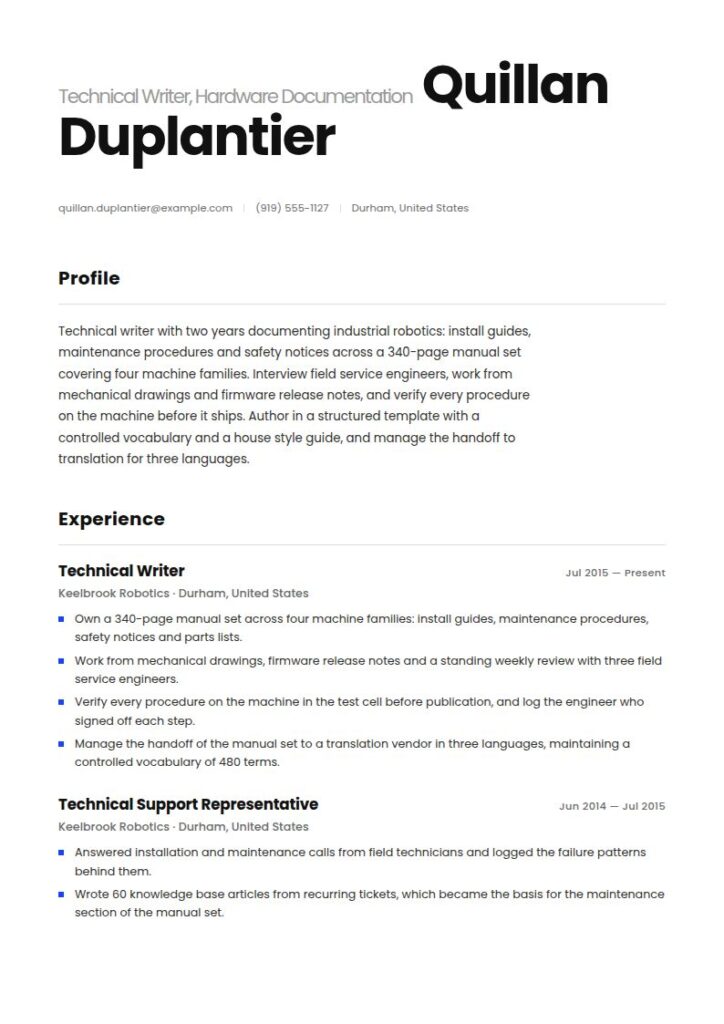
Technical writer with two years documenting industrial robotics: install guides, maintenance procedures and safety notices across a 340-page manual set covering four machine families. Interview field service engineers, work from mechanical drawings and firmware release notes, and verify every procedure on the machine before it ships. Author in a structured template with a controlled vocabulary and a house style guide, and manage the handoff to translation for three languages.
Work Experience
07/2015 - Present, Technical Writer, Keelbrook Robotics, Durham, United States
- Own a 340-page manual set across four machine families: install guides, maintenance procedures, safety notices and parts lists.
- Work from mechanical drawings, firmware release notes and a standing weekly review with three field service engineers.
- Verify every procedure on the machine in the test cell before publication, and log the engineer who signed off each step.
- Manage the handoff of the manual set to a translation vendor in three languages, maintaining a controlled vocabulary of 480 terms.
06/2014 - 07/2015, Technical Support Representative, Keelbrook Robotics, Durham, United States
- Answered installation and maintenance calls from field technicians and logged the failure patterns behind them.
- Wrote 60 knowledge base articles from recurring tickets, which became the basis for the maintenance section of the manual set.
Education
08/2011 - 05/2015, Bachelor of Arts, English, North Carolina State University, Raleigh, United States
Minor in computer science. Two semesters of technical and scientific communication.
Skills
Task-based procedures, 75
Reading mechanical drawings, 70
Safety notices and warnings, 80
Controlled vocabulary and terminology, 70
Localization handoff, 65
Structured templates and house style guide, 70
Languages
English, native
French, conversational
Certificates
09/2015, OSHA 10-Hour General Industry, U.S. Department of Labor, Occupational Safety and Health Administration
Taken to write safety notices against the standards they cite.
Summary
A technical writer resume is a one to two page document naming the documentation set you own, its size and version cadence, the toolchain it ships in, and how you know a page worked. This guide gives you three adaptable versions, the toolchain line most applicants leave vague, and current Bureau of Labor Statistics pay and outlook for the occupation.
Technical Writer resume examples by experience level
A technical writer resume is a one to two page document that names the documentation set you own, how big it is, what it ships in, and what evidence you have that a page did its job.
That is a different document from a writer's resume. A hiring manager here is not asking whether you write well; they assume it and will test it with a writing sample anyway. They are asking whether you can get accurate information out of a busy engineer, structure it for someone trying to complete a task, and ship it in the same release train as the product without becoming the bottleneck.
Resume guide for a technical writer resume
This guide and the corresponding technical writer resume example will cover:
- How to write a technical writer resume, section by section
- Why the size and shape of your docs set belongs on the page
- Three adaptable summaries: junior, senior technical writer and documentation lead
- What to say about your toolchain, and why vague tooling lines cost interviews
- What the job market looks like and what BLS says the occupation pays
How to write a technical writer resume
Six sections: contact header with a writing sample link, summary, experience, documentation and tooling, skills, and education with certifications. One page for the first five years, two once you own a set or a team.
The order matters. The documentation and tooling block sits high because it is the fastest way for a manager to judge whether you can be productive in their environment, and because it is the part almost every applicant leaves generic.
| Section | What it is answering | Where it goes |
|---|---|---|
| Writing sample link | Can this person write for a user under pressure? | Contact header, or a named public docs site |
| Summary | What kind of docs, at what size, for which audience? | Directly under the header |
| Experience | What did they own, and what changed when they owned it? | Reverse chronological, a number per bullet |
| Documentation and tooling | Will they be productive in our repository next week? | Its own block, named products and formats |
| Education and certifications | Any domain background? Any formal credential? | Last, kept short |
Write the audience and the task, not the document type
"Wrote user manuals" describes an output. It does not say who read it or what they were trying to do, which is the only thing that makes documentation good or bad.
Compare two bullets. "Maintained product documentation for a software platform" against "Rewrote the twelve most-visited how-to topics as task-based procedures for integration engineers working against a deadline; support tickets tagged to those pages fell 38% over two quarters."
The second names the audience, the task, the change and the evidence. It also says you have access to support data and know how to read it, which is uncommon in this field.
Every docs set has an audience with a job to do: a field technician with the machine in front of them, a developer pasting a code sample, an auditor following a procedure. Name yours.
Run the finished file through the ATS resume checker before you apply. Technical writing posts in large employers go through the same parsing as engineering posts.
Choosing the best resume format for a technical writer resume
Reverse chronological, one page until you have owned a set or led a team, two after that. The reader wants the sequence of products and domains: what you documented, for whom, and for how long.
Contract work is common here and is not a problem. Administrative and support services, largely staffing and contract employers, holds 8 percent of technical writers and pays the occupation's highest industry median at $99,280 as of May 2025 (BLS Occupational Outlook Handbook, May 2025). Group short contracts under one heading with the client type and docs set for each, rather than listing six three-month entries.
Keep the document plain. A technical writer submitting a two-column resume with icons is telling a documentation manager something unfortunate about their instincts for structured content.
Include your contact information
| ✅ Right | ❌ Wrong |
|---|---|
| Quillan Duplantier | Quillan Duplantier |
| Senior Technical Writer, Developer and Hardware Documentation | Detail-oriented writing professional |
| Public docs: docs.example.com/guides (authored 2019 to 2022) | Writing samples available on request |
| (919) 555-1127, [email protected], Durham, NC | (919) 555-1127, [email protected] |
Link to something a reader can open. Public documentation you wrote is the strongest sample because it is real, shipped and judged by users. If everything you have written sits behind a login or a non-disclosure agreement, say so in one line and offer a redacted sample rather than leaving the line blank.
Make use of a summary
Four lines: the kind of documentation, the audience, the size of the set, and one piece of evidence that a page worked.
Technical writer with two years documenting industrial robotics: install guides, maintenance procedures and safety notices across a 340-page manual set covering four machine families. Interview field service engineers, work from mechanical drawings and firmware release notes, and verify every procedure on the machine before it ships. Author in a structured template with a controlled vocabulary and a house style guide, and manage the handoff to translation for three languages.
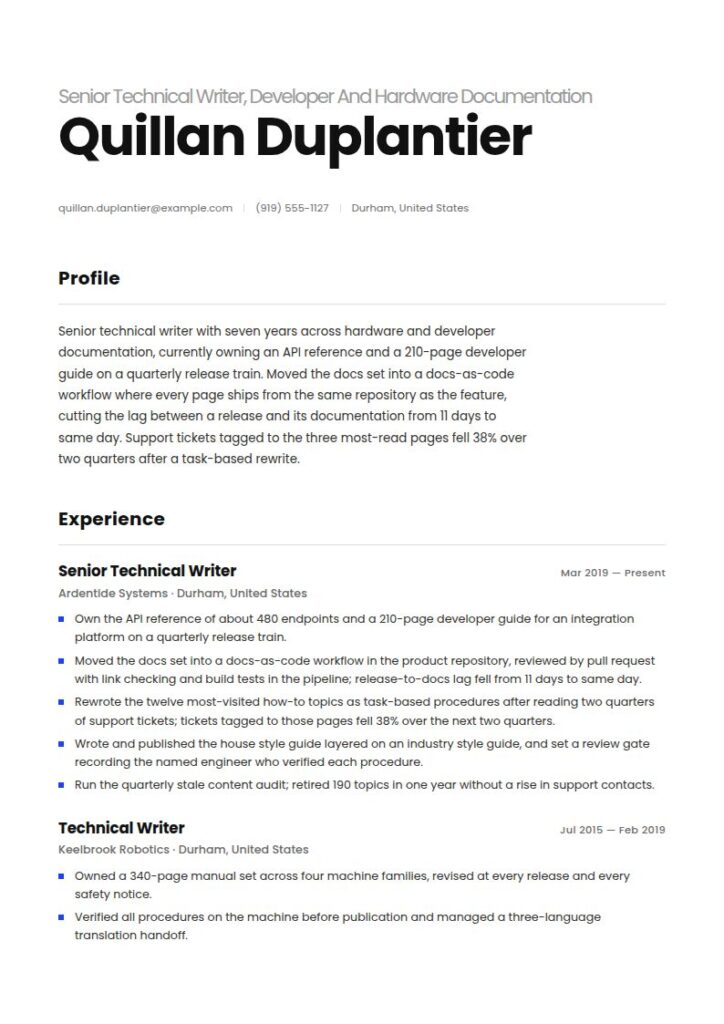
Senior technical writer with seven years across hardware and developer documentation, currently owning an API reference and a 210-page developer guide on a quarterly release train. Moved the docs set into a docs-as-code workflow where every page ships from the same repository as the feature, cutting the lag between a release and its documentation from 11 days to same day. Support tickets tagged to the three most-read pages fell 38% over two quarters after a task-based rewrite.
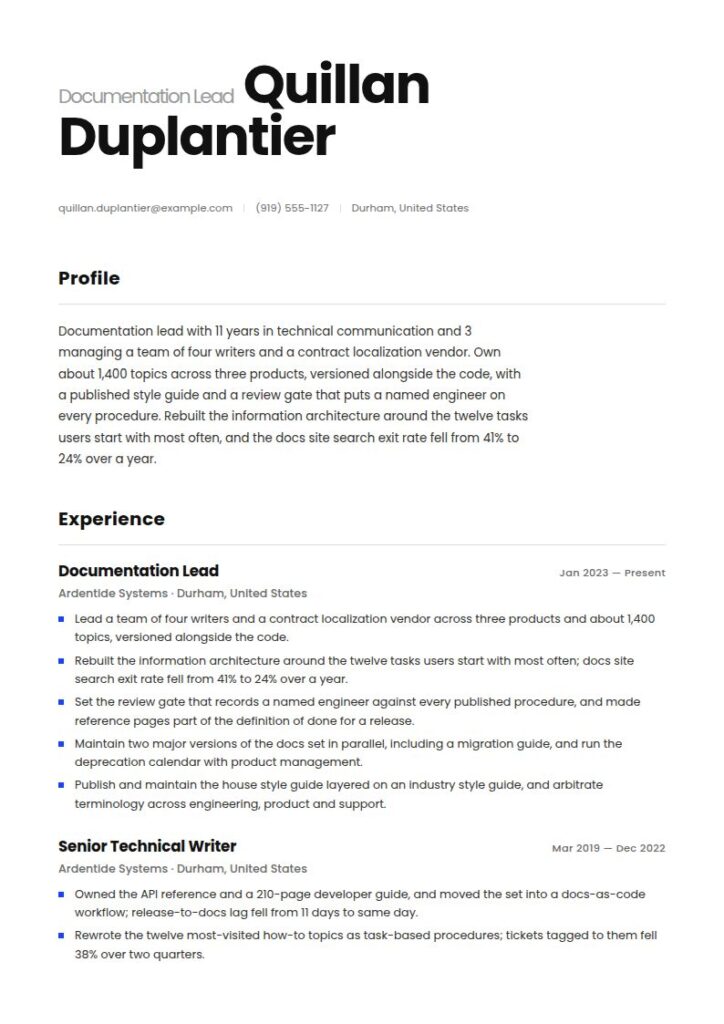
Documentation lead with 11 years in technical communication and 3 managing a team of four writers and a contract localization vendor. Own about 1,400 topics across three products, versioned alongside the code, with a published style guide and a review gate that puts a named engineer on every procedure. Rebuilt the information architecture around the twelve tasks users start with most often, and the docs site search exit rate fell from 41% to 24% over a year.
Right vs wrong: the same technical writer summary, twice
| ✅ Right | ❌ Wrong |
|---|---|
| Senior technical writer with seven years across hardware and developer documentation. | Detail-oriented writing professional with excellent communication skills. |
| Own an API reference and a 210-page developer guide on a quarterly release train. | Responsible for creating and maintaining a variety of technical documents. |
| Docs ship from the same repository as the feature; release-to-docs lag fell from 11 days to same day. | Collaborated with engineering teams to ensure documentation accuracy. |
The right column can be handed a repository. The left column has to be asked four follow-up questions before anyone knows what it means.
Outline your experience
Employer, product, your title, dates. Then three to five bullets, each naming the docs set, the audience, the change and the number.
| Instead of | Use |
|---|---|
| Wrote and maintained technical documentation | Owned a 340-page manual set across four machine families, revised every release and at each safety notice |
| Collaborated with subject matter experts | Ran a standing 30-minute weekly review with three firmware engineers, and put the reviewing engineer's name in the topic metadata |
| Improved documentation quality | Rewrote the twelve most-visited how-to topics as task-based procedures; tickets tagged to them fell 38% over two quarters |
| Used various documentation tools | Authored in Markdown in the product repository, built with a static site generator, reviewed through pull requests with docs tests in the pipeline |
Senior Technical Writer, Ardentide Systems, Durham, NC, March 2019 to Present
Own the API reference and a 210-page developer guide for an integration platform on a quarterly release train, written for integration engineers implementing against a deadline.
Moved the docs set into a docs-as-code workflow in the product repository, reviewed by pull request with link and build checks in the pipeline; release-to-docs lag fell from 11 days to same day.
Rewrote the twelve most-visited how-to topics as task-based procedures after reading two quarters of support tickets; tickets tagged to those pages fell 38% over the following two quarters.
Wrote and published the house style guide, layered on an industry style guide, and set a review gate that records the named engineer who verified each procedure.
Run the quarterly docs audit that retires stale topics; retired 190 topics in one year without a rise in support contacts.
Name the docs set, the toolchain and the release it shipped against
This is the block almost nobody writes properly, and it is the one that decides whether you get a screen. Documentation managers are hiring for a specific environment, and they are trying to work out how much of your first quarter will be spent learning it.
Four things belong in it.
Docs set: API reference (about 480 endpoints, generated from the specification and hand-edited), developer guide (210 pages), release notes, and a migration guide maintained across two major versions. About 1,400 topics in total across three products.
Source: firmware release notes, the OpenAPI specification, a standing weekly engineering review, and hands-on verification in a test environment before publication.
Toolchain: Markdown in the product repository, static site generator build, pull request review with link checking and build tests in the pipeline, versioned docs branches per release, Figma for diagrams, Jira for the docs backlog. Previously structured authoring in DITA with a component content management system.
Evidence: support tickets tagged per topic, docs site search terms and exit rate, time to first successful API call for new integrators, and a quarterly audit of stale topics.
The docs set. Size and shape. Topic count or page count, how many products, how many versions live at once, whether the reference is generated or hand-written. A writer who has maintained two major versions in parallel has solved a problem a single-version writer has never met.
The source. Where accuracy comes from. Documentation is extracted, not imagined. Say how: standing engineering reviews, specification files, reading the code, running the product in a test environment, shadowing field service, sitting with support. "Verified on the machine before publication" and "reproduced every code sample against the current release" are the sentences that separate a technical writer from a writer.
The toolchain. Be specific and honest. Docs-as-code, meaning plain text in version control reviewed through pull requests, is one world. Structured authoring in an XML standard such as DITA, approved as an OASIS Standard in its 1.3 version in 2016 (OASIS Open), inside a component content management system, is another. Help authoring tools are a third. Most managers take a writer who is strong in one and honest about the others over a writer who lists all three.
The evidence. How you know a page worked. Support tickets tagged to a topic, search terms that return nothing, search exit rate, time to first successful task, page feedback scores, and task-based usability test results. Very few applicants offer any of this, and it is the fastest way to sound like a professional rather than a person who writes things down.
Say which style guide you write to, and whether you wrote one
Every mature documentation team writes to a published style guide, usually an industry one such as the Microsoft Writing Style Guide or the Google developer documentation style guide, with a house layer on top for product names, terminology and code sample conventions.
Naming yours tells a manager you have worked somewhere with a real editorial standard, and it lets them picture your onboarding: adapting to a new style guide is a week's work, while learning what a style guide is for is not.
If you wrote or maintained the house layer, say so and say how big it is. A writer who has resolved terminology disputes across engineering, product and support has done the political part of the job.
There is also a formal credential: the Certified Professional Technical Communicator, developed by the Society for Technical Communication and examined at Foundation and Practitioner levels, with Foundation open to anyone and Practitioner requiring the Foundation certificate first (APMG International, retrieved 17 September 2026). It is not a hiring requirement anywhere, but it is a clean line on a resume for a career changer with no published docs to point at.
Build a snapshot of your key skills
Twelve to sixteen entries in four groups: writing and information design, tools, technical fluency, and process. The groups matter because a documentation manager and an engineering manager read different halves.
Writing and information design: Task-based procedures, API reference writing, Information architecture, Minimalism and progressive disclosure, Release notes, Migration guides, Controlled vocabulary
Tools: Markdown and Git, static site generators, DITA and component content management systems, OpenAPI specifications, Figma, Jira, Confluence, screen capture and annotation
Technical fluency: REST APIs and authentication flows, reading Python and JavaScript samples well enough to test them, command line, YAML and JSON, basic SQL, firmware release notes and mechanical drawings
Process: Docs-as-code review by pull request, docs in the definition of done, localization handoff and vendor management, accessibility review, stale content audits
Do not claim a programming language you cannot read. The interview for this job frequently includes being handed a code sample and asked what it does.
List your education and certifications
Degree, institution, year, then certifications, then domain training. Keep it short. This occupation hires on evidence of shipped documentation far more than on credentials.
Bachelor of Arts, English, North Carolina State University, Raleigh, NC, 2015. Minor in computer science.
Graduate Certificate, Technical Communication, 2018.
Certifications: Certified Professional Technical Communicator, Foundation (2021). Certified ScrumMaster (2022).
Domain training: two-week field service training on the robotics platform documented, 2016. Internal API design course, 2020.
The typical entry route is a bachelor's degree plus fewer than five years in a related occupation, with short-term on-the-job training once hired (BLS Occupational Outlook Handbook, 2025). That matters if you are moving in from support, quality assurance, engineering or teaching: the occupation expects a transfer, and prior domain work is an asset rather than a gap.
Choose the right layout and design
Single column, 10 or 11 point body type, clear headings, no graphics, no skills bars. PDF named for yourself and the role.
Give the size of the docs set in topics or pages. Name the audience for each set. Say exactly what your toolchain was, including the review mechanism. Give one piece of evidence that a page worked. Link to published documentation you wrote, with the dates you owned it. Group short contracts under one heading with the docs set for each.
Do not write "various technical documents" when the set has a name and a size. Do not list every tool you have opened once. Do not claim a language you cannot read in an interview. Do not design the resume; structured, parseable and plain is the point. Do not link a docs site you no longer own without saying which parts and which years were yours.
Technical writer job market and outlook
A small, well-paid occupation growing slowly, with most of its openings coming from replacement rather than growth.
| Measure | Value |
|---|---|
| Technical writer jobs, 2025 | 46,400 |
| Projected change, 2025 to 2035 | 1 percent (slower than average), +400 |
| Projected annual openings | ~3,200 |
| Typical entry-level education | Bachelor's degree |
| Work experience in a related occupation | Less than 5 years |
| Median annual wage, May 2025 | $90,390 |
Source: U.S. Bureau of Labor Statistics, Occupational Outlook Handbook, 2025 to 2035 projections and May 2025 wage data, last modified 27 August 2026.
Small occupation, high median, and the industry you sit in moves the number
Technical writers had a median annual wage of $90,390 in May 2025, against $74,250 for media and communication occupations as a whole and $50,980 for all occupations (BLS Occupational Outlook Handbook, May 2025).
The occupation is concentrated: professional, scientific and technical services holds 39 percent of employment, manufacturing 13 percent, information 13 percent, administrative and support services 8 percent, and government excluding education and hospitals 4 percent (BLS, 2025).
Industry medians in May 2025 ran administrative and support services $99,280, government $95,480, professional, scientific and technical services $94,520, information $86,400 and manufacturing $82,860 (BLS, May 2025).
The practical reading is that setting is worth more than title. A writer documenting regulated hardware for a manufacturer and a writer documenting a developer platform in professional services share a job title with roughly $12,000 between the industry medians. Name the setting, the product type and the regulatory context, because that is what a compensation band is built from.
Where the jobs sit:
| Setting | Share of employment | Median annual wage (May 2025) |
|---|---|---|
| Professional, scientific and technical services | 39% | $94,520 |
| Manufacturing | 13% | $82,860 |
| Information | 13% | $86,400 |
| Administrative and support services | 8% | $99,280 |
| Government, excluding education and hospitals | 4% | $95,480 |
Source: U.S. Bureau of Labor Statistics, Occupational Outlook Handbook, May 2025.
What salary you can expect as a technical writer
The median annual wage for technical writers was $90,390, or $43.46 an hour, as of May 2025. The lowest 10 percent earned less than $57,440 and the highest 10 percent more than $145,270 (BLS Occupational Outlook Handbook, May 2025).
That is a high floor for writing work. In the same cycle writers and authors had a median of $76,910 and editors $77,920 (BLS, May 2025). The premium is paid for domain fluency, not for prose.
Three things move you inside the band. Domain is first: hardware with a safety obligation, medical devices, financial infrastructure and developer platforms pay above general software documentation, because the cost of an inaccurate page is higher. Ownership is second: writers who own a set, set the standard and gate a release are paid differently from writers who take tickets. Tooling is third, and it is the one candidates undersell. A writer who can maintain a documentation build and wire checks into a pipeline removes a dependency from the team, and that shows up in an offer.
Key takeaways for a technical writer resume
- Name the docs set: topics or pages, how many products, how many live versions.
- Name the audience and the task each set exists for.
- Say where accuracy comes from: engineers, specifications, the product itself.
- Give the toolchain precisely, including how documentation gets reviewed.
- Offer one piece of evidence that a page worked, such as tickets or search behavior.
- Link published documentation you wrote, with the years you owned it.
- Keep the document plain and single column; it is a structured content sample.
Build your technical writer resume in 15 minutes with our AI resume builder.
Related resume examples
- Writer resume
- Copywriter resume
- Freelance writer resume
- Grant writer resume
- Journalist resume
- Scientist resume
- Translator resume
- Audio engineer resume
- Freelancer resume
- Career change resume
- Work-from-home resume
- One-year experience resume
Pair it with a matching technical writer cover letter.
Technical writer resume questions, answered
How long should a technical writer resume be?
One page for the first five years, two once you own a documentation set, a toolchain or a team. Two pages is normal in this occupation because the tooling and docs set block carries real information, unlike a second page of adjectives.
Do I need a technical background to become a technical writer?
Not a degree in one, but you need demonstrable fluency in the domain you are documenting. BLS gives the typical entry route as a bachelor's degree plus fewer than five years of experience in a related occupation (BLS Occupational Outlook Handbook, 2025). Support, quality assurance, field service, teaching and lab work all transfer well, because each one is practice at explaining a system to someone who has to use it.
What writing sample should I send?
Published documentation you wrote, with the years you owned it. Failing that, write a short task-based procedure for a product you use, including the part most applicants skip: prerequisites, the failure case, and what to do when a step does not work. One well-structured procedure beats a portfolio of unedited long-form articles.
Is docs-as-code required now?
Not universally, but it is the most common developer documentation workflow and it is spreading into hardware and regulated sets. If you have not worked that way, say what you have used and show that you understand version control, review and a build pipeline. Managers hire for the ability to learn a toolchain more often than for a specific one.
How do I prove documentation worked?
Ask for the data before you leave a job. Support tickets tagged to specific topics, docs site searches that return nothing, search exit rate, page feedback scores, time to first successful task, and the retire-and-watch result of a stale content audit. One of those on a resume is unusual enough to be memorable.
Is technical writing a shrinking field?
No, though it is not expanding either. BLS projects employment of technical writers to grow 1 percent between 2025 and 2035, slower than the average for all occupations, adding about 400 jobs and producing roughly 3,200 openings a year (BLS Occupational Outlook Handbook, 2025 to 2035 projections). It is a small occupation with a high median, which means competition is real but the work is well paid when you get it.