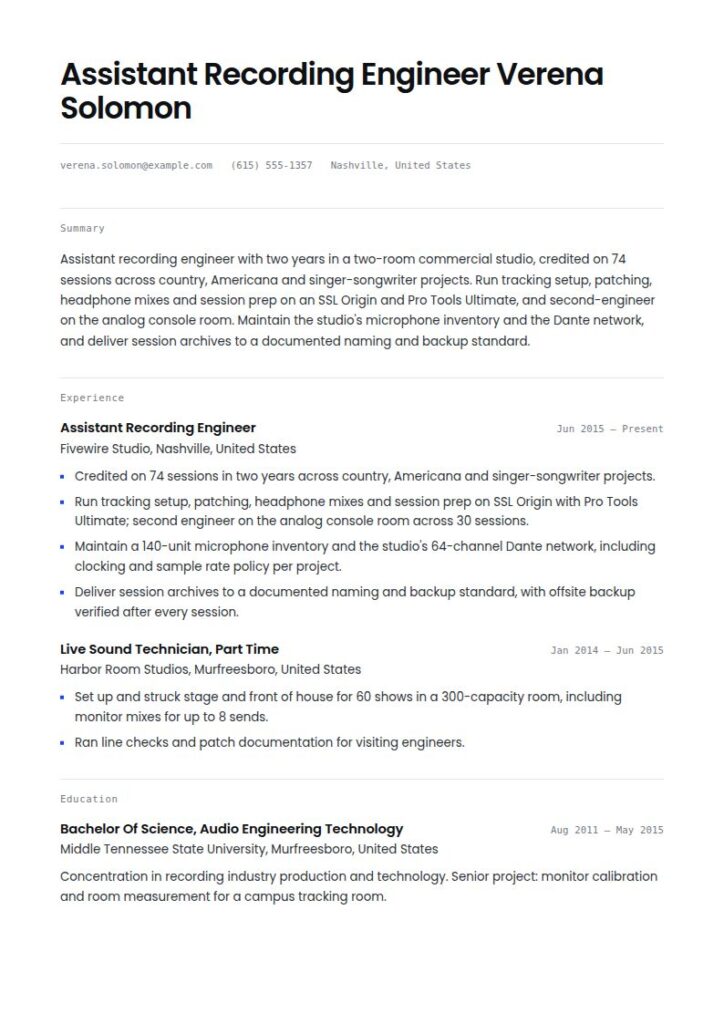
Assistant Recording Engineer Verena Solomon
Assistant Recording Engineer
[email protected] | (615) 555-1357 | Nashville, United States
Profile
Assistant recording engineer with two years in a two-room commercial studio, credited on 74 sessions across country, Americana and singer-songwriter projects. Run tracking setup, patching, headphone mixes and session prep on an SSL Origin and Pro Tools Ultimate, and second-engineer on the analog console room. Maintain the studio's microphone inventory and the Dante network, and deliver session archives to a documented naming and backup standard.
Work Experience
06/2015 - Present, Assistant Recording Engineer, Fivewire Studio, Nashville, United States
- Credited on 74 sessions in two years across country, Americana and singer-songwriter projects.
- Run tracking setup, patching, headphone mixes and session prep on SSL Origin with Pro Tools Ultimate; second engineer on the analog console room across 30 sessions.
- Maintain a 140-unit microphone inventory and the studio's 64-channel Dante network, including clocking and sample rate policy per project.
- Deliver session archives to a documented naming and backup standard, with offsite backup verified after every session.
01/2014 - 06/2015, Live Sound Technician, Part Time, Harbor Room Studios, Murfreesboro, United States
- Set up and struck stage and front of house for 60 shows in a 300-capacity room, including monitor mixes for up to 8 sends.
- Ran line checks and patch documentation for visiting engineers.
Education
08/2011 - 05/2015, Bachelor of Science, Audio Engineering Technology, Middle Tennessee State University, Murfreesboro, United States
Concentration in recording industry production and technology. Senior project: monitor calibration and room measurement for a campus tracking room.
Skills
Multitrack tracking setup and patching, 75
Microphone selection and placement, 70
Pro Tools Ultimate, 80
SSL Origin console operation, 65
Dante networked audio, 70
Headphone mix management, 80
Session archiving and backup verification, 85
Languages
English, native
German, advanced
Certificates
08/2015, Avid Pro Tools Certification, Specialist, Avid
Entry tier of Avid's published Pro Tools user certification.
03/2016, Dante Certification, Level 1, Audinate
Fundamentals of digital audio, video and networking with Dante Controller.
Summary
An audio engineer resume is a one to two page document naming the lane you work in, the rooms and consoles you have operated, the session or show counts behind them, and the delivery specs you hit. This guide gives you three adaptable versions, the signal chain block that separates operators from enthusiasts, and current Bureau of Labor Statistics pay and outlook.
Audio Engineer resume examples by experience level
An audio engineer resume is a one to two page document naming the lane you work in, the rooms and consoles you have actually operated, how many sessions or shows are behind that, and the delivery specs you hand in.
In practice, the word "engineer" hides four different jobs. A tracking and mix engineer in a commercial studio, a front of house engineer on a touring rig, a dialogue editor in post and a broadcast audio operator are not interchangeable, and a resume that does not say which one you are gets read as none of them. Pick the lane in the first line, then prove it with equipment you have put your hands on.
Resume guide for an audio engineer resume
To start, this guide and the corresponding audio engineer resume example will cover:
- First, how to write an audio engineer resume, section by section
- Then, the four lanes, and why the first line has to pick one
- Also, three adaptable summaries: assistant, staff engineer and chief engineer
- Next, the signal chain block that separates operators from enthusiasts
- Finally, what the job market looks like and what you can expect to earn
How to write an audio engineer resume
In short, six sections: contact header with a credits or reel link, summary, the rooms and signal chain block, session and show experience, education and certifications, and skills. In general, one page for your first five years, two once you have a credit list worth its own block.
Pick your lane before you write anything else, because the reader changes completely between them.
| Lane | Who reads the resume | What they are checking |
|---|---|---|
| Studio | Studio manager or chief engineer | Consoles and DAWs operated, session counts, the artists' genres, whether you can run a session alone |
| Live | Production manager or systems tech | Consoles, PA systems, network protocols, show counts, venue and stage sizes, travel availability |
| Post | Post supervisor or audio lead | Dialogue editing, ADR, Foley, mixing to spec, turnaround per episode or reel, deliverable formats |
| Broadcast | Chief engineer or technical director | Plant and control room, live mixing under a director, redundancy, loudness compliance |
Write the equipment you have operated, not the equipment you have seen
The single most common failure on an audio resume is a long equipment list that is really a wish list. Studio managers and production managers screen for it, and they screen by asking a follow-up question you cannot fake.
Write it in three tiers instead. First, what you can run unsupervised and have run for real: "SSL Origin, Avid S6L, Pro Tools Ultimate, Dante networked I/O." Second, what you have assisted on: "Neve 8068 as second engineer, 30 sessions." Third, what you are trained on but have not yet run in a paid session, labeled as such.
That third tier is not a weakness. Somebody who separates the three will tell the truth on a load-in day when something is not working, which is most of the job.
Run the finished file through the free Rezoom ATS resume checker first. Broadcasters, post houses and touring production companies mostly hire through applicant systems that parse before a person reads.
Choosing the best resume format for an audio engineer resume
As a rule, reverse chronological, single column, with a credits or reel link in the header.
Freelance careers are the norm here rather than the exception, and the format has to cope. Group freelance work under one heading with a date range and the client type, then list the significant projects beneath it. For example, eleven separate two-month entries read as instability; the same work under "Freelance Recording and Mix Engineer, 2019 to 2023" reads as a career.
Include your contact information
| ✅ Right | ❌ Wrong |
|---|---|
| Verena Solomon | Verena Solomon |
| Recording and Mix Engineer, Studio and Post | Audio ninja, sound guru, music lover |
| Nashville, TN. Available to travel. (615) 555-1357 | 1128 Delmore Street, Apt 4, Nashville, TN 37206 |
| [email protected]. Credits: verenasolomon.example.com/credits | [email protected]. SoundCloud, Instagram, YouTube, Bandcamp |
Above all, one credits link, working, with the reel or selected mixes on it. If work is under non-disclosure, say so in one phrase and give the client type instead of the name. Put travel availability in the header if you work live or on location: it is the second question a production manager asks and the first that eliminates people.
Make use of a summary
For the summary, four lines: lane, years, rooms and consoles, and one volume number with an outcome.
Assistant recording engineer with two years in a two-room commercial studio, credited on 74 sessions across country, Americana and singer-songwriter projects. Run tracking setup, patching, headphone mixes and session prep on an SSL Origin and Pro Tools Ultimate, and second-engineer on the analog console room. Maintain the studio's microphone inventory and the Dante network, and deliver session archives to a documented naming and backup standard.
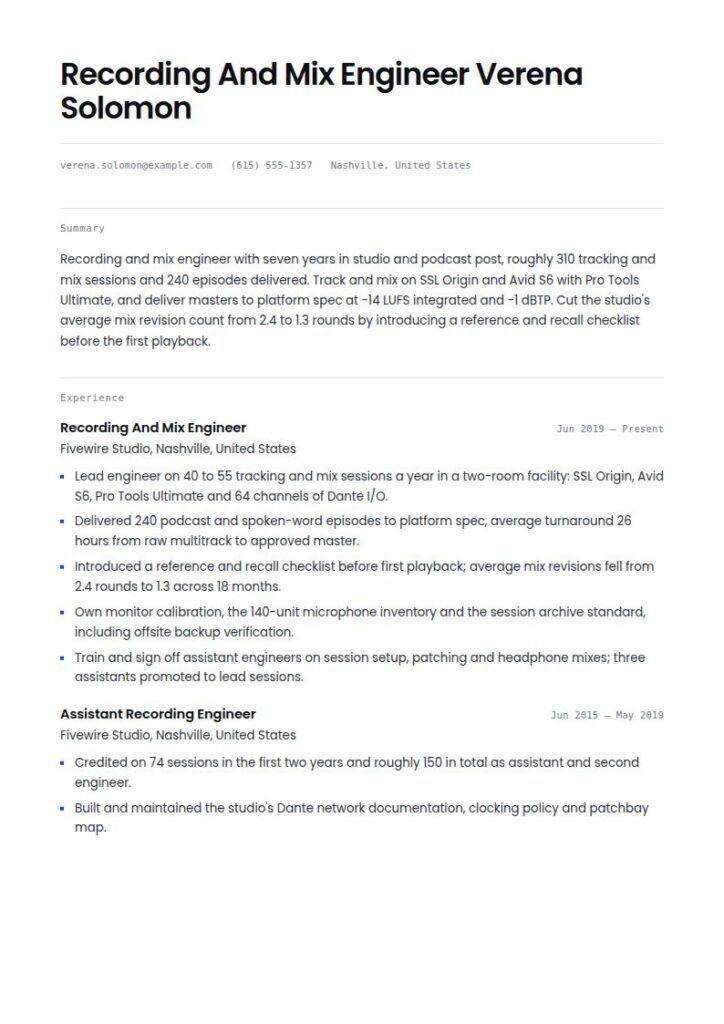
Recording and mix engineer with seven years in studio and podcast post, roughly 310 tracking and mix sessions and 240 episodes delivered. Track and mix on SSL Origin and Avid S6 with Pro Tools Ultimate, and deliver masters to platform spec at -14 LUFS integrated and -1 dBTP. Cut the studio's average mix revision count from 2.4 to 1.3 rounds by introducing a reference and recall checklist before the first playback.
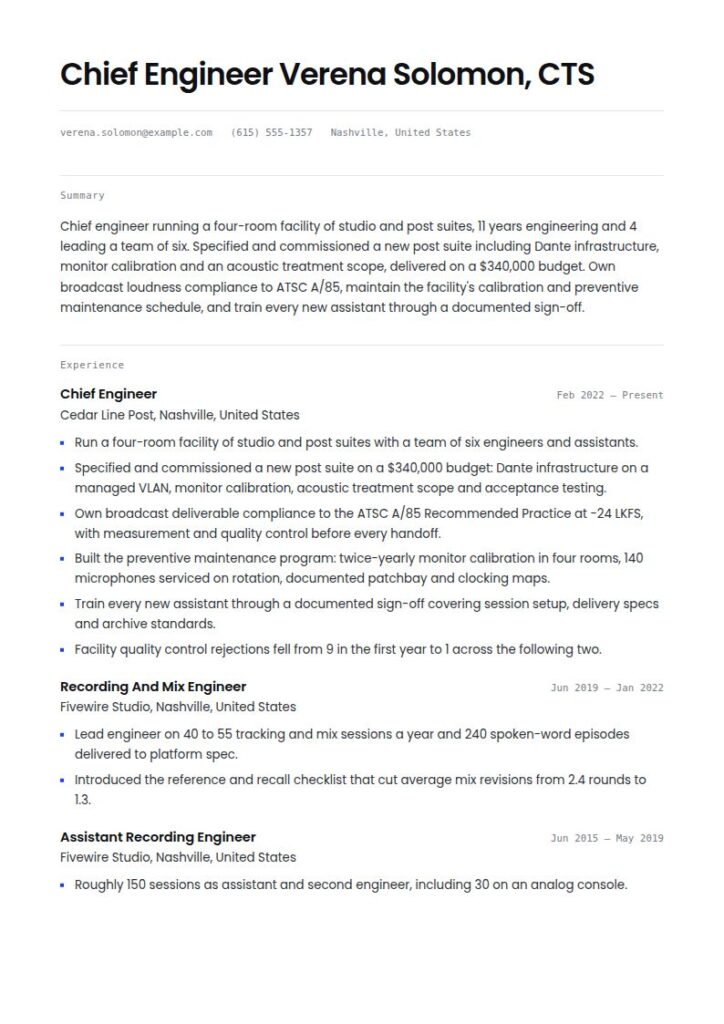
Chief engineer running a four-room facility of studio and post suites, 11 years engineering and 4 leading a team of six. Specified and commissioned a new post suite including Dante infrastructure, monitor calibration and an acoustic treatment scope, delivered on a $340,000 budget. Own broadcast loudness compliance to ATSC A/85, maintain the facility's calibration and preventive maintenance schedule, and train every new assistant through a documented sign-off.
Right vs wrong: the same audio engineer summary, twice
| ✅ Right | ❌ Wrong |
|---|---|
| Recording and mix engineer with seven years in studio and podcast post. | Passionate audio professional with a great ear. |
| Roughly 310 tracking and mix sessions and 240 episodes delivered. | Experience with a wide range of recording and mixing projects. |
| Track and mix on SSL Origin and Avid S6 with Pro Tools Ultimate. | Proficient in all major DAWs and industry-standard equipment. |
| Deliver masters to platform spec at -14 LUFS integrated and -1 dBTP. | Deliver broadcast-quality audio every time. |
By contrast, the right column can be checked in a five-minute conversation. Meanwhile, the wrong column is what every application in the folder says, and a studio manager has learned that "all major DAWs" means one.
Outline your session and show experience
For each role, give facility or client, city, your role, and dates. Then three to five bullets, each naming the room, the equipment, the volume and what you were responsible for.
| Instead of | Use |
|---|---|
| Recorded and mixed music for various artists | Tracked and mixed 310 sessions over seven years across country, Americana and indie rock, 40 to 55 sessions a year as lead engineer |
| Operated professional audio equipment | Ran tracking on SSL Origin and Avid S6 with Pro Tools Ultimate and 64 channels of Dante I/O |
| Mixed live sound for concerts | Mixed front of house on Avid S6L and DiGiCo SD10 for 180 shows across rooms from 400 to 2,400 capacity |
| Worked on podcast production | Delivered 240 episodes to spec at -16 LUFS mono integrated, average turnaround 26 hours from raw tracks |
| Maintained studio equipment | Own the preventive maintenance schedule for 2 control rooms: monitor calibration twice a year, 140 microphones inventoried and serviced on rotation |
| Ensured audio met broadcast standards | Mix and QC to ATSC A/85 at -24 LKFS with true peak headroom, verified on every deliverable before handoff |
Recording and Mix Engineer, Fivewire Studio, Nashville, TN, June 2019 to Present
Lead engineer on 40 to 55 tracking and mix sessions a year in a two-room facility: SSL Origin, Avid S6, Pro Tools Ultimate, 64 channels of Dante I/O.
Delivered 240 podcast and spoken-word episodes to platform spec, average turnaround 26 hours from raw multitrack to approved master.
Introduced a reference and recall checklist before first playback; average mix revisions fell from 2.4 rounds to 1.3 across 18 months.
Own monitor calibration, the microphone inventory of 140 units and the session archive standard, including offsite backup verification.
Train and sign off assistant engineers on session setup, patching and headphone mixes; three assistants promoted to lead sessions.
Name the rooms, the consoles and the signal chain you have actually run
In fact, this is the block that separates operators from enthusiasts, and it is the reason a studio manager reads past the summary.
After all, an audio resume without a signal chain asks to be taken on trust in a trade where nobody is. Therefore, write it as a path, from source to deliverable, and mark honestly what you have run alone.
Rooms run unsupervised: Two-room commercial studio, control room A with an SSL Origin and a 22 by 17 foot live room; post suite with a 5.1 monitoring setup and calibrated near-fields.
Front end: 140-microphone inventory including large and small diaphragm condensers, ribbons and dynamics. Outboard preamps and channel strips patched to a 96-point TT bay. Hardware compression and equalization tracked to tape emulation or straight to Pro Tools.
Conversion and transport: 64 channels of Dante networked I/O on a managed VLAN with clocking and redundancy configured. Word clock distribution and sample rate policy documented per project.
Workstation and monitoring: Pro Tools Ultimate as the primary, Logic Pro and Reaper for client sessions in those formats. Monitoring calibrated twice a year to a documented reference level.
Delivery: Streaming masters at -14 LUFS integrated with true peak at or below -1 dBTP. Spoken word at -16 LUFS mono. Broadcast deliverables mixed and verified to ATSC A/85 at -24 LKFS.
Assisted, not yet run alone: Neve 8068 analog console, 30 sessions as second engineer.
The delivery line at the bottom gets read twice, because it is where standards stop being a matter of taste. For broadcast television, in particular, the specification is legal. The Federal Communications Commission requires "commercials to have the same average volume as the programs they accompany" and applies the "Advanced Television Systems Committee's (ATSC) A/85 Recommended Practice" to enforce it, with rules in effect since 13 December 2012 and binding on TV stations, cable operators, satellite providers and other multichannel video programming distributors (Federal Communications Commission, CALM Act enforcement page). A/85 sets the target at -24 LKFS where content is exchanged without metadata and no other arrangement exists, measured per ITU-R Recommendation BS.1770 (ATSC A/85:2013, section 6). The practice was comprehensively revised for the first time since 2013 as A/85:2026-07, approved on 8 July 2026, adding guidance for streaming services and a loudness and true peak quick reference (ATSC, announced 15 July 2026).
Streaming loudness targets for audio engineers
Music streaming, however, is a different number and it is not a law, it is a platform policy. Spotify states that it adjusts tracks to "-14 dB LUFS, according to the ITU 1770 standard", recommends mastering to -14 dB integrated LUFS with true peak below -1 dBTP, and offers listeners Loud, Normal and Quiet settings at -11, -14 and -19 LUFS (Spotify for Artists, loudness normalization guidance).
As a result, putting both numbers on the page tells a hiring engineer you know the target changes with the destination, which is the most common thing a self-taught mixer has never had to learn.
Pick the lane in the first line: studio, live, post or broadcast. Separate what you run alone from what you have assisted on. Count sessions, shows or episodes, per year and in total. Name consoles, workstations and network transport by model. State the delivery specs you hit and the standard behind them. Put travel availability in the header if you work live or on location.
Do not list every plugin you own; nobody is hired on a plugin collection. Do not claim a console you have watched somebody else drive. Do not name a studio, label, client or artist you did not actually work for, because this is a small trade and the call gets made. Do not use a two-column template with skill percentage bars. Do not send a reel link that has not been opened this month.
Build a snapshot of your key skills
For skills, list ten to fourteen entries in four groups: capture, processing and mixing, systems and networking, and delivery.
Capture: Multitrack tracking, Microphone selection and placement, Gain staging, Headphone mix management, Location and remote recording
Processing and mixing: Mix and recall discipline, Analog and in-the-box hybrid workflow, Dialogue editing and cleanup, Stereo and 5.1 mixing, Mastering for streaming and spoken word
Systems and networking: Dante networked audio and managed VLANs, Clocking and sample rate policy, Patchbay and signal flow documentation, Monitor calibration, Preventive maintenance scheduling
Delivery and standards: ATSC A/85 and loudness compliance, ITU-R BS.1770 measurement, Platform master specs, Session archiving and offsite backup, File naming and delivery documentation
List your education and certifications
Degree or program if you have one, then the vendor and industry certifications that are actually checked in this trade.
Bachelor of Science, Audio Engineering Technology, Middle Tennessee State University, Murfreesboro, TN, 2015
Certifications: Avid Pro Tools certification, Expert level, Music track (2023). Audinate Dante Certification Levels 1 and 2, covering managed networks, quality of service, VLANs, IGMP and redundancy (2022). AVIXA Certified Technology Specialist, CTS (2024).
Continuing: Monitor calibration and room measurement workshop (2025). Immersive mixing for streaming delivery (2026).
Three of those are worth stating precisely because their scope is published. For instance, Avid publishes Pro Tools user certification in three tiers, Specialist, Professional and Expert, each split into Music and Post tracks (Avid certification overview). Similarly, Audinate publishes the Dante Certification Program as Levels 1, 2 and 3 plus a Domain Manager Administrator course, with Level 2 covering "managed networks, optimized performance, and professional troubleshooting" and Level 3 aimed at people "managing enterprise-scale Dante systems" (Audinate, Dante Certification Program). Likewise, AVIXA describes the Certified Technology Specialist as someone who "performs general audiovisual tasks by creating, implementing, supporting, and servicing audiovisual solutions", recommends at least six months of experience before attempting it, and requires holders to keep the credential through continuing education (AVIXA, CTS certification page).
Of course, a degree is optional here and a credential is no substitute for credits. Instead, what the certifications prove is the networking and delivery half of the job, which is the half self-taught engineers most often lack and facilities most often need.
Choose the right layout and design
As for layout, single column, plain type at 10 to 12 point, clear headings, no photograph and no skill percentage bars, which are meaningless on a trade where the follow-up question is the test.
Then export as PDF named for yourself and the lane, and keep the credits link as live text. Production companies and broadcasters parse applications before a person reads them, and a two-column template with icons is where that parsing fails.
Audio engineer job market and outlook
Notably, there is no Occupational Outlook Handbook profile under the title "audio engineer". Instead, the published home of this work is broadcast, sound and video technicians, and inside it the detailed occupation that matches most closely is sound engineering technicians. Both figures are given below.
| Measure | Value |
|---|---|
| Broadcast, sound and video technician jobs, 2025 | 136,600 |
| Projected change, 2025-35 | 1% (slower than average), +1,700 |
| Projected annual openings | ~9,800 |
| Sound engineering technicians, 2025 employment | 15,000 |
| Median annual wage, all technicians, May 2025 | $60,150 |
| Median annual wage, sound engineering technicians, May 2025 | $73,130 |
Source: US Bureau of Labor Statistics, Occupational Outlook Handbook, broadcast, sound and video technicians, 2025-35 projections and May 2025 wage data, page last modified 27 August 2026.
The pay gap inside the occupation is bigger than the growth rate
The four detailed occupations inside this profile pay very differently for May 2025: sound engineering technicians at a median of $73,130, lighting technicians at $68,060, broadcast technicians at $59,570 and audio and video technicians at $58,100 (BLS Occupational Outlook Handbook, page last modified 27 August 2026).
Employment runs the other way. Audio and video technicians, the lowest-paid group, is by far the largest at 87,600 jobs, against 24,100 broadcast technicians, 15,000 sound engineering technicians and 9,900 lighting technicians.
Industry matters as much. Motion picture and sound recording industries employ 12 percent of the occupation at a median of $75,450, against $57,410 in publishing, broadcasting and content, $57,080 in performing arts and spectator sports, and $51,480 in rental and leasing services (BLS, May 2025).
So the resume decision that moves money most is which of those four you are claiming, and whether the page proves it. A file that reads as general audiovisual support gets priced as general audiovisual support, whatever the sessions behind it.
Where the jobs sit:
| Setting | Share of employment | Median annual wage (May 2025) |
|---|---|---|
| Publishing, broadcasting and content | 16% | $57,410 |
| Motion picture and sound recording industries | 12% | $75,450 |
| Performing arts, spectator sports and related | 11% | $57,080 |
| Rental and leasing services | 10% | $51,480 |
Source: US Bureau of Labor Statistics, May 2025.
What salary you can expect as an audio engineer
The median annual wage for broadcast, sound and video technicians was $60,150 as of May 2025, or $28.92 an hour, with the lowest 10 percent earning less than $37,130 and the highest 10 percent more than $108,440 (BLS Occupational Outlook Handbook, page last modified 27 August 2026).
Within that, sound engineering technicians, the detailed occupation closest to a studio or post audio engineer, had a median of $73,130 in May 2025, about 22 percent above the profile as a whole.
In addition, three things move you inside the band. The lane comes first, because sound engineering pays above the audiovisual technician work that shares the profile, and film and sound recording pays above broadcast and live venue work. Systems capability comes second, because a facility needing someone who can commission networked audio and calibrate a room is hiring a scarcer person than one needing a mix. Delivery reliability comes third and is the most concrete: turnaround per episode, revision rounds per mix, and whether anything has ever bounced back from quality control.
Meanwhile, freelance rates sit outside all of this and BLS does not publish them. If you freelance, therefore, the resume's job is to justify a day rate rather than match a band, and the numbers that do that are session counts, turnaround times and the specs you deliver to without being asked.
Key takeaways for an audio engineer resume
- Pick the lane in the first line: studio, live, post or broadcast.
- Write the signal chain as a path, from microphone to deliverable.
- Also separate what you run unsupervised from what you have assisted on.
- Count sessions, shows or episodes, per year and in total.
- State your delivery specs and the standard behind them, including -24 LKFS for broadcast.
- Name consoles, workstations and network transport by model, not by category.
- Keep one working credits or reel link in the header and check it before you send.
Build your audio engineer resume in 15 minutes with our AI resume builder.
Related resume examples
- Journalist resume
- Writer resume
- Copywriter resume
- Freelance writer resume
- Technical writer resume
- Translator resume
- Freelancer resume
- Self-employed resume
- General resume
- Career change resume
- Volunteer resume
- Tour guide resume
Pair it with a matching audio engineer cover letter.
Audio engineer resume questions, answered
How long should an audio engineer resume be?
One page for your first five years. Two once you have a credit list, a facility you run or a specialism worth its own block. Credits belong on a linked page rather than on the resume itself, with the resume carrying the volume, the rooms and the specs.
Should I list every plugin and piece of gear I own?
No. Nobody is hired on a plugin collection, and a long list reads as padding. List consoles, workstations, network transport and monitoring by model, then the front end in categories. Keep the detail for the interview, where a studio manager will test it.
How do I show experience if most of my work was unpaid or at home?
Count it honestly and describe it precisely. Sessions engineered, episodes delivered, the room, the interface, the monitoring and the specs you hit. A candidate who delivered 60 episodes at -16 LUFS on a documented turnaround has a record; a candidate who says they have a home studio does not. Do not describe unpaid work as staff work.
Do certifications matter in audio?
They matter for the systems half of the job. Avid publishes Pro Tools certification in Specialist, Professional and Expert tiers across Music and Post tracks, Audinate publishes Dante Certification at Levels 1, 2 and 3, and AVIXA's Certified Technology Specialist covers general audiovisual practice and is kept current through continuing education. None of them substitutes for credits, and all of them answer a question credits do not.
Should my resume mention loudness standards?
Yes, if you deliver anything. For US television the target is set by the ATSC A/85 Recommended Practice the FCC applies under the CALM Act, at -24 LKFS for exchange without metadata. For music streaming, Spotify normalizes to -14 dB LUFS and recommends true peak at or below -1 dBTP. Naming both shows you know the target changes with the destination.
Is audio engineering a growing field?
Barely. Employment of broadcast, sound and video technicians is projected to grow 1 percent between 2025 and 2035, adding 1,700 jobs, with about 9,800 openings a year mostly from replacement (BLS Occupational Outlook Handbook, page last modified 27 August 2026). The pay gap between the detailed occupations, from $58,100 to $73,130 at the May 2025 medians, is much larger than the growth rate, so the useful move is upward within the occupation rather than into it.