Verena Solomon Recording and Mix Engineer Nashville, 37206, United States [email protected] · (615) 555-1357
17 September 2026
Mr. Desmond Abernathy Head of Audio Cedar Line Post Nashville, United States
Application for Staff Engineer, Cedar Line Post
Dear Mr. Abernathy,
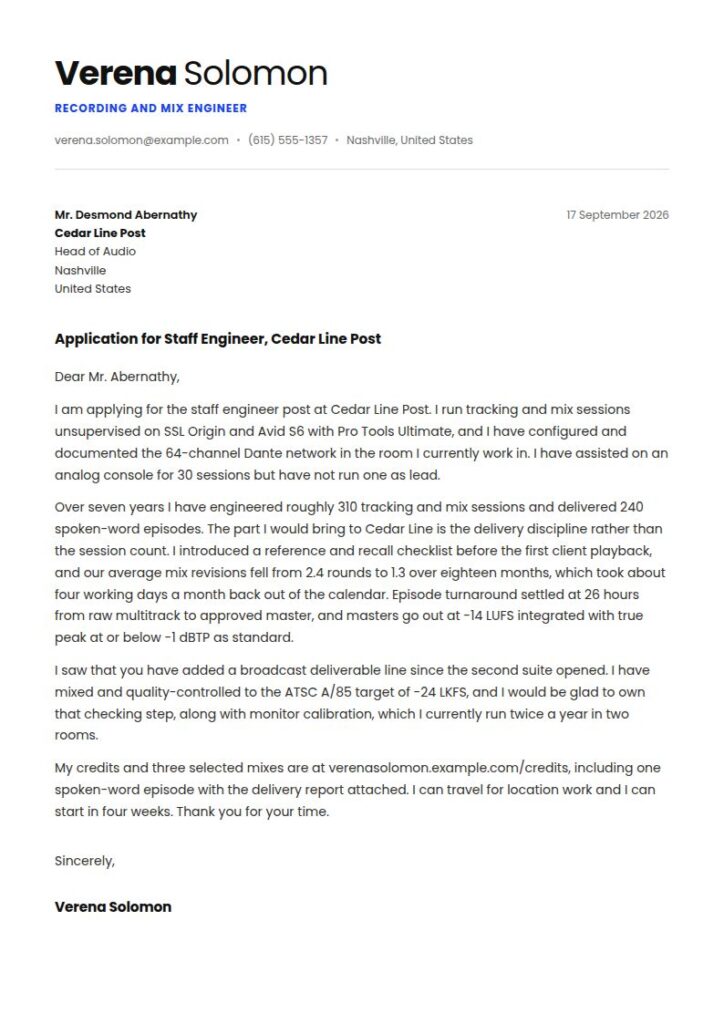
I am applying for the staff engineer post at Cedar Line Post. I run tracking and mix sessions unsupervised on SSL Origin and Avid S6 with Pro Tools Ultimate, and I have configured and documented the 64-channel Dante network in the room I currently work in. I have assisted on an analog console for 30 sessions but have not run one as lead.
Over seven years I have engineered roughly 310 tracking and mix sessions and delivered 240 spoken-word episodes. The part I would bring to Cedar Line is the delivery discipline rather than the session count. I introduced a reference and recall checklist before the first client playback, and our average mix revisions fell from 2.4 rounds to 1.3 over eighteen months, which took about four working days a month back out of the calendar. Episode turnaround settled at 26 hours from raw multitrack to approved master, and masters go out at -14 LUFS integrated with true peak at or below -1 dBTP as standard.
I saw that you have added a broadcast deliverable line since the second suite opened. I have mixed and quality-controlled to the ATSC A/85 target of -24 LKFS, and I would be glad to own that checking step, along with monitor calibration, which I currently run twice a year in two rooms.
My credits and three selected mixes are at verenasolomon.example.com/credits, including one spoken-word episode with the delivery report attached. I can travel for location work and I can start in four weeks. Thank you for your time.
Sincerely, Verena Solomon
Summary
An audio engineer cover letter names the lane you work in, the room and console you can run unsupervised, the session or show count behind that, and the delivery specs you hit. This guide gives you a full adaptable letter, what changes between studio, live, post and broadcast applications, and the openings that get a reel actually opened.
Audio Engineer cover letter examples by experience level
An audio engineer cover letter is a one-page letter saying which lane you work in, which room and console you can run without supervision, how many sessions or shows are behind that, and what you deliver when you finish the job.
In practice, the person reading it is looking at a booking sheet or a delivery calendar, not at your enthusiasm for sound. They want to know whether they can put you in a room next month and walk away.
Guide to an audio engineer cover letter
To help, this guide and the corresponding audio engineer cover letter example will cover:
- First, how to structure the letter, paragraph by paragraph
- Next, why the lane and the console belong in the first two sentences
- What counts as evidence when your best work is under non-disclosure
- Finally, how the letter changes between studio, live, post and broadcast
- The openings that get a reader to open a reel rather than skim it
How to write an audio engineer cover letter
| Paragraph | Its job | Length |
|---|---|---|
| Opening | The post, your lane, the room and console you run alone | 2 to 3 sentences |
| Evidence | One project: the chain, the volume, the turnaround, the spec | 4 to 5 sentences |
| Fit | Something specific about their facility or roster, and what you would take on | 3 to 4 sentences |
| Close | Reel or credits link, availability and travel, thank you | 2 sentences |
Say what you can run alone, in the second sentence
Every audio application says "experienced with a wide range of equipment". None of them answers the question the hiring engineer actually has, which is whether you can be left in a room.
Write the answer: "I run tracking and mix sessions unsupervised on SSL Origin and Avid S6 with Pro Tools Ultimate, and I have configured the Dante network in the room I work in." That is one sentence and it settles the largest doubt in the file.
Then give the honest boundary in the same breath, because it makes the first claim credible: "I have assisted on an analog Neve console for 30 sessions but have not run one as lead." Nobody has ever lost a job for that sentence. People lose jobs for the opposite.
An audio engineer cover letter example you can adapt
Dear Mr. Abernathy,
I am applying for the staff engineer post at Cedar Line Post. I run tracking and mix sessions unsupervised on SSL Origin and Avid S6 with Pro Tools Ultimate, and I have configured and documented the 64-channel Dante network in the room I currently work in. I have assisted on an analog console for 30 sessions but have not run one as lead.
Over seven years I have engineered roughly 310 tracking and mix sessions and delivered 240 spoken-word episodes. The part I would bring to Cedar Line is the delivery discipline rather than the session count. I introduced a reference and recall checklist before the first client playback, and our average mix revisions fell from 2.4 rounds to 1.3 over eighteen months, which took about four working days a month back out of the calendar. Episode turnaround settled at 26 hours from raw multitrack to approved master, and masters go out at -14 LUFS integrated with true peak at or below -1 dBTP as standard.
I saw that you have added a broadcast deliverable line since the second suite opened. I have mixed and quality-controlled to the ATSC A/85 target of -24 LKFS, and I would be glad to own that checking step, along with monitor calibration, which I currently run twice a year in two rooms.
My credits and three selected mixes are at verenasolomon.example.com/credits, including one spoken-word episode with the delivery report attached. I can travel for location work and I can start in four weeks. Thank you for your time.
Sincerely, Verena Solomon
Openings that work
| Instead of | Use |
|---|---|
| I have a lifelong passion for music and sound | I run tracking and mix sessions unsupervised on SSL Origin and Avid S6 with Pro Tools Ultimate |
| I am writing to express my interest in your engineering position | I am applying for the staff engineer post, and the broadcast deliverable line is the part I would own |
| I am proficient in all major DAWs and industry-standard gear | I configured and documented the 64-channel Dante network in the room I work in |
| I pride myself on delivering broadcast-quality audio | Masters go out at -14 LUFS integrated with true peak at or below -1 dBTP |
What counts as evidence when the work is under non-disclosure
However, you cannot name a great deal of audio work. That is normal, and it is not an excuse for a vague letter.
| Kind of evidence | What it looks like in a sentence |
|---|---|
| Volume | 310 tracking and mix sessions over seven years, 40 to 55 a year as lead |
| Turnaround | 26 hours average from raw multitrack to approved master across 240 episodes |
| Revisions | Average mix revisions down from 2.4 rounds to 1.3 across eighteen months |
| Chain | SSL Origin, Avid S6, Pro Tools Ultimate, 64 channels of Dante on a managed VLAN |
| Spec | Delivered at -14 LUFS integrated and -1 dBTP; broadcast work checked to -24 LKFS |
| Facility | Monitor calibration twice a year in two rooms; 140 microphones serviced on rotation |
Instead, client type substitutes for client name: "a national podcast network", "a regional broadcaster", "an independent label roster". Nobody minds the redaction. What they do mind is a letter with nothing checkable in it.
Studio, live, post and broadcast letters are different letters
For a studio job, lead with the console, the session count and whether you can run a room alone. For live, lead with the consoles and PA systems, the show count, the venue sizes and your travel availability, because a production manager is buying dates as much as skill. For post, lead with turnaround per episode or reel, the editing you do yourself, and the deliverable formats. For broadcast, lead with the plant and control room, live mixing under a director, and loudness compliance. In all four, name one real thing about their facility or roster.
Do not claim a console you have only watched. Do not name an artist, label or client you did not work for, because the trade is small and the call gets made. Do not send a letter with no facility name in it. Do not attach a 40-minute reel; two to three minutes with the strongest thing first. Do not say you are available immediately if you are not, since the schedule is the whole negotiation.
The lane you claim is worth more than the growth rate
Employment of broadcast, sound and video technicians is projected to grow 1 percent between 2025 and 2035, adding 1,700 jobs, with about 9,800 openings a year (BLS Occupational Outlook Handbook, page last modified 27 August 2026).
The pay spread inside the profile is far larger than that. For May 2025 the medians were $73,130 for sound engineering technicians, $68,060 for lighting technicians, $59,570 for broadcast technicians and $58,100 for audio and video technicians, against $60,150 for the profile as a whole (BLS, page last modified 27 August 2026).
Industry moves it again: motion picture and sound recording industries paid a median of $75,450 against $51,480 in rental and leasing services (BLS, May 2025).
So the letter's first job is to place you in the right one of those and make it stick. A letter that reads as general audiovisual support gets answered as general audiovisual support, whatever the sessions behind it.
Length, format and sending it
One page, four paragraphs, 250 to 400 words. PDF unless the posting says otherwise, named for yourself and the lane: verena-solomon-recording-mix-engineer-cover-letter.pdf.
Put the reel or credits link in the letter as well as the resume, and keep it under three minutes with the strongest thing first. Use the same session counts and specs as your resume so the two agree; our audio engineer resume example is written with the figures used here.
Address a person. A facility site usually names its chief engineers, post supervisors and production managers, and a generic salutation on an otherwise specific letter reads as a mail merge.
Key takeaways
- To start, name the lane and the console you run unsupervised in the first two sentences.
- Then state the honest boundary of what you have only assisted on; it makes the rest credible.
- Give volume, turnaround and revision numbers rather than adjectives.
- Put the delivery spec in the letter, including the broadcast target if you have hit it.
- Also, substitute client type for client name where work is under non-disclosure.
- In addition, name one real thing about their facility, roster or recent work.
- Finally, say your travel availability and your actual start date.
Write your audio engineer cover letter in 10 minutes with our AI cover letter builder.
Audio engineer cover letter questions, answered
How long should an audio engineer cover letter be?
One page, four paragraphs, 250 to 400 words. The reader is between sessions. The letter's job is to get the reel opened, not to replace it.
Do I need a cover letter if I have a reel?
Yes. A reel proves taste and craft. It does not say which console you can run alone, how many sessions a year you carry, what your turnaround is, or whether you understand delivery specs. Those are the things that decide whether you get booked, and only the letter can say them.
What if my best work is covered by a non-disclosure agreement?
Say so in one clause and give the client type instead: "a national podcast network", "a regional broadcaster". Then put the checkable facts around it: volume, turnaround, the chain, the spec. A redaction with numbers around it reads as professional. A letter with neither reads as thin.
Should I mention loudness targets in a cover letter?
If you deliver, yes, in one clause. For music streaming Spotify normalizes to -14 dB LUFS and recommends true peak at or below -1 dBTP; for US television the FCC applies the ATSC A/85 Recommended Practice under the CALM Act, with a -24 LKFS target for exchange without metadata. Naming the one that matches their output shows you know the target changes with the destination.
How do I write this with no professional credits yet?
Count what you have done precisely and do not inflate it. Sessions engineered, episodes delivered, shows mixed, the room, the interface, the monitoring, the specs you hit. Then name the certification that proves the systems half of the job, since Avid, Audinate and AVIXA all publish what their tiers cover. A beginner who can configure a Dante network and deliver to spec is more useful than one who owns more plugins.