Freelance Writer, Health Care and Higher Education Marisela Renteria
Freelance Writer
[email protected] | (520) 555-1136 | Tucson, United States
Profile
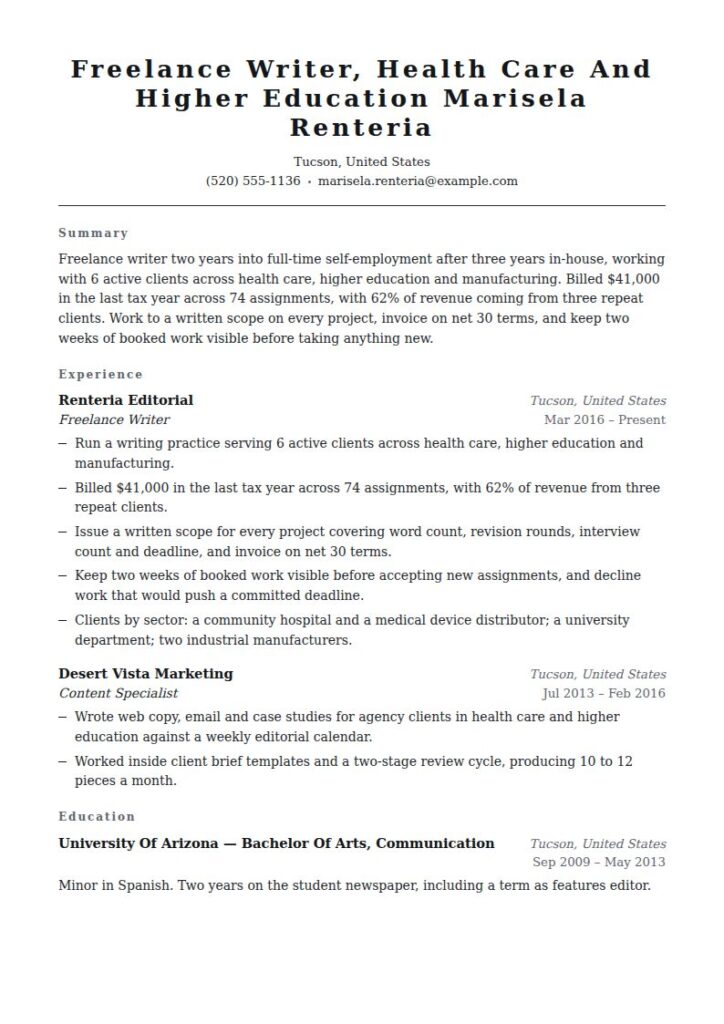
Freelance writer two years into full-time self-employment after three years in-house, working with 6 active clients across health care, higher education and manufacturing. Billed $41,000 in the last tax year across 74 assignments, with 62% of revenue coming from three repeat clients. Work to a written scope on every project, invoice on net 30 terms, and keep two weeks of booked work visible before taking anything new.
Work Experience
03/2016 - Present, Freelance Writer, Renteria Editorial, Tucson, United States
- Run a writing practice serving 6 active clients across health care, higher education and manufacturing.
- Billed $41,000 in the last tax year across 74 assignments, with 62% of revenue from three repeat clients.
- Issue a written scope for every project covering word count, revision rounds, interview count and deadline, and invoice on net 30 terms.
- Keep two weeks of booked work visible before accepting new assignments, and decline work that would push a committed deadline.
- Clients by sector: a community hospital and a medical device distributor; a university department; two industrial manufacturers.
07/2013 - 02/2016, Content Specialist, Desert Vista Marketing, Tucson, United States
- Wrote web copy, email and case studies for agency clients in health care and higher education against a weekly editorial calendar.
- Worked inside client brief templates and a two-stage review cycle, producing 10 to 12 pieces a month.
Education
09/2009 - 05/2013, Bachelor of Arts, Communication, University of Arizona, Tucson, United States
Minor in Spanish. Two years on the student newspaper, including a term as features editor.
Skills
Explainers and web copy, 80
Interviewing and source verification, 70
Writing to a client brief template, 80
Scoping and written statements of work, 70
Net 30 invoicing and collections, 70
AP style, 80
Languages
English, native
Spanish, native
Certificates
04/2017, HIPAA Privacy and Security Training for Contractors, Contracted health care client compliance program
Renewed annually as a condition of health care contract work.
Summary
A freelance writer resume is a one to two page document presenting self-employment as a business: named client types, retainers, how rates are set, and how work is scoped and invoiced. This guide gives you three adaptable versions, the way to write a self-employed period so it reads as competence, and current Bureau of Labor Statistics pay for the occupation.
Freelance Writer resume examples by experience level
In short, a freelance writer resume is a one to two page document that presents self-employment as a business: the clients you carry, the retainers that make revenue predictable, how you set rates, and how work gets scoped, delivered and paid for.
The writing is assumed. Instead, what a reader is uncertain about is everything around it. Whether you can hold a deadline when nobody is managing you, whether you have ever said no to a badly scoped job, whether you know what your time costs. Those are business questions, and most freelance writer resumes answer none of them because they are written as a list of things the person has produced.
Resume guide for a freelance writer resume
For this reason, this guide and the corresponding freelance writer resume example will cover:
- First, how to write a freelance writer resume, section by section
- Why clients, retainers and rates belong on the page and bylines mostly do not
- Then, three adaptable summaries: early freelance, established, and editorial practice
- How to write a self-employed period so a salaried hiring manager reads competence
- Finally, what the market looks like and what BLS says the occupation pays
How to write a freelance writer resume
Overall, six sections: contact header with a portfolio link, summary, the practice, client work, skills, and education. In general, one page under five years of freelancing, two once the practice has retainers and subcontractors.
In fact, "the practice" is the block that does the heavy lifting. Specifically, it is where the business facts live: years self-employed, client count, retainer share, how rates are set, typical turnaround, and the terms you work on. It is unusual, and that is exactly why it works.
| Section | What it is answering | Where it goes |
|---|---|---|
| Portfolio link | Can this person write, and is the link live? | Contact header, in full |
| The practice | Is this a business or a run of odd jobs? | Directly under the summary |
| Client work | Which sectors, formats and scales? | Grouped by sector, not one entry per job |
| Skills | What could they be handed on Monday? | Grouped: formats, subjects, tools, business |
Set rates by the day or the project, and say so on the page
How you price is one of the fastest reads on a freelance writer's seriousness. Per-word pricing rewards length and punishes research, and everyone who has done this for a while knows it. Day rates and project rates price the work.
There is also arithmetic that a salaried reader may not have done. Self-employment tax is 15.3 percent, made up of 12.4 percent for Social Security and 2.9 percent for Medicare, and it is owed once net earnings from self-employment reach $400 (Internal Revenue Service, page last updated 27 June 2026). That sits on top of income tax, and it comes before health insurance, retirement, equipment, software, unpaid administration and unpaid selling time.
Writers and authors had a median wage of $36.98 an hour in May 2025 (BLS Occupational Outlook Handbook, May 2025). A freelance rate that merely matches a salaried hourly figure is a pay cut, and stating on your resume that you price by the day or the project tells a reader you have worked that out.
Run the finished file through the ATS resume checker before applying for a salaried post. Freelance resumes have unusual structures and parse badly if they are built out of headings the software does not recognize.
Choosing the best resume format for a freelance writer resume
Reverse chronological, with self-employment as a single continuous entry rather than one entry per client. Therefore, write it the way a business would be written: the practice name, the city, the dates, and what it does. Then client engagements become bullets or a grouped list underneath.
This matters because the alternative fails in a specific way. By contrast, fourteen separate three-month entries look like fourteen jobs that ended, and an applicant tracking system will read them as short tenures. On the other hand, one entry covering nine years with clients listed underneath reads as a nine-year business, which is what it is.
A functional format is still the wrong answer. After all, it hides the timeline, and the timeline is the evidence that the work was sustained.
Include your contact information
| ✅ Right | ❌ Wrong |
|---|---|
| Marisela Renteria | Marisela Renteria |
| Freelance Writer, Health Care and Higher Education | Freelance writer, editor, and creative soul |
| Portfolio: mariselarenteria.example.com | Samples available upon request |
| (520) 555-1136, [email protected], Tucson, AZ | (520) 555-1136, [email protected] |
Use a business email address on your own domain if you have one, and a professional one at any rate. In other words, this is the smallest possible signal of a real practice and it costs nothing.
Also, name the sectors you write in under your name. "Freelance writer" alone is the least useful title line on any resume, because it describes a tax status rather than a job.
Make use of a summary
For the summary, use four lines: years and shape of the practice, sectors, one revenue or retainer fact, and how you work.
Freelance writer two years into full-time self-employment after three years in-house, working with 6 active clients across health care, higher education and manufacturing. Billed $41,000 in the last tax year across 74 assignments, with 62% of revenue coming from three repeat clients. Work to a written scope on every project, invoice on net 30 terms, and keep two weeks of booked work visible before taking anything new.
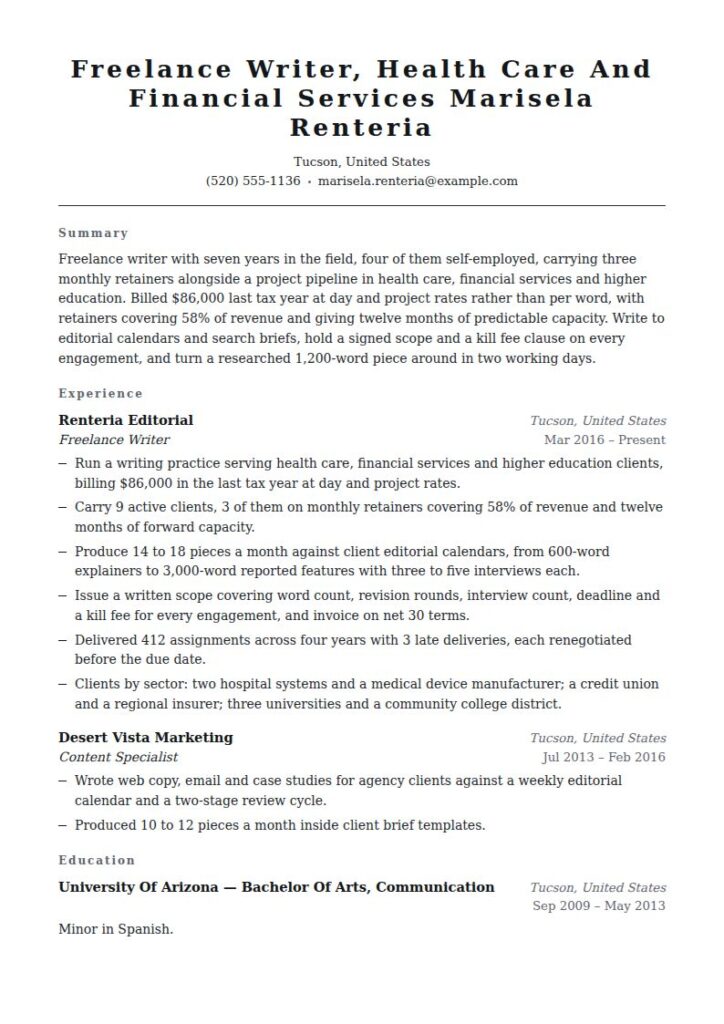
Freelance writer with seven years in the field, four of them self-employed, carrying three monthly retainers alongside a project pipeline in health care, financial services and higher education. Billed $86,000 last tax year at day and project rates rather than per word, with retainers covering 58% of revenue and giving twelve months of predictable capacity. Write to editorial calendars and search briefs, hold a signed scope and a kill fee clause on every engagement, and turn a researched 1,200-word piece around in two working days.
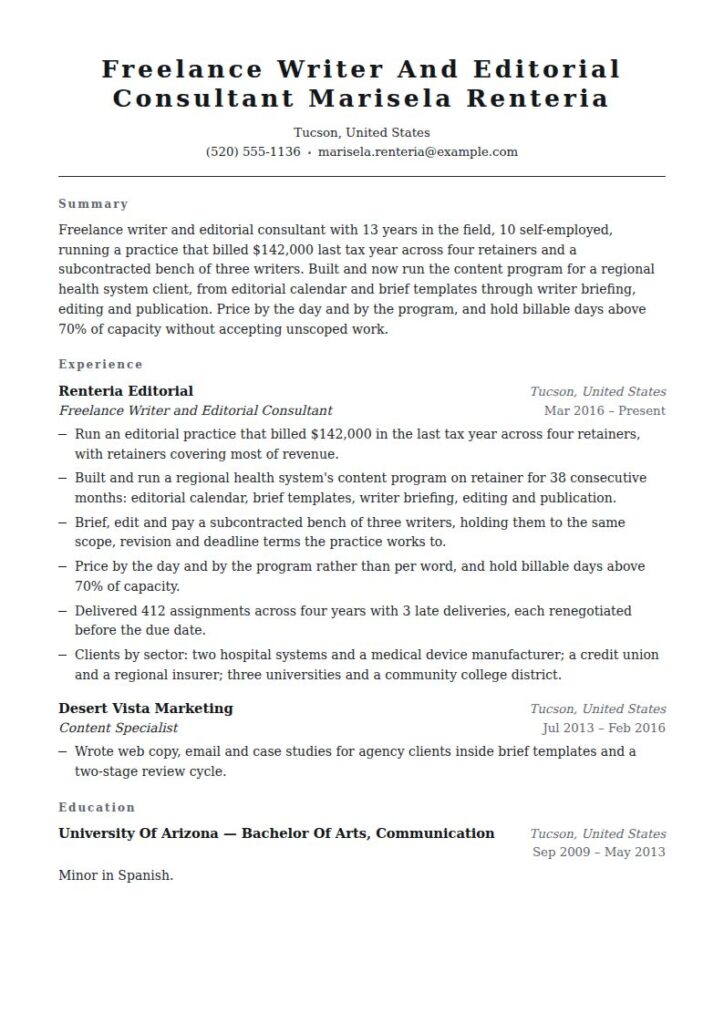
Freelance writer and editorial consultant with 13 years in the field, 10 self-employed, running a practice that billed $142,000 last tax year across four retainers and a subcontracted bench of three writers. Built and now run the content program for a regional health system client, from editorial calendar and brief templates through writer briefing, editing and publication. Price by the day and by the program, and hold billable days above 70% of capacity without accepting unscoped work.
Right vs wrong: the same freelance writer summary, twice
| ✅ Right | ❌ Wrong |
|---|---|
| Four years self-employed, carrying three monthly retainers plus a project pipeline. | Versatile freelance writer with a passion for words and storytelling. |
| Billed $86,000 last tax year at day and project rates; retainers cover 58% of revenue. | Have written for a wide range of clients across many industries. |
| Signed scope and kill fee clause on every engagement; net 30 invoicing. | Reliable, deadline-driven and easy to work with. |
For example, the right column describes a business with terms, revenue and predictability. The left column describes a temperament, which is what every other freelance resume in the pile also describes.
Outline your experience
One heading for the practice. Dates, city, what it does. Then bullets that carry business facts, followed by a grouped client list by sector.
| Instead of | Use |
|---|---|
| Wrote articles for various clients | Carry 9 active clients across health care, financial services and higher education, 3 on monthly retainer |
| Freelance writer, 2016 to present | Renteria Editorial, Tucson, AZ, March 2016 to present: a writing practice serving regulated and technical sectors |
| Wrote blog posts and web content | Produce 14 to 18 pieces a month against client editorial calendars, from 600-word explainers to 3,000-word reported features |
| Worked with clients to meet their needs | Run a 30-minute scoping call before every project, and issue a written scope covering word count, revisions, interview count and deadline |
| Met all deadlines | Delivered 412 assignments across four years with 3 late deliveries, each one renegotiated in advance |
| Managed my own schedule | Keep a booked pipeline two to six weeks ahead and decline work that would push a committed deadline |
Freelance Writer, Renteria Editorial, Tucson, AZ, March 2016 to Present
Run a writing practice serving health care, financial services and higher education clients, billing $86,000 in the last tax year at day and project rates.
Carry 9 active clients, 3 of them on monthly retainers that cover 58% of revenue and give twelve months of forward capacity.
Produce 14 to 18 pieces a month against client editorial calendars, from 600-word explainers to 3,000-word reported features with three to five interviews each.
Issue a written scope for every engagement covering word count, revision rounds, interview count, deadline and a kill fee, and invoice on net 30 terms.
Delivered 412 assignments across four years with 3 late deliveries, each renegotiated before the due date rather than after it.
Clients by sector: two hospital systems and a medical device manufacturer; a credit union and a regional insurer; three universities and a community college district.
Naming sectors rather than organizations is standard and expected. Of course, much freelance writing is ghostwritten or done under a non-disclosure agreement, and a reader who works with freelancers knows it.
Write the self-employed years as a business, not a gap
In practice, a salaried hiring manager reading a freelance period is running a quiet checklist, and it is rarely about the writing. Will this person tolerate a manager? For instance, can they work inside someone else's process? Did they freelance by choice or because they could not find a job? And are they going to leave the moment a good client comes back?
However, you cannot answer those in a cover letter alone. As a result, the resume has to do it structurally, and there are six moves that do it.
Give the practice a name and a shape. "Renteria Editorial, Tucson, AZ, March 2016 to present" reads as a business. "Freelance, various clients" reads as a period of unemployment with writing in it. This is presentation, not invention: a sole proprietorship operating under your own name is a real business.
Put revenue on the page. Billed revenue for a named tax year is the single most effective line on a freelance resume, and almost nobody includes it. It converts an unreadable list of engagements into one verifiable fact. Give one year, say it is billed revenue and not profit, and leave it there.
Freelance writer proof of predictability
Show predictability. Retainers, contract lengths and repeat client share all say the same thing: this was a book of business, not a run of luck. "Retainers cover 58% of revenue" and "62% of revenue from three repeat clients" both answer the manager's real question, which is whether other people chose to keep working with you.
Show that you scope and you refuse. A written scope with revision rounds, interview counts and a kill fee is the freelance equivalent of a job description. Saying that you decline work that would push a committed deadline tells a manager you will not quietly overcommit inside their team either.
Count delivery. Assignments delivered, late deliveries, and how you handled the late ones. A number of misses, stated plainly with what you did about them, reads as far more trustworthy than a claim of perfection.
Say why you freelanced, once, in plain words. A single clause is enough: "moved to freelance to specialize in regulated health content", "freelanced while caring for a family member", "built a practice after a redundancy and kept it for nine years". Vagueness invites the worst assumption; one honest clause closes it.
Write the practice as one continuous entry with a name, a location and dates. Give billed revenue for a named year. Give retainer share and repeat client share. Name sectors when clients are confidential. State your terms: scope, revisions, kill fee, invoicing. Say in one clause why you went freelance and whether you are seeking salaried work now.
Do not list one entry per client, which reads as serial short tenure. Do not put a 40-item byline list on the resume; that is what the portfolio is for. Do not describe the practice in the plural as if it were an agency with staff it does not have. Do not leave a multi-year period labeled only "freelance". Do not hide that you are looking for a salaried role, because a manager worried you will leave is the hardest objection to overcome late.
Most of this occupation is self-employed, so the shape is normal
Self-employed workers are the largest single share of employment for writers and authors, at 65 percent, ahead of professional, scientific and technical services at 9 percent and information at 8 percent (BLS Occupational Outlook Handbook, 2025).
By comparison, 9 percent of editors are self-employed (BLS, 2025), which is worth knowing if you are moving toward an editing role: you would be joining a mostly salaried occupation from a mostly freelance one.
The occupation as a whole is flat, projected to change by 0 percent between 2025 and 2035, a fall of about 500 jobs, with roughly 11,900 openings a year, nearly all replacements (BLS, 2025 to 2035 projections, published 27 August 2026).
The useful conclusion is that self-employment is not an anomaly you need to explain away; it is how most of this occupation works. What needs explaining is only the business underneath it, which is precisely what most freelance resumes leave out.
Build a snapshot of your key skills
For skills, list twelve to sixteen entries in four groups, and the fourth group is the one that separates you: the business skills.
Formats: Reported features, Explainers, Case studies, White papers, Email newsletters, Landing pages, Executive ghostwriting, Annual report narrative
Subjects: Health care and clinical topics for lay readers, Financial services, Higher education, Manufacturing and industrial
Craft and tools: Interviewing, Source verification, Search briefs and keyword targets, AP style, Google Docs and Workspace, WordPress, Asana, Slack
Business: Scoping and written statements of work, Day and project rate setting, Retainer agreements, Kill fee and revision clauses, Net 30 invoicing and collections, Pipeline and capacity planning, Subcontracting and briefing other writers
That last group is the differentiator. It is also true, which is why it holds up in an interview: every working freelancer does these things, and almost none of them think to say so.
List your education and certifications
Degree, institution, year. Then anything that supports the subjects you write about, which matters more here than the degree does.
Bachelor of Arts, Communication, University of Arizona, Tucson, AZ, 2013.
Certifications: Certified Health Education Specialist coursework completed 2021. HIPAA privacy and security training for contractors, renewed annually.
Business: Sole proprietorship registered in Arizona since 2016, with an employer identification number, professional liability insurance, and quarterly estimated tax filing.
That last line is optional and it is worth considering. In addition, for a client-facing contract role or a post at a regulated employer, insurance and a registered business are procurement facts that shorten the onboarding conversation.
Choose the right layout and design
As for layout, use a single column, 10 or 11 point type, plain headings, no graphics. Keep the practice as one entry so parsing software reads one long tenure rather than many short ones.
If you are applying for salaried work, put the in-house roles that came before freelancing in the same reverse chronological run. A reader who can see three years in an agency before nine years freelancing has the answer to the question about tolerating a manager, and does not have to ask it.
Freelance writer job market and outlook
The Bureau of Labor Statistics publishes no Occupational Outlook Handbook profile for freelance writer, because freelance is an employment arrangement rather than an occupation. On pay, the published occupation is writers and authors, and it is the right one: BLS reports that 65 percent of that occupation is self-employed.
| Measure | Writers and authors | Editors |
|---|---|---|
| Employment, 2025 | 140,300 | 105,000 |
| Projected change, 2025 to 2035 | 0 percent, -500 | -1 percent, -1,100 |
| Projected annual openings | ~11,900 | ~7,900 |
| Self-employed share | 65 percent | 9 percent |
| Median annual wage, May 2025 | $76,910 | $77,920 |
Source: U.S. Bureau of Labor Statistics, Occupational Outlook Handbook, May 2025 wage data and 2025 to 2035 projections, last modified 27 August 2026.
Meanwhile, industry medians within writers and authors show where the paid work sits. In May 2025, religious, grantmaking, civic and professional organizations paid a median of $80,480, professional, scientific and technical services $77,860, information $74,590 and educational services $72,610 (BLS, May 2025).
What salary you can expect as a freelance writer
There is no published median for freelance writers specifically, and any per-word rate table you find online comes from self-selected surveys without published methodology. What is sourced is the occupation.
Overall, writers and authors had a median annual wage of $76,910, or $36.98 an hour, in May 2025, with the lowest 10 percent under $44,310 and the highest 10 percent over $139,870 (BLS Occupational Outlook Handbook, May 2025).
Reading that as a freelance rate requires two adjustments, and both go the same way. First, a salaried figure buys paid time off, employer payroll tax contributions, equipment, software and often insurance. Second, self-employment tax of 15.3 percent applies to net earnings from self-employment, split 12.4 percent for Social Security and 2.9 percent for Medicare (Internal Revenue Service, last updated 27 June 2026). A freelance rate, by contrast, has to cover all of that plus the hours you spend selling, scoping, invoicing and chasing payment, which nobody pays for directly.
Three things move a freelance writer's income. Subject is first, and it is the largest single lever: regulated and technical subjects pay well above general content because fewer writers can do them safely. Retainers are second, because predictable revenue lets you refuse bad work. Pricing structure is third. Writers who move from per-word to day and project rates almost always raise their effective hourly rate, because research and interviews stop being unpaid.
Key takeaways for a freelance writer resume
- Write the practice as one continuous entry with a name, a location and dates.
- Give billed revenue for one named tax year, and say it is billed revenue.
- Show predictability: retainer share, repeat client share, contract lengths.
- Name sectors rather than clients where the work is confidential.
- State your terms: written scope, revision rounds, kill fee, net 30 invoicing.
- Count delivery, including the misses and what you did about them.
- Say in one clause why you freelanced, and whether you want salaried work now.
Build your freelance writer resume in 15 minutes with our AI resume builder.
Related resume examples
- Writer resume
- Copywriter resume
- Technical writer resume
- Grant writer resume
- Journalist resume
- Freelancer resume
- Self-employed resume
- Work-from-home resume
- Career change resume
- Translator resume
- Part-time job resume
- Scientist resume
Pair it with a matching freelance writer cover letter.
Freelance writer resume questions, answered
How long should a freelance writer resume be?
One page under five years of freelancing, two once the practice carries retainers, subcontractors or a decade of clients. The second page should be business and sector detail, not a longer list of pieces, which belongs in the portfolio.
Should I list every client on my resume?
No. Group them by sector and give counts: "two hospital systems and a medical device manufacturer" is more readable than eleven organization names and does not breach confidentiality. Name individual clients only where the work is public, the relationship is current and the client would not mind.
Is it a problem that I have been self-employed for years?
Not in this occupation. BLS reports that 65 percent of writers and authors are self-employed (BLS Occupational Outlook Handbook, 2025), so a hiring manager in publishing, marketing or communications reads it as normal. What creates doubt is a multi-year period labeled only "freelance" with no business facts attached to it.
Should I put my income on a resume?
Billed revenue for one tax year, yes, and it is unusually persuasive. It is not a salary claim and it is not boasting; it is the clearest single measure of whether the practice worked. Give one year, label it billed revenue, and do not itemize it by client.
How do I move from freelancing to a salaried writing job?
Put the in-house roles that preceded freelancing in the same timeline, keep the practice as one entry, and address the obvious question in one clause: that you are looking for a salaried role and why. Then lean on the parts of freelancing that salaried teams value, which are scoping, working to other people's editorial calendars, and delivering without supervision.
What do I do about work that was ghostwritten?
Say what you can. "Executive ghostwriting for a regional insurer, 14 bylined-by-client pieces in 2025" describes real work without breaking an agreement. Keep one or two pieces you can share in the portfolio, and offer a writing sample produced for that purpose if everything else is confidential.