Marisela Renteria Freelance Writer and Editorial Consultant Tucson, 85719, United States [email protected] · (520) 555-1136
11 September 2026
Ms. Imogen Trask Content Director Alderpoint Health Systems Tucson, United States
Application for Senior Content Writer, Alderpoint Health Systems
Dear Ms. Trask,
I am applying for the Senior Content Writer post at Alderpoint Health Systems. I have run an editorial practice in Tucson for ten years, writing mostly for health care and higher education clients, and I would like to bring that work inside one organization rather than spreading it across nine.
The engagement closest to your posting is a content program I built for a regional health system on retainer. I set up the editorial calendar and the brief template, wrote the patient-facing explainers myself, and briefed and edited three subcontracted writers on the rest. The program has run for 38 consecutive months. Across the practice as a whole I delivered 412 assignments over four years with three late deliveries, each one renegotiated before the due date, and last tax year the practice billed $142,000 with four retainers covering most of it. I have worked inside other people's calendars, templates and review cycles for a decade, because that is what a retainer is.
I want a salaried role for a specific reason: the work I am proudest of is the program I built and kept running, and freelancing makes that the exception rather than the job. Your patient education library is unusually readable, and the sections on procedure preparation are better than most health systems manage. The gap I noticed is that the Spanish-language pages stop at the top twenty topics, and the follow-up care pages, which are the ones people read at home after a discharge, are English only. I would want to work on that first.
I can give my retainer clients 30 days and start after that. Thank you for reading, and I am glad to share writing samples that are mine to share.
Sincerely, Marisela Renteria
Summary
A freelance writer cover letter has to do something a staff writer's letter does not: explain the business behind the self-employment and say why you want a salaried role now. This guide gives you a full adaptable letter, the four unspoken objections to answer, and what to write when every client is confidential.
Freelance Writer cover letter examples by experience level
A freelance writer cover letter is a one page letter that presents the practice as a business, gives one delivery fact that proves it worked, and answers the question the reader has not asked out loud: why a salaried job, and why now.
That last part is the whole letter. A hiring manager reading a nine-year freelance history is not doubting whether you can write. They are working out whether you will fit inside a team, a process and a calendar you did not design.
Guide to a freelance writer cover letter
This guide and the corresponding freelance writer cover letter example will cover:
- How to structure the letter, paragraph by paragraph
- The four unspoken objections a salaried hiring manager is holding
- Why one delivery number beats a paragraph about versatility
- What to write when every client is under a non-disclosure agreement
- How the letter changes when you are pitching a client rather than applying for a job
How to write a freelance writer cover letter
| Paragraph | Its job | Length |
|---|---|---|
| Opening | The post, the practice, the sectors you write in | 2 to 3 sentences |
| Evidence | One program you ran, one delivery number, one retainer fact | 4 to 5 sentences |
| Why now | Why salaried, why here, and one accurate observation about their content | 3 to 4 sentences |
| Close | Availability, notice on current clients, thank you | 2 sentences |
Answer the four objections before they are raised
Every salaried manager reading a freelance application is holding the same four doubts, and none of them will be said aloud in an interview.
Will they take direction? Answer it by describing work done inside someone else's editorial calendar, brief template and review process, which is most freelance work anyway.
Did they freelance by choice? Answer it in one clause. A deliberate move to specialize, a family circumstance, a redundancy that turned into a practice: any of these is fine, and vagueness is the only bad option.
Will they leave when a good client calls? Answer it by saying what you are doing about your existing clients, such as a notice period or a wind-down date.
Can they work at somebody else's pace? Answer it with a delivery number: assignments delivered, deadlines held, a retainer sustained for a named number of months.
Four sentences across the letter is enough. The letter that does not address them leaves the reader to guess, and the guess is rarely generous.
A freelance writer cover letter example you can adapt
Dear Ms. Trask,
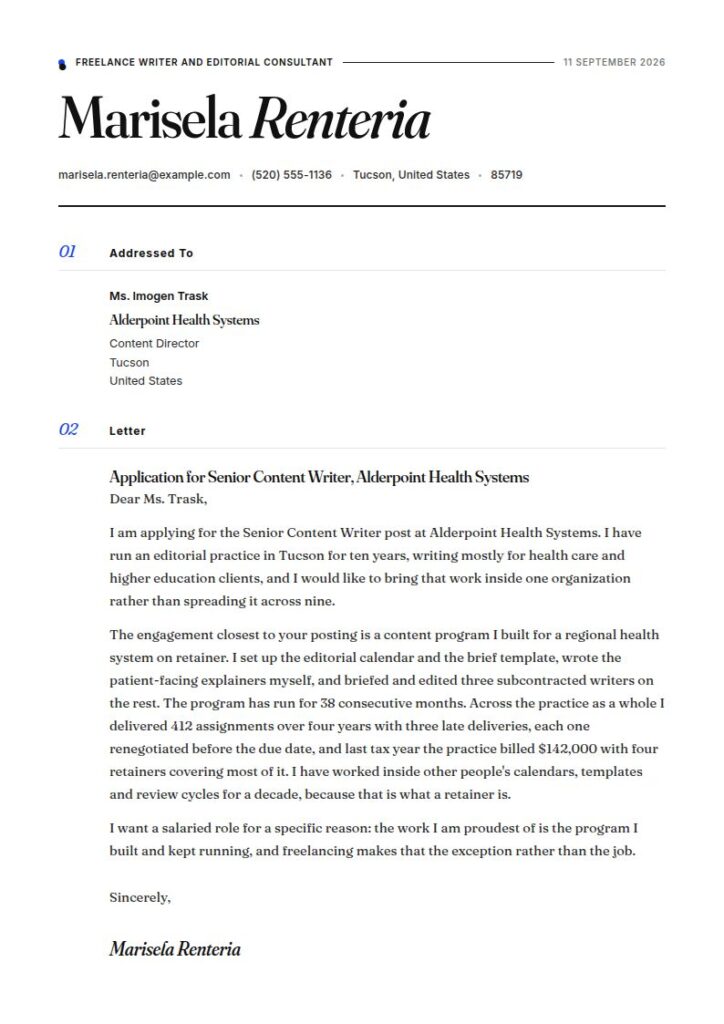
I am applying for the Senior Content Writer post at Alderpoint Health Systems. I have run an editorial practice in Tucson for ten years, writing mostly for health care and higher education clients, and I would like to bring that work inside one organization rather than spreading it across nine.
The engagement closest to your posting is a content program I built for a regional health system on retainer. I set up the editorial calendar and the brief template, wrote the patient-facing explainers myself, and briefed and edited three subcontracted writers on the rest. The program has run for 38 consecutive months. Across the practice as a whole I delivered 412 assignments over four years with three late deliveries, each one renegotiated before the due date, and last tax year the practice billed $142,000 with four retainers covering most of it. I have worked inside other people's calendars, templates and review cycles for a decade, because that is what a retainer is.
I want a salaried role for a specific reason: the work I am proudest of is the program I built and kept running, and freelancing makes that the exception rather than the job. Your patient education library is unusually readable, and the sections on procedure preparation are better than most health systems manage. The gap I noticed is that the Spanish-language pages stop at the top twenty topics, and the follow-up care pages, which are the ones people read at home after a discharge, are English only. I would want to work on that first.
I can give my retainer clients 30 days and start after that. Thank you for reading, and I am glad to share writing samples that are mine to share.
Sincerely, Marisela Renteria
Openings that work
| Instead of | Use |
|---|---|
| I am a freelance writer with experience across many industries | I have run an editorial practice in Tucson for ten years, writing mostly for health care and higher education |
| I am seeking a stable position after years of freelancing | I would like to bring this work inside one organization rather than spreading it across nine |
| I am highly self-motivated and work well independently | I delivered 412 assignments over four years with three late deliveries, each renegotiated in advance |
| I have written for many well-known brands | A content program I built for a regional health system has run on retainer for 38 consecutive months |
| I am flexible and easy to work with | I have worked inside other people's calendars, templates and review cycles for a decade |
What to write when every client is confidential
Ghostwriting and non-disclosure agreements are normal in freelance writing, and the reader almost certainly knows it. Describe the shape of the work instead of naming the buyer.
| The constraint | What the letter says |
|---|---|
| Client cannot be named | Names the sector and scale: "a regional health system", "a 12,000-student university" |
| Work was ghostwritten | "Executive ghostwriting, 14 pieces published under client bylines in 2025" |
| Whole program is confidential | Describes the process: calendar, brief template, review cycle, publication cadence |
| No shareable samples at all | Offers a sample written for the purpose, and says so plainly |
| Only old work is public | Gives the years you owned it and what has changed in your practice since |
Offering a purpose-written sample is stronger than it sounds. It removes the reader's problem and it is a small demonstration of exactly the responsiveness they are hiring for.
When the letter is a pitch rather than an application
For a client pitch, lead with what you would do for them rather than your history, and name your rate structure and availability rather than waiting to be asked. Attach or link two pieces in their sector. Give a concrete first project with a scope and a timeline. For a salaried application, do the opposite and lead with the practice and the delivery record, because the employer is buying reliability rather than a project.
Do not send the same letter to employers and clients; they are buying different things. Do not open a client pitch with your life story. Do not apologize for your rate or quote a per-word figure you will regret. Do not tell a salaried employer you will keep freelancing on the side unless you have checked their policy, because raising it casually creates a problem that was not there.
Self-employment is the majority of this occupation, not the exception
Self-employed workers are the largest share of employment for writers and authors, at 65 percent, against 9 percent for professional, scientific and technical services and 8 percent for information (BLS Occupational Outlook Handbook, 2025).
Employment in the occupation is projected to change by 0 percent between 2025 and 2035, a decline of about 500 jobs, while producing roughly 11,900 openings a year, nearly all of them replacements, with a median annual wage of $76,910 in May 2025 (BLS, published 27 August 2026).
For a letter, the practical consequence is this: a salaried opening is a replacement seat and the applicant pool will be full of freelancers, because that is where most of the occupation is. Being freelance does not distinguish you. Having a business with retainers, terms and a delivery record does.
Length, format and sending it
One page, four paragraphs, 250 to 400 words. PDF unless the posting says otherwise, named plainly: marisela-renteria-senior-content-writer-cover-letter.pdf.
Address a person. Content directors, editorial managers and communications leads are usually findable, and for a client pitch the named person matters even more, because an unaddressed pitch is indistinguishable from a mass email.
Say what your notice looks like. Freelancers often assume they can start immediately, and employers often assume the opposite. One sentence settles it.
Use the same figures as your resume so the two documents agree. Our freelance writer resume example is written with the numbers used here.
Key takeaways
- Open with the practice: how long, what sectors, how many clients.
- Give one delivery number: assignments, deadlines held, months a retainer ran.
- Say why you want a salaried role now, in one clause, without apology.
- Show you have worked inside other people's calendars, briefs and review cycles.
- Name sectors when clients are confidential, and offer a sample that is yours to share.
- Say what notice your current clients need.
- Write a different letter for a client pitch, leading with what you would do for them.
Write your freelance writer cover letter in 10 minutes with our AI cover letter builder.
Freelance writer cover letter questions, answered
How long should a freelance writer cover letter be?
One page, four paragraphs, 250 to 400 words. A client pitch can be shorter still, because a prospective client is reading it on a phone between other things and only wants to know what you would do and what it costs.
Should I explain why I am leaving freelancing?
Yes, in one clause, and without apology. A specific reason lands: wanting to build something over years rather than months, wanting colleagues, wanting to work on one subject deeply. Silence invites the assumption that the practice failed, which is the assumption you least want.
Do I say how much I earned freelancing?
On the resume, one year of billed revenue is useful. In the letter, only if it makes a point the rest of the letter cannot, such as demonstrating that the move to salaried work is a choice rather than a rescue. Never present billed revenue as if it were take-home pay.
Will employers hold self-employment against me?
Rarely in this occupation, where 65 percent of writers and authors are self-employed (BLS Occupational Outlook Handbook, 2025). The objections are about fit and process rather than legitimacy: whether you take direction, work at someone else's pace, and stay. Answer those and the freelance history becomes an advantage, because you have run the business side of writing that most staff writers have never seen.
How is a client pitch different from a job application letter?
Almost entirely. A client is buying a result and wants your proposal, your rate structure and your availability in the first paragraph. An employer is buying reliability and wants your history, your delivery record and your reasons. Sending one in place of the other is the most common mistake freelance writers make when they start applying for jobs.