Translator, Spanish and Portuguese into English Beatriz Andrade
Translator, Spanish and Portuguese into English
[email protected] | (703) 555-1203 | Alexandria, United States
Profile
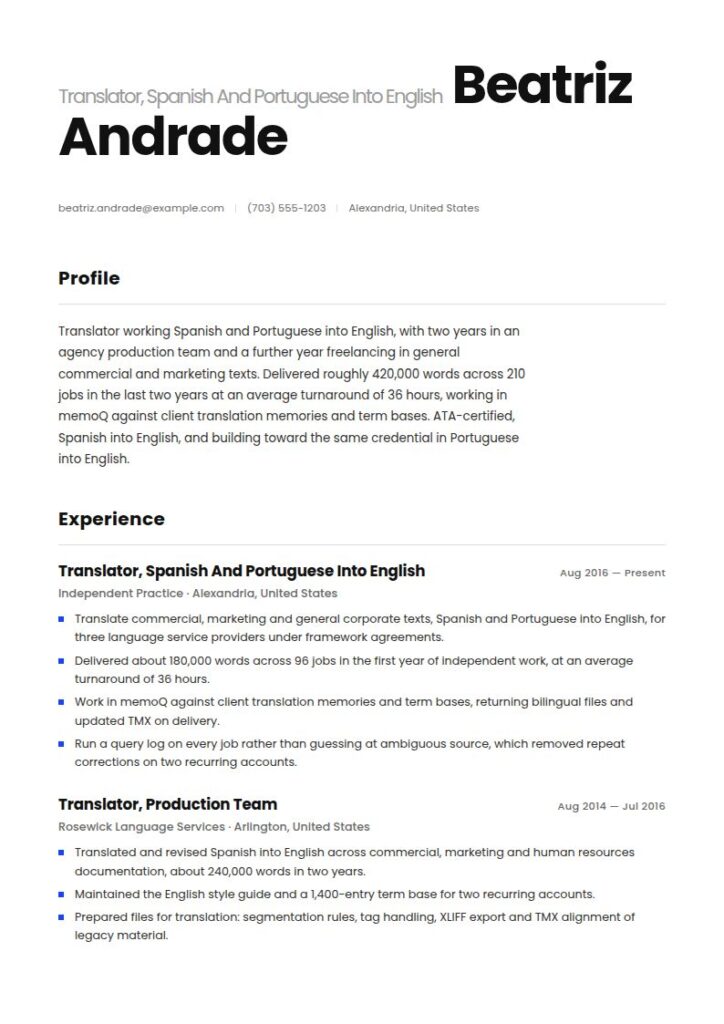
Translator working Spanish and Portuguese into English, with two years in an agency production team and a further year freelancing in general commercial and marketing texts. Delivered roughly 420,000 words across 210 jobs in the last two years at an average turnaround of 36 hours, working in memoQ against client translation memories and term bases. ATA-certified, Spanish into English, and building toward the same credential in Portuguese into English.
Work Experience
08/2016 - Present, Translator, Spanish and Portuguese into English, Independent Practice, Alexandria, United States
- Translate commercial, marketing and general corporate texts, Spanish and Portuguese into English, for three language service providers under framework agreements.
- Delivered about 180,000 words across 96 jobs in the first year of independent work, at an average turnaround of 36 hours.
- Work in memoQ against client translation memories and term bases, returning bilingual files and updated TMX on delivery.
- Run a query log on every job rather than guessing at ambiguous source, which removed repeat corrections on two recurring accounts.
08/2014 - 07/2016, Translator, Production Team, Rosewick Language Services, Arlington, United States
- Translated and revised Spanish into English across commercial, marketing and human resources documentation, about 240,000 words in two years.
- Maintained the English style guide and a 1,400-entry term base for two recurring accounts.
- Prepared files for translation: segmentation rules, tag handling, XLIFF export and TMX alignment of legacy material.
- Ran Xbench quality checks on outgoing files for number, terminology and tag consistency.
Education
08/2012 - 05/2014, Master of Arts, Translation, Spanish and Portuguese, Kent State University, Kent, United States
Thesis on terminology management in regulated life sciences documentation. Coursework in computer-assisted translation, terminology and translation project management.
08/2008 - 05/2012, Bachelor of Arts, Comparative Literature, University of Maryland, College Park, United States
Spanish and Portuguese literature concentration. One year of study in Lisbon.
Skills
Spanish into English translation, 85
Portuguese into English translation, 70
memoQ, 80
Trados Studio, 65
Translation memory and TMX handling, 75
Term base building, 70
Xbench quality assurance, 70
Query log management, 75
English style guide authoring, 65
Languages
English, native
Spanish, fluent
Portuguese, fluent
Certificates
05/2017, ATA-certified Translator, Spanish into English, American Translators Association
Directional certification covering Spanish into English only. Three-hour, open-book, proctored examination.
Summary
A translator resume is a one to two page document naming your language pairs with their direction, the subjects you translate, your certification and the tools you work in. This guide gives you three adaptable versions, the confidentiality rule that keeps client documents off the page, and current Bureau of Labor Statistics pay and outlook for the occupation.
Translator resume examples by experience level
In short, a translator resume is a one to two page document that names your language pairs with a direction, the subjects you translate, the certification behind that claim, and the tools you work in.
First, start with the distinction the job titles keep blurring. Translators work with written communication and interpreters work with spoken communication (U.S. Bureau of Labor Statistics, Occupational Outlook Handbook, last modified 27 August 2026). The two jobs share a language but almost nothing else: one is a desk discipline with revision, terminology management and a delivery file, and the other happens live, once, with no undo. Agencies and staffing teams still use the words interchangeably, so readers take a resume that does not settle the question in its first two lines for the wrong job.
Resume guide for a translator resume
For this reason, this guide and the corresponding translator resume example will cover:
- How to write a translator resume, section by section
- To begin with, why every language pair needs a direction written into it
- Then, three adaptable summaries: early career, specialist and lead
- Also, how to show volume, turnaround and tooling without naming a client
- Finally, what the market looks like and what the Bureau of Labor Statistics says it pays
How to write a translator resume
Six sections: contact header, summary, language pairs, subject specialization and experience, tools, and education with certification. In general, one page for your first five years, two once you carry two pairs, a certification and a decade of regulated subject work.
The order matters because a project manager reads for a filter, not a story. They have a 14,000-word file due Thursday in Spanish into English, and they scan for three things: pair and direction, subject, and whether you can hold the deadline.
| Section | What it is answering | Where it goes |
|---|---|---|
| Language pairs | Which direction do you actually work in? | Immediately under the summary, before experience |
| Subject specialization | Can this person be trusted with a regulated text? | Named subjects with years, not a word cloud |
| Experience | What volume, at what turnaround, under whose review? | Reverse chronological, with numbers |
| Tools | Will you work inside our translation memory and term base? | Its own block, named products and versions |
| Certification | Is the pair claim verifiable by a third party? | With the awarding body, the direction and the year |
Source documents belong to the client, and they never appear on a resume
This is the rule that separates a professional translator's resume from a hobbyist's. Everything you translate arrives under a confidentiality obligation, whether that is a signed non-disclosure agreement, a clause in a framework contract or the ordinary professional duty that attaches to unpublished material.
So no excerpts. No screenshots of a court filing. No sample pages from a clinical study report. No titles of unpublished manuscripts, no patent application numbers, no deal names, and no client names where the engagement itself was confidential.
What you can write is the shape of the work: document type, subject, word count, turnaround, and the review it went through. "Translated 41 informed consent forms and 12 investigator brochures, Spanish into English, roughly 310,000 words across two years, all revised by a second linguist before delivery" tells a project manager more than any sample would, and it breaks nothing.
Where you need to show writing, build a portfolio from published work you have the right to share, or from your own translations of public-domain source texts, and keep it behind a link.
Run the finished file through the ATS resume checker before you send it. Language service providers run large vendor databases, and your pairs, subjects and tools are indexed fields in them.
Choosing the best resume format for a translator resume
As for format, use reverse chronological, with the language pair block lifted above experience. One page under five years, two pages once you hold certification in more than one pair or a decade of specialist work.
A functional format fails here because buyers of translation are buying continuity of subject: five years of medical device files is a different asset from five years of assorted work. After all, a format that dissolves the timeline dissolves the thing they were measuring. If you freelance, write the practice as one continuous entry rather than one entry per client, because a list of twenty short engagements reads as twenty short jobs.
Include your contact information
| ✅ Right | ❌ Wrong |
|---|---|
| Beatriz Andrade | Beatriz Andrade |
| Translator, Spanish and Portuguese into English | Bilingual language professional |
| ATA-certified, Spanish into English | Certified translator and interpreter |
| (703) 555-1203, [email protected], Alexandria, VA | (703) 555-1203, [email protected] |
Two details in the right column do real work: the pair carries a direction, and the certification names the body and the single direction it covers. The wrong column claims both translation and interpreting. If you do both, list separate credentials for each. If you do not, claiming both costs you the assignment the first time someone books you for a deposition.
Make use of a summary
For the summary, use four lines: pairs with direction, subject specialization with years, certification, and one number that shows volume or turnaround.
Translator working Spanish and Portuguese into English, with two years in an agency production team and a further year freelancing in general commercial and marketing texts. Delivered roughly 420,000 words across 210 jobs in the last two years at an average turnaround of 36 hours, working in memoQ against client translation memories and term bases. ATA-certified, Spanish into English, and building toward the same credential in Portuguese into English.
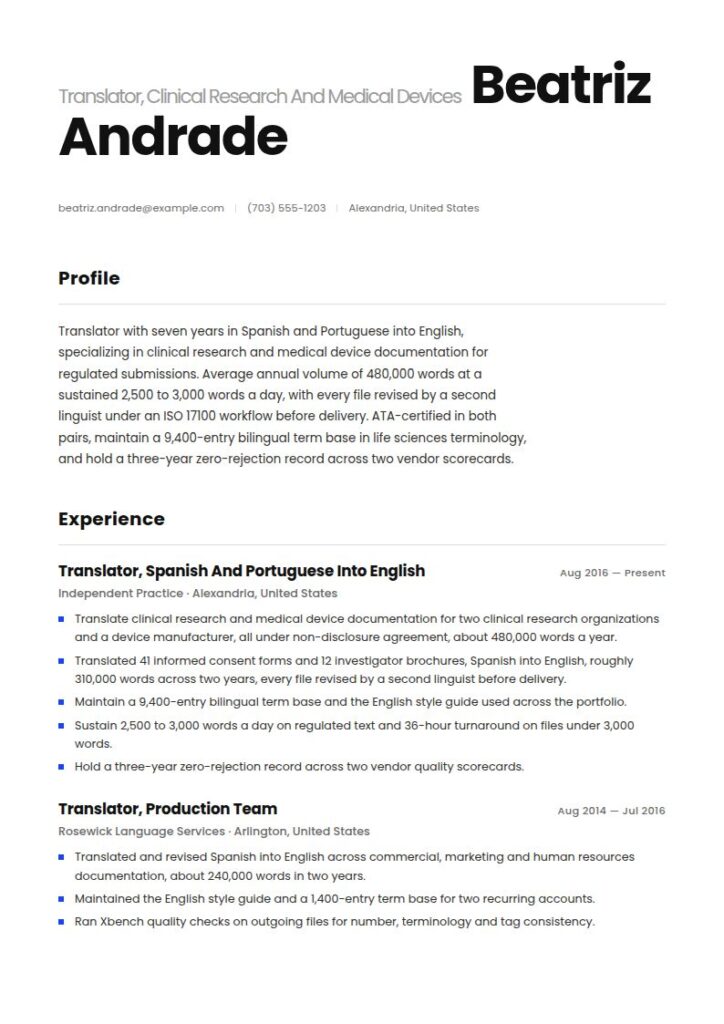
Translator with seven years in Spanish and Portuguese into English, specializing in clinical research and medical device documentation for regulated submissions. Average annual volume of 480,000 words at a sustained 2,500 to 3,000 words a day, with every file revised by a second linguist under an ISO 17100 workflow before delivery. ATA-certified in both pairs, maintain a 9,400-entry bilingual term base in life sciences terminology, and hold a three-year zero-rejection record across two vendor scorecards.
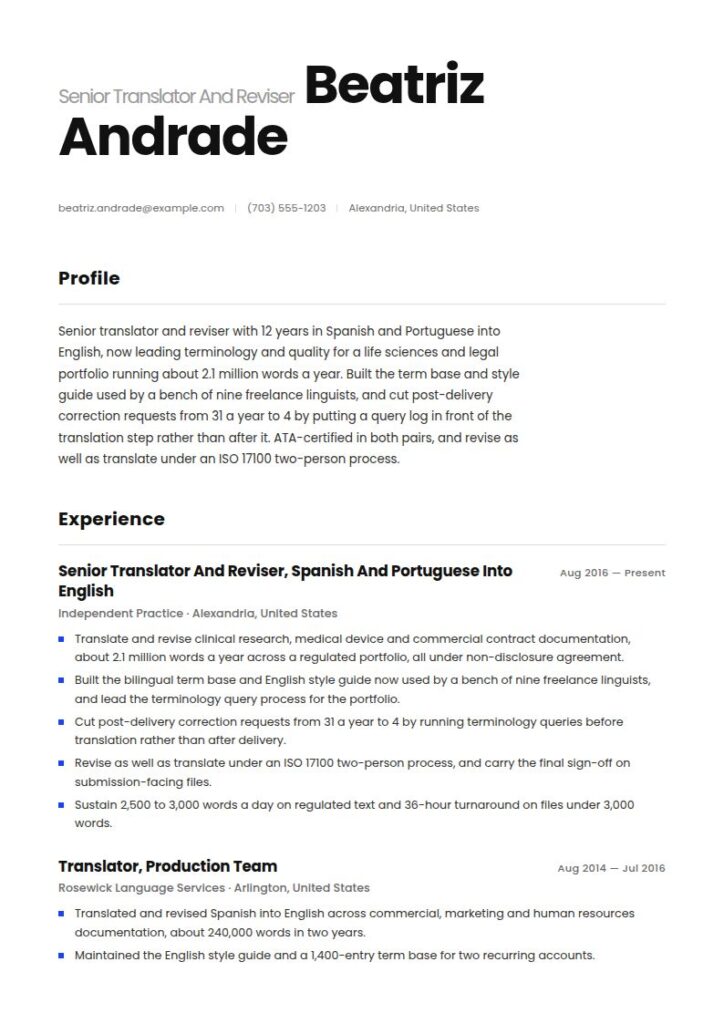
Senior translator and reviser with 12 years in Spanish and Portuguese into English, now leading terminology and quality for a life sciences and legal portfolio running about 2.1 million words a year. Built the term base and style guide used by a bench of nine freelance linguists, and cut post-delivery correction requests from 31 a year to 4 by putting a query log in front of the translation step rather than after it. ATA-certified in both pairs, and revise as well as translate under an ISO 17100 two-person process.
Right vs wrong: the same translator summary, twice
| ✅ Right | ❌ Wrong |
|---|---|
| Translator with seven years in Spanish and Portuguese into English. | Fluent in Spanish, Portuguese and English with excellent language skills. |
| Specializing in clinical research and medical device documentation. | Experienced translating a wide variety of documents across many fields. |
| 480,000 words a year at 2,500 to 3,000 words a day, every file revised by a second linguist. | Known for accuracy, attention to detail and meeting tight deadlines. |
| ATA-certified in both pairs, 9,400-entry bilingual term base in life sciences. | Certified translator with professional qualifications. |
For example, a project manager can book the right column on a Tuesday for a Thursday deadline. The left column cannot, because none of it is measurable and none of it says which way the language goes.
Outline your experience
Employer or practice, city, dates, then three to five bullets. In the experience section, every bullet carries a document type, a direction and a number.
| Instead of | Use |
|---|---|
| Translated documents from Spanish to English | Translated 41 informed consent forms and 12 investigator brochures, Spanish into English, about 310,000 words over two years |
| Worked with translation software | Worked in memoQ and Trados Studio against client translation memories, maintaining a 9,400-entry life sciences term base |
| Ensured high quality translations | Every file revised by a second linguist before delivery under an ISO 17100 two-person process; 4 correction requests across 2.1 million words |
| Met tight deadlines | Sustained 2,500 to 3,000 words a day on regulated text, with 36-hour turnaround on files under 3,000 words |
| Translated for major clients | Worked for two clinical research organizations and a medical device manufacturer, all under non-disclosure agreement |
| Helped improve processes | Moved the terminology query log ahead of the translation step, cutting post-delivery corrections from 31 a year to 4 |
Senior Translator and Reviser, Spanish and Portuguese into English, Independent Practice, Alexandria, VA, August 2016 to Present
Translate and revise clinical research, medical device and commercial contract documentation, about 2.1 million words a year across a regulated portfolio, all under non-disclosure agreement.
Built the bilingual term base and English style guide now used by a bench of nine freelance linguists, and lead the terminology query process for the portfolio.
Cut post-delivery correction requests from 31 a year to 4 by running terminology queries before translation rather than after delivery.
Revise as well as translate under an ISO 17100 two-person process, and carry the final sign-off on submission-facing files.
Sustain 2,500 to 3,000 words a day on regulated text and 36-hour turnaround on files under 3,000 words.
Note what is absent: no client name, no document title, nothing that would breach an agreement if the client read it.
Write your language pairs with a direction, and name what you do not translate
This is the block that decides whether you are hired, and most translator resumes get it wrong by writing languages instead of pairs.
A language pair is directional. In fact, Spanish into English and English into Spanish are two different professional claims, and being good at one implies nothing about the other. Most of the industry works into the language it writes best, usually a first language, and the professional standards rest on that assumption. The American Translators Association offers its certification exam in specific language combinations, each one in a stated direction, so a translator certified for Spanish into English is not certified for English into Spanish (American Translators Association, atanet.org, retrieved 17 September 2026).
Therefore, write it as a small table, not a sentence:
Working pairs: Spanish into English (primary), Portuguese into English
Certified: ATA-certified, Spanish into English, 2017. ATA-certified, Portuguese into English, 2020.
Subject specialization: Clinical research and regulatory submissions (7 years), medical device instructions for use and labeling (5 years), commercial contracts and corporate governance (10 years)
Do not translate into: Spanish, Portuguese. Available to revise into English only.
Services: Translation, revision, terminology management, back translation and reconciliation. Not an interpreter; no spoken assignments taken.
Four things are doing work there. The direction stops the wrong booking. The years next to each subject show depth rather than range. The line saying what you do not do reads as judgment rather than limitation.
And the last line closes the interpreter question, which is worth being blunt about, because interpreting has its own credential ladder. The Federal Court Interpreter Certification Examination is offered for Spanish and English only, in two phases covering sight translation, simultaneous and consecutive interpreting, and it is next scheduled for 2027 (Administrative Office of the U.S. Courts, uscourts.gov, retrieved 17 September 2026). In healthcare, the Certification Commission for Healthcare Interpreters offers CoreCHI and CoreCHI-P for interpreters of all languages and CHI in Spanish, Arabic and Mandarin, and states that these are the only interpreter certifications in the United States accredited by the National Commission for Certifying Agencies (CCHI, cchicertification.org, retrieved 17 September 2026). If you hold one, list it under interpreting with the direction and the language. If you do not, leave the word interpreter off the page.
Build a snapshot of your key skills
For skills, list twelve to sixteen entries in four groups: languages and direction, subject domains, tools, and process.
Languages: Spanish into English, Portuguese into English, English source editing, back translation and reconciliation
Subject domains: Clinical research and regulatory submissions, Medical device labeling, Commercial contracts, Corporate governance, Marketing transcreation
Tools: memoQ, Trados Studio, Phrase, Xbench quality assurance, regular expressions for tag and number checks, XLIFF and TMX handling
Process: Translation memory maintenance, Term base building, Style guide authoring, Query log management, ISO 17100 revision, Machine translation post-editing at full and light levels
Name the tools as products, with the file formats you handle. That is because a vendor manager filtering a database is searching for memoQ and TMX, not for "CAT tools". Computer-assisted translation tools work from a database of previously translated segments called a translation memory, and localizers adapt text and graphics from a source language into a target language (BLS Occupational Outlook Handbook, last modified 27 August 2026); if you do the second thing as well as the first, say so, because it is priced differently.
List your education and certifications
Degree, then certification with the body and the direction, then continuing education, then memberships.
ATA-certified, Spanish into English, American Translators Association, 2017. ATA-certified, Portuguese into English, 2020. The ATA examination is a three-hour, open-book, proctored test built on three passages of 225 to 275 words, of which two must be translated.
Master of Arts, Translation, Spanish and Portuguese, Kent State University, Kent, OH, 2014
Bachelor of Arts, Comparative Literature, University of Maryland, College Park, MD, 2012
Continuing education: Regulatory writing for clinical submissions (2025). Medical terminology for translators (2024). Post-editing of machine translation output (2023).
If your degree is not in translation, that is common and it is not a problem. A bachelor's degree is the typical entry-level education for the occupation, and common fields of degree include foreign language, business and communications (BLS Occupational Outlook Handbook, last modified 27 August 2026). Even so, what matters more is a subject you can prove: a science degree next to a science specialization beats a translation degree with no domain attached.
Choose the right layout and design
As for layout, use a single column, plain type at 11 or 12 point, and the language pair block high enough to be visible without scrolling. No photograph, no flag icons, and no language proficiency bars. By contrast, a bar chart showing Spanish at 90 percent means nothing to a project manager and it parses as nothing to a vendor database.
Send a PDF named for yourself, your pairs and your subject: beatriz-andrade-es-pt-en-life-sciences.pdf. Agency recruiters keep hundreds in a folder, and the filename is the first filter.
Write every pair with a direction. State the subject domains with years next to them. Give annual word volume and a daily rate of production. Name the tools as products and the file formats you handle. Say plainly whether you interpret, and name the credential if you do. Describe confidential work by document type, subject and volume.
Do not write "fluent in three languages" without saying which way you translate. Do not quote, excerpt or screenshot a client document. Do not name a client whose work was covered by a non-disclosure agreement. Do not use proficiency bars or flag icons. Do not claim interpreting on a translator's credential. Do not list every subject you have ever touched; range without depth reads as no specialization at all.
Translator job market and outlook
Overall, a small occupation growing slowly, with about a quarter of it self-employed and the highest medians in government work.
| Measure | Value |
|---|---|
| Interpreter and translator jobs, 2025 | 73,900 |
| Projected change, 2025 to 2035 | 2 percent, 1,500 jobs |
| Projected annual openings | About 6,000 |
| Typical entry-level education | Bachelor's degree |
| Work experience required | None |
| Median annual wage, May 2025 | $60,170, or $28.93 an hour |
Source: U.S. Bureau of Labor Statistics, Occupational Outlook Handbook, May 2025 wage data and 2025 to 2035 projections, last modified 27 August 2026.
Where the work sits, and what each setting pays
BLS publishes interpreters and translators as one occupation, so every figure below covers both. In May 2025 the largest employer was professional, scientific and technical services at 30 percent of employment with a median of $60,850, followed by self-employed workers at 28 percent, educational services at 15 percent with a median of $61,230, hospitals at 7 percent with a median of $63,000, and government at 5 percent with a median of $74,320 (BLS Occupational Outlook Handbook, May 2025).
Two things follow. The best-paying setting is also the smallest, and government language work is gated on security clearance and named credentials rather than on general ability, so put the certifications high on the page if that is where you are aiming.
And 28 percent self-employment is not a fringe. More than a quarter of this occupation works for itself, so a resume that reads as a business rather than a gap is the normal case here.
The occupation grows more slowly than the economy as a whole: all occupations together are projected to rise 3.5 percent between 2025 and 2035, against 2 percent here (BLS, Employment Projections, released 27 August 2026). Machine translation has changed what clients buy rather than removing the buyer. Instead, post-editing, terminology work, back translation and reconciliation, and regulated subject matter where an error has a consequence are what survives, and all four are things a resume can name.
What salary you can expect as a translator
The median annual wage for interpreters and translators was $60,170, or $28.93 an hour, in May 2025. The lowest 10 percent earned less than $37,070 and the highest 10 percent more than $103,660 (BLS Occupational Outlook Handbook, May 2025). For comparison, the median annual wage for all occupations was $50,980 in the same period.
As a result, that spread of roughly $67,000 between the tenth and ninetieth percentiles is wide for an occupation this size, and three things a resume can influence explain most of it.
Subject is the largest: regulated text pays above general text because few people can do it safely and an error is expensive. Direction is second, since a pair with few qualified linguists into English pays above a crowded one. Third, and finally, is what you sell beyond translation. Revision, terminology management, back translation and reconciliation, and post-editing are separately priced services, and a translator who can take the revision seat is booked more often than one who cannot.
If you freelance, show volume and turnaround, because those are the numbers that justify a day rate or a minimum charge rather than a per-word one.
Key takeaways for a translator resume
- Say in the first two lines that you translate written text, and whether you interpret at all.
- To start, write every language pair with a direction, and put the block above experience.
- Name subject domains with years attached; range without depth is not a specialization.
- Give annual word volume, daily production and turnaround, because those are bookable facts.
- Next, keep client documents off the page entirely; describe the work by type, subject and volume.
- Name your certification with the awarding body and the single direction it covers.
- List tools as products and file formats, since vendor managers search databases by product name.
Build your translator resume in 15 minutes with our AI resume builder.
Related resume examples
- Freelancer resume
- Freelance writer resume
- Technical writer resume
- Copywriter resume
- Writer resume
- Journalist resume
- Grant writer resume
- Self-employed resume
- Work-from-home resume
- Tour guide resume
- Career change resume
- Scientist resume
Pair it with a matching translator cover letter.
Translator resume questions, answered
How long should a translator resume be?
One page for your first five years. Two pages once you hold certification in more than one pair, carry a regulated subject specialization, or revise as well as translate. A translator's resume gets long through client lists, and that is the part to cut rather than the part to keep.
What is the difference between a translator and an interpreter on a resume?
Translators work with written communication and interpreters work with spoken communication (BLS Occupational Outlook Handbook, last modified 27 August 2026). Write whichever you do, name the credential that backs it, and if you do both, list two sets of credentials rather than blending them into one line. Blending them is the most common reason a translator gets called about an assignment they cannot take.
Can I put client names on a translator resume?
Only where the engagement itself was not confidential and the client has agreed. Most translation work arrives under a non-disclosure agreement, and the source document is the client's property. Describe the work instead: document type, subject, word volume, turnaround and the review process it passed through. That is more informative than a logo wall and it breaks nothing.
Do I need ATA certification to work as a translator?
No. The occupation has no license, and a bachelor's degree is the typical entry-level education (BLS Occupational Outlook Handbook, last modified 27 August 2026). Certification is worth having because it is third-party evidence of a directional pair claim, which is otherwise unverifiable from a resume. The ATA examination is a three-hour, open-book, proctored test of three passages of 225 to 275 words, two of which must be translated (American Translators Association, retrieved 17 September 2026).
How do I show translation volume without breaking confidentiality?
Aggregate it. Words per year, words per day, number of files, document types, turnaround, and the revision process. "About 310,000 words of clinical documentation across two years, all revised by a second linguist" names no client, no document and no project, and it answers every question a project manager actually has.
Should I list machine translation post-editing on my resume?
Yes, if you do it, and say at what level. Full and light post-editing are different services at different rates, and being explicit protects you from being paid one rate for the other. Name the platforms you have worked behind, and put the line next to your revision and terminology work so it reads as part of a quality process rather than as cheaper translation.