Farm Worker, Tree Nuts and Table Grapes Delfina Arellano
Seasonal Farm Worker and Sweeper Operator
[email protected] | (209) 555-1259 | Modesto, United States
Profile
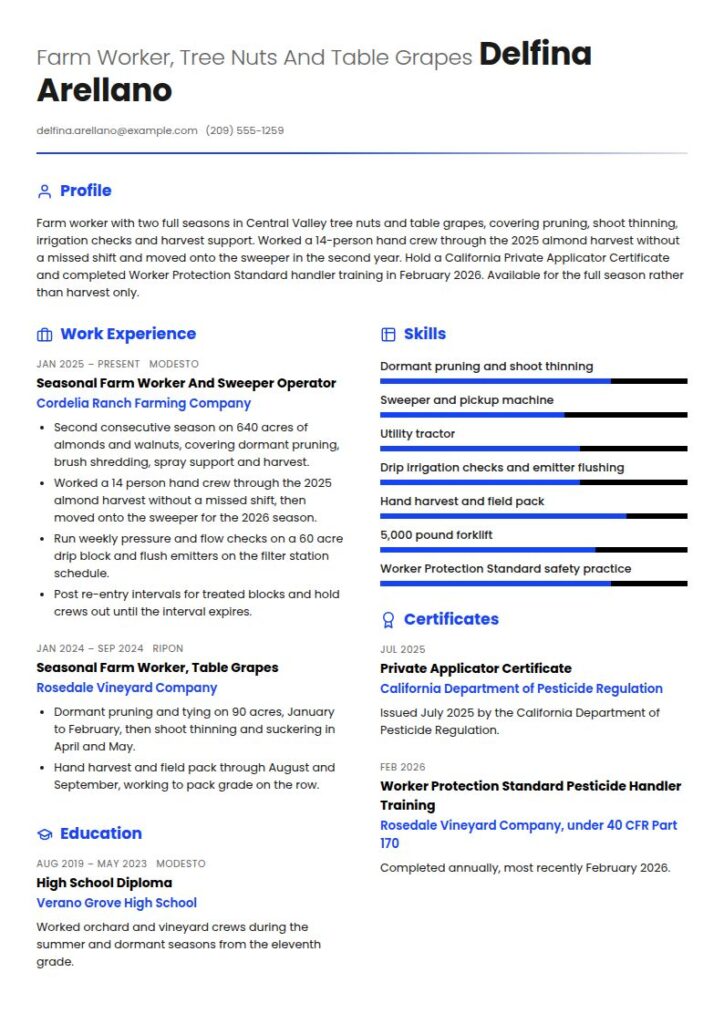
Farm worker with two full seasons in Central Valley tree nuts and table grapes, covering pruning, shoot thinning, irrigation checks and harvest support. Worked a 14-person hand crew through the 2025 almond harvest without a missed shift and moved onto the sweeper in the second year. Hold a California Private Applicator Certificate and completed Worker Protection Standard handler training in February 2026. Available for the full season rather than harvest only.
Work Experience
01/2025 - Present, Seasonal Farm Worker and Sweeper Operator, Cordelia Ranch Farming Company, Modesto, United States
- Second consecutive season on 640 acres of almonds and walnuts, covering dormant pruning, brush shredding, spray support and harvest.
- Worked a 14 person hand crew through the 2025 almond harvest without a missed shift, then moved onto the sweeper for the 2026 season.
- Run weekly pressure and flow checks on a 60 acre drip block and flush emitters on the filter station schedule.
- Post re-entry intervals for treated blocks and hold crews out until the interval expires.
01/2024 - 09/2024, Seasonal Farm Worker, Table Grapes, Rosedale Vineyard Company, Ripon, United States
- Dormant pruning and tying on 90 acres, January to February, then shoot thinning and suckering in April and May.
- Hand harvest and field pack through August and September, working to pack grade on the row.
Education
08/2019 - 05/2023, High School Diploma, General studies, Verano Grove High School, Modesto, United States
Worked orchard and vineyard crews during the summer and dormant seasons from the eleventh grade.
Skills
Dormant pruning and shoot thinning, 75
Sweeper and pickup machine, 60
Utility tractor, 65
Drip irrigation checks and emitter flushing, 65
Hand harvest and field pack, 80
5,000 pound forklift, 70
Worker Protection Standard safety practice, 75
Languages
Spanish, native
English, native
Certificates
07/2025, Private Applicator Certificate, California Department of Pesticide Regulation
Issued July 2025 by the California Department of Pesticide Regulation.
02/2026, Worker Protection Standard Pesticide Handler Training, Rosedale Vineyard Company, under 40 CFR Part 170
Completed annually, most recently February 2026.
09/2025, Forklift Operator Certification, 5,000 pound class, Central Valley Equipment Safety Training
Renewed September 2025.
Summary
A farm worker resume is a one to two page document naming the crops you have worked, the parts of the season you covered, the equipment you are checked out on and the licenses you hold. This guide gives you three adaptable versions, the crop calendar block most applicants leave out, and current Bureau of Labor Statistics pay and outlook for agricultural workers.
Farm Worker resume examples by experience level
In short, a farm worker resume is a one to two page document that names the crops you have worked, the parts of the season you worked them in, the equipment a manager has checked you out on, and the licenses you hold.
After all, this is skilled work and the resume should read that way. Pruning a mature almond orchard, setting a drip line so a block irrigates evenly and keeping a twenty-person crew on a row without a gap are learned trades that people get better at for thirty years. A page written as though you are waiting for something else throws away the one thing a farm manager wants to know: whether you already know the work.
Resume guide for a farm worker resume
This guide and the corresponding farm worker resume example will cover:
- First, how to write a farm worker resume, section by section
- The crop calendar block that decides whether a manager can schedule you
- Three adaptable summaries: first season, experienced hand and crew lead
- How to write equipment, pesticide licensing and irrigation so they count
- What the market pays, and what the published figures actually say
How to write a farm worker resume
Overall, six blocks: contact header, summary, crop and season calendar, work history, equipment and licenses, and education or training. One page suits most of a career; you earn a second once you run a crew and hold a state applicator credential. In practice, the crop calendar sits high for the same reason a license does on a trade resume: it answers the manager's question before they ask it.
| Block | What it answers | Where it goes |
|---|---|---|
| Crops and season windows | Can I put this person on the job I am staffing in March? | Directly under the summary |
| Equipment and licenses | What can they be sent out alone on, and what can they legally apply? | Its own block |
| Work history | How long do they stay, and what did they own? | Reverse chronological, with acres and counts |
| Training and safety | Are they current on the training the law requires? | With dates, because the training is annual |
Run the finished file through the ATS resume checker before you send it. Large growers and farm labor contractors run applications through a system before anyone reads them.
Choosing the best resume format for a farm worker resume
Reverse chronological, with the seasons named. Agriculture is one of the few fields where a year with four employers is normal rather than a warning, so the format must make that legible. BLS states the condition plainly: "Many agricultural workers have seasonal schedules. Seasonal schedules typically include longer periods of work during planting or harvesting or when animals must be sheltered and fed" (BLS Occupational Outlook Handbook, agricultural workers, last modified 27 August 2026).
Therefore, write the season, not just the year. "Harvest crew, August to October 2024" is a complete entry; "2024, various farm work" is not. Functional formats fail here, because a grower wants the sequence: which operation, which crop, which months, how many times you came back.
Include your contact information
| ✅ Right | ❌ Wrong |
|---|---|
| Delfina Arellano | Delfina Arellano |
| Farm Worker, Equipment Operator and Crew Lead, Tree Nuts and Row Crops | Hard working and reliable, willing to do anything |
| CA DPR Qualified Applicator Certificate, Category D, Plant Agriculture | Pesticide certified |
| (209) 555-1259, [email protected], Modesto, CA | (209) 555-1259, [email protected] |
Put the credential and its category on the page: a Qualified Applicator Certificate in Category D is a different hire from one in Category Q, and the office verifies the number anyway. Give a phone number that you answer, because much of this hiring happens by phone at six in the morning.
Make use of a summary
Four lines: the crops, the years or seasons, the equipment and licenses, and one number that shows what you were responsible for.
Farm worker with two full seasons in Central Valley tree nuts and table grapes, covering pruning, shoot thinning, irrigation checks and harvest support. Worked a 14-person hand crew through the 2025 almond harvest without a missed shift and moved onto the sweeper in the second year. Hold a California Private Applicator Certificate and completed Worker Protection Standard handler training in February 2026. Available for the full season rather than harvest only.
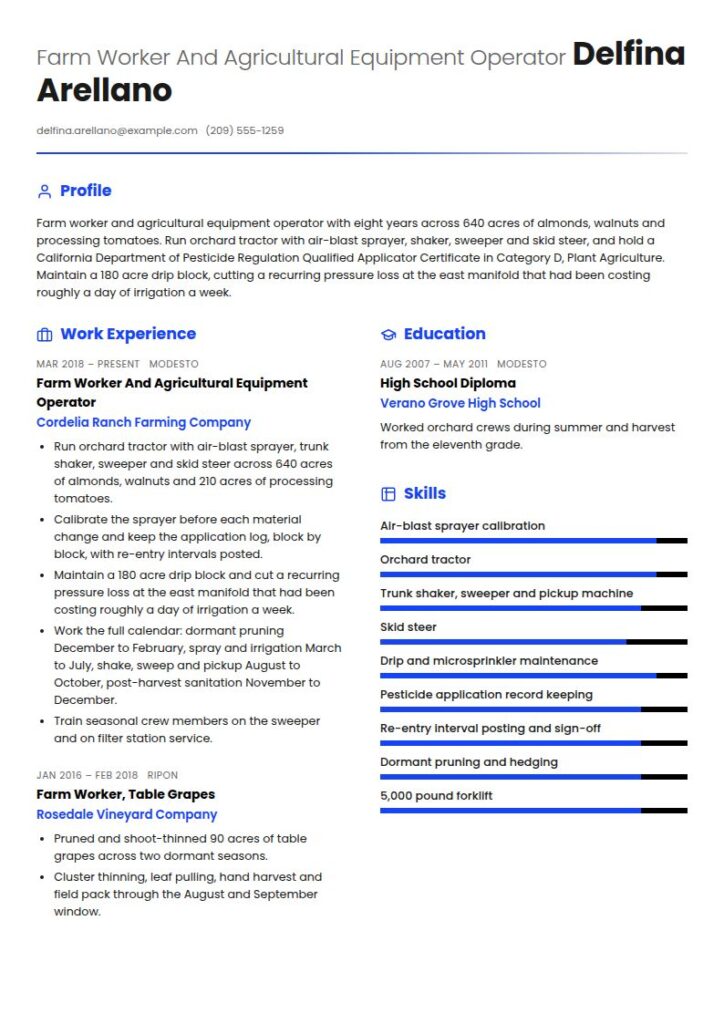
Farm worker and agricultural equipment operator with eight years across 640 acres of almonds, walnuts and processing tomatoes. Run orchard tractor with air-blast sprayer, shaker, sweeper and skid steer, and hold a California Department of Pesticide Regulation Qualified Applicator Certificate in Category D, Plant Agriculture. Maintain a 180 acre drip block, cutting a recurring pressure loss at the east manifold that had been costing roughly a day of irrigation a week.
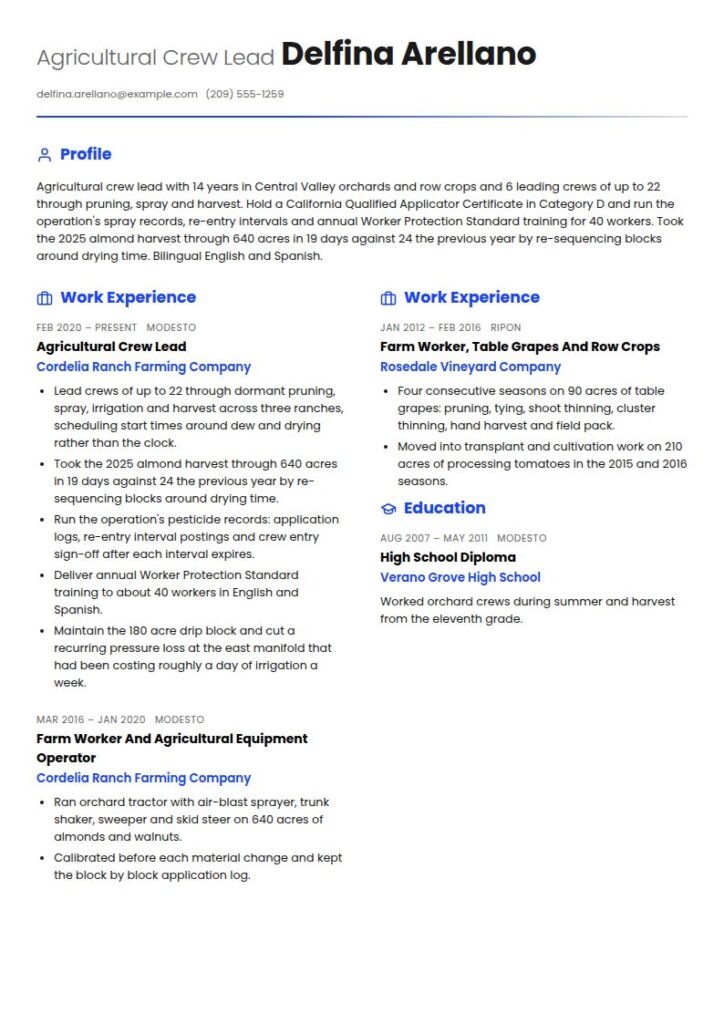
Agricultural crew lead with 14 years in Central Valley orchards and row crops and 6 leading crews of up to 22 through pruning, spray and harvest. Hold a California Qualified Applicator Certificate in Category D and run the operation's spray records, re-entry intervals and annual Worker Protection Standard training for 40 workers. Took the 2025 almond harvest through 640 acres in 19 days against 24 the previous year by re-sequencing blocks around drying time. Bilingual English and Spanish.
Right vs wrong: the same farm worker summary, twice
| ✅ Right | ❌ Wrong |
|---|---|
| Farm worker and equipment operator with eight years across 640 acres of almonds, walnuts and processing tomatoes. | Hard working farm laborer with several years of experience in agriculture. |
| Run orchard tractor with air-blast sprayer, shaker, sweeper, harvester and skid steer. | Experienced with a variety of farm machinery and tools. |
| Hold a California DPR Qualified Applicator Certificate in Category D, Plant Agriculture. | Familiar with chemicals and safety procedures. |
| Maintain a 180 acre drip block and cut a recurring pressure loss at the east manifold. | Responsible for irrigation duties as assigned. |
For example, a manager can put the right column on a job tomorrow morning. Someone has to interview the left column first, and a manager staffing a crew before bloom does not have the week.
Outline your farm experience
Operation type, crop, acreage, city and state, then the months, then three to five lines each naming a task and a number. Acres, rows, bins, hours and head are the units of this work.
| Instead of | Use |
|---|---|
| Performed general farm labor | Pruned and shoot-thinned 90 acres of table grapes across two dormant seasons |
| Operated farm equipment | Ran orchard tractor and air-blast sprayer on 640 acres, calibrating before each material change |
| Helped with irrigation | Maintained a 180 acre drip block: weekly pressure and flow checks, emitter flushing, filter service |
| Assisted with harvest | Ran sweeper and worked pickup through a 19 day almond harvest, 640 acres, roughly 1,400 bins |
| Followed safety rules | Kept re-entry interval postings and spray records for every block and signed off crew entry after each REI expired |
| Supervised other workers | Led a 22 person harvest crew across three ranches, scheduling start times around dew and drying |
Agricultural Crew Lead, Cordelia Ranch Farming Company, Modesto, CA, February 2020 to Present. Almonds, walnuts and processing tomatoes, 640 acres.
Lead crews of up to 22 through dormant pruning, spray, irrigation and harvest across three ranches, scheduling start times around dew and drying rather than the clock.
Took the 2025 almond harvest through 640 acres in 19 days against 24 the previous year by re-sequencing blocks around drying time.
Run the operation's pesticide records: application logs, re-entry interval postings and crew entry sign-off after each REI expires.
Deliver annual Worker Protection Standard training to about 40 workers in English and Spanish, and maintain the 180 acre drip block.
Also, write returning seasons as returning seasons. "Fourth consecutive season with this operation" is one of the strongest lines available to you, because the biggest labor cost a farm carries is a crew that does not come back.
Write the crop calendar you have actually worked
This is the block almost nobody includes, and it is the one that gets you scheduled.
In fact, a farm does not hire "a worker". It hires against a calendar with named windows: dormant pruning in January, bloom in February, thinning in April, harvest from August, post-harvest sanitation into November. Instead, a manager staffing the March window is reading forty files to find someone who has worked a March.
Almonds, 640 acres, 2020 to present: dormant pruning and brush shredding (December to February), bloom hive placement support (February), spray and irrigation (March to July), shake, sweep and pickup harvest (August to October), post-harvest sanitation (November to December).
Table grapes, 90 acres, 2018 to 2020: dormant pruning and tying (January to February), shoot thinning and suckering (April to May), cluster thinning (June), hand harvest and field pack (August to September).
Processing tomatoes, 210 acres, 2021 to present: transplant support (April), cultivation and drip irrigation (May to July), machine harvest support (July to September).
Available: year-round, with harvest overtime. Will return season over season.
That block does four things. It proves the crop, which transfers less widely than people assume, since almond harvest and table grape harvest share almost no skills. The window is the second thing it proves. It proves duration, because a worker who has done post-harvest sanitation stayed past the money. And the last line answers availability, the question that ends most of these calls.
Similarly, if you have worked only harvests, say so straight. "Three consecutive almond harvests, August to October 2023, 2024 and 2025" is a real record.
The pesticide applicator credential is a real license, issued by your state
People underestimate this one because the work is outdoors and hourly. It is a regulated credential and belongs on the page with its category and number.
Federal law requires any person who applies or supervises the use of restricted use pesticides to be certified under EPA regulations and state, territorial and tribal law, with a federal minimum age of 18 and a maximum recertification interval of five years for commercial and private applicators (U.S. Environmental Protection Agency, Certification Standards for Pesticide Applicators, last updated 6 March 2026). EPA approves the programs; states, tribes, territories and federal agencies issue the certification, so the credential is a state one and its name changes at the state line.
California shows the shape. The Department of Pesticide Regulation issues a Private Applicator Certificate, a Qualified Applicator Certificate, a Qualified Applicator License, a Pest Control Aircraft Pilot Certificate and an Agricultural Pest Control Adviser License among others (CDPR, Apply for a License, last updated 24 August 2026). The Qualified Applicator Certificate carries 13 categories plus subcategory Q, and a candidate must be 18 and pass the Laws, Regulations, and Basic Principles examination plus at least one category examination at 70 percent or higher, then renew every two years with 20 hours of approved continuing education, four of them in laws and regulations (CDPR, Qualified Applicator Certificate packet, revision 7/24).
Write it in full: credential name, issuing department, category, number, expiry.
Build a snapshot of your key skills
Four groups: equipment, crop work, irrigation and water, and safety and compliance. Name the machine, not the category.
Equipment: Orchard tractor, Air-blast sprayer calibration, Trunk shaker, Sweeper and pickup machine, Skid steer, 5,000 pound forklift, Flail mower
Crop work: Dormant pruning, Shoot thinning and suckering, Hedging and topping, Mummy shake, Grading and field pack, Bin and tag handling
Irrigation and water: Drip and microsprinkler maintenance, Pressure and flow checks, Emitter flushing, Filter station service, Valve and manifold repair
Safety and compliance: Worker Protection Standard handler training, Re-entry interval posting and sign-off, Application record keeping, Respirator fit, Heat illness prevention, Rollover protection checks
Languages: English and Spanish, both fluent
In addition, bilingual work is a paid skill here and chronically left off resumes. If you interpret for a crew or translate labels and postings, that is a line of its own.
List your education and certifications
Formal schooling matters less here than current, dated training. Write training with the month, because most of it expires.
Qualified Applicator Certificate, Category D, Plant Agriculture, California Department of Pesticide Regulation, #QAC-118472, issued March 2022, current through March 2028. 20 continuing education hours completed in the current cycle, 4 of them in laws and regulations.
Private Applicator Certificate, California Department of Pesticide Regulation, first issued February 2019.
Worker Protection Standard pesticide handler training, annual, most recent February 2026. Deliver WPS worker and handler training to crews in English and Spanish.
Forklift operator certification, 5,000 pound class, renewed September 2025. High school diploma, Modesto, CA, 2011.
The Handbook is candid about the entry bar: most agricultural workers do not need a formal educational credential, and typical training is short-term on-the-job training of up to one month (BLS Occupational Outlook Handbook, agricultural workers, last modified 27 August 2026). That is why the credential block does so much work: when the floor is open to everyone, the licensed applicant is visible from the top of the page.
Name the crop, the acreage and the months for every entry. Put your applicator credential on the page with its category, number and expiry. List machines by name and say which ones you run alone. Say what you are available for and whether you will return next season. Date your most recent Worker Protection Standard training, since it is annual.
Do not write "various farm work" for a year you actually worked. Do not call yourself pesticide certified without naming the credential, because the office verifies it. Do not claim a machine you have only ridden along on. Do not hide seasonal gaps, since seasonal employment is the normal shape of this industry. Do not apologize for the work anywhere on the page.
Choose the right layout and design
Single column, plain type at 11 or 12 point, no photograph, no graphics. One page unless you are leading crews and holding credentials.
Two points matter more here than in office work. Make it legible as a printout and as a phone photograph, because people hand these pages across a ranch office desk as often as they email them. And if the crew's working language is Spanish, a second version is useful as well.
Farm worker job market and outlook
A very large occupation, slowly shrinking, with heavy replacement demand. Put simply, there is work, and competition for the better paid parts of it.
| Measure | Value |
|---|---|
| Agricultural worker jobs, 2025 | 831,900 |
| Projected employment, 2035 | 818,700 |
| Projected change, 2025 to 2035 | Decline of 2 percent, -13,300 |
| Projected annual openings | About 111,500 |
| Typical entry-level education | No formal educational credential for most roles |
| Typical on-the-job training | Short-term, up to 1 month |
| Median annual wage, May 2025 | $35,890 |
| Median hourly wage, May 2025 | $17.25 |
Source: U.S. Bureau of Labor Statistics, Occupational Outlook Handbook, agricultural workers, May 2025 wage data and 2025 to 2035 projections, last modified 27 August 2026.
Where farm worker openings come from
BLS is explicit about where those openings come from: employment is projected to decline 2 percent, and all of the roughly 111,500 projected annual openings are expected to result from the need to replace workers who transfer to other occupations or exit the labor force. Crop production employs 53 percent of agricultural workers, animal production and aquaculture 23 percent, wholesale trade 4 percent and support activities for agriculture and forestry 3 percent, with wholesale trade paying a median of $37,800 (BLS Occupational Outlook Handbook, May 2025, last modified 27 August 2026).
The seat on the machine is the raise
The most useful number on the Handbook page is not the headline median but the spread between the detailed occupations inside it, because that spread is what a resume can move.
In May 2025, farmworkers and laborers in crop, nursery and greenhouse work had a median of $35,660 across 546,800 jobs. Farmworkers in farm, ranch and aquacultural animal work had a median of $36,670 across 202,100 jobs. Agricultural equipment operators had a median of $41,730 across 66,900 jobs, and animal breeders $51,130 across 6,900 (BLS Occupational Outlook Handbook, agricultural workers, May 2025, published 27 August 2026).
The gap between a hand crop worker and an equipment operator is $6,070 a year on the median, and the operator line is a twelfth the size of the hand line. That is the argument for the equipment block: every machine you can name, and every credential that lets you apply something other people cannot, moves you toward the smaller and better paid part of the same occupation.
Seasonal employment is structural here rather than accidental, which is why the H-2A temporary agricultural program exists. The Immigration and Nationality Act authorizes the admission of temporary nonimmigrant workers to perform agricultural labor of a temporary or seasonal nature, and employers must first have attempted to find US workers, must provide safe and clean housing and safe transportation to the job site where the work keeps workers away from their residence overnight, and must guarantee employment for at least 75 percent of the hours in the contract period (U.S. Department of Labor, Wage and Hour Division, H-2A program). Those terms are worth knowing whether or not you are an H-2A worker, because the same job orders set the terms on which employers hire domestic workers in corresponding employment.
What salary you can expect as a farm worker
The median annual wage for agricultural workers was $35,890 in May 2025, or $17.25 an hour. The lowest 10 percent earned less than $31,270 and the highest 10 percent more than $47,880 (BLS Occupational Outlook Handbook, May 2025 wage data, published 27 August 2026).
In other words, that is a narrow distribution, which tells you the money is made by moving between the occupation's detailed lines rather than negotiating inside one. Three things move you along that path: a named machine list, because operators are hired by machine; a state applicator credential with its category, because restricted use application is legally closed without it; and a crew lead record with a number, because supervision is the one route inside the occupation that needs no new license. Overtime rules and piece rates vary by state and crop, so ask about both before you agree to a season.
Key takeaways for a farm worker resume
- Name the crops and the acreage; crop experience transfers less widely than people assume.
- Put a crop calendar block under the summary, with the months you have actually worked.
- Finally, write the season in every date range, not just the year.
- List machines by name and say which ones you run alone.
- Put your applicator credential on the page with its category, number and expiry.
- Date your Worker Protection Standard training, because it is annual.
- Use acres, bins, rows, head and hours, the units farms use to measure this work.
Build your farm worker resume in 15 minutes with our AI resume builder.
Related resume examples in other fields
- Tractor driver resume
- Landscaping resume
- General laborer resume
- Warehouse worker resume
- Forklift operator resume
- Production worker resume
- Material handler resume
- Maintenance worker resume
- Truck driver resume
- Machine operator resume
- Factory worker resume
- Part-time job resume
Pair it with a matching farm worker cover letter.
Farm worker resume questions, answered
How long should a farm worker resume be?
One page for most of a career, two once you lead crews and hold a state applicator credential. If your history is many short seasons, group them by operation and list the seasons under each.
How do I handle gaps between seasons?
Write the seasons as seasons and let the gaps stand. Seasonal schedules are the normal shape of this industry and BLS says so directly (BLS Occupational Outlook Handbook, agricultural workers, last modified 27 August 2026). A manager who staffs harvest crews is not confused by a gap between October and January. An unexplained year is the problem, so if you were packing or on construction, name it in one line.
Do I need a pesticide license to get farm work?
No, not for most jobs. BLS puts it as: agricultural workers who handle pesticides might need a pesticide applicator license (BLS Occupational Outlook Handbook, last modified 27 August 2026). Restricted use pesticides are the line, and federal law requires certification to apply or supervise those, issued by your state, territory or tribe under an EPA-approved program (EPA, Certification Standards for Pesticide Applicators, last updated 6 March 2026). If you hold one it is among the most valuable lines on your page. If not, your annual Worker Protection Standard training is still worth dating.
What do I put on a farm worker resume with no experience?
Anything proving you can do physical work on a schedule and be trusted with equipment: a driver license and clean record, a forklift certification, landscaping or packing shed work with the hours named, family farm work written as a job with the acreage and the tasks. Then say when you can start, because availability is a real qualification in seasonal hiring and most first-time applicants never mention it.
Should the resume be in English or Spanish?
Send English unless the posting is in Spanish, and bring a Spanish version to the interview. If you are bilingual, that belongs on the page as a skill rather than a footnote, especially if you interpret for crews or deliver safety training in both languages.
Is farm work a career or a stopgap?
It is a career for a great many people and the resume should be written on that basis. The published data describes an occupation of 831,900 workers with about 111,500 openings a year, wage steps from hand crop work at a $35,660 median to equipment operation at $41,730 and animal breeding at $51,130, and a state-issued licensing ladder (BLS Occupational Outlook Handbook, May 2025, published 27 August 2026; EPA, last updated 6 March 2026). That is the shape of a trade. Write it like one.