Packaging Line Operator Rashida Latif
Packaging Line Operator
[email protected] | (419) 555-0171 | Toledo, United States
Profile
Packaging line worker with 18 months in a beverage plant running to current good manufacturing practice, hired through an agency and converted to direct employment after 8 months. Work the case packer and palletiser on a line filling 420 bottles a minute, running pre-operational sanitation checks and completing the hourly quality record for fill level, cap torque and date coding. Trained on allergen changeover procedure and on the plant hygiene and disease control rules. Available for the full 12-hour rotating shift pattern including nights and weekends.
Work Experience
08/2014 - Present, Packaging Line Operator, Maumee Valley Beverage, Toledo, United States
- Hired through Glass City Staffing in August 2014 and converted to direct employment in April 2015.
- Run the case packer and palletiser on a line filling 420 bottles a minute in a plant working to current good manufacturing practice.
- Complete the hourly quality record for fill level, cap torque and date coding, and run pre-operational sanitation checks at line start.
- Trained on allergen changeover procedure and on the plant hygiene and disease control rules.
- Work the full 2-2-3 rotating 12-hour pattern including nights and weekends.
08/2014 - 04/2015, Packaging Line Operator (agency assignment, converted to direct employment), Glass City Staffing, assigned to Maumee Valley Beverage, Toledo, United States
- Agency assignment on the packaging hall of a beverage plant, converted to direct employment after 8 months.
- Completed the plant good manufacturing practice induction and the allergen awareness module during the assignment.
Education
08/2010 - 05/2014, High School Diploma, General studies, Toledo Early College High School, Toledo, United States
Completed the school health sciences and food safety electives.
Skills
Good manufacturing practice, 80
Case packing and palletising, 85
Hourly quality records, 80
Pre-operational sanitation checks, 75
Allergen changeover awareness, 70
12-hour rotating shift working, 90
Manual handling, 85
Languages
English, native
Arabic, native
Certificates
09/2014, Good manufacturing practice and food safety induction, Maumee Valley Beverage plant program
Plant induction covering hygiene, illness reporting, outer garments, hand washing and allergen cross-contact precautions.
06/2015, Allergen changeover and segregation training, Maumee Valley Beverage plant program
Allergen changeover procedure, dedicated tooling, segregation and post-changeover verification.
Summary
A factory worker resume is a one page document naming the rule set your plant runs under, the compliance status you personally hold, and the shift pattern you can work. This guide gives you three adaptable versions, the credential block that lets you move between plants, and current Bureau of Labor Statistics pay and outlook for production occupations.
Factory Worker resume examples by experience level
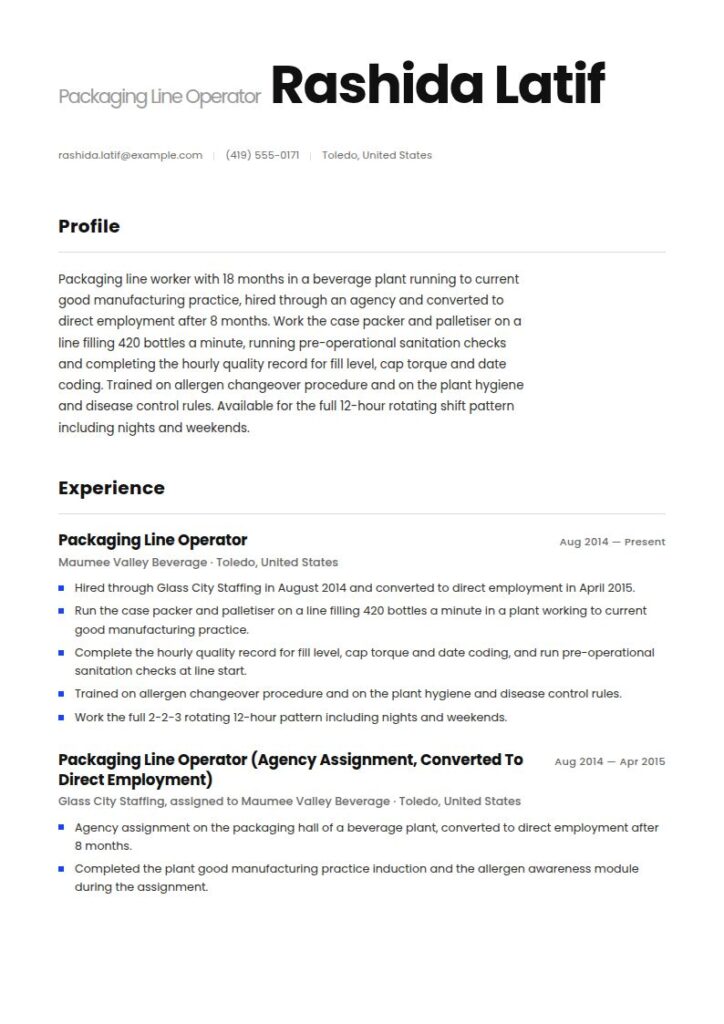
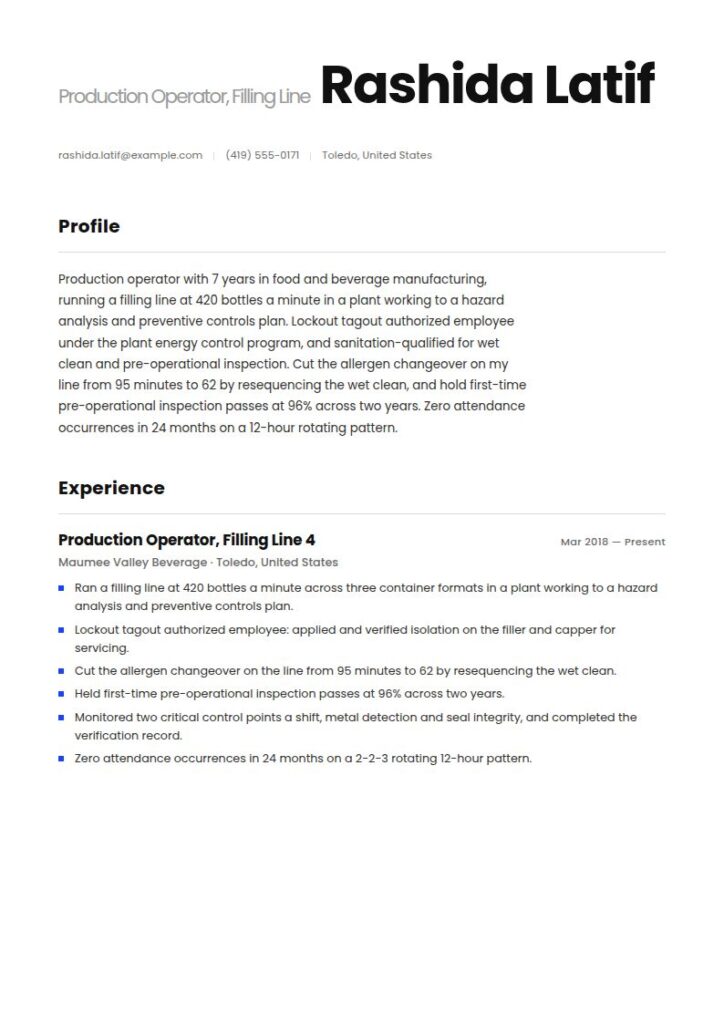
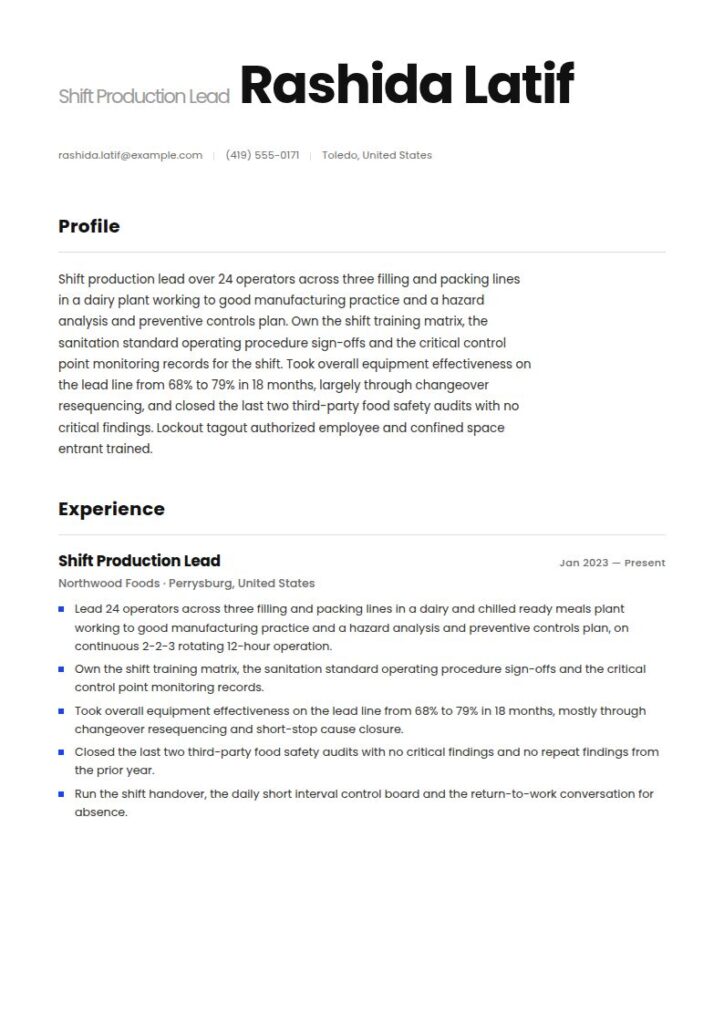
A factory worker resume is a one page document that names the rule set the plant ran under, the compliance status you personally held inside it, and the shift pattern you can work.
That is a different page from the one most people write. The usual factory worker resume lists tasks: operated machinery, packed product, maintained a clean work area. Tasks are the part of this job that does not transfer, because every plant teaches its own. The rule set transfers. A worker who is a lockout tagout authorized employee and has worked to good manufacturing practice can be hired into a food plant, a pharmaceutical packer or a household goods line. A worker whose resume says "general labor" cannot, whatever they can actually do.
Resume guide for a factory worker resume
This guide and the corresponding factory worker resume example will cover:
- How to write a factory worker resume, section by section
- Why the compliance environment decides which plants can hire you
- Three adaptable summaries: packaging line, production operator and shift lead
- How to write the shift pattern and reliability honestly, and why it helps
- What the job market looks like and what you can expect to earn
How to write a factory worker resume
Six blocks: contact header, summary, compliance and training status, production experience, skills, education and certifications. One page.
The compliance block sits directly under the summary because it answers a gating question. A plant running a hazard analysis and preventive controls program cannot put an untrained person on a critical control point, and one running an energy control program cannot let an unauthorised employee clear a jam behind a guard. Those are not preferences; they are why your file is in the shortlist or not.
| Section | What it is answering | Where it goes |
|---|---|---|
| Compliance and training status | Which plants can hire this person without retraining them from zero? | Directly under the summary |
| Production experience | What did the line run at, and what did they hold it to? | Reverse chronological, numbers in the bullets |
| Skills | Do they know sanitation, changeover and record keeping, or only the machine? | Short grouped block |
| Education and certifications | Named authorities and dates | Bottom, short |
Write down the rule set before you write the job
Before you draft anything, list the rules your plant actually ran on. Not the company handbook, the external ones.
In food and beverage that is current good manufacturing practice and a hazard analysis and preventive controls plan. The federal rule is 21 CFR Part 117, Current Good Manufacturing Practice, Hazard Analysis, and Risk-Based Preventive Controls for Human Food, and its Subpart B sets the personnel requirements for hygiene and disease control you have been following every shift (eCFR, current edition, read September 2026).
Any plant with machinery runs an energy control program under OSHA 29 CFR 1910.147, and the standard draws a real distinction between the two kinds of worker it names. Then there is confined space, powered truck clearance and hearing conservation.
Each of those is a line on your resume, and each is a plant that can hire you without starting the training from zero.
Run the finished file through the free Rezoom ATS resume checker before you send it. Large manufacturers screen high-volume applications through a parser first.
Choosing the best resume format for a factory worker resume
Reverse chronological, one page, single column. Plants read for two things: whether the compliance environment you came from resembles theirs, and whether you stay.
Do not use a functional layout. In a regulated plant, dates are part of the credential. Energy control training, food safety training and a truck evaluation all carry dates, and hiding the timeline makes every one of them unverifiable.
Include your contact information
| ✅ Right | ❌ Wrong |
|---|---|
| Rashida Latif | Rashida Latif |
| Production Operator, GMP food plant, LOTO authorized employee | Reliable factory worker seeking new opportunity |
| Toledo, OH, available for 12-hour rotating shifts including nights | Toledo, OH |
| (419) 555-0171, [email protected] | (419) 555-0171, [email protected] |
Two things in that right column are doing all the work. "LOTO authorized employee" is a status with a legal definition behind it, and the shift line answers the question a continuous operations plant asks before any other.
Make use of a summary
Four lines: the plant type and its rule set, the line and its rate, your compliance status, and one reliability or quality number.
Packaging line worker with 18 months in a beverage plant running to current good manufacturing practice, hired through an agency and converted to direct employment after 8 months. Work the case packer and palletiser on a line filling 420 bottles a minute, running pre-operational sanitation checks and completing the hourly quality record for fill level, cap torque and date coding. Trained on allergen changeover procedure and on the plant hygiene and disease control rules. Available for the full 12-hour rotating shift pattern including nights and weekends.
Production operator with 7 years in food and beverage manufacturing, running a filling line at 420 bottles a minute in a plant working to a hazard analysis and preventive controls plan. Lockout tagout authorized employee under the plant energy control program, and sanitation-qualified for wet clean and pre-operational inspection. Cut the allergen changeover on my line from 95 minutes to 62 by resequencing the wet clean, and hold first-time pre-operational inspection passes at 96% across two years. Zero attendance occurrences in 24 months on a 12-hour rotating pattern.
Shift production lead over 24 operators across three filling and packing lines in a dairy plant working to good manufacturing practice and a hazard analysis and preventive controls plan. Own the shift training matrix, the sanitation standard operating procedure sign-offs and the critical control point monitoring records for the shift. Took overall equipment effectiveness on the lead line from 68% to 79% in 18 months, largely through changeover resequencing, and closed the last two third-party food safety audits with no critical findings. Lockout tagout authorized employee and confined space entrant trained.
Right vs wrong: the same factory worker summary, twice
| ✅ Right | ❌ Wrong |
|---|---|
| Lockout tagout authorized employee under the plant energy control program. | Follows all safety rules and procedures at all times. |
| Sanitation-qualified for wet clean and pre-operational inspection, 96% first-time pass. | Responsible for keeping the work area clean. |
| Cut the allergen changeover on my line from 95 minutes to 62 by resequencing the wet clean. | Assisted with product changeovers as needed. |
The right column tells a hiring manager which regulated plants can take you and what you would improve when you got there. The left column describes any of six million people.
Outline your production experience
Plant, what it makes, the rule set it runs under, your line and its rate, your shift pattern, your dates. Then three to five bullets, each carrying a number or a named procedure.
| Instead of | Use |
|---|---|
| Operated production machinery | Ran a filling line at 420 bottles a minute across three container formats |
| Followed food safety procedures | Monitored two critical control points a shift, metal detection and seal integrity, and completed the verification record |
| Cleaned equipment at end of shift | Ran the wet clean and pre-operational inspection, 96% first-time pass across two years |
| Helped with changeovers | Cut the allergen changeover from 95 minutes to 62 by resequencing the wet clean |
| Worked safely around machinery | Lockout tagout authorized employee; applied and verified isolation on the filler and the capper |
| Good attendance record | Zero attendance occurrences in 24 months on a 2-2-3 rotating 12-hour pattern |
Shift Production Lead, Northwood Foods, Perrysburg, OH, January 2023 to Present
Dairy and chilled ready meals plant running to good manufacturing practice and a hazard analysis and preventive controls plan, continuous operation on a 2-2-3 rotating 12-hour pattern. Lead 24 operators across three filling and packing lines.
Own the shift training matrix, the sanitation standard operating procedure sign-offs and the critical control point monitoring records, including metal detection and seal integrity verification.
Took overall equipment effectiveness on the lead line from 68% to 79% in 18 months, mostly by resequencing changeovers and closing out short-stop causes at the daily review.
Closed the last two third-party food safety audits with no critical findings and no repeat findings from the prior year.
Run the shift handover, the daily short interval control board and the return-to-work conversation for absence.
The compliance environment decides who can hire you
Two people can do identical work for a decade and be worth different things on the open market, because one can evidence the rule set and the other cannot. Think of it as a passport rather than a skill: the tasks stay behind at the plant, and the status travels.
Rule set: food and beverage manufacturing under current good manufacturing practice and a hazard analysis and preventive controls plan; personnel hygiene and disease control rules per 21 CFR Part 117 Subpart B.
Energy control: lockout tagout authorized employee under the plant energy control program, OSHA 29 CFR 1910.147. Trained to apply, verify and remove isolation on filling, capping and conveying equipment.
Sanitation: wet clean and dry clean qualified, sanitation standard operating procedure sign-off, pre-operational inspection, chemical titration and concentration checks.
Allergen control: trained on allergen changeover, segregation, dedicated tooling and post-changeover verification.
Records: critical control point monitoring and verification records, hourly quality checks, deviation and corrective action write-up, batch and lot traceability.
Other clearances: confined space entrant, powered industrial truck employer-certified under OSHA 29 CFR 1910.178(l), hearing conservation program participant, first aid.
Shift: continuous operations, 2-2-3 rotating 12-hour pattern, nights and weekends, willing to work scheduled overtime.
Four notes on writing that block accurately, because in a regulated plant an overstated claim is caught in the first week.
Lockout tagout status is a defined term, so use it correctly. OSHA 29 CFR 1910.147(b) defines an authorized employee as "a person who locks out or tags out machines or equipment in order to perform servicing or maintenance on that machine or equipment", and an affected employee as one "whose job requires him/her to operate or use a machine or equipment on which servicing or maintenance is being performed under lockout or tagout" (eCFR, current edition, read September 2026). Authorized employees are trained to recognize hazardous energy sources, the type and magnitude of energy present, and the methods of isolating and controlling it. If you place your own lock, say so. If you have only been briefed on what a lock means, you are affected, and writing anything else will not survive a plant induction.
Good manufacturing practice is a plant condition and a personal record. The federal cGMP requirements for human food sit in 21 CFR Part 117 Subpart B, and 117.10 places personnel requirements on hygiene, illness reporting, outer garments, hand washing, jewellery, hair restraints and precautions against allergen cross-contact (eCFR, current edition, read September 2026). If you have worked to those rules, say so in those words, because they are the words the next quality manager uses.
Name the other regulated clearances. Confined space entry, powered truck operation, working at height and hearing conservation each have their own program. OSHA 29 CFR 1910.95(c)(1) requires a continuing, effective hearing conservation program "whenever employee noise exposures equal or exceed an 8-hour time-weighted average sound level (TWA) of 85 decibels measured on the A scale (slow response)" (eCFR, current edition, read September 2026), so being an audiometric-tested participant tells a reader you have worked in a real noise environment.
In other sectors, name their equivalent. Medical device and pharmaceutical plants ask about cleanroom gowning and the classification of the room you gowned into. Electronics assembly asks about electrostatic discharge control. Automotive asks about the quality management system. The principle does not change: name the external rule set, not the internal task.
Be honest about shift pattern, attendance and overtime
This is the second half of the same argument, and most applicants leave it out.
A continuous operations plant runs 24 hours, usually on 12-hour rotating shifts, and its most expensive problem is a line short of an operator at three in the morning. Reliability here is not a soft skill; it is the thing being purchased.
Write it plainly and truthfully. The pattern you have worked, in the plant's own language: 2-2-3 rotating, four on four off, continental, straight nights. Your attendance record, if it is good, as a number rather than an adjective. Your position on scheduled overtime and weekend call-in. If you cannot rotate, say so on the page rather than at the offer stage.
The temp-to-hire route, in numbers
A large share of factory hiring starts through an agency. Among assemblers and fabricators, temporary help services employ 9 percent of the workforce, and that industry pays a median of $36,860 against the $45,450 median for the occupation as a whole (BLS Occupational Outlook Handbook, May 2025).
Production occupations overall had a median annual wage of $46,990 in May 2025 (BLS Occupational Outlook Handbook, May 2025).
Read that as a route rather than a trap. Agency work is how a great many people enter a plant without prior manufacturing experience, and conversion to direct employment is the pay rise. What shortens the wait is compliance status: the temp who has completed the plant's food safety and energy control training and holds a clean attendance record is the one the supervisor asks to keep, because keeping them costs nothing and replacing them costs the whole induction again.
If you converted, write the month it happened. It is evidence that a plant chose you when it was free not to.
Build a snapshot of your key skills
Twelve to fourteen entries in three groups, weighted towards the regulated ones.
Compliance and quality: Good manufacturing practice, Hazard analysis and preventive controls, Critical control point monitoring, Allergen changeover and segregation, Sanitation standard operating procedures, Pre-operational inspection, Batch and lot traceability, Deviation and corrective action records
Production: Filling and capping line operation, Case packing and palletising, Format changeover, Short interval control, Overall equipment effectiveness, Line clearance
Safety and equipment: Lockout tagout authorized employee, Confined space entrant, Powered industrial truck (employer-certified), Chemical handling and titration, Hearing conservation program, Manual handling
List your education and certifications
Short, dated, and with each authority named. This block is where a quality manager checks whether your compliance claims are real.
Lockout tagout authorized employee, plant energy control program under OSHA 29 CFR 1910.147, Northwood Foods, most recent retraining 2025.
Good manufacturing practice and food safety induction, annual refresher, Northwood Foods, most recent 2026.
Sanitation standard operating procedure qualification, wet clean and pre-operational inspection, 2019.
Confined space entrant, plant permit-required confined space program, 2024.
Powered industrial truck operator, sit-down counterbalance, employer-certified under OSHA 29 CFR 1910.178(l), most recent evaluation 2024.
High School Diploma, Toledo Early College High School, Toledo, OH, 2014.
Note the phrasing on the plant-issued items. Each is site training, not a portable license, and "plant program, most recent retraining 2025" is both accurate and more persuasive than implying a national certificate that does not exist.
Choose the right layout and design
Single column, 11 or 12 point, no photograph, no graphics, PDF unless the portal asks for Word. Keep the compliance block as plain labeled lines so a parser reads every term.
Name the rule set the plant ran under, in the industry's own words. Say whether you are a lockout tagout authorized employee or an affected employee. Give the line rate and one changeover or quality number. Write the shift pattern by name and your attendance record as a number. Say when an agency assignment converted to direct employment.
Do not write "followed all safety procedures", which is a claim every applicant makes and none evidences. Do not claim authorized employee status if you have never placed a lock. Do not describe plant training as a license or a national certification. Do not leave the shift pattern off the page. Do not list tasks that only make sense inside the plant you are leaving.
Factory worker job market and outlook
A flat group with very heavy replacement demand, spread across food, beverage, plastics, metals, electronics and consumer goods.
| Measure | Value |
|---|---|
| Median annual wage, production occupations, May 2025 | $46,990 |
| Projected change, 2025 to 2035 | Little or no change |
| Projected annual openings, production occupations | ~867,700 |
| Assemblers and fabricators employed by temporary help services | 9% |
| Median annual wage, temporary help services | $36,860 |
Source: U.S. Bureau of Labor Statistics, Occupational Outlook Handbook, 2025-35 projections and May 2025 wage data.
Around 867,700 openings a year across a group with essentially no net growth means the market is replacement hiring (BLS Occupational Outlook Handbook, 2025-35 projections). Plants are backfilling, not expanding. So the reader is working out whether hiring you ends the cycle or restarts it in four months, and compliance status, a stated shift pattern and an attendance number are what answer that. None of the three requires a promotion.
What salary you can expect as a factory worker
Production occupations had a median annual wage of $46,990 in May 2025, above the median for all occupations (BLS Occupational Outlook Handbook, May 2025).
The route through the band is the thing worth understanding. Temporary help services pay a median of $36,860 to assemblers and fabricators, against $45,450 for that occupation as a whole (BLS, May 2025). Conversion from agency to direct employment is therefore the largest single step most factory workers make, and it usually comes with holiday, health cover and a shift premium attached rather than a headline rate alone.
After conversion, three things move you further. Regulated status is first, because a plant pays to keep the few people who can be scheduled onto a critical control point or asked to isolate a machine. Shift is second: nights, weekends and rotating patterns carry premiums quoted separately from base pay. Third is the move from operator to shift lead, decided in most plants on training records, audit outcomes and attendance rather than speed on a machine.
Key takeaways for a factory worker resume
- Name the external rule set your plant ran under, not the internal task list.
- Say whether you are a lockout tagout authorized employee, using the standard's own term.
- Write good manufacturing practice, sanitation and allergen work in the words a quality manager uses.
- Give the line rate and one changeover, sanitation or quality number.
- State the shift pattern by name and your attendance as a number.
- Say when an agency assignment converted to direct employment, and in what month.
- Describe plant training as plant training, with the year of the most recent refresher.
Build your factory worker resume in 15 minutes.
Related production resume examples
- Machine operator resume
- Production worker resume
- Assembler resume
- Manufacturing technician resume
- Quality assurance resume
- Material handler resume
- Forklift operator resume
- Welder resume
- Machinist resume
- Production resume
- Operations manager resume
- Operations director resume
Pair it with a matching factory worker cover letter.
Factory worker resume questions, answered
How long should a factory worker resume be?
One page. A plant checks your compliance status, your dates and your shift availability, and all three fit easily. Two pages only if you have led shifts in more than one regulated sector and the audit history is worth the room.
What do I put on a factory worker resume with no experience?
Any work with a standard, a record and a consequence: kitchen line, care work, cleaning to a checklist, agricultural packing, a military detail. Then the three things entry-level plant hiring turns on, which are willingness to work the advertised shift pattern, attendance, and whether you can complete the induction training. A food handler course or an OSHA 10-hour card before you apply is worth the weekend, because most applicants at this level bring nothing dated at all.
Is temp work through an agency worth putting on the resume?
Yes. Temporary help services employ 9 percent of assemblers and fabricators, so it is one of the main doors into the industry rather than a mark against you (BLS Occupational Outlook Handbook, May 2025). Name the agency, the plant, what it made and the dates, and if you were converted to direct employment, write the month it happened.
What does lockout tagout authorized employee actually mean on a resume?
It means you personally place locks to isolate energy for servicing or maintenance, which is how OSHA 29 CFR 1910.147(b) defines the term, as distinct from an affected employee who operates equipment being serviced or works in the area (eCFR, current edition, read September 2026). Write whichever one is true. Plants verify it against their own training records within the first week, and the distinction is the difference between two very different jobs.
Should I really put my attendance record on a resume?
If it is good, yes, as a number with a period attached: "zero attendance occurrences in 24 months". Continuous operations plants lose more money to unfilled shifts than to slow ones, and no adjective communicates this. If your record is not good, leave it out and let the shift availability line do the work instead.
How do I move from one industry to another, say food to pharmaceutical packing?
Lead with the transferable rule set. Good manufacturing practice, record keeping, batch traceability, changeover discipline and energy control all carry across, and a food plant background is well understood by pharmaceutical and personal care packers. Then be explicit about the thing you have not done, such as gowning into a classified cleanroom, and say you are ready to qualify. Naming the gap makes the rest of the claim credible.