Machinist Apprentice Bjorn Halvorsen
Machinist Apprentice
[email protected] | (815) 555-0119 | Rockford, United States
Profile
Machinist apprentice in the third year of a four year program at a precision job shop, working to prints on lathe and mill work in aluminum, mild steel and 303 stainless. Hold plus or minus 0.001 inch in production on turned diameters and check my own work with micrometers, a bore gauge and a height gauge on a surface plate. Read orthographic and sectioned drawings unaided and am working through geometric dimensioning and tolerancing with the shop's quality engineer. Hold NIMS credentials in dimensional measurements and machining.
Work Experience
08/2009 - Present, Machinist Apprentice, Rock River Precision, Rockford, United States
- Third year of a four year apprenticeship covering turning, milling, workholding, metrology and print reading.
- Hold plus or minus 0.001 inch in production on turned diameters in aluminum, mild steel and 303 stainless.
- Check my own work with outside micrometers, a bore gauge set against gauge blocks and a height gauge on a surface plate, logging actuals on the check sheet.
- Read orthographic and sectioned drawings unaided and take datum questions to the quality engineer rather than guessing.
- Deburr and finish to the drawing callout rather than to habit, after a run of parts was returned for edge break.
09/2008 - 05/2009, Machine Shop Assistant, Rock Valley College Technology Center, Rockford, United States
- Prepared stock, cleaned machines and maintained the tool crib for two evening machining classes a week.
- Completed the program's manual lathe and mill practicals.
Education
08/2005 - 05/2009, High School Diploma, Rockford East High School, Rockford, United States
Machine shop and technical drawing electives.
Skills
Manual turning and milling to print, 70
Outside micrometers and bore gauges, 75
Surface plate and height gauge technique, 70
Orthographic and sectioned drawing interpretation, 75
Logging actuals rather than pass and fail, 75
Deburring and finishing to callout, 70
Languages
English, native
Norwegian, intermediate
Certificates
10/2011, NIMS credentials, dimensional measurements and machining, National Institute for Metalworking Skills
Taken through the apprenticeship program.
Summary
A machinist resume is a one page document naming the tightest tolerance you hold in production, the material and feature you hold it on, and how you measured it. This guide gives you three adaptable versions, the print reading and metrology evidence a shop can test in an interview, and current Bureau of Labor Statistics pay and outlook for machinists specifically.
Machinist resume examples by experience level
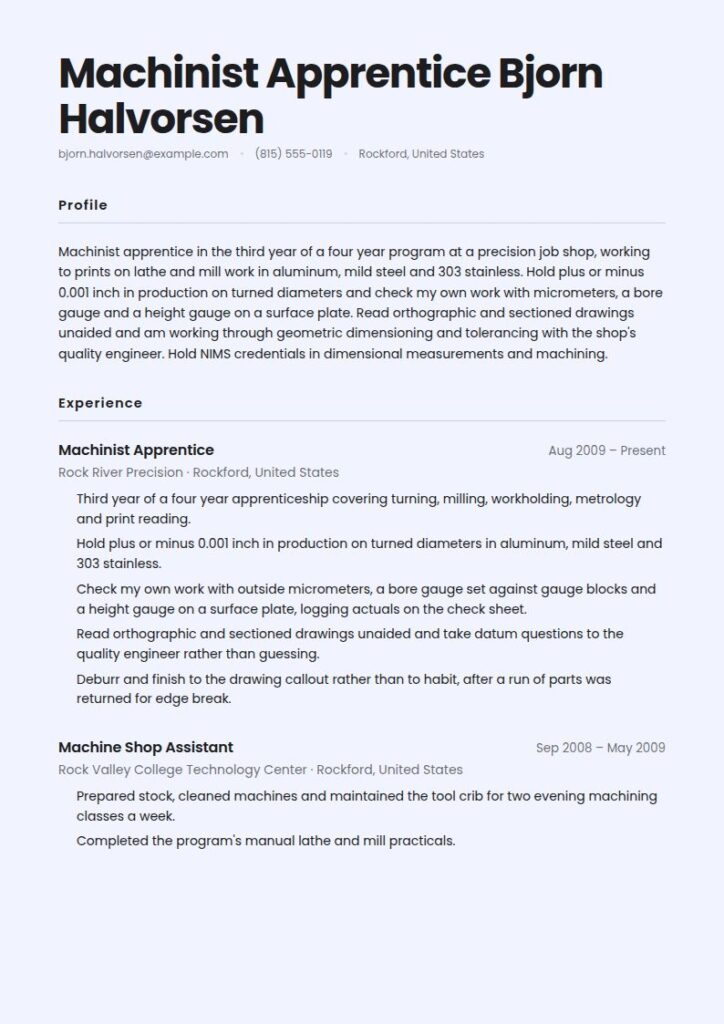
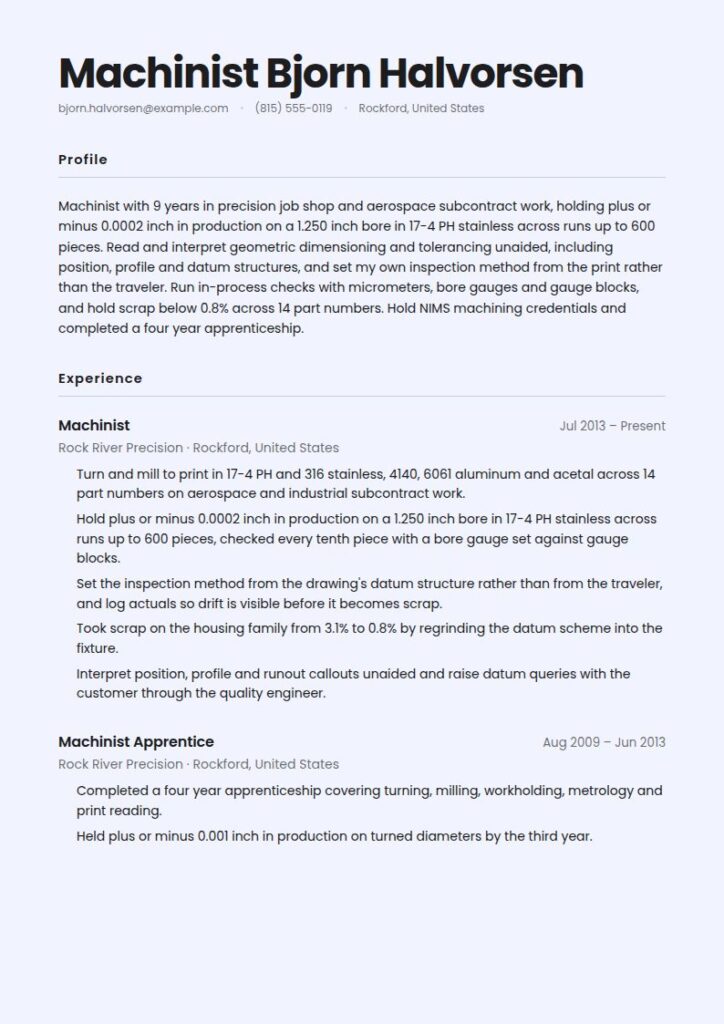
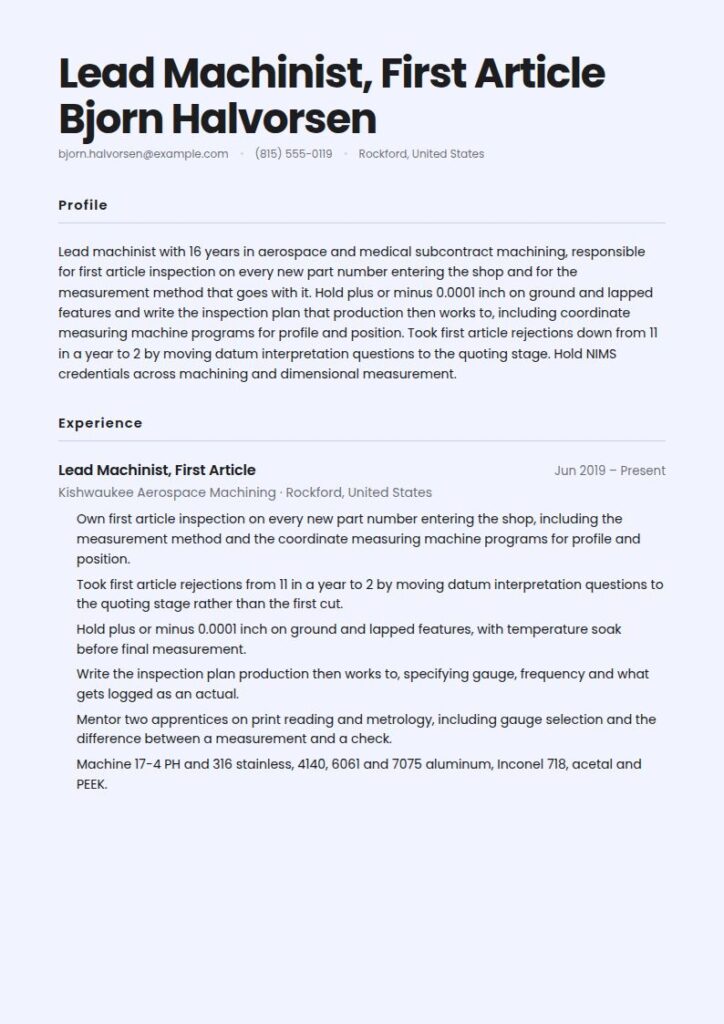
A machinist resume is a one page document that states the tightest tolerance you hold in production, the material and the feature you hold it on, and how you measured it.
Everything else on the page is secondary to that, because it is the only claim a shop can test. A machining interview usually ends at a surface plate or a print, and the questions are the same everywhere: what is the closest you have held, on what, how did you check it, and what does this symbol on the drawing mean. A resume that has already answered the first three is a resume that gets to the fourth.
Resume guide for a machinist resume
This guide and the corresponding machinist resume example will cover:
- How to write a machinist resume, section by section
- How to state a tolerance claim so it survives an interview
- Three adaptable summaries: apprentice, production machinist and first article lead
- What print reading and metrology evidence belongs on the page
- What the job market looks like and what you can expect to earn
How to write a machinist resume
Six blocks: contact header, summary, tolerance and metrology, machining experience, skills, education and credentials. One page.
The tolerance and metrology block goes directly under the summary because it is what a shop is buying. Materials, features and measurement methods are the vocabulary of capability here, and a reader can size you up from four lines of it faster than from a page of duties.
| Section | What it is answering | Where it goes |
|---|---|---|
| Tolerance and metrology | How close does this person hold, on what material, and how do they prove it? | Directly under the summary |
| Machining experience | What parts, what runs, what scrap, what inspection outcome? | Reverse chronological, a number in each bullet |
| Skills | Print reading, metrology, materials, process | Grouped, metrology first |
| Education and credentials | Apprenticeship, NIMS credentials, dated | Bottom, short |
Write the tolerance claim before anything else
Start with one sentence and get it exactly right, because you will be asked about it.
A complete tolerance claim has four parts: the number, the feature, the material and the run. "Held plus or minus 0.0002 inch on a 1.250 inch bore in 17-4 PH stainless across a 600 piece run" is a claim. "Works to tight tolerances" is not, and the second one invites the interviewer to find your limit rather than letting you state it.
Then add how you measured it, because a tolerance without a measurement method is an assertion. Bore gauge set against gauge blocks on a surface plate, checked every tenth piece, is what turns the number into evidence.
If your tightest work was a one-off rather than a run, say so. A machinist who distinguishes between what they have hit once and what they can hold all day is a machinist the shop can plan around.
Run the finished file through the free Rezoom ATS resume checker before you send it. Larger shops and aerospace suppliers parse applications before anyone opens them.
Choosing the best resume format for a machinist resume
Reverse chronological, one page, single column.
Machining is a long-term on-the-job training occupation, which BLS records as typical for machinists alongside a high school diploma at entry and the availability of apprenticeships (BLS Occupational Outlook Handbook, May 2025). That makes the timeline itself part of your evidence: how many years, on what kind of work, under whom. A functional layout removes exactly that, and in a trade where capability accumulates by the year it reads as concealment.
Include your contact information
| ✅ Right | ❌ Wrong |
|---|---|
| Bjorn Halvorsen | Bjorn Halvorsen |
| Machinist, holds plus or minus 0.0002 inch in production, first article inspection | Experienced machinist with strong attention to detail |
| Rockford, IL, second shift or days | Rockford, IL |
| (815) 555-0119, [email protected] | (815) 555-0119, [email protected] |
The title line in the right column is unusual and it should be. It puts a number where every other applicant puts an adjective, and it makes the shortlist decision almost automatic for a shop whose work sits at that band.
Make use of a summary
Four lines: years and the kind of work, the tolerance band with its material, how you inspect, and one scrap or inspection outcome.
Machinist apprentice in the third year of a four year program at a precision job shop, working to prints on lathe and mill work in aluminum, mild steel and 303 stainless. Hold plus or minus 0.001 inch in production on turned diameters and check my own work with micrometers, a bore gauge and a height gauge on a surface plate. Read orthographic and sectioned drawings unaided and am working through geometric dimensioning and tolerancing with the shop's quality engineer. Hold NIMS credentials in dimensional measurements and machining.
Machinist with 9 years in precision job shop and aerospace subcontract work, holding plus or minus 0.0002 inch in production on a 1.250 inch bore in 17-4 PH stainless across runs up to 600 pieces. Read and interpret geometric dimensioning and tolerancing unaided, including position, profile and datum structures, and set my own inspection method from the print rather than the traveler. Run in-process checks with micrometers, bore gauges and gauge blocks, and hold scrap below 0.8% across 14 part numbers. Hold NIMS machining credentials and completed a four year apprenticeship.
Lead machinist with 16 years in aerospace and medical subcontract machining, responsible for first article inspection on every new part number entering the shop and for the measurement method that goes with it. Hold plus or minus 0.0001 inch on ground and lapped features and write the inspection plan that production then works to, including coordinate measuring machine programs for profile and position. Took first article rejections down from 11 in a year to 2 by moving datum interpretation questions to the quoting stage. Hold NIMS credentials across machining and dimensional measurement.
Right vs wrong: the same machinist summary, twice
| ✅ Right | ❌ Wrong |
|---|---|
| Hold plus or minus 0.0002 inch on a 1.250 inch bore in 17-4 PH stainless across runs up to 600 pieces. | Experienced working to tight tolerances on a variety of materials. |
| Read geometric dimensioning and tolerancing unaided, including position, profile and datum structures. | Able to read blueprints and technical drawings. |
| Hold scrap below 0.8% across 14 part numbers. | Committed to producing high quality parts. |
The right column tells a shop owner which of their jobs you can be put on this week. The left column is what every applicant writes, which is why it decides nothing.
Outline your machining experience
Shop, what it makes, who the end customer is, the materials, your dates. Then three to five bullets, each naming a part or a feature and carrying a number.
| Instead of | Use |
|---|---|
| Machined parts to specification | Held plus or minus 0.0002 inch on a 1.250 inch bore in 17-4 PH stainless across a 600 piece run |
| Read blueprints | Interpreted position and profile callouts and set the inspection method from the print rather than the traveler |
| Inspected parts | Checked every tenth piece with a bore gauge set against gauge blocks, logging actuals rather than pass and fail |
| Worked with various materials | Turned and milled 17-4 PH and 316 stainless, 4140, 6061 aluminum and Inconel 718 |
| Reduced scrap | Took scrap on the housing family from 3.1% to 0.8% by regrinding the datum scheme into the fixture |
| Helped with quality issues | Ran first article inspection on 23 new part numbers, including the coordinate measuring machine programs for profile |
Lead Machinist, First Article, Kishwaukee Aerospace Machining, Rockford, IL, June 2019 to Present
Aerospace and medical subcontract machining, 17-4 PH and 316 stainless, 4140, 6061 aluminum and Inconel 718, second shift.
Own first article inspection on every new part number entering the shop, including the measurement method and the coordinate measuring machine programs for profile and position.
Took first article rejections from 11 in a year to 2 by moving datum interpretation questions to the quoting stage rather than the first cut.
Hold plus or minus 0.0001 inch on ground and lapped features and write the inspection plan production then works to.
Mentor two apprentices on print reading and metrology, including gauge selection and the difference between a measurement and a check.
State the tightest tolerance you hold in production, and on what
This is the section that makes a machinist resume a machinist resume, and it is four or five lines long.
A tolerance on its own means nothing. Plus or minus 0.0005 inch on a 12 inch aluminum plate and plus or minus 0.0005 inch on a thin walled Inconel ring are not comparable jobs, and every machinist reading your resume knows it. So the claim has to carry its context: the feature, the material, the size, and whether it was a one-off or a run.
Tightest held in production: plus or minus 0.0002 inch on a 1.250 inch bore in 17-4 PH stainless, across runs up to 600 pieces, checked every tenth piece.
Tightest held as a one-off: plus or minus 0.0001 inch on ground and lapped faces, single piece work with temperature soak before final measurement.
Typical production band: plus or minus 0.001 inch on turned diameters and milled features across 14 part numbers.
Materials: 17-4 PH and 316 stainless, 4140, 6061 and 7075 aluminum, Inconel 718, acetal and PEEK.
Measurement: outside micrometers and bore gauges set against gauge blocks on a surface plate; height gauge and test indicator; thread and plug gauges; optical comparator for profile; coordinate measuring machine for position and profile reporting. All shop gauges on a traceable calibration recall schedule.
Inspection roles: first piece and in-process checks logged as actuals rather than pass and fail; first article inspection on new part numbers; non-conformance write-up and containment.
Four rules make that block survive an interview.
Separate what you hold from what you have hit. A single part measured at 0.0001 inch on a good day is a different claim from a run that stayed inside 0.0002 inch for 600 pieces. Write both if both are true, and label them. Shops care far more about the second one, because that is what they quote against.
Name the material and the feature, not just the number. Thin wall, deep bore, long slender turning and hardened material each change what a tolerance costs. A machinist who states the material and the geometry is telling the reader they understand why the number was hard.
Say how you measured it, and log actuals. Recording the measured value rather than a tick in a pass column is the habit that lets a shop see drift before it becomes scrap. It also tells a quality engineer that you understand a gauge has its own error, which is the single most useful thing a production machinist can know.
Do not inflate. Tolerance claims are checked at interview, on a part, with a gauge, and often on the same afternoon. An inflated number is the one defect on a machinist resume that cannot be recovered from.
Prove you can read the print without help
The second half of the argument is the drawing, and it is where a shop decides whether you need supervision.
Print reading is the skill that separates a machinist from a machine operator in most shops, and it is almost never evidenced on a resume beyond the words "able to read blueprints". Make yours specific in three ways.
Name what you read unaided. Orthographic and sectioned views, auxiliary views, weldment and assembly drawings, revision levels and change notes, and geometric dimensioning and tolerancing including position, profile, runout and datum structures. Say which of these you handle alone and which you check with a quality engineer, because an honest boundary reads as competence rather than as a limit.
Name the drawing standard your prints call out. Every controlled drawing states the standard it is dimensioned and toleranced to in its title block. Read yours and name it on the page rather than describing the symbols in your own words. It tells a reader you have looked at the part of the drawing most applicants never mention.
Show that you take the inspection method from the print. The traveler tells you what to make; the drawing tells you what the part has to be. A machinist who sets the measurement from the datum structure on the drawing, rather than from whatever the last operator used, is the one a shop trusts with a first article.
Machinists and tool and die makers are not the same number
BLS publishes machinists and tool and die makers on a single Handbook profile, and the combined median annual wage was $59,620 in May 2025. Underneath it, machinists had a median of $58,750 and tool and die makers $64,050 (BLS Occupational Outlook Handbook, May 2025).
The occupations also move in opposite directions. From 2025 to 2035 machinist employment is projected to change by 1 percent while tool and die maker employment is projected to decline by 9 percent, against employment in 2025 of 288,300 machinists and 56,700 tool and die makers (BLS Occupational Outlook Handbook, 2025 to 2035 projections).
Use the machinist figure when you are talking about machinist pay, and say which one you are quoting. If you are negotiating, the number that matters more than either is the industry: machinists in transportation equipment manufacturing had a median of $61,920 in May 2025, in machinery manufacturing $59,590 and in fabricated metal product manufacturing $54,910, which is also where 35 percent of machinists work (BLS Occupational Outlook Handbook, May 2025).
Build a snapshot of your key skills
Twelve to fourteen entries in three groups, metrology first.
Metrology and inspection: Outside and inside micrometers, Bore gauges and gauge blocks, Height gauge and test indicator, Surface plate technique, Thread and plug gauges, Optical comparator, Coordinate measuring machine inspection, First article inspection, Logging actuals and reading drift
Prints and tolerancing: Orthographic and sectioned drawing interpretation, Geometric dimensioning and tolerancing including position, profile, runout and datum structures, Revision level control, Setting inspection method from the drawing
Machining and materials: Turning and milling to print, Workholding and fixture datum schemes, Speeds and feeds for stainless, steel, aluminum and nickel alloys, Tool wear compensation, Deburring and finishing to drawing callout, Non-conformance write-up
List your education and credentials
Short, dated, with the issuing body named. Apprenticeship goes first if you served one.
Machinist apprenticeship, four year program, Rock River Precision, Rockford, IL, completed 2013.
NIMS credentials in machining and dimensional measurement, National Institute for Metalworking Skills, most recent 2021.
Coordinate measuring machine inspection and programming, in-house training, Kishwaukee Aerospace Machining, 2020.
Geometric dimensioning and tolerancing, 40 hour course, Rock Valley College, Rockford, IL, 2016.
High School Diploma, Rockford East High School, Rockford, IL, 2009.
Two notes on the credential line. NIMS issues credentials across machining, chip making, dimensional measurements, quality control, industrial technology maintenance, additive manufacturing and metalforming, in Classic and Smart credential families (NIMS, nims-skills.org, accessed September 2026), so name the areas you hold rather than writing "NIMS certified" on its own. And be accurate about how much it is worth: the Occupational Outlook Handbook describes completing a certification program as optional for this occupation rather than required (BLS Occupational Outlook Handbook, May 2025). It is supporting evidence for a tolerance and metrology claim, not a substitute for one.
Choose the right layout and design
Single column, 11 or 12 point, no photograph, no graphics, PDF unless the portal asks otherwise. Write tolerances in full rather than with symbols, because parsers and some fonts mangle them.
State the tightest tolerance you hold in production with the feature, the material and the run length. Separate that from anything you have hit once. Say how you measured it and whether you log actuals. Name the geometric tolerancing you read unaided. Name the drawing standard your prints call out. Put scrap or first article numbers in the bullets.
Do not write "tight tolerances" without a number. Do not quote your best single measurement as a production capability. Do not write "NIMS certified" without saying in what. Do not claim geometric tolerancing you cannot explain at a print. Do not quote the combined machinist and tool and die maker median when you mean machinists.
Machinist job market and outlook
A stable occupation with steady replacement hiring, concentrated in fabricated metal products.
| Measure | Value |
|---|---|
| Machinists employed, 2025 | 288,300 |
| Projected change, machinists, 2025 to 2035 | 1% |
| Projected annual openings, machinists and tool and die makers | ~30,400 |
| Typical entry-level education | High school diploma or equivalent |
| Typical training | Long-term on-the-job training, apprenticeships available |
| Median annual wage, machinists, May 2025 | $58,750 |
Source: U.S. Bureau of Labor Statistics, Occupational Outlook Handbook, 2025 to 2035 projections and May 2025 wage data.
Where machinists work:
| Industry | Share of machinist employment | Median annual wage, May 2025 |
|---|---|---|
| Fabricated metal product manufacturing | 35% | $54,910 |
| Machinery manufacturing | 21% | $59,590 |
| Transportation equipment manufacturing | 13% | $61,920 |
Source: U.S. Bureau of Labor Statistics, Occupational Outlook Handbook, May 2025.
Read those two tables together. The largest employer of machinists pays the least of the three, and the highest paying of the three employs the fewest (BLS Occupational Outlook Handbook, May 2025). Moving between them is a real decision, and the thing that makes it possible is a documented capability band rather than years served, because a transportation equipment supplier is buying the tolerance and the inspection discipline rather than the hours.
What salary you can expect as a machinist
Machinists had a median annual wage of $58,750 in May 2025. The lowest 10 percent earned less than $39,200 and the highest 10 percent more than $80,010 (BLS Occupational Outlook Handbook, May 2025).
Two comparisons are worth having in your head before a conversation about pay. Tool and die makers, published on the same Handbook profile, had a median of $64,050 in May 2025, and the combined figure for both occupations was $59,620 (BLS Occupational Outlook Handbook, May 2025). Quote the machinist number when you mean machinists.
What moves an individual through the band is capability that can be demonstrated. A tolerance band held in production, not once. Metrology you own rather than borrow from the inspection room. Geometric tolerancing read unaided. First article work, which is the point at which a shop stops paying you to make parts and starts paying you to decide whether a part is right. Each of those is a line on a resume before it is a raise.
Key takeaways for a machinist resume
- State the tightest tolerance you hold in production, with the feature, material and run length.
- Separate that from the tightest you have ever hit once.
- Say how you measured it, and that you log actuals rather than pass and fail.
- Name the geometric tolerancing you read unaided and the drawing standard your prints call out.
- Put NIMS credentials on with the areas named, and treat them as supporting evidence.
- Give a scrap or first article number in at least one bullet.
- Keep it to one page and write tolerances in full rather than in symbols.
Build your machinist resume in 15 minutes.
Related production resume examples
- Machine operator resume
- Manufacturing technician resume
- Quality assurance resume
- Welder resume
- Assembler resume
- Production worker resume
- Factory worker resume
- Production resume
- Material handler resume
- Forklift operator resume
- Operations manager resume
- Operations director resume
Pair it with a matching machinist cover letter.
Machinist resume questions, answered
How long should a machinist resume be?
One page. A shop is checking your tolerance band, your materials, your metrology and your dates, and all four fit. Two pages only if you hold first article responsibility across several sectors and the inspection work genuinely will not compress.
What tolerance should I put on my machinist resume?
The tightest you can hold repeatably in production, with the feature, the material and the run length attached, and separately the tightest you have achieved once if it is meaningfully closer. Do not round in your favor. The number gets tested on a part with a gauge, often during the same interview.
Is NIMS certification worth it for a machinist?
It is useful supporting evidence rather than a requirement. NIMS issues credentials across machining, chip making, dimensional measurements, quality control and other areas, in Classic and Smart credential families (NIMS, nims-skills.org, accessed September 2026), and the Occupational Outlook Handbook describes completing a certification program as optional for this occupation (BLS Occupational Outlook Handbook, May 2025). Name the areas you hold rather than writing "NIMS certified" alone, and keep the tolerance and metrology claim as the main evidence.
How do I show geometric dimensioning and tolerancing on a resume?
Name the callout types you read unaided, such as position, profile, runout and datum structures, and say where your boundary is. Then name the drawing standard your prints call out in the title block. That combination is far more convincing than a line saying you can read blueprints, and it is the part an interviewer will go straight to with a drawing in their hand.
What do I put on a machinist resume with no shop experience?
Whatever you have that involves a measurement and a consequence: a trade program with a practical, vehicle or motorcycle engine work, gunsmithing, a NIMS credential taken at a community college, a machining course project with a dimensional inspection attached. Then say what you can measure and to what. Machining is a long-term on-the-job training occupation with apprenticeships available (BLS Occupational Outlook Handbook, May 2025), so shops expect to train, but they will not train someone who has never had to hold a number.