Bjorn Halvorsen Lead Machinist, First Article Rockford, 61108, United States [email protected] · (815) 555-0119
12 September 2026
Ms. Harriet Vandeveld Machining Winnebago Precision Group Loves Park, United States
Application for Machinist, Winnebago Precision Group
Dear Ms. Vandeveld,
I am applying for the Machinist post at Winnebago Precision Group. The short version of what I can do is this: I hold plus or minus 0.0002 inch in production on a 1.250 inch bore in 17-4 PH stainless across runs up to 600 pieces, I read geometric dimensioning and tolerancing unaided including position, profile and datum structures, and I set my inspection method from the drawing rather than from the traveler.
The work I would most want to bring across is what happened to scrap on a housing family we ran for an aerospace customer. It sat at 3.1% for two years and everyone treated it as a hard part. It was a datum problem: the fixture located on a surface the drawing did not use as a datum, so every measurement was arguing with the print. I reground the datum scheme into the fixture, changed the check to a bore gauge set against gauge blocks every tenth piece, and scrap settled at 0.8% and stayed there.
I understand you have been taking on more medical work and that first article turnaround has been the constraint. First article is the part of the job I have owned for the last seven years, including the measurement plan and the coordinate measuring machine programs for profile and position, and I took first article rejections at my current shop from 11 in a year to 2 by moving datum interpretation questions to the quoting stage instead of the first cut.
I completed a four year machinist apprenticeship in 2013, I hold NIMS credentials in machining and dimensional measurements with my most recent in 2021, and I took a 40 hour geometric dimensioning and tolerancing course in 2016. I can work days or second shift and give two weeks of notice. Thank you for your time.
Sincerely, Bjorn Halvorsen
Summary
A machinist cover letter states the tightest tolerance you hold in production, the feature and material you hold it on, and how you measured it. This guide gives you a full adaptable letter, the four parts of a tolerance claim that survives an interview, the evidence a shop can test at the bench, and what to write when your best work was a one-off rather than a production run.
Machinist cover letter examples by experience level
A machinist cover letter states the tightest tolerance you hold in production, the feature and material you hold it on, and how you measured it.
The person reading it usually owns the shop or runs the floor, and they are deciding which of the jobs currently on the board you could be put on. That decision is made on numbers and materials, not adjectives, and it is made in the first four lines.
Guide to a machinist cover letter
This guide and the corresponding machinist cover letter example will cover:
- How to structure the letter, paragraph by paragraph
- The four parts of a tolerance claim that survives an interview
- What counts as evidence when your work is parts rather than projects
How to write a machinist cover letter
| Paragraph | Its job | Length |
|---|---|---|
| Opening | The post, the tolerance band, the material, the print reading | 2 to 3 sentences |
| Evidence | One scrap or inspection number, and what you changed | 4 to 5 sentences |
| Fit | Something real about their shop, and what you would own | 3 to 4 sentences |
| Close | Apprenticeship and credentials with dates, shift, notice | 2 sentences |
Lead with the number, and make it a complete claim
A tolerance claim has four parts, and a letter giving fewer than four invites the reader to assume the worst of them: the number, the feature, the material and the run. "Plus or minus 0.0002 inch on a 1.250 inch bore in 17-4 PH stainless, across runs up to 600 pieces" is complete. "Tight tolerance experience on a range of materials" is not.
Then say how you checked it. A bore gauge set against gauge blocks, every tenth piece, logged as actuals rather than pass and fail. A shop owner reads that and knows you understand a gauge has its own error, which is what separates someone who makes parts from someone trusted with the first one.
A machinist cover letter example you can adapt
Dear Ms. Vandeveld,
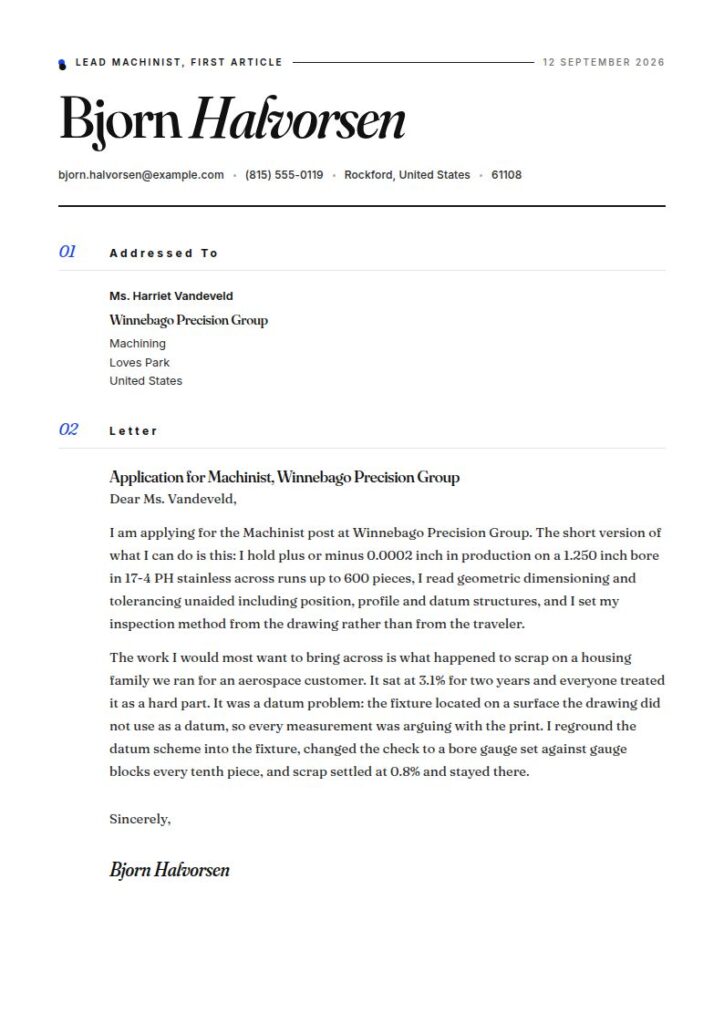
I am applying for the Machinist post at Winnebago Precision Group. The short version of what I can do is this: I hold plus or minus 0.0002 inch in production on a 1.250 inch bore in 17-4 PH stainless across runs up to 600 pieces, I read geometric dimensioning and tolerancing unaided including position, profile and datum structures, and I set my inspection method from the drawing rather than from the traveler.
The work I would most want to bring across is what happened to scrap on a housing family we ran for an aerospace customer. It sat at 3.1% for two years and everyone treated it as a hard part. It was a datum problem: the fixture located on a surface the drawing did not use as a datum, so every measurement was arguing with the print. I reground the datum scheme into the fixture, changed the check to a bore gauge set against gauge blocks every tenth piece, and scrap settled at 0.8% and stayed there.
I understand you have been taking on more medical work and that first article turnaround has been the constraint. First article is the part of the job I have owned for the last seven years, including the measurement plan and the coordinate measuring machine programs for profile and position, and I took first article rejections at my current shop from 11 in a year to 2 by moving datum interpretation questions to the quoting stage instead of the first cut.
I completed a four year machinist apprenticeship in 2013, I hold NIMS credentials in machining and dimensional measurements with my most recent in 2021, and I took a 40 hour geometric dimensioning and tolerancing course in 2016. I can work days or second shift and give two weeks of notice. Thank you for your time.
Sincerely, Bjorn Halvorsen
Openings that work
| Instead of | Use |
|---|---|
| I am an experienced machinist with excellent attention to detail | I hold plus or minus 0.0002 inch in production on a 1.250 inch bore in 17-4 PH |
| I take pride in producing quality parts | Scrap on the housing family went from 3.1% to 0.8% and stayed |
How to state a tolerance claim in a letter
Three rules, and they matter more here than in most trades because the claim is tested with a gauge, often on the same day.
Separate the run from the one-off. What you hold across 600 pieces and what you hit once on a good afternoon are different claims, and a shop quotes against the first. Write both if both are true and label which is which.
Put the material and the feature next to the number. A thin wall, a deep bore, a long slender turning and a hardened material all change what a tolerance costs. Naming them shows you know why the number was hard.
Say what you measured with. Micrometer, bore gauge, gauge blocks on a surface plate, height gauge, optical comparator, coordinate measuring machine. Then say whether you log actuals, because the measured value rather than a tick is what shows drift before it becomes scrap.
Give the tolerance, the feature, the material and the run in the first two sentences. Say how you measured and whether you log actuals. Name the geometric tolerancing you read unaided. Give one scrap or first article number with what you changed. Close with the apprenticeship and credentials, dated.
Do not write "tight tolerances" with no number. Do not quote a single best measurement as a production capability. Do not claim tolerancing you cannot explain at a drawing. Do not write "NIMS certified" without naming the areas. Do not open with detail-oriented, and do not send a letter with no shop name in it.
What counts as evidence at the bench
You do not need a title to have a number.
| Kind of evidence | What it looks like in a sentence |
|---|---|
| Tolerance held | Plus or minus 0.0002 inch on a 1.250 inch bore in 17-4 PH across runs of 600 |
| Scrap | Scrap on the housing family fell from 3.1% to 0.8% after the fixture datum scheme was reground |
| First article | First article rejections fell from 11 in a year to 2 |
Quote the machinist number, not the combined one
BLS publishes machinists and tool and die makers on one Handbook profile with a combined median annual wage of $59,620 in May 2025. Separately, machinists had a median of $58,750 and tool and die makers $64,050 (BLS Occupational Outlook Handbook, May 2025).
The two also move differently. From 2025 to 2035 machinist employment is projected to change by 1 percent while tool and die maker employment is projected to decline by 9 percent, with about 30,400 openings a year projected across both (BLS Occupational Outlook Handbook, 2025 to 2035 projections).
Industry matters at least as much: machinists in transportation equipment manufacturing had a median of $61,920 in May 2025 against $54,910 in fabricated metal product manufacturing, which is where 35 percent of machinists work (BLS Occupational Outlook Handbook, May 2025). A documented tolerance band is what lets you apply into the first of those from the second.
Length, format and sending it
One page, four paragraphs, 250 to 400 words. PDF unless the portal asks for Word, named for yourself and the post: bjorn-halvorsen-machinist-cover-letter.pdf.
Address a person. Most precision shops are small enough that the owner or shop manager is named on the site, and a named recipient reads as preparation.
Use the same figures as your resume so the two agree. Our machinist resume example uses the numbers shown here.
Key takeaways
- Open with the tolerance, the feature, the material and the run length.
- Say how you measured it and whether you log actuals.
- Separate what you hold in production from what you have hit once.
- Give one scrap or first article number and what you changed to move it.
- Name the geometric tolerancing you read unaided.
- Close with the apprenticeship and credentials, each with a date.
- One page, four paragraphs, addressed to a named person.
Write your machinist cover letter in 10 minutes.
Machinist cover letter questions, answered
How long should a machinist cover letter be?
One page, four paragraphs, 250 to 400 words. The reader is checking a tolerance, a material, a measurement method and your availability, and all four fit in the opening half of the page.
Should I really put a tolerance number in a cover letter?
Yes, and it is the single thing that most improves a machinist letter. It is the only claim a shop can test, and stating it yourself means you set the band rather than having an interviewer probe for it. Make sure it is the number you hold repeatably, because it gets checked on a part.
What if my best work was a one-off rather than a production run?
Say both and label them. "Plus or minus 0.0001 inch on a single ground and lapped face, and plus or minus 0.001 inch across production runs" is honest and useful. Shops quote against the production figure, and volunteering the distinction reads as someone who understands how work is estimated.
Do I need to mention NIMS credentials in the letter?
Mention them in the closing line with the areas named, not as the argument. NIMS issues credentials across machining, chip making, dimensional measurements, quality control and other areas in Classic and Smart credential families (NIMS, nims-skills.org, accessed September 2026), and the Occupational Outlook Handbook calls a certification program optional for this occupation (BLS Occupational Outlook Handbook, May 2025). The tolerance and the metrology carry the letter.
How do I write to a shop that runs work I have not done?
Lead with the transferable part, which is the tolerance band, the materials and the measurement discipline rather than the product. Then name the gap plainly: stainless and aluminum but not nickel alloys, or production work but not first article. Naming it makes the rest of the letter credible.