Rashida Latif Shift Production Lead, GMP food plant Toledo, 43606, United States [email protected] · (419) 555-0171
12 September 2026
Mr. Pieter Vandenberg Production Great Lakes Provisions Bowling Green, United States
Application for Production Operator, Bowling Green plant
Dear Mr. Vandenberg,
I am applying for the Production Operator post on your filling lines. I have spent eleven years in food and beverage plants running to good manufacturing practice and a hazard analysis and preventive controls plan, I am a lockout tagout authorized employee under my current plant's energy control program, and I am sanitation-qualified for wet clean and pre-operational inspection.
The work I would most want to bring across is changeover. On Filling Line 4 at my previous plant the allergen changeover was taking 95 minutes and eating most of a shift twice a week. I resequenced the wet clean so the chemical dwell ran while tooling was being swapped rather than after, and we brought it to 62 minutes with no change to the verification steps or the sign-off. In my current role leading a shift of 24 operators, the same approach took overall equipment effectiveness on our lead line from 68% to 79% over 18 months, and our last two third-party food safety audits closed with no critical findings.
I understand your Bowling Green site runs continuous operations with a rotating 12-hour pattern. I have worked 2-2-3 rotations for eleven years, I have had zero attendance occurrences in the last 24 months, and I am willing to take scheduled overtime and weekend call-in. I live 26 miles from the site, which I mention because you will want to know.
I am a confined space entrant, employer-certified on a sit-down counterbalance truck with my most recent evaluation in 2024, and my food safety refresher is current to 2026. I can give two weeks of notice. Thank you for your time.
Sincerely, Rashida Latif
Summary
A factory worker cover letter names the rule set the plant you worked in ran under, the compliance status you personally hold, and the shift pattern you can work. This guide gives you a full adaptable letter, the way to write agency and temp-to-hire history, and how to move between regulated sectors without overstating what you have done.
Factory Worker cover letter examples by experience level
A factory worker cover letter is a one page letter that tells a plant which rule set you have worked under, what status you hold inside it, and which shifts you can work.
Those three answers decide whether your file goes forward, and almost nobody puts them in writing. The average factory worker cover letter promises reliability in general terms, and a production manager cannot schedule general terms. They can schedule a lockout tagout authorized employee who has worked to good manufacturing practice and will take the rotating nights.
Guide to a factory worker cover letter
This guide and the corresponding factory worker cover letter example will cover:
- How to structure the letter, paragraph by paragraph
- Why the compliance environment belongs in the first two sentences
- How to write shift pattern, attendance and overtime honestly
- What to say when moving between regulated sectors
How to write a factory worker cover letter
| Paragraph | Its job | Length |
|---|---|---|
| Opening | The role, the rule set you have worked under, your status in it | 2 to 3 sentences |
| Evidence | One line, one improvement, one number, one period | 4 to 5 sentences |
| Fit | Something specific about their plant, plus shift and attendance | 3 to 4 sentences |
| Close | Clearances with dates, notice period, thank you | 2 sentences |
Lead with the rule set, not the task list
The opening sentence should tell a production manager which plants can hire you without restarting your training from zero.
"I have spent seven years in food and beverage manufacturing under current good manufacturing practice and a hazard analysis and preventive controls plan, and I am a lockout tagout authorized employee under the plant energy control program."
Every phrase in that sentence maps onto something the receiving plant already runs. Compare it with "I have extensive experience operating machinery in a factory setting", which describes work that does not transfer and status that cannot be checked.
A factory worker cover letter example you can adapt
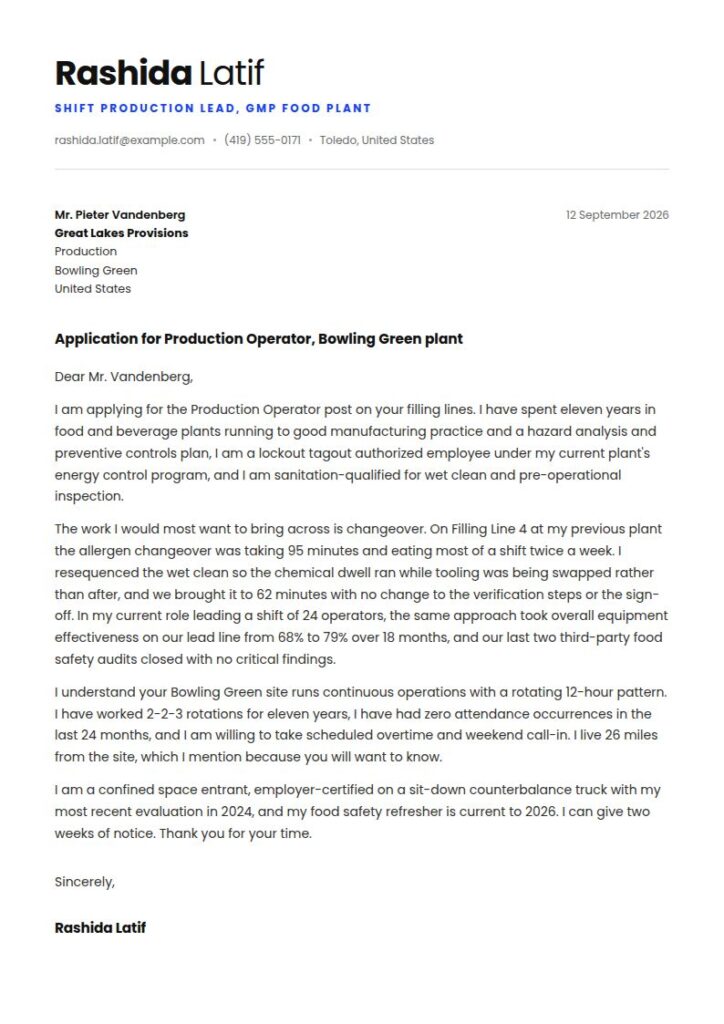
Dear Mr. Vandenberg,
I am applying for the Production Operator post on your filling lines. I have spent eleven years in food and beverage plants running to good manufacturing practice and a hazard analysis and preventive controls plan, I am a lockout tagout authorized employee under my current plant's energy control program, and I am sanitation-qualified for wet clean and pre-operational inspection.
The work I would most want to bring across is changeover. On Filling Line 4 at my previous plant the allergen changeover was taking 95 minutes and eating most of a shift twice a week. I resequenced the wet clean so the chemical dwell ran while tooling was being swapped rather than after, and we brought it to 62 minutes with no change to the verification steps or the sign-off. In my current role leading a shift of 24 operators, the same approach took overall equipment effectiveness on our lead line from 68% to 79% over 18 months, and our last two third-party food safety audits closed with no critical findings.
I understand your Bowling Green site runs continuous operations with a rotating 12-hour pattern. I have worked 2-2-3 rotations for eleven years, I have had zero attendance occurrences in the last 24 months, and I am willing to take scheduled overtime and weekend call-in. I live 26 miles from the site, which I mention because you will want to know.
I am a confined space entrant, employer-certified on a sit-down counterbalance truck with my most recent evaluation in 2024, and my food safety refresher is current to 2026. I can give two weeks of notice. Thank you for your time.
Sincerely, Rashida Latif
Openings that work
| Instead of | Use |
|---|---|
| I am a reliable and hard-working factory worker | I have spent eleven years in food and beverage plants running to good manufacturing practice |
| I have experience operating a variety of machinery | I am a lockout tagout authorized employee under my plant's energy control program |
| I am able to work in a fast-paced environment | I have worked 2-2-3 rotating 12-hour shifts for eleven years |
| I take pride in maintaining high standards | I am sanitation-qualified for wet clean and pre-operational inspection |
Each right-hand sentence names something the receiving plant already runs a program for, which is why it gets read.
Shift pattern, attendance and overtime
Say all three in one short passage in the third paragraph.
A continuous operations plant is buying coverage. The most expensive thing that happens to a production manager is a line short of an operator on a night shift, and much of the interview exists to work out how likely you are to be that gap. Naming the rotation you have worked, an attendance figure and your position on overtime answers it before it is asked.
| What to state | How it reads |
|---|---|
| Pattern worked | Eleven years on a 2-2-3 rotating 12-hour pattern, days and nights |
| Attendance | Zero attendance occurrences in the last 24 months |
| Overtime | Willing to take scheduled overtime and weekend call-in |
| Travel | 26 miles from the site, own transport |
If any of those is not true, leave it out rather than softening it. All four get checked, the last one by the commute itself.
Moving between regulated sectors
The rule set transfers, so the letter maps yours onto theirs and is exact about the gap.
Food and beverage work maps well onto pharmaceutical and personal care packing, because record keeping, batch traceability, hygiene rules and changeover discipline carry across. What does not carry across is cleanroom gowning into a classified room. Say so plainly: name what you hold, name what you would need to qualify on, and say you are ready to do it. A candidate who knows that difference has genuinely worked inside a quality system.
Name the rule set in the first two sentences. Use the standard's own term for your energy control status. Give one changeover, sanitation or audit result with a number and a period. State the rotation you have worked and your attendance as a figure. Say when an agency assignment converted to direct employment.
Do not claim authorized employee status if you have never placed a lock. Do not call plant training a license or a national certification. Do not write "excellent attention to detail" in a letter about a regulated plant, because the records are the evidence and the phrase is not. Do not leave the shift question for the interview.
Why the temp-to-hire route is worth naming
Production occupations had a median annual wage of $46,990 in May 2025, with employment across the group projected to show little or no change from 2025 to 2035 and about 867,700 openings a year, nearly all of them replacements (BLS Occupational Outlook Handbook, 2025-35 projections and May 2025 wage data).
Agency work is a main entry route. Among assemblers and fabricators, temporary help services employ 9 percent of the workforce at a median of $36,860, against $45,450 for that occupation overall (BLS, May 2025).
So the conversion from agency to direct employment is both common and financially significant, and it is evidence in its own right. A plant that converted you chose to when it was free not to. Put the month in the letter.
Length, format and sending it
One page, four paragraphs, 250 to 400 words. PDF unless the portal insists on Word, named for yourself and the post: rashida-latif-production-operator-cover-letter.pdf.
Name the specific plant, not just the company. Large manufacturers run many sites with different rule sets, and naming the one you want shows you looked at more than the job board listing.
Keep the figures the same as your resume. Our factory worker resume example is written with the numbers used here.
Key takeaways
- Name the rule set your plant ran under in the first two sentences.
- Use the standard's own term for your lockout tagout status.
- Give one changeover, sanitation or audit number with its period.
- State the shift rotation you have worked, by name.
- Give your attendance as a figure, not an adjective.
- Say when an agency assignment converted to direct employment.
- When changing sector, name the gap you would need to qualify on.
Write your factory worker cover letter in 10 minutes.
Factory worker cover letter questions, answered
How long should a factory worker cover letter be?
One page, four paragraphs, 250 to 400 words. Production managers read applications between shift handovers, and the compliance answers fit easily inside that.
Do I need a cover letter if the plant uses an online application?
Attach one wherever the form allows it. The form asks for dates and availability. The letter is where you say which rule set you have worked under, whether you place your own locks and what your attendance has been, which is what decides the shortlist.
What do I write with no factory experience?
Write about work that had a written standard and a record: a kitchen, a care setting, cleaning to a checklist, agricultural packing, a military detail. Then answer the shift question directly, because entry-level plant hiring turns on it, and say you are ready to complete the induction and food safety training. Honesty about the gap beats a paragraph of enthusiasm.
Should I mention that I started through an agency?
Yes. Among assemblers and fabricators, temporary help services employ 9 percent of the workforce, so it is a main door into manufacturing (BLS Occupational Outlook Handbook, May 2025). Name the agency and the plant, and if you converted to direct employment, give the month. That conversion is a plant's own judgement of you, written down.
How do I write about a plant closure or a line shutting down?
One clause, in the paragraph where the job appears: "the site closed its chilled line in November". Closures are routine in production and every manager reading your letter has lived through one. What reads badly is a gap with no explanation, because the reader fills it in themselves.