Quentin Abernethy Senior Manufacturing Technician Cedar Rapids, 52404, United States [email protected] · (319) 555-0168
12 September 2026
Ms. Ingrid Halvorsen Maintenance and Reliability Waverly Bioprocess Systems Waterloo, United States
Application for Manufacturing Technician, Waverly Bioprocess Systems
Dear Ms. Halvorsen,
I am applying for the Manufacturing Technician post at Waverly Bioprocess Systems. My stack is process equipment in a food ingredient plant: a spray dryer with a gas-fired air heater, a three-effect falling-film evaporator, a twin-screw extruder and a clean-in-place skid, all on Allen-Bradley ControlLogix and CompactLogix with FactoryTalk View SE and ME. I troubleshoot to component level, hold edit rights on three line programs under our change control procedure, and I am not authorized for safety system changes.
The work I would most want to repeat for you is the preventive maintenance rebuild. I moved the program from calendar intervals to failure history across 143 assets, which took mean time between failures on the extruder from 240 hours to 610 and removed 1,180 hours of unplanned downtime a year. Mean time to repair on the dryer line fell from 4.1 hours to 2.3 after I pre-kitted the eight most common repairs and rewrote the fault-finding guide. I also own calibration for 168 instrument loops covering temperature, pressure and flow, including out-of-tolerance investigations, and earlier in the same plant I took dryer line OEE from 61% to 74% over eighteen months by separating short stops from breakdowns in the data.
Your posting mentions a spray dryer installation next year and a move away from calendar-based maintenance. Both are work I have just finished doing. I would start with eighteen months of failure history rather than with the manufacturer's recommended intervals, because that is where the real intervals hide, and I would want to write the installation, operational and performance qualification protocols for the new dryer myself rather than hand them to a contractor.
I hold an Associate of Applied Science in Electromechanical Technology from Kirkwood Community College, the CMRT from the Society for Maintenance and Reliability Professionals, and CCST Level I from the International Society of Automation, plus current authorized lockout and tagout and confined space entry. I can give three weeks' notice. Thank you for your time.
Sincerely, Quentin Abernethy
Summary
A manufacturing technician cover letter names the process equipment, the control platform behind it, and the level of intervention you are trusted with. This guide gives you a full adaptable letter, the difference between a maintenance-leaning and a process-leaning letter, and the reliability numbers that make a maintenance manager pick up the phone.
Manufacturing Technician cover letter examples by experience level
A manufacturing technician cover letter is a one-page letter naming the equipment you work on, the control platform it runs on, and how deep into it you are authorized to go.
The person reading it is holding a list of the machines in their building. They are not weighing your enthusiasm; they are checking whether your stack overlaps theirs. A letter that leads with the overlap gets answered.
Guide to a manufacturing technician cover letter
This guide and the corresponding manufacturing technician cover letter example will cover:
- How to structure the letter, paragraph by paragraph
- Why the equipment and control platform belong in the first three sentences
- How to state your level of intervention honestly and gain credibility for it
- Whether to write the maintenance letter or the process letter
How to write a manufacturing technician cover letter
| Paragraph | Its job | Length |
|---|---|---|
| Opening | The post, the equipment, the controls, your depth | 3 to 4 sentences |
| Evidence | One reliability or yield result with numbers and a period | 4 sentences |
| Fit | A real detail from their plant and where you would start | 3 sentences |
| Close | Degree, certifications, site qualifications, availability | 2 sentences |
Say what you are allowed to touch, not just what you have touched
The line that separates a good technical letter from an average one is the level of intervention.
"I read and fault-find Allen-Bradley ladder logic in Studio 5000 and hold edit rights on three line programs under change control" tells a maintenance manager exactly where you sit. So does the honest version without edit rights.
A vague claim of PLC programming has the opposite effect, because the reader has interviewed people who wrote it and could not describe a change control record. Precision here reads as competence, not as modesty.
A manufacturing technician cover letter example you can adapt
Dear Ms. Halvorsen,
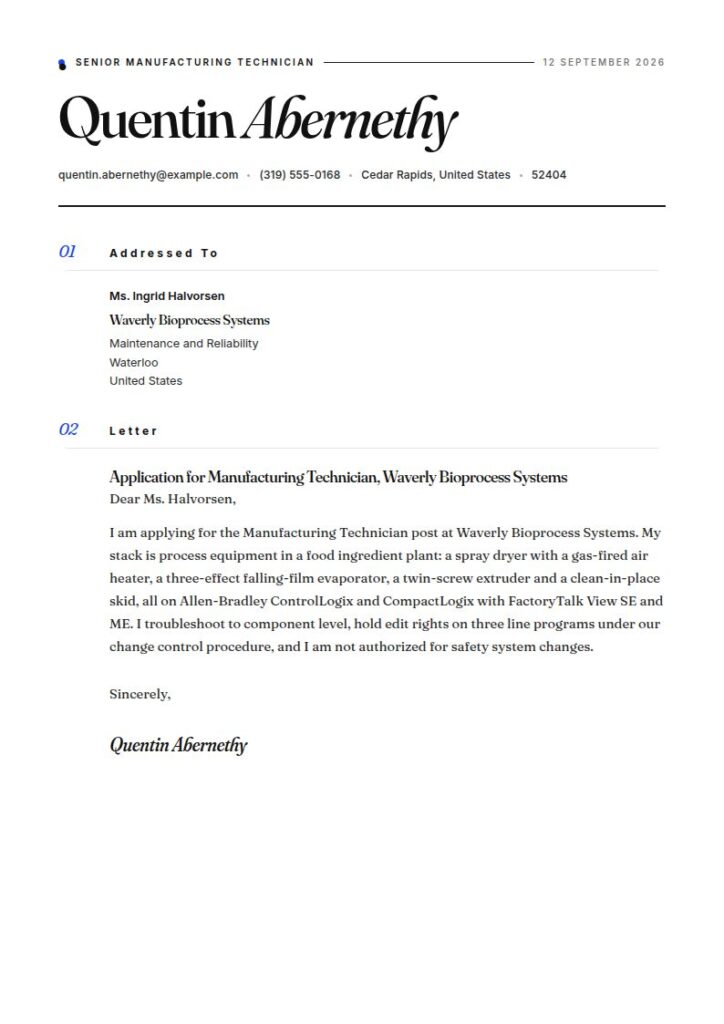
I am applying for the Manufacturing Technician post at Waverly Bioprocess Systems. My stack is process equipment in a food ingredient plant: a spray dryer with a gas-fired air heater, a three-effect falling-film evaporator, a twin-screw extruder and a clean-in-place skid, all on Allen-Bradley ControlLogix and CompactLogix with FactoryTalk View SE and ME. I troubleshoot to component level, hold edit rights on three line programs under our change control procedure, and I am not authorized for safety system changes.
The work I would most want to repeat for you is the preventive maintenance rebuild. I moved the program from calendar intervals to failure history across 143 assets, which took mean time between failures on the extruder from 240 hours to 610 and removed 1,180 hours of unplanned downtime a year. Mean time to repair on the dryer line fell from 4.1 hours to 2.3 after I pre-kitted the eight most common repairs and rewrote the fault-finding guide. I also own calibration for 168 instrument loops covering temperature, pressure and flow, including out-of-tolerance investigations, and earlier in the same plant I took dryer line OEE from 61% to 74% over eighteen months by separating short stops from breakdowns in the data.
Your posting mentions a spray dryer installation next year and a move away from calendar-based maintenance. Both are work I have just finished doing. I would start with eighteen months of failure history rather than with the manufacturer's recommended intervals, because that is where the real intervals hide, and I would want to write the installation, operational and performance qualification protocols for the new dryer myself rather than hand them to a contractor.
I hold an Associate of Applied Science in Electromechanical Technology from Kirkwood Community College, the CMRT from the Society for Maintenance and Reliability Professionals, and CCST Level I from the International Society of Automation, plus current authorized lockout and tagout and confined space entry. I can give three weeks' notice. Thank you for your time.
Sincerely, Quentin Abernethy
Openings that work
| Instead of | Use |
|---|---|
| I am a skilled manufacturing professional with hands-on experience | My stack is spray dryer, falling-film evaporator, twin-screw extruder and CIP skid on ControlLogix |
| I have strong PLC and troubleshooting skills | I fault-find in Studio 5000 and hold edit rights on three programs under change control |
| I have a proven record of reducing downtime | Extruder MTBF went from 240 hours to 610; unplanned downtime fell 1,180 hours a year |
| I am detail oriented and safety conscious | I own calibration for 168 loops, including out-of-tolerance investigations |
Match the vocabulary: maintenance-leaning or process-leaning
Two different managers hire under this title, and they read for different words.
A maintenance or reliability manager reads for assets, work orders, spares, isolation, PM completion, mean time between failures and mean time to repair. A process or manufacturing engineering manager reads for runs, parameters, capability, first pass yield, scrap, OEE and qualification.
Read the posting, decide which one wrote it, and lead with that vocabulary in the first two paragraphs. Most technicians can write both letters honestly. The mistake is blending them, which leaves each manager hunting for their own job in your paragraph.
Two occupations, two market shapes
Industrial engineering technologists and technicians, the process-leaning side of this title, had a median annual wage of $66,120 as of May 2025, or $31.79 an hour, with an associate's degree as the typical entry-level education. The occupation held 76,700 jobs in 2025 and is projected to grow 3 percent from 2025 to 2035, with about 6,600 openings a year (BLS Occupational Outlook Handbook, May 2025 and 2025-35 projections).
Industrial machinery mechanics, the maintenance-leaning side, had a median of $64,520 as of May 2025. That wider group held 547,300 jobs in 2025 and is projected to grow 14 percent from 2025 to 2035, with about 51,900 openings a year (BLS Occupational Outlook Handbook, May 2025 and 2025-35 projections).
Nearly identical pay, very different volume. If you can write the maintenance letter as well as the process one, you are writing into a market with roughly eight times the annual openings.
What counts as evidence for a manufacturing technician
| Kind of evidence | What it looks like in a sentence |
|---|---|
| Reliability | Extruder MTBF from 240 hours to 610 after rebuilding PM around failure history |
| Recovery speed | Dryer line MTTR from 4.1 hours to 2.3 by pre-kitting the eight most common repairs |
| Availability | 1,180 hours of unplanned downtime removed in a year across 143 assets |
| Yield | Evaporator changeover product loss from 1.9% to 0.8% |
| Discipline | 42 PM work orders a month at 98% on-time completion |
| Qualification | Wrote and executed IQ, OQ and PQ for a replacement case packer, released in 9 days |
Name the process equipment and the control platform in the first paragraph. State your level of intervention, including where you have no edit rights. Give one reliability or yield result with a before, an after and a period. Read the posting for maintenance or process vocabulary and match it. Name your site qualifications, such as authorized lockout and tagout. Say where you would start in their plant, and keep it specific.
Do not write "manufacturing equipment" or "various machinery". Do not claim PLC programming if you read logic. Do not give an OEE or MTBF number without the asset and the period. Do not list every certificate you hold; three that match the posting is plenty. Do not run past one page.
Length, format and sending it
One page, four paragraphs, 300 to 400 words. PDF, named for you and the post: quentin-abernethy-manufacturing-technician-cover-letter.pdf.
Address a person where the posting names one, and a role where it does not.
Keep the figures identical to your resume. Our manufacturing technician resume example uses the numbers here.
Key takeaways
- Lead with the equipment stack and the control platform, not with interest in the role.
- State your level of intervention, including what you are not authorized to touch.
- Give one reliability or yield result with a before, an after and a period.
- Use the reader's metrics: MTBF, MTTR, PM completion, downtime hours, OEE, scrap and yield.
- Decide whether the posting is maintenance-leaning or process-leaning and match its vocabulary.
- Close with the degree, two or three matching certifications and your site qualifications.
- Keep it to one page and say where you would start in their plant.
Write your manufacturing technician cover letter in 10 minutes.
Manufacturing technician cover letter questions, answered
Do manufacturing technicians need a cover letter?
Attach one wherever there is a field for it. The application form collects your history; the letter is the only place you can lay out the equipment stack and your level of intervention, which is what the hiring manager is actually screening on.
How specific should I be about equipment in the letter?
Very. Name the assets and the control platform by vendor and family: ControlLogix, CompactLogix, S7-1200, FactoryTalk View. Those are the words a technical reader scans for, and a generic phrase such as "process equipment" is scanned straight past.
What if my equipment does not match their posting?
Say what transfers and be plain about what does not. Controls platforms, calibration practice, root cause method and qualification documentation move between industries; specific process knowledge does not. A technician who names the boundary is more convincing than one who implies everything transfers.
Should I mention certifications in the letter?
Two or three that match the posting, in the closing sentence, with the issuing bodies named. Site qualifications such as authorized lockout and tagout and confined space entry are worth a mention because they shorten your induction, which a maintenance manager notices.
How do I write this letter with no plant experience?
Lead with the program and the lab equipment you trained on, named specifically, then any operator or apprentice time on real assets. State clearly what you can do unsupervised and what you cannot. An honest entry-level letter with a real equipment list beats a padded one, because the first technical question exposes the difference.