Mirela Voicu Assembly Cell Lead, Certified IPC Trainer Wichita, 67208, United States [email protected] · (316) 555-0142
12 September 2026
Ms. Annike Sorensen Assembly Operations Meridian Flight Systems Wichita, United States
Application for Wire Harness Assembler, Meridian Flight Systems
Dear Ms. Sorensen,
I am applying for the Wire Harness Assembler post at Meridian Flight Systems. I have built wire harnesses and electromechanical units build-to-print at class 3 for the last five years, inspected against IPC-A-620 and J-STD-001, and I hold Certified IPC Specialist status against IPC-A-610 and IPC-A-620 with a Certified IPC Trainer endorsement in IPC-A-610 and J-STD-001.
The work I would most want to bring across is what happened to first pass yield on our flight control harness family. It was sitting at 94.1%, and most of the loss came from a lay-up sequence on the form board that put the shield terminations in after the overbraid rather than before. I rewrote the sequence, retrained the bench on it, and we finished two years later at 98.6% with no change to the acceptance criteria. Since taking the cell in 2023, moving inspection to the point of build rather than the end of it has taken harness rework hours down 41% in 18 months.
I understand your Wichita line builds at class 3 and that you have been bringing harness work back in house. Because I am a Certified IPC Trainer, I can certify and recertify your assemblers against IPC-A-610 and J-STD-001 without booking an outside instructor, which is usually what holds up a cell qualification. I have also run every first article inspection on my own cell since 2023, including the dimensional and continuity records that go out with the first shipment.
I torque to drawing specification with calibrated tools and record every value on the traveler, I work an electrostatic discharge controlled bench as routine, and my IPC-A-610 certification was most recently recertified in 2025. I can give two weeks of notice. Thank you for your time.
Sincerely, Mirela Voicu
Summary
An assembler cover letter names the acceptance standard your builds were inspected against, the product class you worked at, the IPC certification that proves it, and one yield or rework number. This guide gives you a full adaptable letter, the openings that work, the evidence that counts on a bench, and what to write when your shop never used a published standard at all.
Assembler cover letter examples by experience level
An assembler cover letter is a one page letter telling a production or quality lead which acceptance standard your builds were inspected against, what product class you worked at, and what a number on your bench did while you held it.
The person reading it is usually filling a certified seat. They are working out whether you can be put on qualified work in week one or week twelve, and that answer is a certificate and a class, not an adjective.
Guide to an assembler cover letter
This guide and the corresponding assembler cover letter example will cover:
- How to structure the letter, paragraph by paragraph
- Why the standard and the product class belong in the first two sentences
- What counts as evidence when you build rather than manage
- How to write about certification honestly when you hold none yet
How to write an assembler cover letter
| Paragraph | Its job | Length |
|---|---|---|
| Opening | The post, what you build, the standard and class, the certification | 2 to 3 sentences |
| Evidence | One build family, one number, and what you changed to move it | 4 to 5 sentences |
| Fit | Something real about their shop, and what you would bring to it | 3 to 4 sentences |
| Close | Torque, electrostatic discharge and record habits, notice, thank you | 2 sentences |
Put the standard and the class in the first two sentences
Most assembler letters open by saying the writer is detail-oriented, which carries no information because no applicant writes the opposite.
Open with what the reader is sorting for. IPC describes IPC-A-610, Acceptability of Electronic Assemblies, as the most widely used electronics assembly acceptance standard in the electronics industry, and its certification program offers Certified IPC Specialist, Certified IPC Trainer and Certified Standards Expert with endorsements against documents including J-STD-001, IPC-A-610 and IPC-A-620 (IPC, electronics.org, accessed September 2026).
So write the document, the class and the credential: "I build wire harnesses build-to-print at class 3, inspected against IPC-A-620 and J-STD-001, and I am a Certified IPC Specialist against IPC-A-610 and IPC-A-620." That sentence does the work of three paragraphs.
An assembler cover letter example you can adapt
Dear Ms. Sorensen,
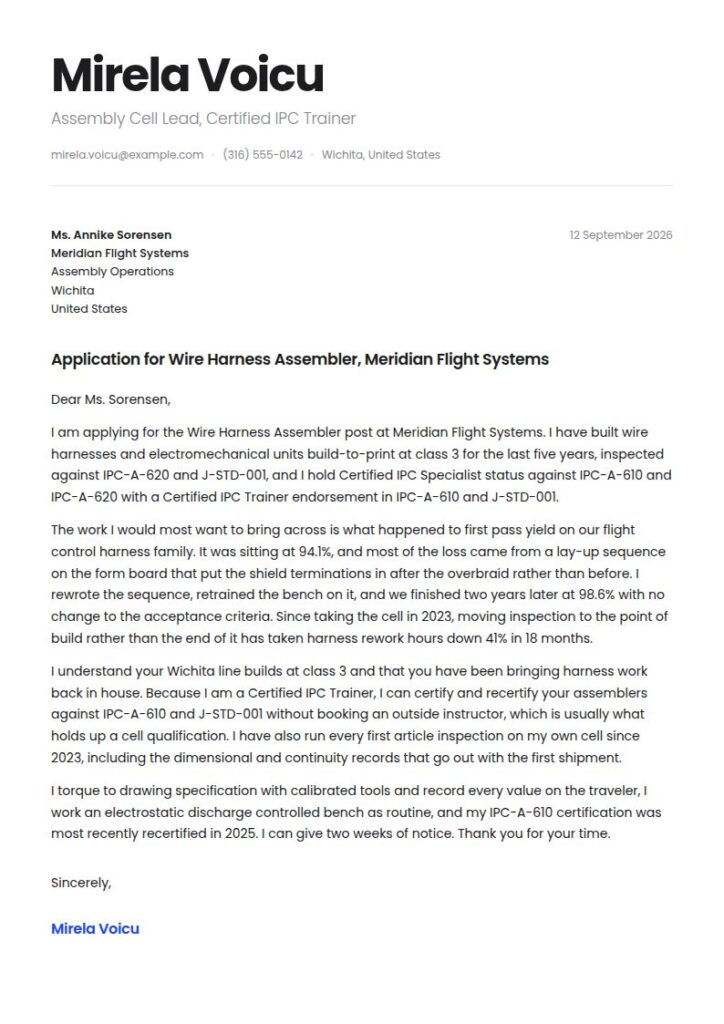
I am applying for the Wire Harness Assembler post at Meridian Flight Systems. I have built wire harnesses and electromechanical units build-to-print at class 3 for the last five years, inspected against IPC-A-620 and J-STD-001, and I hold Certified IPC Specialist status against IPC-A-610 and IPC-A-620 with a Certified IPC Trainer endorsement in IPC-A-610 and J-STD-001.
The work I would most want to bring across is what happened to first pass yield on our flight control harness family. It was sitting at 94.1%, and most of the loss came from a lay-up sequence on the form board that put the shield terminations in after the overbraid rather than before. I rewrote the sequence, retrained the bench on it, and we finished two years later at 98.6% with no change to the acceptance criteria. Since taking the cell in 2023, moving inspection to the point of build rather than the end of it has taken harness rework hours down 41% in 18 months.
I understand your Wichita line builds at class 3 and that you have been bringing harness work back in house. Because I am a Certified IPC Trainer, I can certify and recertify your assemblers against IPC-A-610 and J-STD-001 without booking an outside instructor, which is usually what holds up a cell qualification. I have also run every first article inspection on my own cell since 2023, including the dimensional and continuity records that go out with the first shipment.
I torque to drawing specification with calibrated tools and record every value on the traveler, I work an electrostatic discharge controlled bench as routine, and my IPC-A-610 certification was most recently recertified in 2025. I can give two weeks of notice. Thank you for your time.
Sincerely, Mirela Voicu
Openings that work
| Instead of | Use |
|---|---|
| I am a detail-oriented assembler with a strong work ethic | I build wire harnesses build-to-print at class 3, inspected against IPC-A-620 and J-STD-001 |
| I am writing to express my interest in your assembler position | I am applying for the Wire Harness Assembler post, and I am a Certified IPC Specialist against IPC-A-610 and IPC-A-620 |
Naming the standard without overstating it
A quality engineer will check this, so the letter has to be exactly true.
Write the document designation rather than a paraphrase. "IPC certified" does not say which standard or which level, and both matter. Certified IPC Specialist means you are certified against a named document; Certified IPC Trainer means you can certify other people to it.
Name the product class beside the standard. Acceptance criteria in these documents are applied at different product classes, set by the customer and the end use rather than by you, and an interviewer will check the claim by asking you to describe a defect.
Do not invent a validity period: write when you were certified and when you last renewed. If your shop never used a published standard, say what it did use, such as a customer drawing, a control plan or a first article report. A real internal criterion still tells the reader you were graded on something.
Name the acceptance standard by its designation and put the product class next to it. Say which IPC credential you hold and against which document. Give one yield or rework number with the period it covers and what you changed to move it. Say whether you worked build-to-print or to a work instruction. Close on torque recording, electrostatic discharge control and first piece inspection.
Do not write "IPC certified" with nothing after it. Do not claim class 3 work on the strength of one job. Do not describe in-house training as a national certification. Do not open with detail-oriented, hard-working or team player. Do not send a letter with no company name in it.
What counts as evidence on an assembly bench
You do not need to have managed anything to have a number.
| Kind of evidence | What it looks like in a sentence |
|---|---|
| Yield | First pass yield on the flight control harness family went from 94.1% to 98.6% over two years |
| Rework | Harness rework hours fell 41% in 18 months after inspection moved to the point of build |
| Qualification | Certified nine assemblers against IPC-A-610 in house as a Certified IPC Trainer |
Why the certification line changes what happens to your file
Assemblers and fabricators held 1,799,500 jobs in 2025, the occupation is projected to change by 1 percent from 2025 to 2035, and about 177,500 openings are projected each year on average (BLS Occupational Outlook Handbook, 2025 to 2035 projections).
Essentially no growth with that many annual openings means shops are replacing people rather than expanding, and a replacement in a certified seat is expensive: the bench cannot take qualified work until the new hire has been through the standard.
Pay follows the same logic. Transportation equipment manufacturing employs 25 percent of assemblers and fabricators at a median of $50,790, against $45,450 for the occupation overall (BLS Occupational Outlook Handbook, May 2025). The sectors at the top of that range build to the tightest acceptance criteria, and a letter naming a standard and a class applies into them rather than past them.
Length, format and sending it
One page, four paragraphs, 250 to 400 words. PDF unless the portal asks otherwise, named for yourself and the post: mirela-voicu-harness-assembler-cover-letter.pdf.
Address a person. Production supervisors and quality managers are usually findable, and a named recipient reads as someone who prepares.
Keep the numbers identical to the ones on your resume. Our assembler resume example uses the same figures, so the two files agree line for line.
Key takeaways
- Name the acceptance standard and the product class in the first two sentences.
- Say which IPC credential you hold and against which document, with the year.
- Give one yield or rework number, the period it covers, and what you changed.
- Say whether the work was build-to-print or to a work instruction.
- Name one real thing about their shop, taken from their own pages.
- One page, four paragraphs, addressed to a named person.
Write your assembler cover letter in 10 minutes.
Assembler cover letter questions, answered
How long should an assembler cover letter be?
One page, four paragraphs, 250 to 400 words. The reader is checking the standard, the class, the certification and one number, and all four fit in the first half of the page.
Do I need a cover letter if the manufacturer uses an online application?
Attach one wherever there is a field for it. The form collects the same structured answers from everyone. The letter is the only place you can say which standard you were inspected against, at what class, and what a number on your bench did while you held it.
What do I write if I have no IPC certification yet?
Say so plainly, then say what you were graded against instead: a customer drawing, a control plan, a first article report. Write that you are ready to certify, with the date if you have one booked. Many employers certify their own people in house.
Should I mention agency or temporary work in the letter?
Yes. Temporary help services employ 9 percent of assemblers and fabricators (BLS Occupational Outlook Handbook, May 2025), so it is a main route into the industry. Name the agency, the plant, what it built and the standard it built to, and if you converted to direct employment, say which month.
How do I write to a shop in a sector I have not worked in?
Lead with the transferable part, which is the standard and the inspection habit rather than the product. Then be specific about the gap: you have built at class 2 and want class 3 work, or you have built to work instructions and want build-to-print. Naming the gap is what makes the rest of the letter credible.