Electronic Assembler, Certified IPC Specialist Mirela Voicu
Electronic Assembler
[email protected] | (316) 555-0142 | Wichita, United States
Profile
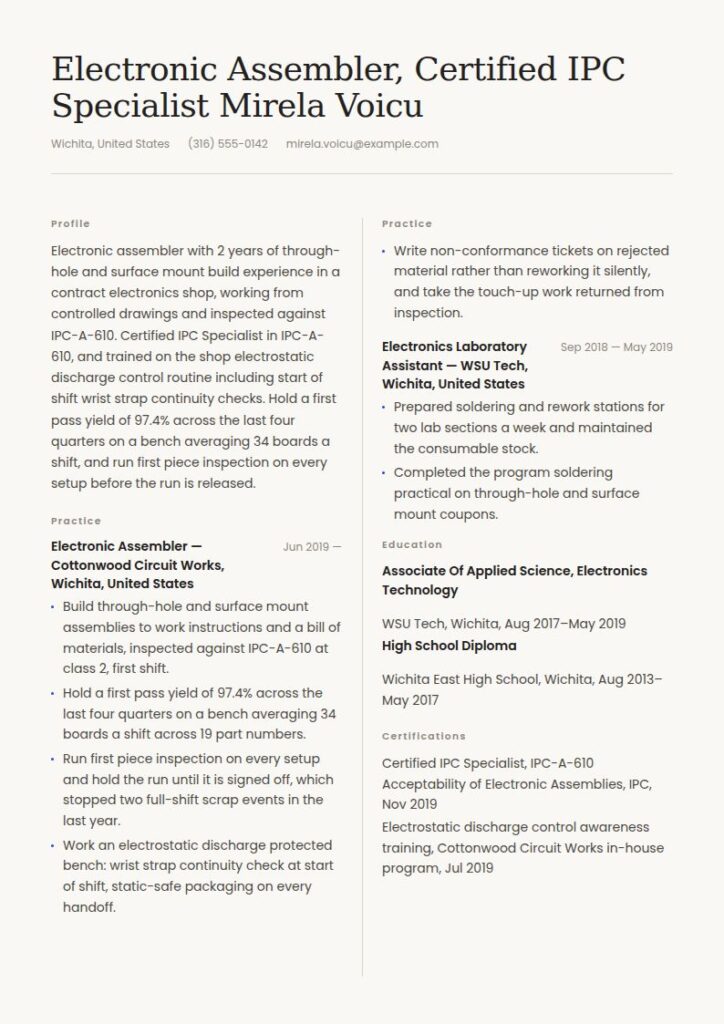
Electronic assembler with 2 years of through-hole and surface mount build experience in a contract electronics shop, working from controlled drawings and inspected against IPC-A-610. Certified IPC Specialist in IPC-A-610, and trained on the shop electrostatic discharge control routine including start of shift wrist strap continuity checks. Hold a first pass yield of 97.4% across the last four quarters on a bench averaging 34 boards a shift, and run first piece inspection on every setup before the run is released.
Work Experience
06/2019 - Present, Electronic Assembler, Cottonwood Circuit Works, Wichita, United States
- Build through-hole and surface mount assemblies to work instructions and a bill of materials, inspected against IPC-A-610 at class 2, first shift.
- Hold a first pass yield of 97.4% across the last four quarters on a bench averaging 34 boards a shift across 19 part numbers.
- Run first piece inspection on every setup and hold the run until it is signed off, which stopped two full-shift scrap events in the last year.
- Work an electrostatic discharge protected bench: wrist strap continuity check at start of shift, static-safe packaging on every handoff.
- Write non-conformance tickets on rejected material rather than reworking it silently, and take the touch-up work returned from inspection.
09/2018 - 05/2019, Electronics Laboratory Assistant, WSU Tech, Wichita, United States
- Prepared soldering and rework stations for two lab sections a week and maintained the consumable stock.
- Completed the program soldering practical on through-hole and surface mount coupons.
Education
08/2017 - 05/2019, Associate of Applied Science, Electronics Technology, WSU Tech, Wichita, United States
Coursework in soldering practice, drawing interpretation and electronic assembly inspection.
08/2013 - 05/2017, High School Diploma, Wichita East High School, Wichita, United States
Skills
IPC-A-610 acceptability criteria, 75
Through-hole and surface mount hand soldering, 80
First piece inspection, 80
Electrostatic discharge control, 85
Work instruction and bill of materials reading, 75
Rework and touch-up, 65
Non-conformance write-up, 65
Languages
English, native
Igbo, native
Certificates
11/2019, Certified IPC Specialist, IPC-A-610 Acceptability of Electronic Assemblies, IPC, CIS-610-118240
Certified against IPC-A-610 through an in-house Certified IPC Trainer.
07/2019, Electrostatic discharge control awareness training, Cottonwood Circuit Works in-house program
Site training, refreshed annually.
Summary
An assembler resume is a one page document naming the workmanship standard your work was inspected against, the product class the line built to, and whether you hold Certified IPC Specialist status. This guide gives you three adaptable versions, the certification block that moves you between sectors, and current Bureau of Labor Statistics pay and outlook for assemblers and fabricators, the published occupation this job sits inside.
Assembler resume examples by experience level
An assembler resume is a one page document that names the workmanship standard your builds were inspected against, the product class the line worked to, and the certification that proves you can read that standard yourself.
Almost nobody writes that page. The usual assembler resume lists verbs: assembled, soldered, inspected, packaged. Every applicant has those verbs, so they decide nothing. What decides the hire is which acceptance criteria you have worked to, because a shop building flight hardware and a shop building consumer speakers grade the same solder joint against different rules.
Resume guide for an assembler resume
This guide and the corresponding assembler resume example will cover:
- How to write an assembler resume, section by section
- Which workmanship standard to name, and how to name it accurately
- Three adaptable summaries: electronic assembler, harness assembler and cell lead
- What Certified IPC Specialist status is worth on the page
- What the job market looks like and what you can expect to earn
How to write an assembler resume
Six blocks: contact header, summary, workmanship and certification, assembly experience, skills, education and certifications. One page, and one page is genuinely enough.
The workmanship block sits directly under the summary because it is the gate. A quality engineer scanning applications is sorting for people who already know what a lifted lead, a cold joint or a disturbed conductor looks like under a named acceptance criterion. That sorting happens before anyone reads a single bullet.
| Section | What it is answering | Where it goes |
|---|---|---|
| Workmanship and certification | Which acceptance standard has this person been inspected against, and at what product class? | Directly under the summary |
| Assembly experience | What did they build, to what drawing, at what yield? | Reverse chronological, a number in each bullet |
| Skills | Hand skills, inspection skills and the documentation habit | Short grouped block |
| Education and certifications | Named issuing body and the year | Bottom, short and dated |
Write the standard down before you write the job
Start by listing the documents your work was graded against, not the tasks you performed.
For electronic assemblies that is usually IPC-A-610, Acceptability of Electronic Assemblies, which IPC describes as the most widely used electronics assembly acceptance standard in the electronics industry, and whose current revision is J. For cable and wire harness work it is IPC-A-620. For the soldering process itself it is J-STD-001 (IPC, electronics.org, accessed September 2026).
Then write the product class the line built to. Acceptance criteria in these standards are applied at different product classes, and the class is set by the customer and the end use, not by you. Naming it tells a reader in four words how tight the grading was where you worked.
If you have never been inspected against a published standard, say what you were inspected against instead: a customer drawing, a first article report, a control plan. Anything named beats "checked for quality".
Run the finished file through the free Rezoom ATS resume checker before you send it. Contract manufacturers hire in volume and parse first.
Choosing the best resume format for an assembler resume
Reverse chronological, one page, single column. Assembly hiring reads for two things in sequence: what you have been certified and inspected to, and whether your history is continuous.
A functional or skills-first layout fails here for a specific reason. Certification and recertification carry dates, and so do the standards themselves, since revisions change. A layout that hides when you were trained makes every claim on the page unverifiable, and in a shop where the quality system is audited, unverifiable is the same as absent.
Include your contact information
| ✅ Right | ❌ Wrong |
|---|---|
| Mirela Voicu | Mirela Voicu |
| Electronic and Harness Assembler, Certified IPC Specialist, IPC-A-610 and IPC-A-620 | Hard-working assembler seeking a new opportunity |
| Wichita, KS, available for first or second shift | Wichita, KS |
| (316) 555-0142, [email protected] | (316) 555-0142, [email protected] |
The title line in the right column is doing the work of a whole paragraph. It names the two acceptance standards the candidate has been certified against and the credential level, which is the exact combination a quality engineer searches an applicant database for.
Make use of a summary
Four lines: what you build, the standard and class you build it to, your certification status, and one yield or rate number.
Electronic assembler with 2 years of through-hole and surface mount build experience in a contract electronics shop, working from controlled drawings and inspected against IPC-A-610. Certified IPC Specialist in IPC-A-610, and trained on the shop electrostatic discharge control routine including start of shift wrist strap continuity checks. Hold a first pass yield of 97.4% across the last four quarters on a bench averaging 34 boards a shift, and run first piece inspection on every setup before the run is released.
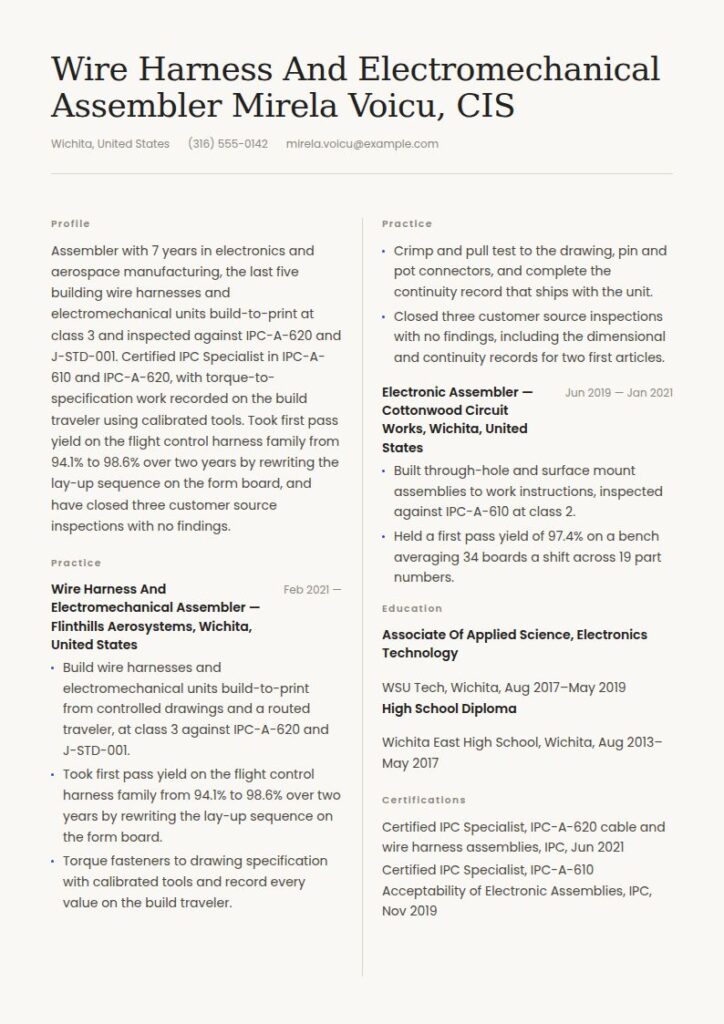
Assembler with 7 years in electronics and aerospace manufacturing, the last five building wire harnesses and electromechanical units build-to-print at class 3 and inspected against IPC-A-620 and J-STD-001. Certified IPC Specialist in IPC-A-610 and IPC-A-620, with torque-to-specification work recorded on the build traveler using calibrated tools. Took first pass yield on the flight control harness family from 94.1% to 98.6% over two years by rewriting the lay-up sequence on the form board, and have closed three customer source inspections with no findings.
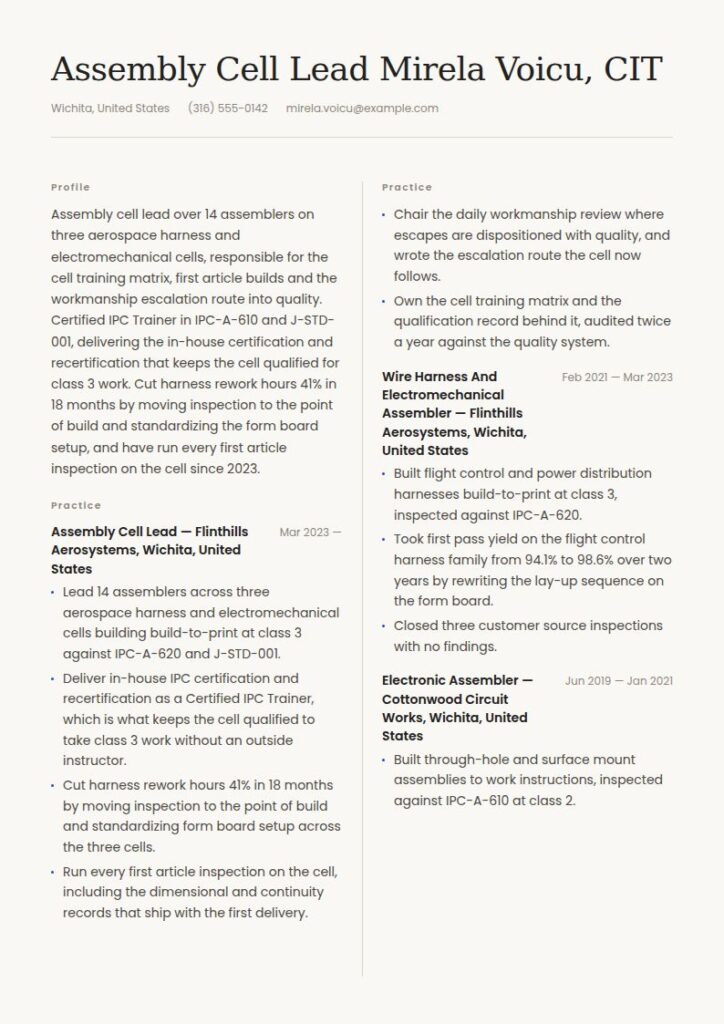
Assembly cell lead over 14 assemblers on three aerospace harness and electromechanical cells, responsible for the cell training matrix, first article builds and the workmanship escalation route into quality. Certified IPC Trainer in IPC-A-610 and J-STD-001, delivering the in-house certification and recertification that keeps the cell qualified for class 3 work. Cut harness rework hours 41% in 18 months by moving inspection to the point of build and standardizing the form board setup, and have run every first article inspection on the cell since 2023.
Right vs wrong: the same assembler summary, twice
| ✅ Right | ❌ Wrong |
|---|---|
| Build wire harnesses build-to-print at class 3, inspected against IPC-A-620 and J-STD-001. | Assemble products according to blueprints and instructions. |
| Certified IPC Specialist in IPC-A-610 and IPC-A-620. | Certified in quality standards. |
| Took first pass yield on the flight control harness family from 94.1% to 98.6% over two years. | Consistently produced high quality work with attention to detail. |
The right column can be checked in a morning: a certificate exists or it does not, a yield number came off a report or it did not. The left column is the same sentence every applicant sends, and it is worth nothing precisely because it costs nothing.
Outline your assembly experience
Employer, what the plant builds, who the end customer is, the standard and class, your shift, your dates. Then three to five bullets, each naming a build and carrying a number.
| Instead of | Use |
|---|---|
| Assembled products according to instructions | Built wire harnesses build-to-print from controlled drawings and a routed traveler, at class 3 |
| Soldered components onto circuit boards | Hand soldered through-hole and surface mount assemblies to J-STD-001, inspected against IPC-A-610 |
| Used hand tools and power tools | Torqued fasteners to drawing specification with calibrated tools, recording every value on the build record |
| Inspected own work for defects | Ran first piece inspection on every setup and held the run until it was released |
| Worked in a clean and organized area | Worked an electrostatic discharge controlled bench: wrist strap continuity checked at start of shift, static-safe packaging on every handoff |
| Met daily production goals | Held 42 harnesses a shift at a first pass yield of 98.6% across the year |
Assembly Cell Lead, Flinthills Aerosystems, Wichita, KS, March 2023 to Present
Aerospace harness and electromechanical assembly, build-to-print at class 3 against IPC-A-620 and J-STD-001, first shift. Lead 14 assemblers across three cells.
Own the cell training matrix and deliver in-house IPC certification and recertification as a Certified IPC Trainer, which is what keeps the cell qualified to take class 3 work.
Cut harness rework hours 41% in 18 months by moving inspection to the point of build and standardizing form board setup across the three cells.
Run every first article inspection on the cell, including the dimensional and continuity records that go back to the customer with the first shipment.
Chair the daily workmanship review where escapes are dispositioned with quality, and wrote the escalation route the cell now follows.
Name the workmanship standard your work was inspected against
This is the section that separates an assembler resume from a general labor resume, and it takes four lines.
An assembler is not paid to attach parts. An assembler is paid to produce a build that passes inspection against a published acceptance criterion, repeatedly, with a record behind it. The tasks stay at the plant you leave. The standard travels with you, and so does the certificate that says you can read it.
Acceptance standards: IPC-A-610 Acceptability of Electronic Assemblies; IPC-A-620 cable and wire harness assemblies; J-STD-001 soldering requirements. Product class: class 3 aerospace work since 2021, class 2 commercial electronics before that.
Certification: Certified IPC Specialist, IPC-A-610, certified 2019, recertified 2025. Certified IPC Specialist, IPC-A-620, certified 2021. Certified IPC Trainer, IPC-A-610 and J-STD-001, 2024.
Build method: build-to-print from controlled drawings and routed travelers on aerospace work; build to work instruction with a bill of materials on commercial electronics.
Inspection: first piece inspection on every setup; in-process visual inspection to the named standard; first article inspection records including dimensional and continuity results.
Torque and fastening: torque to drawing specification using calibrated tools, values recorded on the build record, tools on a calibration recall schedule.
Electrostatic discharge control: ESD-protected workstation, wrist strap continuity check at start of shift, static-safe packaging and handling on every handoff.
Four rules for writing that block so it survives contact with a quality engineer.
Name the standard, not a paraphrase of it. IPC's certification program is built around named documents, and it offers Certified IPC Specialist, Certified IPC Trainer and Certified Standards Expert, with certification endorsements available for J-STD-001, IPC-A-610, IPC-A-620, IPC-A-600, IPC-7711/7721 rework and repair, and IPC-6012 (IPC, electronics.org, accessed September 2026). "IPC certified" on its own is ambiguous, because it does not say which document or which level. Write the document and the level.
Say which credential you actually hold. Certified IPC Specialist means you have been certified against a standard. Certified IPC Trainer means you can certify other people to it, which is a different thing to a hiring manager: a trainer keeps a whole cell qualified without an outside instructor. Do not blur the two, and if the certificate came from an in-house trainer rather than an outside course, that is still the same credential and you can say so plainly.
Put the product class next to the standard. Acceptance criteria are applied at different product classes, and the class is chosen by the customer and the end use. A reader who builds at the strictest class wants to know whether you have worked there, because bringing someone up to it takes months.
Distinguish build-to-print from build to work instruction. Build-to-print means you work from the controlled engineering drawing and the drawing is the authority, so reading it correctly is part of the job. Build to work instruction means someone has already translated the drawing into steps. Both are real work, they are not the same skill, and shops hire for one or the other. Say which you have done, and if you have done both, say which sector each was in.
Show the inspection evidence, not just the build
The second half of the argument is what you did to prove the build was good, and it is where most assembler resumes go quiet.
Where the standard you hold sends you
Assemblers and fabricators held 1,799,500 jobs in 2025, and the median annual wage for the occupation was $45,450 in May 2025 (BLS Occupational Outlook Handbook, May 2025).
The spread by sector is what the certification decides. Transportation equipment manufacturing employs 25 percent of all assemblers and fabricators and pays a median of $50,790, machinery manufacturing employs 10 percent at $47,350, and computer and electronic product manufacturing employs 8 percent at $45,540 (BLS Occupational Outlook Handbook, May 2025).
Those sectors are not equally open to you. The ones that pay at the top of that list are the ones building to the tightest acceptance criteria, and they hire on evidence that you have already worked there: a named standard, a product class, a certificate with an issuing body. An applicant with the same ten years and none of those three reads as an unknown risk, and unknown risk gets sorted into the lower band.
Write the evidence as procedure, not as adjective. Three lines do it.
First piece inspection: say that you build the first unit of a setup, hold the run, and release it only when the piece is signed off. That is the habit that stops a whole shift of scrap, and it is the single most persuasive thing an assembler can claim.
In-process inspection: say what you check while building, against what, and whether you buy off a neighbor's work as well as your own. Self-inspection to a named standard is a real qualification in most quality systems.
Records: torque values on the build record, continuity results, serial and lot traceability, non-conformance write-ups. In an audited shop the record is the product.
Build a snapshot of your key skills
Twelve to fourteen entries in three groups, weighted towards the standards and the inspection work.
Workmanship and inspection: IPC-A-610 acceptability criteria, IPC-A-620 harness acceptability, J-STD-001 soldering requirements, First piece inspection, First article inspection, In-process visual inspection, Non-conformance write-up
Build skills: Through-hole and surface mount hand soldering, Wire harness lay-up and form board work, Crimping and pull testing, Connector pinning and potting, Torque to specification with calibrated tools, Mechanical and electromechanical assembly, Rework and touch-up
Systems and controls: Build-to-print drawing interpretation, Routed travelers and work instructions, Electrostatic discharge control, Calibration recall awareness, Serial and lot traceability, Basic hand measurement with calipers
List your education and certifications
Short, dated, with the issuing body named on every line. This is the block the quality department checks.
Certified IPC Trainer, IPC-A-610 and J-STD-001, IPC, 2024. Delivers in-house certification and recertification for the assembly cells.
Certified IPC Specialist, IPC-A-620 cable and wire harness assemblies, IPC, 2021.
Certified IPC Specialist, IPC-A-610 Acceptability of Electronic Assemblies, IPC, certified 2019, most recently recertified 2025.
Electrostatic discharge control awareness training, Flinthills Aerosystems in-house program, most recent refresher 2026.
Associate of Applied Science, Electronics Technology, WSU Tech, Wichita, KS, 2019.
High School Diploma, Wichita East High School, Wichita, KS, 2017.
Note the phrasing on the in-house line. Company training is not a portable certificate, and writing it as site training with a refresher year is more convincing than dressing it up as a qualification that does not exist.
Choose the right layout and design
Single column, 11 or 12 point, no photograph, no graphics, PDF unless the portal asks otherwise. Keep every standard designation on its own labeled line, because the strings a recruiter searches on are the document numbers themselves.
Name the acceptance standard your builds were inspected against, by its document designation. Say which IPC credential you hold and against which standard. Put the product class next to the standard. Say whether you worked build-to-print or to a work instruction. Give one yield, rate or rework number with the period it covers. Name the issuing body and the year on every certification line.
Do not write "IPC certified" without saying which standard and which level. Do not invent a validity period for a certificate; write the year it was issued and the year it was last renewed. Do not claim class 3 experience because you once built one job that way. Do not describe in-house training as a national certification. Do not list the tools you touched instead of the criteria you were graded against.
Assembler job market and outlook
A very large occupation with essentially no growth and heavy replacement demand, concentrated in transportation equipment.
| Measure | Value |
|---|---|
| Assemblers and fabricators employed, 2025 | 1,799,500 |
| Projected change, 2025 to 2035 | 1% (slower than average) |
| Projected annual openings | ~177,500 |
| Typical entry-level education | High school diploma or equivalent |
| Typical on-the-job training | Moderate-term on-the-job training |
| Median annual wage, May 2025 | $45,450 |
Source: U.S. Bureau of Labor Statistics, Occupational Outlook Handbook, 2025 to 2035 projections and May 2025 wage data.
About 177,500 openings a year in an occupation projected to grow 1 percent over the decade means almost every vacancy is a replacement (BLS Occupational Outlook Handbook, 2025 to 2035 projections). Shops are backfilling benches, and a backfill is an expensive event when the bench requires certification, because an uncertified hire cannot take the work until they have been through the standard. That is the whole reason a certification line near the top of your page changes how fast your file moves.
Where assemblers and fabricators work:
| Industry | Share of employment, 2025 | Median annual wage, May 2025 |
|---|---|---|
| Transportation equipment manufacturing | 25% | $50,790 |
| Machinery manufacturing | 10% | $47,350 |
| Temporary help services | 9% | $36,860 |
| Fabricated metal product manufacturing | 9% | $45,500 |
| Computer and electronic product manufacturing | 8% | $45,540 |
Source: U.S. Bureau of Labor Statistics, Occupational Outlook Handbook, May 2025.
What salary you can expect as an assembler
Assemblers and fabricators had a median annual wage of $45,450 in May 2025, which is $21.85 an hour. The lowest 10 percent earned less than $34,020 and the highest 10 percent more than $67,440 (BLS Occupational Outlook Handbook, May 2025).
That is a wide band for an occupation with a high school entry requirement, and the sector you sit in explains most of it. Transportation equipment manufacturing pays a median of $50,790 while temporary help services pays $36,860, a difference of nearly $14,000 for work that can look identical from the outside (BLS Occupational Outlook Handbook, May 2025).
What moves you across that gap is evidence, and the resume is where it goes. Certification against a named standard is the first lever, because it lets a shop put you on certified work from week one. Class 3 experience is the second. Being the person who can run a first article inspection is the third, and becoming a trainer who can certify other people is the fourth, since it converts you from a bench cost into the thing that keeps the cell qualified.
Key takeaways for an assembler resume
- Name the acceptance standard your builds were inspected against, by its document designation.
- Write the product class next to it, because the class is how tight the grading was.
- Say which IPC credential you hold and against which standard, with the year and any renewal.
- Distinguish build-to-print work from building to a work instruction.
- Give one first pass yield, rework or rate number with the period it covers.
- Show the inspection habit: first piece, in-process, first article, and the records.
- Keep it to one page, single column, with the document designations on their own lines.
Build your assembler resume in 15 minutes.
Related production resume examples
- Production worker resume
- Machine operator resume
- Manufacturing technician resume
- Quality assurance resume
- Factory worker resume
- Welder resume
- Machinist resume
- Material handler resume
- Forklift operator resume
- Production resume
- Operations manager resume
- Operations director resume
Pair it with a matching assembler cover letter.
Assembler resume questions, answered
How long should an assembler resume be?
One page. The certification block, three jobs and a skills group fit comfortably, and the reader is checking four things: the standard, the class, the dates and the yield. Go to two pages only if you have led a cell and can evidence first article and training work that will not compress.
What do I put on an assembler resume with no experience?
Anything with a specification, a check and a consequence. Vehicle or bicycle repair, a trade course with a practical component, kitchen work to a recipe card, military maintenance detail. Then say plainly that you can read a drawing, or that you want to be trained to. Employers in this occupation expect to train: BLS records moderate-term on-the-job training as typical for assemblers and fabricators and a high school diploma as the typical entry-level education (BLS Occupational Outlook Handbook, May 2025). What they will not train is the habit of following a written instruction exactly, so give one example that shows it.
Is IPC certification worth getting before I apply?
It is the single cheapest thing you can add to an assembler resume if you are aiming at electronics or harness work. IPC offers Certified IPC Specialist, Certified IPC Trainer and Certified Standards Expert, with endorsements against J-STD-001, IPC-A-610, IPC-A-620, IPC-A-600, IPC-7711/7721 and IPC-6012 (IPC, electronics.org, accessed September 2026). Specialist against IPC-A-610 is the usual starting point, and many employers will put you through it once you are hired, so it is also fair to write on the page that you are ready to certify.
Should I write the product class on my resume?
Yes, next to the standard. Acceptance criteria in these standards are applied at different product classes, set by the customer and the end use. Naming the class you worked at tells the reader how tight the grading was in one word, and it is the detail that stops an aerospace shop from passing over someone who has actually done the work.
How do I move from general assembly into aerospace or medical device assembly?
Lead with whatever named standard you have, even if it is a customer drawing rather than a published document, and then be explicit about the gap. Say you have built to class 2 and want class 3 work, or that you have built to work instructions and want build-to-print. Naming the gap is what makes the rest of the claim credible, and a certification in progress is worth writing down with the date you sit it.