Operations Director, single site manufacturing Yolanda Priestley
Operations Director
[email protected] | (864) 555-0142 | Greenville, United States
Profile
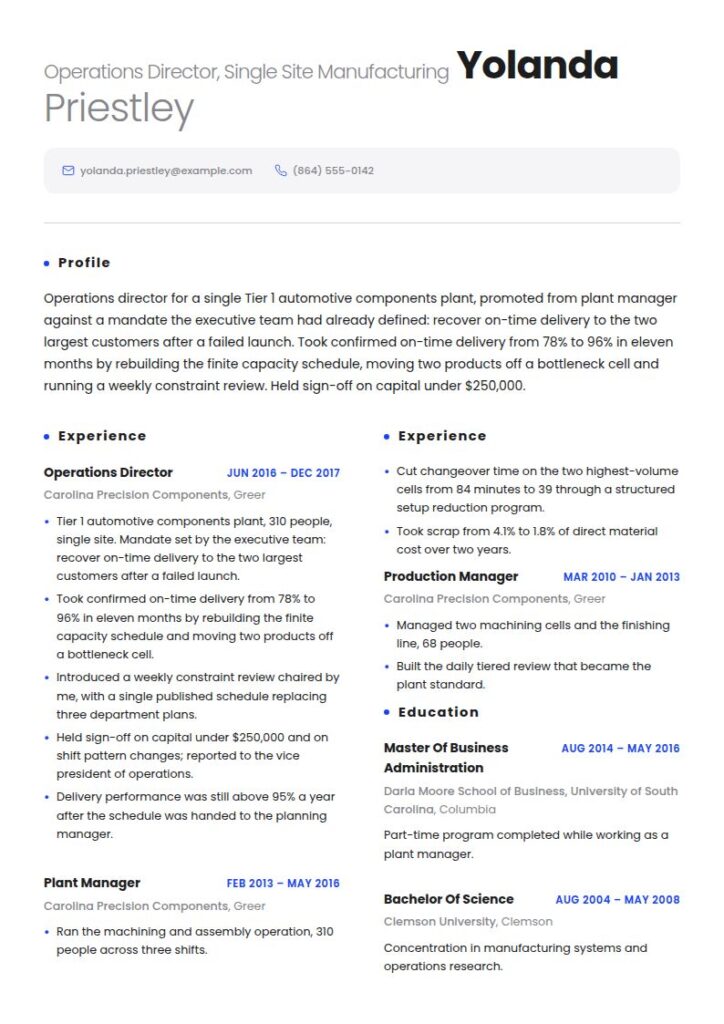
Operations director for a single Tier 1 automotive components plant, promoted from plant manager against a mandate the executive team had already defined: recover on-time delivery to the two largest customers after a failed launch. Took confirmed on-time delivery from 78% to 96% in eleven months by rebuilding the finite capacity schedule, moving two products off a bottleneck cell and running a weekly constraint review. Held sign-off on capital under $250,000.
Work Experience
06/2016 - 12/2017, Operations Director, Carolina Precision Components, Greer, United States
- Tier 1 automotive components plant, 310 people, single site. Mandate set by the executive team: recover on-time delivery to the two largest customers after a failed launch.
- Took confirmed on-time delivery from 78% to 96% in eleven months by rebuilding the finite capacity schedule and moving two products off a bottleneck cell.
- Introduced a weekly constraint review chaired by me, with a single published schedule replacing three department plans.
- Held sign-off on capital under $250,000 and on shift pattern changes; reported to the vice president of operations.
- Delivery performance was still above 95% a year after the schedule was handed to the planning manager.
02/2013 - 05/2016, Plant Manager, Carolina Precision Components, Greer, United States
- Ran the machining and assembly operation, 310 people across three shifts.
- Cut changeover time on the two highest-volume cells from 84 minutes to 39 through a structured setup reduction program.
- Took scrap from 4.1% to 1.8% of direct material cost over two years.
03/2010 - 01/2013, Production Manager, Carolina Precision Components, Greer, United States
- Managed two machining cells and the finishing line, 68 people.
- Built the daily tiered review that became the plant standard.
Education
08/2014 - 05/2016, Master of Business Administration, Operations and Supply Chain, Darla Moore School of Business, University of South Carolina, Columbia, United States
Part-time program completed while working as a plant manager.
08/2004 - 05/2008, Bachelor of Science, Industrial Engineering, Clemson University, Clemson, United States
Concentration in manufacturing systems and operations research.
Skills
Finite capacity scheduling, 85
Daily management and tiered review, 85
Lean manufacturing, 80
Six Sigma, 80
Operating budget ownership, 70
Capital appraisal and payback, 65
Root cause and corrective action, 80
OSHA recordkeeping and incident rate reporting, 65
Languages
English, native
Spanish, intermediate
Certificates
05/2014, Certified in Planning and Inventory Management (CPIM), Association for Supply Chain Management
Maintained current.
09/2012, Certified Six Sigma Black Belt, American Society for Quality
Project portfolio in changeover reduction and scrap elimination.
Summary
An operations director resume is a two page document that states, for each role, what the operation looked like on arrival, what you were brought in to change, what you were allowed to decide, and what the numbers did afterwards. This guide gives you three adaptable versions, the mandate frame that replaces a list of functions, and current Bureau of Labor Statistics pay and outlook.
Operations Director resume examples by experience level
An operations director resume is a two page document that states, for every role, what the operation looked like when you walked in, what you were brought in to change, what you were allowed to decide, and what the numbers did afterwards.
Most director resumes do something else. They reproduce an organization chart in prose: directed manufacturing, warehousing, planning, quality and environmental health and safety for a business unit. That tells a reader which boxes reported to you, not what you did with them. A chief executive replacing an operations director is not buying custody of functions; they are buying a change they have already decided has to happen.
Resume guide for an operations director resume
This guide and the corresponding operations director resume example will cover:
- How to write an operations director resume, section by section
- Why each role has to read as a mandate rather than a set of responsibilities
- Three adaptable summaries: first appointment, multi-site, and group level
- How to show that the change you made survived your handover
- What the job market looks like and what you can expect to earn
How to write an operations director resume
Six blocks: contact header, executive summary, roles written as mandates, operating systems and methods, education and certifications, and a line on board exposure. Two pages: one cannot carry four mandates, and three reads as a candidate who cannot select.
Scope belongs on the page, but as a single line inside each role rather than as the argument. Once a reader knows the operation was nine sites, every further sentence about size tells them something they already know. What they do not know is what you changed.
| Section | What it is answering | Where it goes |
|---|---|---|
| Executive summary | What kind of operating problem does this person get hired to fix? | Top, four lines |
| Operating roles as mandates | What state was it in, what changed, did it hold? | Reverse chronological, most of both pages |
| Operating systems and methods | Which planning and improvement systems have they run? | Short grouped block |
| Education and certifications | Named authorities and dates | Bottom, short |
Write four sentences per role before you write a single bullet
For each operations director role you have held, answer four questions in plain sentences, and only then turn them into bullets.
What state was the operation in on the day you arrived? Give the baseline as a number: service level, cost per unit, inventory turns, recordable injury rate, on-time delivery, whatever the business was being judged on.
What were you brought in to change? One clause. Consolidate five distribution centers into three. Put a monthly sales and operations planning cycle in place. Take the warehouse management system live. Recover a safety record.
What could you actually decide? Capital sign-off up to a limit, hiring your own site leaders, the make-or-buy recommendation, the network design.
What happened, and what was the figure a year later? The second half of that question is what makes the first half believable.
Run the finished file through the free Rezoom ATS resume checker before you send it. Search firms and corporate portals both parse the document into a structured record before a human reads it.
Choosing the best resume format for an operations director resume
Reverse chronological, two pages, single column. A reader is following a sequence of operating problems, and the sequence is the argument: which you were trusted with, in what order, and how they grew.
A functional layout destroys that, turning specific turnarounds into competencies any of a hundred thousand managers could claim. If your dates contain a short tenure, write the mandate anyway and let it explain itself: a nineteen-month role that ended when the consolidation finished is a normal operations story, not a red flag.
Include your contact information
| ✅ Right | ❌ Wrong |
|---|---|
| Yolanda Priestley | Yolanda Priestley |
| Operations Director, multi-site manufacturing and distribution | Results-driven operations executive and strategic leader |
| Network consolidation, sales and operations planning, ERP and WMS cutover | Operations, logistics, supply chain, quality, EHS, HR, finance |
| (864) 555-0142, [email protected], Greenville, SC | (864) 555-0142, [email protected] |
The third line does the work. Three named operating changes tell a reader what kind of role to consider you for; a list of every function that has reported to you tells them nothing, because at director level the functions are much the same everywhere.
Make use of a summary
Four lines: the kind of operation you run, the mandate you delivered, one result with a baseline and a period, and the decision level you have worked at.
Operations director for a single Tier 1 automotive components plant, promoted from plant manager against a mandate the executive team had already defined: recover on-time delivery to the two largest customers after a failed launch. Took confirmed on-time delivery from 78% to 96% in eleven months by rebuilding the finite capacity schedule, moving two products off a bottleneck cell and running a weekly constraint review. Held sign-off on capital under $250,000.
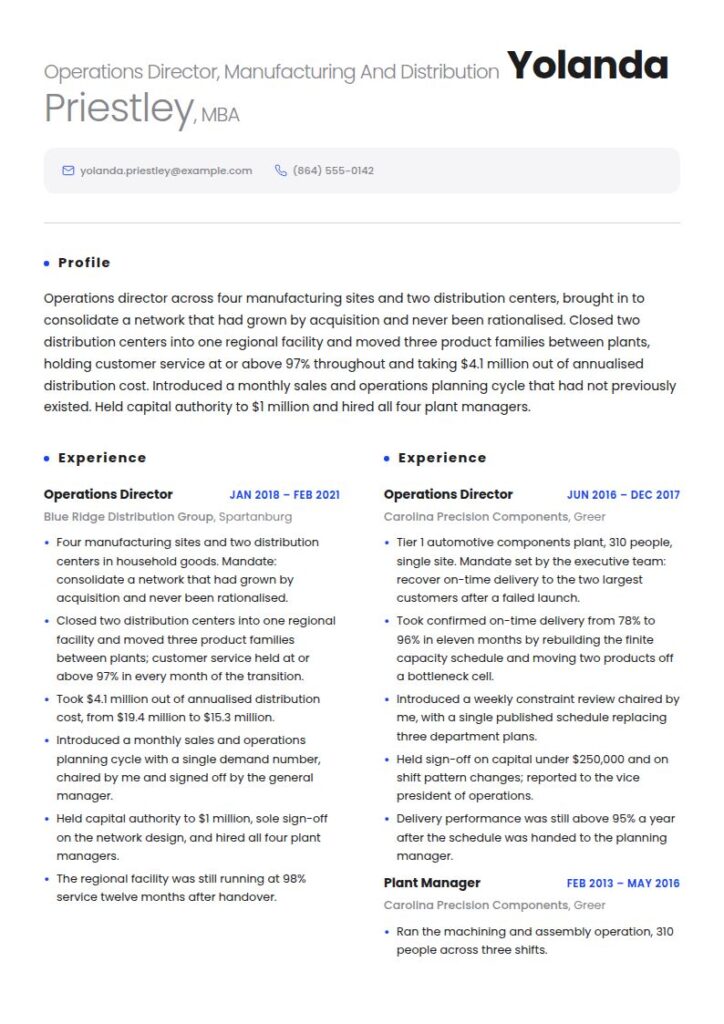
Operations director across four manufacturing sites and two distribution centers, brought in to consolidate a network that had grown by acquisition and never been rationalised. Closed two distribution centers into one regional facility and moved three product families between plants, holding customer service at or above 97% throughout and taking $4.1 million out of annualised distribution cost. Introduced a monthly sales and operations planning cycle that had not previously existed. Held capital authority to $1 million and hired all four plant managers.
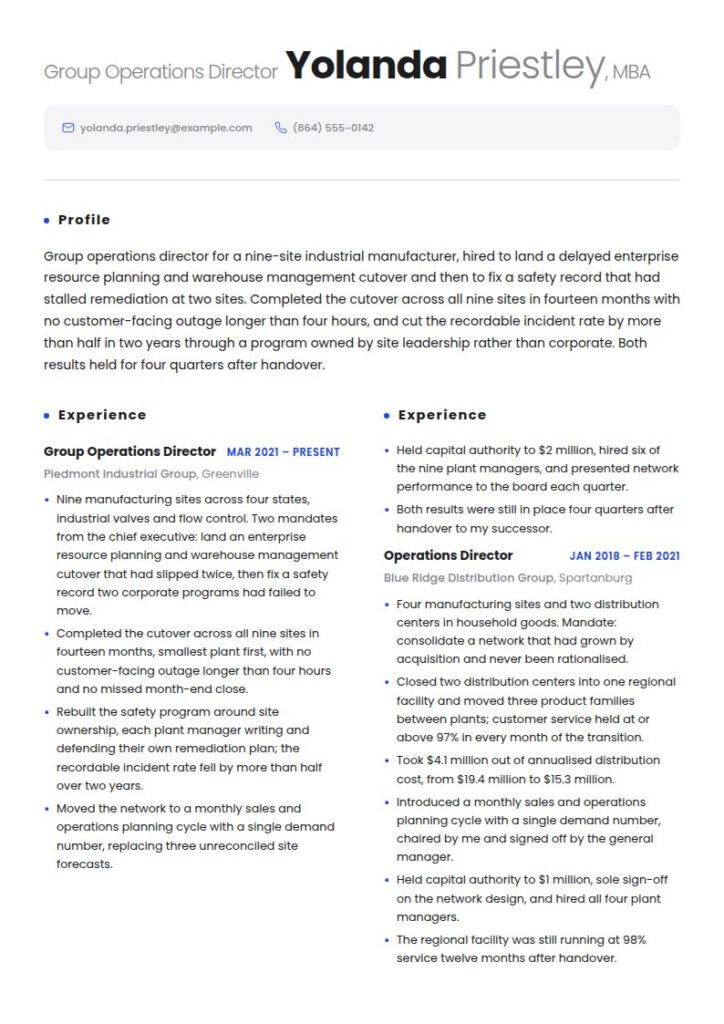
Group operations director for a nine-site industrial manufacturer, hired to land a delayed enterprise resource planning and warehouse management cutover and then to fix a safety record that had stalled remediation at two sites. Completed the cutover across all nine sites in fourteen months with no customer-facing outage longer than four hours, and cut the recordable incident rate by more than half in two years through a program owned by site leadership rather than corporate. Both results held for four quarters after handover.
Right vs wrong: the same operations director summary, twice
| ✅ Right | ❌ Wrong |
|---|---|
| Brought in to consolidate a network that had grown by acquisition and never been rationalised. | Responsible for all operations across multiple sites and functions. |
| Closed two distribution centers into one while holding customer service at or above 97%. | Drove significant operational efficiencies and cost savings. |
| Introduced a monthly sales and operations planning cycle that had not previously existed. | Implemented best practices in planning and supply chain management. |
| Held capital authority to $1 million and hired all four plant managers. | Provided strategic leadership to a large cross-functional team. |
Every sentence in the right column can be tested at interview, which is why it works. The left column survives no follow-up question at all.
Outline your operations experience
Company, what it makes or moves, the footprint in one clause, your dates. Then the mandate in a single sentence, then three to five bullets, each carrying a baseline, a change and a period.
| Instead of | Use |
|---|---|
| Responsible for manufacturing, warehousing and logistics | Brought in to consolidate six sites to four after two acquisitions closed in the same year |
| Improved operational efficiency across the network | Took confirmed on-time delivery from 78% to 96% over eleven months and held it through the following year |
| Implemented a new ERP system | Led the enterprise resource planning cutover across nine sites in fourteen months, no customer-facing outage longer than four hours |
| Reduced costs significantly | Took $4.1 million out of annualised distribution cost by closing two facilities into one regional site |
| Led a culture of safety | Cut the recordable incident rate by more than half in two years with the program owned by site leaders, not corporate |
Group Operations Director, Piedmont Industrial Group, Greenville, SC, March 2021 to Present
Nine manufacturing sites across four states, industrial valves and flow control. Hired with two explicit mandates from the chief executive: land the enterprise resource planning and warehouse management cutover that had already slipped twice, then fix a safety record two previous corporate programs had failed to move.
Completed the cutover across all nine sites in fourteen months, sequencing the smallest plant first and holding the highest-volume sites until the template was stable. No customer-facing outage exceeded four hours and no site missed a month-end close.
Rebuilt the safety program around site ownership: each plant manager wrote and defended their own remediation plan, and corporate audited rather than authored. The recordable incident rate fell by more than half over two years.
Moved the network to a monthly sales and operations planning cycle with a single demand number, replacing three unreconciled site forecasts.
Held capital authority to $2 million, hired six of the nine plant managers, and presented to the board quarterly. Both results were still in place four quarters after handover.
Write every role as a mandate, not a job description
A director is hired against a defined operating change, and the resume that names the change beats the resume that names the functions, even when the second candidate ran a larger operation. A mandate has four parts, and a role missing any one of them reads as an assertion rather than a record.
| Part | What it looks like on the page | Why a reader needs it |
|---|---|---|
| The starting state | On-time delivery at 78%, two distribution centers 40 miles apart | Without a baseline, an improvement figure means nothing |
| The mandate | One clause: what you were brought in to change | It says which of their problems you are the answer to |
| The decision rights | Capital limit, hiring authority, make-or-buy, network design | The sharpest proof of the level you have worked at |
| The result and its date | The figure, the period, and the figure a year later | A change that reverses is not a result |
Six mandates cover most of what operations directors are hired to do. Find yours and write it in its own vocabulary.
| Mandate | The baseline sentence | The result sentence |
|---|---|---|
| Network consolidation | Six sites after two acquisitions, none rationalised | Six to four in eighteen months, service held at 97%, $4.1 million out |
| Sales and operations planning | Three site forecasts, never reconciled | Monthly cycle live in five months, forecast accuracy published from month one |
| ERP or WMS cutover | A program already slipped twice, no stable template | Nine sites in fourteen months, no outage over four hours, every close met |
| Insourcing or outsourcing | Single-source supplier, 9 week lead time | Subassembly insourced in seven months, lead time to 12 days |
| Safety turnaround | Two sites with stalled remediation, two failed corporate programs | Recordable rate more than halved in two years, open items cleared |
| Cost or margin recovery | Contribution margin falling for six consecutive quarters | Margin recovered over five quarters with no cut to direct labor |
Name what you could decide, not just what reported to you
Decision rights are the most under-used evidence on an operations director resume, and the fastest way to establish the level you have worked at. Write them as facts: "capital authority to $1 million", "hired all four plant managers", "owned the make-or-buy recommendation to the executive committee", "signed the network design", "set the shift pattern without needing group approval".
Two candidates can both say they led four plants. The one who also held the capital limit, hired the plant managers and signed the design has described a different job. If your authority was narrower than you would like, say what it actually was; overstating it is the easiest thing in the document to catch in a reference call.
One thing separates a strong operations director resume from an average one: what happened after you left. Operating changes reverse. A planning cycle survives as long as the person who chairs it; an under-resourced consolidation gets quietly undone. Readers are looking for evidence that your change was built into the business rather than carried by your own attention.
Mandate: consolidate a distribution network of five facilities built up through acquisition, without losing customer service during the transition.
Starting state: five distribution centers, two of them 40 miles apart on overlapping territory. Confirmed on-time delivery 91%. Annualised distribution cost $19.4 million. No single owner of network design.
Decision rights: capital authority to $1 million, sole sign-off on the network design, hiring authority for site leadership, and the closure recommendation to the executive committee.
What I did: modeled four options against cost and next-day coverage, took the recommendation to the executive committee in month three, and ran the closures in sequence rather than in parallel.
Result: five facilities to three over eighteen months. Confirmed on-time delivery never fell below 97% in any month of the transition and finished at 98%. Annualised distribution cost $15.3 million, down $4.1 million.
Durability: the regional facility was still running at 98% service twelve months after I left, and the network design review I set up is still held twice a year.
Use figures you could defend from a report the company still has, and never write the durability line unless you know it is true. "I had already left" is an acceptable interview answer; a wrong claim ends the process.
Build a snapshot of your key skills
Twelve to sixteen entries in three groups. Keep it to systems and methods you have personally run.
Planning and execution: Sales and operations planning, Demand planning and forecast accuracy, Master production scheduling, Finite capacity scheduling, Inventory policy and turns, Network design and modeling
Improvement and quality: Lean manufacturing, Six Sigma, Value stream mapping, Daily management and tiered review, Root cause and corrective action, Overall equipment effectiveness
Systems and controls: Enterprise resource planning implementation, Warehouse management system cutover, Capital appraisal and payback, Make-or-buy analysis, OSHA recordkeeping and incident rate reporting, Site safety program design
List your education and certifications
Short, dated, each authority named. At this level the degrees matter less than the operating credentials and whether they are current.
Master of Business Administration, Darla Moore School of Business, University of South Carolina, Columbia, SC, 2016.
Bachelor of Science, Industrial Engineering, Clemson University, Clemson, SC, 2008.
Certified in Planning and Inventory Management (CPIM), Association for Supply Chain Management, 2014, maintained current.
Certified Six Sigma Black Belt, American Society for Quality, 2012.
OSHA 30-hour General Industry, authorized OSHA Outreach trainer course, 2019.
Keep credentials in the same block as the degrees rather than under a heading called "professional development". A reader checking whether you have run a planning cycle finds the letters CPIM faster than a line of prose.
Choose the right layout and design
Single column, 11 point body type, clear role headings, no photograph, no skills bar charts. PDF unless the portal asks for Word. Put the company descriptor and footprint on one line under the role title, so the reader never guesses at size.
Open each role with the mandate in one sentence. Give the baseline number before the improved number. Name the decision rights you held, including the capital limit. Say what the figure was a year later if you know. Use the operating vocabulary of the sector you are applying into. Keep it to two pages by cutting the oldest roles to two lines each.
Do not build the page around what reported to you; that is a different resume. Do not list every function in the header. Do not give an improvement percentage with no baseline. Do not claim a change held if you do not know. Do not include a page of core competencies. Do not use a two-column executive template for a corporate portal.
Operations director job market and outlook
The honest starting point: the Bureau of Labor Statistics publishes no Occupational Outlook Handbook profile for an operations director. The nearest published occupation, and the one almost every operations director role maps onto in federal data, is general and operations managers, reported inside the Handbook's top executives profile.
| Measure | Value |
|---|---|
| General and operations managers employed, 2025 | 3,599,000 |
| Top executives employed, 2025 | 3,890,600 |
| Projected change for top executives, 2025 to 2035 | 5 percent, faster than average |
| Projected annual openings, top executives | ~304,100 |
| Typical entry-level education | Bachelor's degree |
| Typical related work experience required | 5 years or more |
| Median annual wage, general and operations managers, May 2025 | $105,770 |
Source: U.S. Bureau of Labor Statistics, Occupational Outlook Handbook, 2025 to 2035 projections and May 2025 wage data.
The industry you sit in is worth more than the title
Median pay for general and operations managers varies far more by industry than by job title. In May 2025 the median was $151,040 in professional, scientific and technical services, $130,960 in manufacturing, $115,620 in wholesale trade, $112,230 in construction and $75,860 in retail trade. The spread inside the occupation is wider still: the lowest 10 percent earned less than $50,090 and the highest 10 percent more than $253,390 (BLS Occupational Outlook Handbook, May 2025).
Two things follow. Write in the vocabulary of the sector you are targeting, since a retail operations role and a manufacturing one carry the same title and are read by people who use different nouns. And if you are changing sector, the mandate is your bridge: a consolidation is legible to any of them, whereas your plant vocabulary is not.
Top executives are projected to grow 5 percent between 2025 and 2035, faster than average, with about 304,100 openings a year (BLS Occupational Outlook Handbook, 2025 to 2035 projections). Most are replacement demand, which is another way of saying this is a succession market: someone leaves, a mandate opens, and the shortlist is built from people who have already done that thing somewhere else.
What salary you can expect as an operations director
With no separate Handbook profile for operations director, the usable federal anchor is general and operations managers, who had a median annual wage of $105,770 in May 2025 (BLS Occupational Outlook Handbook, May 2025). That median covers everything from a single-site operations lead to a group director, which is why the industry and percentile figures matter more than the midpoint.
A director-level band sits well above it and is set by three things. Sector comes first: manufacturing paid a median of $130,960 to general and operations managers in May 2025, against $75,860 in retail trade (BLS, May 2025). Scale comes second, meaning revenue and site count. Third is the mandate, because a business hiring someone to land a delayed cutover or recover a safety record is buying a scarce piece of experience and prices accordingly. Only the third is something your resume can move.
Key takeaways for an operations director resume
- Write each role as a mandate: the state on arrival, the change, the decision rights, the result.
- Give the baseline number before the improved number.
- Name your decision rights, including the capital limit and the hires you made.
- Say what the figure was a year later, and say nothing if you do not know.
- Keep scope to one line per role; it sets the band, it does not win the interview.
- Use the operating vocabulary of the sector you are applying into.
- Two pages, single column, oldest roles cut to two lines each.
Build your operations director resume in 15 minutes.
Related production resume examples
- Operations manager resume
- Quality assurance resume
- Manufacturing technician resume
- Production worker resume
- Machine operator resume
- Material handler resume
- Forklift operator resume
- Welder resume
- Machinist resume
- Assembler resume
- Factory worker resume
- Production resume
Pair it with a matching operations director cover letter.
Operations director resume questions, answered
How long should an operations director resume be?
Two pages. One page cannot carry four mandates with baselines and results attached, and at this level the results are the document. Cut the oldest roles to two lines each rather than dropping the durability sentences from recent ones. Three pages reads as an inability to select.
What if my role was given to me without a formal mandate?
Almost none are written down, and that is not the point. Reconstruct it: what was the business worried about in the month you were appointed, and what did your first year actually go on? That is the mandate, whether or not anyone called it one. Write it as one clause, with the baseline number attached.
How do I write a mandate that failed or was canceled?
Honestly and briefly. Programs get stopped for funding, acquisitions or a change of chief executive, and every experienced reader has lived through it. Write what you were asked to do, what you got done before it stopped, and the reason in a neutral clause. A canceled consolidation in which you still closed two facilities beats a vague sentence that hides the ending.
Do I need a Six Sigma or planning certification for an operations director role?
Neither is a legal requirement, and the Handbook lists a bachelor's degree plus five or more years of related work experience as the typical entry route for top executives (BLS Occupational Outlook Handbook, 2025 to 2035 projections). What credentials such as the Association for Supply Chain Management's CPIM or the American Society for Quality's Six Sigma Black Belt do is make a planning or improvement claim checkable in seconds.
How do I move from operations manager to operations director?
Get one mandate and finish it. The gap between the two roles is less about headcount than about whether you have owned a defined operating change end to end, including the uncomfortable decision. If your current role does not offer one, volunteer for the cutover, the consolidation, the insourcing study or the safety remediation, and own the recommendation rather than just the workstream. That single line is what makes a director shortlist.