Production Shift Supervisor Felicity Nakamura-Boyle
Production Shift Supervisor, Second Shift
[email protected] | (864) 555-0165 | Greenville, United States
Profile
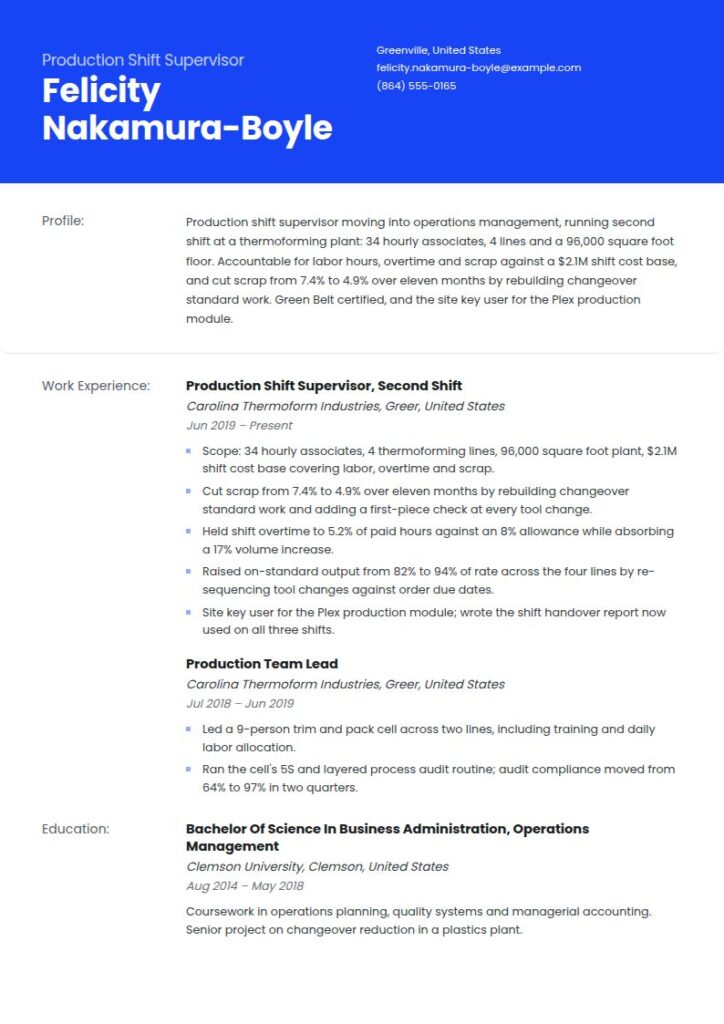
Production shift supervisor moving into operations management, running second shift at a thermoforming plant: 34 hourly associates, 4 lines and a 96,000 square foot floor. Accountable for labor hours, overtime and scrap against a $2.1M shift cost base, and cut scrap from 7.4% to 4.9% over eleven months by rebuilding changeover standard work. Green Belt certified, and the site key user for the Plex production module.
Work Experience
06/2019 - Present, Production Shift Supervisor, Second Shift, Carolina Thermoform Industries, Greer, United States
- Scope: 34 hourly associates, 4 thermoforming lines, 96,000 square foot plant, $2.1M shift cost base covering labor, overtime and scrap.
- Cut scrap from 7.4% to 4.9% over eleven months by rebuilding changeover standard work and adding a first-piece check at every tool change.
- Held shift overtime to 5.2% of paid hours against an 8% allowance while absorbing a 17% volume increase.
- Raised on-standard output from 82% to 94% of rate across the four lines by re-sequencing tool changes against order due dates.
- Site key user for the Plex production module; wrote the shift handover report now used on all three shifts.
07/2018 - 06/2019, Production Team Lead, Carolina Thermoform Industries, Greer, United States
- Led a 9-person trim and pack cell across two lines, including training and daily labor allocation.
- Ran the cell's 5S and layered process audit routine; audit compliance moved from 64% to 97% in two quarters.
Education
08/2014 - 05/2018, Bachelor of Science, Business Administration, Operations Management, Clemson University, Clemson, United States
Coursework in operations planning, quality systems and managerial accounting. Senior project on changeover reduction in a plastics plant.
Skills
Shift labor planning and allocation, 80
Changeover reduction and standard work, 80
Scrap and yield analysis, 75
5S and layered process audits, 85
Plex production module, 75
OSHA recordkeeping and near-miss reporting, 70
Excel and Power Query, 70
Languages
English, native
Spanish, intermediate
Certificates
03/2020, Lean Six Sigma Green Belt, Clemson University Center for Corporate Learning
Project: changeover reduction across four thermoforming lines.
09/2019, OSHA 30-Hour General Industry, OSHA Outreach Training Program
Summary
An operations manager resume is a one to two page document that states span of control before it claims results: direct and indirect reports, shifts and sites covered, the annual operating budget, and the cost lines you were held to. This guide gives you three adaptable versions, the scope block most applicants leave out, and current Bureau of Labor Statistics pay and outlook.
Operations Manager resume examples by experience level
An operations manager resume is a one to two page document that says, in the first six lines, how many people you ran, how much money you controlled, and how much of a plant or network you were responsible for.
Operations manager is the most inflated title on the market. It is worn by a team lead with four reports on one shift and by an executive running six sites and a nine-figure cost base. Both write the same bullets: improved efficiency, reduced costs, led continuous improvement. The reader cannot tell them apart, so the reader assumes the smaller of the two.
The fix is not better verbs. It is numbers that establish scope before any claim is made about what you achieved inside it.
Resume guide for an operations manager resume
This guide and the corresponding operations manager resume example will cover:
- How to write an operations manager resume, section by section
- How to state span of control so the title stops being ambiguous
- Three adaptable summaries: shift supervisor moving up, single-site manager, multi-site manager
- The difference between running a shift, running a site and running a network
- What the job market looks like and what you can expect to earn
How to write an operations manager resume
Six sections: contact header, summary, scope of responsibility, experience, skills, and education with certifications. One page while you are still running one shift; two pages once you own a budget.
The scope block is the section that does not appear on most operations resumes, and it is the reason most operations resumes read as junior. Put it immediately under the summary, before the first job.
| Section | What it is answering | Where it goes |
|---|---|---|
| Scope of responsibility | How big was the thing you ran? | Directly under the summary, before experience |
| Experience | What moved, by how much, over what period? | Reverse chronological, one number per bullet |
| Skills | Which systems and methods do you already run? | Grouped, with the ERP or WMS named |
| Education and certifications | Do they clear the stated bar for the posting? | Last, unless the posting gates on a degree |
Write the span sentence before you write anything else
Draft one sentence that a stranger could use to size your job: "34 hourly associates on second shift across 4 thermoforming lines in a 96,000 square foot plant, with accountability for labor hours, scrap and overtime against a $2.1M shift cost base."
Everything else on the resume is then read against that sentence. A 6% scrap reduction inside a $2.1M cost base is a different achievement from a 6% scrap reduction inside a $40M one, and without the span sentence the reader has no way to tell which you did.
If you cannot write the sentence, that is useful information: it usually means you have never been given the budget number, which is itself a fact about the level you were operating at.
Run the finished file through the free Rezoom ATS resume checker before you submit. Manufacturers and third-party logistics operators run applicant tracking systems that parse the file before an operations director opens it.
Choosing the best resume format for an operations manager resume
Reverse chronological, always. Operations hiring is a progression check: shift to department, department to site, site to network. A hiring manager wants to see that ladder and how long each rung took.
Functional formats fail badly here. They hide the sequence, and the sequence is the qualification. Two pages become reasonable once you are managing managers, because you now have two layers of results to show: what the sites did, and what you did to the sites.
Keep the layout single column. Distribution and manufacturing employers use applicant tracking systems as the first filter, and two-column templates, text boxes and header graphics are where parsing breaks.
Include your contact information
| ✅ Right | ❌ Wrong |
|---|---|
| Felicity Nakamura-Boyle | Felicity Nakamura-Boyle |
| Operations Manager, Distribution and Manufacturing | Results-driven operations leader and change agent |
| 128 associates, 3 shifts, $14.2M operating budget | Extensive management experience |
| (864) 555-0165, [email protected], Greenville, SC | (864) 555-0165, [email protected] |
The third line is the whole trick. A headline that carries reports, shifts and budget answers the sizing question before the reader reaches the summary, which is the only question they have in the first four seconds.
Make use of a summary
Four lines: what you run now, how big it is, one cost or service line you moved with a number, and the systems you run it on.
Production shift supervisor moving into operations management, running second shift at a thermoforming plant: 34 hourly associates, 4 lines and a 96,000 square foot floor. Accountable for labor hours, overtime and scrap against a $2.1M shift cost base, and cut scrap from 7.4% to 4.9% over eleven months by rebuilding changeover standard work. Green Belt certified, and the site key user for the Plex production module.
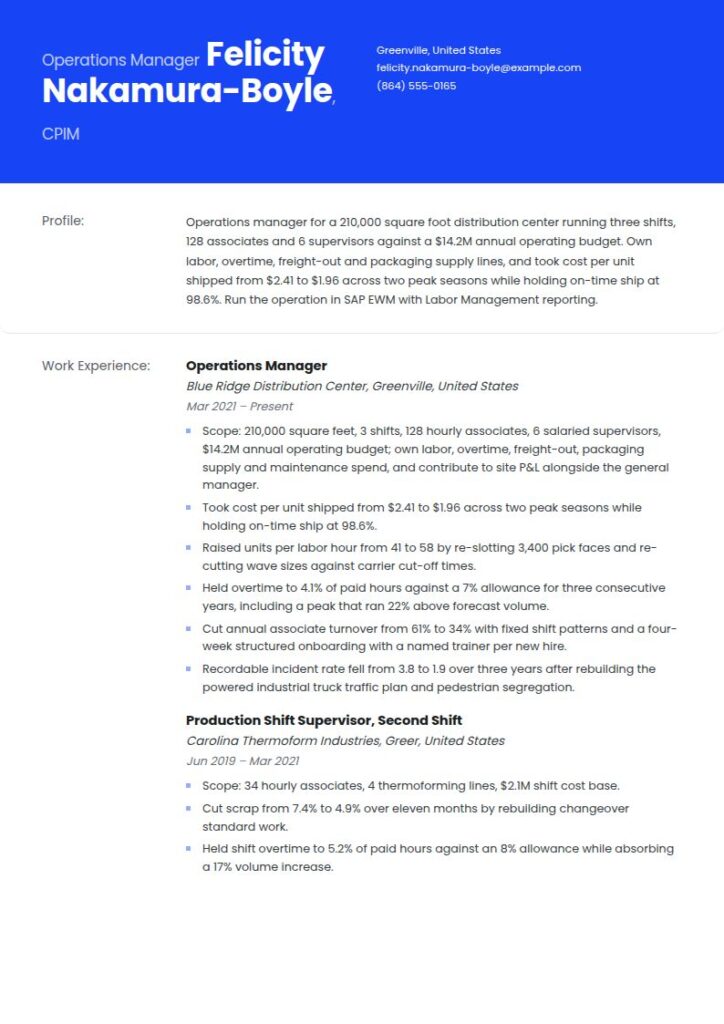
Operations manager for a 210,000 square foot distribution center running three shifts, 128 associates and 6 supervisors against a $14.2M annual operating budget. Own labor, overtime, freight-out and packaging supply lines, and took cost per unit shipped from $2.41 to $1.96 across two peak seasons while holding on-time ship at 98.6%. Run the operation in SAP EWM with Labor Management reporting.
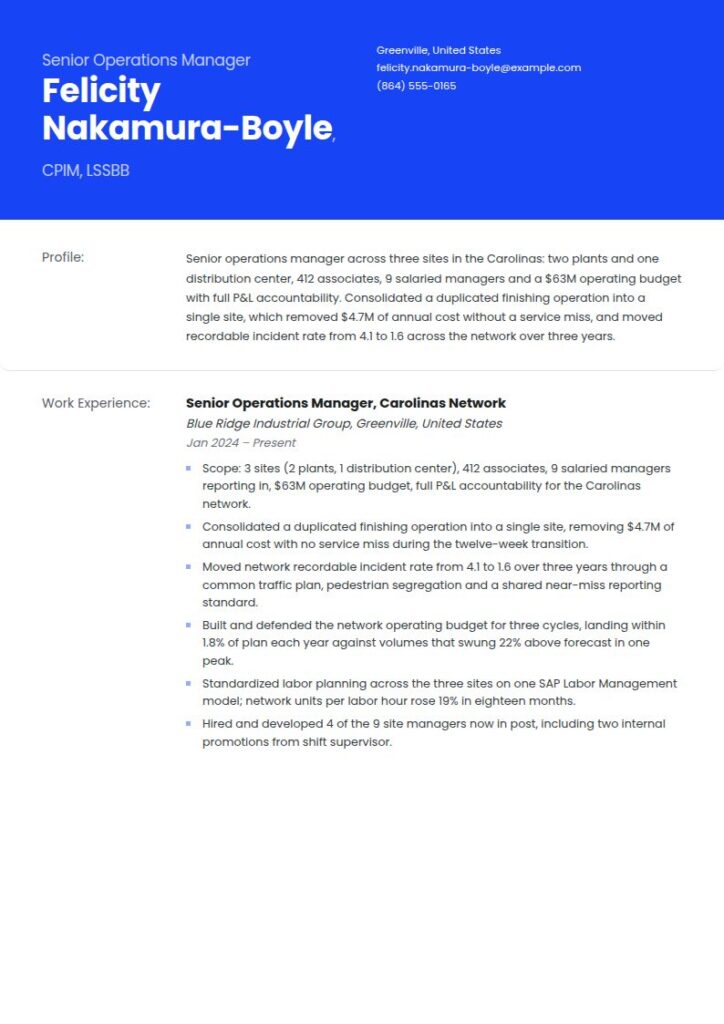
Senior operations manager across three sites in the Carolinas: two plants and one distribution center, 412 associates, 9 salaried managers and a $63M operating budget with full P&L accountability. Consolidated a duplicated finishing operation into a single site, which removed $4.7M of annual cost without a service miss, and moved recordable incident rate from 4.1 to 1.6 across the network over three years.
Right vs wrong: the same operations manager summary, twice
| ✅ Right | ❌ Wrong |
|---|---|
| Operations manager for a 210,000 square foot distribution center, three shifts, 128 associates and 6 supervisors. | Experienced operations manager overseeing a large warehouse team. |
| Own a $14.2M operating budget covering labor, overtime, freight-out and packaging supply. | Responsible for budget management and cost control. |
| Cost per unit shipped went from $2.41 to $1.96 across two peak seasons at 98.6% on-time ship. | Delivered significant cost savings while improving service levels. |
The right column can be sized, compared and checked. The left column could describe a team of five or a network of five hundred, and a reader who cannot tell will default to the smaller reading.
Outline your operations experience
Site, company, city, and dates, then a scope line, then three to five bullets. The scope line is not optional at this level: it is what turns each job into a comparable unit.
| Instead of | Use |
|---|---|
| Managed daily warehouse operations | Ran three shifts across a 210,000 square foot DC, 128 associates and 6 direct reports |
| Reduced operating costs | Took cost per unit shipped from $2.41 to $1.96 over two peak seasons |
| Improved productivity | Raised units per labor hour from 41 to 58 by re-slotting the pick faces and re-cutting wave sizes |
| Managed a budget | Held a $14.2M operating budget to plan for three consecutive years, with overtime at 4.1% of hours against a 7% allowance |
| Improved safety culture | Cut recordable incident rate from 4.1 to 1.6 across three sites in three years |
| Led continuous improvement projects | Ran 14 kaizen events; the two that mattered removed 3 touches from outbound and 9 hours a week of maintenance downtime |
Operations Manager, Blue Ridge Distribution Center, Greenville, SC, March 2021 to Present
Scope: 210,000 square feet, 3 shifts, 128 hourly associates, 6 salaried supervisors, $14.2M annual operating budget. Accountable for labor, overtime, freight-out, packaging supply and maintenance spend; contributed to site P&L alongside the general manager.
Took cost per unit shipped from $2.41 to $1.96 across two peak seasons while holding on-time ship at 98.6%.
Raised units per labor hour from 41 to 58 by re-slotting 3,400 pick faces and re-cutting wave sizes against carrier cut-off times.
Held overtime to 4.1% of paid hours against a 7% allowance for three consecutive years, including a peak that ran 22% above forecast volume.
Cut annual associate turnover from 61% to 34% by moving to fixed shift patterns and a four-week structured onboarding with a named trainer per new hire.
Recordable incident rate fell from 3.8 to 1.9 over three years after rebuilding the powered industrial truck traffic plan and pedestrian segregation.
State your span: headcount, budget, sites and the P&L lines you actually owned
This is the section that separates the two jobs hiding inside one title, and almost nobody writes it.
Put a compact scope block under your summary, and repeat a one-line version under each job. It costs six lines and it does more work than any other part of the page.
Scope of responsibility
People: 128 hourly associates and 6 salaried supervisors, direct hire authority, 3 shifts including weekend nights.
Footprint: one 210,000 square foot distribution center, 14 dock doors, 3,400 pick faces, 22 powered industrial trucks.
Budget: $14.2M annual operating budget, built and defended annually, held to plan for three consecutive years.
Cost lines owned: direct and indirect labor, overtime, freight-out, packaging supply, maintenance and repair, powered industrial truck lease and service.
P&L: contributor, not owner. Site P&L sits with the general manager; I own the controllable cost lines above and present variance monthly.
Systems: SAP EWM, SAP Labor Management, Kronos, and Power BI dashboards built in-house.
Note the last two lines. Saying you contributed to the P&L rather than owned it is not a weakness; it is the single fastest way to be believed about everything else. Operations directors have read hundreds of resumes that claim P&L ownership from people who never saw a revenue line, and they screen for it in the first interview. Getting there first buys credibility that a stronger claim would have cost you.
The three jobs called operations manager
| Level | What is actually being run | Numbers the resume must carry |
|---|---|---|
| Shift or department | One shift, one department, one value stream | Headcount on shift, lines or zones, output or throughput, scrap or overtime as a percentage, shift cost base |
| Site | A whole plant or distribution center, all shifts | Total headcount, salaried reports, square footage, operating budget, cost per unit, service level, safety rate |
| Network | Multiple sites, managers reporting to you | Sites, total headcount, managers managed, network budget, P&L status, consolidation or footprint decisions |
Write to the one you actually did. A shift supervisor who states 34 associates and a $2.1M shift cost base reads as honest and promotable. A shift supervisor who writes "led plant operations" reads as neither, and the interview will find it out in five minutes.
The pay spread proves the title spans two different jobs
General and operations managers had a median annual wage of $105,770 as of May 2025, with the lowest 10 percent under $50,090 and the highest 10 percent over $253,390 (BLS Occupational Outlook Handbook, May 2025).
That is a fivefold spread inside one occupation code. No other factor in this occupation moves pay like scope: the same job title covers a person running a shift for under $50,000 and a person running a network for over a quarter of a million.
The sector split makes the same point. General and operations managers in manufacturing had a median of $130,960 as of May 2025, against $75,860 in retail trade (BLS Occupational Outlook Handbook, May 2025). If your experience is in manufacturing or distribution, the industry belongs in your headline, because it is worth roughly $55,000 of median before anything else on the page is read.
Build a snapshot of your key skills
Twelve to sixteen entries in four groups: systems, operating methods, financial control, and people. Name the actual software. "ERP experience" is not a skill; "SAP EWM" is a filter term a recruiter searches on.
Systems: SAP EWM, SAP Labor Management, Plex, Kronos and UKG time and attendance, Power BI, Excel modeling to Power Query level
Operating methods: Standard work and changeover reduction, layered process audits, kaizen facilitation, 5S, root cause analysis to 8D, demand and labor planning, slotting and wave design
Financial control: Operating budget build and defense, monthly variance analysis, cost per unit modeling, capital request preparation, freight and packaging spend management
People and safety: Direct hire and performance management, shift pattern design, structured onboarding, powered industrial truck traffic planning, OSHA recordkeeping, union-free grievance handling
List your education and certifications
Degree, then certifications with the issuing body and the year. Bachelor's degree is the typical entry-level education for this occupation (BLS Occupational Outlook Handbook, 2026), but progression from the floor is common and a promotion history reads as strongly as a degree once you have a budget behind you.
Bachelor of Science, Business Administration, concentration in Operations Management, Clemson University, Clemson, SC, 2018
Certifications: Certified in Planning and Inventory Management (CPIM), Association for Supply Chain Management, 2022. Lean Six Sigma Black Belt, 2024, and Green Belt, 2020. OSHA 30-Hour General Industry, 2019, refreshed 2025. Powered industrial truck trainer and evaluator, in-house program, 2021.
Choose the right layout and design
Single column, 11 or 12 point body text, section headings that read as headings, no photograph, no skills bar charts. Two pages maximum, and the second page has to earn itself with a second layer of results, not with a longer skills list.
Put headcount, square footage and budget in the first six lines. Split direct from indirect reports. Say which cost lines you owned by name. State whether you owned the P&L or contributed to it. Give a before, an after and a period on every result. Name the ERP, WMS and time and attendance systems you actually ran. Say how many shifts and whether weekends were in your span.
Do not write "managed daily operations" anywhere on the page. Do not claim P&L ownership if you owned cost lines; the difference is the first thing an operations director probes. Do not give a percentage improvement without the base it came from. Do not list every kaizen event; list the two that moved a number. Do not describe yourself as a change agent, a results-driven leader or a strategic thinker.
Operations manager job market and outlook
A very large management occupation with steady growth, where the hiring bar is set by scope rather than by credential.
| Measure | Value |
|---|---|
| Top executives jobs, 2025 | 3,890,600 |
| Projected change, 2025-35 | 5% (faster than average), +190,600 |
| Projected annual openings | ~304,100 |
| Typical entry-level education | Bachelor's degree |
| Median annual wage, general and operations managers, May 2025 | $105,770 |
Source: U.S. Bureau of Labor Statistics, Occupational Outlook Handbook, 2025-35 projections and May 2025 wage data.
Where general and operations managers work, and what those sectors pay:
| Industry | Share of employment | Median annual wage (May 2025) |
|---|---|---|
| Professional, scientific and technical services | 12% | $151,040 |
| Retail trade | 12% | $75,860 |
| Construction | 7% | $112,230 |
| Wholesale trade | 7% | $115,620 |
| Manufacturing | 7% | $130,960 |
Source: U.S. Bureau of Labor Statistics, Occupational Outlook Handbook, May 2025.
Read that table as a map rather than a ranking. Retail trade and professional services employ the same share of general and operations managers and pay a median roughly $75,000 apart. Moving between sectors is therefore one of the largest pay decisions available in this occupation, and it turns on whether your scope translates. Labor planning, cost per unit and service level translate almost everywhere. Sector-specific process knowledge does not, which is why the systems and methods lines on your resume matter when you cross over.
What salary you can expect as an operations manager
The median annual wage for general and operations managers was $105,770 as of May 2025. The lowest 10 percent earned less than $50,090 and the highest 10 percent more than $253,390 (BLS Occupational Outlook Handbook, May 2025). Top executives as a whole had a median of $108,780 a year, or $52.30 an hour (BLS, May 2025).
Three things place you inside that range, and all three are things your resume either states or hides.
The first is span. Reports, sites and budget are the variables the market prices, and a resume that omits them is priced at the bottom of whatever band the reader is already imagining.
The second is sector. Manufacturing pays a median of $130,960 against retail trade at $75,860 (BLS, May 2025). If you have manufacturing or distribution scope, say so in the headline rather than three jobs down the page.
The third is P&L. The move from owning cost lines to owning a profit and loss statement is the step that opens the top of the range, and it is a step employers verify. Being precise about where you sit today is what gets you considered for the role one step up, because it tells the reader you understand the difference.
Key takeaways for an operations manager resume
- State span before you state achievement: reports, shifts, square footage and budget in the first six lines.
- Split direct from indirect reports, and say how many salaried managers reported to you.
- Name the cost lines you owned rather than writing "budget management".
- Say plainly whether you owned the P&L or contributed to it.
- Give every result a before, an after and a time period.
- Put the sector in the headline; manufacturing and retail medians sit about $55,000 apart.
- Name the ERP, WMS and labor management systems, because recruiters search on them.
Build your operations manager resume in 15 minutes.
Related production resume examples
- Operations director resume
- Production resume
- Production worker resume
- Quality assurance resume
- Manufacturing technician resume
- Machine operator resume
- Material handler resume
- Forklift operator resume
- Factory worker resume
- Assembler resume
- Machinist resume
- Welder resume
Pair it with a matching operations manager cover letter.
Operations manager resume questions, answered
How long should an operations manager resume be?
One page while you are running a shift or a department. Two pages once you own an operating budget or manage salaried managers, because you then have two layers of results to show. Three pages reads as a career history rather than an application, and the scope block does the work that extra pages are usually trying to do.
Should I put the operating budget on my resume?
Yes, if you built it, defended it or were held to it. Give the figure and say which cost lines sat inside it. If the number is commercially sensitive, use a band such as "$10M to $15M annual operating budget" rather than dropping it, because a missing budget figure is read as no budget.
What if my title was supervisor but I did operations manager work?
Keep the real title and let the scope block carry the argument. Write "Production Shift Supervisor" with a scope line stating 34 associates, 4 lines and a $2.1M shift cost base, and the reader will size the job correctly. Inflating a title is the one error that gets caught in reference checks, and it costs the offer rather than the interview.
Do I need a degree to be an operations manager?
A bachelor's degree is the typical entry-level education for this occupation (BLS Occupational Outlook Handbook, 2026), and it does gate some corporate postings. It is not the only route: promotion from supervisor to site manager is common in manufacturing and distribution, and once you can state a budget and a headcount, the degree question moves down the reader's list.
How do I show results if my site was already running well?
Show that you held it, and say what tried to break it. "Held overtime to 4.1% of paid hours against a 7% allowance through a peak that ran 22% above forecast" is a stronger claim than a soft improvement in a quiet year. Stability under a named pressure is a result, and operations directors recognize it faster than most candidates expect.
Which certifications are worth listing?
The ones a posting screens on: a supply chain credential such as CPIM from the Association for Supply Chain Management, a Lean Six Sigma belt, and OSHA 30-Hour General Industry. List the issuing body and the year for each. A long tail of short courses adds nothing, and it pushes the scope block further down the page.