Receiving and Put-Away Associate Marcelino Duarte
Receiving and Put-Away Associate
[email protected] | (863) 555-0170 | Lakeland, United States
Profile
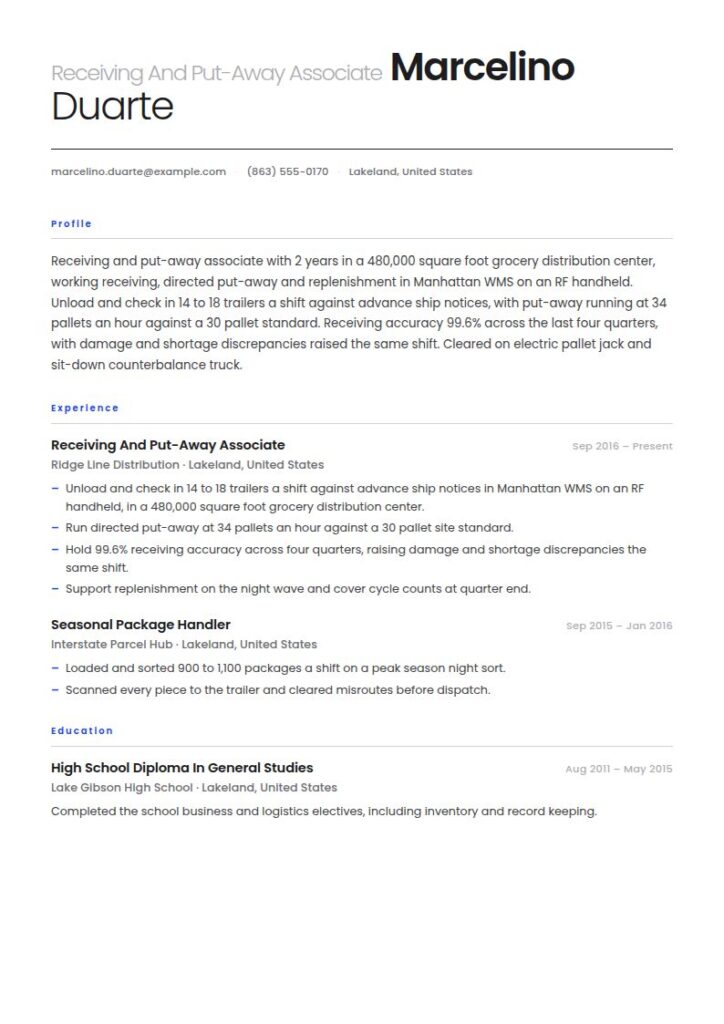
Receiving and put-away associate with 2 years in a 480,000 square foot grocery distribution center, working receiving, directed put-away and replenishment in Manhattan WMS on an RF handheld. Unload and check in 14 to 18 trailers a shift against advance ship notices, with put-away running at 34 pallets an hour against a 30 pallet standard. Receiving accuracy 99.6% across the last four quarters, with damage and shortage discrepancies raised the same shift. Cleared on electric pallet jack and sit-down counterbalance truck.
Work Experience
09/2016 - Present, Receiving and Put-Away Associate, Ridge Line Distribution, Lakeland, United States
- Unload and check in 14 to 18 trailers a shift against advance ship notices in Manhattan WMS on an RF handheld, in a 480,000 square foot grocery distribution center.
- Run directed put-away at 34 pallets an hour against a 30 pallet site standard.
- Hold 99.6% receiving accuracy across four quarters, raising damage and shortage discrepancies the same shift.
- Support replenishment on the night wave and cover cycle counts at quarter end.
09/2015 - 01/2016, Seasonal Package Handler, Interstate Parcel Hub, Lakeland, United States
- Loaded and sorted 900 to 1,100 packages a shift on a peak season night sort.
- Scanned every piece to the trailer and cleared misroutes before dispatch.
Education
08/2011 - 05/2015, High School Diploma, General studies, Lake Gibson High School, Lakeland, United States
Completed the school business and logistics electives, including inventory and record keeping.
Skills
Manhattan WMS on RF handheld, 80
Receiving against advance ship notices, 85
Directed put-away, 85
Replenishment, 75
Electric pallet jack, 85
Sit-down counterbalance truck, 80
Dock safety and trailer chocking, 80
Languages
English, native
Spanish, native
Certificates
01/2017, Powered industrial truck operator: electric pallet jack and sit-down counterbalance, Employer-certified under OSHA 29 CFR 1910.178(l), Ridge Line Distribution
Site certification with the three yearly re-evaluation the standard requires; certification is employer-specific and does not transfer.
03/2017, OSHA 10-hour General Industry, OSHA Outreach Training Program authorized trainer
Covers powered industrial trucks, materials handling, walking and working surfaces and hazard communication.
Summary
A material handler resume is a one page document naming the warehouse management system you work in, the transaction types you run inside it, and your throughput and accuracy against the site standard. This guide gives you three adaptable versions, the rate block most applicants leave out, and current Bureau of Labor Statistics pay and outlook for hand laborers and material movers.
Material Handler resume examples by experience level
A material handler resume is a one page document that names the system you work inside, the transactions you run in it, and the rate and accuracy you hold against the site standard.
That is the whole difference between a file that gets a call and a file that does not. "Moved materials in a fast-paced warehouse environment" is unhirable, because it describes an activity that every applicant in the stack also did. "Picked to 99.8% accuracy at 142 lines per hour against a 120 line standard in Manhattan WMS, and cycle counted A-class locations weekly" is a hire, because a warehouse manager already knows what that person costs and what they return.
Resume guide for a material handler resume
This guide and the corresponding material handler resume example will cover:
- How to write a material handler resume, section by section
- Which system and rate details belong on the page and where
- Three adaptable summaries: receiving associate, RF picker and inventory control lead
- How to write accuracy, cycle counting and equipment clearances so they can be checked
- What the job market looks like and what you can expect to earn
How to write a material handler resume
Six blocks: contact header, summary, systems and equipment, warehouse experience, skills, and education with certifications. One page, because nobody in distribution reads a second.
The system block goes high because it shortens onboarding. Someone who already knows an RF gun and a directed put-away flow is productive in a week; someone who has never seen one takes a month, and the manager reading your file is doing that arithmetic.
| Section | What it is answering | Where it goes |
|---|---|---|
| Systems and equipment | Which WMS and which trucks, so how fast can they be useful? | Directly under the summary |
| Warehouse experience | What rate did they hold, at what accuracy? | Reverse chronological, numbers in every bullet |
| Skills | Do they know the transaction set, or only the tasks? | Short grouped block |
| Education and certifications | Equipment clearances and anything safety related | Bottom, short, with the authority named |
Find your rate before you write anything
Every distribution center measures its people. Go and look at your own numbers first: the labor management report, the engineered standard, the pick accuracy on your scorecard, your cases or lines per hour.
Write down three things. The system you work in, your rate, and the standard you are measured against. The standard matters as much as the rate, because 142 lines an hour means nothing alone; 142 against a 120 standard means you run at 118 percent of it.
Then find your accuracy. Pick accuracy, inventory record accuracy by location, or mispick rate. Rate without accuracy is a warning sign to an experienced manager, because anybody can go faster by scanning less carefully.
Run the finished file through the free Rezoom ATS resume checker before you apply. Distribution employers run high-volume hiring through portals that read the file into a record before a person sees it.
Choosing the best resume format for a material handler resume
Reverse chronological, one page, single column. Warehouse managers read for continuity and peak season history: who you worked for, what they shipped, how long you lasted, and whether you came back the next year.
Seasonal and agency work is normal here, so do not hide it. Group it under the agency or the season with the sites named. What reads badly is not short assignments; it is unexplained months.
Include your contact information
| ✅ Right | ❌ Wrong |
|---|---|
| Marcelino Duarte | Marcelino Duarte |
| Inventory Control Lead, SAP EWM and Manhattan WMS | Warehouse professional with excellent work ethic |
| Lakeland, FL, available for nights and weekend shifts | Lakeland, FL |
| (863) 555-0170, [email protected] | (863) 555-0170, [email protected] |
Naming the two systems in the header is not showing off. It is the single fastest way to tell a reader that your training curve at their site is measured in days rather than weeks.
Make use of a summary
Four lines: the system, the transactions, the rate against the standard, and the accuracy.
Receiving and put-away associate with 2 years in a 480,000 square foot grocery distribution center, working receiving, directed put-away and replenishment in Manhattan WMS on an RF handheld. Unload and check in 14 to 18 trailers a shift against advance ship notices, with put-away running at 34 pallets an hour against a 30 pallet standard. Receiving accuracy 99.6% across the last four quarters, with damage and shortage discrepancies raised the same shift. Cleared on electric pallet jack and sit-down counterbalance truck.
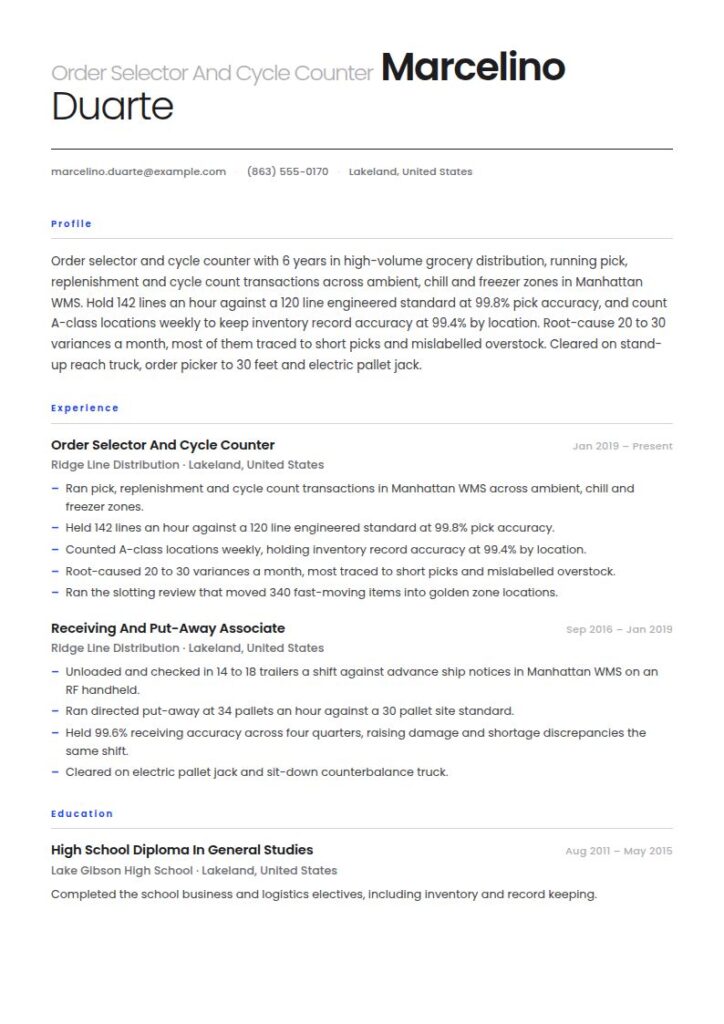
Order selector and cycle counter with 6 years in high-volume grocery distribution, running pick, replenishment and cycle count transactions across ambient, chill and freezer zones in Manhattan WMS. Hold 142 lines an hour against a 120 line engineered standard at 99.8% pick accuracy, and count A-class locations weekly to keep inventory record accuracy at 99.4% by location. Root-cause 20 to 30 variances a month, most of them traced to short picks and mislabelled overstock. Cleared on stand-up reach truck, order picker to 30 feet and electric pallet jack.
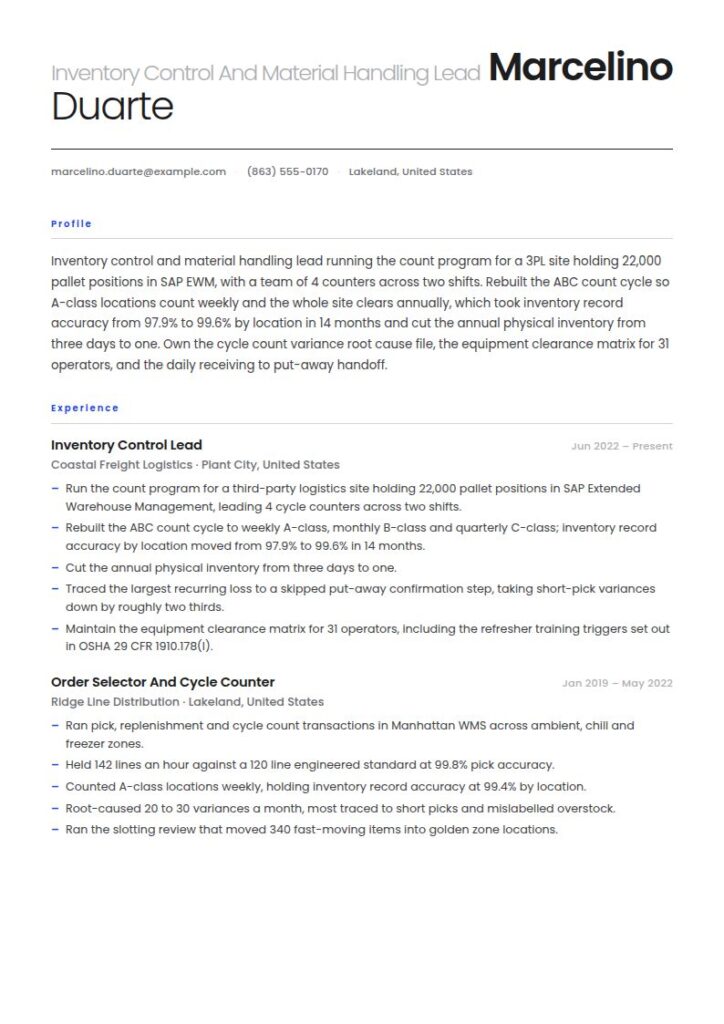
Inventory control and material handling lead running the count program for a 3PL site holding 22,000 pallet positions in SAP EWM, with a team of 4 counters across two shifts. Rebuilt the ABC count cycle so A-class locations count weekly and the whole site clears annually, which took inventory record accuracy from 97.9% to 99.6% by location in 14 months and cut the annual physical inventory from three days to one. Own the cycle count variance root cause file, the equipment clearance matrix for 31 operators, and the daily receiving to put-away handoff.
Right vs wrong: the same material handler summary, twice
| ✅ Right | ❌ Wrong |
|---|---|
| Hold 142 lines an hour against a 120 line engineered standard at 99.8% pick accuracy. | Consistently meet or exceed daily productivity goals. |
| Run pick, replenishment and cycle count transactions in Manhattan WMS across three temperature zones. | Experience with warehouse management systems and RF scanners. |
| Count A-class locations weekly to hold inventory record accuracy at 99.4% by location. | Assist with inventory counts and general warehouse duties. |
The right column is three checkable claims. A warehouse manager can verify all of them on a reference call in under a minute, and that is exactly why they carry weight.
Outline your warehouse experience
Site, what it distributes, its size, the system, your shift and your dates. Then three to five bullets, each with a rate, an accuracy figure or a count.
| Instead of | Use |
|---|---|
| Moved materials throughout the warehouse | Ran directed put-away at 34 pallets an hour against a 30 pallet standard in Manhattan WMS |
| Picked orders accurately and efficiently | Held 142 lines an hour at 99.8% pick accuracy against a 120 line engineered standard |
| Assisted with inventory counts | Cycle counted A-class locations weekly, root-causing 20 to 30 variances a month |
| Operated forklifts and other equipment | Cleared on stand-up reach truck, order picker to 30 feet, sit-down counterbalance and electric pallet jack |
| Received incoming shipments | Checked in 14 to 18 trailers a shift against advance ship notices, 99.6% receiving accuracy |
| Kept the warehouse clean and organized | Ran the slotting review that moved 340 fast-moving items to golden zone locations |
The word doing the work in that right column is the standard. A number with nothing beside it cannot be read: a reader from a 90 line site and a reader from a 160 line site draw opposite conclusions from the same 142.
Inventory Control Lead, Coastal Freight Logistics, Plant City, FL, June 2022 to Present
Third-party logistics site holding 22,000 pallet positions for grocery and consumer goods clients, running SAP Extended Warehouse Management. Lead a team of 4 cycle counters across two shifts.
Rebuilt the ABC count cycle so A-class locations count weekly, B-class monthly and C-class quarterly. Inventory record accuracy by location moved from 97.9% to 99.6% in 14 months and the annual physical inventory dropped from three days to one.
Own the variance root cause file. Traced the largest recurring loss to a put-away confirmation step operators were skipping under time pressure, and the fix took short-pick variances down by roughly two thirds.
Maintain the equipment clearance matrix for 31 operators, including refresher training triggered by an accident, a near miss or an unsatisfactory evaluation as required under OSHA 29 CFR 1910.178(l).
Run the daily receiving to put-away handoff with two client account teams and report dock-to-stock time weekly.
Name the system and your rate
This is the section that decides whether your resume is read as a warehouse worker or as a warehouse professional, and it takes about six lines.
A material handler is hired on measurable throughput inside a named system. Everything else on the page is context. So state the system, the transactions, the rate, the accuracy, and the equipment, and state them so precisely that a manager could check every one of them.
Warehouse systems: SAP Extended Warehouse Management (current), Manhattan WMS (6 years), RF handheld and voice-directed picking, Oracle Transportation Management for outbound visibility.
Transactions run: receiving against advance ship notices, directed and manual put-away, replenishment, discrete and batch pick, pack and label, loading, returns processing, cycle count and adjustment posting.
Rate: 142 lines an hour against a 120 line engineered standard, sustained across four quarters. Put-away 34 pallets an hour against a 30 pallet standard.
Accuracy: 99.8% pick accuracy, 99.6% receiving accuracy, 99.4% inventory record accuracy by location.
Cycle counting: ABC program owner. A-class weekly, B-class monthly, C-class quarterly, with variance root cause and adjustment approval.
Equipment: sit-down counterbalance, stand-up reach truck, order picker to 30 feet, electric pallet jack, walkie rider, clamp attachment. Employer-certified under OSHA 29 CFR 1910.178(l), most recent evaluation 2025.
Four notes on writing that block honestly.
First, name the system as the industry names it: SAP EWM, Manhattan, Blue Yonder, Oracle WMS, or "an in-house RF system" if that is what it was. A candidate who writes "used a scanner" has told the reader they may never have run a transaction they could name.
Second, the transaction list separates a picker from a material handler. Receiving, put-away, replenishment, pick, pack, cycle count: if you have run all six, you can be moved anywhere in the building.
Third, cycle counting is the highest-value line most material handlers never write down. Anyone can count. A site pays for the counter who root-causes the variance rather than only posting the adjustment, because the adjustment closes the number and the root cause stops it recurring.
Fourth, be exact about equipment. Under OSHA 29 CFR 1910.178(l)(4)(iii) an operator's performance must be evaluated at least once every three years, and under 1910.178(l)(6) the employer's certification record has to name the operator, the training date, the evaluation date and who carried them out. The certification is site-specific and employer-specific, so it does not travel with you, though prior training shortens the new employer's program. Write "employer-certified, most recent evaluation 2025" rather than implying a portable license, and name the truck types rather than writing "forklift", since the standard itself distinguishes designations such as D, DS, DY, E, ES, EE, EX, G, GS, LP and LPS.
Where the rate is worth the most money
Hand laborers and material movers are spread across two very different halves of the economy, and they are not paid alike. Retail trade employs 35 percent of them at a median of $36,090, while transportation and warehousing employs 22 percent at a median of $44,710 (BLS Occupational Outlook Handbook, May 2025).
That gap of $8,620 is the largest lever most material handlers have, and it is available to anyone who can evidence throughput. Wholesale trade sits at $41,600 and manufacturing at $41,370, against an occupation median of $38,220, or $18.38 an hour (BLS, May 2025).
The reading is simple. The measured, systems-literate half of this occupation lives in distribution and warehousing, and a resume built on lines per hour, accuracy and a named WMS is aimed squarely at it.
Build a snapshot of your key skills
Twelve to fourteen entries in three groups. Keep the system names in their own group so a reader scanning for "Manhattan" or "EWM" finds them in one place.
Systems: SAP Extended Warehouse Management, Manhattan WMS, RF handheld scanning, Voice-directed picking, Label and ASN printing, Basic Excel for count reporting
Transactions and inventory: Receiving against advance ship notices, Directed put-away, Replenishment, Discrete and batch picking, Pack and load, Cycle counting and ABC programs, Variance root cause and adjustment posting, Slotting review, Returns processing
Equipment and safety: Sit-down counterbalance, Stand-up reach truck, Order picker to 30 feet, Electric pallet jack and walkie rider, Clamp attachment, Dock safety and trailer chocking, Manual handling and team lift
List your education and certifications
Short. Hand laborers and material movers typically need no formal educational credential to enter the occupation (BLS Occupational Outlook Handbook, 2026), so this block exists to hold clearances, not qualifications.
Powered industrial truck operator, sit-down counterbalance, stand-up reach and order picker. Employer-certified under OSHA 29 CFR 1910.178(l); most recent evaluation 2025.
OSHA 10-hour General Industry card, OSHA Outreach Training Program authorized trainer, 2017.
SAP Extended Warehouse Management, site super-user training, Coastal Freight Logistics, 2023.
Cycle counting and inventory record accuracy, internal program, 2023.
High School Diploma, Lake Gibson High School, Lakeland, FL, 2015.
Choose the right layout and design
Single column, 11 or 12 point, plain headings, no photograph, no graphics. PDF unless the portal asks for Word.
Put the rate and accuracy figures in the summary and in the bullets, not in a sidebar. High-volume distribution recruiters filter on parsed fields and keyword matches, and anything in a text box or a two-column layout is where that parsing fails.
Name the WMS. Give your rate with the site standard beside it. Give an accuracy figure with it. List the transaction types you have actually run. Name each truck type and say the certification is employer-issued. State your shift availability and whether you will work freezer or chill.
Do not write "fast-paced environment" or "team player". Do not claim a forklift license, because OSHA certification is issued by an employer for a site. Do not give a rate with no standard beside it. Do not hide seasonal or agency work; group it instead. Do not pad the page with duties that every applicant shares.
Material handler job market and outlook
One of the largest occupations in the United States, with steady growth and enormous turnover, which means the hiring question is never whether there is a job but which building you end up in.
| Measure | Value |
|---|---|
| Hand laborer and material mover jobs, 2025 | 6,917,800 |
| Projected change, 2025 to 2035 | 4% (about as fast as average), +288,900 |
| Projected annual openings | ~904,200 |
| Typical entry-level education | No formal educational credential |
| Median annual wage, May 2025 | $38,220 |
Source: U.S. Bureau of Labor Statistics, Occupational Outlook Handbook, 2025-35 projections and May 2025 wage data.
About 904,200 openings a year is roughly one for every seven people in the occupation, and most are replacements. That churn is what your resume competes against. A site replacing much of its floor each year is not looking for the most impressive candidate; it wants the one still there in six months who arrives able to run a transaction. Say both things.
Where the jobs sit:
| Industry | Share of employment | Median annual wage (May 2025) |
|---|---|---|
| Retail trade | 35% | $36,090 |
| Transportation and warehousing | 22% | $44,710 |
| Manufacturing | 10% | $41,370 |
| Wholesale trade | not separately reported | $41,600 |
Source: U.S. Bureau of Labor Statistics, Occupational Outlook Handbook, May 2025.
What salary you can expect as a material handler
The median annual wage for hand laborers and material movers was $38,220, or $18.38 an hour, as of May 2025. The lowest 10 percent earned less than $30,190 and the highest 10 percent more than $52,340 (BLS Occupational Outlook Handbook, May 2025).
Three things decide where in that band you land, and your resume controls two of them.
Industry is the biggest. Transportation and warehousing pays a median of $44,710 against retail trade at $36,090, and the work is often physically similar (BLS, May 2025). A resume that reads as retail stockroom will be read for retail stockroom pay, even when the person could run a pick path at 118 percent of standard. Write the warehouse vocabulary and the warehouse numbers.
Role within the group is second. Laborers and freight, stock and material movers had a median of $40,240 and machine feeders and offbearers $41,220, against $37,330 for stockers and order fillers and $36,280 for hand packers and packagers (BLS, May 2025). Packing to picking to inventory control is a pay ladder, and each step is unlocked by a system and a metric you can evidence.
The third is shift and premium. Nights, freezer and weekend differentials are quoted on top of the base rate in most distribution centers, and productivity or accuracy bonuses attach to exactly the numbers this page has been telling you to record. If your site pays a bonus against an engineered standard, then your rate is not a resume detail; it is your pay rate at the next site too.
Key takeaways for a material handler resume
- Name the warehouse management system in the header and the summary.
- Give your rate with the site standard beside it, so the number can be read.
- Pair every rate with an accuracy figure, because rate alone reads as corner cutting.
- List the transaction types you have run, not the tasks you performed.
- Put cycle counting and variance root cause on the page if you have done them.
- Name each truck type and say the certification is employer-issued and site-specific.
- State your shift availability, including freezer, chill, nights and weekends.
Build your material handler resume in 15 minutes.
Related production resume examples
- Forklift operator resume
- Machine operator resume
- Assembler resume
- Production worker resume
- Factory worker resume
- Manufacturing technician resume
- Quality assurance resume
- Welder resume
- Machinist resume
- Production resume
- Operations manager resume
- Operations director resume
Pair it with a matching material handler cover letter.
Material handler resume questions, answered
How long should a material handler resume be?
One page. Distribution hiring runs at volume and nobody turns the page. If you have fifteen years across several sites, keep the last three roles in detail and compress the rest to one line each with the site, the system and the dates.
What do I put on a material handler resume with no warehouse experience?
Anything measured: a picking or stocking rate from retail, a delivery count, a production line rate, kitchen tickets an hour, a military supply role. Then the two things a distribution center screens for at entry, which are shift availability and whether you are cleared on any powered equipment. If you are not, say you are willing to be trained and certified on site, which is how the standard works anyway.
Should I list my forklift certification?
Yes, but describe it correctly. Under OSHA 29 CFR 1910.178(l)(6) the employer certifies the operator for that site, and the record names the operator, the training date, the evaluation date and who conducted them, so it does not transfer between employers. List the truck types you have been cleared on and the year of your most recent evaluation. Prior training shortens the new employer's program, which is the real value of writing it down.
How do I write rate figures if my site does not publish a standard?
Give what your site does measure and say what it is measured against. Cases or units an hour over a stated shift length, trailers unloaded a shift, pallets put away an hour, orders completed. If there is no standard at all, say so plainly and give the volume instead: "picked an average of 1,100 lines a shift across a 10 hour night shift". A stated volume with a shift length attached is still a checkable number.
Is cycle counting worth mentioning if I only did it occasionally?
Yes, if you say what you did with the variance. Counting is common; root-causing is not. One sentence naming a recurring variance you traced and what changed as a result puts you ahead of most applicants for inventory control roles, which is the best-paid step on this ladder.
Does seasonal and agency work hurt my application?
No, provided you present it as one block rather than as five separate jobs. Name the agency or the season, list the sites, what each handled and the dates, and add what you were cleared on at each. Peak season work that a site invited you back for is a positive signal, so say it if it happened.