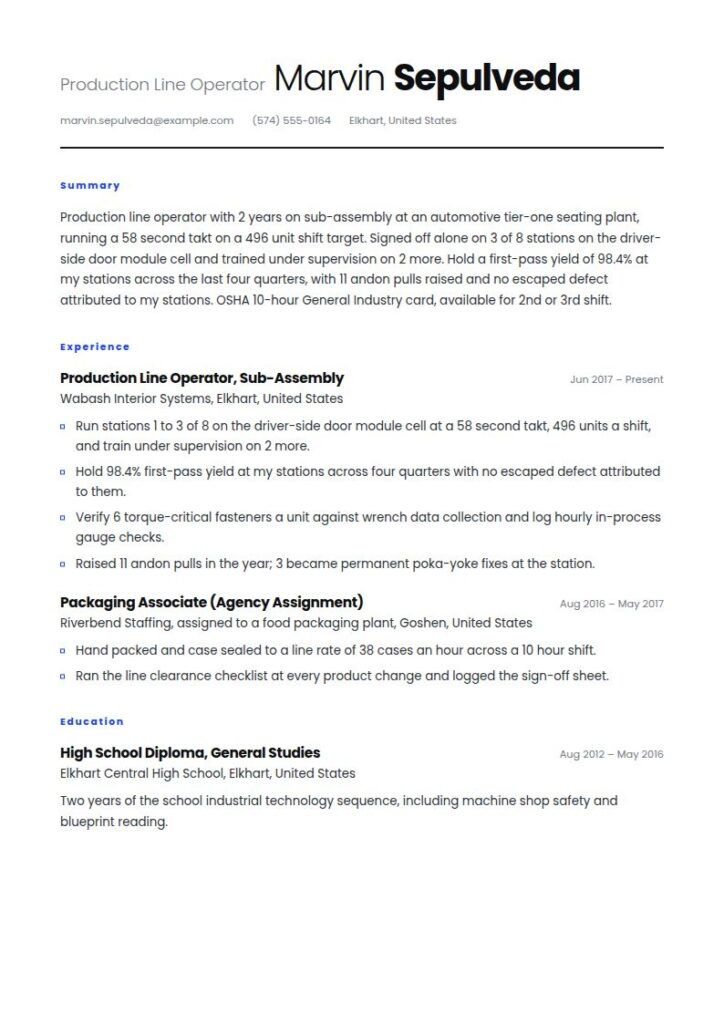
Production Line Operator Marvin Sepulveda
Production Line Operator, Sub-Assembly
[email protected] | (574) 555-0164 | Elkhart, United States
Profile
Production line operator with 2 years on sub-assembly at an automotive tier-one seating plant, running a 58 second takt on a 496 unit shift target. Signed off alone on 3 of 8 stations on the driver-side door module cell and trained under supervision on 2 more. Hold a first-pass yield of 98.4% at my stations across the last four quarters, with 11 andon pulls raised and no escaped defect attributed to my stations. OSHA 10-hour General Industry card, available for 2nd or 3rd shift.
Work Experience
06/2017 - Present, Production Line Operator, Sub-Assembly, Wabash Interior Systems, Elkhart, United States
- Run stations 1 to 3 of 8 on the driver-side door module cell at a 58 second takt, 496 units a shift, and train under supervision on 2 more.
- Hold 98.4% first-pass yield at my stations across four quarters with no escaped defect attributed to them.
- Verify 6 torque-critical fasteners a unit against wrench data collection and log hourly in-process gauge checks.
- Raised 11 andon pulls in the year; 3 became permanent poka-yoke fixes at the station.
08/2016 - 05/2017, Packaging Associate (agency assignment), Riverbend Staffing, assigned to a food packaging plant, Goshen, United States
- Hand packed and case sealed to a line rate of 38 cases an hour across a 10 hour shift.
- Ran the line clearance checklist at every product change and logged the sign-off sheet.
Education
08/2012 - 05/2016, High School Diploma, General studies, Elkhart Central High School, Elkhart, United States
Two years of the school industrial technology sequence, including machine shop safety and blueprint reading.
Skills
Standard work and takt time, 80
Quality at source, 80
Torque-critical fastening, 75
Andon response, 75
In-process gauge checks, 75
5S zone ownership, 80
Sub-assembly and kitting, 75
Languages
English, native
Spanish, native
Certificates
09/2017, OSHA 10-hour General Industry, OSHA Outreach Training Program authorized trainer
Ten hour general industry outreach card covering machine guarding, hazard communication and personal protective equipment.
Summary
A production worker resume is a one page document naming the line you ran, the takt time you held, and the stations on your cross-training matrix that you are signed off to work alone. This guide gives you three adaptable versions, the sign-off block most applicants leave out, and current Bureau of Labor Statistics pay and outlook for assemblers and fabricators.
Production Worker resume examples by experience level
A production worker resume is a one page document that names the line you ran, the rate it ran at, and the stations on that line you are signed off to work on your own.
That last part is what almost nobody writes down, and it is what a plant manager is reading for. A line does not fail because one person is slow. It fails because somebody calls in, the only operator certified on station 6 is on the other shift, and the cell runs short until break. The worker who can be moved is the worker who gets kept, gets the overtime, and gets asked about the team lead job.
Resume guide for a production worker resume
This guide and the corresponding production worker resume example will cover:
- How to write a production worker resume, section by section
- Why a cross-training matrix belongs on the page and where to put it
- Three adaptable summaries: line operator, multi-station associate and team lead
- How to write rate and first-pass yield in the same sentence without sounding like a report
- What the job market looks like and what you can expect to earn
How to write a production worker resume
Six blocks: contact header, summary, cross-training and sign-offs, production experience, skills, and education with certifications. One page, because a production resume that runs to two is usually two pages of duties.
The order matters. A plant reads for capability first and history second, so sign-offs go high: they answer the only question the hiring supervisor has, which is where this person can be put on Monday.
| Section | What it is answering | Where it goes |
|---|---|---|
| Cross-training and sign-offs | Which stations can this person run alone, today? | Directly under the summary |
| Production experience | What did the line do while they were on it? | Reverse chronological, rate and yield in the bullets |
| Skills | Do they speak standard work, andon, poka-yoke, changeover? | A short grouped block, not a keyword wall |
| Education and certifications | Anything that shortens onboarding? | Bottom, short, with the awarding body named |
Count your stations before you write a word
Before you open a template, go and look at the training matrix on the wall of your cell: operator names down the side, stations across the top, and a symbol in each square for trained, under supervision, signed off alone, and qualified to train others.
Write down two numbers. How many stations are on your line, and how many squares next to your name are at sign-off level or above. Then count the changeovers you can run without a technician standing there.
"Worked on the assembly line" tells a supervisor nothing. "Signed off alone on six of eight stations on the door module line, plus two of the three model changeovers" tells them your value in one sentence.
Run the finished file through the free Rezoom ATS resume checker before you send it. Most large manufacturers now take applications through a portal that reads the file into a structured record before a human opens it.
Choosing the best resume format for a production worker resume
Reverse chronological, one page, single column. Plants read production resumes for continuity: which plant, which product, how long, and why you left.
Functional formats fail here. A skills-first layout with no dates reads as short tenure being hidden, and short tenure is what a manufacturing recruiter screens hardest for, because replacing an operator who leaves in month three means paying for the whole training curve again.
If you have gaps from layoffs or plant closures, write the reason on the line: "plant closure, seat frame line consolidated". Layoffs are ordinary here, and an explained gap stops being a question.
Include your contact information
| ✅ Right | ❌ Wrong |
|---|---|
| Marvin Sepulveda | Marvin Sepulveda |
| Production Associate, signed off on 8 of 8 stations | Hard-working team player with a strong work ethic |
| Elkhart, IN, available for 2nd and 3rd shift | Elkhart, IN |
| (574) 555-0164, [email protected] | (574) 555-0164, [email protected] |
Two details in that right column do real work: the station count reads as a capability, and the shift line answers the first question a staffing coordinator asks, because the hard vacancies are almost never on days.
Make use of a summary
Four lines: what you build, the line and its rate, how many stations you hold, and one quality or changeover number.
Production line operator with 2 years on sub-assembly at an automotive tier-one seating plant, running a 58 second takt on a 496 unit shift target. Signed off alone on 3 of 8 stations on the driver-side door module cell and trained under supervision on 2 more. Hold a first-pass yield of 98.4% at my stations across the last four quarters, with 11 andon pulls raised and no escaped defect attributed to my stations. OSHA 10-hour General Industry card, available for 2nd or 3rd shift.
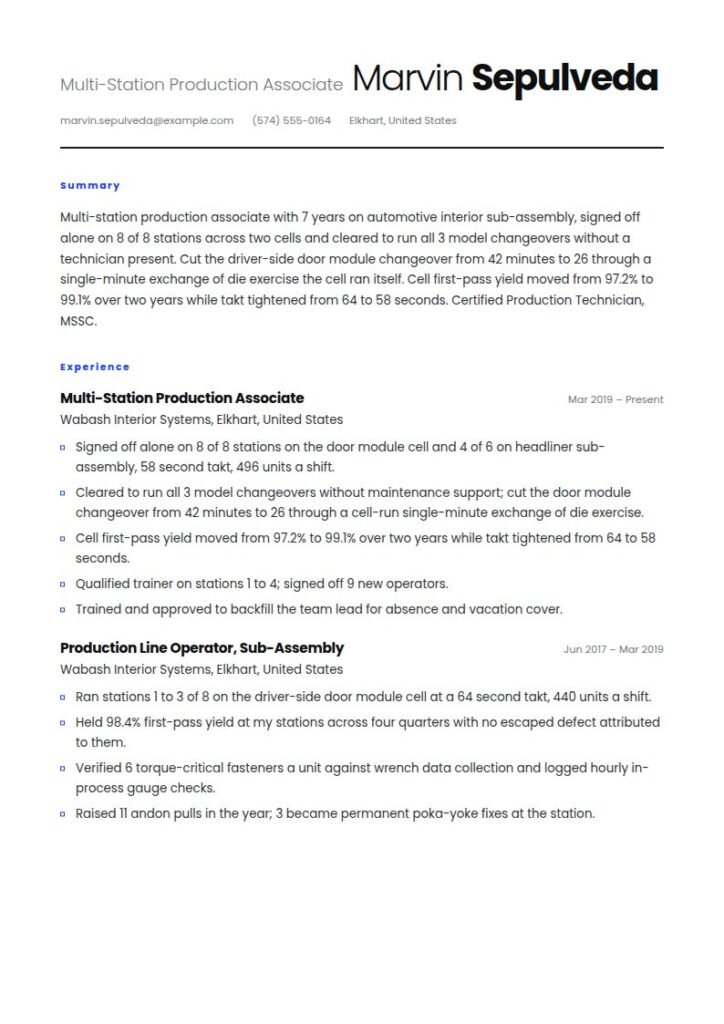
Multi-station production associate with 7 years on automotive interior sub-assembly, signed off alone on 8 of 8 stations across two cells and cleared to run all 3 model changeovers without a technician present. Cut the driver-side door module changeover from 42 minutes to 26 through a single-minute exchange of die exercise the cell ran itself. Cell first-pass yield moved from 97.2% to 99.1% over two years while takt tightened from 64 to 58 seconds. Certified Production Technician, MSSC.
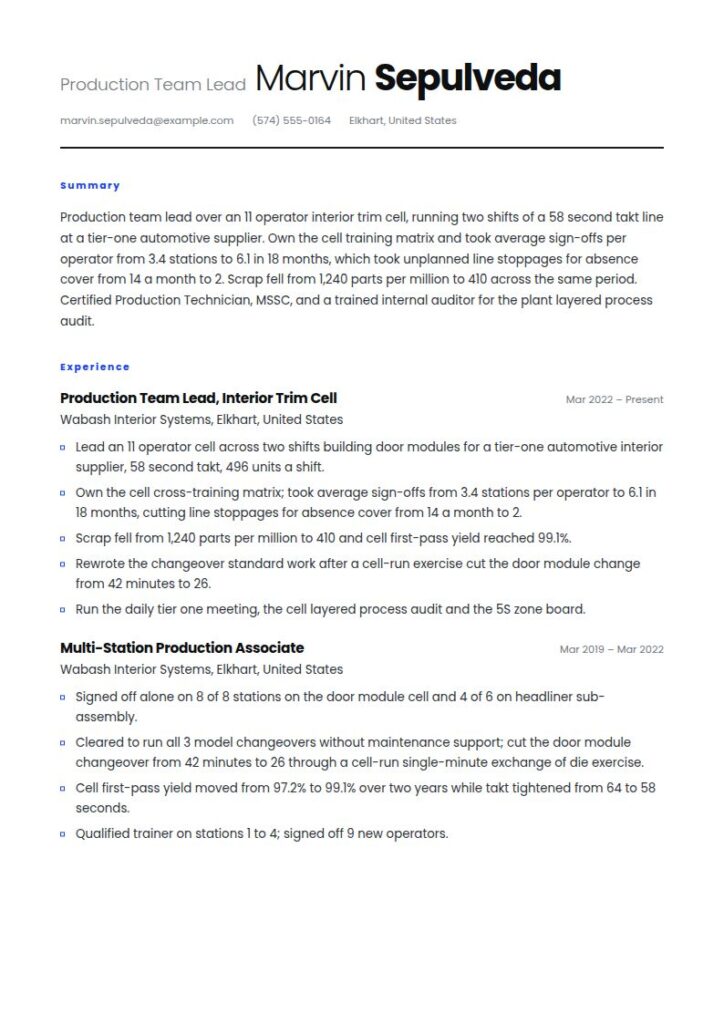
Production team lead over an 11 operator interior trim cell, running two shifts of a 58 second takt line at a tier-one automotive supplier. Own the cell training matrix and took average sign-offs per operator from 3.4 stations to 6.1 in 18 months, which took unplanned line stoppages for absence cover from 14 a month to 2. Scrap fell from 1,240 parts per million to 410 across the same period. Certified Production Technician, MSSC, and a trained internal auditor for the plant layered process audit.
Right vs wrong: the same production worker summary, twice
| ✅ Right | ❌ Wrong |
|---|---|
| Signed off alone on 8 of 8 stations across two cells and cleared on all 3 model changeovers. | Experienced in all aspects of the assembly process. |
| Cell first-pass yield moved from 97.2% to 99.1% while takt tightened from 64 to 58 seconds. | Consistently met and exceeded production targets. |
| Cut the door module changeover from 42 minutes to 26 through an exercise the cell ran itself. | Contributed to continuous improvement initiatives. |
The right column can be scheduled onto a shift roster tomorrow. The left column is a person who worked somewhere, and every file in the stack says that.
Outline your production experience
Plant, what it makes, your line and your dates. Then three to five bullets, each carrying a rate, a yield, a scrap number or a time.
| Instead of | Use |
|---|---|
| Worked on the production line | Ran a 58 second takt on the driver-side door module cell, 496 units a shift |
| Responsible for quality checks | Ran quality at source on 6 torque-critical fasteners a unit, 100% verified by torque wrench data collection |
| Met daily production targets | Held 98.4% first-pass yield at my stations across four quarters with no escaped defect attributed to them |
| Assisted with machine changeovers | Cleared to run all 3 model changeovers alone; cut the door module changeover from 42 minutes to 26 |
| Followed safety procedures | Raised 11 andon pulls in the year, 3 of which became permanent poka-yoke fixes at the station |
| Trained new employees | Signed off 9 new operators on stations 1 to 4 as the cell's qualified trainer |
That "escaped defect" phrase is worth learning: a defect that got past you and reached the next customer, internal or external. In a tier supply chain it is the number that puts a plant on a customer watch list, and an operator whose count is zero has said something no adjective can say.
Production Team Lead, Interior Trim Cell, Wabash Interior Systems, Elkhart, IN, March 2022 to Present
Lead an 11 operator cell across two shifts building driver-side and passenger-side door modules for a tier-one automotive seating and interior supplier, 58 second takt, 496 units a shift.
Own the cell cross-training matrix. Took average sign-offs from 3.4 stations per operator to 6.1 in 18 months, which cut line stoppages caused by absence cover from 14 a month to 2.
Cell first-pass yield moved from 97.2% to 99.1% over two years and scrap fell from 1,240 parts per million to 410, driven mostly by three poka-yoke fixes the cell proposed after andon pulls.
Cleared to run all 3 model changeovers alone and rewrote the changeover standard work after a cell-run exercise cut the door module change from 42 minutes to 26.
Run the daily tier one meeting, the layered process audit for the cell, and the 5S zone board.
Show your cross-training matrix: the stations you are signed off to run
This is the block that separates two operators with identical job titles, and it is missing from almost every production resume that gets sent.
Every line plant keeps a skills matrix. The names differ by company, but the ladder is the same: trained in theory, working under supervision, signed off to work alone, qualified to train others. Only the third level is worth money on a Monday morning, because that is where you can be put on a station with nobody standing behind you. Say which level you hold, station by station.
Line and product: driver-side and passenger-side door modules, tier-one automotive interior supplier, 58 second takt, 496 units a shift, two shift continuous operation.
Signed off to work alone: stations 1 to 8 of 8 on the door module cell, stations 1 to 4 of 6 on the headliner sub-assembly cell.
Qualified to train others: stations 1 to 4, door module cell.
Changeovers: cleared to run all 3 model changeovers on the door module line without maintenance support, and 1 of 2 on headliner.
Backfill: trained and approved to cover the team lead role for absence and vacation, including tier one board, absence roster and the andon response.
Quality: quality at source on 6 torque-critical fasteners a unit, torque wrench data collection, in-process gauge checks each hour, layered process audit trained.
Every line in that block converts into a decision. The product and takt tell a reader the pace you are used to, and a 58 second cycle is a different animal from a 12 minute one. A fraction is honest and legible where "fully cross-trained" is neither. A trainer sign-off lets a plant absorb a new hire class without pulling a supervisor off the floor. Changeovers run alone save minutes every time the schedule turns over. And backfill for the lead, if it is true, turns an operator application into a conversation about a lead job.
The difference between "worked the line" and "certified on six of eight stations plus two changeovers" is not style. The first describes attendance. The second describes what breaks when you are not there.
Where flexible operators are worth the most money
Assemblers and fabricators are concentrated in the industry that runs the tightest lines. Transportation equipment manufacturing employs 25 percent of them, the largest single share, and pays a median of $50,790, well above the $45,450 median for the occupation as a whole (BLS Occupational Outlook Handbook, May 2025).
Within the occupation the specialist assembly roles pay higher still: aircraft structure, surfaces, rigging and systems assemblers had a median of $65,380 and engine and machine assemblers $53,710 (BLS, May 2025).
The pattern is consistent. Pay rises with the cost of a line stopping, so a resume showing you can be moved between stations on a high-takt line is aimed at the part of the occupation that pays most for exactly that.
Build a snapshot of your key skills
Ten to fourteen entries in three groups, not a keyword wall. A production supervisor can tell the difference between someone who has stood in a cell and someone who has read about one.
Line and process: Standard work, Takt time and line balancing, Model changeover and SMED, Sub-assembly and final assembly, Torque-critical fastening, Kitting and sequencing
Quality: Quality at source, First-pass yield, Poka-yoke design and validation, In-process gauge checks, Layered process audit, Scrap and parts-per-million tracking, Containment and sort
Systems and safety: Andon response, 5S zone ownership, Total productive maintenance daily checks, Kanban and pull replenishment, OSHA 10-hour General Industry, Lockout tagout awareness level
Name the level on the safety items honestly. Awareness level is not authorized employee level, and the plant finds out which you hold on day one.
List your education and certifications
Short block. A high school diploma or equivalent is the typical entry-level education for assemblers and fabricators (BLS Occupational Outlook Handbook, 2026), so nobody reads this section for a degree. They read it for anything that shortens the training curve.
Certified Production Technician, Manufacturing Skill Standards Council, 2021. The CPT 4.0 program is made up of individual production technician certificate assessments, and candidates must earn the first four certificates to hold the full certification (MSSC program page, September 2026).
OSHA 10-hour General Industry card, OSHA Outreach Training Program authorized trainer, 2017.
Powered industrial truck operator, sit-down counterbalance, employer-certified under OSHA 29 CFR 1910.178(l), most recent evaluation 2025.
Internal auditor, layered process audit, plant quality department, 2023.
High School Diploma, Elkhart Central High School, Elkhart, IN, 2016.
One honest note on forklift certification. Under OSHA 29 CFR 1910.178(l)(6) the employer certifies the operator, and the record names the operator, the training date, the evaluation date and who did them, so the certificate belongs to the site rather than to you. List it, but write it as "employer-certified" rather than implying it transfers.
Choose the right layout and design
Single column, 11 or 12 point, clear headings, no photograph, no graphics, no skill rating bars, PDF unless the portal asks for a Word file.
Write the sign-off block as a plain list, not a table of symbols. A matrix rendered as a grid of ticks is the one thing on a production resume that reliably comes out of a parser as gibberish.
Give the station count as a fraction of the total. Name the product and the takt time. Say which changeovers you can run without support. State your first-pass yield with the period it covers. Write the shifts you can work, including nights and weekend continental patterns. Explain a plant closure or layoff on the line where it happened.
Do not write "fully cross-trained" without the count behind it. Do not claim a lockout tagout level you do not hold. Do not put a skills grid of colored squares on the page, because the portal cannot read it. Do not list every machine in the plant as a skill when you ran three of them. Do not hide short tenures by removing dates; it reads as exactly what it is.
Production worker job market and outlook
A very large occupation with almost no growth and enormous replacement demand, which means hiring is constant and the competition is for the good plants rather than for a job.
| Measure | Value |
|---|---|
| Assembler and fabricator jobs, 2025 | 1,799,500 |
| Projected change, 2025 to 2035 | 1% (slower than average), +16,700 |
| Projected annual openings | ~177,500 |
| Typical entry-level education | High school diploma or equivalent |
| Median annual wage, May 2025 | $45,450 |
Source: U.S. Bureau of Labor Statistics, Occupational Outlook Handbook, 2025-35 projections and May 2025 wage data.
Read those numbers together. Growth of 1 percent over ten years is nearly flat, and yet the occupation expects about 177,500 openings a year, almost all of it replacement. Vacancies are not scarce. What is scarce is the operator a plant does not have to replace again in a year, which is why continuity and sign-off depth read louder here than anything else on the page.
Where the jobs sit:
| Industry | Share of employment | Median annual wage (May 2025) |
|---|---|---|
| Transportation equipment manufacturing | 25% | $50,790 |
| Machinery manufacturing | 10% | $47,350 |
| Temporary help services | 9% | $36,860 |
| Fabricated metal product manufacturing | 9% | $45,500 |
| Computer and electronic product manufacturing | 8% | $45,540 |
Source: U.S. Bureau of Labor Statistics, Occupational Outlook Handbook, May 2025.
What salary you can expect as a production worker
The median annual wage for assemblers and fabricators was $45,450, or $21.85 an hour, as of May 2025. The lowest 10 percent earned less than $34,020 and the highest 10 percent more than $67,440 (BLS Occupational Outlook Handbook, May 2025).
That spread of roughly $33,000 between the bottom and top deciles is not explained by effort. Three things move an operator up it, and two of them belong on the resume.
The first is industry. Transportation equipment manufacturing pays a median of $50,790 against $36,860 in temporary help services, nearly $14,000 apart for work that can look similar on paper (BLS, May 2025). Moving from an agency assignment to a direct tier supplier role is the largest single pay decision most production workers make.
The second is shift. Premiums for nights, weekend continental patterns and scheduled overtime are quoted separately from the base rate, so writing your availability on the resume is a rate negotiation you are opening early.
The third, and the one this page is about, is depth of sign-off. Pay grades in most line plants step up with certified stations and changeover clearance, because that is what the plant can put a number on. Every station on your matrix is a documented reason to move you a grade, and listing them starts the conversation at the right grade instead of the bottom one.
Key takeaways for a production worker resume
- Lead with the stations you are signed off to run alone, written as a fraction of the total.
- Name the product, the line and the takt time so a reader knows the pace you are used to.
- Say which changeovers you can run without a technician standing there.
- Put first-pass yield, scrap in parts per million or escaped defects in the bullets, with the period.
- Say whether you are qualified to train others and whether you backfill the team lead.
- State your shift availability, because the hard vacancies are almost never on days.
- Keep it to one page, single column, and explain any layoff or plant closure on the line.
Build your production worker resume in 15 minutes.
Related production resume examples
- Assembler resume
- Machine operator resume
- Manufacturing technician resume
- Factory worker resume
- Quality assurance resume
- Welder resume
- Machinist resume
- Forklift operator resume
- Material handler resume
- Production resume
- Operations manager resume
- Operations director resume
Pair it with a matching production worker cover letter.
Production worker resume questions, answered
How long should a production worker resume be?
One page, almost always. Two only if you have led cells at more than one plant and have a training or continuous improvement record worth the space. A supervisor filling a shift roster wants the station list and the dates, and both fit on one side.
What do I put on a production worker resume with no experience?
Anything with a rate, a standard and a consequence for getting it wrong: warehouse picking, kitchen line work, agricultural packing, a military maintenance detail, a school shop class where you ran a machine. Then write the two things a plant screens for, your shift availability and your willingness to work the pattern advertised. An OSHA 10-hour card costs a weekend and puts you above the file next to yours.
Should I list temp agency assignments?
Yes, with the agency named and the client plant named where you are allowed to. Temporary help services employ 9 percent of assemblers and fabricators, so nobody here reads agency work as a red flag (BLS Occupational Outlook Handbook, May 2025). Group short assignments under the agency as one entry, which stops six two-month lines reading as six jobs lost.
How do I describe quality work if my plant does not track first-pass yield?
Use whatever your plant does count: scrap in parts per million, rework hours, defects per unit, containment events, or how long the cell has gone without an escaped defect. Give the before, the after and the time frame. If nothing is measured at your station, say what you verified and how often.
Is a Certified Production Technician worth it?
It is worth it when you are moving between industries or coming in without plant experience, because it gives a reader a common reference point. The Manufacturing Skill Standards Council CPT 4.0 program is built from individual certificate assessments, with the first four required for the full certification (MSSC program page, September 2026). With five years on a line and a full sign-off matrix, your matrix is the stronger credential.
Do I need to say which shifts I can work?
Yes, in the header. Continuous operations plants recruit hardest for nights and weekend patterns, and a candidate who has already said yes to those is read first. If you can only work days, say that too, because finding out at the offer stage wastes everyone's time.