Ludmila Prazak CNC Setter and Operator Racine, 53403, United States [email protected] · (262) 555-0169
12 September 2026
Mr. Dale Furlong Production Oak Creek Precision Products Oak Creek, United States
Application for Setup Operator, second shift, Oak Creek Precision Products
Dear Mr. Furlong,
I am applying for the second shift setup operator post at Oak Creek Precision Products. I am a CNC setter and operator on 3-axis vertical machining centers running Haas Next Generation Control and Fanuc 0i-MF, and I set my own jobs: work offsets, tool offsets, tool presetting and changes, work-holding, program edits at the control and first-piece proving. I hold plus or minus 0.0005 in routinely on milled features in aluminum 6061 and 4140 steel.
The change I would most want to repeat is a changeover reduction. My current shop runs short batches, so setup time was the constraint rather than cycle time. I built a staged tooling cart and a one-page standard setup sheet for the six highest-volume part numbers, and average changeover fell from 74 minutes to 41 across those jobs. I also run two machines at once on cycles over eight minutes, which is how I get to between 240 and 380 parts a shift depending on the part family.
Your posting mentions short-run hydraulic components and a mixed Haas and Fanuc floor, which is exactly the mix I run now. I do my own first-piece inspection with micrometers, bore gauges and a height gauge and work from drawings with GD&T callouts, so parts do not sit waiting for someone else to release them. I am also comfortable picking up lathe work if the cell needs cover.
I am available for second shift and can start with two weeks' notice. Thank you for your time, and I would be glad to run a setup for you as part of an interview.
Sincerely, Ludmila Prazak
Summary
A machine operator cover letter tells a production supervisor which machines and controls you run, whether you set them up or only operate them, and gives one number they can put a cost on. This guide gives you a full adaptable letter, the openings that work, and how to write yourself toward the setup seat when you are currently tending.
Machine Operator cover letter examples by experience level
A machine operator cover letter is a short letter that answers one question before the reader gets to your resume: can you set the machine up, or do you need someone else to?
A production supervisor is staffing a shift. Setters and tenders are different slots on that board, and the letter that says which slot you fill is doing the reader's job for them.
Guide to a machine operator cover letter
This guide and the corresponding machine operator cover letter example will cover:
- How to structure the letter, paragraph by paragraph
- Why the control name belongs in your first two sentences
- Which single number to lead with, and how to make it costable
- How to write toward the setup seat when you are currently tending
How to write a machine operator cover letter
| Paragraph | Its job | Length |
|---|---|---|
| Opening | The post, the machines and controls, setup or operate | 2 to 3 sentences |
| Evidence | One improvement with a before, an after and a period | 4 sentences |
| Fit | Their parts, materials or shift pattern, and what you can run | 3 sentences |
| Close | Availability, shift flexibility, thank you | 2 sentences |
Lead with the control and the setup claim
Supervisors read these letters looking for two tokens: a control name and a setup verb.
"I am a CNC setter and operator on 3-axis vertical machining centers, Haas Next Generation Control and Fanuc 0i-MF, and I do my own setups: work offsets, tool offsets, tool changes, program edits at the control and first-piece proving."
That is one sentence and it places you on the shift board. "I am a reliable machine operator with experience in a fast-paced manufacturing environment" places you nowhere, because it is true of everyone in the folder.
A machine operator cover letter example you can adapt
Dear Mr. Furlong,
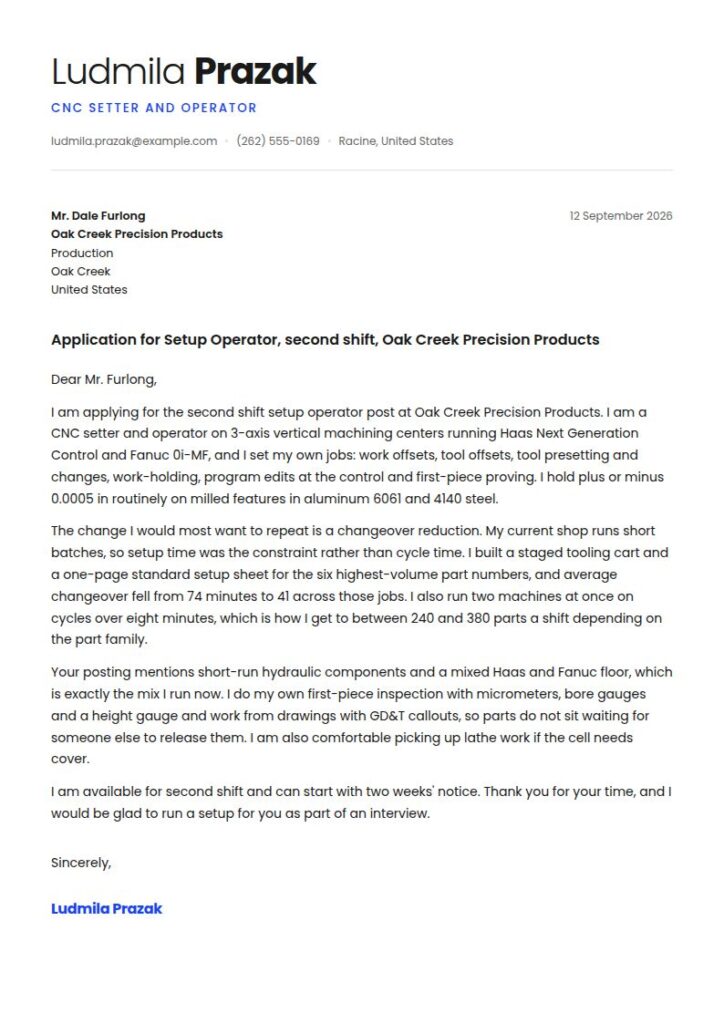
I am applying for the second shift setup operator post at Oak Creek Precision Products. I am a CNC setter and operator on 3-axis vertical machining centers running Haas Next Generation Control and Fanuc 0i-MF, and I set my own jobs: work offsets, tool offsets, tool presetting and changes, work-holding, program edits at the control and first-piece proving. I hold plus or minus 0.0005 in routinely on milled features in aluminum 6061 and 4140 steel.
The change I would most want to repeat is a changeover reduction. My current shop runs short batches, so setup time was the constraint rather than cycle time. I built a staged tooling cart and a one-page standard setup sheet for the six highest-volume part numbers, and average changeover fell from 74 minutes to 41 across those jobs. I also run two machines at once on cycles over eight minutes, which is how I get to between 240 and 380 parts a shift depending on the part family.
Your posting mentions short-run hydraulic components and a mixed Haas and Fanuc floor, which is exactly the mix I run now. I do my own first-piece inspection with micrometers, bore gauges and a height gauge and work from drawings with GD&T callouts, so parts do not sit waiting for someone else to release them. I am also comfortable picking up lathe work if the cell needs cover.
I am available for second shift and can start with two weeks' notice. Thank you for your time, and I would be glad to run a setup for you as part of an interview.
Sincerely, Ludmila Prazak
Openings that work
| Instead of | Use |
|---|---|
| I am a reliable machine operator with a strong work ethic | I am a CNC setter and operator on Haas and Fanuc 3-axis mills and I do my own setups |
| I have experience operating various types of machinery | 3-axis vertical machining centers and CNC lathe, Haas Next Generation Control and Fanuc 0i-MF |
| I am dedicated to producing high quality parts | I hold plus or minus 0.0005 in on milled features in aluminum 6061 and 4140 steel |
| I am a fast learner in a fast-paced environment | Average changeover fell from 74 minutes to 41 across the six highest-volume part numbers |
Pick one number your reader can cost
A production supervisor thinks in minutes, parts and scrap. Choose the number that converts most directly into money on their floor.
| Number | Why it lands |
|---|---|
| Changeover time before and after | Short-run shops are limited by setup, not by cutting |
| Scrap rate against target | Says you know the target, which most applicants do not |
| Parts per shift by part family | Gives a staffing figure rather than a boast |
| Machines tended at once, with cycle length | Tells the supervisor how to staff you on day one |
| Spindle utilization or uptime | Speaks the language of the person costing the cell |
| Tolerance routinely held, with the material | Sets the class of work you can be given |
One or two of these is enough. Six is a resume, not a letter.
Writing toward the setup seat when you are tending now
Most setters started as tenders, and supervisors know it. The letter is where you show the ladder rather than claim the top of it.
Say exactly what you do today, in the shop's own words: load, cycle start, gauge to a check sheet, clear jams, change inserts. Name any setup step you have already been shown, such as die change assist or offset adjustment. Name the control you have worked on, even if you only ran it. Give your scrap rate against the line target. Ask directly for the setup training and say you will test on it.
Do not call yourself a setter if you are not one; the trial shift settles it inside an hour. Do not write "various machines" or "all types of CNC". Do not leave out the material and the tolerance, which are what define the work. Do not send a letter with no numbers. Do not copy the same letter to a stamping plant and a precision machine shop, because they want different sentences.
A declining occupation that still hires heavily
Metal and plastic machine workers held 963,000 jobs in 2025, and employment is projected to fall 7 percent from 2025 to 2035, a decline of 63,000 jobs. Even so, about 78,100 openings a year are projected, driven mainly by replacement need (BLS Occupational Outlook Handbook, 2025-35 projections).
The median annual wage was $47,700, or $22.94 an hour, in May 2025, with the lowest 10 percent under $36,020 and the highest 10 percent over $69,790. Inside the group, computer numerically controlled tool operators had a median of $50,690 and computer numerically controlled tool programmers $68,120 (BLS, May 2025).
Read those together and the strategy for your letter is obvious. The seats that are thinning are the tending seats. The pay is on the setup and programming rungs. Every sentence in your letter should push your reader toward the rung above the one your job title suggests.
Length, format and sending it
Half a page to one page, four short paragraphs, 200 to 350 words. PDF unless the portal insists otherwise, named for yourself and the post: ludmila-prazak-setup-operator-cover-letter.pdf.
Address a person where you can. Production managers, shift supervisors and plant human resources contacts are frequently named in the posting, and a named greeting on a shop floor application is unusual enough to be noticed.
Keep the figures identical to your resume. Our machine operator resume example is written with the same controls, tolerances and numbers used here.
Key takeaways
- Say setup or operate in the first sentence, in those words.
- Name the machine type and the specific control, not "CNC machines".
- List what you do at the control: offsets, tool changes, program edits, proving out.
- Lead with one costable number, usually changeover time or scrap against target.
- Give the tolerance you hold and the material you hold it in.
- Say how many machines you tend at once and on what cycle length.
- Offer to run a setup at interview, and address a named person.
Write your machine operator cover letter in 10 minutes.
Machine operator cover letter questions, answered
How long should a machine operator cover letter be?
Half a page to one page, four short paragraphs, 200 to 350 words. Supervisors read these standing up. The control name, the setup claim and one number should all be visible without scrolling.
Do machine operator jobs need a cover letter at all?
Many are filled through agency portals with no letter field, so attach one only where there is somewhere to put it. Where it counts is the direct application to a small or mid-size shop, where a supervisor is reading the applications personally and is trying to work out whether you can set up.
What if I have only ever tended machines?
Say so and be specific about what tending involved: parts per shift, the gauges you use, the checks you run, your scrap rate against the line target, the jams you clear yourself. Then ask for the setup training and offer to test on it. That is a normal and welcome letter, and it beats an inflated one that falls apart on the trial shift.
Should I list every machine I have run?
No. List the machine types and controls that match the posting, then say "also experienced on" with two or three more. A long undifferentiated list reads as thin experience spread wide, which is the opposite of the impression you want.
Is it worth applying if the occupation is shrinking?
Yes. Employment is projected to decline 7 percent from 2025 to 2035, yet about 78,100 openings a year are still expected because of replacement need (BLS Occupational Outlook Handbook, 2025-35 projections). The market is real; it just rewards setup skill more each year, which is what the letter should be arguing.