General Laborer, Dispatched Mireya Vasquez-Ibarra
General Laborer, dispatched
[email protected] | (559) 555-2120 | Fresno, United States
Profile
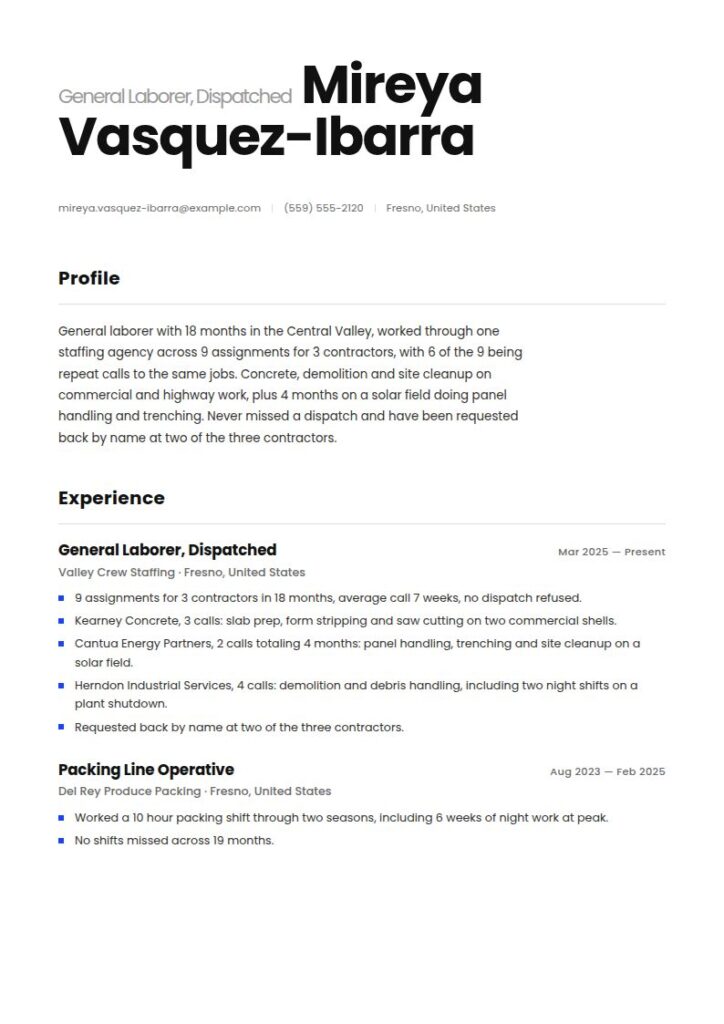
General laborer with 18 months in the Central Valley, worked through one staffing agency across 9 assignments for 3 contractors, with 6 of the 9 being repeat calls to the same jobs. Concrete, demolition and site cleanup on commercial and highway work, plus 4 months on a solar field doing panel handling and trenching. Never missed a dispatch and have been requested back by name at two of the three contractors.
Work Experience
03/2025 - Present, General Laborer, dispatched, Valley Crew Staffing, Fresno, United States
- 9 assignments for 3 contractors in 18 months, average call 7 weeks, no dispatch refused.
- Kearney Concrete, 3 calls: slab prep, form stripping and saw cutting on two commercial shells.
- Cantua Energy Partners, 2 calls totaling 4 months: panel handling, trenching and site cleanup on a solar field.
- Herndon Industrial Services, 4 calls: demolition and debris handling, including two night shifts on a plant shutdown.
- Requested back by name at two of the three contractors.
08/2023 - 02/2025, Packing Line Operative, Del Rey Produce Packing, Fresno, United States
- Worked a 10 hour packing shift through two seasons, including 6 weeks of night work at peak.
- No shifts missed across 19 months.
Education
08/2019 - 05/2023, High School Diploma, General studies, Belmont Heights High School, Fresno, United States
Construction technology elective, two years.
Skills
Concrete form stripping and stacking, 65
Demolition and debris handling, 70
Site cleanup and material staging, 75
Trenching support, 60
Solar panel handling, 65
Night shift and shutdown work, 70
Adapting to new site rules and orientations, 80
Languages
English, native
Spanish, native
Certificates
04/2025, NCCER Core Curriculum, NCCER, NCCER Registry card 5128744
Recorded on the NCCER Registry and verifiable by an employer through a shared link.
06/2023, Class C Driver License, California Department of Motor Vehicles
Clean record.
09/2025, First Aid and CPR, American Red Cross
Summary
A general laborer resume has one structural problem no other trade has: the work is dispatched a job at a time, so an honest history looks like job hopping. This guide shows you how to group short assignments under the agency or the contractor, three adaptable versions, and current Bureau of Labor Statistics pay for the occupation and for agency work specifically.
General Laborer resume examples by experience level
A general laborer resume is a one page document with a problem no other construction trade has to solve: the work arrives one job at a time, so a truthful list of where you have been looks like somebody who cannot hold a job.
In fact, eleven assignments in two years is not instability. It is what dispatched work is. But a hiring manager scanning the left margin sees eleven start dates, eleven end dates and a shrug, and that file loses to a worse worker with two employers on it. However, the fix is not to hide anything. It is to group the work so the reader sees what happened, which is four years of somebody being sent back out and asked for by name.
Resume guide for a general laborer resume
For that reason, this guide and the corresponding general laborer resume example will cover:
- First, how to write a general laborer resume, section by section
- How to group short assignments so a four year run reads as four years
- Then, three adaptable summaries: new, experienced and crew lead
- Also, what the agency line on your resume is doing, and how to write it
- Finally, what the job market looks like and what you can expect to earn
How to write a general laborer resume
Overall, five sections: contact header, summary, work history grouped by employer, skills, and training. Generally, one page, almost always: the length problem here is never too little material, it is too many lines. The grouping decision comes first, because it changes what the reader sees.
| Section | What it is answering | Where it goes |
|---|---|---|
| Work history, grouped | Has this person been working steadily, and for whom? | Immediately after the summary |
| Projects under each group | What did they actually do, and at what size? | Indented under the employer, three to six per group |
| Recalls and requests | Did anybody ask for them back? | Inside the group line, as a count |
| Training | What are they building toward? | Last, and short |
Group first, then decide what to cut
Write out every assignment you can remember on a scrap sheet: contractor, city, dates, what you did. Then sort them by who was paying you, not by date.
Most people find two or three piles. One agency that sent them out repeatedly, one or two contractors who hired them directly, and a scatter of one-off jobs. Those piles are your employer headings, and the one-off jobs get a single line at the bottom of their pile.
The result is usually three employers on a page where the raw list had fourteen. Nothing is hidden, the dates still add up, and the reader can see the shape of it.
Run the finished file through the ATS resume checker before you send it. Grouped entries are exactly where parsers stumble, and it is worth knowing whether yours survived.
Choosing the best resume format for a general laborer resume
Reverse chronological, grouped by employer. Not functional, and not a skills-first layout, whatever a template site tells you about hiding gaps.
After all, the reason is specific to this occupation. That is because a functional resume removes dates, and a reader who cannot find dates assumes the worst about them. Grouping keeps every date and simply puts the employer above the projects instead of beside them. In other words, you are changing the hierarchy, not the facts.
Include your contact information
| ✅ Right | ❌ Wrong |
|---|---|
| Mireya Vasquez-Ibarra | Mireya Vasquez-Ibarra |
| General Laborer, Heavy Civil and Concrete | Reliable worker available immediately |
| 6 years, 3 employers, Central Valley and Sierra foothills | Various construction companies |
| (559) 555-2120, [email protected], Fresno, CA | (559) 555-2120, [email protected] |
The third line is the one that matters. "6 years, 3 employers" answers the stability question before the reader starts counting entries.
Make use of a summary
Four lines: how long you have worked, how many employers that is under, the work you do, and one number that shows you were trusted with something.
General laborer with 18 months in the Central Valley, worked through one staffing agency across 9 assignments for 3 contractors, with 6 of the 9 being repeat calls to the same jobs. Concrete, demolition and site cleanup on commercial and highway work, plus 4 months on a solar field doing panel handling and trenching. Never missed a dispatch and have been requested back by name at two of the three contractors.
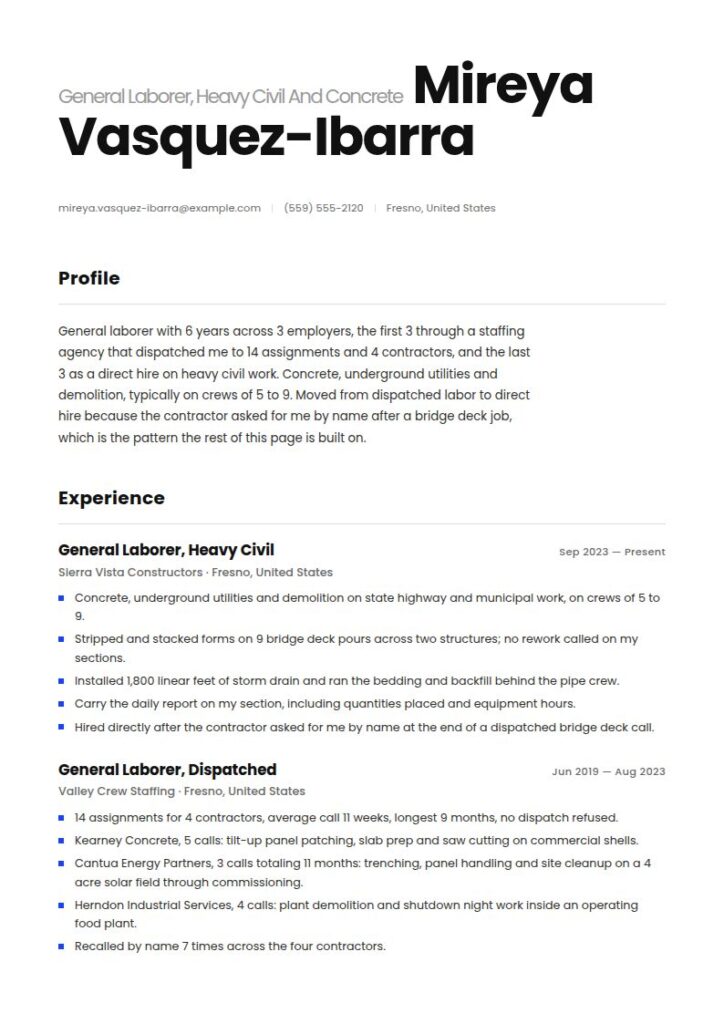
General laborer with 6 years across 3 employers, the first 3 through a staffing agency that dispatched me to 14 assignments and 4 contractors, and the last 3 as a direct hire on heavy civil work. Concrete, underground utilities and demolition, typically on crews of 5 to 9. Moved from dispatched labor to direct hire because the contractor asked for me by name after a bridge deck job, which is the pattern the rest of this page is built on.
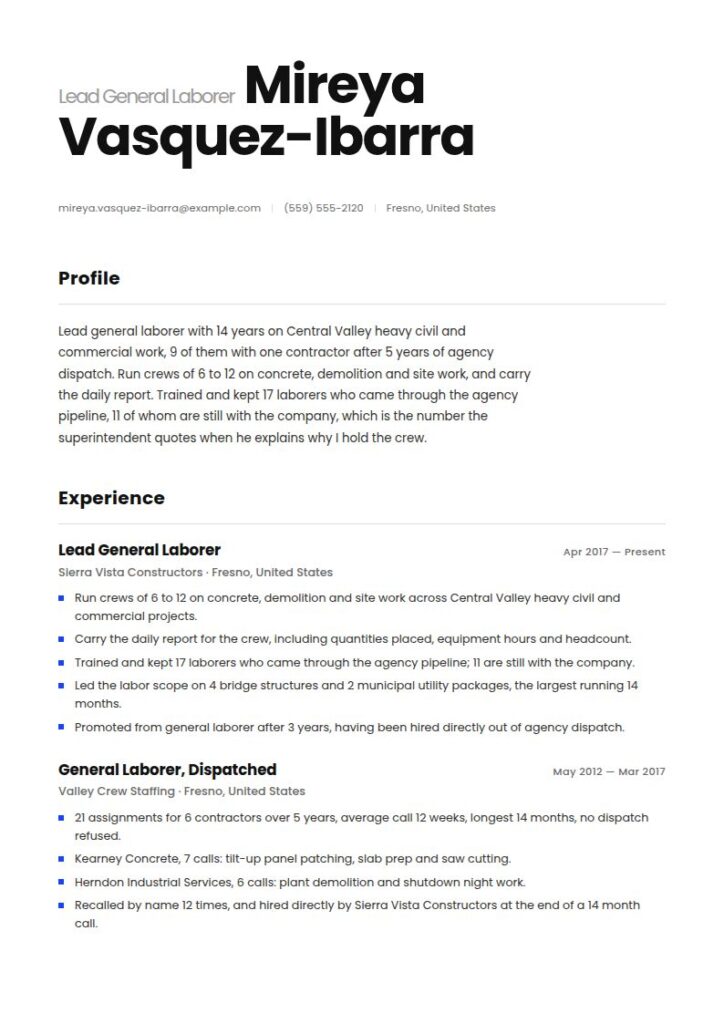
Lead general laborer with 14 years on Central Valley heavy civil and commercial work, 9 of them with one contractor after 5 years of agency dispatch. Run crews of 6 to 12 on concrete, demolition and site work, and carry the daily report. Trained and kept 17 laborers who came through the agency pipeline, 11 of whom are still with the company, which is the number the superintendent quotes when he explains why I hold the crew.
Right vs wrong: the same general laborer summary, twice
| ✅ Right | ❌ Wrong |
|---|---|
| General laborer with 6 years across 3 employers, the first 3 through a staffing agency. | Experienced laborer with a background at various construction companies. |
| Dispatched to 14 assignments and 4 contractors, then hired directly by one of them. | Worked on many different projects for different clients. |
| The contractor asked for me by name after a bridge deck job. | Known for reliability and a strong work ethic. |
The right column explains the number of entries before the reader can hold it against you. In contrast, the left column leaves them to draw their own conclusion, and it is the wrong one.
Outline your general laborer experience
Employer, city, the span of dates, and then the projects underneath. Specifically, three to six projects per employer, each one line, each with a number.
| Instead of | Use |
|---|---|
| Laborer, Kearney Concrete, March 2022 to May 2022 | Under the agency heading: Kearney Concrete, 3 calls between 2021 and 2023, tilt-up panel patching and slab prep |
| Various construction companies, 2019 to 2023 | Valley Crew Staffing, June 2019 to August 2023: 14 assignments across 4 contractors, average call 11 weeks |
| Performed general labor | Stripped and stacked forms on 9 bridge deck pours, crew of 7, no rework called on my sections |
| Short term contract work | Recalled 6 times by the same contractor across two years, including twice by name |
| Helped out wherever needed | Ran the site cleanup and material staging for a 4 acre solar field through commissioning |
Sierra Vista Constructors, Fresno, CA, September 2023 to Present. General Laborer, heavy civil.
Concrete, underground utilities and demolition on state highway and municipal work, on crews of 5 to 9.
Stripped and stacked forms on 9 bridge deck pours across two structures; no rework called on my sections.
Installed 1,800 linear feet of storm drain and ran the bedding and backfill behind the pipe crew.
Carry the daily report on my section, including quantities placed and equipment hours.
Valley Crew Staffing, Fresno, CA, June 2019 to August 2023. General Laborer, dispatched.
14 assignments for 4 contractors, average call 11 weeks, longest 9 months. Never turned down a dispatch.
Kearney Concrete, 3 calls: tilt-up panel patching, slab prep and saw cutting on two commercial shells.
Cantua Energy Partners, 2 calls totaling 7 months: panel handling, trenching and site cleanup on a 4 acre solar field through commissioning.
Herndon Industrial Services, 4 calls: demolition and debris handling inside an operating food plant, including night shifts on a shutdown.
Group short projects so your history reads as continuous work
Even so, this is the section that decides a general laborer resume, and almost nobody does it.
In reality, dispatched and per-project work produces an honest history that looks dishonest. Three weeks here, two months there, a nine month run, then three weeks somewhere else. As a result, listed flat, one entry per assignment, it reads as a person who cannot stay anywhere. Listed grouped, the same facts read as four years of steady work for one agency that kept sending you out because contractors kept asking.
For example, here is the same two years, written both ways.
| Written flat, 8 entries | Written grouped, 1 entry |
|---|---|
| Laborer, Kearney Concrete, Mar 2021 to May 2021 | Valley Crew Staffing, Fresno, CA, January 2021 to December 2022 |
| Laborer, Herndon Industrial Services, Jun 2021 to Jul 2021 | 8 assignments, 3 contractors, average call 10 weeks, no dispatch refused |
| Laborer, Cantua Energy Partners, Aug 2021 to Feb 2022 | Kearney Concrete, 3 calls: tilt-up patching, slab prep, saw cutting |
| Laborer, Kearney Concrete, Mar 2022 to May 2022 | Cantua Energy Partners, 2 calls, 7 months total: solar field trenching and panel handling |
| Laborer, Herndon Industrial Services, Jun 2022 | Herndon Industrial Services, 3 calls: plant demolition and shutdown night work |
| Laborer, Cantua Energy Partners, Jul 2022 to Sep 2022 | Recalled by name at Kearney and Herndon |
| Laborer, Kearney Concrete, Oct 2022 to Nov 2022 | |
| Laborer, Herndon Industrial Services, Dec 2022 |
What grouping changes and what it keeps
Nothing has been removed. Indeed, the dates are the same, the contractors are the same, and a reference check would produce the same answers. Instead, what has changed is that the reader can see the recall pattern, which is the most persuasive fact in a dispatched history and the one a flat list buries.
Group under whoever paid you. If a staffing agency employed you, the agency is the employer and the contractors are projects under it. If you were hired directly by a contractor for a series of jobs, the contractor is the employer and the jobs are the projects. Do not put a contractor's name in the employer position when the agency signed your checks, because a reference call to that contractor will produce a person who does not have you in their system.
Count the things a scattered history can prove that a settled one cannot. How many assignments, how many contractors, the average and longest call, how many recalls and how many of those by name, and whether you ever turned down a dispatch. Those numbers are not available to someone who worked at one place for six years, and they answer exactly what the reader is worried about.
Explaining moves and agency employment
Say why you moved, once, in the summary. One clause is enough: hired directly after a recall, laid off at the end of a project, or the agency lost the account. Readers assume the worst about unexplained movement and accept almost any stated reason.
Agency work is a small slice of the occupation and a real pay difference
Temporary help services accounts for 2 percent of employment among construction laborers and helpers, and the median annual wage there was $35,740 in May 2025, against $46,680 for the occupation as a whole and $47,540 in construction of buildings (BLS Occupational Outlook Handbook, May 2025 wage data with 2025 to 2035 projections, published 27 August 2026).
That gap of nearly $11,000 is the practical argument for writing the agency line well. Agency work is the ordinary way into the trade, but it is not where the occupation's money is, and the move from dispatch to direct hire is worth real wages.
It also explains why the recall count belongs on the page. The route from the first column to the third runs through a contractor deciding they would rather employ you than rent you, and the evidence they use for that decision is how many times they have already asked for you.
One more thing worth knowing while the agency is still your employer. OSHA treats the arrangement as shared: "The staffing agency and the staffing agency's client (the host employer) are joint employers of temporary workers and, therefore, both are responsible for providing and maintaining a safe work environment," and host employers "must treat temporary workers like any other workers in terms of training and safety and health protections" (OSHA temporary worker initiative, osha.gov, retrieved 17 September 2026). Consequently, a laborer who can say that plainly at interview sounds like somebody who has paid attention to how their own employment works.
Build a snapshot of your key skills
In brief, ten to fourteen entries in three groups: the work, the machines and tools, and the site habits that make you easy to send anywhere.
Work: Concrete form stripping and stacking, Bedding and backfill, Demolition and debris handling, Site cleanup and material staging, Trenching support, Solar panel handling
Machines and tools: Skid steer, Walk behind compactor, Concrete saw, Jackhammer and breaker, Pipe laser and grade rod, Hand and power tools
On site: Daily reports and quantity counts, Traffic control on state highway work, Night shift and shutdown work, Reading a plan set and a grade stake, Working across four contractors' site rules
That last line is doing real work. Moreover, somebody dispatched to nine sites has learned nine orientations and nine sets of site rules, and adapting fast is a genuine skill that settled workers often do not have.
List your education and certifications
Short, last, and pointed at where you are going rather than where you have been.
Construction Craft Laborer apprenticeship, second year, registered apprenticeship program, Fresno, CA, 2024 to present. Apprentices earn a portable, nationally recognized credential on completion (U.S. Department of Labor, apprenticeship.gov, retrieved 17 September 2026).
NCCER Core Curriculum, recorded on the NCCER Registry, 2023. NCCER states that its credentials "are portable and recognized globally" and can be verified by an employer through a shared link or QR code (NCCER, nccer.org, retrieved 17 September 2026).
High school diploma, Fresno, CA, 2018. California Class C driver license, clean record.
Both lines are chosen for the same reason. A portable credential is the one thing in a dispatched career that belongs to you rather than to whoever was paying you that month.
Choose the right layout and design
Single column, 11 or 12 point, one page, no photograph, no graphics. Send a PDF named for yourself and the job: mireya-vasquez-ibarra-general-laborer-resume.pdf.
In summary, indentation is the only formatting decision that matters. The employer line sits flush left in bold, while the projects under it are indented once and never bolded. Do not put the project list in a second column, because that is where applicant systems interleave the columns into nonsense, and your whole history is in that list.
Group assignments under whoever employed you, with the contractors as projects underneath. Put the count of assignments, contractors and recalls in the employer line. Keep every date on the page. Give one number per project line: feet, pours, acres, crew size, shifts. Say in one clause why you moved. Name the agency by its real name, since a reference check goes there.
Do not list eleven separate two-month jobs down the left margin. Do not use a functional format to hide the dates; it reads as hiding. Do not put a contractor's name in the employer position when an agency paid you. Do not write "various construction companies", which answers nothing and invites the question. Do not leave the recall count out; it is the strongest fact you have.
General laborer job market and outlook
BLS publishes no separate Handbook profile for general laborers; the published occupation is construction laborers and helpers, and it is a large one with heavy churn.
| Measure | Value |
|---|---|
| Construction laborer and helper jobs, 2025 | 1,674,400 |
| Projected change, 2025-35 | 6 percent, faster than average |
| Projected annual openings | About 137,000 |
| Typical entry-level education | No formal educational credential typically required |
| Typical on-the-job training | Short-term on-the-job training |
| Median annual wage, May 2025 | $46,680, or $22.44 an hour |
Source: BLS Occupational Outlook Handbook, construction laborers and helpers, May 2025 wage data with 2025 to 2035 projections, published 27 August 2026.
Therefore, about 137,000 openings a year against 1,674,400 jobs is a lot of movement, and that movement is why your history looks the way it does. It is also why the grouped format works: the reader knows how this occupation is staffed and is not looking for someone who never moved. They are looking for evidence that when you moved, somebody wanted you back.
Meanwhile, here is where the work sits, in the same cycle:
| Industry | Share of employment | Median annual wage, May 2025 |
|---|---|---|
| Specialty trade contractors | 32 percent | $46,360 |
| Self-employed | 24 percent | Not published |
| Construction of buildings | 17 percent | $47,540 |
| Heavy and civil engineering construction | 15 percent | $47,420 |
| Temporary help services | 2 percent | $35,740 |
Source: BLS Occupational Outlook Handbook, construction laborers and helpers, May 2025.
The 24 percent self-employed share is worth a note, because a good deal of laborer work never appears on a resume at all. If that is a chunk of your history, write it as a business with a name, a span of dates and a description of the work, rather than leaving a hole.
What salary you can expect as a general laborer
The median annual wage for construction laborers and helpers was $46,680 as of May 2025, or $22.44 an hour, with construction laborers specifically at $47,120 (BLS Occupational Outlook Handbook, May 2025 wage data, published 27 August 2026).
In particular, the published industry medians sit within about $1,200 of each other across the three construction industries, from $47,540 in construction of buildings down to $46,360 with specialty trade contractors. By comparison, temporary help services is the outlier at $35,740, and that single figure is the clearest statement of what this page is about. In other words, the same work, done by the same person, pays differently depending on who is employing them.
So the resume's job is not to argue that you deserve more. It is to move you from one row of that table to another, and what does that is a history a contractor can read as continuous. A contractor hires directly when they believe you will still be there in a year, and three grouped entries with a recall count in each tell them far more about that than eleven scattered ones.
Key takeaways for a general laborer resume
- First, group assignments under whoever employed you, with contractors as projects underneath.
- Then put the counts in the employer line: assignments, contractors, average call length, recalls.
- Keep every date. Also, remember that grouping changes the hierarchy, never the facts.
- Name the recalls, especially the ones that asked for you by name.
- Explain a move in one clause in the summary, and then stop explaining.
- Finally, write side work as a business with a name and a span, not as a gap.
- Put a portable credential last, because it is the part of the career that is yours.
Build your general laborer resume in 15 minutes with our AI resume builder.
Related construction resume examples
- Construction worker resume
- Construction resume
- Contractor resume
- Construction manager resume
- Construction project manager resume
- Construction superintendent resume
- Glazier resume
- Material handler resume
- Forklift operator resume
- Landscaping resume
- Painter resume
- Handyman resume
Pair it with a matching general laborer cover letter.
General laborer resume questions, answered
How do I write a resume when I have had eleven jobs in three years?
Group them under whoever paid you. If an agency dispatched you, the agency is one employer and the eleven jobs are projects listed under it. Keep all the dates, add a count of assignments and recalls to the employer line, and the eleven entries become one entry with a track record inside it.
Is it dishonest to group assignments under a staffing agency?
No, it is more accurate. The agency was your employer: it paid you, carried your paperwork, and is where a reference check lands. Listing each host contractor as a separate employer is the version that misleads, because none of them employed you.
Should I list every short assignment?
List the ones that add something: a named contractor, a recognizable kind of work, a recall, or a number worth quoting. Cover the rest with one line inside the group, such as "plus 5 shorter calls for 3 contractors, 2 to 6 weeks each".
How do I handle gaps between assignments?
Small gaps between calls are normal and the grouped format absorbs them, because the employer line spans the whole period. For a gap of several months, say what it was in a clause: seasonal layoff, injury and return to full duty, caring for family, or work outside construction. A stated reason ends the question.
Is agency work worth putting on a resume at all?
Yes, and it is worth naming the agency. Temporary help services is only 2 percent of employment in this occupation and pays a median of $35,740 against $46,680 overall (BLS Occupational Outlook Handbook, May 2025), so the agency period is usually the start of a career rather than the whole of it. The point of writing it well is to show the direction of travel: dispatched, then requested back, then hired.
What if I mostly worked cash side jobs?
Write it as self-employment with a name, a span of dates and a plain description: "Self-employed general labor, Fresno, CA, 2021 to 2023: concrete tear-out, fencing, demolition and hauling for homeowners and two small contractors." Self-employment is 24 percent of this occupation (BLS, May 2025), so nobody is surprised by it. A hole on the page is far more damaging than an unglamorous entry.