Registered Glazing Apprentice, Third Year Sione Fonoti
Glazing Apprentice
[email protected] | (253) 555-2130 | Tacoma, United States
Profile
Third-year registered glazing apprentice with 4,100 on-the-job hours across storefront, entrance systems and stick-built curtain wall on commercial projects in Pierce and King counties. Set insulating glass units to 6 feet by 10 feet with a vacuum cup rig and two-person crew, and have run the layout and anchor set on two full storefront elevations. Completed related training in sealants, glazing tapes and aluminum fabrication, and hold a current forklift and scissor lift authorization.
Work Experience
09/2023 - Present, Glazing Apprentice, Tideflat Glass & Metal, Tacoma, United States
- 4,100 on-the-job hours to date across storefront, entrance systems and stick-built curtain wall on commercial projects in Pierce and King counties.
- Set insulating glass units to 6 feet by 10 feet with a vacuum cup rig in a two-person set crew.
- Ran layout and anchor setting on two full storefront elevations under a journeyman's sign-off.
- Cut, fabricated and glazed aluminum storefront framing in the shop between field calls.
- Hold current scissor lift, boom lift and forklift authorizations and run the daily lift inspection for my crew.
07/2022 - 08/2023, Glass Shop Assistant, Sixth Avenue Glass, Tacoma, United States
- Cut, edged and tempered-stock handled residential and storefront replacement glass in a retail shop.
- Learned safe glass handling, suction cup work and sealant application before entering the apprenticeship.
Education
09/2018 - 06/2022, High School Diploma, General, Lincoln High School, Tacoma, United States
Construction trades pathway, including blueprint reading.
Skills
Storefront and entrance systems, 70
Stick-built curtain wall glazing, 55
Glass handling and vacuum cup rigs, 80
Sealant and gasket application, 70
Aluminum fabrication, 65
Shop drawing reading, 55
Scissor and boom lift operation, 80
Languages
English, native
Samoan, native
Certificates
09/2023, Registered glazier apprenticeship, third year, Registered apprenticeship program
4,100 on-the-job hours recorded to date, plus related classroom instruction in glass handling, sealants and glazing systems.
04/2024, Aerial and scissor lift authorization, Employer equipment authorization
04/2024, Forklift authorization, Employer equipment authorization
Summary
A glazier resume is a one to two page document naming the glazing systems you have installed, the glass types you have handled and the certification you personally hold. This guide gives you three adaptable versions, the scope vocabulary that separates curtain wall work from storefront work, the difference between AGMT and NACC, and current Bureau of Labor Statistics pay and outlook for the occupation.
Glazier resume examples by experience level
A glazier resume is a one to two page document that names the glazing systems you have installed, the glass you have set, and the certification that belongs to you rather than to your employer.
In practice, the word "glazier" on its own tells a hiring manager almost nothing. That is because curtain wall, storefront, window wall and structural silicone glazing are separate scopes, bid separately and crewed separately. As a result, a shop hiring a curtain wall installer and a shop hiring a storefront and door mechanic want two different people, and both will read a resume that says only "glazier" and move on.
Resume guide for a glazier resume
For this reason, this guide and the corresponding glazier resume example will cover:
- First, how to write a glazier resume, section by section
- Then, the four system scopes, and why naming yours changes who calls you
- Also, three adaptable summaries: apprentice, journeyman and foreman
- In addition, what AGMT certifies, what NACC certifies, and why mixing them up is costly
- Finally, what the market looks like and what you can expect to earn
How to write a glazier resume
Overall, five sections: contact header, summary, systems and glass block, employment history, and training and certification. In general, one page as an apprentice or journeyman, two once you are running crews.
The systems block goes above the employment history, because it is what an estimator or general foreman scans first. In other words, it answers the question they started with: can this person be put on the job we are short on.
| Section | What it is answering | Where it goes |
|---|---|---|
| Systems installed | Curtain wall, storefront, window wall, structural silicone? | Its own block under the summary |
| Glass handled | Insulating units, laminated, tempered, fire-rated, what thickness and weight? | Same block, second line |
| Employment history | Which projects, which system, what square footage? | Reverse chronological, with named buildings |
| Training and certification | Apprenticeship completed, and what do you personally hold? | Last, but explicit about who holds what |
Write the system name, not the word glazing
The National Glass Association's commercial fenestration course draws the lines this way. A storefront is a fixed glazing system most commonly used on the ground floor of commercial buildings, typically spanning one to two stories and anchored between floor slabs, performing best at 4 to 5 foot spacing between vertical mullions with spans generally up to 10 to 12 feet. A window wall is an assembly of pre-glazed windows installed between floor slabs, suited to mid-rise and high-rise residential and commercial buildings. A curtain wall is a non-load-bearing exterior wall that hangs from the building structure like a curtain, beyond the face of the floor slabs, and can span multiple stories (National Glass Association, retrieved 17 September 2026).
Curtain wall then splits again by how it arrives. Stick systems are assembled piece by piece on site; unitized systems arrive factory-assembled as cassettes and are set as whole panels (National Glass Association, retrieved 17 September 2026). Those are different skills, different rigging and different pace. So write "unitized curtain wall" or "stick-built curtain wall" or "storefront and entrance systems", not "glazing".
Run the finished file through the ATS resume checker before you send it. Larger glazing contractors and general contractors run applications through a system before a person opens them.
Choosing the best resume format for a glazier resume
Reverse chronological, with a project list. After all, glazing work is remembered by building, and naming the buildings is the fastest credibility you have: a superintendent who has been on one knows immediately what the work involved.
Functional formats do not survive here. Glazing is a trade with an apprenticeship and a ladder, and a reader wants to see the ladder: apprentice years, journeyman years, and when you first ran a crew.
Include your contact information
| ✅ Right | ❌ Wrong |
|---|---|
| Sione Fonoti | Sione Fonoti |
| Journeyman Glazier, Unitized and Stick Curtain Wall | Hardworking glazier with attention to detail |
| AGMT certified installer, #AGMT-40218 | NACC certified |
| (253) 555-2130, [email protected], Tacoma, WA | (253) 555-2130, [email protected] |
In particular, the third row is the one that matters, and the wrong column is a real mistake people make. More on that below.
Make use of a summary
Specifically, four lines: years in the trade and where you are on the apprenticeship ladder, the systems you install, the glass you have handled, and one project with a number on it.
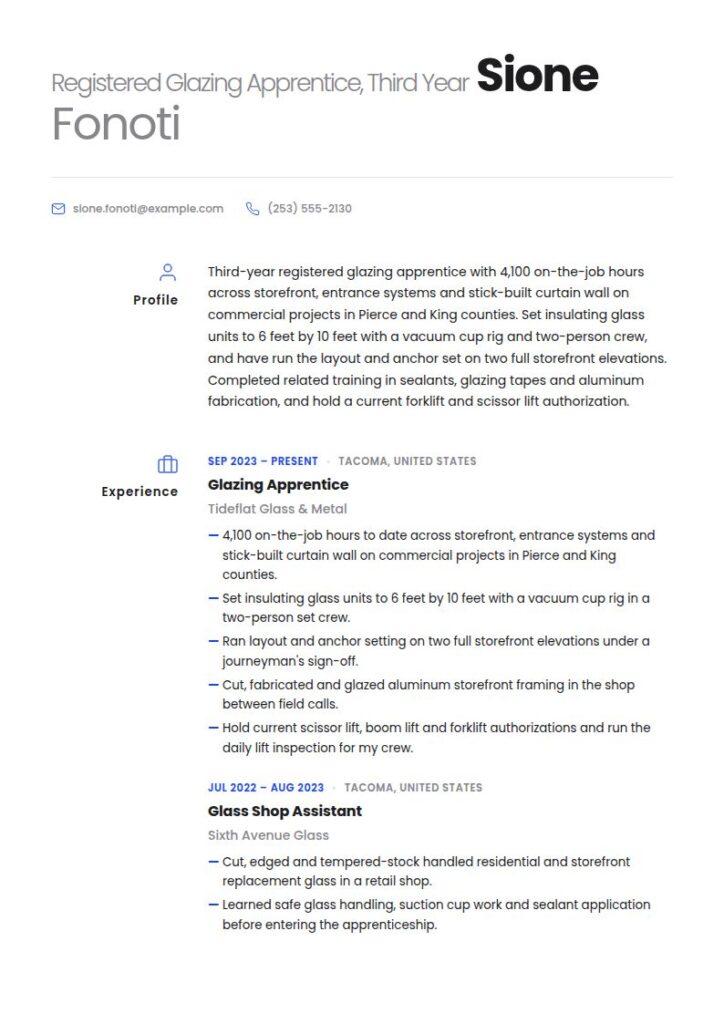
Third-year registered glazing apprentice with 4,100 on-the-job hours across storefront, entrance systems and stick-built curtain wall on commercial projects in Pierce and King counties. Set insulating glass units to 6 feet by 10 feet with a vacuum cup rig and two-person crew, and have run the layout and anchor set on two full storefront elevations. Completed related training in sealants, glazing tapes and aluminum fabrication, and hold a current forklift and scissor lift authorization.
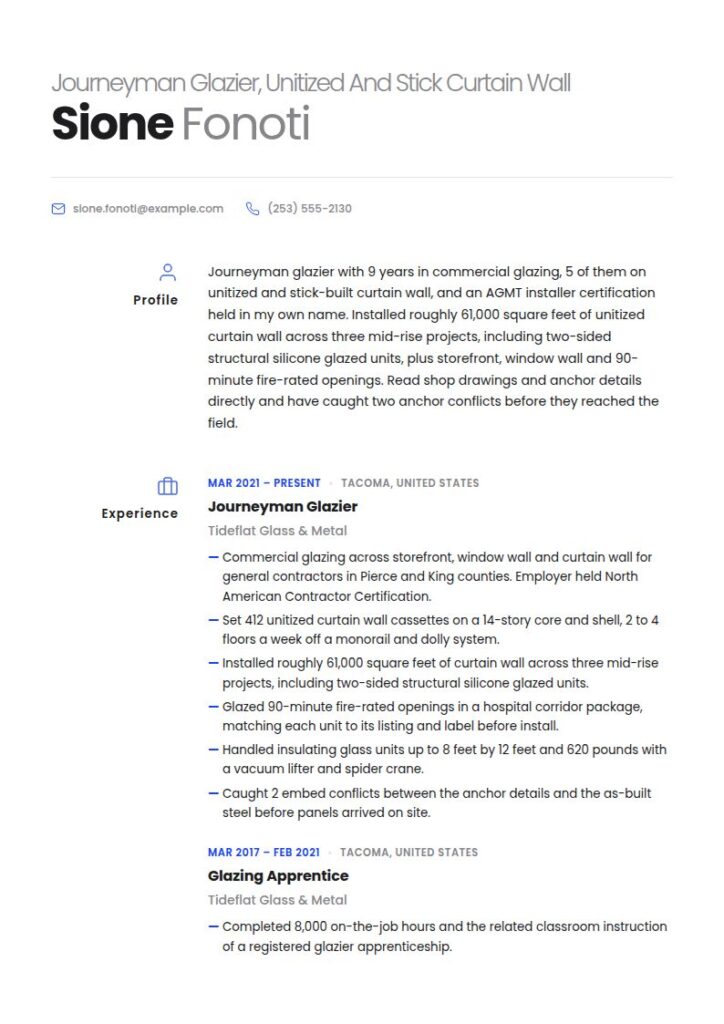
Journeyman glazier with 9 years in commercial glazing, 5 of them on unitized and stick-built curtain wall, and an AGMT installer certification held in my own name. Installed roughly 61,000 square feet of unitized curtain wall across three mid-rise projects, including two-sided structural silicone glazed units, plus storefront, window wall and 90-minute fire-rated openings. Read shop drawings and anchor details directly and have caught two anchor conflicts before they reached the field.
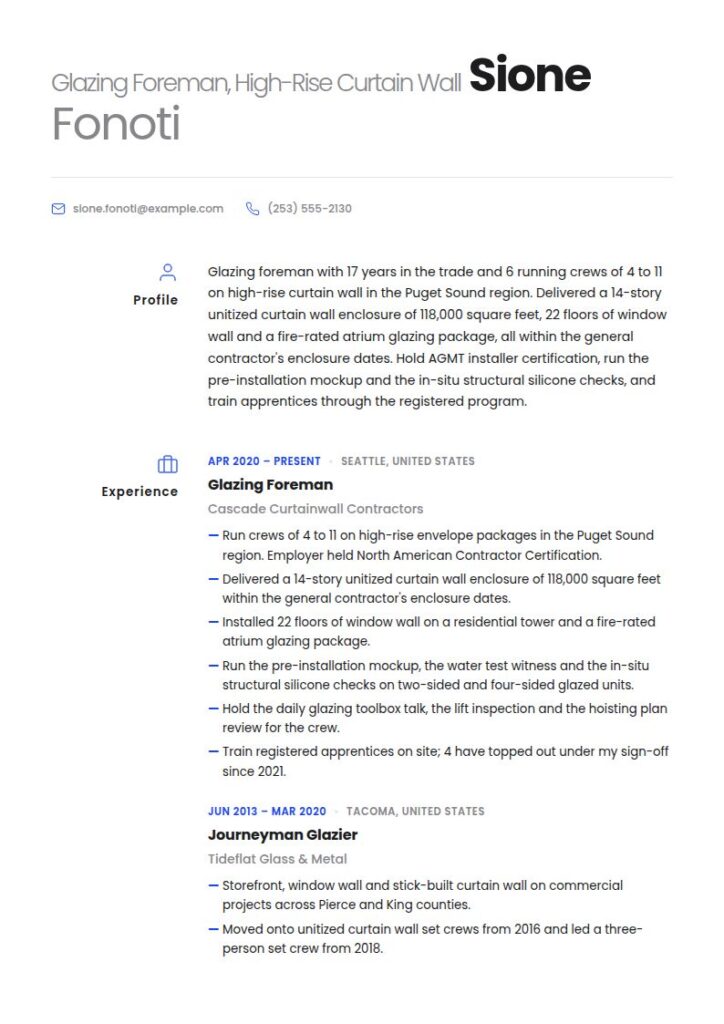
Glazing foreman with 17 years in the trade and 6 running crews of 4 to 11 on high-rise curtain wall in the Puget Sound region. Delivered a 14-story unitized curtain wall enclosure of 118,000 square feet, 22 floors of window wall and a fire-rated atrium glazing package, all within the general contractor's enclosure dates. Hold AGMT installer certification, run the pre-installation mockup and the in-situ structural silicone checks, and train apprentices through the registered program.
Right vs wrong: the same glazier summary, twice
| ✅ Right | ❌ Wrong |
|---|---|
| Journeyman glazier with 9 years in commercial glazing, 5 of them on unitized and stick-built curtain wall. | Experienced glazier with a strong work ethic and attention to detail. |
| Installed roughly 61,000 square feet of unitized curtain wall across three mid-rise projects. | Installed glass on many commercial buildings. |
| AGMT installer certification held in my own name. | NACC certified. |
In practice, the middle row is the one that gets interviews. The bottom row is the one that gets a resume set aside, for a reason that is worth its own section.
Outline your experience
Company, city, dates, then the projects. Then, for each: the building or its type, the system, the square footage or panel count, and what you were responsible for.
| Instead of | Use |
|---|---|
| Installed glass and glazing systems on commercial buildings | Set 412 unitized curtain wall cassettes on a 14-story core and shell, 2 to 4 floors a week |
| Worked with a team to complete projects on schedule | Ran a 6-person crew to hit the general contractor's enclosure date on a 118,000 square foot facade |
| Handled various types of glass | Set insulating glass units up to 8 feet by 12 feet and 620 pounds with a vacuum lifter and spider crane |
| Followed safety procedures | Held the glazing toolbox talk and the daily lift inspection for a crew of 6 |
| Read blueprints | Worked from shop drawings and anchor details; flagged 2 embed conflicts before steel was set |
Journeyman Glazier, Tideflat Glass & Metal, Tacoma, WA, March 2021 to Present
Commercial glazing across storefront, window wall and curtain wall for general contractors in Pierce and King counties.
Set 412 unitized curtain wall cassettes on a 14-story core and shell, 2 to 4 floors a week off a monorail and dolly system.
Installed roughly 61,000 square feet of curtain wall across three mid-rise projects, including two-sided structural silicone glazed units.
Glazed 90-minute fire-rated openings in a hospital corridor package, matching each unit to its listing and label before install.
Handled insulating glass units up to 8 feet by 12 feet and 620 pounds with a vacuum lifter and spider crane.
Caught 2 embed conflicts between the anchor details and the as-built steel before the panels arrived on site.
Name the systems and the glass, and get AGMT and NACC the right way round
Two halves, and both of them are scope.
The systems. Curtain wall, storefront, window wall and structural silicone glazing are not synonyms and they are not interchangeable on a resume. Structural silicone glazing in particular is its own scope with its own standard. ASTM C1401, the Standard Guide for Structural Sealant Glazing, describes an application where the sealant is not only a barrier against air and water through the building envelope but primarily provides structural support and attachment of the glazing to a window, curtain wall or other framing system, applies to building walls up to 15 degrees from vertical, and accepts only a silicone chemically curing sealant specifically formulated, tested and marketed for structural sealant glazing (ASTM International, C1401-14(2022), retrieved 17 September 2026). Its companion, ASTM C1394, covers in-situ evaluation of existing two-sided and four-sided structural silicone glazing installations (ASTM International, C1394-20, retrieved 17 September 2026).
If you have worked two-sided or four-sided structural silicone, say which, because they are different risk profiles and a contractor who bids that scope is specifically looking for people who have done it.
The glass. Name the products, not "various types of glass". Insulating glass units, laminated, heat-strengthened, tempered and fire-rated glazing are different to handle, set and replace. Give the sizes and weights you have rigged, because a 620 pound unit is a different job from a 90 pound one.
Safety and fire-rated glazing rules
Safety glazing has a federal rule behind it that is worth knowing by name. The Consumer Product Safety Commission's Safety Standard for Architectural Glazing Materials, 16 CFR Part 1201, covers glazing in storm and combination doors, interior and exterior doors, bathtub and shower doors and enclosures, and patio-type sliding glass doors; Category I covers storm and combination doors and doors with no single glazed piece over 9 square feet, while Category II covers shower and bathtub enclosures, patio-type sliding glass doors and doors with glazed pieces greater than 9 square feet, and the standard incorporates ANSI Z97.1-2015 by reference (Consumer Product Safety Commission, retrieved 17 September 2026).
Similarly, fire-rated glazing carries its own label, and the label is a sentence you should be able to read. The International Code Council's documentation on labeling fire-rated glazing assemblies describes a marking in which "D" indicates glazing permitted in fire door assemblies meeting the fire protection requirements of NFPA 252, "H" that the glazing meets the hose stream requirement, "T" that it meets the temperature rise requirement, and "OH" that it meets fire protection and hose stream requirements for fire window openings, each followed by the rating period in minutes (International Code Council, retrieved 17 September 2026). For example, a glazier who writes "glazed 90-minute fire-rated openings, matched to listing and label" has said something a superintendent will believe.
AGMT certifies you. NACC certifies your employer.
This is the most common error on a glazier's resume, and it is not a small one.
The Architectural Glass and Metal Technician certification, AGMT, is the program for glazing installers: you certify yourself or your personnel. The North American Contractor Certification, NACC, is the program for glazing contractors: it certifies your company. Both are administered by an independent third party, AMS, Inc., both are sponsored and overseen by the Architectural Glass and Metal Certification Council, a not-for-profit public benefit organization, and both hold ANAB accreditation (glazingcertification.com, retrieved 17 September 2026).
So a glazier who writes "NACC certified" on a resume has claimed the employer's credential as a personal one. Anyone in the industry knows immediately what happened, and the charitable reading is that you do not understand your own certification scheme.
Write it as it is: "AGMT certified installer" under your own certifications, and, if you want the company credential on the page at all, "employer held NACC contractor certification" inside the job entry where it belongs. That second line is useful, because it tells a reader what standard of shop you trained in. It just is not yours.
Systems installed: Unitized curtain wall, stick-built curtain wall, window wall, storefront and entrance systems, two-sided structural silicone glazed units, interior partitions and rated openings
Glass handled: Insulating glass units to 8 feet by 12 feet and 620 pounds, laminated, heat-strengthened, tempered, 90-minute fire-rated glazing, spandrel and back-painted panels
Rigging and access: Vacuum lifters and cup rigs, spider crane, monorail and dolly, scissor and boom lift, swing stage
Build a snapshot of your key skills
Ten to fourteen entries, grouped so a reader can find the one they came for.
Systems: Unitized curtain wall install, Stick curtain wall fabrication and glazing, Window wall, Storefront and entrances, Structural silicone glazing, Rated opening glazing
Field craft: Shop drawing and anchor detail reading, Layout and anchor setting, Sealant and gasket application, Waterproofing transitions and flashing, Punch list and glass replacement
Access and rigging: Vacuum lifter, Spider crane, Monorail and dolly, Scissor and boom lift, Swing stage
Tools and systems: Kawneer, YKK AP and Oldcastle system familiarity, Bluebeam Revu for drawing markup, Procore daily reports
Also, name the system manufacturers you have installed. As a result, a shop that runs one manufacturer's line reads that as a shorter learning curve.
List your education and certifications
Apprenticeship first with its hours and completion, then the certification you personally hold, then the access and equipment cards.
Registered glazier apprenticeship, completed 2021. 8,000 on-the-job hours plus related classroom instruction in glass handling, sealants, aluminum fabrication and glazing systems.
AGMT, Architectural Glass and Metal Technician, installer certification #AGMT-40218, held in my own name. Administered by AMS, Inc. and overseen by the Architectural Glass and Metal Certification Council.
Employer held North American Contractor Certification (company credential, not personal).
High school diploma, Lincoln High School, Tacoma, WA.
Equipment: Aerial and scissor lift authorization, forklift authorization, rigging and signaling.
The Bureau of Labor Statistics gives a high school diploma or equivalent as the typical entry-level education for glaziers, with the trade learned through a 3 or 4 year apprenticeship or on-the-job training, and notes that some states may require a license, typically involving a test plus a combination of work experience and education (BLS Occupational Outlook Handbook, published 27 August 2026). Check the state you are applying in, because the requirement sits with the state, not the trade.
Choose the right layout and design
Above all, single column, plain type at 11 or 12 point, clear headings, no photograph. Put the systems block high enough that it survives a phone screen, since a general foreman is often reading this on a tablet in a job trailer.
Name the system on every project: unitized curtain wall, stick, window wall, storefront. Give square footage, panel counts or elevation counts. Say which glass you have handled, with sizes and weights. Name the buildings where you can. Put AGMT under your own certifications with the number. Say whether structural silicone work was two-sided or four-sided.
Do not write "NACC certified" about yourself; it is the company's certification. Do not write "various types of glass" or "all aspects of glazing". Do not leave the apprenticeship hours off, since they are the ladder a reader is checking. Do not claim a manufacturer's system you have only seen installed. Do not bury the systems block on page two.
Glazier job market and outlook
A small, slow-growing occupation with concentrated employment, which makes scope precision more valuable rather than less: there are few openings, so the ones there are go to the resume that matches the scope.
| Measure | Value |
|---|---|
| Glazier jobs, 2025 | 59,200 |
| Projected employment, 2035 | 60,300 |
| Projected change, 2025-35 | 2% (slower than average), +1,100 |
| Projected annual openings | 3,900 |
| Typical entry-level education | High school diploma or equivalent |
| Median annual wage, May 2025 | $57,080 ($27.44 an hour) |
Source: U.S. Bureau of Labor Statistics, Occupational Outlook Handbook, 2025-35 projections and May 2025 wage data, published 27 August 2026.
Two in three glaziers work for one kind of employer
Foundation, structure, and building exterior contractors employ 67 percent of glaziers, far ahead of retail trade at 12 percent, building finishing contractors at 6 percent, construction of buildings at 5 percent and manufacturing at 3 percent (BLS Occupational Outlook Handbook, published 27 August 2026).
That concentration is the practical argument for the systems block. Two thirds of the jobs are with exterior envelope contractors, the population that bids curtain wall, window wall and storefront as separate line items and crews them separately. They are not reading your resume to find out whether you are a good worker; they are reading it to find out which line item you belong on. That 67 percent also holds the highest industry median, $58,650 a year against $51,740 in building finishing contractors and $47,840 in construction of buildings (BLS, May 2025).
Where the work sits:
| Industry | Share of employment | Median annual wage (May 2025) |
|---|---|---|
| Foundation, structure, and building exterior contractors | 67% | $58,650 |
| Retail trade | 12% | $52,360 |
| Building finishing contractors | 6% | $51,740 |
| Construction of buildings | 5% | $47,840 |
| Manufacturing | 3% | $47,360 |
Source: U.S. Bureau of Labor Statistics, May 2025, published 27 August 2026.
What salary you can expect as a glazier
Overall, the median annual wage for glaziers was $57,080, or $27.44 an hour, as of May 2025 (BLS Occupational Outlook Handbook, published 27 August 2026).
However, the industry spread is about $11,000 wide from top to bottom, and it maps onto scope. Foundation, structure, and building exterior contractors pay a median of $58,650 while manufacturing pays $47,360 (BLS, May 2025). Therefore, a glazier moving from a retail glass shop into commercial envelope work is moving toward the better-paid two thirds of the occupation, and the resume line that makes that move is a systems block with commercial work in it.
Even so, what the national figure cannot tell you is the local one. Glazing pay is shaped by whether a market is union or open shop and by the scale of commercial construction in it. On the other hand, what travels with you is the scope list and the certification.
The registration is the company’s, and so is the bond
The AGMT and NACC confusion is a symptom of a wider one: which credentials in this trade belong to a person, and which to a business.
In Washington, a construction contractor registers with the Department of Labor and Industries, posts a surety bond of $30,000 as a general contractor or $15,000 as a specialty contractor, and carries general liability of $200,000 public liability and $50,000 property damage or $250,000 combined single limit (Washington State Department of Labor and Industries, retrieved 17 September 2026). None of that is yours. It is the company's registration, the company's bond and the company's policy.
What is yours is the apprenticeship you completed, the hours behind it, the AGMT certification if you hold one, and the equipment authorizations in your wallet. Put those under your name, and the company's standing inside the job entry where it belongs.
Key takeaways for a glazier resume
- First, name the system on every project: unitized curtain wall, stick, window wall or storefront.
- Next, put the systems and glass block above the employment history.
- Also, give square footage, panel counts, glass sizes and weights.
- Say whether structural silicone work was two-sided or four-sided.
- In addition, put AGMT under your own certifications, with the number.
- Finally, never write "NACC certified" about yourself, because that certifies your employer.
- List apprenticeship hours and completion, because that ladder is what a reader is checking.
Build your glazier resume in 15 minutes with our AI resume builder.
Related construction resume examples
- Construction worker resume
- General laborer resume
- Construction resume
- Construction superintendent resume
- Construction manager resume
- Contractor resume
- Carpenter resume
- Welder resume
- Painter resume
- Electrician resume
- Cement mason resume
- Maintenance technician resume
Pair it with a matching glazier cover letter.
Glazier resume questions, answered
How long should a glazier resume be?
One page as an apprentice or journeyman. Two once you have run crews, carry a project list worth naming, or have enough system variety that the block itself takes half a page. The second page should be the project list.
What is the difference between AGMT and NACC?
AGMT, Architectural Glass and Metal Technician, certifies the individual glazing installer. NACC, North American Contractor Certification, certifies the glazing contractor company. Both are administered by AMS, Inc. and are sponsored and overseen by the Architectural Glass and Metal Certification Council (glazingcertification.com, retrieved 17 September 2026). Only AGMT belongs under your own name; NACC belongs to your employer.
Should I list the buildings I have worked on?
Yes, where you are free to. A named building lets a reader who knows the project reconstruct the scope and the difficulty in a second. If a client or a non-disclosure agreement prevents it, describe the building instead: "14-story core and shell, unitized curtain wall, 118,000 square feet."
Do I need a license to work as a glazier?
It depends on the state. BLS notes that some states may require glaziers to have a license, typically involving a test plus a combination of work experience and education (BLS Occupational Outlook Handbook, published 27 August 2026). Separately, the company you work for usually carries its own registration, bond and insurance, and those are the company's rather than yours. Check the state board where you are applying and write only what you personally hold.
What do I put on a glazier resume with no experience?
The apprenticeship application or the hours you have, the related classroom instruction, and any glass handling you have done at all, including a retail or auto glass shop. Then the equipment authorizations: forklift, scissor and boom lift. An entry-level candidate who can already be sent up in a lift and has handled glass without breaking it is a better first hire than one who cannot.