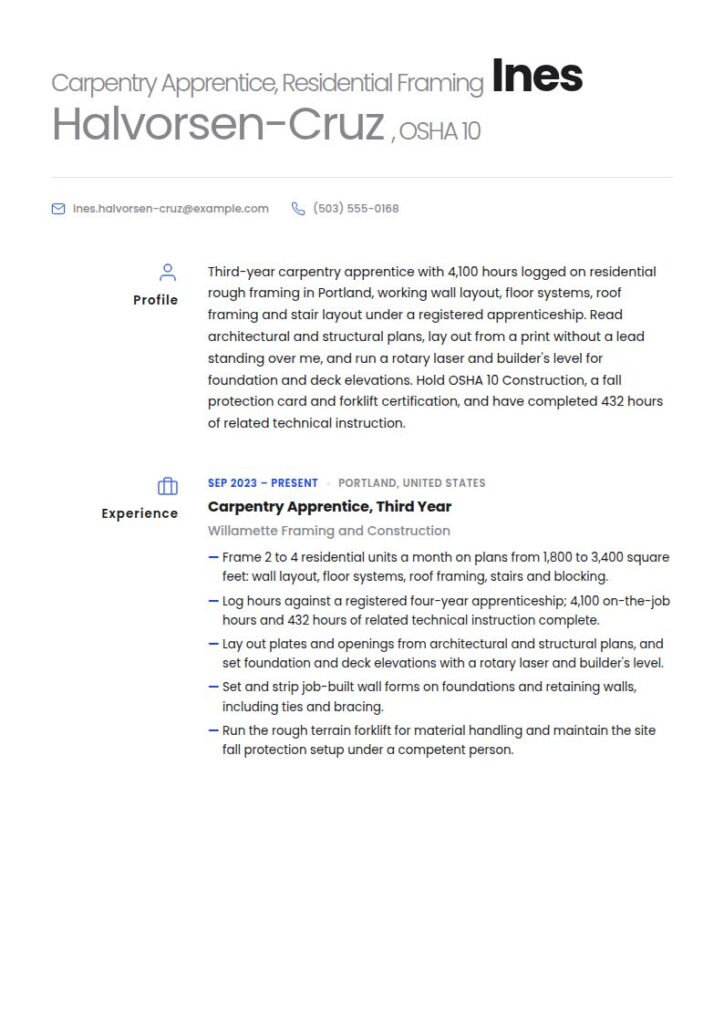
Carpentry Apprentice, Residential Framing Ines Halvorsen-Cruz OSHA 10
Carpentry Apprentice, Third Year
[email protected] | (503) 555-0168 | Portland, United States
Profile
Third-year carpentry apprentice with 4,100 hours logged on residential rough framing in Portland, working wall layout, floor systems, roof framing and stair layout under a registered apprenticeship. Read architectural and structural plans, lay out from a print without a lead standing over me, and run a rotary laser and builder's level for foundation and deck elevations. Hold OSHA 10 Construction, a fall protection card and forklift certification, and have completed 432 hours of related technical instruction.
Work Experience
09/2023 - Present, Carpentry Apprentice, Third Year, Willamette Framing and Construction, Portland, United States
- Frame 2 to 4 residential units a month on plans from 1,800 to 3,400 square feet: wall layout, floor systems, roof framing, stairs and blocking.
- Log hours against a registered four-year apprenticeship; 4,100 on-the-job hours and 432 hours of related technical instruction complete.
- Lay out plates and openings from architectural and structural plans, and set foundation and deck elevations with a rotary laser and builder's level.
- Set and strip job-built wall forms on foundations and retaining walls, including ties and bracing.
- Run the rough terrain forklift for material handling and maintain the site fall protection setup under a competent person.
06/2022 - 09/2023, Construction Laborer, Willamette Framing and Construction, Portland, United States
- Material handling, layout support, demolition and site clean-up across residential framing jobs.
- Learned plate layout, cut lists and roof framing terms on the job before entering the apprenticeship.
Education
09/2023 - Present, Registered Apprenticeship, in progress, Carpentry, Joint Apprenticeship and Training Committee, Portland, United States
Four-year term, 5,200 hours of on-the-job training and a minimum of 144 hours of related technical instruction a year. 4,100 hours and 432 instruction hours complete as of September 2026.
09/2018 - 06/2022, High School Diploma, General, with construction technology electives, Franklin High School, Portland, United States
Three years of construction technology, including framing, plan reading and shop safety.
Skills
Wall layout and plate marking, 80
Floor systems and joist layout, 75
Roof framing and rafter cutting, 65
Stair layout, 60
Architectural and structural plan reading, 70
Rotary laser and builder's level, 75
Job-built wall forms, 60
Rough terrain forklift, 70
Fall protection use and inspection, 80
Languages
English, native
Spanish, fluent
Certificates
10/2023, OSHA 10-Hour Construction, Occupational Safety and Health Administration Outreach Training Program
Course completion card held.
03/2025, Fall Protection User Training, Joint Apprenticeship and Training Committee
Harness inspection, anchorage selection and rescue planning.
05/2024, Rough Terrain Forklift Operator, Willamette Framing and Construction
Powered industrial truck operator evaluation, renewed every three years.
Summary
A carpenter resume is a one page document naming the branch of carpentry you work in, the plans you read, the hours behind your apprenticeship and the safety cards you carry. This guide gives you three adaptable versions, the distinction that decides whether a superintendent calls you, and current Bureau of Labor Statistics pay and outlook for carpenters.
Carpenter resume examples by experience level
A carpenter resume is a one page document that names which kind of carpentry you do, because "carpenter" is not one job and a superintendent reading your file knows it.
A rough framer and a finish carpenter both drive nails for a living and are not interchangeable on a Monday. Neither can walk onto a formwork deck and be useful, and none of the three can lay out a metal stud partition against a reflected ceiling plan without a week of catching up. Every hour a superintendent spends working out which one you are is an hour your resume wasted, and the usual result is that they move on to a file that says so in the first line.
Resume guide for a carpenter resume
This guide and the corresponding carpenter resume example will cover:
- How to write a carpenter resume, section by section
- The branches of carpentry and how to name the one you work in
- Three adaptable summaries: apprentice, journey-level and lead carpenter
- Apprenticeship hours, union and non-union routes, and what each is worth
- What the job market looks like and what you can expect to earn
How to write a carpenter resume
Six blocks: contact header, summary, trade and capability, experience, safety and certifications, and training. One page for your first decade. Two once you run crews, read shop drawings and own a closeout punch list.
The trade line goes directly under the summary. It is the sorting rule, not a nicety. A contractor bidding a hotel interior fit-out is looking for metal stud and drywall layout. A custom builder is looking for scribe work and hardware. A concrete sub is looking for gang forms and she-bolts. Those are three different phone calls.
| Section | What it is answering | Where it goes |
|---|---|---|
| Trade and capability | Which branch of carpentry is this, and at what level? | Directly under the summary |
| Experience | What did they build, how big, and over what period? | Reverse chronological, with project types and numbers |
| Safety and certifications | Can this person be on my site tomorrow? | Its own block, with card dates |
| Training | Apprenticeship hours, union route, related instruction | Bottom, with the hours stated |
Name the project type, not just the employer
"Carpenter, ABC Construction, 2019 to 2024" tells a superintendent nothing. The same job written as project types is a capability sheet: "Tenant improvement fit-outs from 4,000 to 26,000 square feet, mostly medical office and ground floor retail, metal stud partitions, ceiling grid, doors and hardware."
Give the size band, the building type and the scope you personally ran. Square footage, number of units, floors, or door count all work. A carpenter who has hung 400 commercial doors and a carpenter who has hung four are both "experienced with doors and hardware" until one of them writes the number.
If you have worked more than one branch, say so and put them in order of recency, with the hours or years behind each. Breadth is an asset when it is specific and a liability when it is vague.
Run the finished file through the free Rezoom ATS resume checker before you send it. General contractors and large interior subs run applications through a system before a superintendent sees one.
Choosing the best resume format for a carpenter resume
Reverse chronological, one page, single column. Construction hiring reads continuity as evidence that you finished jobs, showed up through a winter and got called back, and a functional format that hides dates reads as a format hiding gaps.
Put the trade and capability block above the experience anyway. That way the first four seconds answer the question the reader has, and the timeline underneath answers the second one.
Include your contact information
| ✅ Right | ❌ Wrong |
|---|---|
| Ines Halvorsen-Cruz | Ines Halvorsen-Cruz |
| Lead Carpenter, Commercial Interiors and Architectural Millwork | Experienced construction professional |
| OSHA 30 Construction, fall protection and scaffold competent person | Safety certified |
| (503) 555-0168, [email protected], Portland, OR | (503) 555-0168, [email protected] |
Put your travel radius and whether you have a truck and your own hand and power tools in the header if either is unusual. Both are questions a superintendent asks on the phone, and answering them on the page moves you up the callback list.
Make use of a summary
Four lines: the branch of carpentry, the years or hours behind it, the plans you read, and one number tied to a project.
Third-year carpentry apprentice with 4,100 hours logged on residential rough framing in Portland, working wall layout, floor systems, roof framing and stair layout under a registered apprenticeship. Read architectural and structural plans, lay out from a print without a lead standing over me, and run a rotary laser and builder's level for foundation and deck elevations. Hold OSHA 10 Construction, a fall protection card and forklift certification, and have completed 432 hours of related technical instruction.
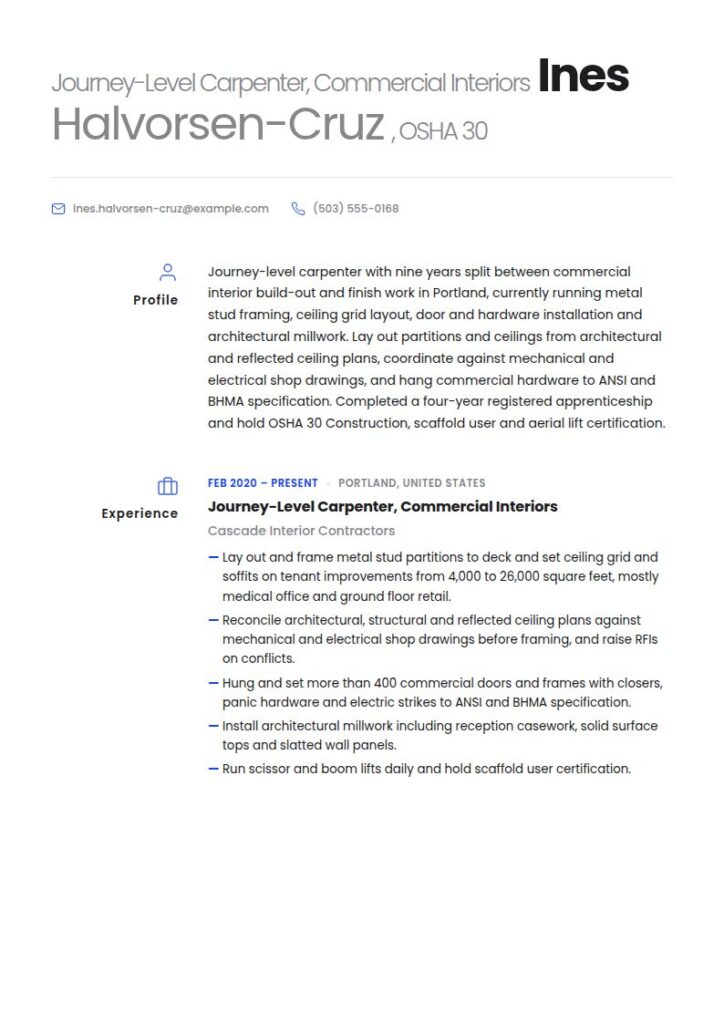
Journey-level carpenter with nine years split between commercial interior build-out and finish work in Portland, currently running metal stud framing, ceiling grid layout, door and hardware installation and architectural millwork. Lay out partitions and ceilings from architectural and reflected ceiling plans, coordinate against mechanical and electrical shop drawings, and hang commercial hardware to ANSI and BHMA specification. Completed a four-year registered apprenticeship and hold OSHA 30 Construction, scaffold user and aerial lift certification.
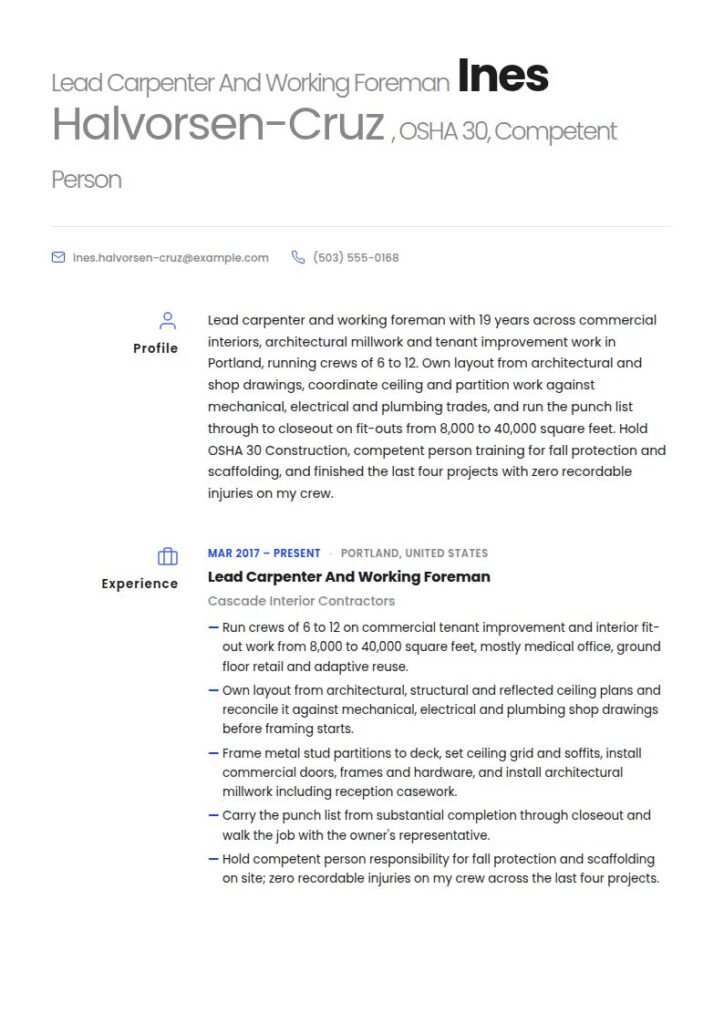
Lead carpenter and working foreman with 19 years across commercial interiors, architectural millwork and tenant improvement work in Portland, running crews of 6 to 12. Own layout from architectural and shop drawings, coordinate ceiling and partition work against mechanical, electrical and plumbing trades, and run the punch list through to closeout on fit-outs from 8,000 to 40,000 square feet. Hold OSHA 30 Construction, competent person training for fall protection and scaffolding, and finished the last four projects with zero recordable injuries on my crew.
Right vs wrong: the same carpenter summary, twice
| ✅ Right | ❌ Wrong |
|---|---|
| Commercial interiors and architectural millwork, 19 years, crews of 6 to 12. | Experienced carpenter with a wide range of construction skills. |
| Lay out partitions and ceilings from architectural and reflected ceiling plans. | Able to read blueprints and work from plans. |
| Fit-outs from 8,000 to 40,000 square feet, run through to closeout. | Worked on many commercial and residential projects. |
The right column can be put on a crew next week. The left column cannot, and the superintendent reading it is building a crew.
Outline your experience
Employer, city, dates, title, and the branch of carpentry. Then bullets naming project type, size, scope and a number. A carpenter bullet with no number in it is a job description.
| Instead of | Use |
|---|---|
| Framed houses | Framed 2 to 4 residential units a month: walls, floor systems, roof framing and stairs, on plans from 1,800 to 3,400 square feet |
| Did finish carpentry | Ran base, casing, crown and scribed built-ins across 14 custom homes, including 9 stair installations with site-built railings |
| Worked with metal studs | Laid out and framed metal stud partitions and ceiling grid across tenant improvements from 4,000 to 26,000 square feet, coordinated to reflected ceiling plans |
| Built concrete forms | Set gang forms and job-built wall forms to 14 feet, including she-bolts, ties and bracing, on foundations and elevator pits |
| Installed doors | Hung and set 400-plus commercial doors and frames with closers, panic hardware and electric strikes to ANSI and BHMA specification |
| Supervised a crew | Ran crews of 6 to 12 through layout, rough-in and closeout, with zero recordable injuries across the last four projects |
Lead Carpenter and Working Foreman, Cascade Interior Contractors, Portland, OR, March 2017 to Present
Run crews of 6 to 12 on commercial tenant improvement and interior fit-out work from 8,000 to 40,000 square feet, mostly medical office, ground floor retail and adaptive reuse.
Own layout from architectural, structural and reflected ceiling plans, and reconcile it against mechanical, electrical and plumbing shop drawings before framing starts, which is where most of the rework on an interior job gets avoided.
Frame metal stud partitions to deck, set ceiling grid and soffits, install commercial doors, frames and hardware, and install architectural millwork including reception casework and slatted wall panels.
Carry the punch list from substantial completion to closeout, and walk the job with the owner's representative.
Hold competent person responsibility for fall protection and scaffolding on site, and finished the last four projects with zero recordable injuries on my crew.
Say which carpentry you do, because the branches do not transfer
This is the block that decides whether your phone rings, and it is the one most carpenter resumes leave out entirely. Three lines, because a superintendent is matching you to a scope of work on a schedule.
Primary trade: Commercial interiors and architectural millwork. Metal stud partition layout and framing to deck, ceiling grid and soffits, drywall layout, commercial doors, frames and hardware, casework and millwork installation, tenant improvement fit-outs from 8,000 to 40,000 square feet.
Also worked: Residential rough framing, 6 years, walls, floor systems, roof framing and stairs. Finish and trim carpentry, 4 years, base, casing, crown, scribed built-ins and stair installation.
Not my trade: Concrete formwork and scenic construction. I have set job-built wall forms but would not run a formwork crew.
Plans and drawings: Architectural, structural, reflected ceiling plans, shop drawings and submittals, door and hardware schedules, RFIs and as-builts.
Equipment I can run: Scissor lift and boom lift, rough terrain forklift, powder actuated tools, laser level and transit, track saw, panel saw, framing and finish nailers.
Five lines, five different questions. The primary trade line says what you can be scheduled for. The second line says what else you can cover in a pinch, with the years attached so it is credible. The third line is the one that reads as professional rather than weak: a carpenter who says what they do not do is a carpenter whose other claims can be trusted. The plans line says whether somebody has to stand next to you. The equipment line says whether you need a lift operator.
The branches are genuinely distinct trades, and the training system treats them that way. The United Brotherhood of Carpenters national apprenticeship guidelines registered with the US Department of Labor set out ten separately registered occupations, including carpenter, residential carpenter specialist, carpenter piledriver, carpenter interior systems, cabinetmaker, millwright, floor coverer, drywall applicator specialist, acoustical carpenter specialist and lather specialist, with four-year programs requiring a minimum of 5,200 hours of work experience and three-year specialty programs a minimum of 3,900 hours (US Department of Labor, National Guidelines for Apprenticeship Standards, Bulletin 2005-23).
That is the clearest possible evidence that the trades are separate. If the apprenticeship system registers them apart, your resume should not blur them together.
Where carpenters actually work, and what each setting pays
Carpenters held 889,700 jobs in 2025 and had a median annual wage of $60,580 in May 2025, with the lowest 10 percent under $40,410 and the highest 10 percent above $99,910 (BLS Occupational Outlook Handbook, May 2025).
The largest single group is self-employed workers at 25 percent of the occupation. Residential building construction follows at 23 percent with a median of $60,600, building finishing contractors at 13 percent and $60,880, nonresidential building construction at 12 percent and $63,780, and foundation, structure and building exterior contractors at 10 percent and $58,790 (BLS Occupational Outlook Handbook, May 2025).
Notice how narrow that spread is: about $5,000 between the best and worst paid of those settings at the median, against a gap of nearly $60,000 between the tenth and ninetieth percentile of the occupation. Almost all of the money is inside the setting, not between settings. It is in your trade, your level, whether you run a crew, and whether the work is union.
Build a snapshot of your key skills
Twelve to sixteen entries in three groups. Keep layout and drawing skills separate, because that is what separates a carpenter from a helper.
Layout and drawings: Architectural and structural plan reading, Reflected ceiling plan layout, Shop drawing and submittal review, Door and hardware schedules, Laser level and transit, Building line and control line layout, RFI and as-built documentation
Framing and interiors: Metal stud partition framing to deck, Ceiling grid and soffit framing, Drywall layout, Rough framing, floor systems and roof framing, Stair layout and construction, Blocking and backing coordination
Finish and millwork: Base, casing and crown, Scribed built-ins and casework, Commercial doors, frames and hardware to ANSI and BHMA, Cabinet and countertop installation, Solid surface and panel work
Site and safety: Fall protection competent person, Scaffold competent person, Aerial and scissor lift operation, Rough terrain forklift, Powder actuated tools, Crew scheduling and punch list closeout
List your education and certifications
Apprenticeship first with its hours, then safety cards with dates, then equipment certifications, then any license.
Registered Carpentry Apprenticeship, completed 2011. Four-year term, 5,200 hours of on-the-job training and 144 hours of related technical instruction a year, through a joint apprenticeship and training committee.
Safety: OSHA 30-Hour Construction (2024). Fall protection competent person (2025). Scaffold competent person (2024). First aid and CPR, American Red Cross (2026).
Equipment: Aerial and scissor lift operator certification (2025). Rough terrain forklift certification (2024). Powder actuated tool operator certification (2023).
Additional: Lead-safe renovator training under the US Environmental Protection Agency Renovation, Repair and Painting Rule (2024). Oregon construction contractor board license, active.
OSHA 10 is the floor, and falls are still the number one citation
The Bureau of Labor Statistics states plainly that all carpenters must pass the Occupational Safety and Health Administration 10-hour safety course (BLS Occupational Outlook Handbook, accessed September 2026). It is the entry card, not an achievement, and a resume that leads with it is a resume with nothing above it.
OSHA 30 is the one that reads as a step up, because it is the course aimed at people with some safety responsibility, and every foreman file should have it.
Fall protection general requirements, 29 CFR 1926.501, was the most frequently cited OSHA standard in fiscal year 2024, with construction ladders at 1926.1053, fall protection training at 1926.503, scaffolding at 1926.451 and construction eye and face protection at 1926.102 also in the top ten (OSHA, Top 10 Most Frequently Cited Standards, fiscal year 2024). Five of the ten are construction standards, and three of those five are about falls. If you hold competent person training for fall protection or scaffolding, that line is worth more on a carpenter resume than another project name.
Choose the right layout and design
Single column, one page, plain type at 11 point, no photograph, no skill bars. Construction applicant systems are often simple, and two column templates with graphics arrive as run-together text. If you have a portfolio of finish or millwork photographs, put a plain link in the header rather than embedding images.
Name your branch of carpentry in the first line. Give project type and size band, not just employer names. State your apprenticeship hours and the related instruction behind them. List safety cards with the year issued. Say what equipment you are certified to operate. Say what you do not do. Give your travel radius and whether you own tools and a truck.
Do not write "carpenter" with nothing after it. Do not claim finish work because you hung a door once. Do not list an expired OSHA or lift card without marking it expired. Do not describe projects without a size. Do not fill a page with duties that every carpenter performs. Do not pad to two pages before you are running crews.
Carpenter job market and outlook
A very large occupation growing about as fast as average, with heavy replacement demand and a hiring pattern set almost entirely by trade branch and local project pipeline.
| Measure | Value |
|---|---|
| Carpenter jobs, 2025 | 889,700 |
| Projected change, 2025-35 | +4% (+35,000), about as fast as average |
| Projected annual openings | ~62,800 |
| Typical entry-level education | High school diploma or equivalent |
| Median annual wage, May 2025 | $60,580 |
| Lowest 10 percent, May 2025 | Less than $40,410 |
| Highest 10 percent, May 2025 | More than $99,910 |
Source: U.S. Bureau of Labor Statistics, Occupational Outlook Handbook, May 2025 wage data and 2025-35 employment projections.
About 62,800 openings a year against a workforce of 889,700 is mostly replacement rather than growth. That is why a superintendent hires on demonstrated scope rather than on years served, and why naming your branch beats listing five employers.
Where the jobs sit:
| Industry | Share of employment | Median annual wage (May 2025) |
|---|---|---|
| Self-employed workers | 25% | Not published on the OOH page |
| Residential building construction | 23% | $60,600 |
| Building finishing contractors | 13% | $60,880 |
| Nonresidential building construction | 12% | $63,780 |
| Foundation, structure, and building exterior contractors | 10% | $58,790 |
Source: U.S. Bureau of Labor Statistics, Occupational Outlook Handbook, May 2025.
What salary you can expect as a carpenter
The median annual wage for carpenters was $60,580 in May 2025, with the lowest 10 percent under $40,410 and the highest 10 percent above $99,910 (BLS Occupational Outlook Handbook, May 2025).
Industry moves it less than most carpenters expect. Nonresidential building construction paid $63,780 against $58,790 in foundation, structure and building exterior contractors, a difference of about $5,000 at the median (BLS, May 2025). The nearly $60,000 spread between the bottom and top deciles is mostly about something else: level, trade branch, crew responsibility and whether the work is union.
A quarter of the occupation is self-employed (BLS, May 2025), and that route changes the calculation entirely, since it puts estimating, contracting and collection on you alongside the carpentry. If that is your direction, the resume should carry the contractor license, the insurance and bonding position, and a couple of complete projects with values attached.
Key takeaways for a carpenter resume
- Name your branch of carpentry in the first line; "carpenter" alone sorts you nowhere.
- Write project type and size band, not just the employer name.
- State apprenticeship hours and related technical instruction, because the trade counts hours.
- List safety cards with dates; OSHA 10 is the floor and OSHA 30 is the step up.
- Say which plans and drawings you work from, including shop drawings and schedules.
- Name the equipment you are certified to operate.
- Say what you do not do, which makes everything else you claim credible.
Build your carpenter resume in 15 minutes.
Related maintenance and repair resume examples
- Mechanic resume
- Cement mason resume
- Painter resume
- Electrician resume
- Plumber resume
- HVAC technician resume
- Handyman resume
- Maintenance technician resume
- Maintenance worker resume
- Construction worker resume
- Maintenance and repair resume
- Glazier resume
Pair it with a matching carpenter cover letter.
Carpenter resume questions, answered
How long should a carpenter resume be?
One page. The trade line, the capability block, the safety cards and two or three employers fit comfortably, and a superintendent reads all of it. Go to two pages only once you run crews, carry competent person responsibility and have projects with values and closeout worth listing.
Which kinds of carpentry should I list?
Name one as your primary trade and the rest as work you have done, with years attached. Rough framing, finish and trim, cabinet and millwork, concrete formwork, commercial interiors and metal stud, and scenic or exhibit construction are genuinely different jobs. The apprenticeship system treats them as separate registered occupations (US Department of Labor, National Guidelines for Apprenticeship Standards, Bulletin 2005-23), so blurring them on a resume costs you credibility rather than buying you breadth.
Is a union apprenticeship worth putting on the page?
Yes, with the hours. A registered four-year program is a minimum of 5,200 hours of on-the-job training plus a minimum of 144 hours of related technical instruction each year under the national guidelines (US Department of Labor, Bulletin 2005-23). Writing "completed a four-year registered apprenticeship, 5,200 hours" tells a contractor exactly what standard you were trained to, whether the shop you are applying to is union or not.
What safety certifications matter most on a carpenter resume?
OSHA 10 Construction is the floor; the Bureau of Labor Statistics records that all carpenters must pass it (BLS Occupational Outlook Handbook, accessed September 2026). OSHA 30 is the step up for anyone with crew responsibility. Beyond that, competent person training for fall protection and scaffolding carries real weight, since fall protection general requirements was the most frequently cited OSHA standard in fiscal year 2024 (OSHA, Top 10 Most Frequently Cited Standards, fiscal year 2024).
What do I put on a carpenter resume with no experience?
Hours and evidence. If you are in a pre-apprenticeship or an apprenticeship, write the hours logged, the related instruction completed and the scopes you have worked. If you are not, write the tools you own, the safety cards you hold, any shop or vocational program, and any work where you kept a schedule and worked from a drawing. Then say which branch of carpentry you are aiming at, because a contractor would rather train someone with a direction.
Should I list projects by name?
List them by type, size and scope rather than by client name unless the project is public and you were credited. A superintendent is matching capability, not collecting references at this stage, and "26,000 square foot medical office fit-out, metal stud and ceiling grid, run to closeout" is more useful to them than a building's name.