Landscape Maintenance Crew Member Dmitri Solano-Achebe
Landscape Maintenance Crew Member (seasonal, April to November)
[email protected] | (616) 555-0173 | Grand Rapids, United States
Profile
Landscape maintenance crew member with three full seasons on commercial routes in West Michigan, running 12 to 14 stops a day across office parks, retail centers and two municipal sites. Operate 60-inch and 72-inch zero-turn mowers, stand-on mowers, walk-behinds, string trimmers, backpack blowers and a 16-foot equipment trailer. Hold a Michigan registered applicator credential for general-use products and returned to the same employer for all three seasons, including snow and ice from December to March.
Work Experience
04/2016 - 03/2019, Landscape Maintenance Crew Member (seasonal, April to November), Grand River Grounds Management, Grand Rapids, United States
- Ran 12 to 14 stops a day on a commercial maintenance route covering office parks, retail centers and two municipal sites, returning to the same employer for three consecutive seasons.
- Operated 60-inch and 72-inch zero-turn mowers, 48-inch stand-on and 36-inch walk-behind mowers for gated properties, plus string trimmers, edgers and backpack blowers.
- Loaded, secured and towed a 16-foot open equipment trailer, and ran the daily pre-trip equipment inspection for the crew.
- Applied general-use fertilizer and weed control under a Michigan registered applicator credential and under the direct supervision of a certified commercial applicator.
- Worked snow and ice from December to March across 11 commercial lots: plow truck, walk-behind blower and tailgate spreader.
05/2015 - 10/2015, Grounds Assistant (seasonal), Kent Hills Golf Club, Grand Rapids, United States
- Mowed fairways and rough on a triplex and wide-area rotary, changed cups and set tee markers on a daily morning rotation.
- Assisted the irrigation technician with head and nozzle replacement across 18 holes.
Education
08/2016 - 05/2018, Associate of Applied Science, Landscape and Turf Management, Grand Rapids Community College, Grand Rapids, United States
Coursework in plant identification, soil science, turfgrass management and irrigation design. Completed while working full seasons.
Skills
Zero-turn and stand-on mower operation, 85
String trimming and edging quality standards, 85
Trailer loading, securing and towing, 80
Mulch and bed maintenance, 75
Spring and fall cleanup, 80
Snow plowing and walkway clearing, 75
Daily equipment inspection and maintenance, 75
Languages
English, native
Spanish, intermediate
Russian, intermediate
Certificates
03/2017, Michigan Registered Applicator, general-use pesticides, Michigan Department of Agriculture and Rural Development
Commercial Core examination plus an approved training program. General-use products only.
02/2018, First Aid and CPR, American Red Cross
Summary
A landscaping resume is a one to two page document read for two things: what equipment you can run and what you are licensed to apply. This guide gives you three adaptable versions, the difference between route maintenance, installation and design build, an accurate account of pesticide applicator licensing, and current Bureau of Labor Statistics pay data.
Landscaping resume examples by experience level
A landscaping resume is read for two things above all others: what equipment you can operate, and what you are licensed to apply.
This is a seasonal, route-based business with thin margins. A branch manager reading applications in February is working out whether you can take a truck and trailer out on Monday and spray a broadleaf herbicide legally.
Resume guide for a landscaping resume
This guide and the corresponding landscaping resume example will cover:
- How to write the resume, section by section
- The equipment and license block that decides most hiring here
- Three adaptable summaries: crew member, crew leader, operations manager
- Route maintenance, installation and design build
- The job market and what you can earn
How to write a landscaping resume
Six sections: contact header, summary, licenses and certifications, equipment operated, experience with route and crew numbers, and education. One page for the first eight years, two once you run crews or a snow operation. Licenses and equipment go above experience, because a crew with nobody certified to spray has to send a second truck.
Route density is the number that sizes a landscaper
A branch manager thinks about commercial maintenance the way a dispatcher thinks about a delivery route: stops per day, acres per day, drive time. So give them the route. "38-property commercial route, 62 acres, 4 crew, 9.5-hour day including drive time" says more than any adjective. Installation work counts jobs per week, average job value and square footage installed instead.
Run the file through the free Rezoom ATS resume checker first; contractors and public employers parse applications into a system.
Choosing the best resume format for a landscaping resume
Reverse chronological, one to two pages, single column. Do not hide seasonality behind a functional format. Label it: "Seasonal, April to November" with "Snow and ice, December to March" underneath. Four consecutive returns to one employer beats most year-round retention records, and H-2B seasons are written the same way.
Include your contact information
| ✅ Right | ❌ Wrong |
|---|---|
| Dmitri Solano-Achebe | Dmitri Solano-Achebe |
| Landscape Crew Leader, Commercial Maintenance and Snow | Hard worker who loves being outdoors |
| Michigan Commercial Applicator, Core plus 3A and 3B. CDL Class B. | Licensed applicator, valid driver license |
| (616) 555-0173, [email protected], Grand Rapids, MI | (616) 555-0173, [email protected] |
Category codes are the point, since 3A and 3B are not interchangeable. Give your driver license class and whether you can tow.
Make use of a summary
Four lines: your side of the business, your route or crew numbers, your applicator categories, and the equipment that makes you deployable immediately.
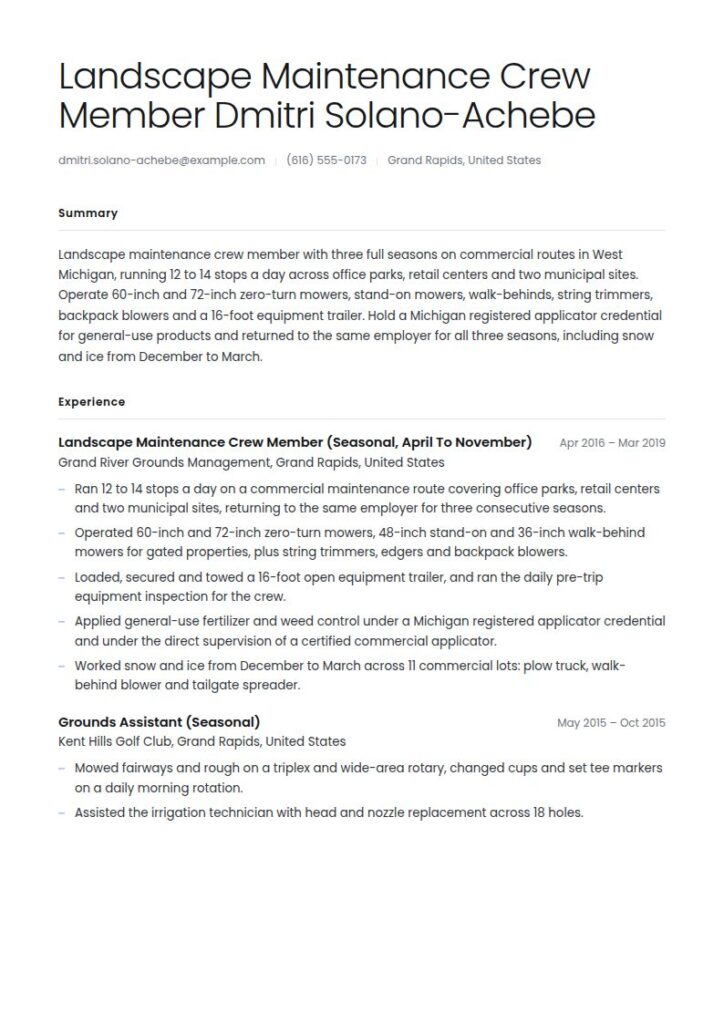
Landscape maintenance crew member with three full seasons on commercial routes in West Michigan, running 12 to 14 stops a day across office parks, retail centers and two municipal sites. Operate 60-inch and 72-inch zero-turn mowers, stand-on mowers, walk-behinds, string trimmers, backpack blowers and a 16-foot equipment trailer. Hold a Michigan registered applicator credential for general-use products and returned to the same employer for all three seasons, including snow and ice from December to March.
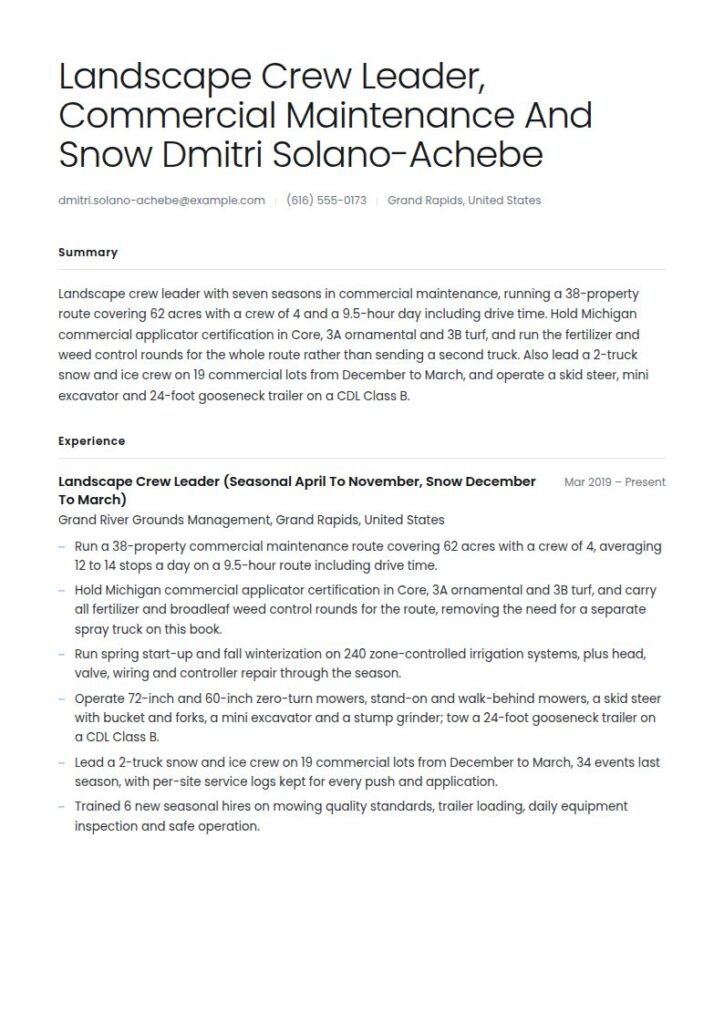
Landscape crew leader with seven seasons in commercial maintenance, running a 38-property route covering 62 acres with a crew of 4 and a 9.5-hour day including drive time. Hold Michigan commercial applicator certification in Core, 3A ornamental and 3B turf, and run the fertilizer and weed control rounds for the whole route rather than sending a second truck. Also lead a 2-truck snow and ice crew on 19 commercial lots from December to March, and operate a skid steer, mini excavator and 24-foot gooseneck trailer on a CDL Class B.
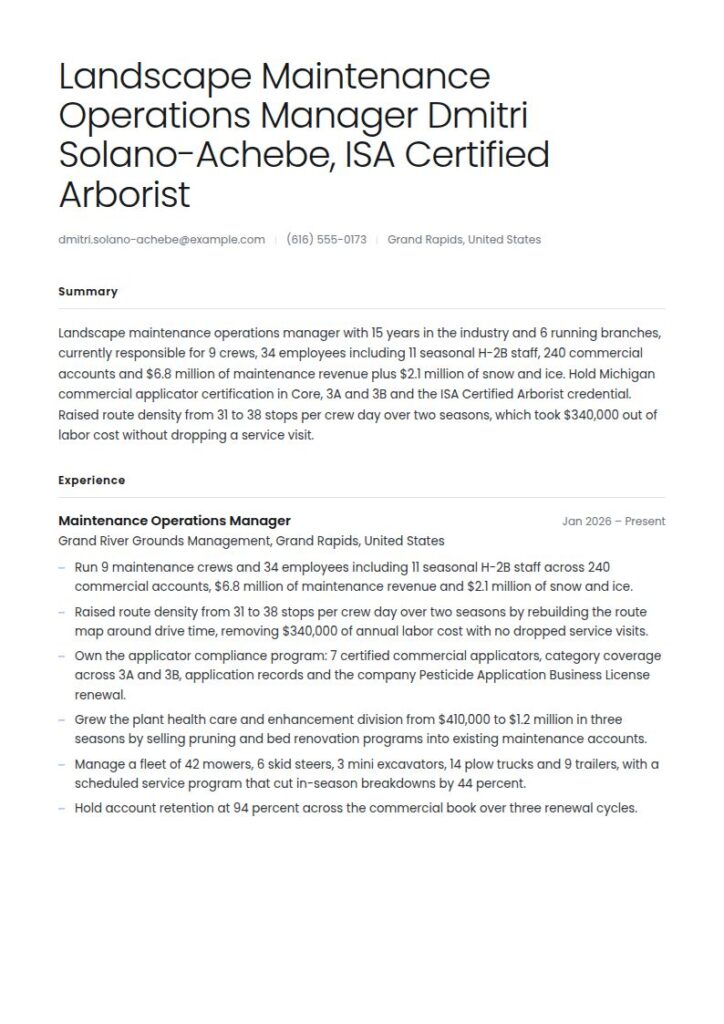
Landscape maintenance operations manager with 15 years in the industry and 6 running branches, currently responsible for 9 crews, 34 employees including 11 seasonal H-2B staff, 240 commercial accounts and $6.8 million of maintenance revenue plus $2.1 million of snow and ice. Hold Michigan commercial applicator certification in Core, 3A and 3B and the ISA Certified Arborist credential. Raised route density from 31 to 38 stops per crew day over two seasons, which took $340,000 out of labor cost without dropping a service visit.
Right vs wrong: the same landscaping summary, twice
| ✅ Right | ❌ Wrong |
|---|---|
| Run a 38-property route covering 62 acres with a crew of 4. | Experienced in maintaining residential and commercial landscapes. |
| Michigan commercial applicator, Core plus 3A ornamental and 3B turf. | Licensed to apply chemicals and fertilizers. |
| Operate skid steer, mini excavator and gooseneck on a CDL Class B. | Skilled with a wide variety of landscaping tools and equipment. |
The right column can be put on a schedule.
Outline your experience
Employer, side of the business, dates and season length, then three to five bullets carrying a number.
| Instead of | Use |
|---|---|
| Mowed and maintained commercial properties | Ran a 38-property route, 62 acres, 4 crew, 12 to 14 stops a day |
| Applied fertilizers and weed control | Carried all fertilizer and broadleaf rounds for a 62-acre route under categories 3A and 3B |
| Operated landscaping equipment | Operate 72-inch zero-turn, stand-on and walk-behind mowers, skid steer and mini excavator; tow a gooseneck on a CDL Class B |
| Worked on snow removal | Led a 2-truck snow crew on 19 lots, 34 events last season |
Head the entry with the season: "Landscape Crew Leader, Grand River Grounds Management, Grand Rapids, MI, 2019 to Present, seasonal April to November with snow December to March."
What you can run and what you are licensed to apply
This is the block that decides most hiring here, and almost nobody writes it as its own section. Two lists, because they answer two questions: whether you can be put on a machine already in the yard, and whether the company can send you to a property alone without breaking a state rule. Be specific, since deck size and whether a machine is ride-on, stand-on or walk-behind change what it can be scheduled for.
Licenses: Michigan Commercial Applicator, Core plus category 3A ornamental and 3B turf, certificate #MI-CA-44821, current through 31 December 2027. CDL Class B with air brake endorsement. ISA Certified Arborist #MI-6712.
Mowing and grounds: 72-inch and 60-inch zero-turn, 48-inch and 52-inch stand-on, 36-inch walk-behind for gated properties, aerator, sod cutter
Heavy and tree: Skid steer with bucket, forks and grapple; mini excavator; compact tractor; stump grinder; chainsaws, pole saw, 6-inch and 12-inch chippers; climbing and rigging to 40 feet
Winter and towing: Straight and V-plow, skid steer pusher box, spreaders, brine applicator; 24-foot gooseneck trailer
Maintenance route, installation or design build: say which one you come from
These are different jobs sold to different customers, and a resume that does not say which one you have done will be read as the lowest-paid of them.
| Side of the business | What the resume should carry |
|---|---|
| Maintenance route: recurring mowing, fertilization, pruning, irrigation, cleanup, usually with snow | Stops per day, acreage, crew size, route hours, accounts retained, applicator categories |
| Installation: project work off a plan, grading, drainage, planting, sod, hardscape | Job values, square footage installed, yards of material |
| Design build: selling and designing the job, not only building it | Average project value, close rate, plant specification |
| Enhancement: pruning programs, bed renovation, plant health care | Plant health care rounds, species handled, enhancement revenue |
The ladder runs crew member, crew leader, account manager, branch manager. Say where you are, because titles vary between companies.
A large industry that is mostly small companies
The landscape industry was worth about $188.8 billion in 2025 across roughly 692,777 landscaping service businesses employing more than 1.4 million people, with finding and keeping qualified employees named as the industry's top concern (National Association of Landscape Professionals, landscape industry statistics, citing IBISWorld, accessed September 2026).
Nearly 700,000 companies sharing 1.4 million workers means the average employer is very small. You are usually writing for the owner, while they staff a season starting in six weeks.
The pesticide applicator license, written accurately
A genuine, state-regulated credential, the most valuable thing most landscapers can add to a resume, and the one applicants most often describe wrongly.
Restricted use pesticides may be bought and applied only by a certified applicator or someone under a certified applicator's direct supervision, and are not sold to the public. Certification is not issued by the EPA: states, tribes, territories and federal agencies administer it under EPA-approved plans covering all 50 states, the District of Columbia, four tribes, six territories and five federal agencies. The federal minimum age is 18, with a narrow exception at 16 on family farms, and a noncertified applicator working under supervision must still complete the training set out in the rule, Worker Protection Standard handler training, or a state-approved program (EPA, certification standards for pesticide applicators, accessed September 2026). Many states go further and require all commercial applicators to be certified, not only those using restricted use products (EPA, how to get certified as a pesticide applicator, accessed September 2026), which is how the Occupational Outlook Handbook puts it too (BLS Occupational Outlook Handbook, 2026).
So the category codes are the content. Michigan separates a commercial applicator, who passes the Commercial Core examination plus at least one category examination and may apply restricted use products, from a registered applicator, who passes Commercial Core plus an approved training program and may apply only general-use products, and from a private applicator working on their own or rented land. Category 3A covers ornamental plants, 3B covers turf, the passing score is 70 percent, and certification runs three years to 31 December. A business applying for hire also needs a Pesticide Application Business License separate from the individual credential (Michigan Department of Agriculture and Rural Development, accessed September 2026).
Write the certification exactly: issuing state, type, category codes, number and expiry. Say whether you are certified or working under supervision, because those are different legal positions. List equipment with sizes and attachments. Give route numbers, and name your winter work on its own line.
Do not write "licensed to spray" with no state and no category; it tells the reader nothing schedulable. Do not imply the EPA certified you. Do not list a lapsed certification. Do not claim equipment you have only ridden on.
Irrigation, backflow and the winter half of the year
Irrigation. Spring start-up and fall winterization are the largest scheduling events of the year, and a crew leader who can troubleshoot rather than just blow out lines is worth a great deal in April. Give the number of systems you handle, whether you install as well as service, and what you can repair: heads, valves, solenoids, wire tracing, controllers, sensors and two-wire decoders.
Backflow. An irrigation system tied to a drinking water supply needs a backflow prevention assembly, and the annual test is generally restricted to a certified tester: the Portland Water Bureau requires annual testing by a state-certified backflow assembly tester, with the tester list held by the Oregon Health Authority (Portland Water Bureau, accessed September 2026). Your state drinking water program and local purveyor set the rule, so check your jurisdiction and give the certificate number if you hold one, because most companies buy that service in.
Snow and ice. In northern markets this is the revenue that keeps the crew employed between December and March. Write it as a real job: sites, contract type, event count, equipment, and whether you ran liquid anti-icing as well as granular. Contract type shows you understand the business, because per-push, per-event, seasonal fixed price and time and materials carry very different risk. There is a written standard too, ANSI/ASCA A1000-2014, System Requirements for Snow and Ice Management Services, from the Accredited Snow Contractors Association (ANSI webstore, accessed September 2026). Name your site logs: slip-and-fall liability is why they exist.
Build a snapshot of your key skills
Twelve to sixteen entries in three groups. Horticulture is the one most crew leaders leave off, and it separates a mowing operator from someone who can run an enhancement program.
Production and route: Route planning and density, crew leading, mowing standards, bed maintenance, spring and fall cleanup, snow site logs
Horticulture and plant health care: Plant identification for regional trees, shrubs, perennials and turf; pruning by species and season; turf disease and insect identification; soil testing and fertility; integrated pest management
Compliance: Applicator Core, 3A and 3B; application records; CDL Class B; equipment inspection; chainsaw and protective equipment safety
List your education and certifications
Certifications first, with the issuing authority, category codes and expiry. Grounds maintenance workers typically need no formal educational credential (BLS Occupational Outlook Handbook, 2026), which makes every credential you hold visible.
| Credential | Issuer | What it takes |
|---|---|---|
| Pesticide applicator certification | State department of agriculture | A core examination plus at least one category examination; in Michigan, 70 percent to pass, valid three years to 31 December (MDARD, accessed September 2026) |
| Landscape Industry Certified Technician, Exterior | National Association of Landscape Professionals | A common core examination plus one specialty: softscape or hardscape installation, turf or ornamental maintenance, or irrigation (NALP, accessed September 2026) |
| ISA Certified Arborist | International Society of Arboriculture | Three years of full-time arboriculture experience, or a degree plus less; a 200-question examination at 76 percent; 30 continuing education units every three years (ISA program guide, revised August 2025) |
Add your CDL class, then any technical coursework.
Choose the right layout and design
Single column, 10 or 11 point type, no photograph or graphics, since larger contractors and municipal employers parse applications before reading them. Put the license and equipment block directly under the summary.
Landscaping job market and outlook
A very large occupation with steady growth and enormous replacement demand.
| Measure | Value |
|---|---|
| Grounds maintenance worker jobs, 2025 | 1,299,200 |
| Projected change, 2025-35 | +5% (+60,100) |
| Projected annual openings | ~162,500 |
| Median annual wage, May 2025 | $40,080 |
| Lowest 10 percent | less than $15.01 an hour |
| Highest 10 percent | more than $28.10 an hour |
Source: U.S. Bureau of Labor Statistics, Occupational Outlook Handbook, May 2025 wages and 2025-35 projections, published 27 August 2026.
Where the work sits: 48 percent in services to buildings and dwellings at $20.90 an hour, 20 percent self-employed, 8 percent in government at $19.33, 8 percent in amusement, gambling and recreation at $17.45, and 3 percent in educational services at $21.39 (BLS Occupational Outlook Handbook, May 2025).
The seasonal labor picture, in the numbers
The H-2B temporary nonagricultural worker program is capped by statute at 66,000 visas a year, 33,000 in each half of the fiscal year, and for fiscal year 2026 the Department of Homeland Security made available up to 64,716 additional supplemental visas. Six sectors, administrative and landscaping services among them, requested nearly 95 percent of all H-2B temporary labor certification applications in fiscal year 2025 according to Department of Labor data cited in that rule (Federal Register, Exercise of Time-Limited Authority to Increase the Fiscal Year 2026 Numerical Limitation for the H-2B Temporary Nonagricultural Worker Program, 3 February 2026).
So seasonal employment is the normal shape of a career here, not a red flag, and a worker who is already certified, licensed to tow and able to run the machine is worth more than the wage difference suggests.
What salary you can expect in landscaping
Grounds maintenance workers had a median annual wage of $40,080 as of May 2025, or $19.27 an hour, with the lowest 10 percent under $15.01 and the highest 10 percent over $28.10 (BLS Occupational Outlook Handbook, May 2025).
| Detailed occupation | Median hourly wage, May 2025 | Employment, May 2025 |
|---|---|---|
| First-line supervisors of landscaping, lawn service and groundskeeping workers | $28.09 | 130,760 |
| Tree trimmers and pruners | $24.50 | 55,160 |
| Pesticide handlers, sprayers and applicators, vegetation | $22.28 | 27,050 |
| Landscaping and groundskeeping workers | $18.82 | 952,640 |
Sources: U.S. Bureau of Labor Statistics, Occupational Outlook Handbook, May 2025; Occupational Employment and Wage Statistics, May 2025.
Read that as a career plan. Tree work is worth about $5.68 an hour more at the median and crew supervision about $9.27, both gated by things you can document: an arborist credential for the first, crew size and route performance for the second. Applicator categories sit in between and are cheapest to acquire.
Key takeaways for a landscaping resume
- Put the equipment list and the license list directly under the summary.
- Write the applicator certification precisely: state, type, categories, number, expiry.
- Give route numbers: stops a day, acres, crew size, route hours.
- Say which side you come from: route, installation or design build.
- Name the winter work on its own line with sites, events and contract type.
- List irrigation by what you can repair, not just start up and blow out.
- Label seasonality openly; returning to one employer is a retention record.
Build your landscaping resume in 15 minutes.
Related maintenance and repair resume examples
- Maintenance and repair sector resume
- Maintenance worker resume
- Maintenance technician resume
- Handyman resume
- Custodian resume
- Janitor resume
- Housekeeping resume
- Carpenter resume
- Cement mason resume
- Painter resume
- Mechanic resume
- Facilities manager resume
Pair it with a matching landscaping cover letter.
Landscaping resume questions, answered
How long should a landscaping resume be?
One page for the first eight years. Two once you run crews, carry a book of accounts, or manage a snow operation. The equipment and license blocks are worth the space; little else is.
Do I need a pesticide applicator license to work in landscaping?
Not to mow, but you do to apply. Restricted use pesticides may only be applied by a certified applicator or someone under their direct supervision, and many states require all commercial applicators to be certified (EPA, accessed September 2026). Check your state, because categories and tiers differ.
How do I show seasonal work without it looking like job hopping?
Label the season on every entry with the winter role underneath, then say how many consecutive seasons you returned to the same employer. Four returns beats most year-round retention records.
What equipment should I list?
Only what you can operate unsupervised, with the detail that changes scheduling: deck sizes and drive type on mowers, skid steer attachments, trailer length, and your CDL class. Leave off anything you have only ridden on.
Is it worth getting the arborist credential?
Tree trimmers and pruners had a median of $24.50 an hour against $18.82 for landscaping and groundskeeping workers as of May 2025 (BLS Occupational Outlook Handbook, May 2025). The credential requires three years of full-time arboriculture experience or a qualifying degree with less, a 200-question examination at a 76 percent pass mark, and 30 continuing education units every three years (ISA Certified Arborist program guide, revised August 2025).