HVAC Installer, EPA 608 Type II Amara Diallo-Knight
HVAC Installer
[email protected] | (704) 555-0101 | Charlotte, United States
Profile
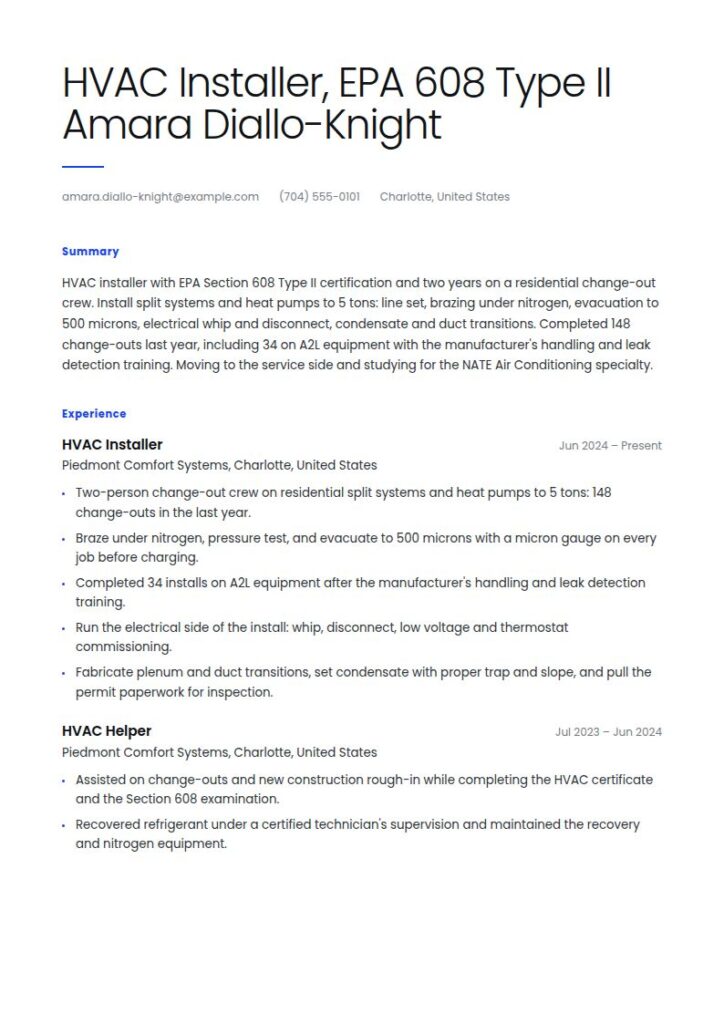
HVAC installer with EPA Section 608 Type II certification and two years on a residential change-out crew. Install split systems and heat pumps to 5 tons: line set, brazing under nitrogen, evacuation to 500 microns, electrical whip and disconnect, condensate and duct transitions. Completed 148 change-outs last year, including 34 on A2L equipment with the manufacturer's handling and leak detection training. Moving to the service side and studying for the NATE Air Conditioning specialty.
Work Experience
06/2024 - Present, HVAC Installer, Piedmont Comfort Systems, Charlotte, United States
- Two-person change-out crew on residential split systems and heat pumps to 5 tons: 148 change-outs in the last year.
- Braze under nitrogen, pressure test, and evacuate to 500 microns with a micron gauge on every job before charging.
- Completed 34 installs on A2L equipment after the manufacturer's handling and leak detection training.
- Run the electrical side of the install: whip, disconnect, low voltage and thermostat commissioning.
- Fabricate plenum and duct transitions, set condensate with proper trap and slope, and pull the permit paperwork for inspection.
07/2023 - 06/2024, HVAC Helper, Piedmont Comfort Systems, Charlotte, United States
- Assisted on change-outs and new construction rough-in while completing the HVAC certificate and the Section 608 examination.
- Recovered refrigerant under a certified technician's supervision and maintained the recovery and nitrogen equipment.
Education
08/2022 - 05/2024, Certificate, Air Conditioning, Heating and Refrigeration Technology, Central Piedmont Community College, Charlotte, United States
EPA Section 608 Type II certification obtained during the program, 2024.
Skills
Brazing under nitrogen, 80
Evacuation to 500 microns and charging, 80
Split system and heat pump installation, 80
A2L equipment handling and leak detection, 70
Line set and duct transitions, 75
Low voltage and thermostat commissioning, 70
Refrigerant recovery, 80
Languages
English, native
French, native
Spanish, beginner
Certificates
03/2024, EPA Section 608 Type II Technician Certification, U.S. Environmental Protection Agency
Servicing and disposal of high-pressure and very high-pressure appliances, except small appliances and motor vehicle air conditioning. Does not expire.
04/2025, A2L Refrigerant Handling and Leak Detection, Equipment manufacturer training
02/2024, OSHA 10-Hour Construction, OSHA Outreach Training Program
Summary
An HVAC technician resume is a one to two page document naming your EPA Section 608 certification type, the equipment you service, your NATE specialties and whether you work service or install. This guide gives you three adaptable versions, the certification block most applicants get wrong, and current Bureau of Labor Statistics pay and outlook.
HVAC Technician resume examples by experience level
An HVAC technician resume is a one to two page document that names your EPA Section 608 certification type, the equipment classes that type covers, your NATE specialties if you hold any, and whether you are a service technician or an installer.
The Section 608 line is the gate. The Environmental Protection Agency requires nearly all HVAC technicians to be certified in proper refrigerant handling (BLS Occupational Outlook Handbook), so a resume without it reads as one from someone who cannot legally open a system. But the type matters as much as the card, and almost nobody writes it.
Resume guide for an HVAC technician resume
This guide and the corresponding HVAC technician resume example will cover:
- How to write an HVAC technician resume, section by section
- What Section 608 Types I, II, III and Universal actually cover
- Three adaptable summaries: installer, service technician and lead
- Why a diagnostic write-up with superheat and subcooling belongs on the page
- What the job market looks like and what you can expect to earn
How to write an HVAC technician resume
Six sections: contact header, summary, certification and equipment block, experience, skills, education and licensing. One page for your first years, two once you carry commercial refrigeration or run a service board.
Certification sits above experience because it is a legal gate. Licensing is separate and local: some states and localities require HVAC technicians to be licensed (BLS Occupational Outlook Handbook), and the classes can be narrow. In North Carolina the State Board of Examiners of Plumbing, Heating and Fire Sprinkler Contractors licenses heating contractors in groups, where Group No. 2 covers conditioned air systems with mechanical refrigeration capacity in excess of fifteen tons and Group No. 3 covers direct heating or cooling systems of fifteen tons or less, single-family residences falling under Group Three regardless of size (North Carolina General Statute 87-21).
| Section | What it is answering | Where it goes |
|---|---|---|
| Section 608 type | Which appliances can this person legally open? | Header and certification block |
| Equipment | Split systems, packaged, VRF, chillers, racks? | Its own line, with tonnage |
| Service or install | Am I filling a truck seat or a crew seat? | Named in the summary |
| Experience | Calls a day, first-visit fix rate, install counts | Reverse chronological, with numbers |
Write the type, not just the card
EPA Section 608 has four technician certifications and they are not interchangeable. Type I is for servicing small appliances. Type II is for servicing or disposing of high-pressure or very high-pressure appliances, except small appliances and motor vehicle air conditioning. Type III is for servicing or disposing of low-pressure appliances. Universal is for servicing all types of equipment (U.S. Environmental Protection Agency, Section 608 Technician Certification Requirements).
That difference decides where you can be sent. Type II covers the residential and light commercial split systems and heat pumps most technicians work on; Type III is the centrifugal chiller world; Universal says both, which is why a Universal card belongs in your header rather than a generic "EPA certified".
Two further facts. The certifications do not expire. And only EPA-certified technicians, or employers buying on their behalf, may purchase refrigerants (40 CFR Part 82, Subpart F), which is why a supply house asks for the card before selling you a cylinder.
Run the finished file through the free Rezoom ATS resume checker first. Mechanical contractors and facilities departments both screen through portals.
Choosing the best resume format for an HVAC technician resume
Reverse chronological. A service manager reads for continuity and for what you have been trusted with alone, and a functional layout hides both. One page for your first years; two once you have commercial refrigeration, controls work or a maintenance book worth describing. Use month and year dates and be honest about seasonal moves, because everyone reading knows this trade has them.
Include your contact information
| ✅ Right | ❌ Wrong |
|---|---|
| Amara Diallo-Knight | Amara Diallo-Knight |
| HVAC Service Technician, EPA 608 Universal | HVAC tech, EPA certified |
| NATE Air Conditioning and Heat Pumps, service. NC Group 3 heating | Certified in heating and air |
| (704) 555-0101, [email protected], Charlotte, NC | (704) 555-0101, [email protected] |
Put the 608 type in the header. It is asked on the phone screen anyway, and answering it first reads as a technician who knows what their card covers.
Make use of a summary
Four lines: 608 type and years, the equipment you service, service or install, and one number.
HVAC installer with EPA Section 608 Type II certification and two years on a residential change-out crew. Install split systems and heat pumps to 5 tons: line set, brazing under nitrogen, evacuation to 500 microns, electrical whip and disconnect, condensate and duct transitions. Completed 148 change-outs last year, including 34 on A2L equipment with the manufacturer's handling and leak detection training. Moving to the service side and studying for the NATE Air Conditioning specialty.
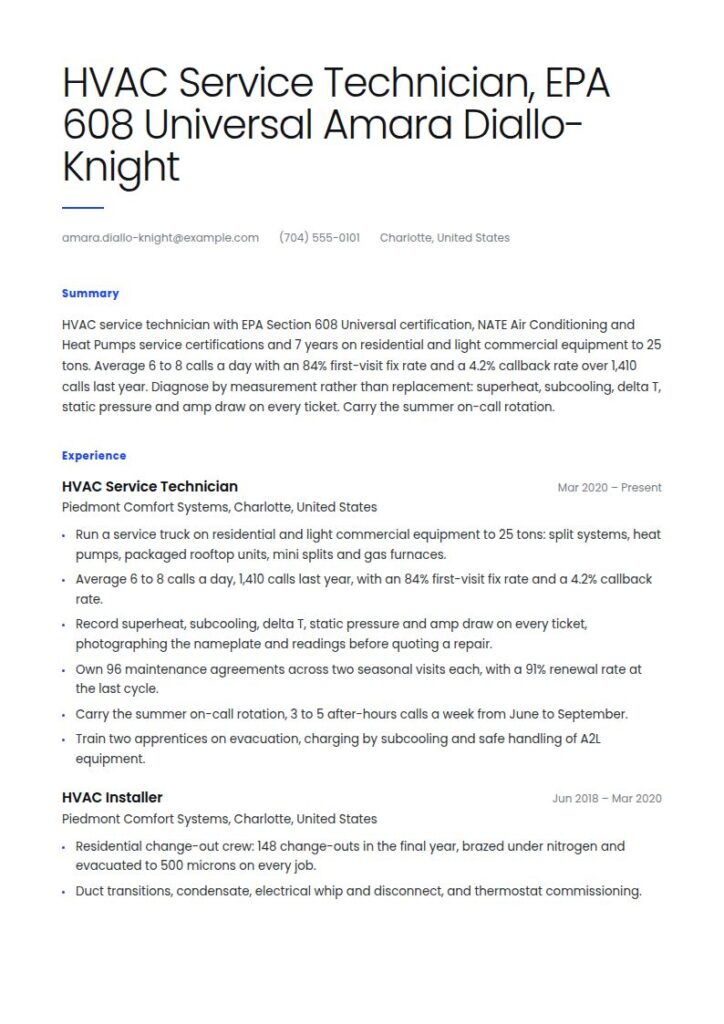
HVAC service technician with EPA Section 608 Universal certification, NATE Air Conditioning and Heat Pumps service certifications and 7 years on residential and light commercial equipment to 25 tons. Average 6 to 8 calls a day with an 84% first-visit fix rate and a 4.2% callback rate over 1,410 calls last year. Diagnose by measurement rather than replacement: superheat, subcooling, delta T, static pressure and amp draw on every ticket. Carry the summer on-call rotation.
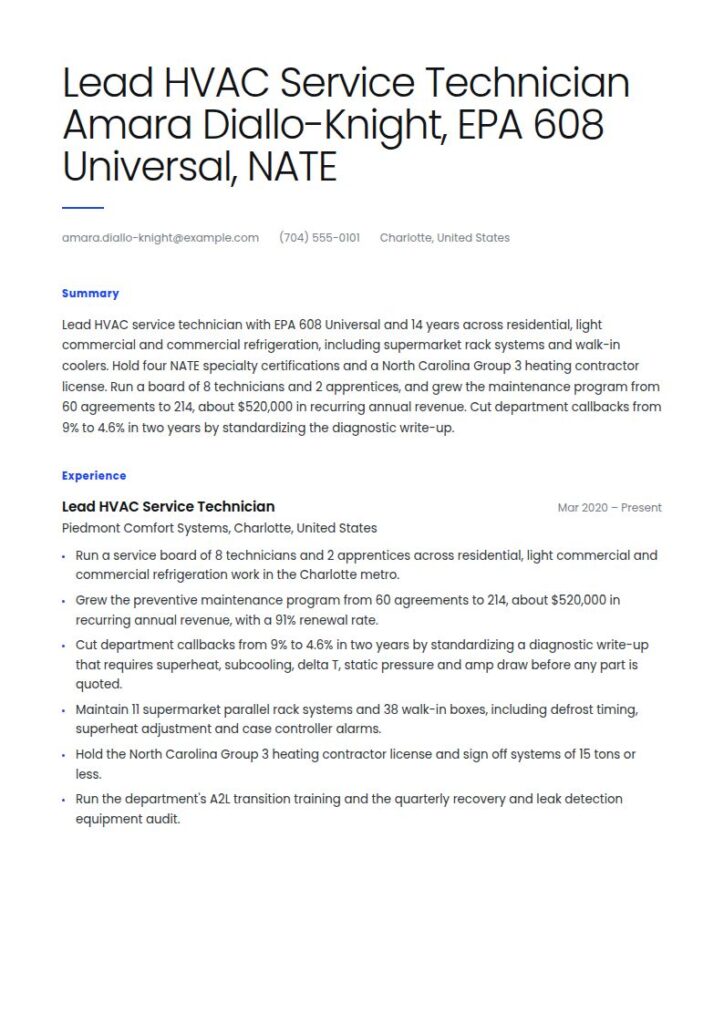
Lead HVAC service technician with EPA 608 Universal and 14 years across residential, light commercial and commercial refrigeration, including supermarket rack systems and walk-in coolers. Hold four NATE specialty certifications and a North Carolina Group 3 heating contractor license. Run a board of 8 technicians and 2 apprentices, and grew the maintenance program from 60 agreements to 214, about $520,000 in recurring annual revenue. Cut department callbacks from 9% to 4.6% in two years by standardizing the diagnostic write-up.
Right vs wrong: the same HVAC technician summary, twice
| ✅ Right | ❌ Wrong |
|---|---|
| HVAC service technician with EPA Section 608 Universal and NATE Air Conditioning and Heat Pumps service certifications, 7 years to 25 tons. | Certified HVAC technician with several years of experience in the field. |
| Average 6 to 8 calls a day with an 84% first-visit fix rate and a 4.2% callback rate over 1,410 calls last year. | Skilled at diagnosing and repairing all types of heating and cooling systems. |
| Superheat, subcooling, delta T, static pressure and amp draw recorded on every ticket. | Committed to excellent customer service and quality workmanship. |
The right column is a dispatch decision. The left is a paragraph every applicant in the folder has written.
Outline your experience
Company, city, dates, then the work. Name the equipment, the tonnage, the refrigerants and the volume. These bullets should read like a ticket history, not a job description.
| Instead of | Use |
|---|---|
| Serviced residential heating and cooling systems | Averaged 6 to 8 calls a day on equipment to 25 tons, 1,410 calls last year |
| Diagnosed and repaired HVAC equipment | Held an 84% first-visit fix rate and 4.2% callback rate by recording superheat, subcooling and static pressure on every ticket |
| Installed new HVAC systems | Completed 148 change-outs, brazed under nitrogen and evacuated to 500 microns on every job |
| Performed preventive maintenance | Owned 96 maintenance agreements across 2 seasonal visits each, 91% renewal rate |
| Worked on commercial equipment | Maintained 11 supermarket rack systems and 38 walk-in boxes, including defrost timing |
HVAC Service Technician, Piedmont Comfort Systems, Charlotte, NC, March 2020 to Present
Run a service truck on residential and light commercial equipment to 25 tons: split systems, heat pumps, packaged rooftop units, mini splits and gas furnaces.
Average 6 to 8 calls a day, 1,410 calls last year, with an 84% first-visit fix rate and a 4.2% callback rate.
Record superheat, subcooling, delta T, static pressure and amp draw on every ticket, photographing the nameplate and readings before quoting a repair.
Own 96 maintenance agreements across two seasonal visits each, 91% renewal at the last cycle.
Carry the summer on-call rotation, 3 to 5 after-hours calls a week from June to September, and train two apprentices on evacuation, charging by subcooling and A2L handling.
Your Section 608 type, your NATE specialties, and which side of the truck you are on
This is the block almost nobody writes correctly, and it is the one a service manager reads first.
EPA Section 608: Universal. Covers small appliances, high and very high pressure appliances, and low pressure appliances.
NATE: CORE plus Air Conditioning (service), Heat Pumps (service), Gas Heating (service), Commercial Refrigeration (service). Renewed 2025, next renewal 2027.
Licensing: North Carolina Group 3 heating contractor license, systems of 15 tons or less, State Board of Examiners of Plumbing, Heating and Fire Sprinkler Contractors.
Equipment: Split systems and heat pumps to 5 tons. Packaged rooftop units to 25 tons. Ductless mini and multi split. Gas furnaces, 80% and condensing. Supermarket parallel rack systems and walk-in boxes.
Refrigerants: R-410A, R-22 recovery and retrofit, R-454B and R-452B A2L with manufacturer handling training. R-404A and R-448A on refrigeration.
Side: Service and diagnostics, with 148 installs behind me.
Six lines, all verifiable. Take them one at a time.
The 608 type decides which appliances you can legally open, and the four types cover genuinely different equipment (EPA, Section 608 Technician Certification Requirements). If you are still an apprentice, note that apprentices are exempt from the certification requirement provided they are closely and continually supervised by a certified technician (EPA). Say that plainly rather than implying a card you do not hold.
NATE is voluntary and the closest thing this trade has to a quality signal: a CORE examination plus specialty examinations on separate service and installation tracks, renewed every two years with 16 continuing education hours or by retaking the specialty exam, with a 120-day grace period (NATE). Naming the specialty and the track says more than "NATE certified".
Refrigerants are worth a line, and worth being precise about. EPA's Technology Transitions program sets a global warming potential limit of 700 for residential and light commercial air conditioning and heat pump products, with a manufacture and import compliance date of 1 January 2025 (EPA, Technology Transitions HFC Restrictions by Sector, updated 28 August 2026). That moved new equipment onto refrigerants such as R-454B and R-452B, which ANSI/ASHRAE Standard 34 classifies as A2L, lower toxicity with a low burning velocity (ASHRAE). There is no federal A2L certification and you should not imply one exists. Write Section 608 plus whatever manufacturer or employer training in A2L handling and leak detection you have actually done.
The side of the truck is the line candidates skip. Install is measured in change-outs, brazing and evacuation practice, duct and electrical work, days per job. Service is measured in calls a day, first-visit fix rate and callback rate. Say which you are, then what you have done on the other side.
A diagnostic write-up is the strongest thing you can put on an HVAC resume
Any technician can say they diagnose accurately. The write-up proves it. A complete one carries nameplate data, measured conditions and the conclusion in that order: indoor and outdoor dry bulb, return and supply temperatures and the delta T, total external static pressure, suction and liquid pressures converted to saturation, superheat, subcooling, compressor amp draw against rated load amps, and the fault all of it points to.
Put it on the resume as a method, not a case study: "Superheat, subcooling, delta T, static pressure and amp draw recorded on every ticket." Then let your callback rate be the evidence. A technician who charges by subcooling on a thermostatic expansion valve system and by superheat on a fixed orifice one, and says so, has separated themselves from the folder in twelve words.
Build a snapshot of your key skills
Twelve to sixteen entries in four groups: diagnostics, refrigeration, heating and airflow, and controls and systems.
Diagnostics: Superheat and subcooling charging, Static pressure and airflow, Electrical troubleshooting and amp draw, Leak detection, Compressor and motor testing
Refrigeration: Recovery, evacuation to 500 microns and charging, Brazing under nitrogen, TXV and metering device replacement, Walk-in boxes, Parallel rack systems and defrost
Heating and airflow: Gas furnace combustion and safeties, Heat pump defrost and auxiliary heat, Duct sizing and transitions, Filtration and IAQ accessories
Controls: Thermostat and zoning, Communicating and inverter systems, Rooftop economizers, Building management system points
List your education and certifications
Section 608 first with the type, then NATE with the specialties and renewal date, then licensing, then training.
EPA Section 608 Universal Certification, 2018. Covers small, high pressure and low pressure appliances.
NATE CORE plus Air Conditioning (service), Heat Pumps (service), Gas Heating (service), Commercial Refrigeration (service). Renewed 2025, next renewal 2027.
North Carolina Group 3 Heating Contractor License, State Board of Examiners of Plumbing, Heating and Fire Sprinkler Contractors, held since 2023.
HVAC Certificate, Central Piedmont Community College, Charlotte, NC, 2012.
Manufacturer training: A2L handling and leak detection (2025). Inverter and communicating systems (2024). Supermarket rack controls (2023). OSHA 10 (2024). North Carolina driver's license, clean record.
Choose the right layout and design
Single column, plain type at 11 or 12 point, clear headings, no photograph, no graphics. Contractor and facilities portals parse the file before anyone reads it, and columns and text boxes are where that breaks.
Put the Section 608 type in the header, not just "EPA certified". Name NATE specialties with the track and renewal year. List the equipment and tonnage you work on. Say whether you are service or install and give that side the numbers. State your diagnostic method in one line. Say whether you take on-call.
Do not imply a certification you do not hold; supply houses and employers verify 608 before you buy refrigerant. Do not claim an A2L certification, because there is no federal one. Do not write "all makes and models" when the nameplate list is what gets you dispatched. Do not hide a seasonal layoff, which is normal here. Do not use a two-column template for a contractor portal.
HVAC technician job market and outlook
| Measure | Value |
|---|---|
| HVACR mechanic and installer jobs, 2025 | 440,900 |
| Projected change, 2025-35 | 11% (much faster than average), +48,200 |
| Projected annual openings | ~40,600 |
| Typical entry-level education | Postsecondary nondegree award |
| Median annual wage, May 2025 | $61,010 |
Source: U.S. Bureau of Labor Statistics, Occupational Outlook Handbook, 2025-35 projections and May 2025 wage data.
Where the work sits:
| Setting | Share of employment | Median annual wage (May 2025) |
|---|---|---|
| Plumbing, heating and air-conditioning contractors | 68% | $60,030 |
| Self-employed | 6% | Not reported |
| Wholesale trade | 3% | $71,190 |
| Educational services | 3% | $62,520 |
| Retail trade | 3% | $62,830 |
Source: U.S. Bureau of Labor Statistics, Occupational Outlook Handbook, May 2025 wage data.
Fast growth, seasonal demand, and a real safety record to respect
Employment of heating, air conditioning and refrigeration mechanics and installers is projected to grow 11 percent from 2025 to 2035, much faster than the average for all occupations, adding 48,200 jobs, with about 40,600 openings projected each year over the decade (BLS Occupational Outlook Handbook, 2025-35 projections).
Sixty-eight percent of the trade works for plumbing, heating and air-conditioning contractors at a median of $60,030, against $71,190 in wholesale trade, the highest paying of the major settings (BLS, May 2025).
The trade also carries real risk: HVAC technicians have one of the highest rates of injuries and illnesses of all occupations, and technicians can be on call for emergencies and work overtime or irregular schedules during peak heating and cooling seasons (BLS Occupational Outlook Handbook). That seasonality is why on-call availability is worth a line; it is the hardest thing a service manager has to cover.
What salary you can expect as an HVAC technician
The median annual wage for heating, air conditioning and refrigeration mechanics and installers was $61,010 in May 2025. The lowest 10 percent earned less than $40,050 and the highest 10 percent more than $95,210 (BLS Occupational Outlook Handbook, May 2025).
Three resume-visible things move you inside that range. Certification depth, because Universal plus commercial refrigeration and NATE specialties widens what you can be dispatched to. Equipment class, because chillers, rack refrigeration and controls bill differently from residential change-outs. And measured performance, because service departments pay on first-visit fix rate, callback rate and agreement renewal. After-hours work is a fourth factor that is not in the median, and it is why a technician who writes "carry the summer on-call rotation" gets called back first.
Key takeaways for an HVAC technician resume
- Put your Section 608 type in the header, because the four types cover different equipment.
- Name NATE specialties with the track and the renewal year, not just "NATE certified".
- List the equipment and tonnage you work on, and the refrigerants you have handled.
- Say whether you are service or install, and give that side the numbers.
- State your diagnostic method in one line, then let the callback rate prove it.
- Be precise about A2L: manufacturer or employer training, not a certification that does not exist.
- Say whether you take the on-call rotation, because seasonal coverage is the hardest gap to fill.
Build your HVAC technician resume in 15 minutes.
Related maintenance and repair resume examples
- Electrician resume
- Plumber resume
- Electrician apprentice resume
- Maintenance technician resume
- Maintenance worker resume
- Handyman resume
- Carpenter resume
- Mechanic resume
- Painter resume
- Cement mason resume
- Facilities manager resume
- Maintenance and repair resume
Pair it with a matching HVAC technician cover letter.
HVAC technician resume questions, answered
How long should an HVAC technician resume be?
One page for your first years. Two once you carry commercial refrigeration, run a service board, or own a maintenance book worth describing. A second page of duty statements is worse than one page of equipment and numbers.
Which EPA Section 608 certification do I need?
It depends on the equipment. Type I is for small appliances, Type II for high-pressure and very high-pressure appliances except small appliances and motor vehicle air conditioning, Type III for low-pressure appliances, and Universal for all types (EPA, Section 608 Technician Certification Requirements). Most residential and light commercial technicians need Type II. The certifications do not expire.
Is NATE certification worth getting?
It is voluntary, so it is a differentiator rather than a requirement, and many contractors pay a differential for it. It is a CORE examination plus specialty examinations on separate service and installation tracks, renewed every two years with 16 continuing education hours or by retaking the specialty exam, with a 120-day grace period (NATE). Write the specialty, the track and the renewal year.
What do I need to know about the new refrigerants?
EPA's Technology Transitions program set a 700 global warming potential limit for residential and light commercial air conditioning and heat pump products, with a manufacture and import compliance date of 1 January 2025 (EPA, updated 28 August 2026), moving new equipment to A2L refrigerants. There is no federal A2L certification, so list Section 608 plus the manufacturer or employer training you have actually completed.
What goes on an HVAC resume with no experience?
Your Section 608 type and date, your training program, and any work that shows you can be trusted with tools and customers. If you are an apprentice without the card, say so accurately: apprentices are exempt while closely and continually supervised by a certified technician (EPA). Then list what you can already do alone, because a helper who can be left to braze and pull a vacuum is worth a seat on a crew.