Facilities Coordinator Priya Ravensworth FMP
Facilities Coordinator
[email protected] | (860) 555-0158 | Hartford, United States
Profile
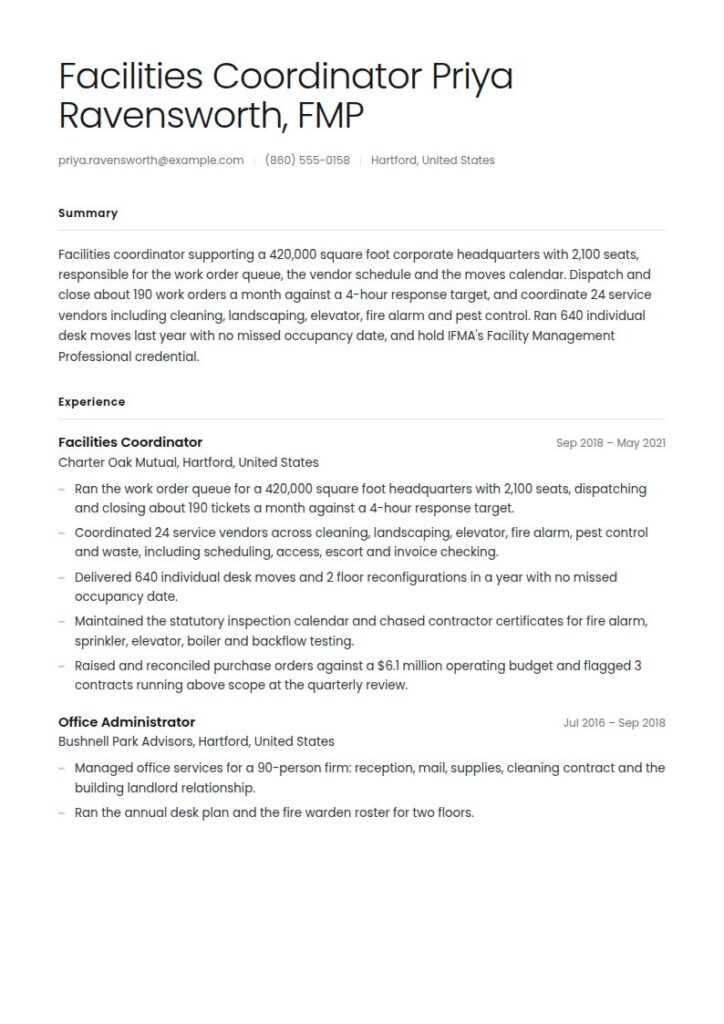
Facilities coordinator supporting a 420,000 square foot corporate headquarters with 2,100 seats, responsible for the work order queue, the vendor schedule and the moves calendar. Dispatch and close about 190 work orders a month against a 4-hour response target, and coordinate 24 service vendors including cleaning, landscaping, elevator, fire alarm and pest control. Ran 640 individual desk moves last year with no missed occupancy date, and hold IFMA's Facility Management Professional credential.
Work Experience
09/2018 - 05/2021, Facilities Coordinator, Charter Oak Mutual, Hartford, United States
- Ran the work order queue for a 420,000 square foot headquarters with 2,100 seats, dispatching and closing about 190 tickets a month against a 4-hour response target.
- Coordinated 24 service vendors across cleaning, landscaping, elevator, fire alarm, pest control and waste, including scheduling, access, escort and invoice checking.
- Delivered 640 individual desk moves and 2 floor reconfigurations in a year with no missed occupancy date.
- Maintained the statutory inspection calendar and chased contractor certificates for fire alarm, sprinkler, elevator, boiler and backflow testing.
- Raised and reconciled purchase orders against a $6.1 million operating budget and flagged 3 contracts running above scope at the quarterly review.
07/2016 - 09/2018, Office Administrator, Bushnell Park Advisors, Hartford, United States
- Managed office services for a 90-person firm: reception, mail, supplies, cleaning contract and the building landlord relationship.
- Ran the annual desk plan and the fire warden roster for two floors.
Education
08/2006 - 05/2010, Bachelor of Science, Business Administration, University of Connecticut, Storrs, United States
Concentration in operations and supply chain management.
Skills
Work order dispatch and CMMS administration, 85
Vendor scheduling and coordination, 80
Space planning and desk moves, 80
Statutory inspection calendar management, 75
Purchase orders and invoice reconciliation, 75
Occupancy reporting, 70
Emergency and fire warden coordination, 70
Languages
English, native
Hindi, native
Portuguese, intermediate
Certificates
03/2021, Facility Management Professional (FMP), International Facility Management Association
Four modules: Finance and Business, Operations and Maintenance, Leadership and Strategy, Project Management.
05/2019, OSHA 10-Hour General Industry, OSHA Outreach Training Program
Summary
A facilities manager resume is a one to two page document about people, contracts and money: the in-house trades you employ, the vendors you hold to a service level, and the operating and capital budgets you defend. This guide gives you three adaptable versions, the IFMA and BOMI credentials that matter, and current Bureau of Labor Statistics pay data.
Facilities Manager resume examples by experience level
A facilities manager resume is a one to two page document about three things: the people you employ, the contracts you hold, and the money you spend.
That is a different job from the one most facilities resumes describe. A facilities manager is not primarily a technical role. You manage a crew of in-house trades and a book of outside vendors, you scope and rebid service contracts, you defend an operating budget and a capital budget in front of finance, you plan space and move people around in it, and you are the named person when a fire marshal, an elevator inspector or a health and safety regulator arrives. The equipment matters, but the equipment is not what you are hired for.
Resume guide for a facilities manager resume
This guide and the corresponding facilities manager resume example will cover:
- How to write a facilities manager resume, section by section
- The crew, the vendor book and the two budgets, and how to size each one
- Three adaptable summaries: coordinator, building manager and portfolio director
- Service contracts, compliance regimes and health and safety accountability
- What the job market looks like and what you can expect to earn
How to write a facilities manager resume
Six sections: contact header, summary, portfolio and team scope, experience with financial and service numbers, credentials, and skills. One page for the first five years, two once you carry a capital budget or more than one site.
Scope goes directly under the summary, and it is financial and human before it is physical. Square footage alone does not size a facilities manager, because a 400,000 square foot building with two staff and a total outsourcing contract is a completely different job from a 400,000 square foot building with eighteen employees and a machine shop.
| Section | What it is answering | Where it goes |
|---|---|---|
| Portfolio and team scope | How many people, how many sites, how much money? | Directly under the summary, in one block |
| Experience | What did they save, deliver, rebid, renegotiate or pass? | Reverse chronological, with dollar values |
| Contracts and vendors | Can they write a scope of work and hold someone to it? | Inside experience, with contract counts and values |
| Credentials | FMP, SFP, CFM, RPA, FMA and the safety cards | Near the end, with issuing body and year |
Size yourself in seven numbers, not in square feet
A hiring manager can place you almost exactly from seven figures, and most facilities resumes give only one of them.
Direct reports and total headcount managed, split between your own employees and contracted staff. Number of sites and total square footage. Occupants or seats supported. Annual operating budget. Annual capital budget. Number of live service contracts and their combined annual value. Union status, because a building with a collective agreement is a different management job.
"11 in-house trades plus 38 contracted staff across 24 vendors, one 420,000 square foot headquarters, 2,100 seats, $8.4 million operating and $5.2 million capital, $4.9 million of third-party contract spend" takes two lines and answers every sizing question in the interview before it is asked.
Run the finished file through the free Rezoom ATS resume checker before you submit. Corporate real estate, healthcare and public sector employers all parse applications into a system before a human opens one.
Choosing the best resume format for a facilities manager resume
Reverse chronological, one to two pages, single column. Tenure matters here more than in most management roles, because a lease cycle, a contract cycle and a capital plan all run on multi-year clocks, and a two-year stay shows none of them completed.
Avoid the systems-list format this job attracts, where the page becomes a column of building systems and software names. That is the format for a technician or an engineer. Yours should read like a manager's: people, contracts, money, and what changed because you were the one signing.
Include your contact information
| ✅ Right | ❌ Wrong |
|---|---|
| Priya Ravensworth, CFM | Priya Ravensworth |
| Facilities Manager, Corporate Portfolio and Vendor Management | Results-driven facilities professional with strong organizational skills |
| IFMA CFM and SFP. BOMI RPA. OSHA 30 General Industry. | Certified facilities manager, various safety certifications |
| (860) 555-0158, [email protected], Hartford, CT | (860) 555-0158, [email protected] |
Put the post-nominals in the header if you hold them. CFM and RPA are both verifiable against a register, and both are uncommon enough to sort a file. Spell the issuing body out at least once further down, because a recruiter outside the field will not recognize the initials.
Make use of a summary
Four lines: the portfolio, the headcount, the two budget figures, and one contract or cost result with a dollar value on it.
Facilities coordinator supporting a 420,000 square foot corporate headquarters with 2,100 seats, responsible for the work order queue, the vendor schedule and the moves calendar. Dispatch and close about 190 work orders a month against a 4-hour response target, and coordinate 24 service vendors including cleaning, landscaping, elevator, fire alarm and pest control. Ran 640 individual desk moves last year with no missed occupancy date, and hold IFMA's Facility Management Professional credential.
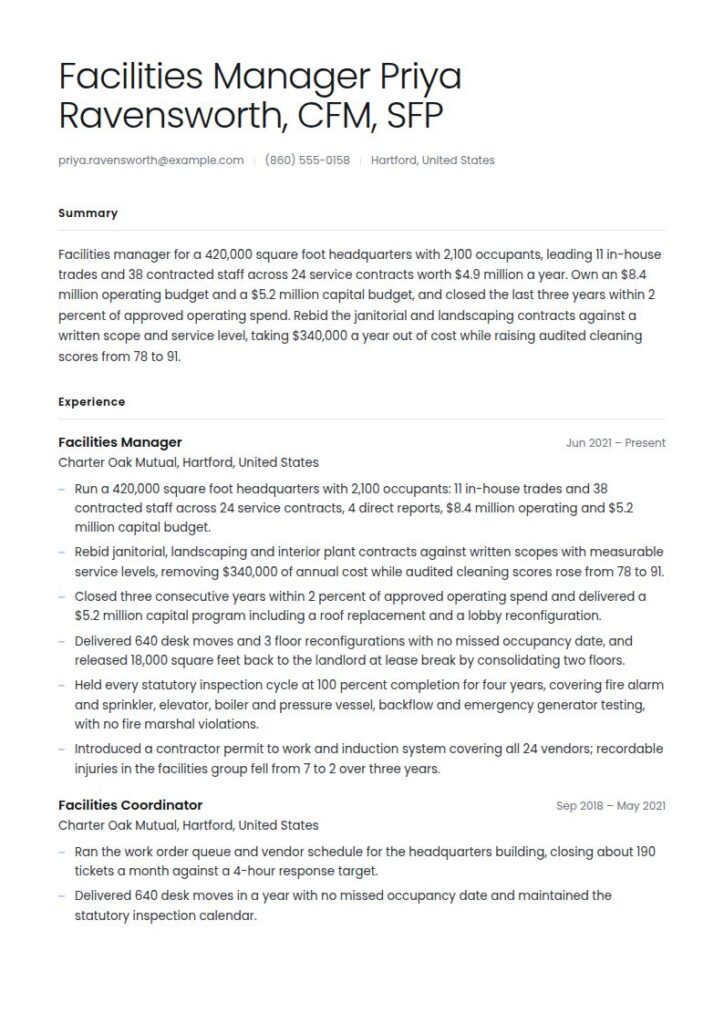
Facilities manager for a 420,000 square foot headquarters with 2,100 occupants, leading 11 in-house trades and 38 contracted staff across 24 service contracts worth $4.9 million a year. Own an $8.4 million operating budget and a $5.2 million capital budget, and closed the last three years within 2 percent of approved operating spend. Rebid the janitorial and landscaping contracts against a written scope and service level, taking $340,000 a year out of cost while raising audited cleaning scores from 78 to 91.
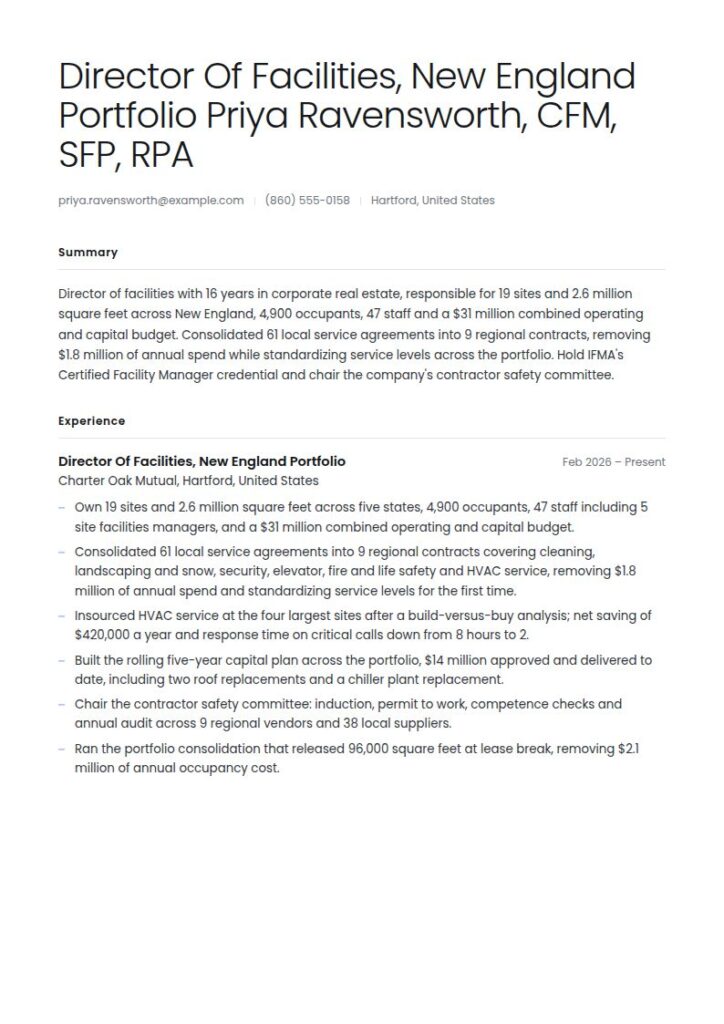
Director of facilities with 16 years in corporate real estate, responsible for 19 sites and 2.6 million square feet across New England, 4,900 occupants, 47 staff and a $31 million combined operating and capital budget. Consolidated 61 local service agreements into 9 regional contracts, removing $1.8 million of annual spend while standardizing service levels across the portfolio. Hold IFMA's Certified Facility Manager credential and chair the company's contractor safety committee.
Right vs wrong: the same facilities manager summary, twice
| ✅ Right | ❌ Wrong |
|---|---|
| Lead 11 in-house trades and 38 contracted staff across 24 service contracts worth $4.9 million a year. | Manage a team of facilities staff and oversee external service providers. |
| Own an $8.4 million operating budget and a $5.2 million capital budget, closing within 2 percent of approved spend. | Responsible for budgeting and cost control across the facility. |
| Rebid janitorial and landscaping, taking $340,000 a year out of cost while raising audited cleaning scores from 78 to 91. | Negotiated with vendors to achieve significant cost savings. |
The right column can be compared against the reader's own building. The left column describes the job title rather than the person holding it, which is why so many capable facilities managers never reach interview.
Outline your experience
Employer, portfolio type, square footage, headcount and dates. Then four to six bullets, each carrying a dollar value, a headcount, a contract count or a compliance outcome.
| Instead of | Use |
|---|---|
| Managed facilities staff and contractors | Led 11 in-house trades and 38 contracted staff across 24 vendors, with 4 direct reports |
| Responsible for the facilities budget | Owned $8.4 million operating and $5.2 million capital, closing within 2 percent of approved operating spend for three years |
| Negotiated vendor contracts | Rebid 9 contracts against written scopes and service levels, removing $340,000 a year while raising audited cleaning scores from 78 to 91 |
| Ensured building compliance | Passed fire alarm, sprinkler, elevator, boiler and backflow inspection cycles at 100 percent for four consecutive years with no fire marshal violations |
| Handled office moves | Delivered 640 desk moves and 3 floor reconfigurations with no missed occupancy date, releasing 18,000 square feet back to the lease |
| Improved workplace safety | Took recordable injuries in the facilities group from 7 to 2 over three years and introduced a contractor permit to work system covering 24 vendors |
Facilities Manager, Charter Oak Mutual, Hartford, CT, June 2021 to Present
Run a 420,000 square foot headquarters with 2,100 occupants: 11 in-house trades and 38 contracted staff across 24 service contracts, 4 direct reports, $8.4 million operating and $5.2 million capital budget.
Rebid janitorial, landscaping and interior plant contracts against written scopes with measurable service levels, removing $340,000 of annual cost while audited cleaning scores rose from 78 to 91.
Closed three consecutive years within 2 percent of approved operating spend and delivered a $5.2 million capital program including a roof replacement and a lobby reconfiguration.
Delivered 640 desk moves and 3 floor reconfigurations with no missed occupancy date, and released 18,000 square feet back to the landlord at lease break by consolidating two floors.
Held every statutory inspection cycle at 100 percent completion for four years, covering fire alarm and sprinkler, elevator, boiler and pressure vessel, backflow and emergency generator testing, with no fire marshal violations.
Introduced a contractor permit to work and induction system covering all 24 vendors; recordable injuries in the facilities group fell from 7 to 2 over three years.
Show the crew, the vendor book and the two budgets
This is the section that separates a facilities manager from the engineer or the technician, and it is the one almost every applicant leaves as a vague sentence about overseeing staff and suppliers.
The crew. Give the shape, not just the number. How many are your employees and how many are agency or contracted. Which trades, and at what license tier. How many direct reports against total headcount. Shift coverage, because a site with a night shift and a weekend rota is a scheduling job as much as a technical one. Union status and which agreement, because negotiating overtime under a collective agreement is a named skill. Then give one people result: retention, vacancy time, an apprenticeship you started, a supervisor you developed.
The vendor book. This is where facilities managers spend most of their money and almost none of their resume space. Give the number of live contracts, the combined annual value, and the categories: cleaning, security, landscaping, elevator, fire and life safety, HVAC service, pest control, waste, catering, mailroom. Then say what you have done to it. Consolidated, rebid, insourced, outsourced, moved from time and materials to fixed price, added service levels where there were none.
The two budgets. Operating and capital are separate documents with separate approvers and separate political weather, and conflating them is the fastest way to look like you have never owned either. Operating covers labor, contracts, utilities, consumables and reactive repair, and it is judged on variance against plan. Capital covers replacement and improvement, is approved in a cycle, and is judged on delivery against approved budget and schedule. Give both figures, say which one you own versus influence, and give one variance or delivery number.
Where facilities management money actually sits
Facilities managers had a median annual wage of $106,660 as of May 2025, with the lowest 10 percent under $64,480 and the highest 10 percent over $176,120, against 165,900 people employed in the occupation in 2025 (BLS Occupational Outlook Handbook, May 2025 and 2025-35 projections).
The industry spread is larger than the seniority spread. Facilities managers in manufacturing had a median of $129,620 against $100,780 in educational services, a gap of roughly $28,800 for the same job title (BLS Occupational Outlook Handbook, May 2025).
The reason is what the building does. Where the facility is a production asset, downtime has a price and the facilities manager sits close to operations. Where it is overhead, the role sits close to procurement. Both are real careers, but they are bid for differently, and the resume that shows contract value, headcount and capital delivery is the one that moves between them.
Service contracts: how they are scoped, priced and renewed
Contract management is the largest single lever a facilities manager has and the least visible on a typical resume. Show that you understand all three stages.
| Stage | What a good answer sounds like | What to put on the resume |
|---|---|---|
| Scoping | A written scope of work with measurable outputs rather than inputs: cleaning audited to a score, not "five cleaners nightly" | Number of contracts rescoped, and the measure you introduced |
| Pricing | Fixed price, time and materials, cost plus a management fee, or performance-based with service level credits | The pricing model you moved a contract to, and why |
| Tendering | Market test, request for proposal, evaluation weighting between price and quality, reference checks | Contracts tendered, bidders evaluated, the weighting used |
| Mobilization | Transition plan, TUPE or staff transfer where it applies, asset and key handover | Transitions run without a service gap |
| Managing | Monthly service review, key performance indicators, service credits, escalation | The KPI regime you ran and what it recovered |
| Renewal | Benchmark before you renew, and know the cost of switching | Contracts renewed, rebid or insourced, with the saving |
The single most useful sentence you can write here is the one that shows you can go both ways. Anyone can outsource. A facilities manager who has insourced a function because the numbers said so, and can show the calculation, reads as someone who runs the decision rather than the default.
One building, a campus or a portfolio
These are three different jobs with the same title, and the resume should say plainly which one you have done.
| Model | What the job actually is | What the resume should carry |
|---|---|---|
| Single building | Hands-on operations: you know the plant, you know the tenants, you are in the building every day | Square footage, occupants, in-house headcount, operating budget, inspection record |
| Campus | Standardizing across buildings that were run differently, plus central plant, roads, grounds and shared services | Number of buildings, central services run, how you standardized, utility and grounds scope |
| Portfolio | Contract and financial management at distance, with local managers or vendors doing the operating | Number of sites, geographic spread, regional contract structure, headcount of managers not technicians |
Moving up that table is the usual career path, and the transition that fails most often is single building to portfolio, because the skills that made you good in the building do not transfer. If you are making that jump, weight the resume towards contracts, standardization and financial control, and be explicit about the number of sites and the reporting line beneath you.
Compliance, inspections and who signs for safety
A building has a calendar of things it must pass, and the facilities manager is usually the named accountable person. Say which regimes you have carried and what the outcome was.
The common ones, and what a reader is checking:
- Fire alarm and sprinkler inspection, testing and maintenance, plus fire extinguisher and emergency lighting testing, signed off to the local fire marshal.
- Elevator inspection and certification, boiler and pressure vessel inspection, and backflow prevention device testing, all on statutory cycles in most jurisdictions.
- Emergency and standby generator testing, and life safety systems more broadly in occupied buildings.
- Accessibility obligations under the Americans with Disabilities Act, including the accessible route, restrooms, signage and areas of refuge.
- Environmental obligations: waste, refrigerant records, above-ground and underground storage tanks, stormwater.
- Sector overlays: the Joint Commission environment of care in healthcare, state licensing inspections in education and childcare, and food safety regimes where there is a kitchen.
On health and safety, the accountability is personal and it is worth writing as such. Name the systems you have run: contractor induction and permit to work, hot work permits, lockout and tagout program ownership, confined space entry authorization, asbestos and lead management plans in older stock, OSHA recordkeeping, incident investigation and corrective action closure.
Contractor safety is your exposure, not theirs
There were 5,070 fatal work injuries in the United States in 2024, a rate of 3.3 per 100,000 full-time equivalent workers, and construction and extraction occupations accounted for 1,032 of them at a rate of 12.6 per 100,000 full-time equivalent workers (BLS Census of Fatal Occupational Injuries, 2024, released 19 February 2026).
Most of the high-risk work in a building is done by people who are not on your payroll: roofers, electricians on shutdowns, window cleaners, tree crews, lift engineers. That is precisely why a permit to work system, a contractor induction and a documented competence check are facilities management responsibilities rather than procurement ones.
On a resume, a sentence like "introduced contractor induction and permit to work across 24 vendors; recordable injuries in the facilities group fell from 7 to 2 over three years" does two jobs at once. It shows a safety outcome and it shows you manage the vendor book by something other than price.
Put headcount, sites, square footage, occupants, operating budget, capital budget and contract value in one block under the summary. Separate your own employees from contracted staff. Give contract counts with combined annual value. Say which budget you own and which you influence. Name the compliance regimes you carried and the inspection outcomes. State whether you have run one building, a campus or a portfolio. Write the credential in full at least once, with the issuing body.
Do not merge operating and capital into one budget figure; a reader who runs both will notice immediately. Do not claim savings you did not calculate, because the first interview question is how you measured it. Do not describe technician work in a manager's resume; if you personally changed the belts, that belongs in an earlier role. Do not list building systems with no money, people or outcome attached. Do not write "CFM certified" without saying it is IFMA's Certified Facility Manager, since recruiters outside the field will not know.
Build a snapshot of your key skills
Twelve to sixteen entries in four groups: people and contracts, financial, compliance and safety, and systems.
People and contracts: Multi-trade team leadership, union and collective agreement administration, scope of work writing, request for proposal and tender evaluation, service level and KPI management, vendor consolidation, insourcing and outsourcing analysis
Financial: Operating budget ownership, capital planning and business cases, variance analysis and forecasting, cost per square foot benchmarking, lease and occupancy cost review, procurement and purchase order control
Compliance and safety: Fire and life safety inspection programs, elevator, boiler and backflow statutory cycles, ADA accessibility obligations, contractor induction and permit to work, OSHA recordkeeping and incident investigation, emergency and business continuity planning
Systems: IWMS and CAFM platforms, CMMS work order management, space planning and occupancy reporting, building management system reporting, ENERGY STAR Portfolio Manager, AutoCAD floor plan maintenance
List your education and certifications
Degree, then credentials with the issuing body, then safety cards. Facilities management is one of the few management occupations where the credential genuinely changes what a recruiter does with your file, because the field has no license and the credentials are the only external verification available.
| Credential | Issuer | What it takes |
|---|---|---|
| FMP, Facility Management Professional | IFMA | Four modules: Finance and Business, Operations and Maintenance, Leadership and Strategy, Project Management, with an assessment per module and no educational or experience prerequisites (IFMA, accessed September 2026) |
| SFP, Sustainability Facility Professional | IFMA | Three units across twelve chapters, roughly 50 hours and 4.9 continuing education units, no prerequisites, with more than 2,500 holders globally (IFMA, accessed September 2026) |
| CFM, Certified Facility Manager | IFMA | Five years of facility management experience, or three years plus a bachelor's or master's degree in facility management; a three-hour exam of 120 multiple-choice questions with a 65 percent pass rate; valid three years and renewed with continuing education units. Accredited by the ANSI National Accreditation Board, with roughly 4,300 credential holders (IFMA, accessed September 2026) |
| RPA, Real Property Administrator | BOMI International, a division of BOMA International | Seven core courses plus one elective, three years of verifiable property management experience, and a proctored 100-question capstone examination (BOMI International, accessed September 2026) |
| FMA, Facilities Management Administrator | BOMI International | The facilities-focused counterpart to the RPA, aimed at people managing building operations rather than the asset |
The CFM is the one that carries weight, and the reason is its eligibility bar rather than its exam: it cannot be bought by someone with no experience. If you are early in the field, the FMP is the sensible first step, because it has no prerequisites and it signals the same body of knowledge.
Certified Facility Manager (CFM), International Facility Management Association, 2025. Current through 2028.
Sustainability Facility Professional (SFP), International Facility Management Association, 2023
Facility Management Professional (FMP), International Facility Management Association, 2021
Real Property Administrator (RPA), BOMI International, 2022
Bachelor of Science, Business Administration, University of Connecticut, Storrs, CT, 2010
Safety and technical: OSHA 30-hour General Industry, 2024. Contractor permit to work system owner. First aid and CPR, American Red Cross, 2026.
Choose the right layout and design
Single column, 10 or 11 point body type, no photograph, no skill bars. Corporate real estate and public sector employers run applicant tracking systems, and two-column templates are where parsing breaks.
Put the scope block immediately under the summary. A facilities director skimming forty files is looking for headcount and budget figures, and if they are buried on page two the file is closed before they are found.
Facilities manager job market and outlook
A mid-sized management occupation growing steadily, reported by the Bureau of Labor Statistics inside the administrative services and facilities managers group.
| Measure | Value |
|---|---|
| Facilities manager jobs, 2025 | 165,900 |
| Projected change, facilities managers, 2025-35 | +7,600, within a group growing 5% |
| Administrative services and facilities managers, employment 2025 | 444,800 |
| Projected annual openings across the group | ~36,100 |
| Typical entry-level education | Bachelor's degree |
| Typical work experience required | Less than 5 years in a related occupation |
| Median annual wage, facilities managers, May 2025 | $106,660 |
Source: U.S. Bureau of Labor Statistics, Occupational Outlook Handbook, May 2025 wage data and 2025-35 employment projections, published 27 August 2026.
The entry route is worth reading carefully. The typical requirement is a bachelor's degree and fewer than five years in a related occupation, which in practice means most facilities managers arrive from somewhere else: a trade, a property or leasing role, office management, a vendor-side account manager, or the military. If that is you, the resume's job is to translate. Crew supervised becomes headcount managed. Purchase orders approved becomes budget controlled. Supplier relationships becomes contract management.
What salary you can expect as a facilities manager
Facilities managers had a median annual wage of $106,660 as of May 2025, with the lowest 10 percent earning less than $64,480 and the highest 10 percent more than $176,120. The closely related administrative services managers had a median of $114,130, with a top decile above $207,720 (BLS Occupational Outlook Handbook, May 2025).
Four things move you up that range, and all four are things a resume can state.
Industry first. Manufacturing paid a median of $129,620 against educational services at $100,780 for the same job title (BLS Occupational Outlook Handbook, May 2025), and the difference is whether the building is a production asset or an overhead line.
Then scope: sites, square footage and headcount. Then money: the size of the budgets you personally own, and whether capital is one of them. Then the credential, because in a field with no license the CFM is the only widely recognized external verification and its eligibility bar keeps it scarce.
Key takeaways for a facilities manager resume
- Put headcount, sites, square footage, occupants and both budget figures in one block under the summary.
- Separate your own employees from contracted staff, and give the number of live service contracts with their combined value.
- Keep operating and capital budgets apart, and say which one you own.
- Show the full contract cycle: scoped, tendered, mobilized, managed, renewed, with a saving you can explain.
- Name the compliance regimes you carried and the inspection outcomes, not just the systems.
- Write contractor safety as a management system, because most of the dangerous work in your building is done by someone else's employees.
- Say plainly whether you have run one building, a campus or a portfolio.
Build your facilities manager resume in 15 minutes.
Related maintenance and repair resume examples
- Maintenance and repair sector resume
- Maintenance technician resume
- Maintenance worker resume
- Handyman resume
- Electrician resume
- Plumber resume
- HVAC technician resume
- Carpenter resume
- Custodian resume
- Janitor resume
- Housekeeping resume
- Landscaping resume
If your work is the engineering side of buildings, uptime and energy rather than contracts and headcount, start with the facilities engineer resume instead.
Pair it with a matching facilities manager cover letter.
Facilities manager resume questions, answered
How long should a facilities manager resume be?
One page for the first five years, two once you carry a capital budget, more than one site, or a contract portfolio worth describing. Keep a separate one-page contract and capital project list rather than stretching to three pages; interviewers in this field ask for one often enough that having it ready is a signal in itself.
Is the CFM worth doing?
It is the only credential in the field with a real eligibility bar: five years of facility management experience, or three years plus a bachelor's or master's in facility management, followed by a three-hour exam of 120 multiple-choice questions that about 65 percent of candidates pass, with roughly 4,300 holders (IFMA, accessed September 2026). That scarcity is the value. If you do not yet qualify, the FMP has no prerequisites and covers the same four domains.
What is the difference between a facilities manager and a facilities engineer?
Contracts and people versus systems and performance. A facilities engineer is measured on uptime, energy intensity and the planned to reactive maintenance ratio. A facilities manager is measured on budget variance, contract value, service levels, compliance outcomes and headcount. Large sites employ both; smaller ones expect one person to do both, in which case write the resume to whichever the job description weights.
How do I move from a trade into facilities management?
Translate the record rather than repeating it. Crew supervised becomes headcount managed, purchase orders raised becomes spend controlled, subcontractors coordinated becomes vendor management, and preventive maintenance schedules become program ownership. The typical entry requirement is a bachelor's degree and fewer than five years in a related occupation (BLS Occupational Outlook Handbook, 2026), so the trade background is not a barrier, but it does have to be rewritten in management units.
Should I list building systems on a facilities manager resume?
Only in the skills block, and without capacities. Detailed plant specifications read as a technician's page. What belongs in your experience is what the systems cost, who maintained them, under what contract, and what happened to availability or spend while you owned them.
What if I have never owned a capital budget?
Say what you have owned and what you have contributed to. Many facilities managers build the business case and defend it while someone else holds the approval. "Wrote and defended the five-year capital plan, $5.2 million approved, delivered by the regional director" is an honest and useful sentence. Inventing sign-off authority is not, and the reference call is where it comes apart.