Residential Painter Dorota Kaminski-Reyes EPA Lead-Safe Certified Renovator
Residential Painter
[email protected] | (505) 555-0193 | Albuquerque, United States
Profile
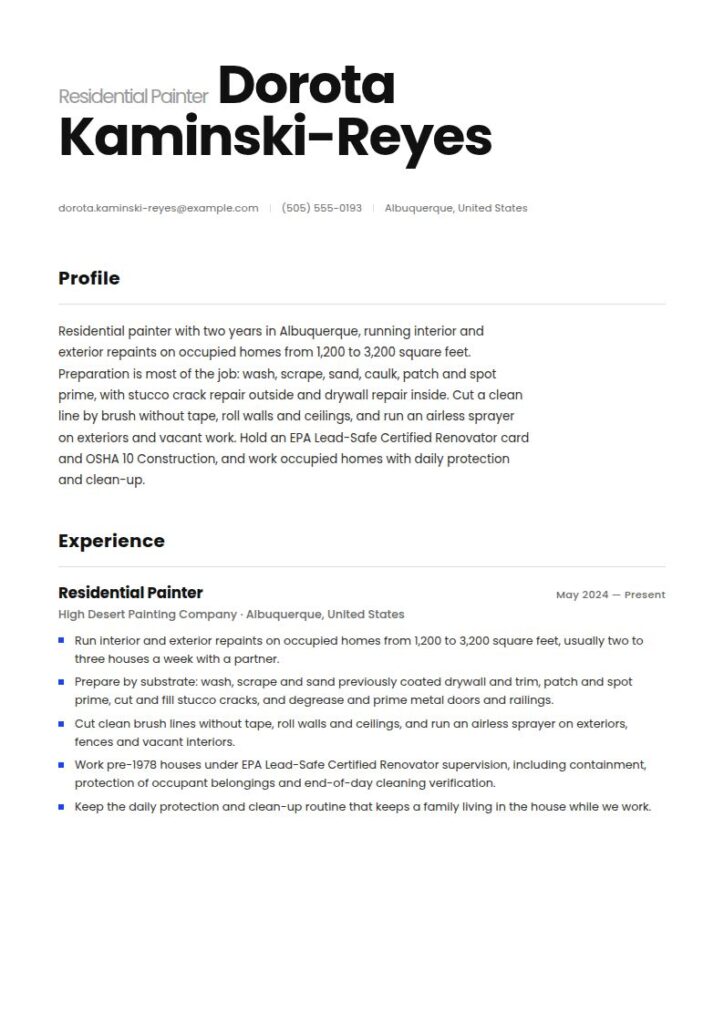
Residential painter with two years in Albuquerque, running interior and exterior repaints on occupied homes from 1,200 to 3,200 square feet. Preparation is most of the job: wash, scrape, sand, caulk, patch and spot prime, with stucco crack repair outside and drywall repair inside. Cut a clean line by brush without tape, roll walls and ceilings, and run an airless sprayer on exteriors and vacant work. Hold an EPA Lead-Safe Certified Renovator card and OSHA 10 Construction, and work occupied homes with daily protection and clean-up.
Work Experience
05/2024 - Present, Residential Painter, High Desert Painting Company, Albuquerque, United States
- Run interior and exterior repaints on occupied homes from 1,200 to 3,200 square feet, usually two to three houses a week with a partner.
- Prepare by substrate: wash, scrape and sand previously coated drywall and trim, patch and spot prime, cut and fill stucco cracks, and degrease and prime metal doors and railings.
- Cut clean brush lines without tape, roll walls and ceilings, and run an airless sprayer on exteriors, fences and vacant interiors.
- Work pre-1978 houses under EPA Lead-Safe Certified Renovator supervision, including containment, protection of occupant belongings and end-of-day cleaning verification.
- Keep the daily protection and clean-up routine that keeps a family living in the house while we work.
06/2023 - 05/2024, Painter's Helper, High Desert Painting Company, Albuquerque, United States
- Masked, protected and set up work areas, sanded and caulked, and handled clean-up and equipment maintenance.
- Learned substrate identification, primer selection and sprayer setup and cleaning on the job.
Education
08/2019 - 05/2023, High School Diploma, General, West Mesa High School, Albuquerque, United States
Building trades electives, including finish carpentry and shop safety.
Skills
Substrate identification and preparation, 70
Scraping, sanding and feather edging, 80
Patching and spot priming, 75
Caulking and sealant work, 80
Stucco crack repair, 65
Brush cut lines without tape, 80
Rolling walls and ceilings, 85
Airless spray setup and cleaning, 70
Occupied home protection and clean-up, 85
Languages
English, native
Spanish, fluent
Polish, conversational
Certificates
07/2024, EPA Lead-Safe Certified Renovator, US Environmental Protection Agency, Renovation, Repair and Painting Rule
Eight-hour initial renovator training course. Required for compensated work disturbing painted surfaces in pre-1978 housing and child-occupied facilities. Recertification due 2029.
09/2023, OSHA 10-Hour Construction, Occupational Safety and Health Administration Outreach Training Program
Course completion card held.
03/2026, Respirator Fit Test, Half Face, High Desert Painting Company
Annual fit test under 29 CFR 1910.134.
Summary
A painter resume is a one page document naming the substrates you prepare, the preparation standard you work to, the coating systems you apply and the lead certification you hold. This guide gives you three adaptable versions, the preparation block that separates painters from rollers, and current Bureau of Labor Statistics pay and outlook for painters.
Painter resume examples by experience level
A painter resume is a one page document about surface preparation, because that is where the quality, the money and the arguments actually live.
Nobody loses a paint job on the topcoat. They lose it because the stucco was not washed, the galvanized metal was not etched, the drywall patch was not spot primed, or the old alkyd was recoated with the wrong product and lifted three weeks later. Every experienced estimator knows this, which is why the resume that describes preparation by substrate is read as a professional's file and the resume that lists colors and brands is read as a helper's.
Resume guide for a painter resume
This guide and the corresponding painter resume example will cover:
- How to write a painter resume, section by section
- How to describe surface preparation by substrate so an estimator recognizes it
- Three adaptable summaries: residential, commercial and industrial coatings
- The EPA lead rule, which is a legal requirement rather than a nice extra
- What the job market looks like and what you can expect to earn
How to write a painter resume
Six blocks: contact header, summary, substrates and preparation, experience, coatings and equipment, and certifications. One page. Two only once you run crews, apply specified industrial systems and carry inspection responsibility.
The preparation block goes directly under the summary. It is the whole argument. A commercial estimator reading your file is trying to work out whether you will cost them a callback, and preparation is the only part of the job that predicts it.
| Section | What it is answering | Where it goes |
|---|---|---|
| Substrates and preparation | Does this person know what to do with each surface? | Directly under the summary |
| Experience | What kind of buildings, at what square footage, occupied or not? | Reverse chronological, with numbers |
| Coatings and equipment | Which systems can they apply, and with what? | Its own block, with products by type |
| Certifications | Can they legally touch a pre-1978 building? | Its own block, with dates |
Describe preparation by substrate, not as a single word
"Surface preparation" on a resume means nothing, because every painter writes it. Preparation is a different job on every material, and naming the differences is what proves you know them.
New drywall gets a primer sealer over finished and dusted joints. Previously coated drywall gets washed, patched, sanded and spot primed. Plaster gets tested for moisture and chalk. Concrete masonry unit gets a block filler. Concrete floors get mechanical profiling, not acid etching, if the system calls for it. Galvanized metal gets degreased and an appropriate primer, because ordinary alkyd will saponify on it. Ferrous metal gets cleaned to a written standard. Weathered exterior stucco gets washed, cracks cut and filled, and an elastomeric or masonry primer depending on the system.
Write four or five of those on the page as a list of substrate and method. It takes three lines and it separates you from every file in the stack that says "detail oriented".
Run the finished file through the free Rezoom ATS resume checker before you send it. Larger painting contractors and facilities departments run applications through a system before an estimator sees one.
Choosing the best resume format for a painter resume
Reverse chronological, one page, single column. Painting contractors read continuity as evidence that your work did not come back, and a functional format that hides dates reads as a format hiding short jobs.
Put the substrate and preparation block above the experience anyway, so the first four seconds do the work.
Include your contact information
| ✅ Right | ❌ Wrong |
|---|---|
| Dorota Kaminski-Reyes | Dorota Kaminski-Reyes |
| Painting Foreman, Industrial and Commercial Coatings | Professional painter |
| EPA Lead-Safe Certified Renovator, OSHA 30 Construction | Lead certified |
| (505) 555-0193, [email protected], Albuquerque, NM | (505) 555-0193, [email protected] |
Put your lead certification in the header, not on page two. It is a legal gate on a large share of American housing stock, and an estimator bidding repaint work on older homes is looking for it before anything else.
Make use of a summary
Four lines: the market you work in, the substrates you prepare, the systems you apply, and one number tied to a project.
Residential painter with two years in Albuquerque, running interior and exterior repaints on occupied homes from 1,200 to 3,200 square feet. Preparation is most of the job: wash, scrape, sand, caulk, patch and spot prime, with stucco crack repair outside and drywall repair inside. Cut a clean line by brush without tape, roll walls and ceilings, and run an airless sprayer on exteriors and vacant work. Hold an EPA Lead-Safe Certified Renovator card and OSHA 10 Construction, and work occupied homes with daily protection and clean-up.
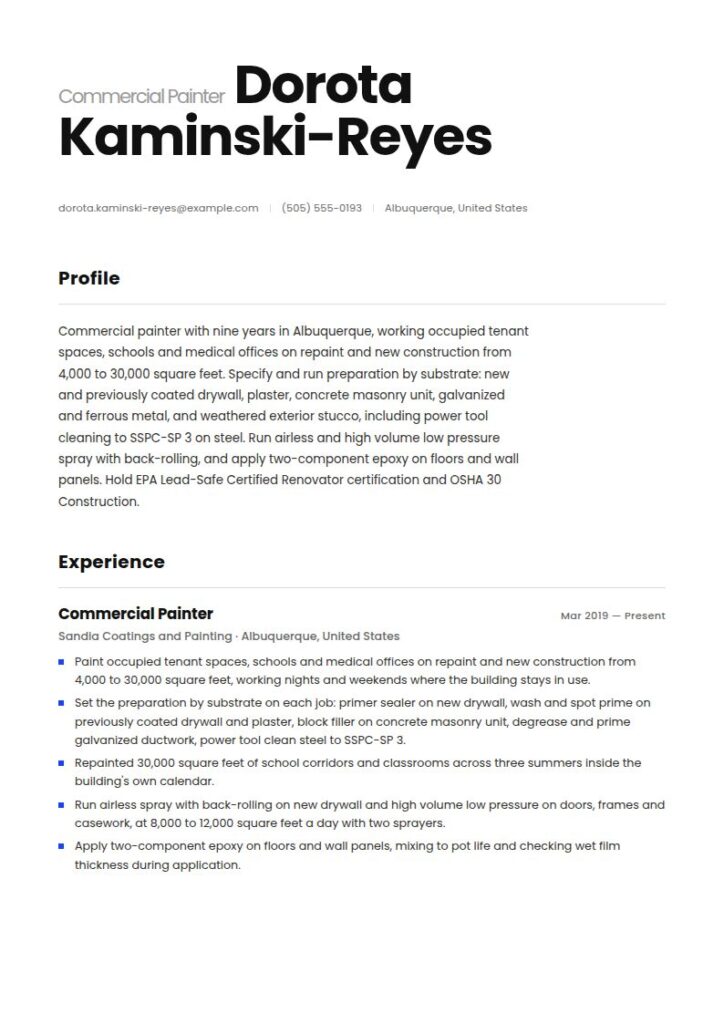
Commercial painter with nine years in Albuquerque, working occupied tenant spaces, schools and medical offices on repaint and new construction from 4,000 to 30,000 square feet. Specify and run preparation by substrate: new and previously coated drywall, plaster, concrete masonry unit, galvanized and ferrous metal, and weathered exterior stucco, including power tool cleaning to SSPC-SP 3 on steel. Run airless and high volume low pressure spray with back-rolling, and apply two-component epoxy on floors and wall panels. Hold EPA Lead-Safe Certified Renovator certification and OSHA 30 Construction.
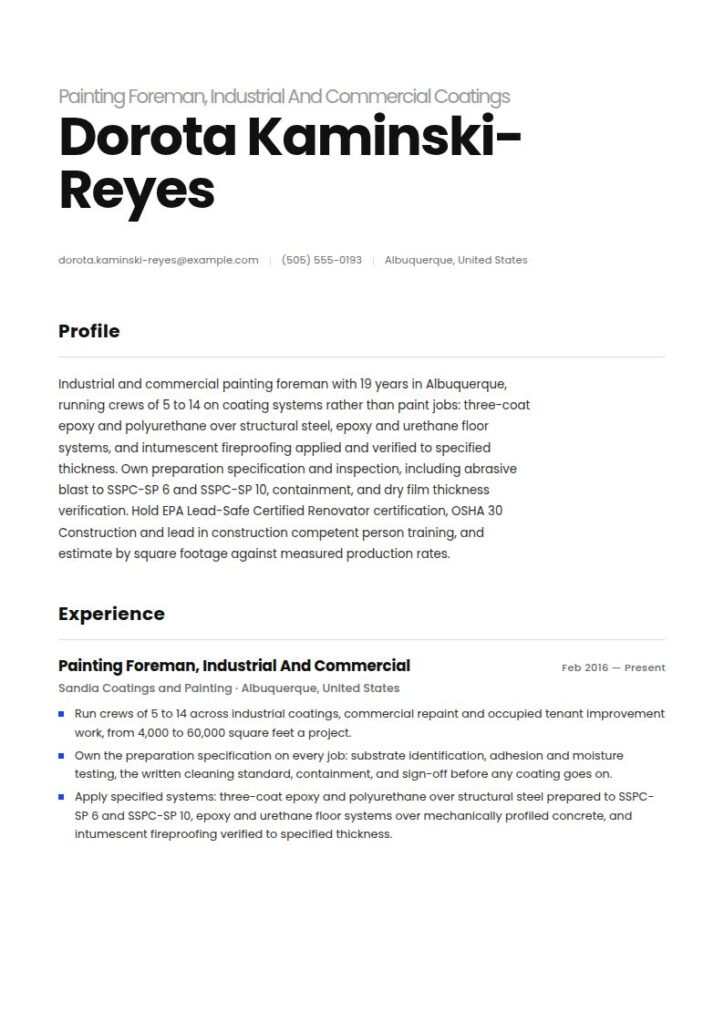
Industrial and commercial painting foreman with 19 years in Albuquerque, running crews of 5 to 14 on coating systems rather than paint jobs: three-coat epoxy and polyurethane over structural steel, epoxy and urethane floor systems, and intumescent fireproofing applied and verified to specified thickness. Own preparation specification and inspection, including abrasive blast to SSPC-SP 6 and SSPC-SP 10, containment, and dry film thickness verification. Hold EPA Lead-Safe Certified Renovator certification, OSHA 30 Construction and lead in construction competent person training, and estimate by square footage against measured production rates.
Right vs wrong: the same painter summary, twice
| ✅ Right | ❌ Wrong |
|---|---|
| Preparation by substrate: drywall, plaster, concrete masonry unit, galvanized and ferrous metal, stucco. | Skilled in surface preparation and painting techniques. |
| Three-coat epoxy and polyurethane over structural steel with dry film thickness verification. | Experienced with industrial and commercial coatings. |
| EPA Lead-Safe Certified Renovator, current, with containment and cleaning verification on pre-1978 work. | Familiar with lead paint safety procedures. |
The right column can be put on a specified job next week. The left column cannot, and the person reading it is checking a specification.
Outline your experience
Employer, city, dates, title, and the market: residential, commercial or industrial. Then bullets naming building type, square footage, substrate, system and a number. A painting bullet with no substrate or scale in it is a job description.
| Instead of | Use |
|---|---|
| Painted interior and exterior surfaces | Repainted 30,000 square feet of occupied school corridors and classrooms over three summers, working nights and weekends around building use |
| Prepared surfaces for painting | Prepared by substrate: washed and spot primed previously coated drywall, block filled concrete masonry unit, degreased and primed galvanized ductwork, power tool cleaned steel to SSPC-SP 3 |
| Used spray equipment | Ran airless spray with back-rolling on new drywall and high volume low pressure for doors, frames and casework, at 8,000 to 12,000 square feet a day with two sprayers |
| Applied industrial coatings | Applied three-coat epoxy and polyurethane over abrasive blasted structural steel to SSPC-SP 6, verified with a dry film thickness gauge against the specification |
| Worked on older buildings | Ran pre-1978 repaint work under EPA Lead-Safe Certified Renovator certification, with containment, prohibited practice controls and cleaning verification on 60-plus homes |
| Estimated jobs | Estimated repaint work by measured square footage against crew production rates, holding labor variance under 8 percent across a season |
Painting Foreman, Industrial and Commercial, Sandia Coatings and Painting, Albuquerque, NM, February 2016 to Present
Run crews of 5 to 14 across industrial coatings, commercial repaint and occupied tenant improvement work, from 4,000 to 60,000 square feet a project.
Own the preparation specification on every job: substrate identification, adhesion and moisture testing, the written cleaning standard, containment, and sign-off before any coating goes on.
Apply specified systems rather than product names: three-coat epoxy and polyurethane over structural steel prepared to SSPC-SP 6 and SSPC-SP 10, epoxy and urethane floor systems over mechanically profiled concrete, and intumescent fireproofing applied and verified to specified thickness.
Run all pre-1978 work under EPA Lead-Safe Certified Renovator certification: containment, prohibited practice controls, waste handling and cleaning verification, across more than 60 homes and two school buildings.
Estimate repaint work by measured square footage against crew production rates, and held labor variance under 8 percent across the last season.
Surface preparation and substrate is the section that decides the job
This is the block that separates painters from people who own a roller, and almost no painter resume includes it. Give it four lines, because an estimator is checking you against a specification they have to honor.
Substrates and preparation: New drywall, primer sealer over dusted joints. Previously coated drywall and plaster, washed, patched, sanded, spot primed. Concrete masonry unit, block filler. Concrete floors, mechanical profiling and moisture testing before a resinous system. Galvanized metal, degreased with a compatible primer. Ferrous metal, hand, power tool or abrasive blast cleaning to the standard specified. Exterior stucco, washed, cracks cut and filled, masonry or elastomeric primer. Previously coated alkyd, tested for adhesion and recoat compatibility before any waterborne topcoat.
Preparation standards: SSPC-SP 1 Solvent Cleaning, SSPC-SP 2 Hand Tool Cleaning, SSPC-SP 3 Power Tool Cleaning, SSPC-SP 6 Commercial Blast Cleaning, SSPC-SP 10 Near-White Metal Blast Cleaning, SSPC-SP 11 Power Tool Cleaning to Bare Metal.
Coating systems: Waterborne and alkyd architectural, two-component epoxy, polyurethane and polyaspartic, direct to metal, elastomeric, intumescent fireproofing, high performance floor systems, wall covering and Level 5 finish coordination.
Testing and verification: Wet and dry film thickness gauges, adhesion testing, moisture and relative humidity testing on concrete slabs, substrate temperature and dew point readings before application, cleaning verification on lead jobs.
Four lines, four different questions. The substrate line says you know that the surface changes the job. The standards line says you have worked to a written specification rather than to habit. The systems line says which bids you can be put on. The verification line says whether somebody has to inspect behind you.
The preparation standards are not folklore. The joint standards published by SSPC and NACE, now under AMPP, define exactly how clean a steel surface must be: SSPC-SP 6 and NACE No. 3 Commercial Blast Cleaning permits staining from previous exposure on up to a third of each unit area, while SSPC-SP 10 and NACE No. 2 Near-White Metal Blast Cleaning permits it on only five percent, and SSPC-SP 11 Power Tool Cleaning to Bare Metal requires a minimum surface profile (AMPP, surface preparation standards summary, accessed September 2026). A painter who can name the difference between SP 6 and SP 10 is a painter an industrial estimator can price.
The EPA lead rule is a legal requirement, not a credential to collect
Under the US Environmental Protection Agency Renovation, Repair and Painting Rule, anyone paid to perform work that disturbs painted surfaces in homes, childcare facilities and preschools built before 1978 must be certified, and their employees must be trained (EPA, Lead Renovation, Repair and Painting Program, accessed September 2026). This is federal law, not a bonus line on a resume.
The individual credential is the certified renovator, obtained through an eight-hour initial renovator training course, with a four-hour refresher course, and both individual renovators and firms must be recertified by EPA every five years (EPA, Small Entity Compliance Guide, EPA-740-K-26-003, March 2026).
The exemption is narrow. Minor repair and maintenance covers six square feet or less of painted surface per room for interior activities, or 20 square feet or less for exterior activities (EPA, accessed September 2026). Almost no repaint job fits inside that.
The rule also prohibits specific practices: open-flame burning or torching of painted surfaces, using power tools without HEPA collection, and operating a heat gun on painted surfaces above 1,100 degrees Fahrenheit. It requires work-area containment, cleaning verification at the end, and distribution of the EPA lead pamphlet to the owner and occupants before the renovation starts (EPA, Small Entity Compliance Guide, March 2026).
If you hold the certification, write it in the header. If you do not and you work on housing, this is the single highest-value line you can add to your resume this month.
Build a snapshot of your key skills
Twelve to sixteen entries in three groups, with preparation kept separate from application.
Preparation: Substrate identification, Washing and degreasing, Scraping, sanding and feather edging, Patching and skim coating, Caulking and sealant work, Block filling, Hand and power tool cleaning, Abrasive blasting, Mechanical concrete profiling, Adhesion and moisture testing
Application: Brush and roll cut lines, Airless spray, High volume low pressure spray, Back-rolling, Two-component mixing and pot life management, Epoxy and urethane floor systems, Intumescent fireproofing, Elastomeric coatings, Wall covering installation, Faux and specialty finishes
Site and compliance: EPA Lead-Safe Certified Renovator practices, Containment and negative pressure enclosures, Cleaning verification, Silica and lead exposure controls, Confined space awareness, Aerial lift and swing stage operation, Estimating by square footage, Color and product submittals
List your education and certifications
Certifications first, since one of them is a legal requirement. Then apprenticeship or training, then equipment.
EPA Lead-Safe Certified Renovator, US Environmental Protection Agency Renovation, Repair and Painting Rule, initial eight-hour course 2016, refresher 2025, next recertification due 2030.
Safety: OSHA 30-Hour Construction (2024). Lead in construction competent person, 29 CFR 1926.62 (2025). Respirable crystalline silica competent person (2024). Respirator fit tested, half and full face (2026). Aerial lift and swing stage operator (2025).
Training: Registered painting apprenticeship, four-year term, completed 2011, with related technical instruction through a joint apprenticeship and training committee.
Manufacturer training: Two-component epoxy and polyurethane systems, resinous floor systems, and intumescent fireproofing application and thickness verification.
New Mexico contractor license, journeyman classification, active.
Choose the right layout and design
Single column, one page, plain type at 11 point, no photograph, no skill bars. If you do specialty or decorative finishes, add a plain link to a photograph set rather than embedding images.
Put the EPA Lead-Safe Certified Renovator line in the header. Name substrates and the preparation each one gets. Cite written preparation standards where the work called for them. Describe coating systems by type, not by brand name. Give square footage and building type. Say whether the work was occupied, and what you did about it. State your production rates if you estimate.
Do not write "surface preparation" as a standalone skill. Do not list paint brands instead of systems; every contractor buys from whoever gives them the discount. Do not claim industrial coatings from having sprayed a handrail. Do not omit the lead certification if you have it, and do not imply you have it if you do not, because EPA certification is verifiable. Do not describe a project without a size.
Painter job market and outlook
A mid-sized occupation growing about as fast as average, with very heavy self-employment and a large share of work concentrated in specialist contractors.
| Measure | Value |
|---|---|
| Painter, construction and maintenance jobs, 2025 | 326,900 |
| Projected change, 2025-35 | +3% (+9,800), about as fast as average |
| Projected annual openings | ~24,900 |
| Typical entry-level education | No formal educational credential |
| Median annual wage, May 2025 | $49,400 |
| Lowest 10 percent, May 2025 | Less than $37,440 |
| Highest 10 percent, May 2025 | More than $78,810 |
Source: U.S. Bureau of Labor Statistics, Occupational Outlook Handbook, May 2025 wage data and 2025-35 employment projections.
About 24,900 openings a year against a workforce of 326,900 is mostly replacement. Because there is no formal educational credential to sort applicants by, the certifications and the preparation vocabulary on your page do more work here than in almost any other trade.
Where the jobs sit:
| Industry | Share of employment | Median annual wage (May 2025) |
|---|---|---|
| Painting and wall covering contractors | 42% | $48,830 |
| Self-employed workers | 31% | Not published on the OOH page |
| Residential building construction | 5% | $52,000 |
| Government, excluding state and local education and hospitals | 2% | $69,660 |
| Nonresidential building construction | 2% | $49,980 |
Source: U.S. Bureau of Labor Statistics, Occupational Outlook Handbook, May 2025.
What salary you can expect as a painter
The median annual wage for painters in construction and maintenance was $49,400 in May 2025, with the lowest 10 percent under $37,440 and the highest 10 percent above $78,810 (BLS Occupational Outlook Handbook, May 2025).
The single most striking number in that table is government. Painters working for government, excluding state and local education and hospitals, had a median of $69,660, against $48,830 at painting and wall covering contractors, which employs 42 percent of the occupation (BLS, May 2025). That is a gap of more than $20,000 at the median. Government and institutional painting posts are usually maintenance roles at a facility rather than production repaint work, they are advertised openly, and they are won on documented certifications, which is precisely what a well-built resume carries.
Nearly a third of the occupation is self-employed (BLS, May 2025), and that route changes the calculation entirely, since estimating, insurance, collection and warranty land on you. If that is your direction, the resume needs the contractor license, the insurance position, and a few complete projects with values attached.
Key takeaways for a painter resume
- Lead with preparation by substrate; it is where quality and disputes actually live.
- Name written preparation standards where the work called for them.
- Describe coating systems by type rather than by brand.
- Put the EPA Lead-Safe Certified Renovator line in the header if you hold it.
- Give square footage, building type, and whether the space was occupied.
- Name your testing equipment, including film thickness and moisture gauges.
- State production rates if you estimate, because that is what a contractor is buying.
Build your painter resume in 15 minutes.
Related maintenance and repair resume examples
- Mechanic resume
- Carpenter resume
- Cement mason resume
- Electrician resume
- Plumber resume
- HVAC technician resume
- Handyman resume
- Maintenance technician resume
- Maintenance worker resume
- Construction worker resume
- Maintenance and repair resume
- Landscaping resume
Pair it with a matching painter cover letter.
Painter resume questions, answered
How long should a painter resume be?
One page. The preparation block, the coating systems, the certifications and two or three employers fit comfortably. Go to two pages only once you run crews, apply specified industrial systems and carry inspection or estimating responsibility.
Do I really need the EPA lead certification?
If you are paid to disturb painted surfaces in housing, childcare facilities or preschools built before 1978, yes. Under the EPA Renovation, Repair and Painting Rule, firms must be certified and individuals trained (EPA, accessed September 2026). The minor repair and maintenance exemption only covers six square feet or less of painted surface per room inside, or 20 square feet or less outside (EPA, accessed September 2026), which no ordinary repaint job fits inside. The credential is an eight-hour initial course with a four-hour refresher, and recertification every five years (EPA, Small Entity Compliance Guide, March 2026).
How do I show surface preparation on a resume without sounding generic?
Name the substrate and the method together. "Galvanized metal degreased and primed with a compatible primer" and "previously coated drywall washed, patched, sanded and spot primed" are sentences a helper cannot write. Add a written standard where one applied, such as power tool cleaning to SSPC-SP 3 or abrasive blast to SSPC-SP 6. Three lines of that is worth more than a paragraph about attention to detail.
Should I list the paint brands I have used?
No. List systems: waterborne and alkyd architectural, two-component epoxy, polyurethane and polyaspartic, direct to metal, elastomeric, resinous floor systems, intumescent fireproofing. Contractors buy from whichever supplier gives them terms, so a brand list tells them nothing, while a system list tells them which bids you can be put on.
Is commercial or industrial work worth moving into?
The pay data suggests where the money is. Painters in government, excluding state and local education and hospitals, had a median of $69,660 in May 2025 against $48,830 at painting and wall covering contractors, which is where 42 percent of the occupation works (BLS Occupational Outlook Handbook, May 2025). Institutional and industrial work is won on documented preparation capability and certifications, which is the argument for building the resume this way in the first place.
What do I put on a painter resume with no experience?
Preparation, certifications and honesty. Write the EPA Lead-Safe Certified Renovator course if you have taken it, your OSHA 10 card, your respirator fit test, and any work where you prepared a surface properly, including your own. Name the equipment you can run and the equipment you have only watched. Then say which market you want, since residential repaint, commercial new construction and industrial coatings hire on different evidence and a contractor would rather train someone with a direction.