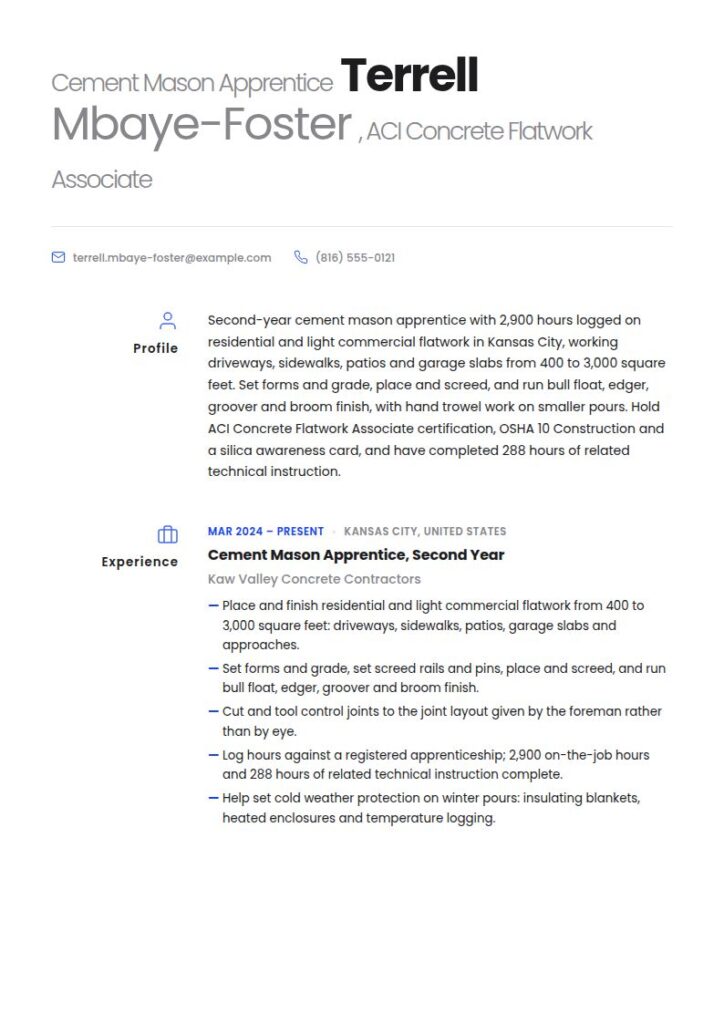
Cement Mason Apprentice Terrell Mbaye-Foster ACI Concrete Flatwork Associate
Cement Mason Apprentice, Second Year
[email protected] | (816) 555-0121 | Kansas City, United States
Profile
Second-year cement mason apprentice with 2,900 hours logged on residential and light commercial flatwork in Kansas City, working driveways, sidewalks, patios and garage slabs from 400 to 3,000 square feet. Set forms and grade, place and screed, and run bull float, edger, groover and broom finish, with hand trowel work on smaller pours. Hold ACI Concrete Flatwork Associate certification, OSHA 10 Construction and a silica awareness card, and have completed 288 hours of related technical instruction.
Work Experience
03/2024 - Present, Cement Mason Apprentice, Second Year, Kaw Valley Concrete Contractors, Kansas City, United States
- Place and finish residential and light commercial flatwork from 400 to 3,000 square feet: driveways, sidewalks, patios, garage slabs and approaches.
- Set forms and grade, set screed rails and pins, place and screed, and run bull float, edger, groover and broom finish.
- Cut and tool control joints to the joint layout given by the foreman rather than by eye.
- Log hours against a registered apprenticeship; 2,900 on-the-job hours and 288 hours of related technical instruction complete.
- Help set cold weather protection on winter pours: insulating blankets, heated enclosures and temperature logging.
05/2023 - 03/2024, Concrete Laborer, Kaw Valley Concrete Contractors, Kansas City, United States
- Stripped forms, placed rebar and mesh to drawings, ran the chute and buggy, and handled site clean-up on flatwork and footing pours.
- Learned mix design basics and batch tickets before entering the apprenticeship.
Education
03/2024 - Present, Registered Apprenticeship, in progress, Cement Masonry and Concrete Finishing, Joint Apprenticeship and Training Committee, Kansas City, United States
Three-year term of on-the-job training with related technical instruction. 2,900 hours and 288 instruction hours complete as of September 2026.
08/2019 - 05/2023, High School Diploma, General, Central High School, Kansas City, United States
Two years of building trades electives, including print reading and shop safety.
Skills
Form setting and grade, 75
Screed rail and pin setting, 70
Placing and screeding, 80
Bull float and darby, 80
Broom finish, 85
Edging, grooving and joint tooling, 75
Hand trowel finish, 65
Rebar and mesh placement, 70
Cold weather protection and blankets, 60
Languages
English, native
Certificates
08/2024, ACI Concrete Flatwork Associate, American Concrete Institute
Written examination only, no work experience requirement. Valid five years.
06/2023, OSHA 10-Hour Construction, Occupational Safety and Health Administration Outreach Training Program
Course completion card held.
04/2024, Respirable Crystalline Silica Awareness, Kaw Valley Concrete Contractors
Exposure control plan, wet cutting and vacuum dust collection under 29 CFR 1926.1153.
Summary
A cement mason resume is a one page document stating what you can place and finish, at what square footage and yardage, and which ACI certifications back it up. This guide gives you three adaptable versions, the capability block that decides hiring in a time-bound trade, and current Bureau of Labor Statistics pay and outlook for cement masons and concrete finishers.
Cement Mason resume examples by experience level
A cement mason resume is a one page document that states what you can place and finish, at what scale, and what happens when the weather turns.
Concrete is the least forgiving material on a jobsite because it is time-bound. A slab does not wait for the crew to work out who knows how to run a power trowel. Once the truck tips, the finish window opens and closes on its own schedule, and a superintendent who puts the wrong crew on a 9,000 square foot pour finds out about it for the next thirty years. That is why this resume is read as a capability sheet: what, how much, how fast, and who certified you.
Resume guide for a cement mason resume
This guide and the corresponding cement mason resume example will cover:
- How to write a cement mason resume, section by section
- How to state placement and finish capability at a scale a superintendent recognizes
- Three adaptable summaries: apprentice, journey-level finisher and foreman
- ACI certifications by their correct names, and what each one proves
- What the job market looks like and what you can expect to earn
How to write a cement mason resume
Six blocks: contact header, summary, placement and finish capability, experience, certifications and testing, and apprenticeship. One page. Two only once you run crews, schedule pours and carry testing responsibility.
The capability block goes directly under the summary. It is the whole reason the page exists. Flatwork and structural concrete are different jobs, a broom finish and a burnished polished floor are different skills, and a crew lead needs to know which of those you can be handed on a Tuesday morning.
| Section | What it is answering | Where it goes |
|---|---|---|
| Placement and finish capability | What can this person place and finish, and how much of it? | Directly under the summary |
| Experience | What did they pour, at what yardage, and over what period? | Reverse chronological, with square feet and cubic yards |
| Certifications and testing | Can they run a slump test and sign for it? | Its own block, with exact ACI names |
| Apprenticeship and training | Hours completed and the route taken | Bottom, with hours stated |
Give square footage and cubic yards, because everything in concrete is scale
"Experienced in flatwork" describes a person who has poured a patio and a person who has poured a distribution center floor identically, which means it describes neither.
Write the scale: "Flatwork placements from 2,000 to 14,000 square feet in a single pour, typically 60 to 180 cubic yards a day with a crew of 6." That sentence tells a superintendent whether you can hold a joint line across a big slab, whether you have run a laser screed or only a hand screed, and whether you have worked a pour that runs past dark.
Then add the finish schedule you can hit: flatness and levelness numbers if the work was specified to them, or the finish itself if it was not. A mason who writes "held F-numbers on specified warehouse slabs" and a mason who writes "broom finish on residential driveways" have told a reader two entirely different things in the same number of words.
Run the finished file through the free Rezoom ATS resume checker before you send it. Larger concrete subcontractors and general contractors parse applications before a superintendent sees one.
Choosing the best resume format for a cement mason resume
Reverse chronological, one page, single column. Concrete hiring reads continuity as evidence that you were called back for the next pour, and a functional format that hides dates reads as a format hiding a string of short jobs.
Put the capability block above the experience anyway. That gives you the capability-sheet benefit in the first four seconds without hiding the timeline.
Include your contact information
| ✅ Right | ❌ Wrong |
|---|---|
| Terrell Mbaye-Foster | Terrell Mbaye-Foster |
| Cement Mason and Concrete Finisher, Flatwork and Structural | Concrete professional |
| ACI Advanced Concrete Flatwork Finisher, ACI Concrete Field Testing Technician Grade I | ACI certified |
| (816) 555-0121, [email protected], Kansas City, MO | (816) 555-0121, [email protected] |
Put your travel radius and whether you will work night pours in the header. Hot weather work moves to nights, and a mason who says yes on the page answers a question the superintendent was going to ask on the phone.
Make use of a summary
Four lines: flatwork or structural, the finishes you run, the scale, and one number tied to a pour.
Second-year cement mason apprentice with 2,900 hours logged on residential and light commercial flatwork in Kansas City, working driveways, sidewalks, patios and garage slabs from 400 to 3,000 square feet. Set forms and grade, place and screed, and run bull float, edger, groover and broom finish, with hand trowel work on smaller pours. Hold ACI Concrete Flatwork Associate certification, OSHA 10 Construction and a silica awareness card, and have completed 288 hours of related technical instruction.
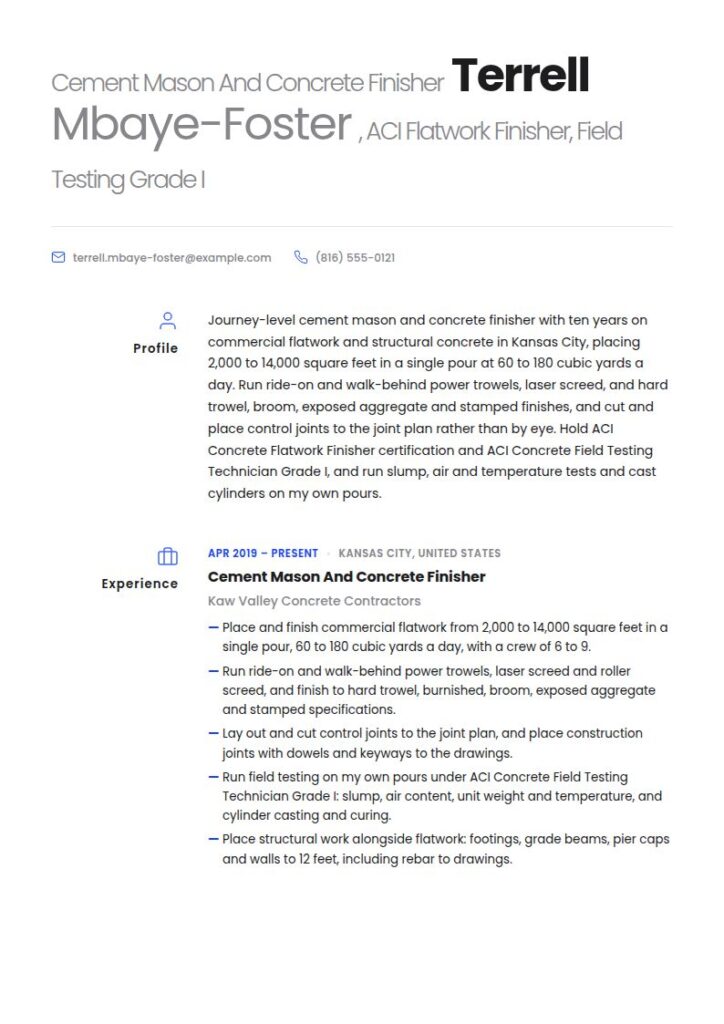
Journey-level cement mason and concrete finisher with ten years on commercial flatwork and structural concrete in Kansas City, placing 2,000 to 14,000 square feet in a single pour at 60 to 180 cubic yards a day. Run ride-on and walk-behind power trowels, laser screed, and hard trowel, broom, exposed aggregate and stamped finishes, and cut and place control joints to the joint plan rather than by eye. Hold ACI Concrete Flatwork Finisher certification and ACI Concrete Field Testing Technician Grade I, and run slump, air and temperature tests and cast cylinders on my own pours.
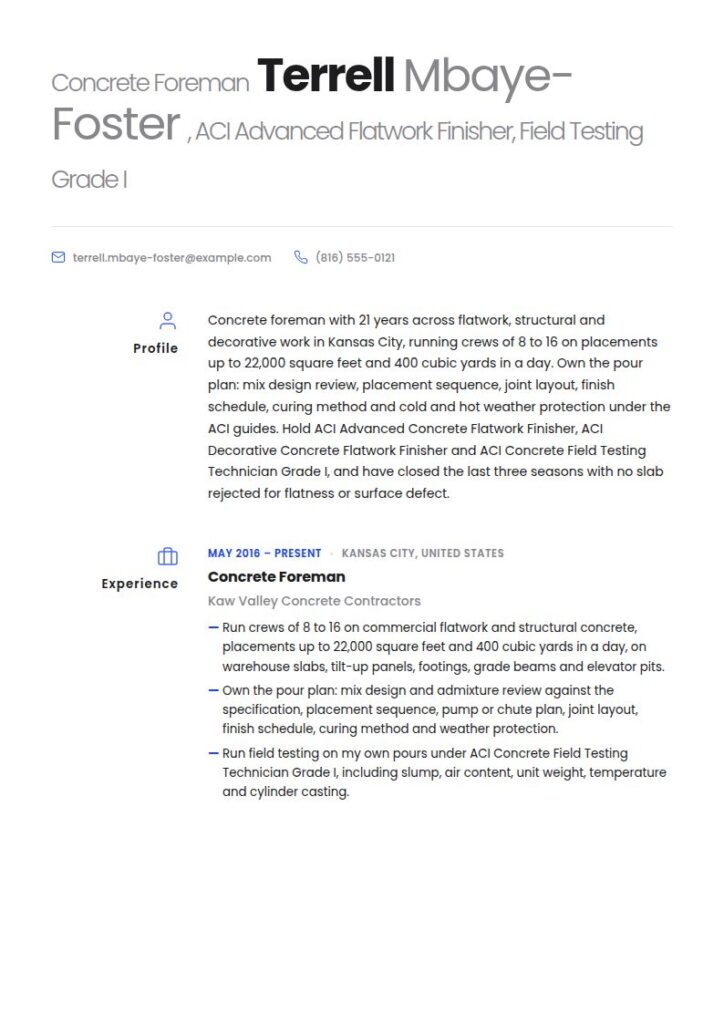
Concrete foreman with 21 years across flatwork, structural and decorative work in Kansas City, running crews of 8 to 16 on placements up to 22,000 square feet and 400 cubic yards in a day. Own the pour plan: mix design review, placement sequence, joint layout, finish schedule, curing method and cold and hot weather protection under the ACI guides. Hold ACI Advanced Concrete Flatwork Finisher, ACI Decorative Concrete Flatwork Finisher and ACI Concrete Field Testing Technician Grade I, and have closed the last three seasons with no slab rejected for flatness or surface defect.
Right vs wrong: the same cement mason summary, twice
| ✅ Right | ❌ Wrong |
|---|---|
| Place 2,000 to 14,000 square feet in a single pour at 60 to 180 cubic yards a day. | Experienced in all aspects of concrete placement and finishing. |
| Run ride-on and walk-behind power trowels, laser screed, and hard trowel and broom finishes. | Skilled with concrete finishing tools and equipment. |
| Hold ACI Concrete Field Testing Technician Grade I and run slump, air and temperature on my own pours. | ACI certified with knowledge of concrete testing. |
The right column can be assigned to a pour on Thursday. The left column cannot, and the person reading it is scheduling trucks.
Outline your experience
Employer, city, dates, title, and whether the work was flatwork, structural or both. Then bullets with square feet, cubic yards, finishes and a number. A concrete bullet with no scale in it is a job description.
| Instead of | Use |
|---|---|
| Poured and finished concrete | Placed 2,000 to 14,000 square feet in a single pour at 60 to 180 cubic yards a day with a crew of 6 to 9 |
| Used concrete finishing tools | Ran ride-on and walk-behind power trowels, laser screed, bull float, and hand trowel for hard trowel and burnished finishes |
| Did decorative concrete | Placed and finished stamped, exposed aggregate and integrally colored work across 40 residential and light commercial jobs |
| Formed concrete structures | Set and stripped wall forms to 12 feet, footings, grade beams, pier caps and elevator pits, including rebar placement to the drawings |
| Tested concrete | Ran slump, air content, unit weight and temperature to the ASTM methods and cast cylinders under ACI Concrete Field Testing Technician Grade I certification |
| Worked in bad weather | Ran cold weather protection under the ACI guide, with insulating blankets, heated enclosures and maturity monitoring on 30 winter pours |
Concrete Foreman, Kaw Valley Concrete Contractors, Kansas City, MO, May 2016 to Present
Run crews of 8 to 16 on commercial flatwork and structural concrete, placements up to 22,000 square feet and 400 cubic yards in a day, on warehouse slabs, tilt-up panels, footings, grade beams and elevator pits.
Own the pour plan: review the mix design and admixtures against the specification, set the placement sequence and pump or chute plan, lay out control and construction joints, choose the finish and the curing method, and write the cold or hot weather protection.
Run field testing on my own pours under ACI Concrete Field Testing Technician Grade I: slump, air content, unit weight and temperature, and casting and curing cylinders to the ASTM methods.
Placed and finished stamped, exposed aggregate, integrally colored and polished work, including a 6,400 square foot polished slab finished to the owner's gloss specification.
Closed the last three seasons with no slab rejected for flatness or surface defect, and no lost time injury on my crew.
State what you can place and finish, and at what scale
This is the block that decides hiring, and it is the one almost every cement mason resume leaves as a vague list of nouns. Give it five lines, because a superintendent is matching you against a pour that is already scheduled.
Placement: Flatwork from 400 to 22,000 square feet in a single pour, 60 to 400 cubic yards a day. Structural: footings, grade beams, walls to 12 feet, pier caps, elevator pits, tilt-up panels. Methods: chute, buggy, line pump, boom pump, conveyor.
Finishes: Broom, hard trowel and burnished, exposed aggregate, stamped, integrally colored, salt finish, polished to owner gloss specification. Repair and restoration: patching, overlays, joint repair, grinding and surface preparation.
Screeding and consolidation: Laser screed, roller screed, vibratory truss screed, hand screed, internal vibrator, vibrating table for precast.
Testing and quality: Slump, air content by pressure and volumetric method, unit weight and yield, temperature, cylinder casting and curing, all to the ASTM methods covered by ACI Concrete Field Testing Technician Grade I.
Weather and curing: Cold weather protection with blankets, heated enclosures and maturity monitoring; hot weather work with evaporation retarder, fogging, night pours and revised placement timing; wet curing, curing compound and control joint timing.
Five lines, five different questions. The placement line says what pour you can be put on. The finish line says which specification you can hit. The screed line says whether you have run big equipment or only hand tools. The testing line says whether someone else has to stand next to the truck. The weather line is the one that separates a mason from a helper, because concrete does not stop for the season and somebody has to know what to do about it.
Be specific about the weather rules, because they are written down. The American Concrete Institute defines cold weather concreting as the period when the air temperature has fallen to, or is expected to fall below, 40 degrees Fahrenheit, or 4 degrees Celsius, during the protection period (ACI 306R-16, Guide to Cold Weather Concreting). Hot weather work has its own guide, ACI 305R-20 (American Concrete Institute). A resume line that names the guide tells a superintendent you learned the trade from a standard rather than from whatever the last crew happened to do.
Get the ACI certification names exactly right, because they are tiered
ACI runs a tiered set of flatwork credentials, and the names matter because each one carries a different work-experience requirement. Concrete Flatwork Associate has no work experience requirement. Concrete Flatwork Finisher requires 1,500 hours of on-the-job finishing experience, roughly one year of full-time work. Advanced Concrete Flatwork Finisher requires either the same 1,500 hours plus a performance examination, or 4,500 hours, roughly three years, without it. All three sit on a two-hour closed-book written examination of about 50 multiple-choice questions with a 70 percent pass mark, and certification is valid for five years (American Concrete Institute, accessed September 2026).
Alongside them, the Specialty Commercial and Industrial Concrete Flatwork Finisher requires proof of at least 2,000 hours of commercial or industrial finishing experience, about one year, on top of the prerequisite certification (American Concrete Institute, accessed September 2026).
The testing credential is separate and is the one that most changes what a crew can do without waiting for an inspector. ACI Concrete Field Testing Technician Grade I covers sampling, slump, temperature, density and yield, air content by both the pressure and volumetric methods, and making and curing test specimens. It takes a one-hour closed-book written examination of 55 multiple-choice questions requiring at least 60 percent on each test method and 70 percent overall, plus a performance examination demonstrating six of the methods, and it is valid for five years (American Concrete Institute, accessed September 2026).
Write those names in full. "ACI certified" could mean any of them, and a hiring foreman who knows the ladder will read it as the lowest rung.
Build a snapshot of your key skills
Twelve to sixteen entries in three groups, with testing and quality kept separate.
Placement and forming: Grade setting and form layout, Screed rail and pin setting, Rebar and mesh placement to drawings, Line and boom pump placement, Vibration and consolidation, Tilt-up panel casting, Pour sequencing
Finishing: Bull float and darby, Hand and machine float, Ride-on and walk-behind power trowel, Hard trowel and burnished finish, Broom and salt finish, Exposed aggregate, Stamping and color hardener, Grinding and polishing
Testing and quality: Slump to ASTM C143, Air content by pressure and volumetric method, Unit weight and yield, Concrete temperature, Cylinder casting and curing, Reading mix designs and batch tickets, Control and construction joint layout
Site and safety: OSHA 30 Construction, Silica exposure control plan, Confined space awareness, Concrete pump safety, Crew scheduling and pour planning, Cold and hot weather protection
List your education and certifications
Apprenticeship with its hours first, then ACI certifications by their full names with dates, then safety cards.
Registered Cement Mason Apprenticeship, completed 2008. Three-year term with on-the-job training hours and related technical instruction through a joint apprenticeship and training committee.
ACI certifications: Advanced Concrete Flatwork Finisher (2019, recertified 2024). Decorative Concrete Flatwork Finisher (2021). Concrete Field Testing Technician Grade I (2017, recertified 2022). All valid five years from completion.
Safety: OSHA 30-Hour Construction (2024). Silica competent person (2025). Concrete pump safety (2023). First aid and CPR, American Red Cross (2026).
Equipment: Ride-on power trowel, laser screed, skid steer and rough terrain forklift operator evaluations current.
Choose the right layout and design
Single column, one page, plain type at 11 point, no photograph, no skill bars. If you do decorative work, put a plain link to a photograph set in the header rather than embedding images, because stamped and polished work is the one part of this trade that genuinely benefits from being seen.
State flatwork, structural or both in the first line. Give square footage per pour and cubic yards per day. Name the finishes you can actually run, including decorative. Write ACI certifications by their full names. Say whether you run field testing yourself. Say what you do in cold and hot weather, and name the guide. Say whether you will work nights.
Do not write "concrete finisher" with nothing after it. Do not write "ACI certified" without naming the certification. Do not claim polished or stamped work from watching it. Do not describe a pour without a size. Do not leave joint layout off the page if you do it, because joints are where most slab complaints come from. Do not pad to two pages before you are running crews.
Cement mason job market and outlook
A trade inside a larger masonry group that is growing slowly overall, with heavy replacement demand and a hiring pattern set by local construction pipeline.
| Measure | Value |
|---|---|
| Cement mason and concrete finisher jobs, 2025 | 204,800 |
| All masonry worker jobs, 2025 | 277,700 |
| Projected change, cement masons and concrete finishers, 2025-35 | +2% (+3,300) |
| Projected change, all masonry workers, 2025-35 | +1%, slower than average |
| Projected annual openings, all masonry workers | ~18,400 |
| Typical entry-level education | High school diploma or equivalent |
| Median annual wage, cement masons and concrete finishers, May 2025 | $57,020 |
Source: U.S. Bureau of Labor Statistics, Occupational Outlook Handbook, May 2025 wage data and 2025-35 employment projections.
Cement masons and concrete finishers are by far the largest part of the masonry group at 204,800 of 277,700 jobs, ahead of brickmasons and blockmasons at 62,400, stonemasons at 9,300 and terrazzo workers and finishers at 1,200 (BLS Occupational Outlook Handbook, 2025). Those other three are shrinking or flat, so most of the group's hiring is concrete.
Where the jobs sit:
| Industry | Share of masonry worker employment | Median annual wage (May 2025) |
|---|---|---|
| Poured concrete foundation and structure contractors | 31% | $55,690 |
| Masonry contractors | 19% | $61,110 |
| Other specialty trade contractors | 12% | $58,870 |
| Construction of buildings | 12% | $61,030 |
| Heavy and civil engineering construction | 8% | $55,560 |
Source: U.S. Bureau of Labor Statistics, Occupational Outlook Handbook, May 2025.
What salary you can expect as a cement mason
The median annual wage for cement masons and concrete finishers was $57,020 in May 2025. Across the whole masonry worker group the median was $58,270, with the lowest 10 percent under $39,670 and the highest 10 percent above $91,350 (BLS Occupational Outlook Handbook, May 2025).
Industry moves the number by a few thousand dollars: construction of buildings paid a masonry worker median of $61,030 and masonry contractors $61,110, against $55,690 for poured concrete foundation and structure contractors, which is the largest single employer of the group at 31 percent (BLS, May 2025).
Most of the $50,000 spread between the bottom and top deciles sits inside the trade rather than between industries. It is decorative and polished work, which is priced differently from gray flatwork. It is structural work and formwork, which carries more responsibility. It is the ACI testing credential, which lets a crew keep placing. It is running a crew and owning the pour plan. And it is being the person who can be trusted with a winter pour, because that work still has to happen and most crews would rather it did not.
Key takeaways for a cement mason resume
- Say flatwork, structural or both in the first line; they are different jobs.
- Give square footage per pour and cubic yards per day, because everything in concrete is scale.
- Name the finishes you can run, including decorative work, which prices higher.
- Write ACI certifications by their full names; the tiers mean different things.
- Say whether you run field testing yourself, because it keeps a pour moving.
- Show joint layout and curing, which is where most slab complaints start.
- Say what you do in cold and hot weather, and name the guide you work to.
Build your cement mason resume in 15 minutes.
Related maintenance and repair resume examples
- Mechanic resume
- Carpenter resume
- Painter resume
- Electrician resume
- Plumber resume
- HVAC technician resume
- Handyman resume
- Maintenance technician resume
- Maintenance worker resume
- Construction worker resume
- Maintenance and repair resume
- Welder resume
Pair it with a matching cement mason cover letter.
Cement mason resume questions, answered
How long should a cement mason resume be?
One page. The capability block, the finishes, the ACI certifications and two or three employers fit comfortably, and a superintendent reads the whole thing. Go to two pages only once you run crews, own pour plans and carry testing responsibility.
Which ACI certification should I get first?
Concrete Flatwork Associate needs no work experience, so it is the natural starting point. Concrete Flatwork Finisher requires 1,500 hours of on-the-job finishing experience, roughly a year, and Advanced Concrete Flatwork Finisher requires either those 1,500 hours plus a performance examination or 4,500 hours without one (American Concrete Institute, accessed September 2026). If you are already placing regularly, the credential that changes a crew's day most is Concrete Field Testing Technician Grade I, because it means nobody waits for a testing agency to check a slump.
Do I need to list cubic yards as well as square feet?
Yes, if you know them. Square footage tells a reader the size of the slab; cubic yards a day tells them the pace your crew can hold and how many trucks a superintendent can schedule against you. Together they describe the job far better than either alone.
How do I show decorative concrete on a resume?
Name the techniques rather than the word decorative: stamped, exposed aggregate, integrally colored, color hardener, salt finish, polished with a gloss specification. Give a count of jobs or a square footage. ACI runs a Decorative Concrete Flatwork Finisher certification (American Concrete Institute, accessed September 2026), and if you hold it, write it out in full. Then add a plain link to photographs, because this is one of the few trades where a picture is genuinely evidence.
What do I put on a cement mason resume with no experience?
Hours, tools and willingness. If you are in an apprenticeship, write the hours logged and the related instruction completed, and the pours you have worked with sizes. If not, write any concrete work you have done at all with its scale, the ACI Concrete Flatwork Associate certification if you have taken it, your OSHA 10 card, your silica awareness training, and whether you will work early starts and night pours. Concrete crews start before dawn and work to the material, and someone who says plainly that they will is worth training.
Does cold weather work belong on the resume?
It is one of the strongest lines you can write. The American Concrete Institute defines cold weather concreting as the period when air temperature has fallen to, or is expected to fall below, 40 degrees Fahrenheit during the protection period (ACI 306R-16). A mason who can name the protection method, the maturity monitoring and the strip times is a mason a contractor can keep working through a winter, which is the difference between a seasonal job and a year-round one.