Terrell Mbaye-Foster Concrete Foreman Kansas City, 64110, United States [email protected] · (816) 555-0121
11 September 2026
Ms. Anahit Petrosyan Concrete Superintendent Harrow Ridge Constructors Kansas City, United States
Application for Concrete Foreman, Harrow Ridge Constructors
Dear Ms. Petrosyan,
I am applying for the Concrete Foreman post at Harrow Ridge Constructors. I run crews of 8 to 16 on flatwork and structural concrete, placements up to 22,000 square feet and 400 cubic yards in a day, and I hold ACI Advanced Concrete Flatwork Finisher, ACI Decorative Concrete Flatwork Finisher and ACI Concrete Field Testing Technician Grade I. That last one means my crew runs slump, air content and temperature on our own pours instead of waiting on a testing agency.
At Kaw Valley Concrete Contractors I own the pour plan rather than just the finish: mix design review against the specification, placement sequence, joint layout, finish schedule, curing method and weather protection. The result I would point to is the boring one. Across the last three seasons we have not had a slab rejected for flatness or surface defect, and we have had no lost time injury on my crew. On a trade where a mistake is permanent, that record is the argument.
I noticed your recent work includes polished floors in adaptive reuse buildings. I finished a 6,400 square foot polished slab to the owner gloss specification on a first attempt last year, and it is the part of the trade I most want more of. I also run cold weather work to ACI 306R with blankets, heated enclosures and maturity monitoring, so my crews stay busy through a Missouri winter.
My ACI certifications, OSHA 30 card and silica competent person training are all current, and I will work night pours in hot weather. I can start on two weeks notice. Thank you for your time.
Sincerely, Terrell Mbaye-Foster
Summary
A cement mason cover letter names what you can place and finish, the square footage and yardage you work at, and the ACI certifications standing behind it. This guide gives you a full adaptable letter, what changes between flatwork, structural and decorative employers, and the openings that get a finisher onto the next pour.
Cement Mason cover letter examples by experience level
A cement mason cover letter is a one page letter that tells a concrete superintendent what you can place and finish, at what scale, and whether you can be trusted with a pour that is already on the schedule.
Concrete hiring is driven by the calendar. Trucks are booked, a slab has to go before the steel, and somebody is deciding whether the new finisher goes on the 14,000 square foot pour or the sidewalk. A letter that answers that question directly is unusual enough to get remembered.
Guide to a cement mason cover letter
This guide and the corresponding cement mason cover letter example will cover:
- How to structure the letter, paragraph by paragraph
- Why placement scale belongs in the first paragraph
- What counts as evidence when concrete goes right
- Flatwork, structural and decorative employers, and how the letter changes
- The openings that get a finisher onto the next pour
How to write a cement mason cover letter
| Paragraph | Its job | Length |
|---|---|---|
| Opening | The post, what you place and finish, and at what scale | 2 to 3 sentences |
| Evidence | One pour type, one size, one number, one outcome | 4 to 5 sentences |
| Fit | Something specific about their work, and what you would own | 3 to 4 sentences |
| Close | ACI certifications, safety cards, night work, availability | 2 sentences |
Put the scale in the first paragraph
"I am an experienced concrete finisher" describes both the person who pours patios and the person who runs a warehouse slab. A superintendent cannot act on it.
"I place 2,000 to 14,000 square feet in a single pour, 60 to 180 cubic yards a day, with a crew of 6 to 9" is a sentence they can schedule against. It says how many trucks you can keep up with, whether you have run a laser screed, and whether you have held a joint line across a big slab.
Then add the credential in full: "I hold ACI Concrete Flatwork Finisher and ACI Concrete Field Testing Technician Grade I, so I run slump, air and temperature on my own pours." That second half is worth real money to a contractor, because it means placing does not stop while somebody waits for a testing agency.
A cement mason cover letter example you can adapt
Dear Ms. Petrosyan,
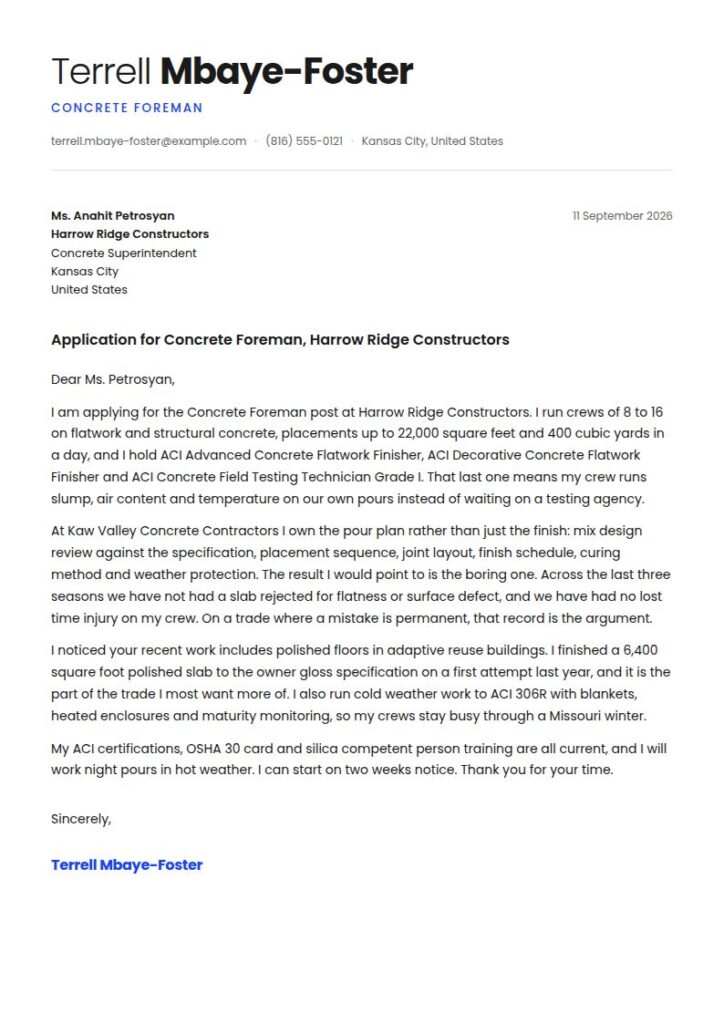
I am applying for the Concrete Foreman post at Harrow Ridge Constructors. I run crews of 8 to 16 on flatwork and structural concrete, placements up to 22,000 square feet and 400 cubic yards in a day, and I hold ACI Advanced Concrete Flatwork Finisher, ACI Decorative Concrete Flatwork Finisher and ACI Concrete Field Testing Technician Grade I. That last one means my crew runs slump, air content and temperature on our own pours instead of waiting on a testing agency.
At Kaw Valley Concrete Contractors I own the pour plan rather than just the finish: mix design review against the specification, placement sequence, joint layout, finish schedule, curing method and weather protection. The result I would point to is the boring one. Across the last three seasons we have not had a slab rejected for flatness or surface defect, and we have had no lost time injury on my crew. On a trade where a mistake is permanent, that record is the argument.
I noticed your recent work includes polished floors in adaptive reuse buildings. I finished a 6,400 square foot polished slab to the owner gloss specification on a first attempt last year, and it is the part of the trade I most want more of. I also run cold weather work to ACI 306R with blankets, heated enclosures and maturity monitoring, so my crews stay busy through a Missouri winter.
My ACI certifications, OSHA 30 card and silica competent person training are all current, and I will work night pours in hot weather. I can start on two weeks notice. Thank you for your time.
Sincerely, Terrell Mbaye-Foster
Openings that work
| Instead of | Use |
|---|---|
| I am an experienced concrete finisher | I run crews of 8 to 16 on placements up to 22,000 square feet and 400 cubic yards a day |
| I have worked with concrete for many years | I hold ACI Advanced Concrete Flatwork Finisher and Concrete Field Testing Technician Grade I |
| I take pride in quality work | No slab rejected for flatness or surface defect across the last three seasons |
| I would be a valuable addition to your team | I noticed your recent work includes polished floors in adaptive reuse buildings |
What counts as evidence when concrete goes right
Good concrete work is invisible, so it has to be written down as an absence of problems.
| Kind of evidence | What it looks like in a sentence |
|---|---|
| Scale | Placements up to 22,000 square feet and 400 cubic yards in a day |
| Rejection rate | No slab rejected for flatness or surface defect across three seasons |
| Testing | Run slump, air, unit weight and temperature on our own pours under ACI Grade I certification |
| Weather | About 30 winter pours a season with blankets, heated enclosures and maturity monitoring |
| Decorative | A 6,400 square foot polished slab finished to the owner gloss specification on a first attempt |
| Safety | No lost time injury on my crew across three seasons |
Flatwork, structural and decorative employers
For a flatwork contractor, lead with square footage per pour, cubic yards a day and the finishes you run. For a structural or foundation contractor, lead with forms, walls, footings, grade beams and rebar, and the heights you have worked. For a decorative contractor, lead with techniques, a job count and a link to photographs. For a general contractor hiring direct, lead with testing, joint layout and weather protection, because those are the three things that produce claims. Name one real thing about their current work.
Do not call yourself experienced without a size attached. Do not write "ACI certified" without naming the certification, since the tiers are different credentials. Do not claim polished or stamped work you have only watched. Do not leave joint layout out if you do it, because joints are where most slab complaints start. Do not send a letter with no contractor name in it.
A trade where most of the money sits inside the trade
Cement masons and concrete finishers held 204,800 jobs in 2025, the largest part of a masonry worker group of 277,700, and the occupation is projected to grow 2 percent from 2025 to 2035, adding 3,300 jobs (BLS Occupational Outlook Handbook, 2025-35 projections). Across the whole masonry group there are about 18,400 openings a year (BLS Occupational Outlook Handbook).
The median annual wage for cement masons and concrete finishers was $57,020 in May 2025. Across masonry workers as a group the median was $58,270, with the lowest 10 percent under $39,670 and the highest 10 percent above $91,350 (BLS Occupational Outlook Handbook, May 2025).
Between industries the spread is only a few thousand dollars: $61,110 at masonry contractors and $61,030 in construction of buildings, against $55,690 at poured concrete foundation and structure contractors, which employs the largest share at 31 percent (BLS, May 2025). So the $50,000 gap between the bottom and top of the trade is about what you can do, not where you do it, and that is exactly what a cover letter is for.
Length, format and sending it
One page, four paragraphs, 250 to 400 words. PDF unless the application says otherwise, named for yourself and the post: terrell-mbaye-foster-concrete-foreman-cover-letter.pdf.
Address a person. Concrete superintendents and owners are usually named on a company site, and a letter with no name on it reads as a letter sent to twelve contractors.
Use the same figures as your resume so the two agree. Our cement mason resume example is written with the numbers used here.
Key takeaways
- Put square footage per pour and cubic yards a day in the first paragraph.
- Name ACI certifications in full; the tiers are different credentials.
- Say whether you run field testing yourself, because it keeps a pour moving.
- Give one absence-of-problems number: rejections, callbacks or injuries.
- Name the finishes you run, including decorative, which prices higher.
- Say what you do in cold and hot weather, and name the guide.
- Say whether you will work night pours, and when you can start.
Write your cement mason cover letter in 10 minutes.
Cement mason cover letter questions, answered
How long should a cement mason cover letter be?
One page, four paragraphs, 250 to 400 words. Superintendents read these on a phone between pours, and length does not read as effort.
Do I really need a cover letter for a concrete job?
Attach one wherever there is a field for it, and send one with any direct email. An application form collects the same information from everyone. The letter is the only place you can say what size pour you can be put on, which finishes you can hit, and whether you can test your own concrete.
Which ACI certification should I name first?
The highest one you actually hold, written in full. Concrete Flatwork Associate requires no work experience; Concrete Flatwork Finisher requires 1,500 hours of on-the-job finishing experience; Advanced Concrete Flatwork Finisher requires either those 1,500 hours plus a performance examination or 4,500 hours without one (American Concrete Institute, accessed September 2026). If you also hold Concrete Field Testing Technician Grade I, name it in the same sentence, because it changes what a crew can do without waiting.
What if my experience is all residential?
Say so, give the sizes and finishes, and say which direction you want. Residential flatwork teaches you finish quality on small crews with no margin for error. What it does not teach is holding a joint line across a big slab or keeping up with a continuous truck rotation, so a letter that acknowledges that and asks for the step up reads far better than one that implies the two are the same.
Should I mention night work and winter work?
Yes, both, if you will do them. Hot weather placement often moves to nights, and the American Concrete Institute defines cold weather concreting as the period when air temperature has fallen to, or is expected to fall below, 40 degrees Fahrenheit during the protection period (ACI 306R-16). A finisher who works both ends of the calendar is a year-round hire rather than a seasonal one, and that is worth saying plainly.