Kofi Mensah-Boateng Night Crew Leader Newark, 07103, United States [email protected] · (973) 555-0163
11 September 2026
Ms. Gianna Ferraro Branch Operations Meridian Facility Services Elizabeth, United States
Application for Night Crew Leader, Meridian Facility Services
Dear Ms. Ferraro,
I am applying for the Night Crew Leader post with Meridian Facility Services. I currently lead a night crew of nine across four commercial accounts totaling 310,000 square feet of office, medical office and light industrial space, working 6:00 pm to 2:30 am, and my hazard communication and bloodborne pathogen training are current.
The work I would bring is route discipline. When I took over the four accounts, our monthly inspection average was 82 and we were losing time on the medical office building. I rebuilt the nightly route sheets straight from each scope of work, moved the periodic tasks off the nightly run into a proper quarterly schedule, and the average went to 94 over three quarters. All four accounts came through their re-bid, including the medical one that had been flagged. I also train every new cleaner on dilution control and safety data sheets before they are put on a route.
I saw that Meridian has taken on two medical office buildings in Union County this year. That is the work I am strongest at, because the frequencies and the disinfection steps are tighter and the client inspects more often. I hold keys and alarm codes at all four of my current sites and I am used to running the lone-working check-in.
I can work nights, weekends and the periodic floor schedule, and I can give two weeks' notice. Thank you for your time.
Sincerely, Kofi Mensah-Boateng
Summary
A janitor cover letter is written for a contractor filling a night route. It says which shifts you can work, how much square footage you have cleaned, and whether your chemical and bloodborne pathogen training is current. This guide gives you a full adaptable letter, scope of work language, and how to explain jobs that ended when a contract changed hands.
Janitor cover letter examples by experience level
A janitor cover letter is a one-page letter written for a branch manager who has a route to fill this week.
Contract cleaning runs on a bid, a scope of work and a shift rota. The person reading your letter is not curious about your work ethic. They want to know whether you can work nights, how much square footage you have handled, and whether they can put you on an account before the next training cycle.
Guide to a janitor cover letter
This guide and the corresponding janitor cover letter example will cover:
- How to structure the letter, paragraph by paragraph
- Why the shift and the square footage go in the first line
- Scope of work language, and why it changes how you are read
- How to explain jobs that ended when a contract changed hands
- What to write with no formal experience or an overseas record
How to write a janitor cover letter
| Paragraph | Its job | Length |
|---|---|---|
| Opening | The post, your shift, your route size and building type | 2 to 3 sentences |
| Evidence | One number from the scope or the inspection, with a period | 4 to 5 sentences |
| Fit | Something real about their account or portfolio, and what you would take | 3 to 4 sentences |
| Close | Safety training, availability, notice period, thank you | 2 sentences |
Say nights in the first line
Night availability is the hardest thing a cleaning contractor staffs, and it is the fastest way to be read to the end of the page.
Open with it and the route together: "I currently work a 62,000 square foot office account solo from 6:00 pm to 2:30 am, five nights a week." That single sentence answers shift, volume, building type and whether you can work unsupervised.
Then add the line that decides how soon you can start: whether your hazard communication and bloodborne pathogen training are current. A contractor can place a trained cleaner immediately and has to schedule an untrained one.
A janitor cover letter example you can adapt
Dear Ms. Ferraro,
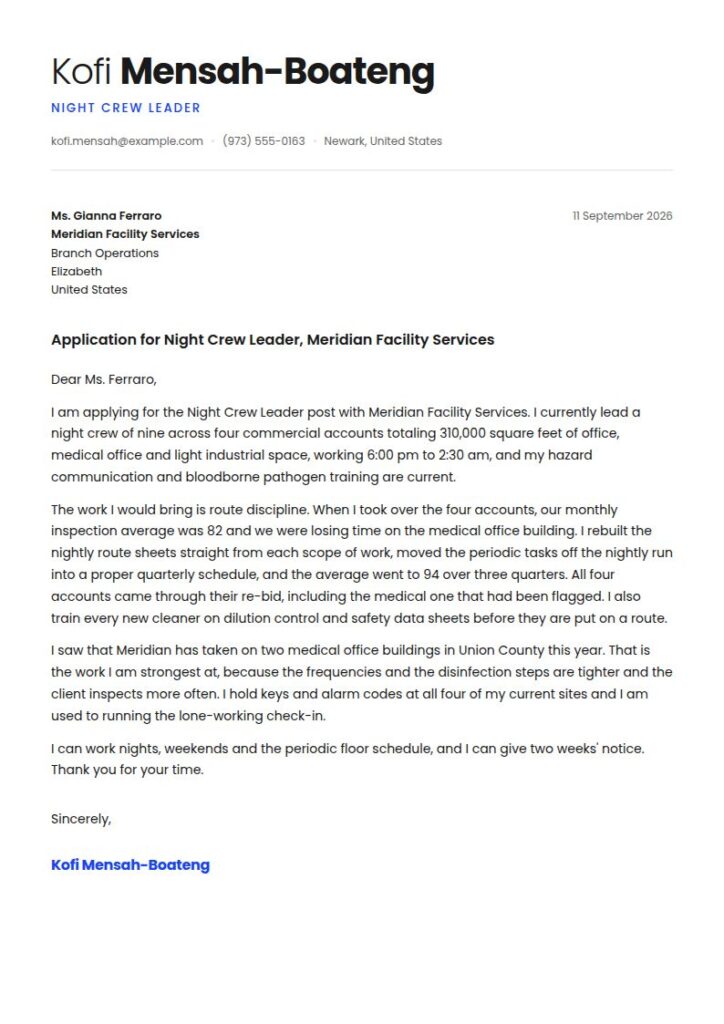
I am applying for the Night Crew Leader post with Meridian Facility Services. I currently lead a night crew of nine across four commercial accounts totaling 310,000 square feet of office, medical office and light industrial space, working 6:00 pm to 2:30 am, and my hazard communication and bloodborne pathogen training are current.
The work I would bring is route discipline. When I took over the four accounts, our monthly inspection average was 82 and we were losing time on the medical office building. I rebuilt the nightly route sheets straight from each scope of work, moved the periodic tasks off the nightly run into a proper quarterly schedule, and the average went to 94 over three quarters. All four accounts came through their re-bid, including the medical one that had been flagged. I also train every new cleaner on dilution control and safety data sheets before they are put on a route.
I saw that Meridian has taken on two medical office buildings in Union County this year. That is the work I am strongest at, because the frequencies and the disinfection steps are tighter and the client inspects more often. I hold keys and alarm codes at all four of my current sites and I am used to running the lone-working check-in.
I can work nights, weekends and the periodic floor schedule, and I can give two weeks' notice. Thank you for your time.
Sincerely, Kofi Mensah-Boateng
Openings that work, and what counts as evidence
| Instead of | Use |
|---|---|
| I am a hard worker and very reliable | I work a 62,000 square foot office account solo, 6:00 pm to 2:30 am, five nights a week |
| I am writing regarding your cleaning vacancy | I am applying for the Night Crew Leader post with Meridian Facility Services |
| I always do a thorough job | Monthly inspection average went from 82 to 94 across three quarters |
| I am available to start immediately | My hazard communication and bloodborne pathogen training are current |
| Kind of evidence | What it looks like in a sentence |
|---|---|
| Route | 62,000 square feet solo in an eight-hour shift |
| Detail | 34 offices, 6 restroom blocks, 42 fixtures, two lobbies nightly |
| Quality | No quality deductions across four monthly client inspections |
| Retention | All four accounts retained at re-bid, including one flagged at risk |
| Equipment | Trained on autoscrubber, 1,500 rpm burnisher and carpet extractor |
| Trust | Keyholder and alarm code holder, opening and securing the site alone |
Scope of work language, and why it changes how you are read
The single fastest way to sound like someone who has actually done this job is to describe your work the way the contract describes it: by area and by frequency.
A scope of work splits the building into area types and gives every task a frequency. Nightly: trash, restroom fixtures, sweeping, mopping, vacuuming, glass spots. Weekly: damp mopping, dusting, break room detail. Monthly: high dusting, vents, deep restroom work. Quarterly or annual periodics: strip and refinish, carpet extraction, interior windows, pressure washing. Then the quality standard, the inspection method and the performance measures the contractor is paid against.
Write one sentence in that shape and you have separated yourself from the stack: "Nightly, weekly and quarterly periodic schedule across 62,000 square feet, with monthly client inspection and no deductions in the last four."
Say which shifts you can work in the first line, because nights are the hardest thing to staff. Give the square footage and the building type. Use the frequency words the scope uses: nightly, weekly, monthly, periodic. Name the machines you are trained on. Say your hazard communication and bloodborne pathogen training are current, with the year. Give your notice period.
Do not describe anything you saw inside an office or on a desk. Do not write that you are hardworking and honest without a number beside it. Do not leave a lost account unexplained, since a clause fixes it. Do not claim equipment you have not been trained on. Do not send a letter with no shift in it, because the shift is what is being filled.
Explaining jobs that ended when a contract changed hands
This is the most common problem on a janitorial resume and the easiest to fix.
Accounts are re-bid every few years. When a building changes contractor, the new company usually takes on the existing crew because they know the site. On paper that reads as three employers in six years. It was six years in one building.
In the letter, say it in a clause: "I have worked the Riverfront Corporate Center since 2019, through two changes of contractor." On the resume, lead the entry with the site and list the employers underneath it. Nobody in this industry will think less of you for a lost contract; what they cannot do is guess.
The same plainness works for everything else. A gap gets one line: a layoff when an account was lost, a move, an illness, caring for a family member. Overseas work gets sized so it can be used: the building type and the square footage, or the floors and rooms, and the American job title for what you did. If you speak another language, say so, because crews are frequently multilingual and the person who can pass a safety briefing on is usually the next crew leader.
Your safety training is a legal requirement, so say it is current
OSHA's Hazard Communication Standard, 29 CFR 1910.1200, covers janitorial work in full. Paragraph (h)(1) requires that "employers shall provide employees with effective information and training on hazardous chemicals in their work area at the time of their initial assignment", and paragraph (e)(1) requires a written program covering labeling, safety data sheets and training. In an interpretation letter dated 23 May 1991, OSHA confirmed the standard applies to the janitorial service industry and that employers must give "all exposed workers with the right-to-know information about the hazards of the chemicals they work with".
Bloodborne pathogen training is separate and also mandatory where exposure is foreseeable: under 29 CFR 1910.1030(g)(2)(ii) it must be given "at the time of initial assignment" and "at least annually thereafter", with hepatitis B vaccination offered within 10 days of initial assignment at no cost to the worker (OSHA, Hepatitis B Vaccination Protection fact sheet).
For context on the market you are writing into, the Bureau of Labor Statistics puts janitors and building cleaners at 2,432,600 jobs in 2025 with about 321,800 openings a year and a median wage of $36,840 (BLS Occupational Outlook Handbook, May 2025 wages, 2025-35 projections). In a market that size, the file that is already compliant gets placed first.
Length, format and sending it
One page, four paragraphs, 250 to 350 words. PDF unless the contractor's portal says otherwise, named for yourself and the post.
Address a person where you can. Branch managers, operations managers and account managers are usually named on a contractor's site or on the job posting itself.
Keep the numbers the same as your resume. Our janitor resume example uses the same route, the same inspection scores and the same accounts, so the two documents agree.
Key takeaways
- Put your shift and your route size in the first sentence.
- Name the building type: office, medical, school, industrial, retail.
- Use scope of work language: nightly, weekly, monthly, periodic.
- Give one quality number, such as an inspection score or a run without deductions.
- Say your hazard communication and bloodborne pathogen training are current.
- Explain a lost contract in a clause rather than leaving it to be guessed at.
- Say what you were trusted with: keys, alarm codes, lone working.
Write your janitor cover letter in 10 minutes.
Janitor cover letter questions, answered
How long should a janitor cover letter be?
One page, four paragraphs, 250 to 350 words. Contract cleaning hires fast and often in volume, so a short letter that answers shift, square footage and training beats a long one every time.
Do I need a cover letter for a cleaning job?
It is not always expected, which is exactly why it works. Most applicants send none, and the ones that arrive usually say nothing specific. A letter naming your shift, your route size and your current training gets you into the first call-back group.
What do I write with no cleaning experience?
Write work where you were trusted to be somewhere alone and finish a list: warehouse, kitchen, grounds, security, farm, construction clean-up, caretaking for a place of worship. Give the site, the hours and what you were responsible for, then answer what the contractor needs regardless: which shifts you can work, whether you drive, and whether you already hold safety training.
Should I explain why I left a job after a few months?
Yes, in four or five words. "The account moved to another contractor" or "the site closed" is a complete answer, and in contract cleaning it is an ordinary one. What looks bad is a short job with no explanation at all.
Is it worth mentioning that I can run floor equipment?
Yes, by machine. An autoscrubber, a high-speed burnisher and a carpet extractor are what the periodic schedule needs, and periodic work is billed separately from the nightly route. Saying which machines you are trained on tells a branch manager you can be put on the better-paid crew.