Assistant Superintendent Rosalyn Trevino-Salas
Assistant Superintendent
[email protected] | (303) 555-2128 | Denver, United States
Profile
Assistant superintendent with three years on multifamily podium work, following eight years as a carpenter and carpenter foreman on the same building type. Run the three-week look-ahead and the daily report on a 214-unit, 8-story podium building, with up to 9 trades and 118 workers on the deck. Designated competent person for fall protection and scaffolding, keeping the first-time inspection rate on my floors above 90 percent.
Work Experience
04/2016 - Present, Assistant Superintendent, Ute Pass Builders, Denver, United States
- Run the three-week look-ahead and the daily report on a 214-unit, 8-story multifamily podium building, with up to 9 trades and 118 workers on the deck on my floors.
- Walk each municipal inspection with the responsible trade foreman the day before; first-time pass rate on my floors has stayed above 90 percent.
- Designated competent person for fall protection and scaffolding, running the weekly harness and anchor point inspection.
- Coordinate deliveries, laydown and hoist time for 9 trades, keeping the hoist booked in 30 minute blocks.
- Track first-work-in-place and mockup approvals for exterior framing, sheathing and window installation.
06/2009 - 03/2016, Journey-Level Carpenter and Carpenter Foreman, Platte Yard Interiors, Denver, United States
- Completed a carpentry apprenticeship in 2013 and ran framing and finish crews of 6 to 11 as foreman from 2015.
- Framed and finished wood-frame multifamily work, including three buildings of 90 units or more.
- Ran daily pre-task planning and the fall protection setup for crews working above the podium deck.
Education
08/2014 - 05/2016, Associate of Applied Science, Construction Management, Front Range Community College, Westminster, United States
Evening program completed while working as a carpenter foreman. Coursework in scheduling, plan reading, building codes and construction safety.
Skills
Three-week look-ahead scheduling, 75
Daily reporting and delay documentation, 85
Fall protection and scaffolding inspection, 85
Delivery, laydown and hoist coordination, 80
Pre-inspection walks with trade foremen, 80
Procore field tools and daily logs, 80
Plan reading and layout, 90
Languages
English, native
Spanish, native
Certificates
02/2016, OSHA 30-hour Construction Outreach, Occupational Safety and Health Administration Outreach Training Program
Course completion card. OSHA states the card is not a certification or license, and construction student cards do not expire.
05/2016, Designated competent person: fall protection and scaffolding, Ute Pass Builders
Employer designation under 29 CFR 1926.20(b)(2).
01/2016, First Aid and CPR, American Red Cross
Summary
A construction superintendent resume is a one to two page document about the site you ran: how many trades were on the deck at peak, how many people, how many inspections passed first time, and how the punch list closed. This guide gives you three adaptable versions, the site description almost nobody writes, and current Bureau of Labor Statistics pay and outlook.
Construction Superintendent resume examples by experience level
A construction superintendent resume is a one to two page document about the site you actually ran: how many trades were on the deck at peak, how many people were under you, how many inspections passed the first time, and how the punch list closed.
The boundary is worth saying out loud, because half the resumes in this stack get it wrong. The project manager, by contrast, owns the contract and the money: buyout, the schedule of values, the submittal register, the RFI log, change order pricing, the monthly application for payment. The superintendent owns means and methods. In short: sequence, manpower, the daily report, quality, inspections and safety on the deck. Therefore, write the second job, in the second job's units, and a reader who has run work will recognize you in three lines.
Resume guide for a construction superintendent resume
For this reason, this guide and the corresponding construction superintendent resume example will cover:
- First, how to write a construction superintendent resume, section by section
- Then, why trades at peak, headcount and inspections belong on the page
- Also, three adaptable summaries: assistant, superintendent and general superintendent
- What OSHA actually means by a competent person, and how to write it honestly
- Finally, what the job market looks like and what you can expect to earn
How to write a construction superintendent resume
Overall, six sections: contact header, summary, a site table, experience, safety and competent person designations, and trades and systems. In general, one page for your first five years, two once you have run a building from excavation to certificate of occupancy.
Also, the site table goes directly under the summary. Everyone writes "supervised daily construction activities." However, almost nobody writes "14 trades and 186 workers on the deck at peak, 94 of 98 inspections passed first time."
| Section | What it is answering | Where it goes |
|---|---|---|
| Site table | How big and how busy was the site this person actually ran? | Directly under the summary |
| Experience | What did they sequence, and what did it do to the schedule? | Reverse chronological, with counts |
| Safety and designations | What are they the competent person for, and what is the record? | Its own block |
| Trades and systems | Which trades have they coordinated, and which field platforms do they run? | Grouped, named specifically |
Write competent person the way the regulation writes it
OSHA defines a competent person as "one who is capable of identifying existing and predictable hazards in the surroundings or working conditions which are unsanitary, hazardous, or dangerous to employees, and who has authorization to take prompt corrective measures to eliminate them" (29 CFR 1926.32(f), retrieved 17 September 2026).
Two halves, and the second is the one people leave out. A competent person has to be authorized to stop and fix the hazard. That authorization comes from the employer, not from a class. OSHA separately requires accident prevention programs to provide "for frequent and regular inspections of the job sites, materials, and equipment to be made by competent persons designated by the employers" (29 CFR 1926.20(b)(2), retrieved 17 September 2026).
So write it as a designation and name the scope: "Designated competent person for excavation and trenching, fall protection and scaffolding." That is a claim a reader can check and a former employer can confirm. "OSHA certified" is not, because OSHA does not certify workers.
Run the finished file through the free Rezoom ATS resume checker before you submit it. Contractor portals parse these before a person opens them.
Choosing the best resume format for a construction superintendent resume
In short, reverse chronological, with the site table above it. One page early, two once you have taken a building from excavation through certificate of occupancy and have more than one of them to show.
Functional formats do real damage here. After all, superintendents are hired on continuity: did this person stay through the hard part, through closeout, through the warranty walk. As a result, a format that removes dates removes the only thing a reader was looking for.
Include your contact information
| ✅ Right | ❌ Wrong |
|---|---|
| Rosalyn Trevino-Salas | Rosalyn Trevino-Salas |
| Construction Superintendent, Multifamily and Podium, up to 14 trades on the deck | Hardworking construction leader with strong attention to detail |
| Competent person: excavation, fall protection, scaffolding. OSHA 30-hour construction card. | OSHA certified |
| (303) 555-2128, [email protected], Denver, CO | (303) 555-2128, [email protected] |
To begin with, put the building type and the trade count in the line under your name. A reader deciding whether to open the file is asking whether you have run their kind of site, and those two facts answer it.
Make use of a summary
Specifically, four lines: the building types you have run, your years, the size of the site at peak, and one number from the field.
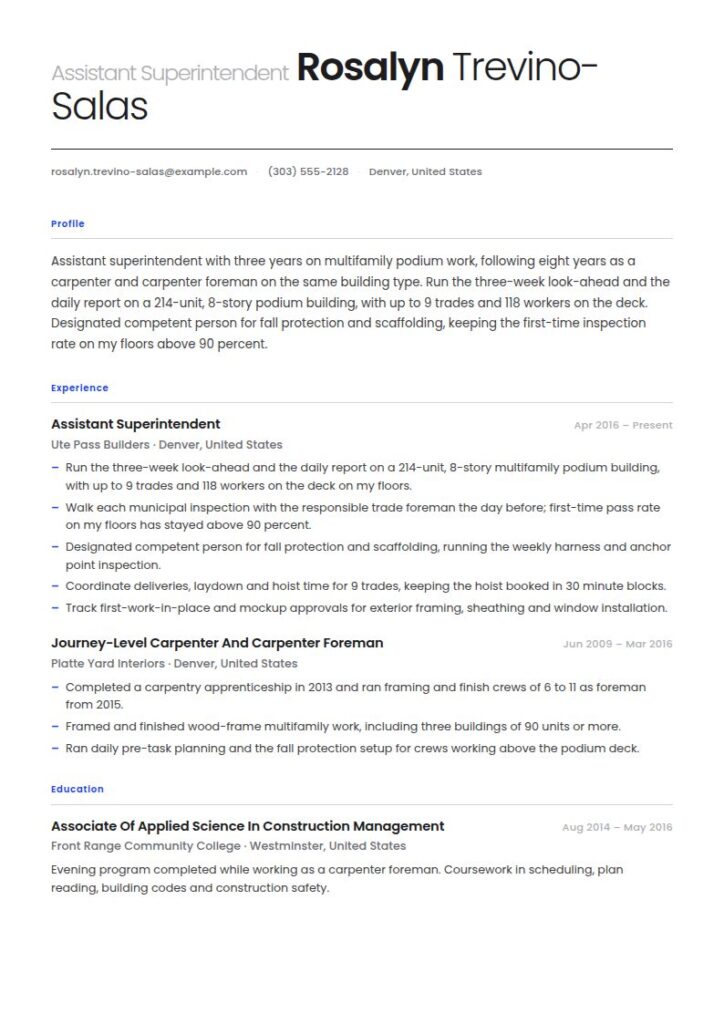
Assistant superintendent with three years on multifamily podium work, following eight years as a carpenter and carpenter foreman on the same building type. Run the three-week look-ahead and the daily report on a 214-unit, 8-story podium building, with up to 9 trades and 118 workers on the deck. Designated competent person for fall protection and scaffolding, keeping the first-time inspection rate on my floors above 90 percent.
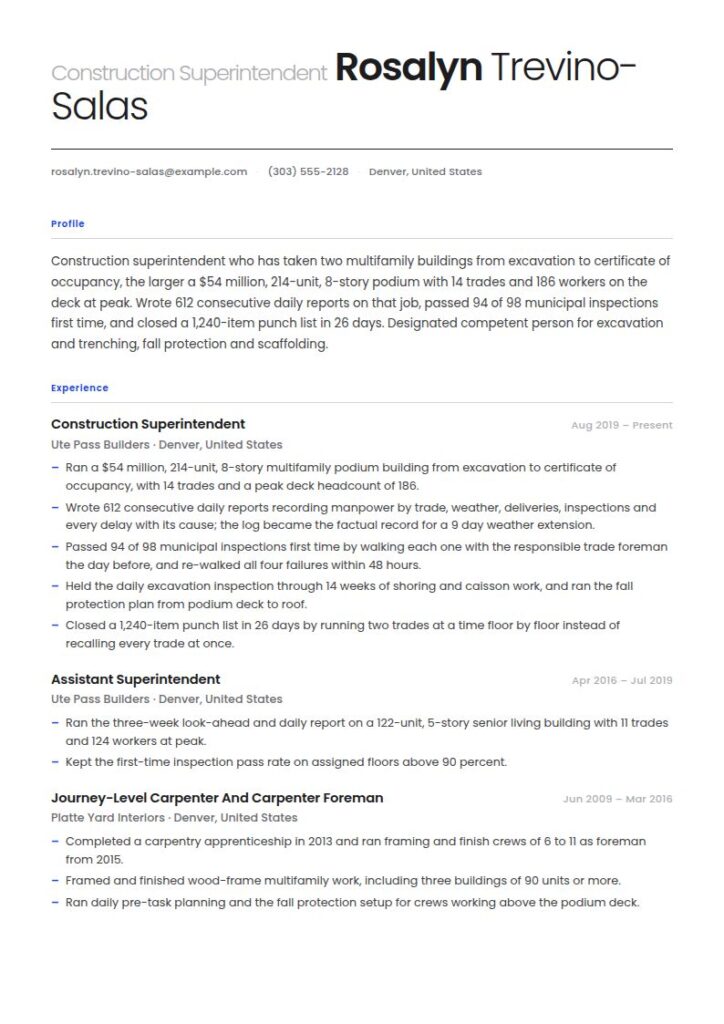
Construction superintendent who has taken two multifamily buildings from excavation to certificate of occupancy, the larger a $54 million, 214-unit, 8-story podium with 14 trades and 186 workers on the deck at peak. Wrote 612 consecutive daily reports on that job, passed 94 of 98 municipal inspections first time, and closed a 1,240-item punch list in 26 days. Designated competent person for excavation and trenching, fall protection and scaffolding.
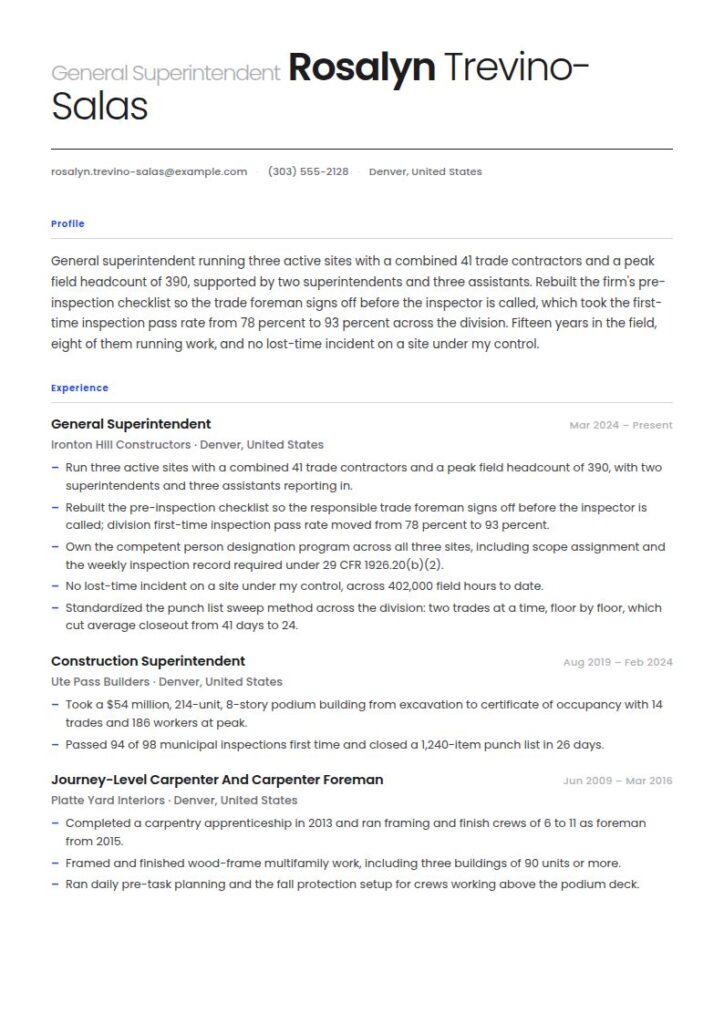
General superintendent running three active sites with a combined 41 trade contractors and a peak field headcount of 390, supported by two superintendents and three assistants. Rebuilt the firm's pre-inspection checklist so the trade foreman signs off before the inspector is called, which took the first-time inspection pass rate from 78 percent to 93 percent across the division. Fifteen years in the field, eight of them running work, and no lost-time incident on a site under my control.
Right vs wrong: the same construction superintendent summary, twice
| ✅ Right | ❌ Wrong |
|---|---|
| Took two multifamily buildings from excavation to certificate of occupancy. | Extensive experience overseeing construction projects from start to finish. |
| 14 trades and 186 workers on the deck at peak on a $54 million, 8-story podium. | Supervised large crews and multiple subcontractors on site. |
| Passed 94 of 98 municipal inspections first time and closed a 1,240-item punch list in 26 days. | Ensured quality workmanship and timely project completion. |
The right column describes a site. The left column, by contrast, describes a job title, and every applicant has the same one.
Outline your experience
Then list the contractor, city, your title, the building type, and dates. Then three to five bullets. In the right column, however, every bullet carries a trade count, a headcount, a day count or an inspection number, and every bullet is about the field.
| Instead of | Use |
|---|---|
| Supervised subcontractors on site | Sequenced 14 trades and up to 186 workers on the deck across an 8-story podium build |
| Maintained daily reports | Wrote 612 consecutive daily reports covering manpower by trade, weather, deliveries and delays |
| Coordinated inspections | Passed 94 of 98 municipal inspections first time by walking each one with the trade foreman the day before |
| Managed project closeout | Closed a 1,240-item punch list in 26 days with a two-trade sweep floor by floor |
| Enforced safety on site | Designated competent person for excavation, fall protection and scaffolding; no lost-time incident across 402,000 field hours |
Construction Superintendent, Ute Pass Builders, Denver, CO, August 2019 to February 2024
Ran a $54 million, 214-unit, 8-story multifamily podium building from excavation to certificate of occupancy, with 14 trades and a peak deck headcount of 186.
Wrote 612 consecutive daily reports recording manpower by trade, weather, deliveries, inspections and every delay with its cause, which became the factual record when the owner questioned a 9 day weather extension.
Passed 94 of 98 municipal inspections first time by walking each one with the responsible trade foreman the day before, and re-walking the four failures within 48 hours.
Held the daily excavation inspection through 14 weeks of shoring and caisson work, and ran the fall protection plan from podium deck through the roof.
Closed a 1,240-item punch list in 26 days, running two trades at a time floor by floor rather than calling everyone back at once.
Describe the site you actually ran: trades, headcount, inspections
In fact, this is the block almost nobody writes, and it is what turns a superintendent's resume from a job description into a site.
In practice, a general superintendent reading your file wants to know one thing: have you stood on a deck as busy as the one I am about to hand you. Trade count and headcount answer it directly, whereas no adjective does.
| Project | Type | Peak trades on deck | Peak headcount | Inspections first time | Punch list |
|---|---|---|---|---|---|
| 8-story multifamily podium, $54M | 214 units, Type III over Type I | 14 | 186 | 94 of 98 | 1,240 items, 26 days |
| 5-story senior living, $31M | 122 units, wood frame | 11 | 124 | 71 of 74 | 690 items, 18 days |
| Mixed-use core and shell, $22M | 4 floors over retail | 9 | 88 | 52 of 55 | 410 items, 12 days |
Peak trades on the deck is the density number. Five trades on a floor is a schedule. Fourteen is a negotiation every morning, and the person who has run fourteen has learned things about sequencing that cannot be taught in a look-ahead meeting.
Peak headcount is the supervision number. It is what tells a reader how many people were relying on your sequence being right, and it scales differently from trade count: a concrete pour week can put 90 people on a site that normally runs 40.
Inspections, punch list and closeout numbers
Inspections passed first time is the quality number, and it is the most persuasive line on the page because it is externally judged. A municipal inspector does not care whose schedule slipped. Write it as a ratio, not a percentage, so the denominator is visible: "94 of 98" is checkable in a way that "96 percent" is not.
Punch list volume and closeout days is the finishing number. Anyone can get a building to 95 percent. Closing 1,240 items in 26 days is a different skill, and it is the one owners remember. AIA A201-2017 requires the Contractor to submit "a comprehensive list of items to be completed or corrected prior to final payment" and defines Substantial Completion as the stage when the Work "is sufficiently complete so that the Owner may occupy or utilize the Work for its intended purpose" (AIA Contract Documents, A201-2017 Sections 9.8.2 and 9.8.1, retrieved 17 September 2026).
What does not belong here. RFI counts, submittal registers, change order values, buyout savings and schedule of values line counts are the project manager's evidence. Borrowing them makes a reader think you have been the project manager's assistant rather than the person running the deck, and on a site where both roles exist, that is the wrong impression to leave.
Build a snapshot of your key skills
Specifically, twelve to sixteen entries in four groups: field control, safety, quality, and the systems you run.
Field control: Three-week look-ahead scheduling, Trade sequencing and manpower loading, Daily reporting, Site logistics and crane and hoist planning, Delivery and laydown coordination, Weather and delay documentation
Safety: Competent person designations for excavation and trenching, fall protection and scaffolding; Daily and weekly site inspections; Pre-task planning and toolbox talks; Incident investigation; Site-specific safety plan authorship
Quality: Pre-inspection walks with trade foremen, Mockup and first-work-in-place review, Building envelope and water test observation, Punch list management and closeout, Warranty walk and owner turnover
Systems: Procore field tools and daily logs, Bluebeam Revu, PlanGrid, Microsoft Project, digital as-built markup
List your education and certifications
Trade background first if you came up through the field, then any degree, then the safety cards, then the designations.
The single most common error on a superintendent's resume is writing "OSHA certified." OSHA states plainly that an Outreach Training Program card "is not considered a certification or license," that the 30-hour class "is more appropriate for supervisors or workers with some safety responsibility" while the 10-hour is aimed at worker awareness, and that student course completion cards in construction "do not have an expiration date" (OSHA Outreach Training Program, retrieved 17 September 2026).
In other words, write the card accurately and it costs you nothing. Write competent person designations separately, because those come from the employer under 29 CFR 1926.20(b)(2), and name the scope you held. If your work included excavations, the specific obligation is worth knowing: a competent person must make daily inspections of excavations, adjacent areas and protective systems for evidence of a possible cave-in, failure of protective systems, hazardous atmospheres or other hazardous conditions, and must remove exposed employees until precautions are taken (29 CFR 1926.651(k)(1) and (k)(2), retrieved 17 September 2026).
OSHA 30-hour Construction Outreach card, issued 2016. OSHA notes the card is not a certification or license and that construction student cards do not expire.
Designated competent person: excavation and trenching, fall protection, scaffolding. Designations held under Ute Pass Builders and Ironton Hill Constructors.
Associate of Applied Science, Construction Management, Front Range Community College, Westminster, CO, 2016
Carpentry apprenticeship completed 2013, journey-level carpenter 2013 to 2018. First aid and CPR, American Red Cross, 2026.
Choose the right layout and design
Above all, single column, plain type at 11 or 12 point, clear headings, no photograph. The site table is the one element worth setting as a ruled table, because a general superintendent will read that and nothing else on the first pass.
Put the site table above the experience block. Give peak trades and peak headcount as separate numbers, because they measure different things. Write inspections as a ratio with the denominator visible. Name the building type and the construction type, since a Type III over Type I podium is not a tilt-up warehouse. List competent person designations by scope and say who designated you. Say how the punch list closed, in items and days.
Do not write "OSHA certified", because OSHA does not certify workers and every safety professional reading your file knows it. Do not claim the project manager's numbers: RFIs, submittals, change orders and buyout are not your evidence. Do not write "supervised subcontractors" when the trade count is the whole point. Do not leave out the excavation and shoring phase; it is where the risk was. Do not use a two-column template for a contractor portal.
Construction superintendent job market and outlook
However, the Bureau of Labor Statistics publishes no separate Occupational Outlook Handbook profile for construction superintendents. Instead, the closest published occupation, and the source of every figure below, is construction managers.
| Measure | Value |
|---|---|
| Construction manager jobs, 2025 | 609,100 |
| Projected change, 2025-35 | 9% (much faster than average), +55,200 |
| Projected annual openings | ~49,700 |
| Typical entry-level education | Bachelor's degree |
| Median annual wage, May 2025 | $114,990 ($55.28 an hour) |
Source: U.S. Bureau of Labor Statistics, Occupational Outlook Handbook, 2025-35 projections and May 2025 wage data, published 27 August 2026.
Read the education line carefully. BLS gives a bachelor's degree as the typical entry-level education for construction managers, and also records moderate-term on-the-job training for the occupation (same source). A large number of working superintendents came up through a trade instead, which is exactly why the site table matters: it is the evidence that substitutes for the credential the profile assumes.
Falls are a six-foot problem, and the superintendent owns it
The OSHA construction fall protection trigger is 6 feet above a lower level, and it is 6 feet consistently: unprotected sides and edges, holes, formwork and reinforcing steel, ramps and runways, excavations 6 feet or more deep, low-slope roofing and steep roofs all carry the same threshold (29 CFR 1926.501(b), retrieved 17 September 2026). Wall openings trigger where the outside bottom edge is 6 feet or more above a lower level and the inside bottom edge is less than 39 inches above the walking surface.
Trenches carry their own rule that a superintendent is expected to hold: a stairway, ladder, ramp or other safe means of egress in any trench 4 feet or more deep, positioned so no worker travels more than 25 feet laterally to reach it (29 CFR 1926.651(c)(2), retrieved 17 September 2026).
Numbers like those are the reason a hiring general superintendent reads the safety block before the skills block. They are also why it is worth writing "no lost-time incident across 402,000 field hours" rather than "committed to safety". The first is a record. The second is what everyone writes.
Where the jobs sit:
| Setting | Share of employment | Median annual wage (May 2025) |
|---|---|---|
| Self-employed | 38% | Not separately published |
| Specialty trade contractors | 17% | $104,100 |
| Nonresidential building construction | 15% | $126,690 |
| Residential building construction | 9% | $98,390 |
| Heavy and civil engineering construction | 8% | $124,430 |
Source: U.S. Bureau of Labor Statistics, Occupational Outlook Handbook, May 2025 data, published 27 August 2026.
What salary you can expect as a construction superintendent
With no title-specific profile published, the usable figure is the construction managers median: $114,990 a year, or $55.28 an hour, as of May 2025, with the lowest 10 percent under $69,690 and the highest 10 percent over $189,440 (BLS Occupational Outlook Handbook, published 27 August 2026).
For superintendents specifically, the spread tracks building type and site complexity more than it tracks years. Running a $54 million podium with 14 trades stacked on a deck is priced differently from running a single-story retail shell, and the difference is visible in the site table before anyone has said a number out loud.
Sector matters too. Meanwhile, the gap between the residential building construction median of $98,390 and the nonresidential median of $126,690 is $28,300, larger than most people's negotiating range and settled before the conversation starts (same source).
BLS also notes that construction managers may need to work extra hours to meet deadlines and may be on call 24 hours a day to respond to project emergencies (same source). For a superintendent that is literal: you are the person called when a pipe breaks at two in the morning. Also, truck allowance, fuel, phone and a completion bonus are the usual package items, worth asking about separately from base.
Key takeaways for a construction superintendent resume
- First, put a site table above the experience block: trades at peak, headcount, inspections, punch list.
- Write inspections as a ratio, not a percentage, so the denominator is visible.
- Next, name the building type and construction type, not just the dollar value.
- Similarly, write competent person designations by scope, and say who designated you.
- Never write "OSHA certified", because OSHA does not certify workers.
- Finally, stay off the project manager's page: RFIs, submittals and change orders are not your evidence.
- Say how the punch list closed, in items and days, because that is the part owners remember.
Build your construction superintendent resume in 15 minutes with our AI resume builder.
Related construction resume examples
- Construction manager resume
- Construction project manager resume
- Contractor resume
- Construction resume
- Construction worker resume
- General laborer resume
- Carpenter resume
- Cement mason resume
- Electrician resume
- Plumber resume
- Glazier resume
- Welder resume
Pair it with a matching construction superintendent cover letter.
Construction superintendent resume questions, answered
How long should a construction superintendent resume be?
One page until you have taken a building from excavation to certificate of occupancy. Two once you have two or three of them and a site table worth showing. Never three. If the table is what pushes you over, drop the oldest project rather than shrinking the type.
What is the difference between a superintendent and a project manager?
The superintendent owns means and methods in the field: sequence, manpower, the daily report, quality, inspections and safety on the deck. The project manager owns the contract and the money: buyout, the schedule of values, the submittal register, the RFI log, change order pricing and the monthly application for payment. They share a job site and a look-ahead schedule. Apply as one of them, and write in that one's units.
Can I write "OSHA certified" if I have my 30-hour card?
No. OSHA states that an Outreach Training Program card "is not considered a certification or license," and that construction student cards do not expire (OSHA Outreach Training Program, retrieved 17 September 2026). Write "OSHA 30-hour Construction Outreach card, issued 2016." It is accurate, it is checkable, and it does not make a safety director wince.
What do I put down if I came up through a trade and have no degree?
Your trade years, written as supervision. Journey-level years, foreman years, crew sizes, the trades you have worked next to, and the buildings you finished. BLS lists a bachelor's degree as the typical entry-level education for construction managers (BLS Occupational Outlook Handbook, published 27 August 2026), but in the field a superintendent who can sequence 14 trades is hired on that evidence. The site table is how you show it.
How do I show results on a job that ran late?
Say what you did in the field about it. A recovery sequence that pulled days back, a trade you doubled up, a resequence that let drywall start on floor 3 while floor 5 was still framing, a shoring change that shortened the excavation phase. Jobs run late for reasons that are often not yours. A superintendent who can describe a recovery in trades and days reads as experienced; one whose every job apparently ran clean reads as new.