Construction Worker, OSHA 10 Construction Dontae Stubblefield
Construction Laborer
[email protected] | (901) 555-2118 | Memphis, United States
Profile
Construction laborer with 14 months on commercial concrete and site crews in Memphis, holding a current OSHA 10-hour Construction course completion card and a Tennessee Class D driver license. Worked 11 pours from form stripping through finishing on a 62,000 square foot distribution shell, and kept the daily compaction test log the superintendent signed. Authorized on skid steer and rough terrain forklift under my employer's evaluation, and available for 6am starts and out of town work.
Work Experience
07/2025 - Present, Construction Laborer, Wolf River Concrete, Memphis, United States
- Work commercial concrete and site crews of 4 to 6 on flatwork, footings and slab on grade.
- Worked 11 pours from form stripping through finishing on a 62,000 square foot distribution shell.
- Keep the daily compaction test log signed by the superintendent, covering 14 lifts across the building pad.
- Authorized on skid steer and rough terrain forklift under the employer's evaluation since October 2025.
06/2024 - 07/2025, Warehouse Order Selector, Delta Ridge Distribution, Memphis, United States
- Picked and staged 180 to 240 cases a shift on a four day, ten hour schedule.
- Sit down forklift evaluated by the employer; no recordable incidents in 13 months.
Education
08/2020 - 05/2024, High School Diploma, General studies, Riverport High School, Memphis, United States
Two years of construction technology electives, including blueprint reading and hand and power tool safety.
Skills
Form setting and stripping, 70
Rebar tying and placement, 65
Flatwork finishing, 55
Skid steer operation, 70
Rough terrain forklift operation, 65
Compaction testing and grade rod, 60
Fall protection systems, 70
Languages
English, native
Certificates
06/2025, OSHA 10-hour Construction course completion card, OSHA-authorized trainer, OSHA Outreach Training Program
Course completion card, not a certification or license. Cards in construction carry no expiration date.
02/2026, First Aid, CPR and AED, American Red Cross
07/2024, Class D Driver License, Tennessee Department of Safety and Homeland Security
Clean record. Own transport to out of town work.
Summary
A construction worker resume is a one page document listing the cards you hold, the designations you carry and the equipment you are authorized to run, because site access is decided before anyone watches you work. This guide gives you three adaptable versions, a credentials block most applicants leave out, and current Bureau of Labor Statistics pay and outlook.
Construction Worker resume examples by experience level
In short, a construction worker resume is a one page document that tells a superintendent what you can be put to work on at seven o'clock tomorrow morning, and what paperwork has to clear first.
However, that second half is where most applicants lose the job. A superintendent short a body is looking at a trench someone must inspect before anyone enters it, a lift that needs an authorized operator, and a badge office that will not print a badge without a screening result. As a result, the resume answering those three questions first gets the call.
Resume guide for a construction worker resume
For that reason, this guide and the corresponding construction worker resume example will cover:
- First, how to write a construction worker resume, section by section
- Then, the credentials block that belongs above your experience, and what goes in it
- Three adaptable summaries: first year, experienced and lead
- Also, what an OSHA card actually is, in OSHA's own words, and what it is not
- Finally, what the job market looks like and what you can expect to earn
How to write a construction worker resume
Overall, six sections: contact header, summary, cards and designations, experience, skills, and training. Generally, one page, and two only with fifteen years and a foreman line behind you.
The order matters more here than in most trades. Cards come before experience because they are a gate rather than an achievement. A candidate the badge office cannot clear is a no, however good the rest of the file reads.
| Section | What it is answering | Where it goes |
|---|---|---|
| Cards and designations | Can this person be let through the gate and put to work today? | Directly under the summary |
| Equipment authorizations | Which machine can they climb on without me training them first? | Inside the same block, on its own line |
| Experience | What scopes have they actually worked, and at what size? | Reverse chronological, with numbers |
| Training | Apprenticeship, craft credentials, the trade they are moving toward | Last, and short |
Write the card, the issuer and the date, not the word certified
An OSHA 10-hour or 30-hour card is not a certification, and OSHA says so in plain words: "Please note that an OSHA card is not considered a certification or license," and "The Outreach Training Program is voluntary and OSHA does not require Outreach training" (OSHA Outreach Training Program FAQs, osha.gov, retrieved 17 September 2026).
Two more facts from the same source. The student cards in construction, general industry, maritime and disaster site work carry no expiration date, and a replacement can only be issued if the class was taken within the last five years, so an old card you have lost is gone for good.
So write what it is: "OSHA 30-hour Construction course completion card, issued by an OSHA-authorized trainer, March 2023." A safety manager reading that knows you understand the difference. "OSHA certified" tells them the opposite.
Run the finished file through the ATS resume checker before you send it. Large contractors and staffing desks parse applications into a system before a person opens them, and a card list that lands as one unbroken paragraph is a card list nobody reads.
Choosing the best resume format for a construction worker resume
Reverse chronological, one page, plain text. A superintendent reads a construction resume for continuity and scope: which contractors, which work, how long, and whether the person stayed through a winter.
Functional and skills-first formats hide the timeline, even though in construction the timeline is the claim. A file listing competencies with no employer attached reads as one with something to hide.
Include your contact information
| ✅ Right | ❌ Wrong |
|---|---|
| Dontae Stubblefield | Dontae Stubblefield |
| Construction Worker, OSHA 30 Construction | Hard working construction professional |
| Competent person, excavations. Rough terrain forklift and skid steer authorized | Safety certified, equipment experience |
| (901) 555-2118, [email protected], Memphis, TN | (901) 555-2118, [email protected] |
Put the two or three cards that matter into the header line under your name, so the reader has their first answer before reaching your summary.
Make use of a summary
In practice, four lines: what you work on, how long, the cards you hold, and one number tied to a scope.
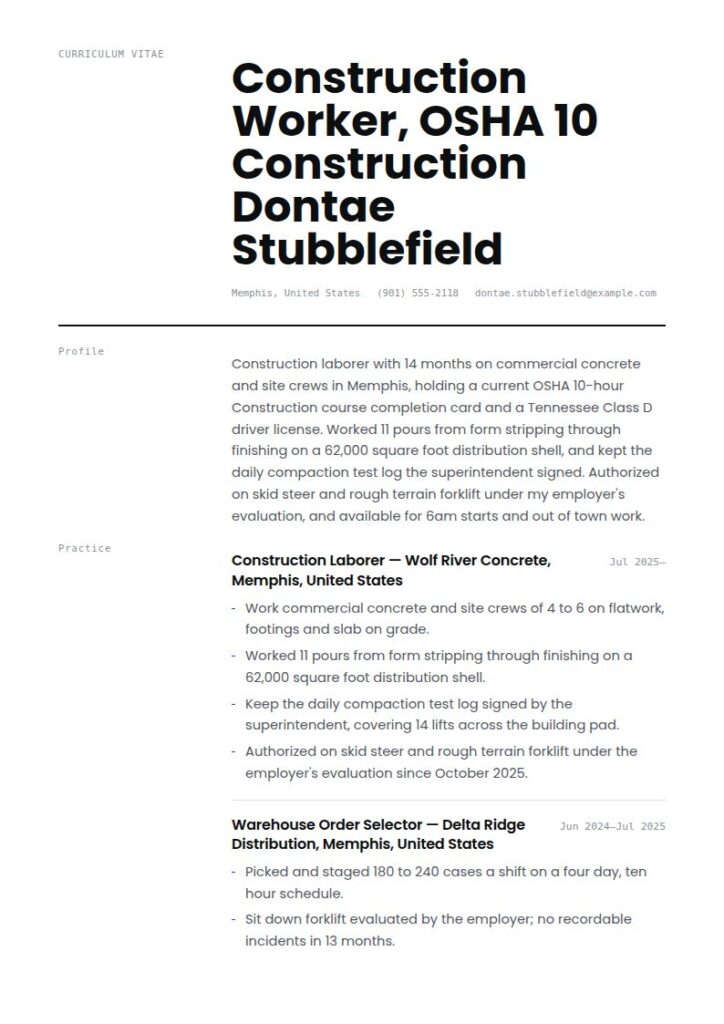
Construction laborer with 14 months on commercial concrete and site crews in Memphis, holding a current OSHA 10-hour Construction course completion card and a Tennessee Class D driver license. Worked 11 pours from form stripping through finishing on a 62,000 square foot distribution shell, and kept the daily compaction test log the superintendent signed. Authorized on skid steer and rough terrain forklift under my employer's evaluation, and available for 6am starts and out of town work.
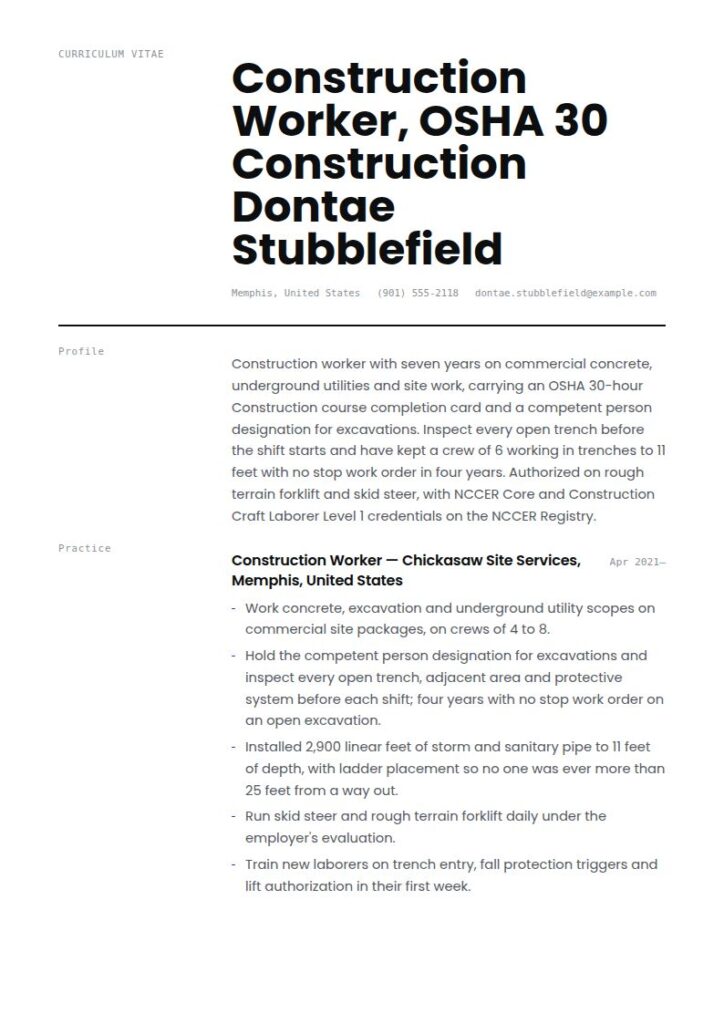
Construction worker with seven years on commercial concrete, underground utilities and site work, carrying an OSHA 30-hour Construction course completion card and a competent person designation for excavations. Inspect every open trench before the shift starts and have kept a crew of 6 working in trenches to 11 feet with no stop work order in four years. Authorized on rough terrain forklift and skid steer, with NCCER Core and Construction Craft Laborer Level 1 credentials on the NCCER Registry.
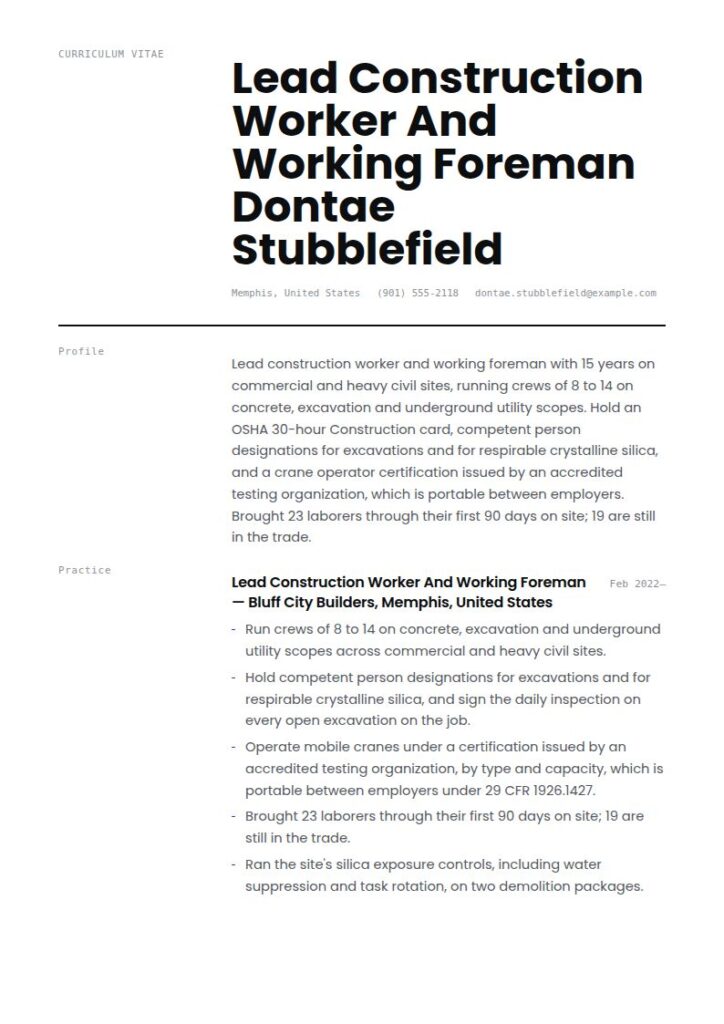
Lead construction worker and working foreman with 15 years on commercial and heavy civil sites, running crews of 8 to 14 on concrete, excavation and underground utility scopes. Hold an OSHA 30-hour Construction card, competent person designations for excavations and for respirable crystalline silica, and a crane operator certification issued by an accredited testing organization, which is portable between employers. Brought 23 laborers through their first 90 days on site; 19 are still in the trade.
Right vs wrong: the same construction worker summary, twice
| ✅ Right | ❌ Wrong |
|---|---|
| Construction worker with seven years on commercial concrete, underground utilities and site work. | Experienced construction professional with a strong work ethic. |
| OSHA 30-hour Construction card and a competent person designation for excavations. | Safety conscious and OSHA certified. |
| Kept a crew of 6 working in trenches to 11 feet with no stop work order in four years. | Committed to getting the job done right the first time. |
On the other hand, a superintendent can schedule the right column on Monday. In contrast, a superintendent has to interview the left column first, and one filling a hole this week does not have that time.
Outline your construction worker experience
Next, list the contractor, city, the scopes you worked, and dates. Then three to five bullets, each naming a scope and carrying a number: a quantity, a depth, a square footage, a crew size or a count of pours. Name the contractor even when the work came through a hall or a staffing desk.
| Instead of | Use |
|---|---|
| Performed general labor duties on construction sites | Worked concrete, excavation and underground utility scopes on four commercial shells between 40,000 and 110,000 square feet |
| Operated heavy equipment | Ran skid steer and rough terrain forklift daily under employer evaluation; loaded and set 180 precast panels across two buildings |
| Followed all safety procedures | Held the competent person designation for excavations and inspected every open trench before each shift, to a maximum depth of 11 feet |
| Helped train new employees | Brought 23 new laborers through their first 90 days, covering fall protection triggers, trench entry and lift authorization |
Construction Worker, Chickasaw Site Services, Memphis, TN, April 2021 to Present
Work concrete, excavation and underground utility scopes on commercial site packages, on crews of 4 to 8.
Hold the competent person designation for excavations and inspect every open trench, adjacent area and protective system before each shift; four years with no stop work order on an open excavation.
Installed 2,900 linear feet of storm and sanitary pipe to 11 feet of depth, including ladder placement so no one was ever more than 25 feet from a way out.
Run skid steer and rough terrain forklift daily under the employer's evaluation, and train new laborers on the trench and lift rules in their first week.
The cards that get you through the gate
After all, construction is one of the few occupations where the first assessment is not of your skill. It is of your wallet. On most commercial and industrial sites the badge office reads your cards before any foreman watches you pick up a shovel, and a card you cannot produce is a card you do not have. That is why the block below belongs above your experience rather than at the bottom with your education. Write it as an inventory of things you actually hold, with the issuer and the date on every line.
Cards: OSHA 30-hour Construction course completion card, OSHA-authorized trainer, March 2023. OSHA 10-hour Construction course completion card, June 2019. First aid, CPR and AED, American Red Cross, February 2026.
Designations held with current employer: Competent person, excavations and trenching. Competent person, respirable crystalline silica.
Equipment authorized: Rough terrain forklift and skid steer, evaluated by employer under 29 CFR 1910.178(l). Mobile crane, certified by an accredited testing organization, by type and capacity.
Screening: Current negative result on file with a third party administrator. Clear background check; can badge within 48 hours.
Driver license: Tennessee Class D, clean record, own transport.
In fact, four different kinds of thing sit in that block, and confusing them is the commonest mistake on a construction resume.
Outreach cards are training, not a license. OSHA's own description is that "The 10-hour training program is primarily intended for entry level workers" while "The 30-hour training program is intended to provide workers with some safety responsibility a greater depth and variety of training," and that "Outreach training does not fulfill the training requirements found in OSHA standards" (OSHA Outreach Training Program overview, osha.gov, retrieved 17 September 2026). Write which card, and write the year.
Competent person designations and inspections
A competent person is a designation your employer makes, not a course you passed. The regulation defines one as "one who is capable of identifying existing and predictable hazards in the surroundings or working conditions which are unsanitary, hazardous, or dangerous to employees, and who has authorization to take prompt corrective measures to eliminate them" (29 CFR 1926.32(f), eCFR, retrieved 17 September 2026). The second half is the part people drop. Without the authority to stop the work, you are not one. So write it the honest way: "competent person, excavations, designated by employer since 2022", and be ready to say what you were authorized to stop.
The designation matters because specific rules attach to it. Excavations must be inspected daily: "Daily inspections of excavations, the adjacent areas, and protective systems shall be made by a competent person" (29 CFR 1926.651(k)(1), eCFR, retrieved 17 September 2026). Similarly, scaffolds carry their own: "Scaffolds and scaffold components shall be inspected for visible defects by a competent person before each work shift" (29 CFR 1926.451(f)(3), same source). Silica has one as well, defined as an individual "who is capable of identifying existing and foreseeable respirable crystalline silica hazards in the workplace," against a permissible exposure limit of 50 micrograms per cubic meter and an action level of 25 micrograms, both as 8-hour time-weighted averages (29 CFR 1926.1153, same source).
Construction equipment authorizations and fall protection
Equipment authorizations mostly do not travel, and one kind does. Powered industrial truck operator training in construction points at the general industry rule: "The requirements applicable to construction work under this paragraph are identical to those set forth at 1910.178(l) of this chapter" (29 CFR 1926.602(d), eCFR, retrieved 17 September 2026), and that rule makes the evaluation the employer's, so a new contractor will evaluate you again. Crane operation is the exception, because the standard splits the two routes: a certification from an accredited testing organization "is portable among employers who are required to have operators certified under this option," while an employer audited certification counts "only where the operator is employed by (and operating the equipment for) the employer that issued the certification" (29 CFR 1926.1427, same source). If yours is the portable kind, say so in those words.
Know the trigger heights, and it will show. Fall protection in construction is required at 6 feet above a lower level, and the figure holds across unprotected sides and edges, holes, formwork and reinforcing steel, ramps and runways, excavations, and low-slope and steep roofs (29 CFR 1926.501(b), osha.gov, retrieved 17 September 2026). Scaffolds are the exception people trip over: there it begins at more than 10 feet above a lower level (29 CFR 1926.451(g)(1), eCFR, same date). A candidate who says "6 feet, except 10 on a scaffold" has told the superintendent more than a page of adjectives would.
Drug and background screening on site
Last, treat drug and background screening as a scheduling fact. For example, owner-controlled and industrial sites gate the badge on a screening result, and the gap between an offer and a first shift is usually that result. One neutral line saying you hold a current negative result and can badge inside two days answers a question the reader would otherwise have to ask.
Build a snapshot of your key skills
Specifically, ten to fourteen entries in four groups: scopes, equipment, tools and materials, and site practice.
Scopes: Cast in place concrete, Underground storm and sanitary, Site grading and compaction, Precast erection support, Demolition and selective removal
Equipment: Skid steer, Rough terrain forklift, Mobile crane, Walk behind and ride on compactors, Concrete saws and core drills
Tools and materials: Form setting and stripping, Rebar tying and placement, Flatwork finishing, Pipe laser and grade rod, Trench box and slide rail installation
Site practice: Trench inspection and protective system checks, Fall protection systems and anchorage, Silica dust controls and water suppression, Confined space entrant duties, Daily toolbox talks
List your education and certifications
Keep this section short and put it last. The cards are already up top; therefore, this is where training that builds toward a trade goes, with the place it can be verified.
Construction Craft Laborer apprenticeship, third year, registered apprenticeship program, Memphis, TN, 2023 to present. Apprentices earn a portable, nationally recognized credential on completion (U.S. Department of Labor, apprenticeship.gov, retrieved 17 September 2026).
NCCER Core Curriculum and Construction Craft Laborer Level 1, recorded on the NCCER Registry, 2022. NCCER states that its credentials "are portable and recognized globally" and can be verified by an employer through a shared link or QR code (NCCER, nccer.org, retrieved 17 September 2026).
High school diploma, Memphis, TN, 2018.
Choose the right layout and design
Single column, 11 or 12 point, one page, no photograph, no graphics, no skill bars. Send a PDF named for yourself and the job: dontae-stubblefield-construction-worker-resume.pdf.
Above all, the card block is the only place to spend design effort, and a bold label with a line break is enough. Two columns and text boxes are where applicant systems drop content.
Put your cards, designations and equipment authorizations in one block under the summary, each with an issuer and a date. Say who designated you a competent person and for what. Name the scopes you have worked rather than the tasks you performed. Give one number per bullet: cubic yards, linear feet, depth, crew size, square footage. State plainly that you can clear a screening and how fast you can badge. Name the contractor even when the work came through a hall or a staffing desk.
Do not write "OSHA certified", because OSHA says the card is not a certification and safety managers know it. Do not claim a competent person designation you were never given the authority to act on. Do not list an equipment authorization as though it travels with you when the rule makes it your employer's. Do not write "various duties as assigned" where the scope name would fit. Do not pad to two pages before you have a foreman line. Do not use a two column template for a contractor portal.
Construction worker job market and outlook
A very large occupation, growing faster than average, with heavy replacement demand and almost no formal educational gate, which is why the card block does the sorting.
| Measure | Value |
|---|---|
| Construction laborer and helper jobs, 2025 | 1,674,400 |
| Projected change, 2025-35 | 6 percent, faster than average |
| Projected annual openings | About 137,000 |
| Typical entry-level education | No formal educational credential typically required |
| Typical on-the-job training | Short-term on-the-job training |
| Median annual wage, May 2025 | $46,680, or $22.44 an hour |
Source: BLS Occupational Outlook Handbook, construction laborers and helpers, May 2025 wage data with 2025 to 2035 projections, published 27 August 2026. Construction laborers specifically had a median of $47,120 in the same cycle.
No credential is required, so the credentials you have are the whole signal
The BLS Occupational Outlook Handbook lists no formal educational credential as typically required to enter this occupation, and short-term on-the-job training as the norm, against 1,674,400 jobs in 2025 and about 137,000 openings a year (BLS Occupational Outlook Handbook, May 2025 wage data with 2025 to 2035 projections, published 27 August 2026).
The same profile notes that employers frequently require safety certification meeting Occupational Safety and Health Administration guidelines, and that a valid driver license may also be required.
Read those together and the hiring logic falls out. No diploma is sorting 1,674,400 people, so the sorting is done by what you can produce at the gate: the card, the designation, the equipment evaluation, the license and the screening result.
Meanwhile, here is where the work sits, in the same cycle:
| Industry | Share of employment | Median annual wage, May 2025 |
|---|---|---|
| Specialty trade contractors | 32 percent | $46,360 |
| Self-employed | 24 percent | Not published |
| Construction of buildings | 17 percent | $47,540 |
| Heavy and civil engineering construction | 15 percent | $47,420 |
| Temporary help services | 2 percent | $35,740 |
Source: BLS Occupational Outlook Handbook, construction laborers and helpers, May 2025.
What salary you can expect as a construction worker
The median annual wage for construction laborers and helpers was $46,680 as of May 2025, or $22.44 an hour, with construction laborers specifically at $47,120 (BLS Occupational Outlook Handbook, May 2025 wage data, published 27 August 2026).
The spread between the published industry medians is narrower than most people expect: construction of buildings pays $47,540 and specialty trade contractors $46,360, a difference of a little over a thousand dollars a year. What moves pay here is not which box your employer sits in, but what you are allowed to do once you are inside the gate.
That is the practical argument for the card block. An operator authorization puts you on a machine rather than behind a shovel. For instance, a competent person designation makes you the person who opens the trench, which is the person the schedule waits on. Likewise, a portable crane certification is the rare credential a new employer does not have to rebuild. Each is a line on a resume before it is a line on a pay stub.
Key takeaways for a construction worker resume
- First, put the cards, designations and authorizations in one block directly under the summary.
- Write "course completion card" and the year, never "OSHA certified", because OSHA says the card is not a certification.
- Then name who designated you a competent person and for what, and be able to say what you could stop.
- Distinguish an employer evaluation from a portable third party certification, because the rules do.
- Next, give a number in every experience bullet: yards, feet, depth, crew size, square footage.
- Also, name the contractor and the scope, never "various duties as assigned".
- State the screening position plainly, because it is the thing standing between an offer and a first shift.
Build your construction worker resume in 15 minutes with our AI resume builder.
Related construction resume examples
- General laborer resume
- Construction resume
- Contractor resume
- Construction manager resume
- Construction project manager resume
- Construction superintendent resume
- Glazier resume
- Carpenter resume
- Cement mason resume
- Electrician resume
- Welder resume
- Forklift operator resume
Pair it with a matching construction worker cover letter.
Construction worker resume questions, answered
How long should a construction worker resume be?
One page. A superintendent reads these standing up, often on a phone, and the useful content is the card block, the contractors and the scopes. Two pages only once you have a decade and a foreman line.
Is an OSHA 10 or OSHA 30 card a certification?
No. OSHA states directly that "an OSHA card is not considered a certification or license" and that "The Outreach Training Program is voluntary and OSHA does not require Outreach training" (OSHA Outreach Training Program FAQs, osha.gov, retrieved 17 September 2026). Write it as a course completion card with the year. Contractors ask for it anyway, and many owner-controlled sites will not badge without one.
Do my OSHA cards expire?
The construction, general industry, maritime and disaster site student cards carry no expiration date (OSHA, osha.gov, retrieved 17 September 2026). A lost card can only be replaced if the class was taken within the last five years, so photograph both sides of yours today and keep the trainer's contact details.
What do I put on a construction worker resume with no experience?
Put the cards first, because they are the only part of the file that does not depend on experience. Take the OSHA 10-hour Construction class, get a first aid and CPR card, and confirm your driver license status. Then write whatever physical work you have done as a job with numbers in it: hours, loads, shifts, weights. Finish with a line saying you can clear a screening and start immediately.
How do I show results when nothing I do gets measured?
Use the numbers on the work: cubic yards placed, linear feet of pipe, depth of trench, square footage of slab, panels set, crew size, pours completed. Then add the number nobody else will give you, which is how long you went without an incident, a stop work order or a failed inspection on work you were responsible for.