Licensed Contractor, Remodeling and Tenant Improvement Ifeanyi Olarewaju
Owner and Qualifying Party
[email protected] | (713) 555-2124 | Houston, United States
Profile
Licensed contractor in the first year of running a single-crew remodeling and tenant improvement business in Houston, after four years as a lead carpenter. Passed the NASCLA Accredited Examination for Commercial General Building Contractors in March 2025 and hold a Louisiana State Licensing Board for Contractors residential license. Closed 11 contracts worth $482,000 in the first twelve months with no lien filed against a job. Carry $1,000,000 per occurrence general liability and Texas workers' compensation coverage.
Work Experience
03/2025 - Present, Owner and Qualifying Party, Olarewaju Building Company LLC, Houston, United States
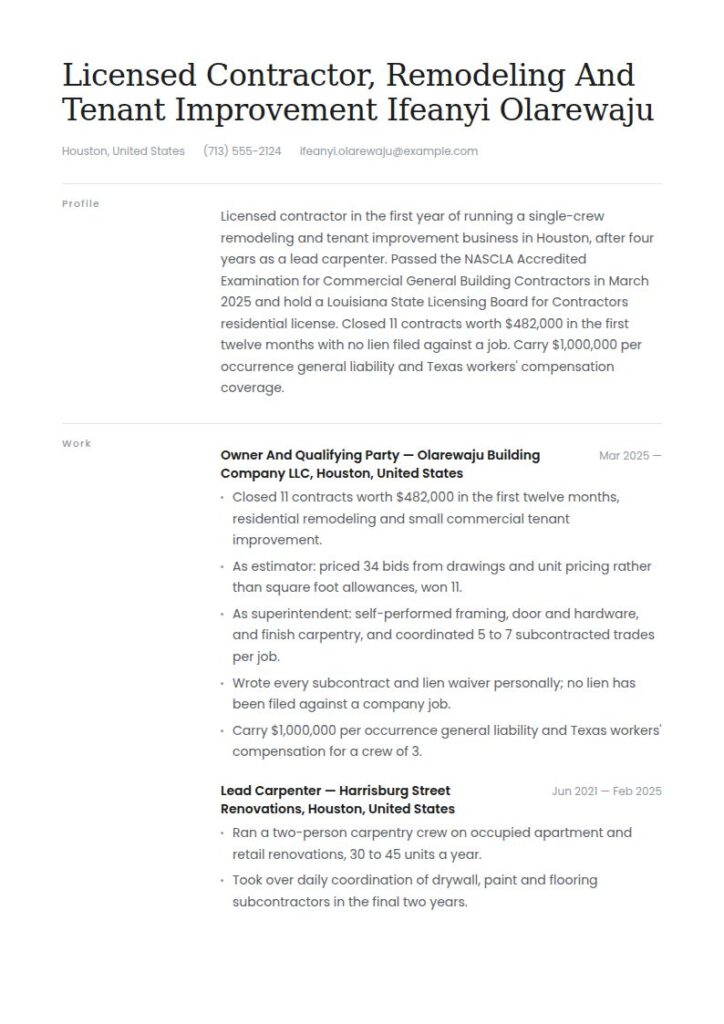
- Closed 11 contracts worth $482,000 in the first twelve months, residential remodeling and small commercial tenant improvement.
- As estimator: priced 34 bids from drawings and unit pricing rather than square foot allowances, won 11.
- As superintendent: self-performed framing, door and hardware, and finish carpentry, and coordinated 5 to 7 subcontracted trades per job.
- Wrote every subcontract and lien waiver personally; no lien has been filed against a company job.
- Carry $1,000,000 per occurrence general liability and Texas workers' compensation for a crew of 3.
06/2021 - 02/2025, Lead Carpenter, Harrisburg Street Renovations, Houston, United States
- Ran a two-person carpentry crew on occupied apartment and retail renovations, 30 to 45 units a year.
- Took over daily coordination of drywall, paint and flooring subcontractors in the final two years.
Education
08/2019 - 05/2021, Associate of Applied Science, Construction Management Technology, Houston Community College, Houston, United States
Coursework in estimating, construction contracts and plan reading.
Skills
Quantity takeoff and unit pricing, 70
Self-perform finish carpentry, 90
Subcontract drafting, 60
Lien waiver and pay application administration, 65
Occupied building and phased work, 75
Bluebeam Revu and QuickBooks Contractor, 70
Languages
English, native
Yoruba, native
Spanish, intermediate
Certificates
03/2025, NASCLA Accredited Examination for Commercial General Building Contractors, National Association of State Contractors Licensing Agencies, NED transcript on file
Result held on the NASCLA National Examination Database for transmission to participating state agencies.
06/2025, Residential contractor license, Louisiana State Licensing Board for Contractors, LA-68412
Active.
Summary
A contractor resume is a one to two page document that names the license classification you hold, the jurisdiction that issued it, and the bond and insurance standing behind it, then translates an owner-operator's history into roles an employer recognizes. This guide gives you three adaptable versions, the credential block most applicants leave out, and current Bureau of Labor Statistics pay for the closest published occupation.
Contractor resume examples by experience level
A contractor resume is a one to two page document that names the license classification you hold, the jurisdiction that issued it and the bond and insurance standing behind it, and then does something harder: it turns a business owner's history into a form an employer can hire from.
In short, those two problems are the whole page. However, in the states that issue them, a contractor's credentials are not a line under education; instead, they are the reason you are allowed to sign a contract at all. And a contractor who has run their own company has been the estimator, the project manager and the superintendent in the same week, so a history written the usual way reads as one person claiming three jobs.
Resume guide for a contractor resume
For that reason, this guide and the corresponding contractor resume example will cover:
- First, how to write a contractor resume, section by section
- Then, why classification, bond and insurance belong in the first three lines
- Three adaptable summaries: newly licensed, established owner and multi-state
- How to write an owner-operator's history so a hiring manager can read it
- Finally, what the market looks like and what you can expect to earn
How to write a contractor resume
Overall, six sections: contact header, summary, license and insurance block, project and employment history, education and certifications, and skills. One page while you are a single-crew operation, two once you hold a license in more than one state. First, put the license block above the work history: it is a gate, not an achievement, and an applicant who cannot qualify a company for the classification a firm bids the job under is a no whatever else the page says.
| Section | What it is answering | Where it goes |
|---|---|---|
| License and classification | Can this person qualify us for the work we bid? | Directly under the summary |
| Bond and insurance | What standing was behind that license? | Same block, second and third line |
| Project history | What did they build, at what value? | Reverse chronological, with contract values |
| Role per project | Were they estimating it, running it, or standing on it? | Named in the bullet, not implied |
Write the classification the way the board writes it
"General contractor" is not a classification anywhere; it is a job title. What a board issues is a specific code with a specific scope, and the code is what a licensing coordinator searches for. California shows how granular this gets: the Contractors State License Board issues a Class A general engineering contractor license, a Class B general building contractor license, a Class B-2 residential remodeling contractor license, and 48 separate C specialty classifications, among them C-10 electrical, C-20 warm-air heating, ventilating and air-conditioning, and C-36 plumbing (Contractors State License Board, retrieved 17 September 2026).
Write yours the same way, with the state, the classification code and the number: "California CSLB Class B general building contractor, #1094882."
Run the finished file through the ATS resume checker before you submit. Larger firms parse applications into a system first, and a two-column license block is where that parsing breaks.
Choosing the best resume format for a contractor resume
Reverse chronological, with one deviation: a named project list can sit as its own block rather than being scattered through employment bullets. In practice, functional formats fail here because a contractor's resume is partly a claim about legal standing over time, and hiding the timeline also hides whether a license lapsed. Do not disguise the ownership either; it is an advantage, and hiding it creates a gap you then have to explain in an interview.
Include your contact information
| ✅ Right | ❌ Wrong |
|---|---|
| Ifeanyi Olarewaju | Ifeanyi Olarewaju |
| General Building Contractor, Commercial Interiors and Light Industrial | Experienced construction professional and business owner |
| LA #68412 commercial, MS #24907, AL #51338 | Licensed and insured |
| (713) 555-2124, [email protected], Houston, TX | (713) 555-2124, [email protected] |
Use a personal email address, not the company one you have been signing contracts from, and put the license numbers in the header rather than at the bottom of page two. After all, verification is the first thing a licensing coordinator does.
Make use of a summary
Four lines: what you are licensed to build and where, how long you have been the responsible party, one volume figure, and one thing that is true about how you ran the business.
Licensed contractor in the first year of running a single-crew remodeling and tenant improvement business in Houston, after four years as a lead carpenter. Passed the NASCLA Accredited Examination for Commercial General Building Contractors in March 2025 and hold a Louisiana State Licensing Board for Contractors residential license. Closed 11 contracts worth $482,000 in the first twelve months with no lien filed against a job. Carry $1,000,000 per occurrence general liability and Texas workers' compensation coverage.
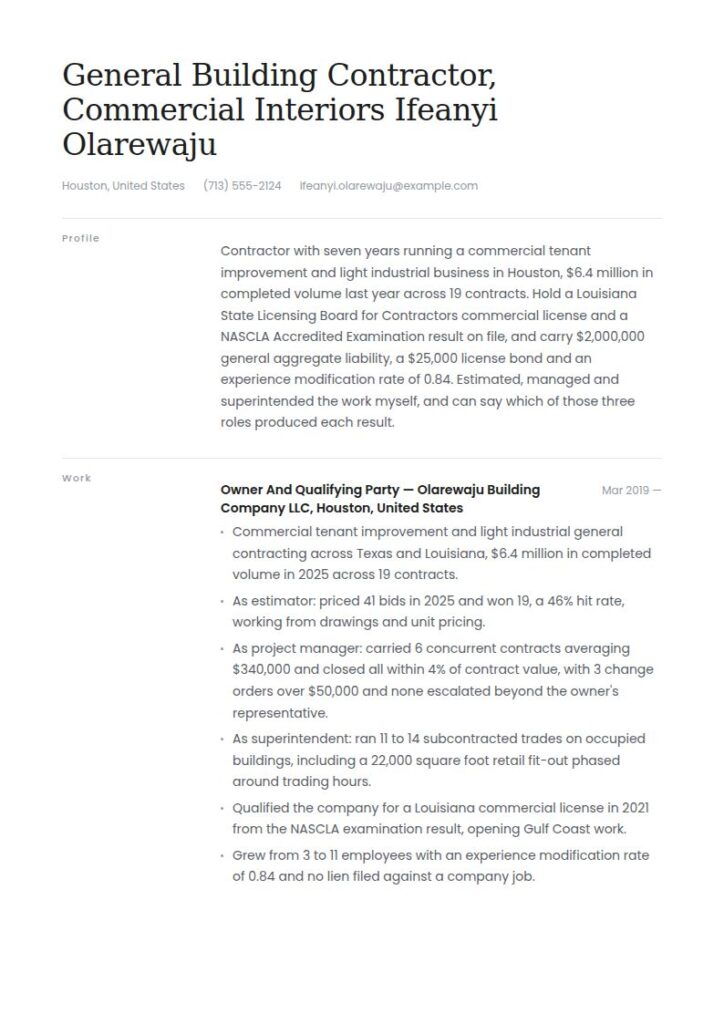
Contractor with seven years running a commercial tenant improvement and light industrial business in Houston, $6.4 million in completed volume last year across 19 contracts. Hold a Louisiana State Licensing Board for Contractors commercial license and a NASCLA Accredited Examination result on file, and carry $2,000,000 general aggregate liability, a $25,000 license bond and an experience modification rate of 0.84. Estimated, managed and superintended the work myself, and can say which of those three roles produced each result.
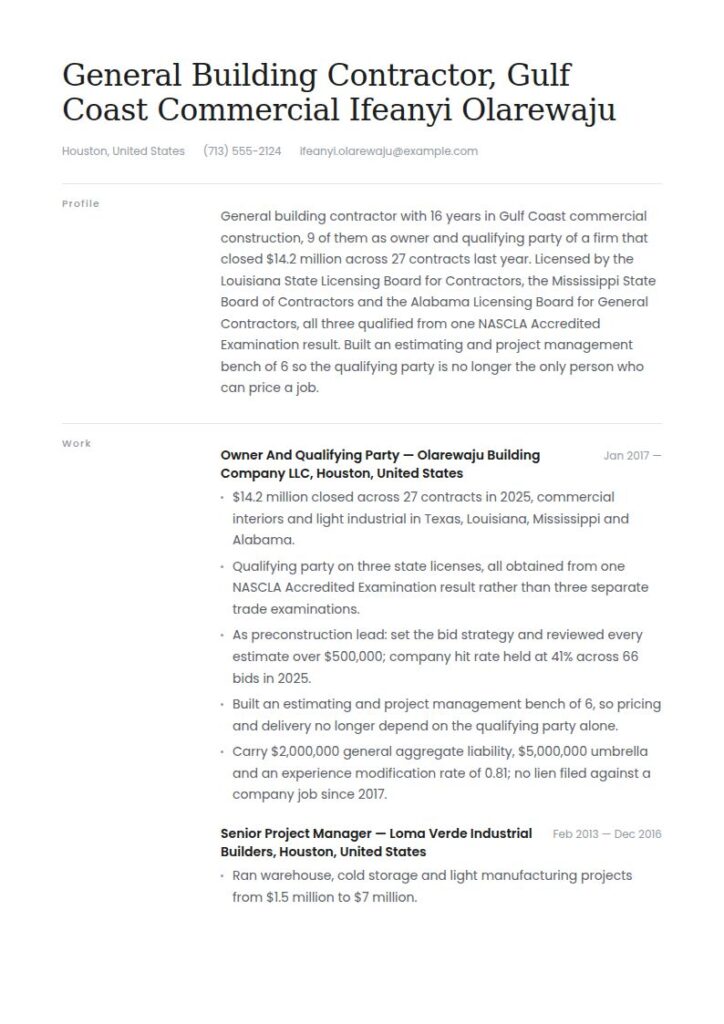
General building contractor with 16 years in Gulf Coast commercial construction, 9 of them as owner and qualifying party of a firm that closed $14.2 million across 27 contracts last year. Licensed by the Louisiana State Licensing Board for Contractors, the Mississippi State Board of Contractors and the Alabama Licensing Board for General Contractors, all three qualified from one NASCLA Accredited Examination result. Built an estimating and project management bench of 6 so the qualifying party is no longer the only person who can price a job.
Right vs wrong: the same contractor summary, twice
| ✅ Right | ❌ Wrong |
|---|---|
| Contractor with seven years running a commercial tenant improvement business in Houston, $6.4 million in completed volume last year across 19 contracts. | Experienced contractor with a proven track record of delivering projects on time and on budget. |
| Louisiana State Licensing Board for Contractors commercial license, NASCLA examination result on file, $25,000 license bond, experience modification rate 0.84. | Fully licensed, bonded and insured. |
| Estimated, managed and superintended the work myself, and can say which of those three roles produced each result. | Wore many hats and handled all aspects of the business. |
"Licensed, bonded and insured", however, is what a contractor writes on the side of a truck. It is not information. Every line in the left column can be checked by someone who wants to check it, and that is the only quality a credential claim needs.
Outline your experience and say which hat you were wearing
This is where owner-operator resumes usually fail, and the failure is compression rather than modesty. When you run a small contracting business you are the estimator on Monday, the project manager on Wednesday and the superintendent on Friday. Written as one job, that becomes a paragraph of everything; written instead as three named functions inside one company, it becomes legible.
| Instead of | Use |
|---|---|
| Managed all aspects of construction projects from start to finish | As estimator: priced 41 commercial interior bids in 2025, won 19, hit rate 46% |
| Responsible for budgets and scheduling | As project manager: carried 6 concurrent contracts averaging $340,000, closed all within 4% of contract value |
| Supervised subcontractors and crews | As superintendent: ran a 14-trade tenant improvement over a live retail floor |
| Handled all paperwork and compliance | Wrote and negotiated all subcontracts; 3 change orders over $50,000, none disputed |
| Grew the business | Volume from $482,000 to $6.4 million over six years, headcount from 3 to 11 |
Split the owner role into the roles the employer is hiring for
Read the posting, find the function it is actually hiring, then give that function its own labeled bullets. If the post is for a project manager, your estimating bullets are supporting evidence and your PM bullets are the argument; for a preconstruction lead, invert it.
An owner has also done something no employed candidate on the pile has done: signed contracts with money at personal risk and carried the bond. "No liens filed against a job in seven years" is a sentence an employed project manager cannot write.
Owner and Qualifying Party, Olarewaju Building Company LLC, Houston, TX, March 2019 to Present
Commercial tenant improvement and light industrial general contracting across Texas and Louisiana, $6.4 million in completed volume in 2025 across 19 contracts.
As estimator: priced 41 bids in 2025 and won 19, a 46% hit rate, working from drawings and unit pricing rather than square foot allowances.
As project manager: carried 6 concurrent contracts averaging $340,000 and closed all within 4% of contract value, with 3 change orders over $50,000 and none escalated beyond the owner's representative.
As superintendent: self-performed carpentry and ran 11 to 14 subcontracted trades on occupied buildings, including a 22,000 square foot retail fit-out phased around trading hours.
Qualified the company for a Louisiana commercial license in 2021 from the NASCLA examination result, with no lien filed against a company job since 2019.
License classification, bond and insurance are the first three lines
Everything else on a contractor's resume is, of course, negotiable. These three, on the other hand, are not, and they belong above the fold in that order.
Line one: the classification, with the issuing jurisdiction. Not "licensed contractor". The board, the class, the number and the status. List every state you are licensed in, because reciprocity is not automatic and a firm bidding across a state line is looking for exactly that.
Line two: the bond. The amount is set by statute, not by you, so stating it tells a reader whose rules you have been operating under. California requires a $25,000 contractor license bond plus a separate $25,000 bond of qualifying individual where one applies, and a disciplinary bond that may not be less than $25,000 nor more than ten times the contractor's bond (Contractors State License Board, retrieved 17 September 2026). Oregon sets it by endorsement instead: $25,000 for a residential general contractor, $20,000 for a residential specialty contractor, $80,000 for a commercial general contractor level 1 and $25,000 for level 2 (Oregon Construction Contractors Board endorsement chart, retrieved 17 September 2026).
Line three: insurance. Limits, not the word "insured". Oregon pairs each of those bonds with a liability minimum: $500,000 per occurrence for a residential general contractor, $300,000 for a residential specialty contractor, $2 million aggregate for a commercial general contractor level 1 and $1 million aggregate for level 2 (Oregon Construction Contractors Board, retrieved 17 September 2026). Add workers' compensation and your experience modification rate if it is good, because that rate is a number someone else calculated about your safety record.
California is one state, and its rules do not generalize
It is tempting to treat the California system as the American system, because it is the most documented. It is not. The Contractors State License Board issues its hazardous substance removal certification only to contractors who already hold an A, B, C-12, C-21, C-36, C-57 or C-61/D-40 license, and asbestos-certified contractors may perform abatement only within the classifications they already hold (Contractors State License Board, retrieved 17 September 2026). That layering is a California design choice, not a national rule.
Texas works nothing like it. The Texas Department of Licensing and Regulation's published list of licensed and regulated programs covers air conditioning and refrigeration contractors, electricians, elevator contractors, mold remediation contractors and water well drillers, among others, and no general or building contractor license appears on it (Texas Department of Licensing and Regulation, retrieved 17 September 2026). Trades are licensed; general building is not. Where a Texas trade license does exist it is precise: an air conditioning and refrigeration contractor license is Class A, allowing work on any size unit, or Class B, limited to cooling systems of 25 tons and under and heating of 1.5 million BTUs per hour and under, with endorsements for environmental air conditioning, commercial refrigeration, and process cooling or heating, and with Class A requiring $300,000 per occurrence and $600,000 aggregate commercial general liability against Class B's $100,000 and $200,000 (Texas Department of Licensing and Regulation, retrieved 17 September 2026).
If you work in a state with no general contractor license, say so on the page, or a reader in California will assume you left the classification line off.
One credential travels. The NASCLA Accredited Examination for Commercial General Building Contractors is a standardized licensing examination that participating jurisdictions accept in place of their own state-specific trade examination, and a passing result is stored in the NASCLA National Examination Database so a candidate can send a state agency the transcript electronically during a license application (National Association of State Contractors Licensing Agencies, retrieved 17 September 2026). The participating agencies include the California Contractors State License Board, the Louisiana State Licensing Board for Contractors, the Mississippi State Board of Contractors, the Alabama Licensing Board for General Contractors, the Nevada State Contractors Board, the North Carolina Licensing Board for General Contractors, the Oregon Construction Contractors Board and the Virginia Board for Contractors (National Association of State Contractors Licensing Agencies, retrieved 17 September 2026).
Also, put that result on the page, even for a single-state job. As a result, it tells a firm that expanding into a neighboring jurisdiction does not cost them a testing cycle.
Licenses: Louisiana State Licensing Board for Contractors, commercial license #LA-68412, active. Mississippi State Board of Contractors #MS-24907, active. Alabama Licensing Board for General Contractors #AL-51338, active. NASCLA Accredited Examination for Commercial General Building Contractors, passed March 2019, transcript held on the NASCLA National Examination Database.
Bond: $25,000 license bond, continuous, no claims paid.
Insurance: commercial general liability $1,000,000 per occurrence and $2,000,000 aggregate; $5,000,000 umbrella; workers' compensation in force since 2019; experience modification rate 0.84.
Build a snapshot of your key skills
Specifically, ten to fourteen entries in three groups: the contractual side, the field side, and the systems you run.
Contractual: Quantity takeoff and unit pricing, Subcontract drafting and negotiation, Change order management, Lien waiver and pay application administration, Prequalification submissions
Field and delivery: Self-perform carpentry, Trade coordination and sequencing, Occupied building and phased work, Punch list closeout, Subcontractor qualification
Systems and tools: Procore, Bluebeam Revu, QuickBooks Contractor, Microsoft Project, On-Screen Takeoff
Name the estimating software specifically; takeoff is the one function where a firm can tell within five minutes of an interview whether the claim is real.
List your education and certifications
The license block is already at the top of the page; repeat it here in full with dates, then degrees.
Bachelor of Science, Construction Management, University of Houston, Houston, TX, 2017
Associate of Applied Science, Construction Management Technology, Houston Community College, Houston, TX, 2014
Certifications: NASCLA Accredited Examination for Commercial General Building Contractors (2019). Louisiana State Licensing Board for Contractors commercial license #LA-68412 (2021). Mississippi State Board of Contractors #MS-24907 (2023). Alabama Licensing Board for General Contractors #AL-51338 (2025).
If you came up through the trades, lead with the apprenticeship and the years instead. The Bureau of Labor Statistics gives a bachelor's degree as the typical entry-level education for construction managers, the closest published occupation, alongside no prior work experience in a related occupation and moderate-term on-the-job training (BLS Occupational Outlook Handbook, published 27 August 2026). "Typical" describes the current workforce, not a requirement.
Choose the right layout and design
Above all, single column, plain type at 11 or 12 point, clear headings, no photograph and no company logo. In particular, the logo of a business you own sends the opposite signal on a page whose job is to say you are ready to be an employee.
Put classification, bond and insurance in the first three lines, in that order. Write the classification as the issuing board writes it, with the state and the number. Label each achievement with the role that produced it: estimator, project manager or superintendent. Give contract values and hit rates. Say plainly if your state does not issue a general contractor license.
Do not write "licensed, bonded and insured" and stop there. Do not hide that you owned the business, because the gap it leaves is worse than the fact. Do not list a lapsed license without saying so. Do not claim a classification your company held but you did not personally qualify. Do not use a two-column template; the license block is the first thing a parser mangles.
Contractor job market and outlook
The Bureau of Labor Statistics publishes no separate Occupational Outlook Handbook profile for contractors, so every figure below comes from the construction managers profile, the closest published occupation.
| Measure | Value |
|---|---|
| Construction manager jobs, 2025 | 609,100 |
| Projected change, 2025-35 | 9% (much faster than average), +55,200 |
| Projected annual openings | 49,700 |
| Typical entry-level education | Bachelor's degree |
| Median annual wage, May 2025 | $114,990 ($55.28 an hour) |
Source: U.S. Bureau of Labor Statistics, Occupational Outlook Handbook, 2025-35 projections and May 2025 wage data, published 27 August 2026.
Nearly two in five are self-employed, and that changes who reads your resume
Self-employed workers make up 38 percent of construction managers, the largest single share of the occupation. Specialty trade contractors account for 17 percent, nonresidential building construction 15 percent, residential building construction 9 percent, and heavy and civil engineering construction 8 percent (BLS Occupational Outlook Handbook, published 27 August 2026).
That 38 percent is the population this page is written for, and it explains the reading problem. A hiring manager has seen many owner resumes and learned that most cannot be compared against an employed candidate's. Labeled roles and contract values are what make yours comparable. BLS also notes that some states require construction managers to be licensed, and that professional certification is optional but demonstrates competency (BLS Occupational Outlook Handbook, published 27 August 2026). The word "some" is why the classification line has to name its state.
In short, here is where the work sits, by median pay:
| Industry | Median annual wage (May 2025) |
|---|---|
| Nonresidential building construction | $126,690 |
| Heavy and civil engineering construction | $124,430 |
| Specialty trade contractors | $104,100 |
| Residential building construction | $98,390 |
Source: U.S. Bureau of Labor Statistics, May 2025, published 27 August 2026.
What salary you can expect as a contractor
However, there is no published national median for "contractor" as an occupation. Instead, the closest figure is the construction managers median, $114,990 a year or $55.28 an hour as of May 2025 (BLS Occupational Outlook Handbook, published 27 August 2026).
The industry spread above is the useful part, because it is a choice rather than a negotiation. Meanwhile, nonresidential building construction pays a median of $126,690 against $98,390 in residential building construction (BLS, May 2025). Therefore, a residential remodeler moving into commercial interiors is moving into a better-paid part of the same trade, and the resume line that makes that move possible is a project list with commercial contract values on it.
For an owner the comparison is harder, because a draw is not a wage and it carries risk an employed role does not. The classification you can qualify a firm for, the volume you have carried, and whether you bring preconstruction ability or only field ability set what that firm will pay you. All three are resume facts.
Key takeaways for a contractor resume
- In short: classification, bond and insurance in the first three lines, in that order.
- Then write the classification exactly as the issuing board writes it, with state and number.
- Also, list every jurisdiction you are licensed in, because reciprocity is not automatic.
- Similarly, put the NASCLA examination result on the page, even for a single-state job.
- Finally, label every achievement with the role that produced it: estimator, project manager or superintendent.
- Give contract values, hit rates and volume rather than adjectives.
- Say plainly if your state issues no general contractor license, so no reader mistakes the gap for an omission.
Build your contractor resume in 15 minutes with our AI resume builder.
Related construction resume examples
- Construction manager resume
- Construction project manager resume
- Construction superintendent resume
- Construction resume
- Construction worker resume
- General laborer resume
- Electrician resume
- Plumber resume
- Carpenter resume
- HVAC technician resume
- Handyman resume
- Glazier resume
Pair it with a matching contractor cover letter.
Contractor resume questions, answered
How long should a contractor resume be?
One page while you are a single-crew operation. Two once you hold a license in more than one state or carry a project list worth reading, and the second page should be that project list.
Should I put my license number on a contractor resume?
Yes, with the issuing board and the status. License records are public, so the number is not sensitive and it is the fastest thing a reader can verify. "Licensed contractor" without a number reads as careless or evasive.
How do I write a contractor resume when I have been self-employed the whole time?
Treat the company as the employer and yourself as the holder of three roles inside it. Give the company name, the years, the type of work and the annual volume, then group your bullets under estimating, project management and field supervision. That lets a hiring manager map you onto the role they are filling.
Do I need a license to work as a contractor everywhere in the United States?
No, and that variation is worth stating on the page. The Texas Department of Licensing and Regulation licenses air conditioning and refrigeration contractors, electricians, elevator contractors and other trades, but no general or building contractor license appears on its published list of regulated programs (Texas Department of Licensing and Regulation, retrieved 17 September 2026). California licenses general building at state level through the Contractors State License Board. Check the board for the state you are applying in.
Is the NASCLA examination worth listing on a resume?
Yes. Participating jurisdictions accept it in place of their own state-specific trade examination, and the result is held in the NASCLA National Examination Database for electronic transmission to a state agency (National Association of State Contractors Licensing Agencies, retrieved 17 September 2026). For a firm bidding across state lines, that means you can qualify a new jurisdiction without a testing cycle.