Farm Tractor and Implement Operator Dwayne Yzaguirre
Farm Tractor Operator
[email protected] | (337) 555-1020 | Lafayette, United States
Profile
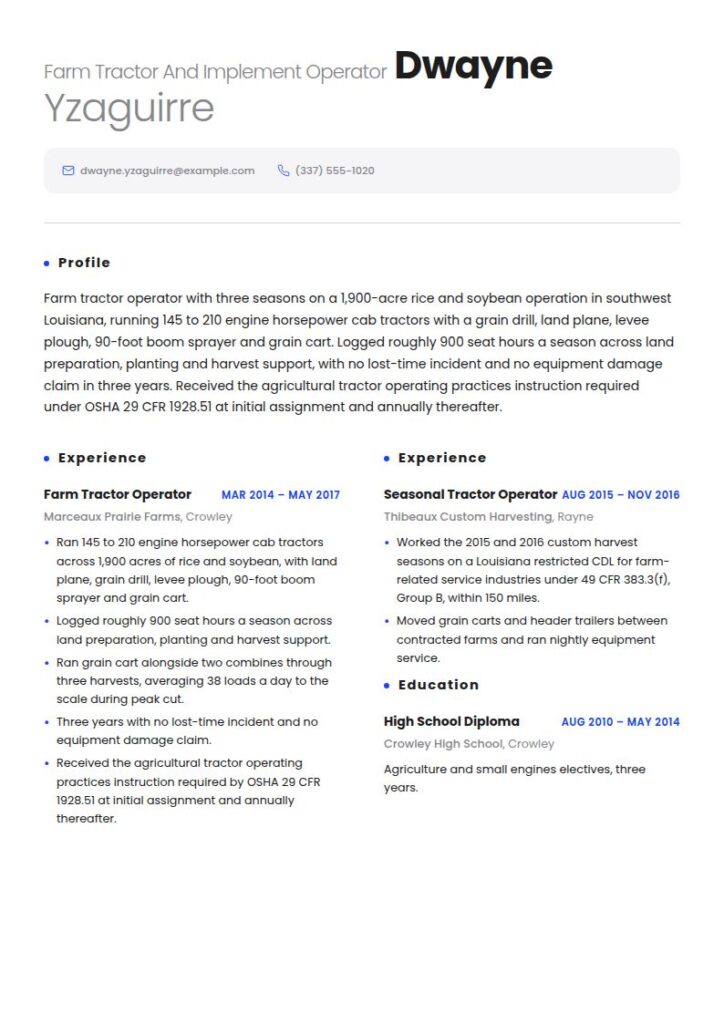
Farm tractor operator with three seasons on a 1,900-acre rice and soybean operation in southwest Louisiana, running 145 to 210 engine horsepower cab tractors with a grain drill, land plane, levee plough, 90-foot boom sprayer and grain cart. Logged roughly 900 seat hours a season across land preparation, planting and harvest support, with no lost-time incident and no equipment damage claim in three years. Received the agricultural tractor operating practices instruction required under OSHA 29 CFR 1928.51 at initial assignment and annually thereafter.
Work Experience
03/2014 - 05/2017, Farm Tractor Operator, Marceaux Prairie Farms, Crowley, United States
- Ran 145 to 210 engine horsepower cab tractors across 1,900 acres of rice and soybean, with land plane, grain drill, levee plough, 90-foot boom sprayer and grain cart.
- Logged roughly 900 seat hours a season across land preparation, planting and harvest support.
- Ran grain cart alongside two combines through three harvests, averaging 38 loads a day to the scale during peak cut.
- Three years with no lost-time incident and no equipment damage claim.
- Received the agricultural tractor operating practices instruction required by OSHA 29 CFR 1928.51 at initial assignment and annually thereafter.
08/2015 - 11/2016, Seasonal Tractor Operator, Thibeaux Custom Harvesting, Rayne, United States
- Worked the 2015 and 2016 custom harvest seasons on a Louisiana restricted CDL for farm-related service industries under 49 CFR 383.3(f), Group B, within 150 miles.
- Moved grain carts and header trailers between contracted farms and ran nightly equipment service.
Education
08/2010 - 05/2014, High School Diploma, Crowley High School, Crowley, United States
Agriculture and small engines electives, three years.
Skills
Cab tractor operation, 145 to 210 horsepower, 85
Implement setup: land plane, grain drill, levee plough, 80
Boom sprayer operation, 70
Grain cart and harvest support, 80
Daily service, greasing and defect reporting, 75
Roll-over protection and seat belt checks, 85
Languages
English, native
French, intermediate
Certificates
03/2014, Agricultural tractor operating practices instruction, OSHA 29 CFR 1928.51, Marceaux Prairie Farms
Given at initial assignment and repeated annually through 2017.
08/2015, Restricted CDL for farm-related service industries, 49 CFR 383.3(f), Louisiana Office of Motor Vehicles
Seasonal, Group B, no hazardous materials endorsement, within 150 miles. Held for the 2015 and 2016 custom harvest seasons.
Summary
Tractor driver is one job title covering three unrelated labor markets: the farm tractor, the yard or terminal tractor, and the highway tractor unit. This guide shows you how to resolve which one you mean in your first line, gives you three adaptable summaries, and sets out what the Bureau of Labor Statistics publishes on pay and employment for the two markets covered here.
Tractor Driver resume examples by experience level
In short, a tractor driver resume is a one to two page document, and its first job is to say which tractor.
After all, the title covers three machines that share a word and almost nothing else: a farm tractor pulling implements across a field, a yard or terminal tractor shunting trailers around a distribution site, and a highway tractor unit pulling a trailer between cities. In practice, different people hire them, under different rules, and the Bureau of Labor Statistics counts them as three separate occupations.
As a result, a recruiter searching "tractor driver" gets all three back in one list, and a resume that does not resolve the ambiguity in its first line is read against whichever job that reader is filling, then rejected for lacking experience it never claimed.
Resume guide for a tractor driver resume
To that end, this guide and the corresponding tractor driver resume example will cover:
- First, how to write a tractor driver resume, section by section
- The three jobs the title covers, and how to name yours in the first line
- Next, three adaptable summaries: the farm season, the yard shift and the lead operator
- Then, which safety rule attaches to which machine, and how to write it
- Finally, what the two published occupations pay, and how their markets differ
How to write a tractor driver resume
Overall, six sections: contact header with a job target line, summary, equipment and authorization, operating experience, skills, and education and certifications. In general, one page early, then two once you have run a yard or trained operators.
In particular, the equipment block sits high because a job title cannot carry it. "Tractor driver" says nothing about horsepower, implements, transmission or attachments, and every one of those decides whether you can be put to work on the first morning.
| Section | What it answers for the reader | Where it goes |
|---|---|---|
| Job target line | Which of the three tractor jobs is this application about? | Under your name, in the header |
| Equipment and authorization | What can this person be put on, and who says so? | Directly under the summary |
| Operating experience | What has this person moved, at what volume, and how safely? | Reverse chronological, volume in the header line |
| Education and certifications | What training is on record, and what date is on it? | Short, grouped, at the end |
Write a job target line under your name
One line under your name settles the ambiguity before the reader forms a view: "Yard and Terminal Tractor Operator", "Farm Tractor and Implement Operator, rice and row crop", or "Class A Tractor-Trailer Driver".
Then make the rest of the file agree with it: if the target line says yard, the summary counts trailer spots and dock doors, not acres. Keep one master file with everything in it, then send a version whose target line, summary and top job match the posting.
Run the finished file through the ATS resume checker first. Farms often take an emailed application, but distribution sites screen through a portal.
Choosing the best resume format for a tractor driver resume
Reverse chronological, single column, no graphics. A reader checks dates and machines, and both are easiest to find on a plain timeline.
Seasonal work is the one complication, and it is not a reason to abandon the format. Also group repeat seasons under one employer heading, name the seasons, and say what you did between them: "seasonal, spring and autumn 2015 and 2016; ran an equipment maintenance shift through both winters" removes the question before it is asked.
Include your contact information
| ✅ Right | ❌ Wrong |
|---|---|
| Dwayne Yzaguirre | Dwayne Yzaguirre |
| Yard and Terminal Tractor Operator, 9 years | Experienced tractor driver and heavy equipment operator |
| Powered industrial truck certification current, evaluated March 2025 | Fully certified, safety conscious |
| (337) 555-1020, [email protected], Lafayette, LA | (337) 555-1020, [email protected] |
Similarly, the term "heavy equipment operator" pulls in a fourth labor market, excavators and loaders, with its own certifications. Name one job.
Make use of a summary
In short, four lines: which tractor, how long, the volume, and the authorization behind it.
Farm tractor operator with three seasons on a 1,900-acre rice and soybean operation in southwest Louisiana, running 145 to 210 engine horsepower cab tractors with a grain drill, land plane, levee plough, 90-foot boom sprayer and grain cart. Logged roughly 900 seat hours a season across land preparation, planting and harvest support, with no lost-time incident and no equipment damage claim in three years. Received the agricultural tractor operating practices instruction required under OSHA 29 CFR 1928.51 at initial assignment and annually thereafter.
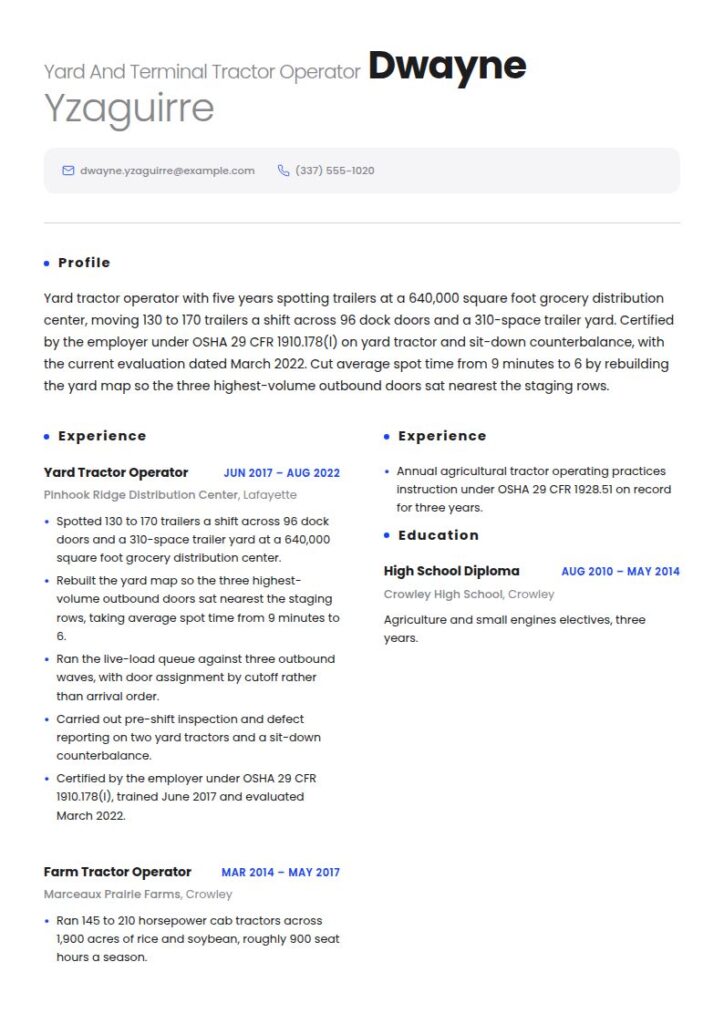
Yard tractor operator with five years spotting trailers at a 640,000 square foot grocery distribution center, moving 130 to 170 trailers a shift across 96 dock doors and a 310-space trailer yard. Certified by the employer under OSHA 29 CFR 1910.178(l) on yard tractor and sit-down counterbalance, with the current evaluation dated March 2022. Cut average spot time from 9 minutes to 6 by rebuilding the yard map so the three highest-volume outbound doors sat nearest the staging rows.
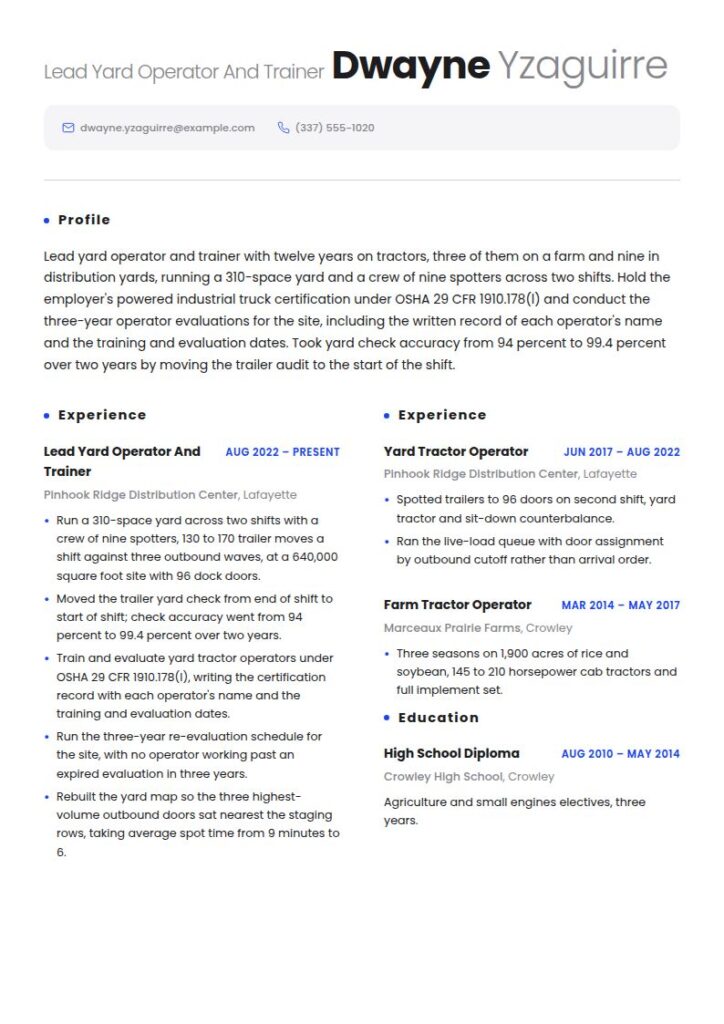
Lead yard operator and trainer with twelve years on tractors, three of them on a farm and nine in distribution yards, running a 310-space yard and a crew of nine spotters across two shifts. Hold the employer's powered industrial truck certification under OSHA 29 CFR 1910.178(l) and conduct the three-year operator evaluations for the site, including the written record of each operator's name and the training and evaluation dates. Took yard check accuracy from 94 percent to 99.4 percent over two years by moving the trailer audit to the start of the shift.
Right vs wrong: the same tractor driver summary, twice
| ✅ Right | ❌ Wrong |
|---|---|
| Yard tractor operator with five years spotting trailers at a 640,000 square foot distribution center. | Experienced tractor driver with a strong work ethic and a clean record. |
| 130 to 170 trailers a shift across 96 dock doors and a 310-space yard. | Responsible for moving trailers and supporting warehouse operations. |
| Certified by the employer under OSHA 29 CFR 1910.178(l), current evaluation dated March 2022. | Forklift and tractor certified. |
As a result, a manager can staff the left-hand column on Monday. In contrast, the right-hand column could describe any of the three jobs, which is the same as describing none.
Outline your operating experience
Employer, site, scale and dates in the header line of each job, then three to five bullets, each naming a machine or implement and carrying a number.
The counting unit is the tell. For example, a farm counts acres, seat hours, implements and passes; a yard counts spots, doors, yard spaces and check accuracy. The wrong unit signals that you learned the vocabulary from a job advert rather than the seat.
| Instead of | Use |
|---|---|
| Operated tractors and farm equipment | Ran 145 to 210 horsepower cab tractors with land plane, grain drill, levee plough and 90-foot boom sprayer across 1,900 acres of rice and soybean |
| Moved trailers around the yard | Spotted 130 to 170 trailers a shift across 96 dock doors and a 310-space yard |
| Followed all safety procedures | Three years with no lost-time incident and no damage claim, with annual 1928.51 instruction on record |
Lead Yard Operator and Trainer, Pinhook Ridge Distribution Center, Lafayette, LA, August 2022 to Present. 640,000 square feet, 96 dock doors, 310 trailer spaces.
Run the yard across two shifts with a crew of nine spotters, 130 to 170 trailer moves a shift and a live-load queue against three outbound waves.
Rebuilt the yard map so the three highest-volume outbound doors sat nearest the staging rows, taking average spot time from 9 minutes to 6.
Moved the trailer yard check from end of shift to start of shift; check accuracy went from 94 percent to 99.4 percent over two years and recovering misplaced trailers stopped being overtime work.
Train and evaluate yard tractor operators under OSHA 29 CFR 1910.178(l), writing the certification record and running the three-year re-evaluation schedule for the site.
The word tractor means three different jobs, so your resume has to say which one
The whole problem fits in one table: three machines, three labor markets, one job title.
| If you mean | The occupation BLS publishes | What the employer is actually checking | Median annual wage, May 2025 |
|---|---|---|---|
| Farm tractor and implements | Agricultural equipment operators | Implements, acreage, crop, season length, the 1928.51 record | $41,730 |
| Yard or terminal tractor | Industrial truck and tractor operators | The employer's 1910.178(l) certification, spots, doors, yard size | $46,420 |
| Highway tractor and trailer | Heavy and tractor-trailer truck drivers | License class, endorsements, medical card, driving record | See the truck driver guide |
Source for the two medians: U.S. Bureau of Labor Statistics, Occupational Outlook Handbook, Agricultural Workers and Material Moving Machine Operators, May 2025 wage data, last modified 27 August 2026.
The farm tractor
Specifically, this is the Handbook's agricultural equipment operators, 66,900 jobs in 2025, inside an agricultural workers group of 831,900 projected to fall 2 percent between 2025 and 2035 (BLS Occupational Outlook Handbook, last modified 27 August 2026). Crop production employs 53 percent of agricultural workers, so most of these seats sit on row crop, rice, grain and orchard operations.
Above all, two federal rules shape what a farm employer needs to see, and neither is a license you go and buy.
To begin with, the first is OSHA 29 CFR 1928.51, on roll-over protective structures. It applies to agricultural tractors manufactured after 25 October 1976 of more than 20 engine horsepower. The employer must provide each of those tractors with a seat belt and ensure the employee uses it while the tractor is moving, tightened enough to confine the employee to the protected area. It also requires that every employee who operates an agricultural tractor "shall be informed of the operating practices" in its appendix, at "the time of initial assignment and at least annually thereafter." That annual instruction is dated and your employer keeps it on record, and almost no applicant writes it down.
The second is the commercial driver's license exception at 49 CFR 383.3. Under 383.3(d) a state may except the driver of a farm vehicle controlled and operated by a farmer, including family members and employees, carrying agricultural products, farm machinery or farm supplies to or from a farm, and used within 241 kilometres, which is 150 miles, of the farmer's farm. For instance, under 383.3(f) a state may issue a restricted CDL to employees of designated farm-related service industries: agri-chemical businesses, custom harvesters, farm retail outlets and suppliers, and livestock feeders. That license is seasonal, valid for at most 210 days in a year, Group B and Group C only, with no hazardous materials endorsement and a 150-mile limit. If you have held one, write it with those limits.
The yard or terminal tractor
By contrast, this is the Handbook's industrial truck and tractor operators, 765,200 jobs in 2025, projected to grow 1 percent between 2025 and 2035, about 11,100 new jobs (BLS Occupational Outlook Handbook, Material Moving Machine Operators, last modified 27 August 2026). Across the whole material moving machine operators group, warehousing and storage is the largest employing industry at 33 percent.
In this case, the rule is OSHA 29 CFR 1910.178(l), and most applicants get it wrong on the page. In fact, the employer, not you, must ensure "that each powered industrial truck operator is competent to operate a powered industrial truck safely", and must complete that training before the operator is permitted to operate except for training purposes. The employer then certifies it, and the certification "shall include the name of the operator, the date of the training, the date of the evaluation, and the identity of the person(s) performing the training or evaluation." Performance is re-evaluated at least once every three years.
So this is not a license that travels with you. As a result, it belongs to the employer who issued it, on the equipment they authorized, and a new employer trains and evaluates you again. Write it as a dated employer certification and let the date do the work: "Powered industrial truck certification under 29 CFR 1910.178(l), yard tractor and sit-down counterbalance, evaluated March 2025, next evaluation due March 2028." Saying plainly that you expect to be evaluated on their equipment reads as competence, not weakness.
The highway tractor unit
If you pull a trailer on the road, your resume is a commercial driving resume, read against license class, endorsements, entry-level driver training, the medical certificate and hours of service. That is a separate guide, and it lives on our truck driver resume page. Name the job as tractor-trailer driving in your target line, then write it there.
Eleven yard seats for every farm seat
The two markets are nothing like the same size. The Bureau of Labor Statistics counted 765,200 industrial truck and tractor operators in 2025 against 66,900 agricultural equipment operators, both in the Occupational Outlook Handbook, last modified 27 August 2026.
They also move in opposite directions: industrial truck and tractor operators are projected to grow 1 percent between 2025 and 2035, while the agricultural workers group containing farm equipment operators is projected to fall 2 percent, from 831,900 to 818,700.
If you have both, that ratio is the argument for leading with the yard: eleven times the seats and a higher median. The farm experience moves down the page, where it reads as seat hours and mechanical judgement.
Build a snapshot of your key skills
Ten to fourteen entries in three groups, matched to the target line rather than to everything you have touched.
Yard operations: Trailer spotting and hostling, dock door assignment, yard map and staging design, trailer yard checks, live load and drop load handling, gate and seal verification
Equipment: Yard tractor with fifth wheel and boom lift, sit-down counterbalance, electric pallet jack, pre-shift inspection and defect reporting, 145 to 210 horsepower cab tractors with land plane, grain drill, levee plough, boom sprayer and grain cart
Safety and records: OSHA 1910.178(l) training and evaluation records, 1928.51 operating practices instruction, roll-over protection checks, near-miss reporting
List your education and certifications
Meanwhile, formal education is rarely the gate on either machine. The Handbook records no formal educational credential as typical for most agricultural workers, and for material moving machine operators a high school diploma or equivalent that is preferred rather than required, with on-the-job training from less than one month to several months (BLS Occupational Outlook Handbook, two occupational profiles, last modified 27 August 2026). Therefore, the certifications block is the important one.
High School Diploma, Crowley, LA, 2014
Powered industrial truck operator training and evaluation, employer certification under OSHA 29 CFR 1910.178(l), Pinhook Ridge Distribution Center: yard tractor and sit-down counterbalance. Trained June 2017, most recent evaluation March 2025, next due March 2028.
Agricultural tractor operating practices instruction, OSHA 29 CFR 1928.51, Marceaux Prairie Farms: initial assignment March 2014, repeated annually through 2017.
Louisiana restricted CDL for farm-related service industries, 49 CFR 383.3(f): seasonal, 2015 and 2016 custom harvest seasons, Group B, within 150 miles.
Choose the right layout and design
One column, 11 or 12 point type, no photograph, no icons, and no two-column equipment grid. Distribution sites parse applications into a system before anyone opens them, and a grid of machine names is where that turns into one unreadable line.
Put a job target line under your name saying which tractor. Name implements and attachments individually. Give volume in the counting unit of that market, acres and seat hours on a farm, spots and doors in a yard. Write the 1910.178(l) certification as a dated employer certification with the next evaluation due. Say when the 1928.51 instruction was last given. Group repeat seasons under one employer heading.
Do not write one resume claiming all three tractor jobs at once. Do not call the powered industrial truck certification a license, because it belongs to the employer and does not travel. Do not write "heavy equipment operator" unless you mean excavators and loaders. Do not leave seasonal gaps unexplained. Do not claim a restricted farm CDL without its seasonal and mileage limits, since both are written into the rule.
Tractor driver job market and outlook
There is no Bureau of Labor Statistics occupation called tractor driver. However, the two published occupations covering the work behave very differently.
| Measure | Agricultural equipment operators | Industrial truck and tractor operators |
|---|---|---|
| Jobs, 2025 | 66,900 | 765,200 |
| Median annual wage, May 2025 | $41,730 | $46,420 |
| Projected change, 2025-35 | -2% for the agricultural workers group | 1%, about 11,100 new jobs |
| Annual openings, parent group | ~111,500 (agricultural workers) | ~70,700 (material moving machine operators) |
| Typical entry-level education | No formal educational credential | High school diploma or equivalent, preferred |
Source: U.S. Bureau of Labor Statistics, Occupational Outlook Handbook, Agricultural Workers and Material Moving Machine Operators, May 2025 wage data and 2025 to 2035 projections, last modified 27 August 2026.
Both openings figures dwarf the projected job growth, because both are replacement markets. In practice, an employer filling a specific hole quickly is why a resume naming the machine beats one describing a career.
What salary you can expect as a tractor driver
The Bureau of Labor Statistics put the May 2025 median annual wage for agricultural equipment operators at $41,730 and for industrial truck and tractor operators at $46,420 (Occupational Outlook Handbook, last modified 27 August 2026). For example, the gap of $4,690 buys a year-round shift pattern and a paved working surface.
The wider material moving machine operators group, which industrial truck and tractor operators sit inside, had a median of $46,670 a year, or $22.44 an hour, in May 2025, with the lowest 10 percent under $36,900 and the highest 10 percent over $64,230 (BLS, May 2025). Within that group, meanwhile, crane and tower operators at $68,080 and hoist and winch operators at $56,450 sit above the yard tractor, which is the usual route to more money without leaving the equipment.
On the farm side, the agricultural workers group median was $35,890, or $17.25 an hour, in May 2025, so agricultural equipment operators at $41,730 already sit near the top of their own group (BLS, May 2025). The machine is the premium. None of these numbers move much through negotiation; what moves them is the machine list and a training record that means an employer does not start you from nothing.
Key takeaways for a tractor driver resume
- To start, say which tractor in a job target line under your name, and make the whole file agree with it.
- Then count in the unit of that market: acres and seat hours on a farm, spots and doors in a yard.
- Name implements and attachments individually; the list decides whether you can start on Monday.
- Also write the 1910.178(l) certification as a dated employer certification with the next evaluation due, not as a license.
- Put the 1928.51 annual operating practices instruction on the page if you have farmed; almost nobody does.
- Finally, give a restricted farm CDL with its seasonal and 150-mile limits, as 383.3(f) states them.
- If you pull a highway trailer, write a commercial driving resume and use the truck driver guide.
Build your tractor driver resume in 15 minutes with our AI resume builder.
Related transport and logistics resume examples
- Truck driver resume
- Delivery driver resume
- Warehouse worker resume
- Warehouse supervisor resume
- Logistics coordinator resume
- Dispatcher resume
- Package handler resume
- Order filler resume
- Stock clerk resume
- Inventory manager resume
- Warehouse manager resume
- Transport and logistics resume
Pair it with a matching tractor driver cover letter.
Tractor driver resume questions, answered
Which tractor job should I put first if I have done two of them?
The one the posting is for, and only that one in the target line and summary. Keep the other in the experience section with its own header line, where it reads as range. Neither kind of manager wants a resume that hedges in its first sentence.
Do I need a CDL to drive a yard tractor?
The Handbook's page covering industrial truck and tractor operators does not mention a commercial driver's license requirement, and yard tractors usually work on private property. Individual employers set their own rule, and some ask for a Class A because the crew occasionally moves a unit on a public road, so read the posting rather than assuming.
How do I write a yard tractor certification that came from a previous employer?
As a dated record, not a qualification you own. Under OSHA 29 CFR 1910.178(l)(6) the certification records the operator's name, the training date, the evaluation date and who carried it out, and 1910.178(l)(4)(iii) requires re-evaluation at least once every three years. Write the equipment types and the dates, then add that you expect to be evaluated again on hire.
What goes on a tractor driver resume with no paid experience?
Machines and hours. Family farm work, a school agriculture program, equipment handled during a seasonal harvest, a diesel or hydraulics short course, and any safety instruction you have received with its date. Then a target line naming one job. An employer is deciding how much supervision you need in week one, and a machine list with hours attached answers that better than a paragraph about willingness to learn.
Is farm tractor work a shrinking career?
The seats are declining slowly rather than disappearing. The agricultural workers group is projected to fall 2 percent between 2025 and 2035, from 831,900 to 818,700, while still producing about 111,500 openings a year, almost all replacements (BLS Occupational Outlook Handbook, last modified 27 August 2026). Agricultural equipment operators are the better paid part of that group, $41,730 against the group's $35,890.