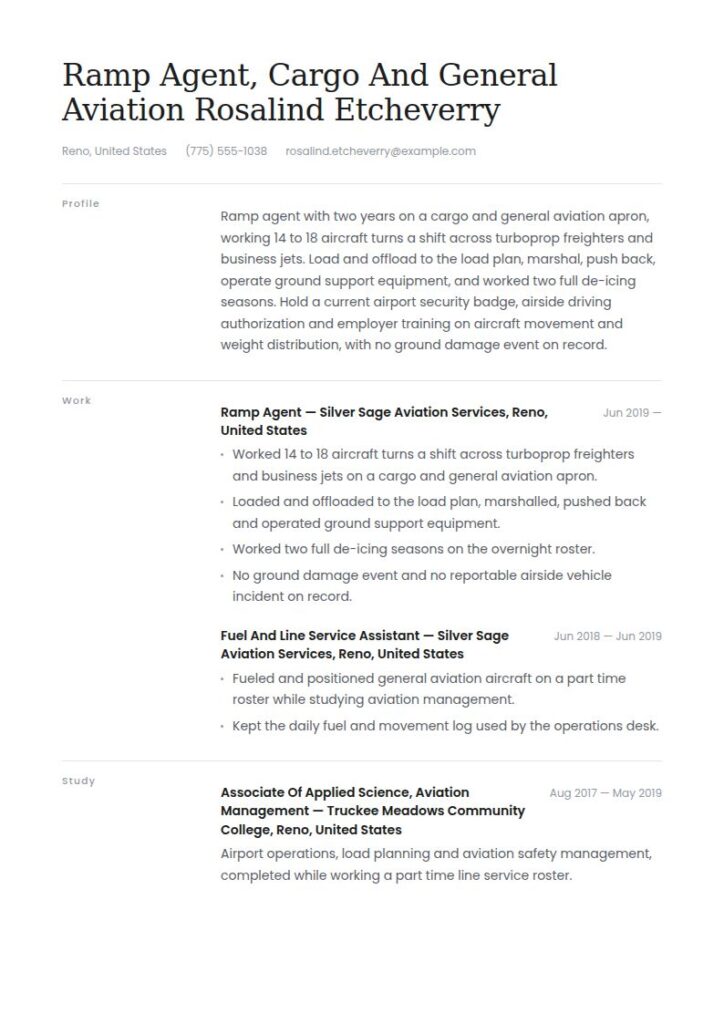
Ramp Agent, Cargo and General Aviation Rosalind Etcheverry
Ramp Agent
[email protected] | (775) 555-1038 | Reno, United States
Profile
Ramp agent with two years on a cargo and general aviation apron, working 14 to 18 aircraft turns a shift across turboprop freighters and business jets. Load and offload to the load plan, marshal, push back, operate ground support equipment, and worked two full de-icing seasons. Hold a current airport security badge, airside driving authorization and employer training on aircraft movement and weight distribution, with no ground damage event on record.
Work Experience
06/2019 - Present, Ramp Agent, Silver Sage Aviation Services, Reno, United States
- Worked 14 to 18 aircraft turns a shift across turboprop freighters and business jets on a cargo and general aviation apron.
- Loaded and offloaded to the load plan, marshalled, pushed back and operated ground support equipment.
- Worked two full de-icing seasons on the overnight roster.
- No ground damage event and no reportable airside vehicle incident on record.
06/2018 - 06/2019, Fuel and Line Service Assistant, Silver Sage Aviation Services, Reno, United States
- Fueled and positioned general aviation aircraft on a part time roster while studying aviation management.
- Kept the daily fuel and movement log used by the operations desk.
Education
08/2017 - 05/2019, Associate of Applied Science, Aviation Management, Truckee Meadows Community College, Reno, United States
Airport operations, load planning and aviation safety management, completed while working a part time line service roster.
Skills
Load plan execution, 85
Marshalling and pushback, 85
Ground support equipment operation, 85
De-icing, 80
Weight distribution and restraint, 80
Aircraft movement safety, 85
Overnight and rotating rosters, 90
Airside vehicle operation, 85
Languages
English, native
Basque, conversational
Certificates
06/2019, Airport Security Badge and Airside Driving Authorization, Employer-sponsored airport badging
Current, renewed annually, with the background check behind it.
07/2019, Ground Handling and Aircraft Movement Training, Silver Sage Aviation Services, employer program
Loading to the load plan, marshalling, pushback and ground support equipment operation. Refreshed each season.
10/2019, De-icing Operations, Silver Sage Aviation Services, employer program
Type I and Type IV application and holdover discipline. Recertified each winter season.
Summary
Aviation is not one job market. Five of them share an airfield, they hire on different cycles, and a resume that does not say which side of the fence you worked is read by the wrong person. This guide maps all five, gives three adaptable summaries for the ramp and operations side, and sets out current Bureau of Labor Statistics pay and employment for each.
Aviation resume examples by experience level
In short, an aviation resume is a one to two page document, and its first job is to say which aviation you mean.
In fact, the word covers five labor markets that happen to share an airfield. Specifically: the flight deck, the cabin, the maintenance hangar, the tower and the operations center, and the ramp and ground side. Moreover, they hire on different cycles, they answer to different parts of the Federal Aviation Administration or to none of it, and the pay between them varies by a factor of six. As a result, a resume headed "Aviation Professional" is read by whichever of the five happens to open it.
Here, for instance, the worked examples use the ramp and operations side, where most people enter the sector.
Resume guide for an aviation resume
To that end, this guide and the corresponding aviation resume example will cover:
- First, how to write an aviation resume, section by section
- Then, the five labor markets in the word aviation and what each one hires on
- Next, three adaptable summaries: ramp agent, operations coordinator and station manager
- Finally, which certificate is the entry ticket to which side of the fence
- What each side pays and how many people it actually employs
How to write an aviation resume
Overall, six sections: contact header, summary, the certificate or training line that admits you to your side, experience with volumes, skills, and education. In general, one page early, then two once you have run a station or hold hours and type ratings worth listing.
| Section | What it is answering | Where it goes |
|---|---|---|
| Side of the fence | Which of the five markets is this person in? | The header line, before anything else |
| Entry ticket | What certificate, rating or training admits them to it? | Directly under the summary |
| Experience | What volume, what aircraft, what station? | Reverse chronological, volume in the header line |
| Education | Which program, and does it shorten the route? | Short, near the foot of the page |
Put the aircraft and the volume in the header line of every job
Aviation reads specificity as competence, and the specifics are always the same two: what you worked on and how much of it.
On the ramp and in operations that means aircraft type and turns: "14 to 18 turns a shift across turboprop freighters and business jets" places you instantly. In the hangar it is type and task: heavy check, line maintenance, avionics bench. On the flight deck it is hours and type ratings. In the cabin it is fleet type, sectors and base.
A reader who knows the sector can tell from one header line whether you have worked a narrow-body scheduled operation, a cargo apron or a general aviation ramp.
Run the finished file through the ATS resume checker first. Carriers, ground handlers and maintenance organizations screen through portals before a manager reads anything.
Choosing the best resume format for an aviation resume
Reverse chronological, single column. Two pages once you hold hours, ratings or a station record; one page until then.
Two exceptions are worth knowing. For example, a flight deck resume carries an hours table, and a maintenance resume often carries an aircraft and task matrix. However, neither is a graphic; both are plain tables that parse.
Everything else stays ordinary. In practice, aviation runs on documentation and it reads resumes the same way: dated, checkable, in order.
Include your contact information
| ✅ Right | ❌ Wrong |
|---|---|
| Rosalind Etcheverry | Rosalind Etcheverry |
| Station Operations Manager, Air Cargo, Ramp and Load Control | Aviation professional with a lifelong love of flight |
| Reno, NV. Current airport security badge, airside driving authorization | Reno, NV |
| (775) 555-1038, [email protected] | (775) 555-1038, [email protected] |
Above all, the second line is the whole point. "Station Operations Manager, Air Cargo" is a market. "Aviation professional" is five markets and belongs to none of them.
Make use of a summary
In short, four lines: the side of the fence and the station, the volume, one measured result, and the ticket that admits you.
Ramp agent with two years on a cargo and general aviation apron, working 14 to 18 aircraft turns a shift across turboprop freighters and business jets. Load and offload to the load plan, marshal, push back, operate ground support equipment, and worked two full de-icing seasons. Hold a current airport security badge, airside driving authorization and employer training on aircraft movement and weight distribution, with no ground damage event on record.
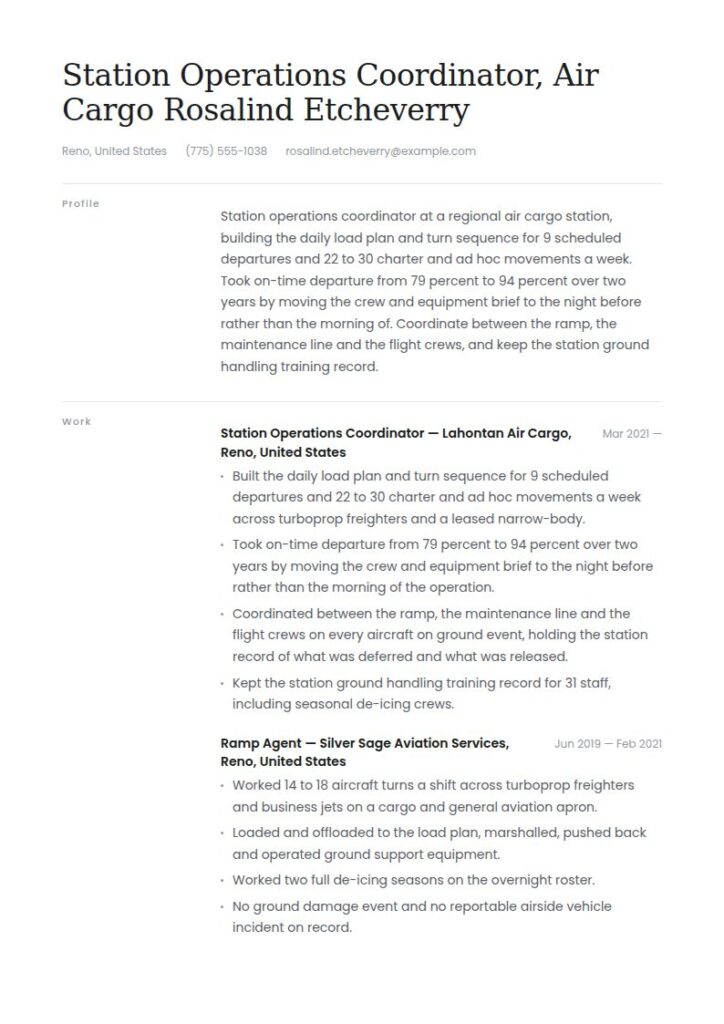
Station operations coordinator at a regional air cargo station, building the daily load plan and turn sequence for 9 scheduled departures and 22 to 30 charter and ad hoc movements a week. Took on-time departure from 79 percent to 94 percent over two years by moving the crew and equipment brief to the night before rather than the morning of. Coordinate between the ramp, the maintenance line and the flight crews, and keep the station ground handling training record.
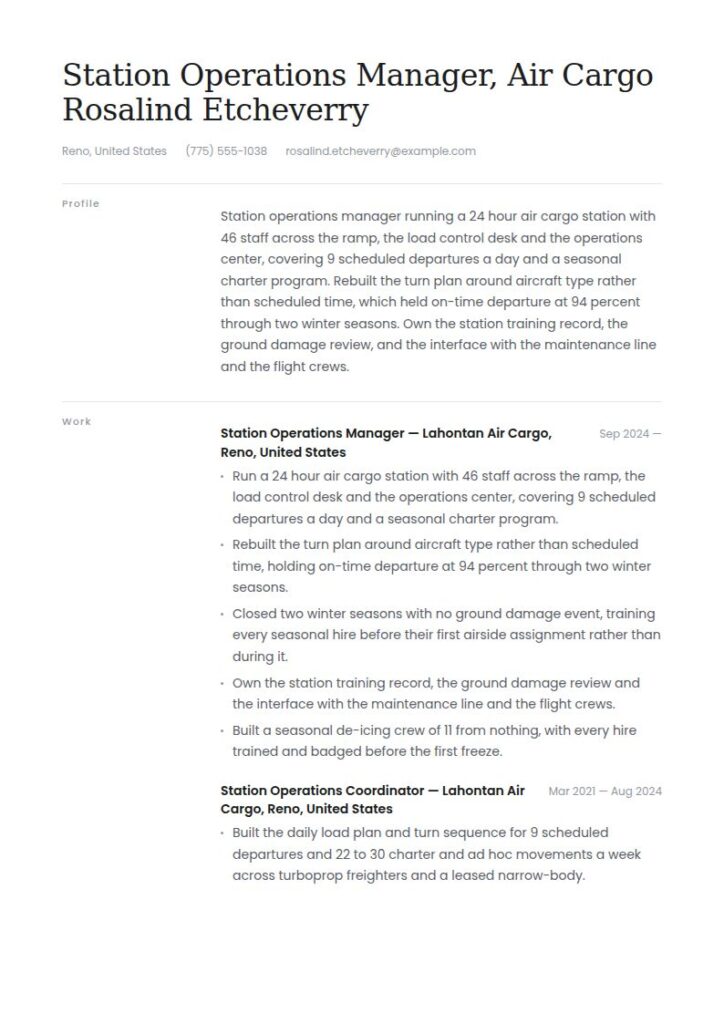
Station operations manager running a 24 hour air cargo station with 46 staff across the ramp, the load control desk and the operations center, covering 9 scheduled departures a day and a seasonal charter program. Rebuilt the turn plan around aircraft type rather than scheduled time, which held on-time departure at 94 percent through two winter seasons. Own the station training record, the ground damage review, and the interface with the maintenance line and the flight crews.
Right vs wrong: the same aviation summary, twice
| ✅ Right | ❌ Wrong |
|---|---|
| Worked 14 to 18 turns a shift across turboprop freighters and business jets. | Experienced in all aspects of airport ground operations. |
| Took on-time departure from 79 percent to 94 percent over two years. | Consistently improved efficiency and customer satisfaction. |
| Ran 46 staff across the ramp, load control and the operations center. | Proven leader in a fast-paced aviation environment. |
As a result, the ✅ column says which of the five markets you belong to and at what scale. In contrast, anyone who has been through an airport could have written the ❌ column.
Outline your aviation experience
Then list the station, operator type, aircraft, volume and dates in the header line. Then three to five bullets carrying numbers.
| Instead of | Use |
|---|---|
| Responsible for aircraft ground handling duties | Worked 14 to 18 turns a shift across turboprop freighters and business jets, loading to the load plan |
| Assisted with flight operations and scheduling | Built the daily load plan and turn sequence for 9 scheduled departures and 22 to 30 charter movements a week |
| Ensured safety and compliance at all times | Closed two winter seasons with no ground damage event and no reportable airside vehicle incident |
Station Operations Coordinator, Lahontan Air Cargo, Reno, NV, March 2021 to August 2024
Built the daily load plan and turn sequence for 9 scheduled departures and 22 to 30 charter and ad hoc movements a week across turboprop freighters and a leased narrow-body.
Took on-time departure from 79 percent to 94 percent over two years by moving the crew and equipment brief to the night before rather than the morning of the operation.
Coordinated between the ramp, the maintenance line and the flight crews on every aircraft on ground event, holding the station record of what was deferred and what was released.
Aviation is five labor markets in one word, so say which side of the fence you worked
Here is the map. After all, each of the five hires separately, reads for something different, and admits people through a different door.
The flight deck. The most credential-heavy side, and the resume is mostly a table of numbers. The Handbook describes the ladder as student pilot certificate, private pilot certificate, instrument rating, commercial pilot certificate, multi-engine rating and finally the airline transport pilot certificate, with a medical certificate confirming vision correctable to 20/20 and type ratings for specific aircraft (BLS Occupational Outlook Handbook, Airline and Commercial Pilots, last modified 27 August 2026).
The bar at the top is written into federal regulation: 14 CFR 61.159 requires, for an airline transport pilot certificate in the airplane category multiengine class, at least 1,500 hours of total time as a pilot, 500 hours of cross-country time, 100 hours of night flight time, 75 hours of instrument flight time in actual or simulated instrument conditions, and 250 hours of flight time in an airplane as pilot in command or as second in command performing those duties under supervision. Write the hours as a table, name the ratings, and note that the Handbook records mandatory retirement at age 65, which shapes the whole hiring cycle above you.
The cabin: flight attendant resumes
The cabin. Entered on a high school diploma or equivalent plus typically one to two years of customer service work, with initial training lasting several weeks to a few months (BLS Occupational Outlook Handbook, Flight Attendants, last modified 27 August 2026). The certificate follows the job rather than preceding it: the FAA Certificate of Demonstrated Proficiency is earned after employer training and an exam, recurrent training runs every year, and additional training is required for each aircraft type. So a cabin resume is about service history, language, availability and reliability before it is about aviation, plus the fleet types you are trained on once you are in.
The maintenance hangar and mechanic ratings
The maintenance hangar. A postsecondary nondegree award is the typical entry, and the credential is the job. The FAA requires maintenance to be done by a certified mechanic with the appropriate ratings or authorizations, or by someone working under the supervision of such a mechanic (BLS Occupational Outlook Handbook, Aircraft and Avionics Equipment Mechanics and Technicians, last modified 27 August 2026). Most work is covered by the Airframe and Powerplant certificate; the Airframe and Powerplant ratings can be held separately; Inspection Authorization is open to A&P mechanics who meet the experience requirements; and an FAA-approved aviation maintenance technician program is recognized as an alternative to the experience route. A hangar resume names the ratings, then the aircraft types and the task categories.
The tower and the operations center
The tower and the operations center. Air traffic control is a federal career with a single front door. Candidates typically complete an Air Traffic Collegiate Training Initiative program or gain qualifying work experience, pass the Air Traffic Controller Specialists Skills Assessment Battery, attend the FAA Academy in Oklahoma City, hold the Air Traffic Control Tower Operator Certificate, and must be a US citizen, pass a medical evaluation and a background check, and apply before the FAA age cutoff; on-the-job training after the Academy runs more than 12 months (BLS Occupational Outlook Handbook, Air Traffic Controllers, last modified 27 August 2026). Beside the tower sits the other operations job, the airline or cargo operations center, which carries no FAA certificate; the operator hires on record and volume rather than by examination.
The ramp and ground handling side
The ramp and the ground side. No certificate admits you. What admits you is the employer's training, the airport security badge they sponsor and the background check behind it, and airside driving authorization. This is the widest door into aviation and the lowest paid: ground handling is paid off the hand laborers and material movers scale, a median of $38,220 as of May 2025 (BLS Occupational Outlook Handbook, last modified 27 August 2026). It is also the side that feeds the other four, which is why you should write it precisely rather than apologetically.
Even so, one rule covers all five: write the entry ticket for the market you are applying to, in its own words, and do not pad the page with the other four. For example, a hangar manager does not care that you can marshal, and a ground handler reading an A&P resume assumes you will leave.
Build a snapshot of your key aviation skills
Twelve to sixteen entries, grouped, and chosen for one side of the fence rather than for range.
Ramp and turn: Load plan execution, Weight distribution and restraint, Marshalling and pushback, Ground support equipment operation, De-icing, Aircraft movement safety
Operations: Turn sequencing by aircraft type, Crew and equipment briefing, Aircraft on ground coordination, Charter and ad hoc movement planning, Delay coding and on-time departure reporting
Station management: Shift rostering across 24 hours, Training record maintenance, Ground damage review, Seasonal hiring and de-icing crew readiness
Systems and documentation: Load control records, Station operations reporting, Airside vehicle authorization records
Therefore, group by side of the fence, not by "hard" and "soft": a reader is scanning for whether you already do their job.
List your education and certifications
Meanwhile, what belongs here depends entirely on the market. On the flight deck, for instance, it is hours, ratings and the medical. In the hangar, by contrast, it is the A&P ratings and any Inspection Authorization. Similarly, in the cabin it is the FAA Certificate of Demonstrated Proficiency and your aircraft type training. Finally, on the ramp and in operations it is the badge, the airside driving authorization and the employer training behind them.
Airport security badge and airside driving authorization, current, sponsored by the employer and renewed annually
Ground handling and aircraft movement training, employer program, completed 2019 and refreshed each season
De-icing operations, employer program, completed 2019, recertified each winter season
Associate of Applied Science, Aviation Management, Truckee Meadows Community College, Reno, NV, 2019
Bachelor of Science, Business Administration, completed part time while working a rotating shift pattern, 2025
Say whether you refresh a training line and when. Aviation employers read an undated training line as expired, because in their own systems it would be.
Choose the right layout and design
In addition: one column, 11 or 12 point, no photograph, no graphics, no rating bars. Hours tables and aircraft and task matrices are fine, because they are plain tables and they parse.
Name your side of the fence in the header line, and put aircraft type and volume in the header line of every job. Write the entry ticket for the market you are applying to, in its own words. Give one measured result with a period attached.
Do not write "Aviation Professional" as a job title. Do not list certificates you hold for a different side of the fence at the top of the page. Do not write an undated training line. Do not describe a safety event in a way that identifies a crew member or a customer.
Aviation job market and outlook
However, the Bureau of Labor Statistics publishes no single occupation called aviation. Instead, four published occupations cover four of the five markets; the fifth, ground handling, takes its pay from a wider material handling occupation.
| Side of the fence | Published occupation | Jobs, 2025 | Change, 2025-35 | Annual openings | Median wage, May 2025 |
|---|---|---|---|---|---|
| Flight deck | Airline and commercial pilots | 154,900 | 7% | ~16,400 | $210,020 |
| Cabin | Flight attendants | 133,700 | 9% | ~18,500 | $63,580 |
| Hangar | Aircraft and avionics equipment mechanics and technicians | 159,800 | 6% | ~13,100 | $80,180 |
| Tower | Air traffic controllers | 24,000 | 2% | ~2,100 | $148,080 |
| Ramp and ground | Hand laborers and material movers | 6,917,800 | 4% | ~904,200 | $38,220 |
Source: U.S. Bureau of Labor Statistics, Occupational Outlook Handbook, five occupational profiles, May 2025 wage data and 2025 to 2035 projections, last modified 27 August 2026.
Inside the pilot line, airline pilots, copilots and flight engineers held 104,600 of those jobs at a median of $232,140 and commercial pilots 50,400 at $123,220; inside the maintenance line, aircraft mechanics and service technicians held 140,000 jobs at $79,870 and avionics technicians 19,800 at $82,280 (BLS, May 2025).
The best-paid side of the fence is also the smallest, by a wide margin
Air traffic controllers held 24,000 jobs in 2025, projected to grow 2 percent through 2035, about 400 new jobs, with roughly 2,100 openings a year over the decade (BLS Occupational Outlook Handbook, last modified 27 August 2026). Flight attendants held 133,700, more than five times as many, and aircraft and avionics mechanics and technicians 159,800.
Openings tell the same story from the other direction: about 18,500 a year in the cabin, 16,400 on the flight deck and 13,100 in maintenance, against 2,100 in the tower.
So the tower pays a May 2025 median of $148,080 and hires very few people a year. If air traffic control is the ambition, treat it as a competitive federal application with a fixed calendar rather than a job search, and keep a second market open while you apply.
Concentration matters too. Scheduled air transportation employs 97 percent of flight attendants (BLS, May 2025), so the cabin is a small number of employers hiring in classes, and federal government employs 92 percent of air traffic controllers (BLS, May 2025). In particular, maintenance and ground handling are the two sides with genuinely diverse employers, which is why they are the easiest to enter and to move within.
What salary you can expect in aviation
Ultimately, the spread is the sector's defining fact. Between ground handling at a median of $38,220 and airline pilots, copilots and flight engineers at $232,140, both May 2025, the same industry pays a factor of six for work that happens within a few hundred meters of itself (BLS Occupational Outlook Handbook, last modified 27 August 2026).
Between the ends, for example, the ladder is: flight attendants at $63,580, aircraft mechanics and service technicians at $79,870, avionics technicians at $82,280, commercial pilots at $123,220 and air traffic controllers at $148,080 (BLS, May 2025).
Also, industry choice moves pay inside each market, sometimes a long way. For airline pilots, copilots and flight engineers, couriers and express delivery services paid a median of $334,930 and scheduled air transportation $293,240 in May 2025. Similarly, for aircraft mechanics and service technicians, air transportation paid $96,170, couriers and express delivery services $90,190 and aerospace product and parts manufacturing $82,720. For flight attendants, nonscheduled air transportation paid $70,700 against $63,570 in scheduled air transportation (BLS, May 2025). The cargo side pays better than the passenger side on both the flight deck and the maintenance line, which is not what most applicants assume.
The resume lesson is narrow: the largest pay decision in aviation is which market you are in, the second is which industry inside it, and both are visible on the page before anyone speaks to you. That is why the header line is worth more than any bullet underneath it.
Key takeaways for an aviation resume
- Say which of the five markets you are in, in the header line, before anything else.
- To start, write the entry ticket for that market in its own words: hours and ratings, the cabin certificate, the A&P ratings, the tower route, or the badge and employer training.
- Then put aircraft type and volume in the header line of every job.
- Use a plain hours table or task matrix if your side calls for one.
- Date every training line and say whether you refresh it.
- Give one measured result with a period attached, such as on-time departure over two years.
- Finally, expect pay to run from $38,220 to $232,140, and aim at the market you want next.
Build your aviation resume in 15 minutes with our AI resume builder.
Related transport and logistics resume examples
- Transport and logistics resume
- Dispatcher resume
- Supply chain resume
- Logistics coordinator resume
- Truck driver resume
- Warehouse manager resume
- Procurement manager resume
- Inventory manager resume
- Warehouse worker resume
- Stock clerk resume
- Package handler resume
- Delivery driver resume
Pair it with a matching aviation cover letter.
Aviation resume questions, answered
How do I get into aviation with no aviation experience?
Through the ramp and the ground side, the only one of the five with no certificate at the door. What you need is the employer's training, the airport security badge they sponsor and the background check behind it, and airside driving authorization. It is the lowest paid of the five, at a median of $38,220 for the material handling scale it is paid off as of May 2025 (BLS, May 2025).
Should I put my private pilot license on a resume for a ground job?
One line at the foot, and no more. It tells a station manager you understand the operation. Put it at the top and the same manager reads a candidate who will leave for flight school as soon as the hours allow, which is often exactly right and not what they are hiring for.
Is air traffic control worth applying for?
It pays a May 2025 median of $148,080 and the federal government employs 92 percent of controllers (BLS Occupational Outlook Handbook, last modified 27 August 2026), so the answer is yes if you can meet the conditions. Understand the shape first: an Air Traffic Collegiate Training Initiative program or qualifying experience, the skills assessment battery, the FAA Academy, US citizenship, a medical and a background check, an age cutoff, and more than 12 months of on-the-job training after it. About 24,000 people hold the job and roughly 2,100 openings arise a year (BLS, May 2025), so apply on their calendar and keep working meanwhile.
Does a cargo operation or a passenger operation pay better?
Cargo, on two of the five sides. For airline pilots, copilots and flight engineers, couriers and express delivery services paid a median of $334,930 in May 2025 against $293,240 in scheduled air transportation, and for aircraft mechanics and service technicians air transportation paid $96,170 and couriers $90,190 (BLS, May 2025). Cargo stations also tend to run overnight, so the roster line on your resume matters as much as the pay line.
How much of my resume should be about safety?
Enough to be checkable. One line per role: seasons closed with no ground damage event, no reportable airside vehicle incident, training completed before first assignment. Aviation employers treat safety claims as records, so write yours as a record. A paragraph about a commitment to safety reads as the absence of one.