Outbound Shift Lead Cornelius Torkelson
Outbound Shift Lead, Second Shift
[email protected] | (937) 555-1008 | Dayton, United States
Profile
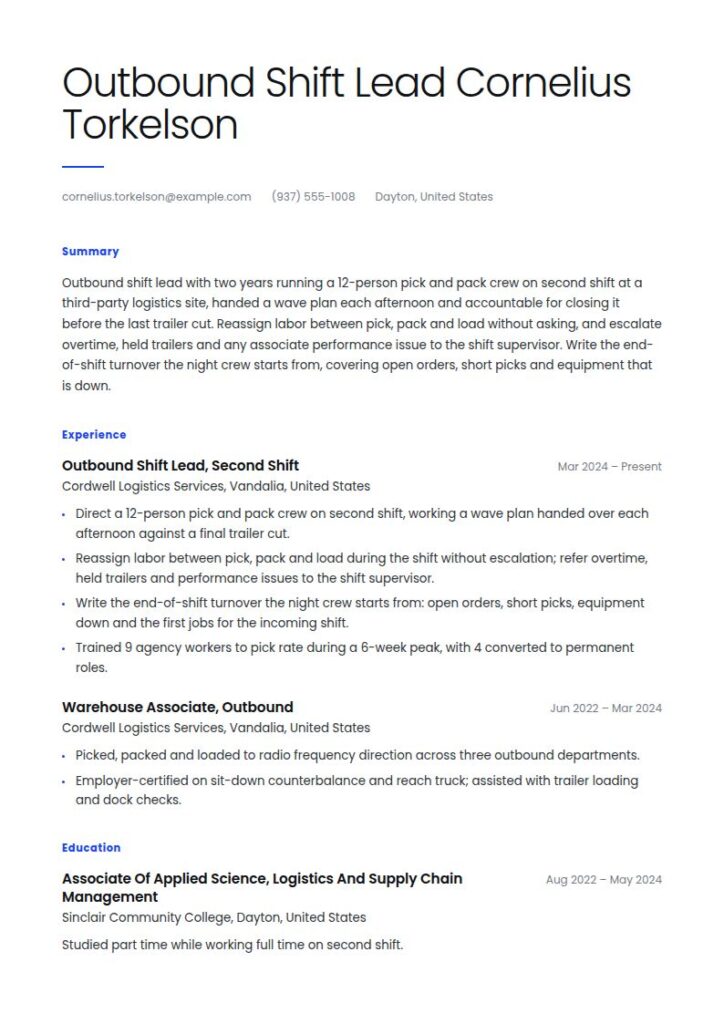
Outbound shift lead with two years running a 12-person pick and pack crew on second shift at a third-party logistics site, handed a wave plan each afternoon and accountable for closing it before the last trailer cut. Reassign labor between pick, pack and load without asking, and escalate overtime, held trailers and any associate performance issue to the shift supervisor. Write the end-of-shift turnover the night crew starts from, covering open orders, short picks and equipment that is down.
Work Experience
03/2024 - Present, Outbound Shift Lead, Second Shift, Cordwell Logistics Services, Vandalia, United States
- Direct a 12-person pick and pack crew on second shift, working a wave plan handed over each afternoon against a final trailer cut.
- Reassign labor between pick, pack and load during the shift without escalation; refer overtime, held trailers and performance issues to the shift supervisor.
- Write the end-of-shift turnover the night crew starts from: open orders, short picks, equipment down and the first jobs for the incoming shift.
- Trained 9 agency workers to pick rate during a 6-week peak, with 4 converted to permanent roles.
06/2022 - 03/2024, Warehouse Associate, Outbound, Cordwell Logistics Services, Vandalia, United States
- Picked, packed and loaded to radio frequency direction across three outbound departments.
- Employer-certified on sit-down counterbalance and reach truck; assisted with trailer loading and dock checks.
Education
08/2022 - 05/2024, Associate of Applied Science, Logistics and Supply Chain Management, Sinclair Community College, Dayton, United States
Studied part time while working full time on second shift.
Skills
Wave plan execution and labor balancing, 70
Shift turnover documentation, 75
Agency labor onboarding, 70
Warehouse management system transactions, 80
Radio frequency scanning, 85
Powered industrial truck operation, 85
Languages
English, native
Certificates
02/2025, Powered Industrial Truck Operator Certification, Employer-certified under OSHA 29 CFR 1910.178(l), Cordwell Logistics Services
Sit-down counterbalance and reach truck. Most recent evaluation 2025.
04/2025, CPR and First Aid, American Red Cross
Summary
A warehouse supervisor resume is a one to two page document naming the shift you ran, the crew you were handed, what you were allowed to decide alone and what the next shift inherited from you. This guide gives you three adaptable versions, the turnover document almost nobody writes about, and current Bureau of Labor Statistics pay for the occupations either side of the job.
Warehouse Supervisor resume examples by experience level
In short, a warehouse supervisor resume is a one to two page document that names the shift you ran, the crew you were handed, what you were allowed to decide without asking, and what the next shift inherited from you.
In practice, supervising a warehouse is a relay, not a command. You take a building already in motion, with a plan written that morning against volume that has since changed, a crew partly of people you know and partly of agency workers who walked in an hour ago, and one fixed constraint: the trailer cut, the wave close, the first-shift start. After all, whatever you do not finish becomes someone else's opening problem.
Resume guide for a warehouse supervisor resume
To that end, this guide and the corresponding warehouse supervisor resume example will cover:
- First, how to write a warehouse supervisor resume, section by section
- Next, three adaptable summaries: shift lead, supervisor and senior supervisor
- Then, the decision authority line that separates a supervisor from a lead
- Finally, what the job market looks like and what you can expect to earn
How to write a warehouse supervisor resume
Overall, six sections: contact header, summary, shift and crew, supervisory experience, skills, and education and certifications. One page as a lead, two once you have run more than one shift pattern or carried a site through peak.
| Section | What it is answering | Where it goes |
|---|---|---|
| Shift and crew | Which shift, how many people, how many agency | Directly under the summary |
| Decision authority | What could this person settle without calling someone? | In the shift block and each role |
| Supervisory experience | What did the shift produce, and what did it hand on? | Reverse chronological, numbers |
| Education and certifications | Does the file clear a stated bar? | Last, unless a posting names one |
Run the finished file through the ATS resume checker before you submit. Distribution centers hire in volume through portals that parse a resume into fields before a human reads a line.
Choosing the best resume format for a warehouse supervisor resume
Reverse chronological, always. Above all, a supervisor's credibility is continuity: the same building through a peak, a systems cutover, a night shift stand-up. However, a functional resume deletes exactly what a distribution center manager reads for.
Also, one format decision is worth making deliberately. If you have run more than one shift pattern, give each its own dated block even inside the same employer: moving from second shift to nights is a different job and the reader will not assume it.
Include your contact information
| ✅ Right | ❌ Wrong |
|---|---|
| Cornelius Torkelson | Cornelius Torkelson |
| Warehouse Supervisor, Night Shift | Hardworking warehouse professional |
| 61 associates and 4 leads, 420,000 sq ft, 30 to 45% agency labor | Supervises staff in a fast-paced environment |
| (937) 555-1008, [email protected], Dayton, OH | (937) 555-1008, [email protected] |
In fact, the third line is the whole argument in fifteen words: which shift, how many people, how big the building, how much of the crew turns over nightly.
Name the shift, then name its purpose
"Second shift supervisor" tells a reader when you worked, not what the shift was for, and the purpose is what makes the experience transferable.
Write both: "Second shift, outbound: wave picking, pack and trailer load against a 23:00 final cut." Or "Night shift: replenishment, slotting corrections, clean-up and equipment charging, so first shift starts on a full pick face."
Those two shifts sit in the same building and are barely the same occupation. One runs against a hard external deadline; the other against the state you have to leave behind. Employers hire for one or the other.
Make use of a summary
In short, four lines: the shift and what it is for, the crew and its agency share, your decision authority, and one measured change in what you handed on.
Outbound shift lead with two years running a 12-person pick and pack crew on second shift at a third-party logistics site, handed a wave plan each afternoon and accountable for closing it before the last trailer cut. Reassign labor between pick, pack and load without asking, and escalate overtime, held trailers and any associate performance issue to the shift supervisor. Write the end-of-shift turnover the night crew starts from, covering open orders, short picks and equipment that is down.
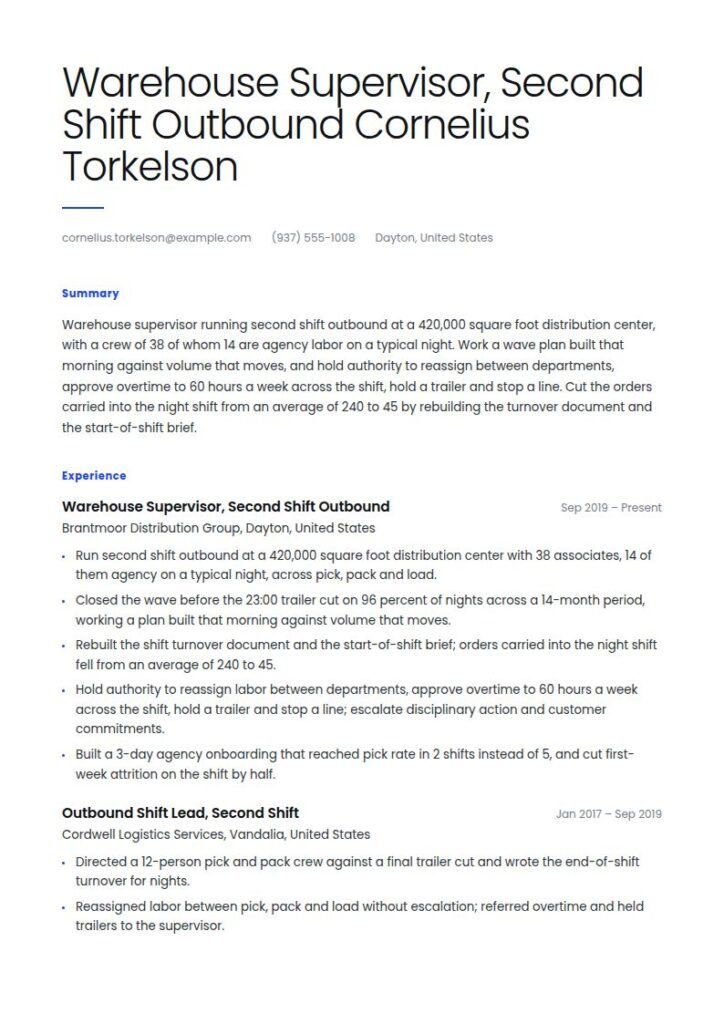
Warehouse supervisor running second shift outbound at a 420,000 square foot distribution center, with a crew of 38 of whom 14 are agency labor on a typical night. Work a wave plan built that morning against volume that moves, and hold authority to reassign between departments, approve overtime to 60 hours a week across the shift, hold a trailer and stop a line. Cut the orders carried into the night shift from an average of 240 to 45 by rebuilding the turnover document and the start-of-shift brief.
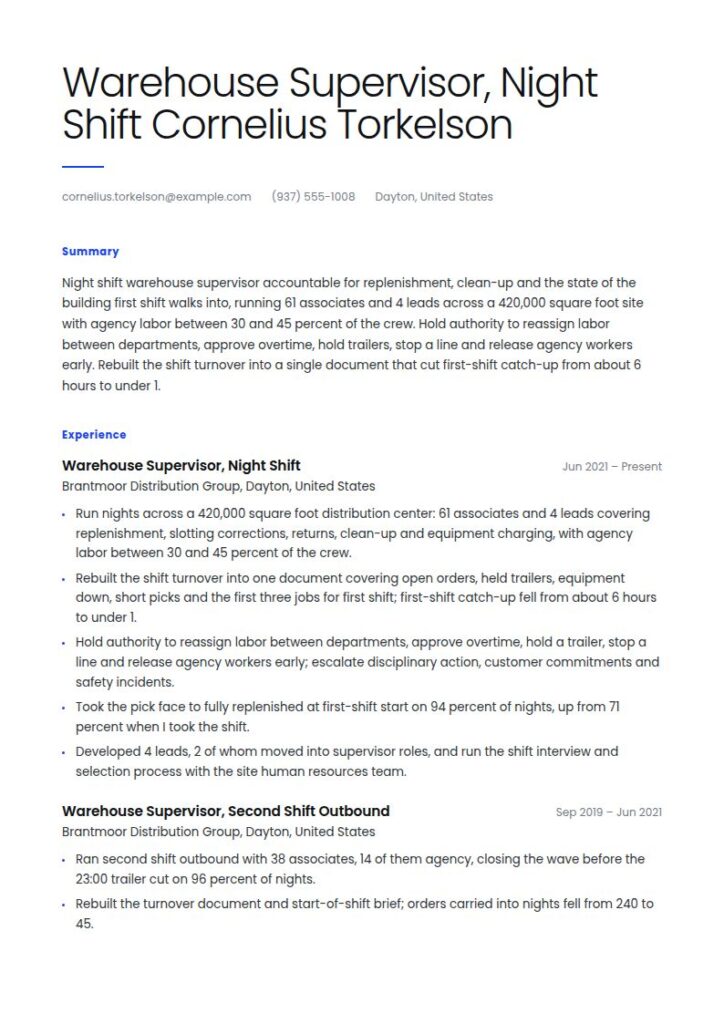
Night shift warehouse supervisor accountable for replenishment, clean-up and the state of the building first shift walks into, running 61 associates and 4 leads across a 420,000 square foot site with agency labor between 30 and 45 percent of the crew. Hold authority to reassign labor between departments, approve overtime, hold trailers, stop a line and release agency workers early. Rebuilt the shift turnover into a single document that cut first-shift catch-up from about 6 hours to under 1.
Right vs wrong: the same warehouse supervisor summary, twice
| ✅ Right | ❌ Wrong |
|---|---|
| Night shift supervisor accountable for replenishment, clean-up and the state of the building first shift walks into. | Experienced warehouse supervisor with a strong background in distribution operations. |
| 61 associates and 4 leads, with agency labor between 30 and 45 percent of the crew. | Supervises a large team in a fast-paced warehouse environment. |
| Cut first-shift catch-up from about 6 hours to under 1 by rebuilding the shift turnover. | Consistently improves productivity and efficiency. |
The right column tells a distribution center manager whether you have already run their shift. The left could describe anyone in the building, including people this candidate supervises.
Outline your supervisory experience
Employer, site size, shift, dates, then the crew line, then three to five bullets. Each carries a number, and at least one is about what you handed on rather than what you produced.
| Instead of | Use |
|---|---|
| Supervised warehouse staff | Ran second shift outbound with 38 associates, 14 of them agency, across pick, pack and load |
| Ensured orders shipped on time | Closed the wave before the 23:00 trailer cut on 96 percent of nights across a 14-month period |
| Trained new employees | Built a 3-day agency onboarding that reached pick rate in 2 shifts instead of 5 |
| Communicated across shifts | Rebuilt the turnover document; orders carried into nights fell from 240 a night to 45 |
Warehouse Supervisor, Night Shift, Brantmoor Distribution Group, Dayton, OH, June 2021 to Present
Run nights across a 420,000 square foot distribution center: 61 associates and 4 leads covering replenishment, slotting corrections, clean-up and equipment charging, with agency labor between 30 and 45 percent of the crew.
Rebuilt the shift turnover into one document covering open orders, held trailers, equipment down, short picks and the first three jobs for the incoming shift; first-shift catch-up fell from about 6 hours to under 1.
Hold authority to reassign labor between departments, approve overtime, hold a trailer, stop a line and release agency workers early; escalate disciplinary action, customer commitments and safety incidents.
Took the pick face to fully replenished at first-shift start on 94 percent of nights, up from 71 percent when I took the shift.
Write your shift: the crew you were given, the plan you were handed and what you handed on
In practice, this section has four parts and none of them is throughput.
One: which shift, and what it exists to do. Shifts are not interchangeable and a reader will not infer the purpose from the hours.
| Shift | What it exists to do | What the resume has to prove |
|---|---|---|
| First shift, receiving | Unload, check in, put away, clear the dock before outbound builds | Trailer turn times, receipt accuracy, dock congestion |
| Second shift, outbound | Pick, pack and load against a fixed carrier cut | Wave close rate against the cut, short pick handling |
| Night shift | Replenish, correct slotting, clean up, charge equipment | The state first shift inherits, and how often it is right |
| Weekend or catch-up | Recover what the week could not close, run cycle work | What was cleared, and what you chose not to touch |
The crew a warehouse supervisor was given
Two: the crew you were actually given. Write the headcount, then the agency share, because the agency share is the real staffing problem and almost nobody puts it on a page. Supervising 38 people of whom 14 walked in today is a different job from supervising 38 you have trained.
Then say what you did about it: the onboarding you built, the tasks you will and will not give a first-night worker, how you decide who goes home when volume drops, and your agency to permanent conversion rate.
What you could decide without escalating
Three: what you could decide alone. This is the line between a lead and a supervisor, and the most useful thing on the page.
| Typically decided alone | Typically escalated |
|---|---|
| Reassigning labor between departments mid-shift | Disciplinary action beyond documented coaching |
| Approving overtime within a shift budget | Changing a customer commitment or carrier cut |
| Holding a trailer, resequencing loads | Any recordable safety incident |
| Stopping a process that is producing errors | Releasing a shipment with a known quality exception |
| Sending agency workers home when volume drops | Headcount approvals and requisitions |
Of course, your version of that table will differ, which is why writing it is worth the space. Therefore, put the authority in your bullets in the organization's own words: "authorized overtime to 60 hours a week across the shift without further approval" is a sentence a reader prices.
The shift handover as evidence
Four: the handover. Every shift hands on a building and most supervisors do it in a text message. The turnover document, the start-of-shift brief and the standing escalation list are the artefacts of the job, and describing them is the clearest evidence you have run a shift rather than worked one.
Shift: Nights, 22:00 to 06:30, Sunday to Thursday. Replenishment, slotting correction, clean-up, equipment charging.
Crew: 61 associates and 4 leads. Agency labor 30 to 45 percent nightly. Departments: replenishment, returns, housekeeping, battery and charging.
Decide alone: labor reassignment between departments, overtime within shift budget, trailer holds, stopping a process, early release of agency labor.
Escalate: disciplinary action, customer commitment changes, recordable incidents, quality holds.
Handover: single-page turnover covering open orders, held trailers, equipment down, short picks and the first three jobs for first shift. Start-of-shift brief at 22:10, five minutes: safety point, plan, constraint.
Build a snapshot of your key skills
Next, ten to fourteen entries in four groups: shift work, people, systems, equipment.
Shift management: Wave planning and labor balancing, Shift turnover documentation, Start-of-shift briefing, Volume flexing, Peak season planning
People: Agency labor onboarding, Coaching and documented performance conversations, Cross-training, Scheduling and absence cover, Interviewing and selection
Systems: Warehouse management system transactions and reporting, Labor management reporting, Radio frequency scanning, Slotting and replenishment logic
Equipment: Powered industrial truck operation and employer-certified trainer, Reach truck and order picker, Battery and charging program, Conveyor and sortation
Also keep the systems line honest about depth. After all, there is a real difference between running transactions in a warehouse management system and being able to read its labor reporting and argue with it, and an interviewer finds that boundary in four questions.
List your education and certifications
Meanwhile, most postings ask for a high school diploma and experience. Put certifications above education if you hold operating or trainer credentials, because those are the ones a site uses.
Powered Industrial Truck Operator Certification, employer-certified under OSHA 29 CFR 1910.178(l): sit-down counterbalance, reach truck, order picker. Most recent evaluation 2025.
Designated Powered Industrial Truck Trainer, Brantmoor Distribution Group, 2023. Deliver training and evaluation and sign the certification record.
CPR and First Aid, American Red Cross, 2025.
Associate of Applied Science, Logistics and Supply Chain Management, Sinclair Community College, Dayton, OH, 2019. High school diploma, 2016.
Even so, there is one point of accuracy resumes routinely get wrong. Specifically, under OSHA 29 CFR 1910.178(l) powered industrial truck certification is issued by the employer, the record must carry the operator's name, the training date, the evaluation date and who performed them, and performance is re-evaluated at least once every three years. As a result, it belongs to the employer and does not travel with you. Therefore, write it as "employer-certified" with the equipment named and your latest evaluation year.
Choose the right layout and design
Single column, 11 or 12 point. Similarly, put the shift and crew block high enough to survive a six-second scan. Likewise, no photograph, no two columns, no graphics: these files go through high-volume portals.
Name the shift and what it exists to do. Give crew size and agency share as separate numbers. Write your decision authority in the organization's own words. Describe the turnover document and what it changed. Give site size and the departments you covered. Put one number on what the next shift inherited.
Do not write "supervised warehouse operations" and leave the reader to guess the shift. Do not report building-level throughput as though it were yours alone. Do not claim a portable forklift license. Do not hide a shift change inside one dated block. Do not give a headcount without saying how many were yours to train.
Warehouse supervisor job market and outlook
The U.S. Notably, the Bureau of Labor Statistics publishes no current Occupational Outlook Handbook profile for first-line supervisors of laborers and material movers. As a result, there is no current federal wage or projection for the job title itself, and the retired per-occupation pages that once carried one belong to an older cycle, too stale to plan a salary conversation around. So this page quotes no supervisor wage, and names the two published occupations either side of the role instead.
| Bracketing occupation, BLS published | Median annual wage, May 2025 | Why it brackets the job |
|---|---|---|
| Hand laborers and material movers | $38,220 | The crew you supervise: the group median for the people on the floor |
| Transportation, storage, and distribution managers | $107,230 | The job above yours: the person who owns the building rather than a shift |
Source: U.S. Bureau of Labor Statistics, Occupational Outlook Handbook, 2025-35 projections and May 2025 wage data.
How labor churn shapes the supervisor job
The floor beneath the job is enormous and it churns. Hand laborers and material movers numbered 6,917,800 in 2025, projected to grow 4 percent through 2035, with about 904,200 openings a year, most of them replacements, and the group typically needs no formal educational credential and a month or less of on-the-job training (BLS Occupational Outlook Handbook, 2025-35 projections and May 2025 wage data). In other words, that churn is the supervisor's working condition, not a background fact.
| Measure, transportation, storage, and distribution managers | Value |
|---|---|
| Jobs, 2025 | 228,100 |
| Projected change, 2025-35 | 6%, faster than the average |
| Projected annual openings | About 18,300 |
| Median annual wage, May 2025 | $107,230, or $51.55 per hour |
| Typical entry-level education | High school diploma or equivalent |
| Work experience in a related occupation | 5 years or more |
| On-the-job training | None |
Source: U.S. Bureau of Labor Statistics, Occupational Outlook Handbook, 2025-35 projections and May 2025 wage data.
Your shift record is the qualification for the job above you
Read the last three rows of that table together. The Handbook lists a high school diploma as the typical entry-level education for transportation, storage, and distribution managers, five years or more of related work experience before the job, and no on-the-job training after it (BLS Occupational Outlook Handbook, May 2025).
That is unusual. Most occupations paying a median of $107,230 gate on a credential. This one gates on years already worked, then hands you the building with no formal training program to follow.
So nobody is going to certify you into the next job, and the evidence has to be your own shift record: what you were trusted to decide, what you changed about how the shift ran, and what condition you left the building in. A resume reporting only throughput has no answer when a hiring manager asks what would happen if they gave you the whole site.
For example, the work sits here: transportation and warehousing employs 30 percent of transportation, storage, and distribution managers, wholesale trade 15 percent and manufacturing 13 percent. On the floor, however, the shape differs, with retail trade employing 35 percent of hand laborers and material movers and transportation and warehousing 22 percent (BLS, May 2025).
What salary you can expect as a warehouse supervisor
For this reason, with no current federal wage published for the job title, treat the two bracketing occupations as the band your offer sits inside. First, below you, hand laborers and material movers had a median of $38,220 a year, or $18.38 an hour, as of May 2025. Then, above you, transportation, storage, and distribution managers had a median of $107,230, or $51.55 an hour (BLS, May 2025).
Moreover, industry moves both ends of that band the same way. For instance, on the floor, transportation and warehousing paid hand laborers and material movers a median of $44,710, wholesale trade $41,600 and manufacturing $41,370, against $36,090 in retail trade. Similarly, at the management end, management of companies and enterprises paid $156,720, government $120,650, manufacturing $117,660, transportation and warehousing $102,850 and wholesale trade $100,670 (BLS, May 2025).
Two readings follow. A dedicated distribution or manufacturing site pays better than retail at every level of the building, so the sector on your resume matters as much as the title. Also, the shift premium is real: nights and weekends usually carry a differential, and a supervisor who has run them has a number to negotiate with.
Ultimately, inside the band, what moves an offer is scope and authority. Crew size, agency share, square footage, departments covered and the decisions you could make alone are the five facts that set your placement, and all five belong on the page rather than in the interview.
Key takeaways for a warehouse supervisor resume
- To start, name the shift and say what it exists to do; the hours alone tell a reader nothing.
- Then give crew size and agency share as two separate numbers.
- In addition, write your decision authority in your employer's own words, including the limits, and describe the turnover document and what changed because of it.
- Put at least one number on what the next shift inherited from you.
- Give site size and departments so a reader can match you to their building.
- Finally, write forklift certification as employer-certified, and give each shift pattern its own dated block.
Build your warehouse supervisor resume in 15 minutes with our AI resume builder.
Related transport and logistics resume examples
- Warehouse manager resume
- Warehouse worker resume
- Order filler resume
- Package handler resume
- Stock clerk resume
- Inventory manager resume
- Logistics coordinator resume
- Dispatcher resume
- Delivery driver resume
- Transport and logistics resume
- Supply chain resume
- Truck driver resume
Pair it with a matching warehouse supervisor cover letter.
Warehouse supervisor resume questions, answered
How long should a warehouse supervisor resume be?
One page as a lead or a first-time supervisor. Two once you have run more than one shift pattern, carried a site through peak or supervised several departments, because the shift block, the authority list and the crew detail need the room.
What if I am a lead rather than a supervisor?
Write the lead job accurately and it will still be read for supervisor posts. Name the crew you directed, the decisions you made without asking, and the ones you escalated. In most buildings the lead runs the floor and the supervisor runs the shift, and a candidate who describes that boundary precisely reads as someone who understands the job.
Should I put throughput numbers on my resume?
Yes, but not alone and not the building's. Units per hour, lines picked and trailers loaded are shared numbers that every applicant has. Pair each with something only you can claim: the wave close rate against the carrier cut, the orders carried into the next shift, the state of the pick face at handover.
How do I write about agency labor without sounding negative?
State it as a condition of the job and then say what you did about it. "Agency labor between 30 and 45 percent of the crew nightly; built a 3-day onboarding that reached pick rate in 2 shifts instead of 5" is a supervisor describing the real problem and the real solution. Leaving the number out reads as a crew of 61 permanent employees, a claim the interview will unpick.
Do I need a forklift certification on a supervisor resume?
List it if you hold it, written correctly: it is employer-certified, not a portable license. Being a designated trainer is worth more on a supervisor resume than being an operator, because it is the part of the certification process a supervisor actually runs.
What if my building had a bad year on service?
Say what you changed and what the trend was, not just the level. A shift that inherited a 71 percent replenishment completion rate and left it at 94 percent is a stronger story than one that held a good number steady. A candidate who describes a bad period accurately is more believable than one whose file holds only good news.